© ephemera 2009 ISSN 1473-2866 www.ephemeraweb.org
volume 9(2): 78-194
volume 9, number 2 (may 2009)
editorial
Project management behind the façade 78
Svetlana Cicmil, Damian Hodgson, Monica Lindgren, and Johann Packendorff
articles
Stop whining, start doing! Identity conflict in project
managed software production 93
Peter Case and Erik Piñeiro
Pull yourselves together, guys! A gendered critique
of project manager’s ethics in a public sector context 113
Lucia Crevani and Thomas Shinozaki Lennerfors
The imagined user in projects: Articulating
competing discourses of space and knowledge work 131
Chris Ivory and Neil Alderman
Struggling to ‘fit in’: On belonging and the ethics
of sharing in project teams 149
Manuela Nocker
notes
Who is colonizing whom? Intertwined identities in
product development projects 168
Thomas Andersson and Mikael Wickelgren
Towards a (more) critical and social constructionist
approach to New Product Development projects 182
Beata Segercrantz
ephemera
Project management behind the façade
∗Svetlana Cicmil, Damian Hodgson, Monica Lindgren and Johann Packendorff
We are having lunch with Eve, senior project manager at a well-known IT consultancy. Eve describes herself as ‘the kind of woman who likes to work’, and goes on to tell us about her professional career. With a master’s degree in computer science, she was employed as a COBOL programmer for a large consulting firm for seven and a half years, during which she became increasingly involved in project management. Over time, she found the consulting firm too big, and paradoxically, made a move to an even bigger government authority. She started out in smaller projects, but then became project leader for an ‘incredible project – big as hell’ with 16 team members and a large budget.
The big project broke her; she worked 65 hours and 6 days every week for a long period. ‘And I guess that was about the third time that I did not have any friends left. You don’t have that if you never leave the workplace. Saturday was my day off, all other days I worked.’ A recruitment consultant searching for an experienced project manager contacted her, and she left at once: since then, she has led projects, translated international methodologies for systems development and implemented new project management models that she found in other consulting firms.
Eve is 42 years old and lives alone in an apartment downtown. She has several hobbies such as reading, photography and opera, but when she works, she is not thinking about anything else. ‘The men who can accept that are not easy to find’, she jokes. She also feels that there is nothing strange anymore about living alone. ‘But I hate this idea that just because you don’t have a family, you don’t have the right to a private life outside work! Even if you do not have a family, you must still find a balance in life. You are a housewife yourself, there is no one else taking care of things.’
She thinks that the media image of IT work is not an attractive one – ‘working 12 hours a day and sleeping at the office is not a decent life’. She also feels that women are good at coordinating things, which makes them suitable for project management, but they must also be able to ‘hit upwards’ (i.e. fight for the interests of the project against other
__________
managers). A ‘decent life’ is also something that the individual has to fight for, Eve says. She thinks that it is becoming increasingly normal for fathers to leave and to declare that they need fixed work hours due to family obligations. Where she now works, most consultants do not have families; Eve tells us about a woman who always left early in order to pick up her ten-year old son from school, and says that it was hard to understand the need for that level of care when the child is of that age. Stressed project leaders, who need people that can work around the clock and do what it takes to hit the deadline, cannot easily accommodate this required flexibility
When Eve herself composes a project team she wants the most competent consultants for each task, but in practice, she has to employ those available at the time. It does not matter if they are tired after previous projects; the only excuse for not working is planned vacations. Working in a project is an ‘outburst’, she says; you lead a group for a couple of months and then it is over. It is always stressful at the end, and she thinks that this is unavoidable. She also goes on to new tasks without any real respite; ‘first there is a party, then there is a day off, and then you go on to the next project. Anyone who could come up with a medicine that would allow people to disconnect from work in their free time would end up very rich.’
Eve’s story is of course unique, but illustrates many of the consequences of a life within and between projects; consequences which have little place in the authorised accounts of projectification and project management. In this special issue, we hope to tell another story of life behind the carefully-constructed façades of project management.
The rationalist façade of project management
Despite a conspicuous absence of solid evidence, it is repeatedly claimed that the use of projects as a form of work has been on the increase for decades (Ekstedt et al., 1999 Morris and Pinto, 2004). Projects, i.e. the handling of unique, complex tasks through temporary, decoupled activities, have always had a place in the history of mankind. For thousands of years, participation in various kinds of project has been a complement to the eternal struggle for food and a roof over one’s head. Constructing pyramids, discovering the New World, crowding the shores of Dunkirk with Allied soldiers; the history books are full of unique, complex undertakings limited in time and scope. Not surprisingly, the abundance of normative literature on project management justifies its existence by reference to the need of mankind to succeed with such large, radical, history-making endeavours.
satellite launch in 1957. Since then, mankind has continued to marvel at the organization of path-breaking large-scale endeavours such as NASA’s Apollo Program, The Channel Tunnel, the Human Genome Project, the Beijing Olympic Games and the Palm Islands in Dubai.
Such staggering megaprojects are, of course, just the plaster and stucco on the façade of project management. The increased interest in projects and project management during recent decades has its roots in notions of modern society characterised by standardisation, large-scale operations and bureaucracy. The emerging industrialism of the 19th century acquired legitimacy from the way products were made accessible to the common man: low prices from economies of scale from the standardization of products. Frederick W. Taylor and others added the necessity of standardizing work on these products and specializing workers to fit the industrialist agenda: if machines are more efficient than humans, then humans should work like machines. Although this reasoning came to pervade society as a whole, projects were still important as distinct work environments on two counts; (1) investments providing the basis for mass production (such as railways, factories, steel mills etc.) required project management skills for their implementation, and (2) the life–cycles of products, organizational structures and technologies all became shorter and shorter, thus highlighting the need for projects as instruments for achieving continuous improvement and innovation (Kanter, 1983; Kreiner, 1992). The efficiency of mass production is dependent upon isolation from the environment and protection against heretical ideas from within; disturbances and free-thinking are shifted to temporary work settings for further exploration. Thus, if industrialism in the guise of mass production can be said to require stability and inertia in production systems, project management can be seen as a way of evoking change and renewal in these systems (Kreiner, 1992).
through the concentration of flexible, autonomous, and knowledgeable individuals in temporary teams, sold on the premise that it enables ‘Controllability and Adventure’ (Sahlin-Andersson and Söderholm, 2002). Project management and projects have seemingly been accepted by many both within and outside the field as natural, self-evident, and indispensable.
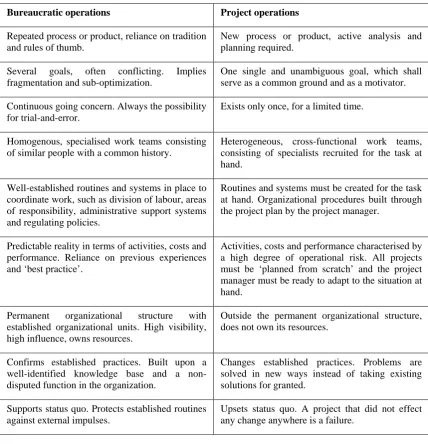
Bureaucratic operations Project operations
Repeated process or product, reliance on tradition and rules of thumb.
New process or product, active analysis and planning required.
Several goals, often conflicting. Implies fragmentation and sub-optimization.
One single and unambiguous goal, which shall serve as a common ground and as a motivator.
Continuous going concern. Always the possibility for trial-and-error.
Exists only once, for a limited time.
Homogenous, specialised work teams consisting of similar people with a common history.
Heterogeneous, cross-functional work teams, consisting of specialists recruited for the task at hand.
Well-established routines and systems in place to coordinate work, such as division of labour, areas of responsibility, administrative support systems and regulating policies.
Routines and systems must be created for the task at hand. Organizational procedures built through the project plan by the project manager.
Predictable reality in terms of activities, costs and performance. Reliance on previous experiences and ‘best practice’.
Activities, costs and performance characterised by a high degree of operational risk. All projects must be ‘planned from scratch’ and the project manager must be ready to adapt to the situation at hand.
Permanent organizational structure with established organizational units. High visibility, high influence, owns resources.
Outside the permanent organizational structure, does not own its resources.
Confirms established practices. Built upon a well-identified knowledge base and a non-disputed function in the organization.
Changes established practices. Problems are solved in new ways instead of taking existing solutions for granted.
Supports status quo. Protects established routines against external impulses.
Upsets status quo. A project that did not effect any change anywhere is a failure.
Table 1: The dichotomisation of bureaucracies and projects. Adapted from Lindgren and Packendorff (2008), based on Graham (1989) and Pinto (1996).
government officials, social workers and university researchers; at the same time all sorts of activities, from legal work to reconstructive surgery to urban regeneration are redefined as ‘projects’. The rapidly growing professional associations for project managers count members from all sectors of society, and project management tools are being used in all kinds of organizational settings. For example, the project has become a key theme in corporate restructuring, a vehicle for (IT-enabled) organizational change, the basic format for social change (if there are hopes for funding from the European Union, World Bank or similar bodies, that is) and a form of employment in contemporary job markets. Moreover, inter-organizational arrangements such as joint ventures, alliances, and temporary collaborations are also often organized and explicitly labelled as projects. This elasticity of the project enables a certain depoliticisation of the activities contained within it; thus ‘describing every accomplishment with a nominal grammar that is the grammar of the project erases the difference between a capitalist project and a humdrum creation… Utterly different things can be assimilated to the term ‘project’: opening a new factory, closing one, carrying out a reengineering project, putting on a play. Each of them is a project, and they all involve the same heroism’ (Boltanski and Chiapello, 2005: 11).
In addition to this development, the project also tends to become the dominating way of organizing operations in many industries. An increasing number of organizations are identified as ‘project-based’, i.e. organizations where almost all operations are organized as projects and where permanent structures fill the function of administrative support (cf. Cicmil and Hodgson, 2006; Nandhakumar, 2002; Whitley, 2006). In these project-based structures, the classic characteristics of unique projects are maintained at the same time as new permanent structures for project portfolio management are instituted to secure managerial control. Project-based work has thus becomes a part of the wave of new organizational forms that has entered most industries during the last decades (cf. Clegg and Courpasson, 2004; Gill, 2002; Hodgson, 2004; Lindgren and Packendorff, 2006). In many major corporations, the development towards project-based structures has been seen as inevitable, natural and desirable (Söderlund and Tell, 2009).
What therefore are the characteristics of the knowledge base to which the supposed project management profession owes its distinctiveness and expert status? Given the above characterisation of projects as a progressive and alternative way of working, it appears on one level paradoxical that the normative toolbox of Project Management originates from the very same conceptual and ideological foundations as Fordist mass manufacturing. Systems Theory is generally quoted as the foundation of the discipline (Morris, 1994), as projects are seen both as functional parts of greater organizational circumstances and as complex activity systems in their own right. The project task is typically supposed to be clearly defined and unambiguous, given as a marching order to the project manager by a more or less remote ‘sponsor’ or ‘owner’. By viewing the task as something externally given, the efforts of the project manager can be directed towards the efficient use of resources and techniques.
Having defined the task and the various goals restricting the work of the project team, conventional Project Management wisdom is then to construct a Work Breakdown Structure (WBS). The aim of the WBS is to identify the activities (or work packages) that have to be performed in order to achieve the goal. The WBS serves the same purpose as specialization and division of labour in mass production planning: to assign different tasks to different people by identifying controllable action sequences.
Having broken down the project into its parts, other techniques derived from general Operations Analysis are available to construct a project plan that, if properly followed, will deliver the desired outcomes. Among them we find simple visualisation techniques such as Gantt charts and network planning methods, along with numerous tools for risk analysis, budgeting, management control, auditing, decision making, and so forth. While this traditional core of the field has indeed met serious challenges over the years - such as the need to coordinate projects within project portfolios, the managerial and motivational aspects often referred to as the ‘human side of projects’, or the unavoidable impact of external complexity on the internal project process – the response remains the same; to construct new, even better, rational tools to ensure project success.
Cracks in the façade: A discipline in crisis?
across the many types of project (e.g. Standish Group, 2006; Bowen et al., 1994; Winch, 1996).
A growing body of literature, as well as a growing body of empirical evidence and the voices of numerous practitioners indicate that accepting and applying these widely promoted project management ‘good practice’ standards does not eliminate project failures, nor does it guarantee project success (Williams, 2004). On the contrary, a number of studies within the field of project management suggest that it is the use of project management, or a certain conception of project management, as a methodology for organisational innovation and change which is at the heart of project failures (Currie, 1994; Thomas, 2000; Maylor, 2001; Geraldi et al., 2008). Thus Clarke (1999) questions the value of project management as a vehicle of change, arguing instead that standardised project management often is itself the cause of project overload, cultural clashes, and engenders individual resistance to imposed procedures and practice. Specifically, it is argued that ‘the wish to avoid inefficiency, and to dominate uncertainty and risks, bureaucratises the project work and changes the function of project managers from a manager of creativity, change and risk to a manager of paper and forms, and consequently, the traditional project management discipline may be harmful for projects, if followed blindly’ (Geraldi et al., 2008: 588). In such (not untypical) circumstances, the selfsame principles of structured project management methodology are simultaneously the major causes of failure.
Project failure rates tend to be fiercely contested, and we would also be sceptical of easy attributions of ‘success’ and ‘failure’; as Fincham suggests, these accounts can be seen as narratives whereby ‘through a kind of social labelling events are formulated into evolving ‘stories’ that evoke either status or stigma’ (Fincham, 2002: 1). Equally, one might argue that the subject of project failure may be as under-theorized as it is conspicuous, an unbearable trauma of a success-focused field, carefully avoided by researchers and practitioners alike (Lindahl and Rehn, 2007). The wider consequences of project failures, however, in terms of the human cost borne by those employed in the project, including the project manager her/himself, and the impact on all those affected by the project, tend to go unnoticed, unreported and often suppressed. This is reflective of a general failure to take on board the social complexity of project environments when creating key performance indicators against which projects are evaluated and approved. As indicated by numerous reports in the public domain about the implications and consequences for multiple communities affected by important major projects (e.g. the Three Gorges Dam, Shell’s Sakhalin 2 oil and gas project, the 2012 Olympics), economic measures tend to dominate decision making processes and to marginalise values, interests and risks related to health, safety, well-being, the environment and long-term possibilities for collaboration and sustainable development.
radically examining the intellectual foundation of project management, thus tackling the perceived root of the problems. With notable exceptions, such as the Rethinking Project Management initiative (Winter et al., 2006), there remains a tendency in the field to assume that the basic framework of project management is compelling and essentially sound, and to see failings in project management as normal in a maturing field, and soon to be ironed out through more complex and elaborate modelling of project planning and monitoring problems and solutions, including an increased reliance on IS /IT and software based tools (see, for example, Young, 2003; Maylor, 2003; Meredith and Mantel, 2003). Despite the increased sophistication of these models and the proliferation of project management text-books, consultancy support and governmental policies, it is still unclear to what extent these complex tools are being actually used by practitioners.
Other attempts to move the field forward (Söderlund, 2005; Winter et al., 2006) include research on projects as vehicles for individual and organisational learning (e.g. Prencipe and Tell, 2001, Newell et al., 2006), research which adopts a knowledge management perspective (e.g. Kasvi et al., 2003; Bresnen et al., 2004) and work informed by familiar aspects of occupational psychology such as leadership and personality (e.g. Shenhar, 2004). Another attempt to broaden the agenda is the political analysis of projects as organisational and social arrangements (Pinto, 1996; Buchanan and Badham, 1999), a precursor of which is Taggert and Silbey’s (1986) world-weary ‘political’ development cycle of projects, which replaces the 4 stages of the traditional, linear Project Life Cycle PLC (Conception, Planning, Execution/Control and Closure) with an alternative life-cycle whose stages include Wild enthusiasm; Disillusionment; Total confusion; Search
for the guilty; Punishment of the innocent and Promotion of non-participants. Such political perspectives on projects tend to suggest the need for a wider picture which considers what goes on in the social construction of projects and project management by focusing on who and which agendas are included in or excluded from decision-making processes (Flyvbjerg et al., 2003; Marshall and Rollinson, 2004). Particularly influential here is the Scandinavian School of Project Studies (Sahlin-Andersson and Söderholm, 2002) which moves beyond traditional understandings of projects and their management, positing among other things the conceptualisation of projects as temporary organisations (Lundin and Söderholm, 1995, Packendorff, 1995) and the recognition of the historically-embedded nature of projects (Kreiner, 1995; Engwall, 2003).
While recognising the advances made in these various directions, we would suggest that the problem is far more deeply rooted in the fundamental principles upon which the field of project management has been established. More widely, however, we need to address the wider consequences of the contemporary project management discourse which tend to languish either disregarded or explicitly and implicitly suppressed.
Making projects critical: Looking behind and beyond the façade
first of a series of workshops under the heading ‘Making Projects Critical’ whose original aim was simply to bring together diverse writings and observations by scholars and practitioners ‘located’ in different ‘zones of belonging’ (fields such as sociology, politics, organisation behaviour, operations management, project management, NPD, IT, construction). Over time, a more substantial agenda emerged; to draw upon wider and more critical intellectual resources than the instrumental rationality, quantitative and positivist methodologies and technicist solutions which have been traditionally brought to bear in attempts to understand and control the project form of organising. The broad range of themes addressed in past MPC workshops include issues of power and domination in project settings, ethics and moral responsibility within projects, tensions between standardisation and creativity in project organisations, the limits to projectification and the dysfunctions of project rationality. Other work presented and debated in these workshops has related to critical analyses of issues of leadership, management competencies and the ongoing professionalisation of project.
So much for the intellectual mission of the MPC movement. At the same time, however, we were collectively very conscious of the significant block of practitioners and indeed academics who had built up what stands as project management theory and practice, and the combination of interest, suspicion, irritation and encouragement felt towards these new arrivals on the crowded shores of project management. In particular, part of the aim of MPC was to enable a reimagining of the project manager role; much of what currently stands as project management theory and commonplace prescription continues to emphasise the role of project managers as ‘implementers’, whose role and responsibility is merely to address issues of control (time and cost) and content (planned scope of work). This position, we felt, explicitly and deliberately marginalises and suppresses their wider potential role as competent social, political and ethical actors, and equally reduces the accountability of these actors for the consequences of projects to a narrowly performative set of criteria, writing out many of the most dubious impacts of both effective and ineffective project management. Concerns about this limited and inadequate conception of the project manager are shared by many in the practitioner community; to cite one; ‘Practitioners, in particular we as project managers, are well advised to rid ourselves of the constricting historical background of a mechanistic world image and rationalism.’ (Balck, 1994: 2).
anyone, although inclusivity poses its own challenges of rejection, compromise, incorporation and the effective neutralisation of any critical intent.
Such a situation is laden by tensions: on the one hand, we are loyal to our intellectual critical commitment but, at the same time, we are developing a collegiate network which includes our mainstream colleagues and friends. As a result, the dynamics and divisions in this arena are not black and white. Through the interaction in these forums, we have also observed the construction of identities on both sides, as critical alternatives are promoted and tested in relation to mainstream work in the field while mainstream researchers and practitioners are invited to engage with critical ideas without feeling threatened or obliged to defend their mainstream commitment.
Six windows in the façade: The papers in this special issue
Given the above characterisation of the background and ambitions of critical project research, we are pleased to introduce the six papers comprising this special issue of
ephemera. As ‘windows in the façade of project management’ they all contribute new insights into the realities of project work practice and new theoretical outlooks that can inspire future critical research on these practices.
In the first article, ‘Stop whining, start doing! Identity conflict in project managed software production’, Peter Case and Erik Piñeiro enter the highly structured world of software development and IT project management. By following conversations in online discussion forums, they are able to show the identity conflicts between project management and the programming profession. Project managers are portrayed in the conversations as representatives of the need for structure and effectiveness, which stands in stark contrast to the technological aesthetics and sense of professionalism by which the programmers define themselves. Case and Piñeiro thereby contribute to our understanding of how the strong performative aspect of project management differs from other professional identity bases and how these differences materialise in resistance, dissent and conflict among those to be ‘project managed’.
male respondents’ narratives. Through their analysis, Crevani and Shinozaki Lennerfors thus deepen our understanding of how the ethical dimension of project management is locally constructed in a highly gendered setting.
In ‘The imagined user in projects: Articulating competing discourses of space and knowledge work’, Chris Ivory and Neil Alderman take their point of departure in the traditional notion of users as influential stakeholders in projects. Through a qualitative study of how senior managers in a university setting present their arguments for a radical shift in office design, they present an alternative image of the user as imagined and as a rhetorical device. Users, they conclude, are invoked by the managers as beneficiaries of the new office designs, but no one is actually interested in their opinions, let alone their professional experiences of academic work. Arguments in favour of the new design are presented as rational, enlightened and contemporary, while arguments against are downplayed as egoistic, parochial and unsubstantiated. Ivory and Alderman thus show us the irrationalities and hypocrisies behind the facades of supposedly rational decision processes in projects – where the powerful user demanding his right can instead be seen as a powerless vehicle for managers in search of legitimacy.
In the second note, ‘Towards a (more) critical and social constructionist approach to New Product Development projects’, Beata Segercrantz also finds her way through the rationalist facades of New Product Development. Criticizing the dominating tendency of NPD researchers and practitioners for being overly concerned with simplistic normative models guiding the product development process, she points at an implicit ‘ontology of being’ where NPD projects are looked upon as reified entities in need of managerial control. Instead, Segercrantz suggests an ‘ontology of becoming’ as an alternative perspective upon New Product Development, whereby ‘attention is shifted to the heterogeneous emergence and becoming of projects in and through which discourse, social practices and subjectivities are dynamically produced’. Through this suggestion, she opens up promising future avenues for research on NPD projects.
Here, then, we leave our readers to reflect and act upon the research presented here and its practical consequences for individuals, organizations and societies. Our articles and notes, our ‘windows in the façade’, will hopefully let some enlightenment in. Some may become (temporarily) blinded – but that is always preferable to becoming ‘just another brick in the wall’, isn’t it? Let the deconstruction start!
Atkinson, R. (1999) ‘Project management: cost, time and quality, two best guesses and a phenomenon, its time to accept other success criteria’, International Journal of Project Management, 17(6): 337-42. Balck, H. (1994) ‘Projects as elements of a new industrial pattern: a division of project management’, in
D.I. Cleland and R. Gareis (eds) Global Project Management Handbook. New York: McGraw-Hill. Boltanski, L. and E. Chiapello (2005) The New Spirit of Capitalism. New York: Verso.
Bowen, H.K. (1994) The Perpetual Enterprise Machine: Seven Keys to Corporate Renewal through
Successful Product and Process Development. New York: Oxford University Press.
Bowen, H. L., K. B. Clark, C. A. Holloway and S. C. Wheelwright (Eds.) (1994) The Perpetual
Enterprise Machine: Seven Keys to Conrporate Renewal through Successful Product and Processs Development. New York: Oxford University Press.
Bresnen, M., A. Goussevskaia and J. Swan (2004) ‘Embedding new management knowledge in project-based organizations’, Organization Studies, 25(9): 1535-1555.
Briner, W. and C. Hastings (1994) ‘The role of projects in the strategy process’, in D.I. Cleland and R. Gareis (eds) Global Project Management Handbook. New York: McGraw-Hill.
Buchanan, D. A. and R.J. Badham (1999) Power, Politics, and Organizational Change: Winning the Turf
Game. London: Sage.
Cicmil, S. and D.E. Hodgson (2006) ‘New possibilities for project management theory: a critical engagement’, Project Management Journal, 37(3): 111-122.
Clarke, A. (1999) ‘A practical use of key success factors to improve the effectiveness of project management.’ International Journal of Project Management, 17(3): 139-145.
Clegg, S. and D. Courpasson (2004) ‘Political hybrids: Tocquevillean views on project organizations’,
Journal of Management Studies, 41(4): 525-47.
Cleland, D.I. and L.R. Ireland (2002) Project Management: Strategic Design and Implementation (4th ed.). New York: McGraw-Hill.
Croucher, S. (2004) Globalization and Belonging: The Politics of Identity in a Changing World. Lanham: Rowman and Littlefield.
Currie, W. (1994) ‘The strategic management of a large scale it project in the financial services sector.’
New Technology, Work and Employment, 9(1): 19-29.
DeFillippi, R. J. (2001) ‘Introduction: project-based learning, reflective practices and learning outcomes’,
Management Learning, 32(1): 5-10.
Ekstedt, E., R.A. Lundin, A. Söderholm and H. Wirdenuis (1999) Neo-Industrial Organising: Renewal by
Action and Knowledge Formation in a Project-Intensive Economy. London: Routledge.
Engwall, M. (2003) ‘No project is an island: linking projects to history and context’, Research Policy, 32(5): 789-808.
Fincham, R. (2002) ‘Narratives of success and failure in systems development’, British Journal of
Management, 13(1): 1-14.
Flyvbjerg, B. (2001) Making Social Science Matter: Why Social Inquiry Fails and How It Can Succeed
Again. Oxford: Cambridge University Press.
Flyvbjerg, B., W. Rothengatter and N. Bruzelius (2003) Megaprojects and Risk: An Anatomy of
Ambition. Cambridge: Cambridge University Press.
Frame, J.D. (1994) The New Project Management: Tools for an Age of Rapid Change, Corporate
Reengineering, and Other Business Realities. San Francisco: Jossey-Bass. Gaddis, P.O. (1959) ‘The project manager’, Harvard Business Review, 37(3): 89–97.
Geraldi, J.G., J.R. Turner, H. Maylor, A. Söderholm, M. Hobday and T. Brady, T. (2008) ‘Innovation in project management: voices of researchers’, International Journal of Project Management, 26(5): 586-589.
Gill, R. (2002) ‘Cool, creative and egalitarian? exploring gender in project-based new media work in Europe’, Information, Communication & Society, 5(1): 70-89.
Graham, R.J. (1989) Project Management as if People Mattered. Bala Cynwyd: Primavera Systems. Grey, C. (2005) ‘Critical management studies: towards a more mature politics’, in D. Howcroft and E.M.
Trauth (eds) Handbook of Critical Information Systems Research. London: Edward Elgar.
Hobday, M. (2000) ‘The project-based organisation: an ideal form for managing complex products and systems?’, Research Policy, 29(7/8): 871-893.
Hodgson, D.E. (2002) ‘‘Know your customer’: marketing, governmentality and the ‘new consumer’ of financial services’, Management Decision, 40(4): 318-328.
Hodgson, D.E. (2004) ‘Project work: the legacy of bureaucratic control in the post-bureaucratic organization’, Organization, 11(1): 81-100.
Hodgson, D.E. (2007) ‘The new professionals: professionalisation and the struggle for occupational control in the field of project management’, in D. Muzio, S. Ackroyd, and J.F. Chanlat (eds)
Redirections in the Study of Expert Labour: Medicine, Law and Management Consultancy.
Basingstoke: Palgrave.
Kanter, R. M. (1983) The Change Masters: Corporate Entrepreneurs at Work. New York: Simon & Schuster.
Kasvi, J.J., M. Vartiainen, and M. Hailikari (2003) ‘Managing knowledge and knowledge competences in projects and project organizations’, International Journal of Project Management, 21(8): 571-582. Koskela, L. and Howell, G. (2002) ‘The underlying theory of project management is obsolete’, in the
proceedings of Project Management Institute Research Conference, PMI, Seattle, WA.
Kreiner, K. (1992) ‘The postmodern epoch of organization theory’, International Studies of Management
and Organization, 22(2): 37–52.
Kreiner, K. (1995) ‘In search of relevance: project management in drifting environments’, Scandinavian
Journal of Management, 11(4): 335-346.
Lindahl, M. and A. Rehn (2007) ‘Towards a theory of project failure’. International Journal of
Management Concepts and Philosophy, 2(3): 246-254.
Lindgren, M. and Packendorff, J. (2006) ‘What’s new in new forms of organizing? on the construction of gender in project-based work’, Journal of Management Studies, 43(4): 841-866.
Lindgren, M. and Packendorff, J. (2008) ‘Från projektarbete till projektintensivt arbete: människan och projektarbetets institutionalisering’ [From project work to project-based work: the individual and the institutionalization of projects], in T. Stjernberg, J. Söderlund and E. Wikström (eds) Projektliv:
Villkor för uthållig projektverksamhet. Lund: Studentlitteratur.
Lundin, R. A. and Söderholm, A. (1995) ‘A theory of the temporary organization’, Scandinavian Journal
Marshall, N. and Rollinson, J. (2004) ‘Maybe Bacon had a point: the politics of interpretation in collective sensemaking’, British Journal of Management, 15(S1): 71-86.
Maylor, H. (2001) ‘Beyond the Gantt chart: project management moving on’, European Management
Journal, 19(1): 92-100.
Maylor H. (2003) Project Management (3rd Edition). London: Financial Times/Prentice Hall.
Meredith, J. R. and S.J. Mantel (2003), Project Management: A Managerial Approach, 5th ed. Hoboken: Wiley.
Morris, P. W. G. (1994) The Management of Projects. London: Thomas Telford.
Morris, P.W.G. and G.H. Hough (1993) The Anatomy of Major Projects: A Study of the Reality of Project
Management. London: Wiley.
Morris, P.W.G. and J.K. Pinto (eds) (2004) The Wiley Guide to Managing Projects. New York: Wiley. Morris, P.W.G., M.B. Patel, and S.H. Wearne (2000) ‘Research into revising the APM project
management body of knowledge’, International Journal of Project Management, 18(3): 155-164. Nandhakumar, J. (2002) ‘Managing time in a software factory: temporal and spatial organization of IS
development activities’, Information Society, 18(4): 251-262.
Newell, S., M. Bresnen, L. Edelman, H. Scarbrough and J. Swan (2006) ‘Sharing knowledge across projects: limits to ICT-led project review practices’, Management Learning, 37(2): 167-185.
Packendorff, J. (1995) ‘Inquiring into the temporary organization: new directions for project management research’, Scandinavian Journal of Management, 11(4): 319-333.
Pinto, J.K. (1996) Power and Politics in Project Management. Sylva: Project Management Institute. Prencipe, A. and F. Tell (2001) ‘Inter-project learning: processes and outcomes of knowledge
codification in project-based firms’, Research Policy, 30(9): 1373-1394.
Sahlin-Andersson, K. and A. Söderholm (eds) (2002) Beyond Project Management: New Perspectives on
the Temporary-Permanent Dilemma. Copenhagen: Liber.
Shenhar, A.J. (2004) ‘Strategic Project LEADERSHIP(R): toward a strategic approach to project management’, R & D Management, 34(5): 569-578.
Silver, C.A. (2000) ‘Where technology and knowledge meet’, Journal of Business Strategy, 21(Nov/Dec): 28-33.
Spicer, A., M. Alvesson, and D. Kärreman (2009) ‘Critical performativity: the unfinished business of critical management studies’, Human Relations, 62(4): 537-560.
Söderlund, J. (2005) ‘What project management really is about: alternative perspectives on the role and practice of project management’, International Journal of Technology Management, 32(3-4): 371-387.
Söderlund, J. and F. Tell (2009) ‘The P-form organization and the dynamics of project competence: project epochs in Asea/ABB, 1950-2000’, International Journal of Project Management, 27(2): 101-112.
Standish Group (2006) Chaos Report. Rockville: Standish Group International.
Taggert, W. M. and V. Silbey (1986) Informational Systems: People and Computers in Organisations. Boston: Allyn and Bacon.
Thomas, J. (2000) ‘Making sense of project management’, in R.A. Lundin and F. Hartman (eds) Projects
as Business Constituents and Guiding Motives. Boston: Kluwer Academic Press.
Whitley, R. (2006) ‘Project-based firms: new organizational form or variations on a theme?’, Industrial
and Corporate Change, 15(1): 77-99.
Wideman, R.M. (1995) ‘Criteria for a project-management body of knowledge’, International Journal of
Project Management, 13(2): 71-75.
Williams, T. (1999) ‘The need for new paradigms for complex projects’, International Journal of Project
Management, 17(5): 269-273.
Williams, T. (2004) ‘Assessing and building on the underlying theory of project management in the light of badly over-run projects’, paper presented at PMI Research Conference, London, UK.
Winch, G. (1996) ‘Thirty years of project management—what have we learned?’, in British Academy of
Winter, M., C. Smith, P.W.G. Morris and S. Cicmil (2006) ‘Directions for future research in project management: the main findings of a UK government-funded research network’, International Journal
of Project Management, 24(8): 638-649.
Young, T.L. (2003) The Handbook of Project Management: A Practical Guide to Effective Policies and
Procedures. London: Kogan Page.
Svetlana Cicmil is Reader in Global Operations at Bristol Business School, University of the West of England, Bristol. In most general terms, her research is founded in a processual-relational approach to the complexity of projects focusing on the paradox of control and individual and collective experiences of unpredictability and change in project work. In addition, Svetlana is interested in the phronesis-centred approach to the ethics of managerial actions in project environments.
E-mail: [email protected]
Damian Hodgson is senior lecturer in Organisational Analysis at Manchester Business School, the University of Manchester. His research focuses on the control of project work and processes of projectification.
E-mail: [email protected]
Monica Lindgren is associate professor in Business Administration at the School of Industrial Engineering and Management at the Royal Institute of Technology, Stockholm. Her research is focused on issues of identity, gender, project work, entrepreneurial processes and leadership, studied from constructionist and critical theory perspectives.
E-mail: [email protected]
Johann Packendorff is associate professor in Industrial Economics and Management at the School of Industrial Engineering and Management at the Royal Institute of Technology, Stockholm. His research is focused on critical and constructionist perspectives on issues relating to project work, entrepreneurship, and leadership.
E-mail: [email protected]
Stop whining, start doing! Identity conflict in
project managed software production
∗Peter Case and Erik Piñeiro
In this article we explore the relationship between software developers and IT project managers as expressed through narrative exchanges in an on-line discussion forum. We interrogate a naturalistic data set to show how the conflict between IT professionals and their immediate managers (project managers) is manifest through the identity work that they engage in. To this end, the article draws attention to strategies of resistance and dissent expressed in the narratives of software developers, contrasting these with the performative expectations espoused by project managers. The purpose is to contribute to a critique of project management stemming from the grassroots experience of those involved in its co-construction. While it is difficult to be precise about the demographics of the community studied (given the anonymity of bulletin board forums), the views of several hundred participants are represented in the discussion threads analysed. In response to the performative environments and disciplines of project management, programmers make recourse to performative strategies (in an Austinian sense) that preserve their status, sense of professional identity and organizational power. The aesthetics of programming appear to play an important part in the expression of programmers’ identity; aesthetics which contrast, and are in conflict with, different forms of performative aesthetics present in the identity work of project managers.
Introduction
The encounter between workers and management has been subjected to a wide range of intellectual and academic analysis within organization studies. Accounts of the relationship range from texts that espouse functionalist visions of organization (inter alia, Daft, 1995; Donaldson, 1996; Schein, 1985) which seek to downplay or occlude the role of conflict through to Marxist-informed Labour Process and radical structural theories in which conflict is understood to be integral to industrial relations (Burawoy, 1979; Burrell and Morgan, 1979; Edwards, 1986; Thompson and McHugh 1995, Thompson and Ackroyd, 1995). In the last two decades or so, organization studies has been subject to a post-structural turn (Burrell 1988, 1998; Cooper 1989; Hassard and
__________
∗ A previous version of this article was presented at the ‘Making Projects Critical 4’ conference, 31st March - 1st April 2008, Royal Institute of Technology, Stockholm, Sweden. The authors wish to thank the organizers, guest editors and anonymous reviewers of ephemera for comments on the original paper and to acknowledge questions and observations from delegates which helped refine the argument.
Parker, 1993; Chia, 1996, 1998) which has introduced a new set of analytical tools with which to undertand the dynamics of the employment relation. Debates between proponents of more orthodox Labour Process accounts of worker/management relations, which understand conflict in terms of fundamental differences of vested class interest, and those of post-structuralists of varying complexion, who propose subtler and more fluid interpretations, have been hotly pursued (Knights and Willmott, 1989; Thompson and Ackroyd, 1995; Thompson and Smith, 2000-1; Knights, 2001; O’Doherty, forthcoming; O’Doherty and Willmott, 2001a, 2001b; Friedman, 2004).
In this article we seek to make a modest contribution to such debates by attending empirically to the manifestation of conflict between software developers (with a focus on coders – or programmers – as opposed to system architects, analysts, etc.) and project managers, who most often are their immediate superiors in the corporate hierarchy. Our study also attempts to augment the existing organization studies literature concerned with knowledge worker identity (Alvesson, 2004; Alvesson and Kärreman, 2007; Alvesson and Willmott, 2004; Kärreman and Alvesson, 2001), focussing particularly on the co-construction of identity conflict. The narrative data that we explore seems to speak to accounts which could be interpreted as representing key aspects of the structuralist account of employment relationships while, simultaneously also being open to post-structural interpretation of power dynamics. One of the key elements in the argument put forward in this article is the particular nature of the relation between programmers and project managers. This particularity revolves around: 1) the difference in the nature of their professional knowledge; and 2) the symbiotic relationship between project management and IT systems.
Knowledge and academic status
before proceeding to our analysis, we need to offer some further remarks on the particular complexity of organizational relationships that result from the meeting of project management and information technology.
Project management and information technology
Over the past fifty years or so IT has insinuated itself into just about every aspect of the social order in developed capitalist economies to the point where life, as we know it, would be inconceivable or, indeed, impossible in practical terms without its facilitation. Perhaps slightly less pervasive, but increasingly ubiquitous in (post)modern life is ‘project management’.
Rather like the word ‘strategy’, the concept of the ‘project’ has permeated everyday organizational discourse, stretching its standardized meaning. Everything, from the most complex multidisciplinary endeavour, such as, developing a $48bn International Space Station, through to organizing a children’s birthday party becomes, in everyday parlance at least, ‘a project’. This may be, in part, due to the fact that the noun form of the word ‘project’ in English has a longer and more stable legacy than one might think. According to the Oxford English Dictionary, the word project finds etymological origins in the Latin prōiectum meaning ‘projecting structure’ (2nd c. A.D.) and
prōiectus, the ‘fact of extending beyond a surface or edge’ – a spatial connotation which, in the intervening years, has become a temporal one. The word migrates to English from Middle French and takes on the meaning of ‘plan’ from proiect or projet. So by the 15th Century it already acquires a relatively stable meaning as ‘[a] plan, draft, scheme, or table of something; a tabulated statement; a design or pattern according to which something is made’. Its meaning as, ‘[a] planned or proposed undertaking; a scheme, a proposal; a purpose, an objective’ also enjoys a lengthy heritage dating back to the 16th Century. Compounds such as ‘project engineer’ and ‘project management’ are, as one might expect, more recent semantic innovations dating only to the beginning decades of the 20th Century. The OED defines project management as, ‘[t]he theory, practice, or occupation of managing projects’ and ‘the group of people in charge of a project’ (OED online), the first recorded use being in the Nevada State Journal of July 1913.
‘projectification’ of work is in contemporary organizations and give some indication of how the project mentality feeds its way, subconsciously, into a particular construction and interpretation of the world. In short, if one rejects simple correspondence theory and assumes that language plays more than a neutral role in discursively producing the social world, there are certain power effects (Foucault 1980) of this seemingly innocuous seven-letter word that we would do well to pay attention to. By thinking in terms of projects and enacting them, we constitute the world in a particular way and embrace a taken-for-granted epistemology and ontology; we embrace a certain way of
knowing and being in the world. Projectification entails, in Foucauldian terms, certain forms of objectivisation and subjectivisation (Florence, 1994) and we shall be concerned in the empirical section of this article to examine how these microphysics give rise to identity conflicts in IT settings.
The development of management and organization science in the last century and a half, or so, has been coupled closely with the evolution of engineering and associated technologies. It is not our place here to fully review the particular history of PM or to offer a detailed critique of its body of knowledge. This has been comprehensively and admirably addressed by others (Cicmil and Hodgson, 2006; Hodgson, 2002, 2004; Hodgson and Cicmil, 2006; Lindgren and Packendorff, 2006) and mere rehearsal of the same points would serve no useful purpose. We would, however, like to make a few remarks on the relationship between engineering technologies and PM since this is directly pertinent to the study we wish to report on below. Shenhav (1999) has made a study of the genealogy of management, arguing that it was engineers in the early part of the 20th Century who ‘manufactured management’ by effectively creating space between ‘capital’ and ‘labour’ to be occupied by a new professional class. Shenhav’s is one of the latest contributions to organization studies that have attempted to draw attention to the historical relationship between the evolution of engineering disciplines and the corresponding need to position employees within a rational matrix (Grint 1991; Jacques 1996). Most famously, of course, the genesis of 20th Century management is often accorded to the engineering-inspired manifestos of F.W. Taylor and his drive to develop The Principles of Scientific Management (Taylor, 1986 [1911]).
PM methodologies: Earned Value Analysis, CPA methodologies and so forth – has given particular form to managerial fantasies, idealism and control aspirations.1
So this is the point at which our two ubiquities meet. IT is, we suggest, a necessary (but not sufficient) condition for the contemporary development and direction of PM methodologies. Both IT and PM are intimately intertwined in a kind of symbiosis. The skills and efforts of computer programmers are necessary to the creation of software that now facilitates the professional work of project managers, while, simultaneously, PM methodology is absolutely integral to the development of functioning software packages. This gives rise to a fascinating and complex set of relationships between the respective disciplines of IT programming and PM, some dimensions of which we shall explore through the empirical study presented below.
Data set and method
Building on earlier work (Case and Piñeiro, 2006; Piñeiro and Case, 2008), the empirical foundation of this study lies on naturalistic data derived from an on-line computer programmer discussion forum (www.slashdot.org). We have been visiting and researching the Slashdot website periodically for the past five years or so, over which time we have become familiar with both the form and content of bulletin board exchanges. The forum initiates about twelve discussions each day, with subsequent exchanges typically lasting anywhere between a couple of days to a week. The discussion threads we have chosen to study for the purposes of this article draw from threads concerned with ‘the aesthetics of coding’ and ‘project management for programmers’ since these contain particularly clear insights into the relationship between programmers, project managers and the PM environment. Bulletin board discussions had already ended by the time we drew on them for analytical purposes and we intentionally made no effort to engage in or to influence on-line exchanges.
The participants, who in most discussions are invariably programmers or other ‘techie’ IT professionals, may enter the discussion as members of Slashdot, in which case their on-line identities are available; or they may access it anonymously, in which case they appear on-line under the shared name of ‘Anonymous Coward’. Furthermore, there is nothing that prevents a participant from having several on-line identities. However,
Slashdot is not an ‘identity laboratory’ forum (Bruckman, 1992). Unlike other more chat-focused on-line ‘hang-outs’ and virtual social networks, this is not a place to meet and get to know people. Its design does not allow for chat and picture exchange; topics of discussion rarely touch upon personal subjects and there is a moderation system in place that has a sobering effect on the discussions. So even if there are cases of ‘flamebaits’ and ‘trolls’ (names given to entries whose goal is to provoke and / or mislead), the discussions can safely be assumed to present us with the participants’
__________
1
earnest opinions, and thus with a rich picture of the diversity of programmers’ attitudes and sensibilities.
The language of Slashdot is English, and the great majority of its participants are native English speakers – even if not always very careful with their mother tongue. A good deal of those participating in the discussions we have studied live in the US – our own crude, experience-based estimate is that about 80% are either US citizens or US workers. So even if there are opinions from programmers from other countries (particularly in those discussions that deal with, for instance, Australian issues), most of the entries originate in the US. It can therefore be said that the material is representative of US programmers, taking into account the heterogeneity of opinions expressed on the themes we explore. At any rate, the question of nationality only makes itself present in very specific discussions, such as those dealing with outsourcing or policy subjects (Piñeiro and Case, 2008).
Analytical tools
In analysing the narrative exchanges of the Slashdot community we have found it useful to make recourse to the theoretical notion of ‘performativity’. There are two broad patterns emergent in our data that lend themselves to interpretation through two corresponding dimensions of this concept. Firstly there are performative acts (Austin, 1976) on the part of programmers in their talk about the aesthetics of coding that enable them to enact identity and membership. Secondly, there is a performative commercial
context (Lyotard, 1984) within which they work, often mediated by PM methodologies. The PM context is almost invariably perceived to be a constraining force on the proper pursuit of the programming art. As they provide an analytical fulcrum for the interpretation of our data, we shall elaborate briefly on both these aspects of performativity.
1. Discursive performances
The concept of the performative was first introduced into the philosophical lexicon by John Austin and subsequently taken up by one of his students, John Searle as the basis for a broader programme of enquiry know as speech act theory (Austin, 1976; Searle, 1977). Post-structuralist thinkers (Derrida, 1977; Butler, 1990, 1993; Deleuze and Guattari, 1988) have also experimented with and developed Austin’s original ideas. Speech acts and performatives have value, we contend, in understanding and representing the socially constructed world of the Slashdot programmers that we studied. Programmers interacting online in the Slashdot forum are doing things in their narrative exchanges. They are bringing about social effects through their displays of technical bravado, expressions of aesthetic preference and espousals of dissent, resistance and subversion.
but are, instead, contributing to a general thread of some sort. It is in the emergent composite exchange that they make disparaging and critical remarks about the ‘other’. 2. Performativity as the optimisation of input to output
We have so far dealt with only one side of the ‘performativity’ equation that we wish to employ, namely, that pertaining to the social effects of narrative performatives. For the other part of the equation we draw on Lyotard’s critique of the role of knowledge in post-industrial societies (Lyotard, 1984). According to Lyotard, the episteme of modern science which found legitimacy in grand narratives of progress and emancipation – totalising stories that gave meaning to local narratives and practices – is being systematically eroded within post-industrial societies by the advancement of information-driven technologies. The search for Truth is replaced by a search for the Efficient under what Lyotard (1984: 111) terms the ‘principle of optimal performance’. Lyotard theorises this new basis of knowledge – the optimisation of input to output – as
performativity (1984: 112). One consequence of post-industrial technology’s privileging of the ends of action over its means is that knowledge ceases to be a valid end in itself. Knowledge is assessed economically not by its truth-value, but by its exchange-value. Knowledge is produced to be sold.
The conflict between programmers and managers presented below hinges on a double application of the concept of Lyotardian performativity. Firstly, it is used to highlight antagonism. Programmers are clearly conscious of the forces of performativity intruding into and shaping their working lives. They articulate an explicit concern that their efforts, which they conceive of as artistry or craftsmanship, are all too often compromised by the tight resource constraints and disciplinary requirements of the PM environment. Managers take the opposite side, accusing programmers of ‘whining’ instead of doing what must be done to move the project forward. Secondly, both sides struggle to impose their own characteristic knowledge as the truly performative one. This double use of ‘performativity’ constitutes the themes along which programmers and managers structure their identities, in opposition to each other: aesthetic versus performance concerns and technical versus managerial knowledge.
Empirical observations
Conflict from the programmers’ perspective
The performance of ‘programmer’ identity is context-dependent and different faces are presented to different audiences. In cetain instances programmers will express an interest in meeting deadlines and getting products ready for market but, as we shall see, when responding to the perceived performativity of PM discipline those same programmers will present a very different aspect of identity; one that is far more concerned with program quality and elegance. Our data indicate that the figure of the manager, in general, and of the project manager (often the direct superior), in particular, act as crucial foils in the construction of ‘techie’ identity.
managers. As mentioned above, this oppositional relation in our data set manifests around two main themes: ‘Code Aesthetics’ and ‘Technical Knowledge’.
Code aesthetics
This line of identity construction is predicated on the notion that code is worthy of attention for its own sake. Coding is a realm of human creation which celebrates the ethic of gras artis gras. It allows for personal styles and aesthetic convictions that offer programmers great satisfaction and that, in the eyes of the programmers, deserve respect. Managers are often accused of both failing to understand the aesthetic dimension of the coding art as well as not treating it with due respect.2
Often Slashdotters explicitly define themselves as ‘computer geeks’, ‘hackers’ and ‘code jockeys’, terms whose radicalism or ‘cool-ness’ contrast with submissive tenor of words like ‘worker’, ‘programmer’ or ‘employee’ which might also be used to describe their roles. This process of identification, self-presentation and affiliation is common in many of the exchanges either as a performative subtext or as part of the manifest communication. Consider, for instance, the following posting by MikeFM:3
software is like building w/ toothpicks (Score:2)
by MikeFM (12491) on Wednesday September 05, @12:59AM (#2254465)
[…] I like to write beautiful code.. as I imagine most real programmers do.. us geeks that live, breath, and dream in code.. but in real life there usually is not enough time or resources given to manage to write really well planned out code. This is why Microsoft sucks and a popular motto is ‘When it’s done!’ among the truely geeky programming houses and why open source will eventually kill most commercial software.
MikeFM is here engaged in a micro-sociological process of expressing identification – ‘us geeks’ – and rehearsing key elements of a hacker credo. These elements are discussed at length in Pekka Himanen’s account of the ethos and life-worlds of computer hackers entitled, The Hacker Ethic and the Spirit of the Information Age (Himanen, 2001). In this work Himanen identifies a set of characteristics and ethics that, he contends, mark hackers apart as a subculture, as follows: (a) hackers are passionate about their endeavours and are motivated by what they take to be the intrinsic value and craft in their work; (b) hackers are ambivalent toward – if not on occasion outright suspicious of – money and the commercial exploitation of computer systems and applications; and, (c) hackers are committed to ‘facilitating access to
__________
2
Programming aesthetics are more complex than we have space to address here. For a more detailed treatment see Piñeiro (2003) and Case & Piñeiro (2006). To make the main point briefly, a program that offers exactly the same function to the user can be written in a myriad of ways, allowing programmers great degrees of stylistic and structural freedom. Matters of style and structure are sometimes debated by Slashdot programmers and strong preferences expressed regarding: (1) the use or otherwise of comments in coding; (2) the use of indentation; (3) whether minimalism or, indeed deliberate obfuscation, is preferable to more extensive, discursive or literate forms of coding. There is also the direct issue of aesthetic ideals, with ‘clean code’, ‘simple code’, ‘tight code’ and ‘structured code’ being contested topics.
3
information and to computer resources’ (2001: 51) such that access to resources should, ideally, be free of charge.
Mike FM’s remark ‘[…] us geeks that live, breath and dream in code’ may sound to us non-geeks like an over-reaction but it can be better appreciated considering Himanen’s first – and perhaps most important – element of the hacker ethic, which contrasts the hacker’s unique orientation to work with the concept of the Protestant work ethic propounded by Weber (1976). Unlike many workers who find their work dull and alienating, hackers are passionate about their endeavours and are motivated by what they take to be the intrinsic value and craft in their work. They are often willing to work long hours (in their spare time or for employers) on projects that they deem worthy of their efforts4.
In addition, MikeFM states a preference for, and alludes to, the superiority of open source code, that is, systems and applications that are worked on free of charge by a self-selecting community of programmers. We also see evinced in MikeFM’s posting a common hacker refrain, namely, ‘Microsoft bashing’. It is almost obligatory to ‘hate’ Microsoft and be committed to open source, if one is to be a proper hacker. Accordingly, Microsoft is cast as a central villain and scapegoated by the Slashdot programming community on a routine basis in their exchanges. Rightly or wrongly, this company is seen as representing the antipathy of the hacker ethic and, as such, it plays an important iconic role in the identity work of those who wish to affiliate with other ‘serious programmers’.
According to many Slashdotters, ‘quality’ is always a secondary consideration for project managers. What matters is simply shipping the goods on time and according to budget. In line with the hacker ethic, such constraints are perceived as a huge and compromising imposition on the aesthetic ideals of programmers who wish to produce high quality code. Accordingly, the actions and alleged values of villainous project managers are perceived as a direct threat to the individual and collective identity of members of the programming community. The following narrative by an anonymous Slashdotter illustrates well the manner in which programmers feel constrained and how they give vent to their frustrations by finding fault with the organizational conditions under which they work:
__________
4
software manager managing bridge architects… (Score:1, Insightful) by Anonymous Coward on Tuesday September 04, @05:20PM (#2253011)
manager -> we need to ship this bridge in 3 months. engineer -> yes, but it’s really big and really important manager -> yes, but it has to ship in 3 months.
engineer -> so how much weight does it need to support? manager -> i dunno, I’ll let you known in 2.9 months. engineer -> what is it bridging?
manager -> why all these stupid questions, start building. engineer -> I should do an architectural drawing first.
manager -> why bother, here’s some metal, start slapping it together. Remember it ships in 2 months.
engineer -> I thought you said 3 months?
manager -> oh didn’t I tell you, we heard a rumour that a competitor will be shipping their bridge in 2.5 months, so we have to beat them.
continue forever.
the reason there is no internal beauty is we (engineers) aren’t given any time to build quality (although the argument could be made that the only way to build on schedule is by building quality). The other problem is, bugs actually translate into lucrative support contracts for most enterprise software vendors. Why improve quality? there is no revenue stream there. […]
In the following narrative, Greyfox places emphasis on the antagonistic relationship between the programmer and the project manager to whom s/he reports (beauty vs. deadline):
Oh Yeah… (Score:2)
by Greyfox (87712) on Tuesday September 04, @05:11PM (#2252945)
Try telling your manager sometime that you want to redesign a piece of code because ‘It’s aesthetically displeasing’ or because ‘The design sucks.’ He’ll laugh you out of the office and quite possibly the company. Nevermind that you were right or that your redesign would drastically improve maintability and probably speed things up. Managers don’t want good code. They want code that you can squat and shit as quickly as possible because the only metric they look at is the deadline. It may not smell good. It may self destruct in a few months. It will certainly keep your team in ‘fireman mode’ for the rest of the time they’re at the company, but by God it made the deadline and that’s all that counts. […]
There are important self-presentational aspects (Goffman, 1959, 1967) to the Slashdot exchanges as epitomized by Greyfox’s put down of computer illiterate or, at least, computer-incompetent project managers who believe that programming language architecture will in itself produce effective software design. Contributors to the Slashdot forums routinely use their narratives to establish their own programming credentials and prowess, MikeFM’s ‘us geeks that live, breath and dream in code’ being an extreme case. Which brings us to the second main theme of programmer identity construction: technical knowledge.
Technical knowledge
according to this attributional predicate, managers are oblivious to the principles that result in high-quality software, and, more generally, to what decisions are in the best interests of the company.
Quite independently of Anonymous Coward, MikeFM uses a similarly powerful construction metaphor to illustrate the manner in which commercial pressures prompt project managers to adopt short-term palliative solutions to software design problems:
software is like building w/ toothpicks (Score:2) by MikeFM (12491) on Wednesday September 05, @12:59AM (#2254465)
I think in the book ‘The Hacker and the Ants’ there is a quote along the line of programming being like building out of toothpicks carefully glued together and if just one toothpick is out of place the whole thing comes crumbling down […].
The issue of the (project) managers’ ignorance can become very loaded when it comes to the subject of outsourcing. It is demeaning for programmers to find themselves being laid-off by managers who, in their view, do not have the competence to make such decisions. The following quote is extracted from a discussion about IT off-shoring:
Maybe it’s time for the technocratic war to begin. (Score:5, Interesting) by Anonymous Coward on Friday December 19, @12:14PM (#7764834)
The managers and CEOs of this country have no idea about how to make router connection [sic] or how to correct a line of code in their payroll systems.
I’m on call 24x7x365 while the CEO sleeps.
The none [sic] technical types need to understand where info power resides.
Here are some further entries that illustrate the way in which claims about technical knowledge are used to bolster programmer identity and deride the ignorance of project managers:
I couldn’t disagree more… (Score:4, Insightful) by gustar (125316) on Friday June 21, @08:46AM (#3742810)
[…] Over the course of my career I have dealt with legions of formal ‘project managers’, (folks who are pure project managers lacking any technical background) and I have yet to realize any value in my interactions with any of them, beyond the occasional willingness to record meeting minutes.
To date I have found them to be glorified secretaries, whose primary tactic is to latch on to knowledgeable people and not only drain information but actually get them to perform the real tasks of project management, such as scheduling and resource estimation […]
The digitally self-styled 192939495969798999 describes how PM can wreck the fun aspects of programming by making decisions on the basis of resource contraints rather than ‘scientific research’:
Welcome to programming (Score:3, Informative) by 192939495969798999 (58312)
<info@devinmoor[ ]om [‘e.c’ in gap]> on Friday June 21, @06:34AM (#3742415)