Ames Laboratory Accepted Manuscripts
Ames Laboratory
3-16-2018
AAuAl (A = Ca, Sc, and Ti): Peierls Distortion,
Atomic Coloring, and Structural Competition
Joyce Pham
Iowa State University
Gordon J. Miller
Iowa State University and Ames Laboratory, [email protected]
Follow this and additional works at:
https://lib.dr.iastate.edu/ameslab_manuscripts
Part of the
Inorganic Chemistry Commons
This Article is brought to you for free and open access by the Ames Laboratory at Iowa State University Digital Repository. It has been accepted for inclusion in Ames Laboratory Accepted Manuscripts by an authorized administrator of Iowa State University Digital Repository. For more information, please [email protected].
Recommended Citation
Pham, Joyce and Miller, Gordon J., "AAuAl (A = Ca, Sc, and Ti): Peierls Distortion, Atomic Coloring, and Structural Competition" (2018).Ames Laboratory Accepted Manuscripts. 171.
AAuAl (A = Ca, Sc, and Ti): Peierls Distortion, Atomic Coloring, and
Structural Competition
Abstract
Using density functional theory, the crystal structure variation of AAuAl (A = Ca, Sc, and Ti) from
orthorhombic Co2Si-type to distorted hexagonal Fe2P-type and then Ni2In-type structures is shown to
correlate with their electronic struc-tures and valence electron counts, sizes of the active metals A, and site
preferences for Au and Al atoms, which are arranged to maximize Au−Al nearest neighbor contacts. An
evaluation of chemical pressure imposed by the varying A metals using total energy vs. volume calculations
indicates that larger unit cell volumes favor the orthorhombic structure whereas smaller vol-umes favor the
hexagonal structures. The electronic origin of the Mg2Ga-type crystal structure of ScAuAl, refined as a
distorted Fe2P-type supercell doubled along the c-axis, indicates a Peierls-type distortion mechanism of the
Au-chains along the c-axis.
Disciplines
Chemistry | Inorganic Chemistry
AAuAl (A = Ca, Sc, and Ti): Peierls Distortion, Atomic Coloring, and
Structural Competition
Joyce Pham
†and Gordon J. Miller
*,†,§†Department of Chemistry, Iowa State University, and §U.S. Department of Energy, Ames Laboratory, Ames, Iowa 50011−3111, United States
Supporting Information Placeholder
ABSTRACT: Using density functional theory, the crystal structure variation of AAuAl (A = Ca, Sc, and Ti) from orthorhombic Co2Si-type to distorted hexagonal Fe2P-type and then Ni2In-type structures is shown to correlate with their electronic
struc-tures and valence electron counts, sizes of the active metals A, and site preferences for Au and Al atoms, which are arranged
to maximize Au−Al nearest neighbor contacts. An evaluation of chemical pressure imposed by the varying A metals using total energy vs. volume calculations indicates that larger unit cell volumes favor the orthorhombic structure whereas smaller vol-umes favor the hexagonal structures. The electronic origin of the Mg2Ga-type crystal structure of ScAuAl, refined as a distorted
Fe2P-type supercell doubled along the c-axis, indicates a Peierls-type distortion mechanism of the Au-chains along the c-axis.
INTRODUCTION
Polar intermetallic compounds containing Au exhibit diverse structures ranging from large clusters and networks of com-plex polyhedra and even quasicrystals,1 to smaller atomic
co-ordination spheres and 2-dimensional building blocks.2 A
de-fining characteristic of this class is the occurrence of polar-co-valent interactions between the formally electropositive met-als from groups 1−4 including rare-earth elements, and the more electronegative elements from the late transition metals and early p-block. The more electronegative metals form com-plex clusters or networks with large voids that are filled by the electropositive metals for structural cohesion.3 To date, there
lacks a holistic set of fundamental algorithms to predict and ra-tionalize the diverse structures observed for polar intermetal-lic compounds, such as those like the octet rule, valence elec-tron-to-atom (e/a) values, or metallic radius ratios proposed for Zintl-Klemm or Hume-Rothery phases.4
A widely used “rule of thumb” to categorize polar intermetal-lic structures involves using valence electron concentrations (VECs), which are evaluated as the sum of the total number of valence (s+p+d) electrons per formula unit (e−/fu). For the sim-plest ternary stoichiometry 1:1:1, there are already more than 2000 polar intermetallic compounds reported with many con-taining Au because it is the most electronegative metal accord-ing to Mulliken and Paulaccord-ing electronegative values.5 Some of
the commonly observed structures and their corresponding VEC values for 1:1:1 compounds are as follows:5-6 (1)
ortho-rhombic TiNiSi (Co2Si-derivative)-type with 15−18 e−/fu, and is
considered one of the most ubiquitous structure types dis-cussed herein; (2) hexagonal Fe2P-type with 15−19 e−/fu but
observed mostly for compositions with 18 e−/fu; and (3) hex-agonal CaIn2- and Ni2In-type structures, which are observed for
compounds with 13−18 e−/fu. For the 1:1:1 compositions con-taining Au in the Inorganic Chemistry Structural Database (ICSD), there are 15 compounds in the Fe2P-type structure, and
all except for LuAuAl (17 e−/fu) and MgAuGa (16 e−/fu) are re-ported with In. If Al replaces In in these compounds, the
TiNiSi-type structure is observed instead, and of these 21 compounds with Au, 15 contain both Au and Al, in which all except for CaAuAl (16 e−/fu) contains 17 e−/fu. In total, there are 62 com-pounds containing Au in the CaIn2- or Ni2In-type structure, in
which only TiAuAl (Ni2In-type; 18 e−/fu) contains both Au and
Al so that 50 of the 62 compounds all contain 18 e−/fu. From these VEC trends, it seems that most 1:1:1 polar intermetallic compounds containing both Au and In would crystallize in the Fe2P-type structure, but that those with both Au and Al would
more likely crystallize in the TiNiSi-type, although the Ni2
In-type is plausible as well. However, VEC does not solely distin-guish any of these common structure types (Co2Si/TiNiSi, Fe2P,
and Ni2In or CaIn2), so that other factors contributing to the
structural variation may be size effects, an understanding of which may be fruitful for investigations using variable pressure to induce structural transitions.
In addition to relationships between VECs and the structure-types discussed above, variations of atomic coordinates in the structure types due to distortions or atomic arrangements (“coloring”)7 on going from binary to ternary phases lead to
ad-ditional structural derivatives. For instance, the Mg2Ga-type
(hP18) structure is a subtly distorted supercell of the Fe2P-type
with a doubled c-axis, so that ZrNiAl and HfRhSn are ternary derivatives of Fe2P and Mg2Ga, respectively.8 The question
re-mains about the factors influencing the occurrence of Mg2
Ga-type over its more popular Fe2P-type subcell. Similarly, within
the CaIn2 family, the isopointal NdPtSb and LiGaGe structures
differ in their interlayer interactions along the c-axis so that even though both possess hexagonal chair conformations ([Pt3Sb3] and [Ga3Ge3], respectively) within the puckered
hon-eycomb net of electronegative metal/metalloid atoms, the for-mer exhibits 2-dimensional characteristics whereas the latter features a 3-dimensional tetrahedral network. Again, what fac-tors give rise to these two isopoints within the CaIn2 structure
type?
re-cently reported to adopt the HfRhSn structure-type (Mg2Ga
ter-nary derivative).9 We discuss its bonding features, electronic
structure and stability, atomic size effects and site preferences, and compare its energetics with competing structure types to rationalize the existence of ScAuAl in the Fe2P-type and its
dis-tortion to the Mg2Ga supercell as opposed to the TiNiSi-, Ni2
In-, and Ca2In-type structures. Moreover, we perform analogous
studies on its neighbors TiNiSi-type CaAuAl (16 e−/fu) and Ni2In-type TiAuAl (18 e−/fu).
EXPERIMENTAL SECTION
Synthesis. ScAuAl was initially found as a product in the search for quasicrystals and their crystalline approximants within the Sc– Au–Al system. A stoichiometric loading confirms its formation us-ing an annealus-ing heatus-ing scheme in contrast to the report9 of its
ex-istence from an arc melting synthesis.
Sc chunks (99.9%, APL-Aldrich), Au spheres (99.99%, Ames La-boratory), and Al ingots (99.999% Alfa−Aesar) were weighed for molar ratios 1Sc: 2Au: 5Al and 1Sc: 1Au: 1Al, with sample sizes to-taling 300.0(1) mg. Reaction mixtures were loaded into tantalum ampoules in a glovebox under argon atmosphere, with moisture
levels at ≤ 0.1 ppm. The tantalum reaction vessels were then arc -welded shut and subsequently sealed under vacuum in a secondary silica jacket to avoid oxidation of the tantalum during heating to reaction temperatures. All reactions were heated in a tube furnace to 1050 °C for 30 hours, slowly cooled at 10 °C/h to 700 °C and held at this temperature for 15 days, after which they were quenched by rapid submersion into room temperature water.
Powder X-ray Diffraction. Phase analysis was carried out using powder X-ray diffraction (PXRD) data collected on the Stoe Stadi P diffractometer equipped with a position-sensitive image-plate de-tector and a Cu Kα1radiation source (λ = 1.54060 Å). Ground
sam-ples were dispersed onto and sandwiched between two transpar-ent acetate films with the aid of vacuum grease. To ensure instru-ment aligninstru-ment, a Si powder standard (to compare against sample ICSD # 53783) was mixed with each preliminary scan of the speci-men.10 Data were acquired over a 1−hr exposure period with step
sizes of 0.03°in 2θ, and were analyzed by juxtaposing the observed
PXRD patterns against theoretical PXRD patterns calculated from single-crystal XRD refined models and those of reported binary compounds containing the constituent elements.
Single-Crystal XRD. Diffraction data for selected crystals were collected on a Bruker SMART11 APEX II CCD diffractometer with
graphite-monochromatized Mo Kα1 radiation (λ = 0.71073 Å) at
ambient conditions between one hemisphere to a full sphere in
re-ciprocal space in ω at 20−30 seconds exposure time per frame. For the sample chosen from the 1:2:5 loading included in the main text, 2160 frames were collected over an 18 h exposure pe-riod and these frames were integrated using the Bruker SAINT software package, which yielded 7792 total peaks in the hexagonal unit cell for θmax of 31.27°(0.68 Å resolution). The final unit cell
parameters were based upon refinements of XYZ-centroids of the
2268 reflections with intensities exceeding 20σ(I) and scattering angles 2θ between 11.26° and 62.05°. Data were corrected empir-ically for absorption using the multi-scan method in the program SADABS,12 from which the ratio of maximum transparent
transmis-sion was 0.446.13 Analogously, for the sample chosen from the
1:1:1 loading in the main text, 1800 frames were collected with a total exposure time of 15 h that yielded 4550 total peaks in the
hex-agonal unit cell for θmax of 28.87°(0.74 Å resolution). The unit cell
parameters were calculated from refinements of XYZ-centroids of
the 1329 reflections in scattering angles 2θ between 11.25° and 56.62° with a ratio of 0.438 maximum transmission. See Tables S1– S4 for additional data sets.
Using the program XPREP,14 determination of the space group
𝑃𝑃6�2𝑚𝑚 emerged for ScAuAl crystals selected for samples loaded as 1Sc: 2Au: 5Al, so that doubling the c-axis to achieve the space group
𝑃𝑃6�2𝑐𝑐 was performed manually. Using the same software, the space group 𝑃𝑃6�2𝑐𝑐 was selected for crystals from sample loadings 1Sc: 1Au: 1Al. All structural models were solved in the SHELXTL 6.14 program suite15 using direct methods and refined from the
full-ma-trix least-squares fitting of observed structure factors with final re-finements that included anisotropic displacements and secondary extinction parameters. The absolute structural parameters were refined to account for the non-centrosymmetric characteristics of
𝑃𝑃6�2𝑚𝑚 and 𝑃𝑃6�2𝑐𝑐.16 Structure Tidy of the WinGX-Platon program
suite was used to standardize the crystallographic sites and to in-vert and realign the origin of the raw/observed hkl data.
Atomic Site Preference, Bader Charge Analysis, Formation Energy, and Electronic Structure. To rationalize the ScAuAl atomic arrangement (“coloring”), first principles electronic struc-ture calculations using VASP 5.2 was carried out on its subcell (Fe2P-type).17 The projected augmented wave GGA−PBE method
(generalized gradient approximation with exchange correlation potentials as constructed by Perdew, Burke, and Ernzerhof)18 was
employed for six different isocompositional coloring models and their total energies were calculated and compared. For all calcula-tions, the energy cutoff was 500 eV, the self-consistent conver-gence criterion was 0.01 meV, and the orbital basis set included Sc(3p64s23d1), Au(5d106s1), and Al(3s23p1). For each model, the
numbers of various interatomic interactions (i.e., Sc−Au/Al, Sc−Sc, and Al/Au−Al/Au,) were assessed to rationalize the atomic site preference of the experimental ScAuAl subcell. Analogous site-preference studies were also performed on the CaAuAl and TiAuAl neighbors with additional orbital bases Ca(3s23p64s2) and
Ti(3p64s23d1).19 For these site-preference calculations, the
re-ported total energies are from relaxation of the atoms only, so the cell shape and volume were held fixed. To further assess the order-ing of Au and Al atoms in ScAuAl, a Bader charge analysis from the results of VASP structural optimizations was carried out on the ex-perimental model of ScAuAl and on “ScCd2,” in which the atomic
sites with the greatest charge were assigned to the more electro-negative metal Au.20 The “ScCd2” model was examined to provide a
uniform frame-of-reference for the Au and Al atoms and so that the total electron count per formula unit is consistent with the experi-mental ScAuAl if the d electrons are considered core.
The AAuAl (A = Ca, Sc, Ti) formation energies (∆Ereaction) were
calculated from the respective elements and reported binary struc-tures Au2Al, AuAl2, AAu2, Au2A (A = Sc only), AAl2, and A2Al (A = Sc
only) after VASP optimization, which relaxes the atoms as well as the cell shape and volume.21Additionally, structural optimizations
and total energy calculations were carried out for the competing structures: TiNiSi (Co2Si-derived); NdPtSb, LiGaGe and ScAuSi (all
CaIn2-derived); Ni2In; and Cu2Sb.22 For all models, the numbers of
interatomic interactions (A−Au/Al, A−A, and Al/Au−Al/Au) per formula unit were evaluated to rationalize the observed AAuAl (A = Ca, Sc, Ti) structural trend. Additionally, chemical pressure ef-fects were investigated using calculated total energies as a function of unit cell volume (E(V)) for the competing structures CaAuAl (RCa
= 1.97 Å; TiNiSi-type), ScAuAl (RSc= 1.64 Å; Fe2P substructure), and
TiAuAl (RTi= 1.47 Å; Ni2In-type). For these E(V) calculations, the
total energies were from relaxation of only the atoms at fixed vol-umes. Data were fitted using the Murnaghan potential to extract the volumes with lowest energies and their associated bulk moduli.
The electronic band structures, densities of states (DOS), and crystal orbital Hamilton population (COHP)23 curves for pair-wise
interactions less than 3.4 Å apart were calculated for AAuAl and
spin-polarization or spin-orbit coupling. Input structural parame-ters for the TB−LMTO−ASA calculations of ScAuAl used the VASP optimized model of the experimental subcell (Fe2P-type), whereas
those of CaAuAl, TiAuAl, and the other competing structural mod-els were taken from the experimentally reported structures di-rectly.19 The self-consistent calculation convergence limit was 0.01
meV, the maximum overlap before empty spheres were introduced was 18.7%, and the atomic orbital basis sets contained: Ca(4s, 3d) and Ca(4p, 4f) downfolded; Sc(4s,3d) and Sc(4p) downfolded; Ti(4s, 4p, 3d); Au(6s,6p,5d), and Au(5f) downfolded, Al(3s,3p) and Al(3d) downfolded. The irreducible wedges of the first Brillouin zones used for plotting the DOS and subsequent COHP curves con-tained 3001 or 5001 k-points. See Table S13 for respective atomic Wigner−Seitz radii of each model.25 All graphs and calculations are
reported per formula unit, unless designated as per atom.
[image:5.612.58.289.206.425.2]RESULTS AND DISCUSSION
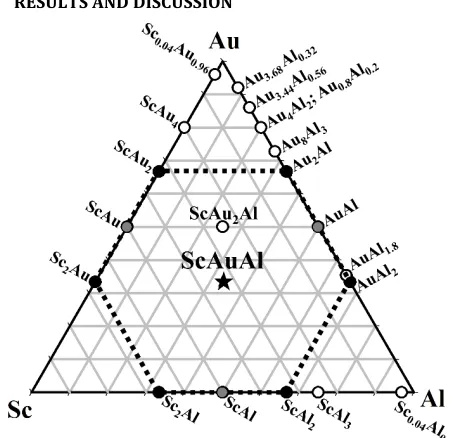
Figure 1. ScAuAl existence triangle showing ScAuAl sitting at the center of the MoSi2-type ScAu2, cubic MgCu2-type ScAl2, Ni2In-type
Sc2Al, MoSi2-type Au2Al, Co2Si-type Sc2Au and CaF2-type AuAl2
hex-agon (black), with edges bisected by CsCl-type ScAu and ScAl, and monoclinic AuAl (gray).
Figure 2. Observed and simulated PXRD patterns from refined sin-gle-crystal XRD data for both supercell (Mg2Ga-type) and subcell
(Fe2P-type) in Sc−Au−Al.
During the search for polar intermetallic quasicrystals and their crystalline approximants in the Ca−Au−Al system1b and as
part of a broader investigation on the effects of atomic sizes (chemical pressure) and valence electron counts in such com-pounds, the Sc-poor region of the Sc−Au−Al system was exam-ined. The loaded molar ratio 1Sc: 2Au: 5Al led to ScAuAl as the major phase with probable traces of at most two of Sc2Al, ScAl,
and ScAl2 (unequivocal determination of the precise trace
phase(s) cannot be made by X-ray powder diffraction). (See Figure S1 for PXRD pattern of the 1Sc: 2Au: 5Al loading with probable binary traces.) ScAuAl sits at the center of the
Sc−Au−Al existence triangle (Figure 1), as well as a hexagon
formed by tetragonal MoSi2-type ScAu221a and Au2Al;26 cubic
MgCu2-type ScAl221b and CaF2-type AuAl2;27 hexagonal Ni2
In-type Sc2Al;28 and orthorhombic Co2Si-type Sc2Au.29 The only
other Sc−Au−Al compound reported in the ICSD is the Heusler
(AlCu2Mn)-type ScAu2Al, which bisects the CsCl-type ScAu and
AuAl along the 50% Au-content line.30 In the PXRD pattern
from products of the 1Sc: 2Au: 5Al synthesis, the minor phases were assigned as follows: the two peaks at 2θ values ~26−27° were identified as belonging to Sc2Al28 and ScAl,31 respectively,
and those around 39° and 41° can be indexed for Sc2Al and
ScAl2,21b respectively. However, no single binary or ternary
compound from the Sc−Au−Al system could be conclusively
as-signed to all peaks, a result which calls for analysis using single-crystal XRD for possible new phase(s).
Three crystals were randomly selected from the product of the 1Sc: 2Au: 5Al loading and all crystallographic solutions re-fined initially to the composition ScAuAl, so that subsequent synthesis of this refined composition and single-crystal XRD analysis of randomly selected specimens from the sample con-firmed its formation. However, preliminary structural solu-tions of crystals selected from the 1Sc: 1Au: 1Al loading differ from the 1Sc: 2Au: 5Al synthesis by a doubling of the unit cell along the c-axis in the pure phase sample (see Figure 2 for PXRD patterns). In the PXRD pattern of the doubled c-axis
structure, the less intense peaks at 2θ values ~19°, 31°, 40°,
48°, 54°, 66°, 72°, and 77° are not clearly visible in the corre-sponding pattern for the product of the 1Sc: 2Au: 5Al loading. Therefore, subsequent investigations were aimed at assessing the origin of this structural variation by crystallographic refine-ments and electronic structural studies.
Crystallographic Refinement and Structure. During pre-liminary stages of this investigation, the structure of ScAuAl was reported to crystallize in the HfRhSn-type structure, which is a derivative of the Mg2Ga-type and is a slightly distorted
su-perstructure of the Fe2P-type with a doubled c-axis caused by
alternating long-short Au–Au chains along the c-direction.8b, 9
ScAuAl specimens from the sample loaded as 1Sc: 2Au: 5Al yielded structures that can be refined in the Fe2P-type with
ac-ceptable statistical assessment values (R = 0.016 for F2 > 2s(F2);
wR(F2) = 0.040; Rint = 0.032; and GOF = 1.21; see Table S1). For
this solution, there are four sites in the asymmetric unit: Au1(1a), Au2(2d), Al(3f, x = 0.2642(5)), and Sc(3g, x = 0.5979(3)), in which Au2(2d) and Al(3f) lie in the same plane, the 2d−2d Au2−Au2 distances along the c-axis are 3.6217(3) Å,
and the 2d–3fAu2−Al distances in the ab-plane are 2.687(4) Å,
but the Ueq value for the Au2(2d) sites is substantially larger by
factors of 1.9−2.3 over those for the Au1(1a) and Al(3f) sites.
Manually doubling the unit cell, revising the space group to
𝑃𝑃6�2𝑐𝑐, and assigning the Au2 sites to two 4f sites, each partially occupied but constrained to a total of 4 atoms, led to a refine-ment with the corresponding z-coordinates of the Au2(4f) sites
shifted 0.141(7) Å and 0.155(7) Å in opposite directions out of
0 15 30 45 60 75 90 105 120 135
ScAuAl calculated (subcell)
ScAuAl calculated (doubled c)
1Sc: 1Au: 1Al observed
1Sc: 2Au: 5Al observed
Int
ens
ity
(a
rb.
unit
s)
[image:5.612.63.288.500.690.2]the Au−Al planes along cand resulting in Au−Au distances of 3.312(9) and 3.905(9) Å. Moreover, the occupancy factor of the
Al(6h) site was refined, resulting in 98.4(3)% Al/1.6% Au, and the Ueq of all sites were mutually similar in magnitudes. A
sta-tistical Hamilton test based on the number of parameters and weighted R-refinement values of the two models show that re-finement of the subcell can be rejected up to the 25% signifi-cance level.32 Thus, this optimal refinement yields
ScAu1.017(3)Al0.983 in a disordered Mg2Ga-type structure.On the
other hand, three specimens selected from the 1Sc: 1Au: 1Al loading can be refined directly in the Mg2Ga-type
superstruc-ture with the Au2 (4f) and Al (6g) in the same plane, 4f−4f
Au2−Au2 distances alternating at 3.3325(8) and 3.9162(8) Å
(average: 3.6244(8) Å) along c, and 4f−6gAu2−Al distances of
2.705(2) Å in the ab-plane. See Tables S2 and S4 for a
crystal-lographic refinement summary.
According to the ICSD, ScAuAl is the only polar intermetallic compound with both Au and Al that crystallizes in the Mg2
Ga-type superstructure and LuAuAl is the only other polar inter-metallic with Au and Al adopting the Fe2P-type substructure.
All other members of the LnAuAl series (Ln = Y, Ce to Yb) crys-tallize in the orthorhombic TiNiSi-type instead, which is also the structure reported for CaAuAl, to be discussed later.33 The
metallic radius of Lu (RLu= 1.73 Å) is smaller than that of the
other lanthanides (Ln = Y, Ce to Yb), which vary from 1.75−2.04
Å (RTm= 1.75 Å, REu= 2.04 Å), so that atomic size seems to play
an important factor in the structural variation of AIIIAuAl (AIII =
trivalent electropositive metal), which favors the formation of the TiNiSi-type structure for larger electropositive metals, the Fe2P-type for slightly smaller ones, and the Mg2Ga-type for the
smallest trivalent electropositive atom Sc (RSc= 1.64 Å).
There-fore, the unit cell volume of the ScAuAl subcell is smaller
(162.90(2) Å3) than that of Fe2P-type LuAuAl (177.36 Å3), a
re-sult arising mainly from a shortening of the c-axis, whereas the
a- and b-axes lengthen (from 7.1033(4) Å to 7.2067(6) Å).
Ad-ditionally, all interatomic contacts shorten on going from
Lu-AuAl to ScLu-AuAl, except the Al−Al interactions, which extend
from 3.0758(2) Å to 3.2966(3) Å, and form the triangles of the
[Al3(Au1)2] trigonal bipyramids in their structures.33 To
high-light the interactions between Au and Al atoms, which are more electronegative than Sc, there are also [Al3(Au2)2+Al1]
“half-chair conformers” within the ScAuAl Fe2P-substructure, fea-tures which are related to the [Au3Ge3] “chair conformers” in
18 e−/fu ScAuGe (LiGaGe-type).22e (See Figure S1 for atomic
co-ordination spheres.) On the other hand, for 16 e−/fu CaAuAl, the orthorhombic TiNiSi-type structure occurs, as seen for LnAuAl (Ln = Y, Ce to Yb), whereas 18 e−/fu TiAuAl adopts the hexago-nal Ni2In-type structure.19 Therefore, the structural variation
from CaAuAl to ScAuAl to TiAuAl follows along TiNiSi-type to Mg2Ga-type (Fe2P-superstructure) to Ni2In-type, which
[image:6.612.57.566.51.251.2]changes directly with decreasing metallic radius in the electro-positive element (RCa= 1.97 Å, RSc= 1.64 Å, RTi= 1.47 Å).
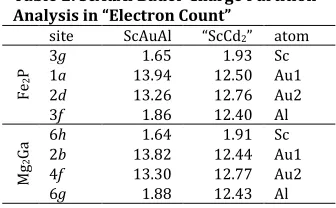
Table 2. ScAuAl Bader Charge Partition Analysis in “Electron Count”
site ScAuAl “ScCd2” atom
Fe2
P 31ga 13.94 1.65 12.50 Au1 1.93 Sc 2d 13.26 12.76 Au2 3f 1.86 12.40 Al
Mg
2
Ga
6h 1.64 1.91 Sc 2b 13.82 12.44 Au1 4f 13.30 12.77 Au2 6g 1.88 12.43 Al
Atomic Site Preference. Since the crystallographic refine-ments of ScAuAl yield structures that are subtle distortions from the hexagonal Fe2P-type, the site preferences for different
elements were analyzed using the smaller subcell (the calcu-lated total energy of the experimental structure is just 6 meV lower than that of the Fe2P model). Evaluating atomic colorings
of a structural network involves evaluating factors contrib-uting to the site energy and bond energy terms of the total band energy.7 The site energy term can be qualitatively assessed
us-ing a Bader charge analysis on models that use the same atomic potentials for the sites being examined for differentiation. For ScAuAl, Bader charge analyses of ScAuAl and hypothetical “ScCd2” in both the Fe2P- and Mg2Ga-type structures
[image:6.612.353.521.420.524.2]corrobo-rate the experimental coloring (see Table 2). For all models, the charges on the 1a (2b) and 2d (4f) sites are greater than those on the 3f (6g) sites and indicate their respective preferences for Au and Al based on their relative electronegativities.
Table 1. ScAuAl Selected Crystallographic Refinement Parameters
refined composition ScAu1.017(3)Al0.983 ScAuAl
instrument Bruker CCD APEX II
radiation; λ (Å)/ temp.(K) Mo Kα; 0.71073/298
space group/ Pearson P6�2𝑐𝑐/ hP18
loading 1Sc: 2Au: 5Al 1Sc: 1Au: 1Al
θ range collection/ param. 3.3o−31.3o/ 23 3.3o–29.0o/ 19
absorp. μ(mm-1)/ correction 71.83/ empirical 69.90/ empirical
meas./ indpnt./ obs. [I > 2σ(I)]/ 7249/ 383/ 229 4550/ 307/ 291
R[F2 > 2σ(F2)]/ wR(F2)/ Rint/ GOF 0.015/ 0.039/ 0.035/ 1.05 0.018/ 0.036/ 0.035/ 1.15
Δρmax, Δρmin(e Å−3) 1.13, −0.96 1.35, −1.33
dimensions (Å) a = 7.2074(6); c = 7.2443(6) a = 7.2362(10); c = 7.2448(10)
volume (Å3)/ Z 325.90(6)/ 6 328.53(10)/ 6
index ranges −10 ≤ h, k ≤ 10; −5 ≤ l≤ 5 −9 ≤ h, k, l ≤ 9
absolute structure param. 0.00(3) 0.03(3)
2b, x, y, z, Uiso Au1 0, 0, 1/4 0.0092(2) Au1 0, 0, 1/4 0.0077(2)
4f, x, y, z, Uiso Au2 (0.54(2)) 1/3, 2/3, 0.0195(9) 0.0100(5) Au2 1/3, 2/3, 0.02100(6) 0.0079(2)
Au3 (0.42(2)) 2/3, 1/3, 0.0214(9) 0.0100(5) -- -- --
6g, x, y, z, Uiso Al/0.016(3)Au 0.2645(5), 0, 0 0.012(1) Al 0.2628(6), 0, 0 0.0080(7) 6h, x, y, z, Uiso Sc 0.4019(7), 0.4024(7), 1/4 0.0137(4) Sc 0.4096(4), 0.3947(4), 1/4 0.0075(5) 2b–2b (c-axis), 2b–6g, 2b–6h 3.6221(3) 2.629(1) 2.899(6) 3.6224(5) 2.626(2) 2.912(3) 4f–4f (c-axis), 4f–6g, 4f–6h 3.312(9),
Table 3. ScAuAl Atomic Site Preference from Isocompositional Coloring Models.
(Å) Experiment α β γ δ ε
< 2.7 Au−Al (12×) Au−Al (12×) Sc−Au (12×) Sc−Au (12×) Sc−Al (12×) Sc−Al (12×)
< 2.9 Sc−Au (15×) Sc−Al (15×) Au−Al (15×) Sc−Al (15×) Au−Al (15×) Sc−Au (15×)
< 3.2 Sc−Al (18×) Sc−Au (18×) Sc−Al (16×) Au−Al (16×) Sc−Au (18×) Au−Al (18×)
< 3.4 Al−Al (3×) Au−Au (3×) Sc−Sc (3×) Au−Au (3×) Sc−Sc (3×) Al−Al (3×)
eV/f.u. 0 +0.347 +0.960 +1.480 +1.759 +2.112
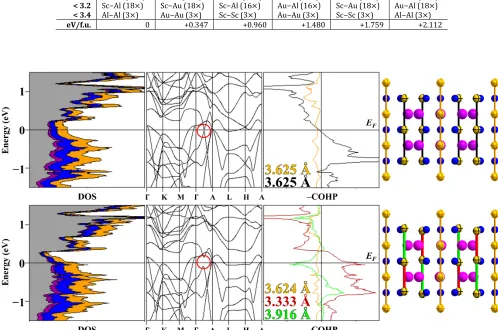
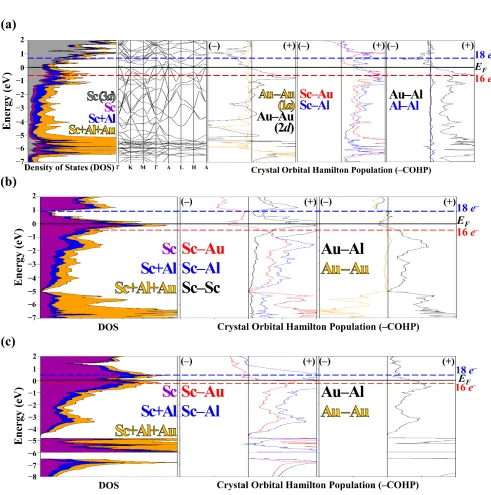
Figure 3. ScAuAl electronic structures in the Fe2P-type subcell (top) and Mg2Ga-type supercell (bottom) with Au−Au pseudo Peierl’s
distortion. For all COHP curves, (−) and (+) respectively indicate antibonding and bonding.Sc is in dark purple, Au is in dark yellow and Al is blue. Sc(3d) orbital contribution in the DOS is in gray.
To examine the bond energy term in ScAuAl, interatomic
dis-tances less than 3.4 Å, which is 0.14 Å greater than the Sc−Sc
distances in hcp Sc, were taken into account in the Fe2P-type
model. Thus, there are seven different interatomic contacts (2.638(5), 2.681(1), 2.848(5), 2.893(5), 3.005(6), 3.125(3), and
3.331(2) Å) to account for in ScAuAl, and, for space group
𝑃𝑃6�2𝑚𝑚 (no. 189), there are six different atomic arrangements that can be generated by switching elements among the various crystallographic sites to maintain the overall composition ScAuAl. According to the results of VASP total energy calcula-tions for each coloring, listed in Table 2 (and Table S5), the low-est energy occurs for the experimental model, which
maxim-izes the number of shortest Au−Al interactions, followed by the
next shortest distances of Sc−Au interactions so that Sc−Al and
Al−Al distances are respectively longer. The next most
energet-ically competitive model in this set (coloring α in Table 2) also has shortest Au−Al interactions, but the next shortest distances are Sc−Al contacts rather than Sc−Au. Therefore, ScAuAl
pre-fers shorter Sc−Au over Sc−Al contacts, which can be
influ-enced by the greater polar character of Sc−Au over Sc−Al inter-actions, as well as stabilizing Sc−Au interactions between nearly empty 3d atomic orbitals of Sc with formally filled 5d
AOs of Au. Model β has overall more total Au−Al interactions
(15×) at distances less than 3.4 Å than both the experimental
and α model, but these interactions are not amongst the
short-est distances, which suggshort-ests that ScAuAl prefers to maximize
the number of shortest Au−Al interactions over a greater
fre-quency of Au−Al interactions at longer averaged distances, in
general, and that the next shortest distances favor Sc−Au over Sc−Al contacts. This atomic site preference analysis based on interatomic interactions also supports a structure that can be broken up into “planes” of [(Au2)2Al3] and [Sc3(Au1)] stacked
alternately along the c-axis as mentioned in the atomic struc-ture discussion. The preference for shorter Sc–Au contacts is also observed in nonstoichiometric ScAu1.017(3)Al0.983, which is
refined from selected specimens in the 1Sc: 2Au: 5Al molar loading. Here, the sites Au3/Au2 that split along the c-axis out of the [Au2Al3] plane lead to overall more number of Sc–Au
shorter distances (2.754(5) Å (3×); (2.946(5) Å (3×)) than in the case without the splitting (Sc–Au: 2.845(3) Å (6×)).
Like ScAuAl, TiNiSi-type CaAuAl also exhibits shortest Au−Al
distances followed by Ca−Au, with longer Ca−Al distances.19a In
TiAuAl, Au−Al distances are also the shortest, whereas Ti−Ti
and Ti−Au/Al are comparable,19bwhich implies enhanced A−A
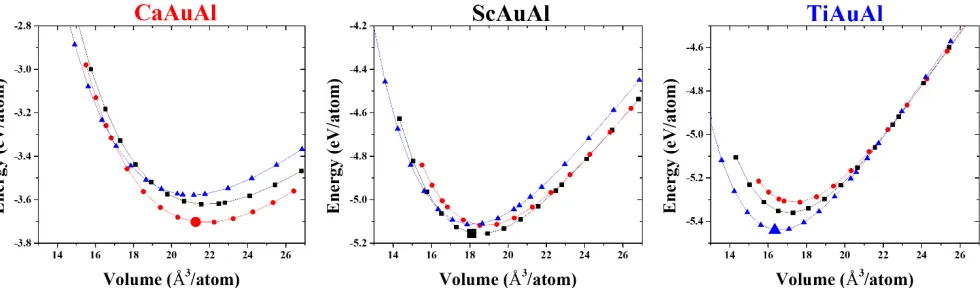
Figure 4. AAuAl total energies as a function of volume in competing models: TiNiSi as observed for CaAuAl in red; Fe2P refined for ScAuAl
[image:8.612.55.294.222.361.2]in black, and Ni2In as observed for TiAuAl in blue. For each, the experimental model is shown as a larger data point.
Table 4. AAuAl (A = Ca, Sc, Ti) Formation Energies (eV/f.u.)
Sc + Au + Al → ScAuAl −2.308
1 2 ScAu2 +
1
2 ScAl2→ ScAuAl −0.348 1
2 Sc2Al + 1
2 Au2Al → ScAuAl −1.313 1
2 Sc2Au + 1
2 AuAl2→ ScAuAl −0.663
Ca + Au + Al → CaAuAl −2.142
1 2 CaAu2 +
1
2 CaAl2→ CaAuAl −0.569
Ti + Au + Al → TiAuAl −1.522
1 2 TiAu2 +
1
2 TiAl2→ TiAuAl −0.226
of shortest distances between the more electronegative ele-ments, i.e., Au and Al, while manifesting a large number of sta-bilizing polar-covalent A−(Au+Al) interactions subject to the
size constraints of A reflects one of the hallmarks of this com-pound class.1b, 4a
Electronic Origins of the Distortion from Fe2P-type to
Mg2Ga-type in ScAuAl. As indicated by our crystallographic
refinements and a previous investigation,9 ScAuAl is slightly
distorted from the Fe2P-type structure. The calculated
elec-tronic DOS curve, band structure, and Au–Au COHP curves (see Figure 3) for Fe2P-type ScAuAl reveal distinct similarities to a
Peierls-like distortion, because at the Fermi level the band structure shows a degeneracy via band crossing near the mid-point wavevector between the Γ(0,0,0) and A(0,0,c*/2) and the
Au2−Au2 COHP curve crosses from bonding states below to
an-tibonding states above the Fermi level. Upon distortion of the
structure to create alternating Au−Au distances along the c
-axis, the degeneracy is broken in the band structure, the Fermi level falls within the gap for these states at k~ (0, 0, c*/4), and, as seen in the COHP curve (Figure 3), the shorter and longer
Au−Au distances give, respectively, occupied bonding and ant
i-bonding states at the Fermi level.
The Peierls-like distortion is observed for chains formed by the Au2 atoms only, and not those by Au1, a result that leads to
shorter Sc−Au distances. Half of the interplanar Sc−Au
dis-tances (2.852(3) Å) of the subcell become shorter on going to
the distorted structure (2.826(4) and 2.886(3) Å), but remain
the same on average. On the other hand, all Au−Al distances
re-main the same (interplanar: 2.624(5) vs. 2.622(4) Å; intrapla-nar: 2.699(4) to 2.704(3) Å). Thus, the distortion implies a strong preference for Sc(3d)−Au(5d) interactions, as also seen by the Sc 3d-partial orbital breakdown of the electronic DOS
(Figure 3) and atomic site preferences for Sc−Au near neigh-bors (Table 3).
Formation Energies. The theoretical energy of formation provides information on the stability of a compound and the feasibility of assembling the structure from its constituent starting reagents. AAuAl (A = Ca, Sc, Ti) formation energies cal-culated from the elements and their corresponding binaries ½ AAu2 + ½ AAl2 show that, in general, the formations of the
ter-naries are all energetically favorable (Table 4), and that com-putational studies and experimental structural reports of AAuAl corroborate one another. Additionally, whereas the for-mation of ScAuAl from the elements is most energetically fa-vorable in comparison to that of (Ca/Ti)AuAl, formation of CaAuAl from CaAu2 and CaAl2 is more favorable than formation
of (Sc/Ti)AuAl from their binaries. This type of calculation pro-vides some insight into the potential use of binary precursors for the synthesis of a ternary compound.
Competing Structural Models. Differences in AAuAl (A = Ca, Sc, Ti) formation energies are much larger than differences in energies between related structures, so that, in general, the factors giving rise to a compound in a specific structure is an investigation that utilizes and analyzes calculated electronic structures, atomic site preferences, and relative atomic charac-teristics such as size and electronegativity.
From CaAuAl to ScAuAl to TiAuAl, the overall decreasing unit cell volume (VCaAuAl = 21.324 Å3/atom; VScAuAl = 18.103 Å3/atom; and VTiAuAl= 16.344 Å3/atom) reflects the decreasing
metallic radius of the formally electropositive element (RCa,Sc,Ti = 1.97, 1.64, 1.47 Å). For the elements themselves, these
de-creasing metallic radii correspond to filling metal−metal bond-ing states of the 3d band, so we may anticipate similar features for the electronic structures of these ternary intermetallics. The size effect from the electropositive metal is also demon-strated by LnAuAl (Ln = rare-earth metals)33 adopting the
or-thorhombic TiNiSi-type as opposed to hexagonal Mg2Ga-
(dou-bled, distorted Fe2P-) type for ScAuAl. To examine this size
ef-fect of the A elements, total energy vs. volume, E(V), curves were calculated for AAuAl (A = Ca, Sc, Ti) in the three compet-ing TiNiSi-, Fe2P-, and Ni2In-type models (Figure 4), all of which
Table 5. Calculated Murnaghan Minimum Energy E0 (eV/atom), Volume V0 (Å3/atom), and Bulk Modulus B0 (Mbar) and its derivative B0’
Compound
CaAuAl ScAuAl TiAuAl
Ty
pe
[image:9.612.60.551.115.610.2]TiNiSi −3.705; 21.850; 0.6744; 4.156 −5.118; 18.773; 1.0506; 5.059 −5.314; 17.322; 1.3159; 5.946 Fe2P −3.622; 21.920; 0.6411; 4.026 −5.155; 18.508; 1.0496; 4.956 −5.361; 17.019; 1.3038; 5.740 Ni2In −3.580; 21.137; 0.6599; 3.920 −5.110; 18.138; 1.0105; 4.649 −5.437; 16.474; 1.2757; 5.361
Figure 5. ScAuAl in the (a) experimental, (b) TiNiSi-type and (c) Ni2In-type as respectively seen for CaAuAl and TiAuAl. For all COHP curves,
(−) and (+) indicate antibonding and bonding, respectively for contacts < 3.5 Å.
16−18 e−/fu AAuAl compounds: (a) at large volumes, the
Ti-NiSi-type structure is favorable (it becomes energetically
com-petitive for ScAuAl at ~10% above Vexpand for TiAuAl at ~11%
above Vexp); and (b) at small volumes, the hexagonal Ni2In-type
structure is favorable (it becomes competitive for ScAuAl at
~3% below Vexpand for CaAuAl at ~7% below Vexp). These
re-sults imply that under pressure, ScAuAl may transform into a
hexagonal Ni2In-type; CaAuAl is also susceptible to this
trans-formation but the pressure would be much higher than for ScAuAl. Furthermore, fitting all curves using a Murnaghan form (Table 5) shows that the bulk moduli for all TiNiSi-type curves are the largest.
Table 6. AAuAl Competing Models, Total Energies, and Integrated COHP < 3.5 Å
ScAuAl (Fe2P-type)
TiNiSi Fe2P Ni2In NdPtSb LiGaGe ScAuSi ∆E(eV/f.u.) +0.031 0.000 +0.081 +0.077 +0.079 +0.140
a (Å) b(Å) c (Å)
6.674 4.378 7.636 7.287 3.625 4.467 6.389 4.459 6.419 4.459 6.428 4.427 6.623
V (Å3/f.u.) 55.779 55.563 55.191 55.257 55.333 56.213
−
IC
OH
P (
%
) Sc−AuSc−Al 23.16 27.95 19.12 15.33 30.24 29.23 29.26 37.36 26.99 26.74 23.83 31.47
Sc−Sc 4.59 -- -- -- 1.54 4.48
Au−Al 38.73 64.39 42.77 44.03 45.38 22.52
Al−Al -- 1.16 -- -- -- 2.36
Au−Au 5.57 -- -- -- -- 1.80
CaAuAl (TiNiSi-type)
∆E(eV/f.u.) 0.000 +0.138 +0.216 +0.213 +0.217 +0.212
a(Å) b (Å) c (Å)
7.337 4.552 7.824 7.255 4.310 4.548 7.597 4.563 7.526 4.564 7.513 4.536 7.703
V (Å3/f.u.) 65.319 65.485 68.043 67.836 67.752 68.642
−
IC
OH
P (
%
) Ca−AuCa−Al 21.83 19.94 14.59 28.35 27.09 23.31 34.55 13.36 26.12 25.27 21.60 30.57
Ca−Ca -- -- -- -- 1.03 2.89
Au−Al 55.93 70.73 45.53 47.65 52.05 26.97
Al−Al 2.31 1.32 -- -- -- 2.98
Au−Au -- -- -- -- -- 2.04
TiAuAl (Ni2In-type)
∆E(eV/f.u.) +0.234 +0.157 0.000 +0.020 +0.024 +0.121
a(Å) b (Å) c (Å)
6.516 4.001 7.747 6.694 3.977 4.461 5.740 4.365 6.150 4.363 6.161 4.395 6.025
V (Å3/f.u.) 50.494 51.435 49.452 50.740 50.788 50.392
−
IC
OH
P (
%
) Ti−AuTi−Al 33.83 24.72 27.78 21.33 34.01 27.62 39.69 35.05 40.21 32.19 28.66 34.51
Ti−Ti 5.43 -- 6.65 -- 4.25 8.98
Au−Al 28.50 52.98 31.72 28.12 32.04 13.97
Al−Al -- 0.97 -- -- -- 1.26
Au−Au 4.46 -- -- -- -- 1.06
competing models provide effective rationale for the observed structural variations. These are obtained by calculated elec-tronic DOS and COHP curves for nearest pairwise interactions
for distances less than 3.5 Å. Since the observed structures
(Ti-NiSi-type for 16 e−/fu CaAuAl; distorted Fe2P-type for 17 e−/fu ScAuAl; and Ni2In-type for 18 e−/fu TiAuAl) all contain [AuAl]
networks involving [Au3Al3] alternant hexagonal rings, three
additional structure types based upon the hexagonal CaIn2
-type were examined: (1) NdPtSb--type, observed for CeAuGe,
but contains no Au−Ge interactions along the c-direction
yield-ing essentially separated puckered hexagonal [Au3Ge3] layers;
(2) LiGaGe-type, which occurs for ScAuGe, and have a 3D
tetra-hedral framework with only Au−Ge contacts; and (3) ScAuSi
features [Au3Si3] puckered hexagons stacked directly on top of
one another with distances that suggest Au−Au and Si−Si inter-layer interactions.22 Geometrically, the hexagonal layers of the
electronegative metal/metalloid network in CaIn2-type
deriva-tives are puckered in a chair-conformation; those in Ni2In-type
(TiAuAl) are planar; and those in the distorted Fe2P-type
(ScAuAl) are half-chair conformers.
Table 6 summarizes the total energies, relative to the lowest energy structure, calculated unit cell parameters, and percent integrated Hamilton populations (ICOHPs) evaluated for all
in-teractions within 3.5 Å for AAuAl (A = Ca, Sc, and Ti) in the
var-ious competing models (see Tables S6−S11 for more details). Some general observations of the results in Table 6 include: (i)
for all AAuAl, the total energies for hexagonal Ni2In- and CaIn2
-derivatives, except for the ScAuSi-type, fall within a few milli-volts of each other; (ii) the lowest energy structures for CaAuAl and TiAuAl exhibit the smallest unit cell volumes per formula unit; and (iii) the Fe2P-structure type always shows the
great-est polar-covalent bonding contributions coming from Au−Al contacts for all AAuAl cases.
Examination of the DOS and COHP curves for these cases can illuminate these outcomes. Figure 5 shows these curves for 17
e−/fu ScAuAl in Fe2P-, TiNiSi-, and Ni2In-type arrangements. The different structures significantly affect the shapes of the DOS curves. For the Fe2P-type, there are no clear gaps in the
DOS, although the Au 5d band is clearly seen at 5 eV below the Fermi level and is about 1.5 eV wide. At the Fermi level, there is a pseudogap arising from the general crossing of Sc 3d states with Au 6s and 6p orbitals (the rationale for the distortion of ScAuAl was given earlier). This pseudogap region also corre-sponds to essentially optimized Au−Al interactions, but there remain Sc−Au and Sc−Al bonding states above EF as seen in
their COHP curves in Figure 5. By applying a rigid-band ap-proximation to these curves, for 16 e−/fu, significant Au−Al states would be depleted, whereas for 18 e−/fu, Au−Al anti-bonding states would be populated. The DOS curves for ScAuAl in the TiNiSi- and Ni2In-alternatives show distinct
(pseudo)gaps for 12 electrons, which correspond to formally filling one s-band and the Au 5d band with electrons. The Fermi levels for 17 e−/fu both lie close or on peaks in the DOS curve, and the Ni2In-type DOS shows considerable contributions from
Sc wavefunctions among the occupied states. Therefore, the Fe2P-related structure adopted by ScAuAl optimizes Au−Al
in-teractions while avoiding Sc−Au antibonding interactions, which are indicated for TiNiSi-type “ScAuAl” in its COHP curve. (See Figure S2 for electronic structures of ScAuAl in competing structures related to CaIn2: NdPtSb- LiGaGe-, and ScAuSi.)
Analogous analyses are afforded for the (Ca/Ti)AuAl neigh-bors to rationalize features stabilizing their observed struc-tures. In TiNiSi-type CaAuAl, the next most competitive model to the experimental one is the Fe2P-type structure; in both, Au−Al interactions contribute the most to the total ICOHP value, as in ScAuAl. (See Tables S8–S9 for summaries and Fig-ure S3 for electronic structFig-ures of CaAuAl in competing struc-ture types.) Also like ScAuAl, there are overall bonding Ca−Au
and Ca−Al interactions at the Fermi level, but unlike ScAuAl the
Au−Al interactions are not optimized. The small volume of the unit cell relative to the other structural models reflects that there may be significant stabilization arising from charge trans-fer from Ca to the electronegative Au and Al atoms in this struc-ture. In Ni2In-type TiAuAl, the observed Ni2In- and CaIn2-type
models are energetically close, which is somewhat surprising given that the [Au3Al3] hexagons in the CaIn2-type variants are
puckered whereas those in the Ni2In-type are planar. For the
observed structure of TiAuAl, the Au−Al distances are the shortest (2.5448(5) Å), followed by the Ti−Ti distances
(2.9145(5) Å) (See Tables S10−S11 for summaries of TiAuAl
and its competing structure types and Figure S4 for electronic structures.) According to analysis of the ICOHPs (Table 6), the Ni2In-type structure yields a nearly even distribution in
bond-ing contributions from Au−Al, Ti−Au, and Ti−Al interactions,
while also providing some Ti−Ti bonding. The CaIn2-types
show similar characteristics, but with some subtle redistribu-tion in bonding contriburedistribu-tions, results which raredistribu-tionalize the similar total energies to the Ni2In-type model. On the other
hand, the relative destabilization of TiNiSi- and Fe2P-types
reducing the contributions of Ti−Au and Ti−Al to the total bond energy term.
CONCLUSIONS
AAuAl (A = Ca, Sc, Ti) compounds with consecutively increas-ing valence electron concentration (16−18 e−/fu) and decreas-ing atomic radius crystallize in different structure types: ortho-rhombic TiNiSi-type CaAuAl; hexagonal Mg2Ga-type ScAuAl (a
distorted superstructure of Fe2P-type); and hexagonal Ni2
In-type TiAuAl. Density functional theory and atomic site prefer-ence investigations using total energy calculations show that this structural variation is related to both chemical pressure ef-fects, results indicating larger unit cells favoring the ortho-rhombic TiNiSi structure and smaller unit cells favoring the hexagonal Fe2P- or Ni2In-type structure, as well as atomic
ar-rangements that maximize the number of Au−Al nearest neigh-bor contacts. Electronic DOS and COHP plots highlight the polar
covalent A−(Au+Al) interactions, which are also necessary for
structural cohesion. For the ScAuAl structure specifically, the electronic band structure and Au−Au COHP curves indicate that the refined Mg2Ga-type structure arises from a Peierls-like
dis-tortion of the Au-chains along the c-axis, which gives rise to the doubled c-axis on going from the Fe2P- to Mg2Ga-type
struc-tures.
ASSOCIATED CONTENT
Supporting Information (SI) with the following is available free of charge on the ACS Publications website: Phase analysis of the 1Sc: 2Au: 5Al loading; Environment of each atom in the ScAuAl asymmetric unit of Fe2P structure; Selected crystallographic
pa-rameters of ScAuAl refined in the Fe2P-structure as selected from
the 1Sc: 2Au: 5Al molar loading as well as the Mg2Ga-structure as
selected from the 1Sc: 1Au: 1Al molar loading; ScAuAl (Fe2
P-struc-ture), CaAuAl (TiNiSi-strucP-struc-ture), and TiAuAl (Ni2In-structure)
rel-ative total formation energies and energies of competing struc-tures with numbers of selected interatomic distances; ScAuAl structural parameters after VASP optimization used for subse-quent electronic calculations; Ca, Sc, Ti, Au, and Al Wigner Seitz ra-dii; DOS and COHP curves of AAuAl in all competing structure types.
AUTHOR INFORMATION
Corresponding author*E-mail: [email protected]
Notes
The authors declare no competing financial interest.
ACKNOWLEDGEMENTS
The authors are grateful for funding from the U.S. National Sci-ence Foundation (Grant DMR 10-05765). Diffraction instrumenta-tion was provided by support of the Basic Energy Sciences, Materi-als Sciences Division, U.S. Department of Energy at Ames Labora-tory, which is operated by Iowa State University under contract no. DE-AC02-07CH11358. All computational investigations were per-formed on the CRUNCH system supported by the Iowa State Uni-versity Computation Advisory Committee Project no. 202-17-10-08-0005.
REFERENCES
1. (a) Miller, G. J.; Thimmaiah, S.; Smetana, V.; Palasyuk, A.; Lin,
Q. Gold’s Structural Versatility Within Complex Intermetallics: From Hume-Rothery to Zintl and Even Quasicrystals Mater. Res. Soc. Symp. Proc.2013, 1517; (b) Pham, J.; Kreyssig, A.; Goldman, A. I.; Miller, G. J. An Icosahedral Quasicrystal and Its 1/0 Crystalline Approximant in the Ca–Au–Al System Inorg. Chem. 2016, 55, 10425–10437.
2. Palasyuk, A.; Grin, Y.; Miller, G. J. Turning Gold into “Diamond”: A Family of Hexagonal Diamond-Type Au-Frameworks Intercon-nected by Triangular Clusters in the Sr−Al−Au System J. Am. Chem. Soc.2014, 136, 3108–3117.
3. (a) Miller, G. J.; Lee, C.-S.; Choe, W. Structure and Bonding Around the Zintl Border. In Inorganic Chemistry Highlights; Meyer, G.; Naumann, D.; Wesemann, L., Eds.; Wiley-VCH: Weinheim, Ger-many, 2002; pp 21–53; (b) Miller, G. J.; Schmidt, M.; Wang, F.; You, T.-S. Quantitative Advances in the Zintl−Klemm Formalism Struc-ture and Bonding (Zintl Phases) 2011, 139, pp 1–55.
4. (a) Miller, G. J.; Reedijk, J.; Poeppelmeier, K. R. Metal-Rich Com-pounds of the d-Metals. Comprehensive Inorganic Chemistry II
2013, 2, 311–357; (b) Nesper, R. Bonding Patterns in Intermetallic Compounds Angew. Chem. Int. Ed. Engl.1991, 30, 789–817.
5. (a) Dshemuchadse, J.; Steurer, W. More Statistics on Interme-tallic Compounds−Ternary Phases Acta Crystallogr. Sect. A2015,
71, 335–345; (b) Bojin, M. D.; Hoffmann, R. The RE−M−E Phases-Overview Helv. Chim. Acta.2003, 86, 1653–1682.
6. (a) Bojin, M. D.; Hoffmann, R. The RE−M−E Phases−What's Possible Helv. Chim. Acta.2003, 86, 1683–1708; (b) Seibel, E. M.; Schoop, L. M.; Xie, W.; Gibson, Q. D.; Webb, J. B.; Fuccillo, M. K.; Kri-zan, J. W.; Cava, R. J. Gold−Gold Bonding: The Key to Stabilizing the 19-Electron Ternary Phases LnAuSb (Ln = La−Nd and Sm) J. Am. Chem. Soc.2015, 137, 1282–1289.
7. Miller, G. J. The “Coloring Problem” in Solids: How it Affects Structure, Composition and Properties Eur. J. Inorg. Chem.1998,
1998, 523–536.
8. (a) Zumdick M. F.; Hoffmann, R.-D.; Pöttgen, R. The Interme-tallic Zirconium Compounds ZrNiAl, ZrRhSn, and ZrPtGa − Struc-tural Distortions and Metal-Metal Bonding in Fe2P Related
Com-pounds Z. Naturforsch. B.1999, 54b, 45–53; (b) Zumdick, M. F.; Pöttgen, R. Determination of the Superstructures for the Stannides ZrIrSn, HfCoSn, and HfRhSn Z. Kristallogr. Cryst. Mater.1999, 214, 90–97.
9. Radzieowski, M.; Benndorf, C.; Haverkamp, S.; Eckert, H.; Janka, O. On New Ternary Equiatomic Scandium Transition Metal Aluminum Compounds ScTAl with T = Cr, Ru, Ag, Re, Pt, and Au Z. Naturforsch. B.2016, 71, 553–566.
10. Kuestner, H. R. Struktur des Siliziums Physikalische Zeitschrift1923, 24, 25–29.
11. SMART, version 5; Bruker AXS: Madison, WI, 2003. 12. Sheldrick, G. M. SADABS; University of Gottingen: Gottingen, Germany, 2001.
13. Blessing, R. An Empirical Correction for Absorption Anisot-ropy. Acta Crystallogr., Sect. A1995, 51, 33–38.
14. Sheldrick, G., SHELX, version 6.14; Bruker AXS: Madison, WI,
2000–2003.
15. Sheldrick, G., A Short History of SHELX. Acta Crystallogr. Sect. A2008, 64, 112–122.
17. (a) Blöchl, P. E. Phys. Rev. B1994, 50, 17953; (b) Kresse, G.; Hafner, J. Phys. Rev. B1993, 47, 558; (c) Kresse, G.; Furthmüller, F.
Comput. Mater. Sci.1996, 6, 15.
18. Perdew, J. P.; Burke, K.; Ernzerhof, M. Generalized Gradient Approximation Made Simple Phys. Rev. Lett.1996, 77, 3865.
19. (a) Cordier, G.; Friedrich, T. Crystal Structure of Calcium Gold Aluminium (1/1/1), CaAuAl Z. Kristallogr. Cryst. Mater.1992, 201, 304–305; (b) Jorda, J. L.; Muller, J.; Braun, H. F.; Susz, C. Phase Rela-tionships in the Ternary System Ti−Au−Al at 775 K J. Less Common Met.1987, 134, 99–107.
20. Bader, R. F. W. Atoms in Molecules: A Quantum Theory. Clar-endon Press: 1994.
21. (a) Reule, H.; Steeb, S.; Donolato, C. Structure of the Com-pounds Ag4Sc, Ag2Sc, Au4Sc, Au2Sc, and Ag3Yb J. Less Common Met. 1971, 24, 108–112; (b) Schuster, J. C.; Bauer, J. The Ternary
Sys-tems Sc−Al−N and Y−Al−N J. Less Common Met.1985, 109, 345– 350; (c) Zachwieja, U. Synthesis and Structure of CaAu2 and SrAu2
J. Alloys Cmpd.1996, 235, 12–14; (d) Nowotny, H.; Mohrnheim, A. Die Kristallstruktur von Al2Ca, Z. Kristallogr., Kristallgeo.,
Kristall-phys., Kristallchem.1939, 100, 540–542; (e) Pietrokowsky, P. The Partial Constitutional Diagram TiAu2−Au: Lattice Parameters of the
Alpha Solid Solutions and the Intermediate Phase TiAu4J. Inst. Met. 1962, 90, 434–438; (f) Schuster, J. C.; Ipser, H. Phases and Phase Relations in the Partial System TiAl3−TiAl Z. Metallkunde1990, 81,
389–396.
22. (a) Fornasini, M. L.; Iandelli, A.; Pani, M. Different Stacking of the Gold and Silicon Atoms in the Phases RAuSi (R = Sc, Y, Lu) J. Alloys Cmpd.1992, 187, 243–247; (b) Bockelmann, W.; Schuster, H.-U. Z. Anorg. Allg. Chem.1974, 410; (c) Bockelmann, W.; Jacobs, H.; Schuster, H.-U. Z. Naturforsch. B1970, 25; (d) Wenski, G.; Mewis, A. REPtX Compounds with Structures Related to AlB2- and
MgAgAs-Type (RE = Y, Rare Earth Element; X = P, As, Sb), Z. Kristal-logr.1986, 176, 125–134; (e) Pöttgen, R.; Borrmann, H.; Felser, C.; Jepsen, O.; Henn, R.; Kremer, R. K.; Simon, A. Crystal and Electronic Structures of ScAuGe, CeAuGe, and LuAuGe: A Transition from Two- to Three-Dimensional [AuGe] Polyanions. J. Alloys Cmpd.
1996, 235, 170–175; (f) Hoffmann, R. D.; Pöttgen, R. AlB2-Related
Intermetallic Compounds – A Comprehensive View Based on
Group-Subgroup Relations Z. Kristallogra. Cryst. Mater.2001, 216, 127–145.
23. Dronskowski, R.; Bloechl, P. E. Crystal Orbital Hamilton Pop-ulations (COHP): Energy-Resolved Visualization of Chemical Bond-ing in Solids Based on Density-Functional Calculations J. Phys. Chem.1993, 97, 8617–8624.
24. Jepson, O. B., A.; Andersen, O.K., The Program TB-LMTO-ASA, version 4.7; Max-Planck-Institut für Festkörperforschung, Stuttgart, Germany, 1999.
25. Lambrecht, W. R. L.; Andersen, O. K., Minimal Basis Sets in the Linear Muffin-Tin Orbital Method: Application to the Diamond-Structure Crystals C, Si, and Ge Phys. Rev. B1986, 34, 2439–2449.
26. Pušelj, M.; Schubert, K. Kristallstrukturen der Phasen Au2Al(h), Au2Al1−(r) und Au2Al1+(r) J. Less Common Met.1974, 35,
259–266.
27. West, C. D.; Peterson, A. W. The Crystal Structure of AuAl2Z.
Kristallogr., Kristallgeo., Kristallphys., 1934, 88, 93–94.
28. Eymond, S.; Parthé, E. Sc2Al with Ni2ln structure Type J. Less
Common Met.1969, 19, 441–443.
29. Palenzona, A.; Manfrinetti, P. The Phase Diagram of the Sc−Au System J. Alloys Cmpd.1997, 257, 224–226.
30. (a) Frank, K.; Schubert, K. Kristallstruktur von AuAl J. Less Common Met.1970, 22, 349–354; (b) Aldred, A. T. Intermediate Phases Involving Scandium Trans. Metallurgical Soc. Aime1962,
224, 1082–1083; (c) Dwight, A. E.; Kimball, C. W., ScT2X and LnT2X
Compounds with the MnCu2Al-Type Structure J. Less Common Met. 1987, 127, 179–182.
31. Schob, O.; Parthe, E. AB Compounds with Sc, Y and Rare Earth Metals. I. Scandium and Yttrium Compounds with CrB and CsCl Structure. Acta Crystallogr.1965, 19, 214–224.
32. Hamilton, W. Significance Tests on the Crystallographic R
Factor Acta Crystallogr.1965, 18, 502–510.
For Table of Contents Only
The origin of the hexagonal ScAuAl structure, in which the unit-cell is distorted due to alternating long-short Au–Au chains along the