1
Structure of DNA
Definition & Classification
Definition & Classification
Nucleic Acid:
Nucleic Acid:
Linear polymers of
Linear polymers of
nucleotides
nucleotides
that
that
function in the storage and expression of
function in the storage and expression of
genetic information, and its transfer from
genetic information, and its transfer from
one generation to the next.
one generation to the next.
Two Main Types:
Two Main Types:
1 - Ribonucleic Acid (RNA)
1 - Ribonucleic Acid (RNA)
2 - De-oxyribonucleic Acid (DNA)
3
Molecular Components of Nucleotides
Molecular Components of Nucleotides
Three Components:
Three Components:
1) Nitrogenous Base 1) Nitrogenous Base 2) Pentose Sugar 2) Pentose Sugar 3) Phosphate
3) Phosphate
Phosphate
Ribose
Adenosine-5’-monophosphate
OH
Pyrimidines:
Pyrimidines:
Six-membered heterocyclic rings of C & N.
Six-membered heterocyclic rings of C & N.
Purines:
Purines:
Fused Six-membered + five-membered
Fused Six-membered + five-membered
heterocyclic rings of C & N.
heterocyclic rings of C & N.
Bases:
Bases:
N-groups can accept protons, giving
N-groups can accept protons, giving
“
“
basic
basic
”
”
properties to the molecule.
properties to the molecule.
Two Families of Nitrogenous Bases
Two Families of Nitrogenous Bases
5
Common Purines & Pyrimidines
Common Purines & Pyrimidines
Purines
Pyrimidines
Notes & Comments Re Nitrogenous Bases
Notes & Comments Re Nitrogenous Bases
Occurrence
Occurrence
A, T, C, G & U are main components of nucleic acids.
A, T, C, G & U are main components of nucleic acids.
Xanthine & hypoxanthine . . .
Xanthine & hypoxanthine . . .
– rarely occur (due to spontaneous deamination of G & A).rarely occur (due to spontaneous deamination of G & A). – are removed during DNA repair.are removed during DNA repair.
– are intermediates in nucleotide catabolism.are intermediates in nucleotide catabolism.
U occurs only in RNA
U occurs only in RNA
’
’
s where it replaces T.
s where it replaces T.
– DNA contains A,T,C,G.DNA contains A,T,C,G.– RNA contains A,U,C,G.RNA contains A,U,C,G.
7
Some Interesting Nitrogenous Bases
Some Interesting Nitrogenous Bases
Theobromine & Theophylline
Theobromine & Theophylline
– Secondary metabolites of cocoa beans and tea leaves. Secondary metabolites of cocoa beans and tea leaves. – Act as diuretic, cardiac stimulant, and esp. vasodilator – Act as diuretic, cardiac stimulant, and esp. vasodilator –
relaxes smooth muscles (bronchiodilator for asthmatics). relaxes smooth muscles (bronchiodilator for asthmatics).
Caffeine
Caffeine
– Stimulant, diuretic. Stimulant, diuretic.
– Antagonist to adenosine.Antagonist to adenosine.
Theobromine
8
Nucleo
Nucleo
sides
sides
Nitrogenous Bases Attached to Sugars
Nitrogenous Bases Attached to Sugars
Sugar is Ribose or 2-Deoxy-ribose (RNA vs. DNA).Sugar is Ribose or 2-Deoxy-ribose (RNA vs. DNA).
Attachment via Attachment via -1-1N glycosidic bond.N glycosidic bond.
Plane of base is Plane of base is to plane of sugar. to plane of sugar.
9
Common Ribonucleosides
Common Ribonucleosides
ThymidineAdenosine
Adenosine
A Physiologically Active Nucleoside
A Physiologically Active Nucleoside
Inhibitory neurotransmitter synthesized in Inhibitory neurotransmitter synthesized in the brain, binds to adenosine receptors. the brain, binds to adenosine receptors.
Binding causes . . .Binding causes . . .
– drowsiness (slows down nerve cell drowsiness (slows down nerve cell activity).
activity).
– dilation of blood vessels (lets more dilation of blood vessels (lets more oxygen in during sleep).
oxygen in during sleep).
Clinically used as an anti-arrhythmic to Clinically used as an anti-arrhythmic to “
“defibrillatedefibrillate”” abnormally fast heartbeats; abnormally fast heartbeats; used in cardiac stress tests.
used in cardiac stress tests.
Caffeine competes with same (brain) Caffeine competes with same (brain) receptor; reversing effects of adenosine. receptor; reversing effects of adenosine.
Adenosine
11
Cordycepin (3
Cordycepin (3
’
’
- Deoxy Adenosine)
- Deoxy Adenosine)
A Physiologically Active Nucleoside
A Physiologically Active Nucleoside
Antibiotic produced by Antibiotic produced by Cordyceps militarisCordyceps militaris
(the
(the ““Scarlet Caterpillar FungusScarlet Caterpillar Fungus””) – ) – parasitizes burried moth pupae. parasitizes burried moth pupae.
Inhibits the final step of RNA biosynthesis Inhibits the final step of RNA biosynthesis
by termination of the ribonucleotide chain. by termination of the ribonucleotide chain.
Cytokinins
Cytokinins
Plant Hormnes Derived from Adenine
Plant Hormnes Derived from Adenine
Cytokinins
Cytokinins
Contain adenine ring system with an attached 5-carbon Contain adenine ring system with an attached 5-carbon hydrophobic group at the free NH
hydrophobic group at the free NH22..
Promote cell division in plants.Promote cell division in plants.
Zeatin Zeatin
13
Nucleo
Nucleo
tides
tides
Nucleosides with One or More Phosphates
Common Ribonucleotides
Common Ribonucleotides
IMP is the IMP is the bio-synthetic precursor synthetic precursor of nucleotides (AMP) of nucleotides (AMP)
Fig. 14.23a Fig. 14.23a
Note:
Note: Thymidine- Thymidine-5
5’’-monophosphate -monophosphate is not shown (not
is not shown (not
found in RNA
15
Common Deoxy-Ribonucleotides
Common Deoxy-Ribonucleotides
Metabolic Functions of Nucleotides
Metabolic Functions of Nucleotides
(besides building blocks of nucleic acids)
(besides building blocks of nucleic acids)
Nucleotide Specific Functions:
Nucleotide Specific Functions:
ATP
ATP
–
–
phosphate acceptor/donor
phosphate acceptor/donor
GTP
GTP
–protein synthesis and signal
–protein synthesis and signal
transduction
transduction
CTP
CTP
–
–
membrane & storage lipid
membrane & storage lipid
synthesis
synthesis
UTP
UTP
–
–
carbohydrate synthesis &
carbohydrate synthesis &
degradation.
17
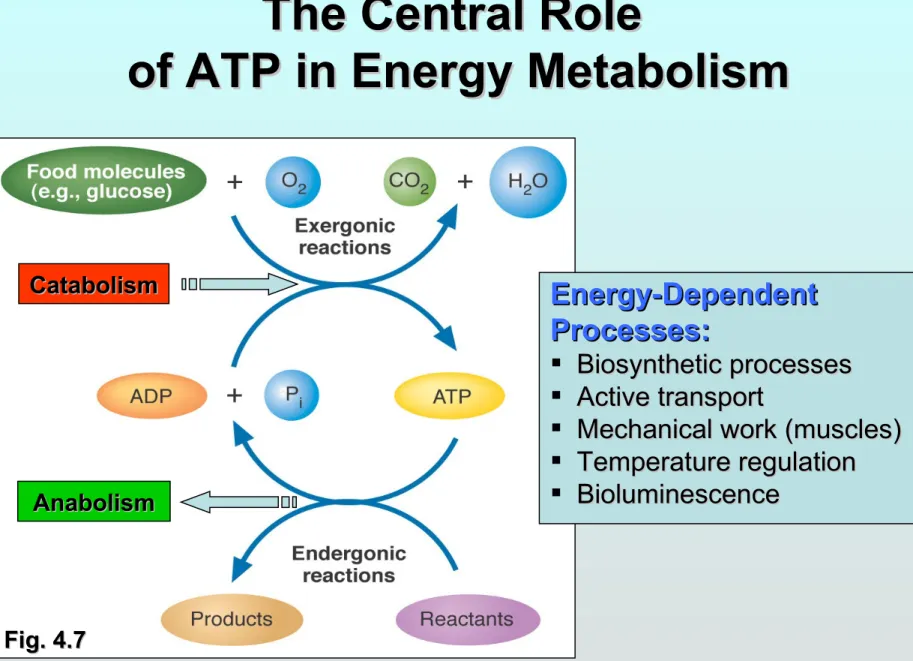
The Central Role
The Central Role
of ATP in Energy Metabolism
of ATP in Energy Metabolism
Fig. 4.7 Fig. 4.7
Catabolism Catabolism
Anabolism Anabolism
Energy-Dependent
Energy-Dependent
Processes:
Processes:
Biosynthetic processesBiosynthetic processes
Active transport Active transport
Mechanical work (muscles)Mechanical work (muscles)
Temperature regulationTemperature regulation
A Closer Look at the Structure of
A Closer Look at the Structure of
Adenylate Nucleotides (ATP)
Adenylate Nucleotides (ATP)
High Energy Bonds
High Energy Bonds
Group Leaving Potential
Group Leaving Potential
Energy (
Energy (
G) of Hydrolysis
G) of Hydrolysis
(
(
= easily broken) = easily broken)19
Energy of Hydrolysis
Energy of Hydrolysis
of Key Phosphorylated Biomolecules
of Key Phosphorylated Biomolecules
Reaction
Reaction
G (Kcal/mole)
G (Kcal/mole)
AMP
AMP Ade + P Ade + Pi i
Glucose-6-phosphate Glucose-6-phosphate Fructose-6-phosphate Fructose-6-phosphate
ATP
ATP ADP + P ADP + Pi i ATP
ATP AMP + P AMP + Pi i PPii ADP
ADP AMP + PAMP + Pii P
Pi i PPii 2 P 2 Pi i
Phosphocreatine Phosphocreatine
Glycerate-Glycerate-11,3-bisphosphate,3-bisphosphate Carbamoyl phosphate
Carbamoyl phosphate Phosphoenolpyruvate Phosphoenolpyruvate
– – 1.51.5 – – 3.33.3 – – 3.83.8 – – 7.37.3 – – 7.67.6 – – 6.56.5 – – 8.08.0 –
– 10.310.3 –
– 11.811.8 –
– 12.312.3 –
– 14.814.8
(Modified from Table 4.1) (Modified from Table 4.1)
(Phosphocreatine) (Phosphocreatine)
Significance of
Significance of
“
“
G
G
”
”
“
“
G
G
”
”
Gibbs Free Energy
Gibbs Free Energy
The energy difference before and The energy difference before and after a process or reaction occurs. after a process or reaction occurs.
G
G
°
°
= G
= G
22– G
– G
11If
If
G is
G is
“
“
+
+
”
”
Input of energy is required.Input of energy is required. Reactions are Reactions are ““unfavorableunfavorable””..
If
If
G is
G is
“
“
-
-
”
”
Energy is given off.Energy is given off.
Reactions are Reactions are ““favorablefavorable”” (or (or spontaneous).
spontaneous).
G
G11
G
G22
T ot al E ne rg y (G ) T ot al E ne rg y (G )
Progress of Reaction
21
Implications of
Implications of
G
G
Reactions with more negative Reactions with more negative G give off more energy.G give off more energy.
Energy given off (-Energy given off (-G) can be used to do G) can be used to do ““workwork””..
Reactions with large -Reactions with large -G can be coupled to those with G can be coupled to those with +
+ G to promote unfavorable reactionsG to promote unfavorable reactions
Reaction
Reaction
G (Kcal/mole)
G (Kcal/mole)
Glucose-6-phosphate Glucose-6-phosphate ATP
ATP ADP + P ADP + Pi i
Phosphoenolpyruvate Phosphoenolpyruvate
– – 3.33.3 – – 7.37.3 –
– 14.814.8
Cyclic Nucleotides
Cyclic Nucleotides
Second Messengers in Signal Cascades
Second Messengers in Signal Cascades
Second Messenger
Second Messenger
A short-lived intracellular chemical
A short-lived intracellular chemical
signal molecule that relays a
signal molecule that relays a
message (stimulus) from an external
message (stimulus) from an external
“
“first messengerfirst messenger””. This relay typically . This relay typically results in a cascade of events leading
results in a cascade of events leading
to a marked amplification of the first
to a marked amplification of the first
messenger.
messenger.
First Messengers:
First Messengers: Hormones, Hormones, neurotransmitters
neurotransmitters
Second Messengers:
Second Messengers: Ca Ca2+2+ ions, ions,
inositol-Pi
inositol-Pi33, diacylglycerol, , diacylglycerol, cyclic cyclic nucleotides
nucleotides..
Fig. 16.2 (An amplified enzyme cascade).
How is cAMP formed?
How is cAMP formed?
23
AMP---24
Cyclic AMP & Cyclic GMP
Cyclic AMP & Cyclic GMP
Second Messengers in Signal Cascades
Second Messengers in Signal Cascades
Adenylate Cyclase
Adenylate Cyclase
ATP → cAMP + PPi
ATP → cAMP + PPi
cAMP is involved in cAMP is involved in manymany signal signal cascades.
cascades.
hormone signaling (e.g. hormone signaling (e.g.
adrenaline, glucagon), apoptosis, adrenaline, glucagon), apoptosis, disease reactions, neuron function. disease reactions, neuron function.
Guanylate Cyclase
Guanylate Cyclase
GTP → cGMP + PPi
GTP → cGMP + PPi
cGMP is involved in nitric oxide cGMP is involved in nitric oxide (NO) signaling.
(NO) signaling.
25
cAMP-Mediated Signal Transduction
cAMP-Mediated Signal Transduction
Recap--Nucleotides
27
DNA Structure: Variations
DNA Structure: Variations
on a Theme
on a Theme
Watson and Crick’s
discovery is referred to as
B-DNA (sodium salt)
Another form is the
A-DNA, which forms when
RNA/DNA duplexes form,
and due to low hydration
Z-DNA (zigzag
conformation) is
left-handed DNA that can form
as a result of torsion
during transcription
Figure 17.12 A-DNA, B-DNA, and Z-DNA
33
Griffith Experiment
Griffith Experiment
Transformation of
one strain by
another
Two strains of
bacteria
R—harmless (1)
S—deadly (2)
Heat killed S is also
‑
harmless (3)
Heat killed S makes R
‑
Avery, MacLeod, and McCarty
Avery, MacLeod, and McCarty
Used the same assay system
Used the same assay system
–
Isolated compounds from Strain S
Isolated compounds from Strain S
–
Added these to Strain R
Added these to Strain R
Only DNA
Only DNA
transformed Strain R, ie, only isolated
transformed Strain R, ie, only isolated
DNA from strain S could make strain R harmful,
DNA from strain S could make strain R harmful,
NOT PROTEINS.
Hershey and Chase experiment
Hershey and Chase experiment
41
Study Questions / Objectives
Study Questions / Objectives
1.
1. Identify and/or describe the molecular components of nucleotides and Identify and/or describe the molecular components of nucleotides and nucleic acids, including distinctions between purines & pyrimidines, nucleic acids, including distinctions between purines & pyrimidines, nucleosides vs. nucleotides, DNA vs. RNA.
nucleosides vs. nucleotides, DNA vs. RNA. 2.
2. Exemplify & describe the occurrence and/or function of nitrogenous Exemplify & describe the occurrence and/or function of nitrogenous bases and related derivatives that are not part of nucleic acids.
bases and related derivatives that are not part of nucleic acids. 3.
3. Describe the role and relative energy yields of ATP and its derivatives Describe the role and relative energy yields of ATP and its derivatives (including other phosphorylated metabolites) in energy metabolism, and (including other phosphorylated metabolites) in energy metabolism, and the significance of
the significance of ““G”G”.. 4.
4. Briefly describe the role or importance of cyclic nucleotides( cAMPand Briefly describe the role or importance of cyclic nucleotides( cAMPand cGMP) in cell signaling.
cGMP) in cell signaling. 5.
5. Describe how a phosphodiester bond is formed?Describe how a phosphodiester bond is formed? 6.
6. How does a DNA chain grow in the 5’-3’ direction?How does a DNA chain grow in the 5’-3’ direction? 7.
7. Describe Griffith, Avery/McLoed/Mccarthy, and Hershey& Chase’s Describe Griffith, Avery/McLoed/Mccarthy, and Hershey& Chase’s