Materials Science and Engineering Publications
Materials Science and Engineering
6-24-2010
Thermodynamic limits of crystallization and the
prediction of glass formation tendency
Yongxin Yao
Iowa State University, [email protected]
Ralph E. Napolitano
Iowa State University, [email protected]
Cai-Zhuang Wang
Iowa State University, [email protected]
Kai-Ming Ho
Iowa State University, [email protected]
Follow this and additional works at:
http://lib.dr.iastate.edu/mse_pubs
Part of the
Condensed Matter Physics Commons
,
Engineering Physics Commons
, and the
Materials Science and Engineering Commons
The complete bibliographic information for this item can be found at
http://lib.dr.iastate.edu/
mse_pubs/119
. For information on how to cite this item, please visit
http://lib.dr.iastate.edu/
howtocite.html
.
Thermodynamic limits of crystallization and the prediction of glass
formation tendency
Abstract
We have calculated the T0 curves for several Al-rare-earth binary alloys to assess the importance of the
transport-based resistance to crystallization in the overall glass formation process and the general effectiveness
of thermodynamic prediction of glass-forming ability. Our results show that the experimentally observed
glass-forming compositions for Al-(Ce, Gd, Ho, Nd, Y, Dy) alloys strongly correlate with the composition
range bounded by the T0curves associated with the relevant crystalline phases. This indicates that sluggish
material transport, together with the tendency for clustering and other types of ordering at medium-range
scale, is a key factor governing glass formation in these systems.
Keywords
Ames Laboratory, Physics and Astronomy
Disciplines
Condensed Matter Physics | Engineering Physics | Materials Science and Engineering
Comments
This article is from
Physical Review B
81 (2010): 212202, doi:
10.1103/PhysRevB.81.212202
.
Thermodynamic limits of crystallization and the prediction of glass formation tendency
Yongxin Yao,1 R. Napolitano,2C. Z. Wang,1and K. M. Ho1
1Ames Laboratory, USDOE and Department of Physics, Iowa State University, Ames, Iowa 50011, USA
2Ames Laboratory, USDOE and Department of Materials Science and Engineering, Iowa State University, Ames, Iowa 50011, USA
共Received 16 April 2010; revised manuscript received 4 June 2010; published 24 June 2010兲 We have calculated theT0 curves for several Al-rare-earth binary alloys to assess the importance of the transport-based resistance to crystallization in the overall glass formation process and the general effectiveness of thermodynamic prediction of glass-forming ability. Our results show that the experimentally observed glass-forming compositions for Al-共Ce, Gd, Ho, Nd, Y, Dy兲 alloys strongly correlate with the composition range bounded by theT0 curves associated with the relevant crystalline phases. This indicates that sluggish material transport, together with the tendency for clustering and other types of ordering at medium-range scale, is a key factor governing glass formation in these systems.
DOI:10.1103/PhysRevB.81.212202 PACS number共s兲: 61.43.Dq, 05.70.⫺a, 61.43.Fs, 82.60.Lf
Metallic alloys which resist crystallization in their under-cooled states sufficiently well to become amorphous solids or “metallic glasses” have emerged as a very interesting and potentially useful class of materials. However, the criteria for glass formation in metallic systems are still poorly under-stood. Unlike traditional topological or network glass sys-tems where structural frustration promotes the formation of the glass state, metallic glasses are only found in multicom-ponent alloy systems. This indicates that restriction of mate-rial transport is a dominant factor in the glass formation pro-cess.
To date, a great deal of effort has been concentrated on共i兲 the quantification of the diverse and unusual physical and mechanical properties afforded by glass-forming metallic al-loys,共ii兲the identification of compositional ranges that give rise to amorphous solids in various alloy systems, and 共iii兲 the development of alloys and processing techniques capable of yielding glassy alloys in quantities or geometries that per-mit engineering application, i.e., “bulk” metallic glasses. A number of excellent reviews1–3are available, and we forego a comprehensive discussion of these topics here.
More fundamentally, considerably less effort has been de-voted to understand the thermodynamic and kinetic implica-tions of the glassy state exhibited by many metallic systems. Differing substantially from the more common oxide glasses, where directional bonding constraints may lead to static glassy network structures, glass formation in metallic sys-tems cannot be reasonably justified in terms of simple topo-logical considerations. Clearly, the transition to the glassy state in a metallic system must be described as kinetic in nature, where relaxation to an energetically favorable crys-talline state becomes sufficiently sluggish to effectively pre-vent its existence. Thus, the fundamental question to be an-swered with regard to this transition is “what are the critical kinetic contributors which limit the crystallization process in a metallic system, and how are these influenced by tempera-ture and chemical composition?” Indeed, a substantial amount of work has been reported pursuant to the second part of this question, and composition ranges where glass formation is practically achievable have been experimentally determined for a number of metallic systems. However, the more fundamental, first part of the question has not been sufficiently addressed, and the suppression of structural and
chemical relaxation processes contributing to the kinetic transition have not been distinguished or well described.
Following the earliest observations of amorphous or “glassy” phase formation, reported in 1960 for a rapidly quenched Au-Si alloy4 and in 1965 for a Pd-Si alloy,5 re-searchers looked to quantify the inherent glass formation ten-dency, commonly termed glass-forming ability 共GFA兲, for metallic systems. Various relationships were proposed, sug-gesting that parameters such as the melting temperature, the cohesive energy, the Debye temperature, the reduced liqui-dus temperature, and linear combinations of pure component melting temperatures may correlate with the glass transition temperature, Tg.6–11 Such correlations offered only limited utility but reasonable success was achieved for several sys-tems through the use of GFA maps constructed with two thermodynamic parameters. For example, Giessen and Whang12 compared the GFA for several binary alloys by plotting the heat of formation for the liquid phase versus the atomic radius ratio of the two alloy components. Also, plots of reduced liquidus temperature关TLR=共T¯L0−TL兲/T¯L0, whereTL is the liquidus temperature andT¯L0is a linear combination of the pure component melting temperatures兴 versus reduced eutectic composition 关共Ce−Cs兲/Ce, whereCe is the eutectic composition and Cs is the solidus composition for the solvent-rich phase at the eutectic temperature兴 were em-ployed by Whang13to compare the GFA for Ti, Zr, Si, and Al alloys.
Work by Luet al.14 suggests that the reduced glass tran-sition temperature共Trg=Tg/TL兲may be a reasonable indica-tor of the GFA in Zr, La, Mg, Pd, and rare-earth alloys 共all containing at least three components兲while other experimen-tal reports suggest that the freezing range, ⌬Txg, is a more reliable indicator in several multicomponent Fe-based, Mg-based, and Pd-Ni-based alloys.15–19 Lu and Liu20 examined this issue and proposed a parameter, defined as ␥=Tx/共Tg +TL兲, that describes the ease of devitrification for a metallic glass and correlates with GFA better than bothTrgand⌬Txg. They go on to relate this parameter to a critical-cooling rate, Rc, and an associated critical section thickness.20,21
Beyond these rudimentary correlations, several ap-proaches have been used for describing the behavior of un-dercooled metallic liquids and predicting glass formation in PHYSICAL REVIEW B81, 212202共2010兲
metallic alloys.22 Beginning with Cohen and Turnbull23 in 1959, free volume theories have been used with reasonable success to describe some aspects of molecular motion and the associated glass transition.8,23–25 Continuum mode-coupling theories26,27 have been useful in describing high-temperature behavior of liquids but these break down at lower temperatures where atomistic mechanisms become im-portant for transport processes.22Egami used local topologi-cal considerations to explain how the glass transition may occur at the nanoscale, giving rise to glassy clusters.22 By modifying a treatment for oxide glasses, Takeuchi and Inoue28 calculated critical-cooling rates,Rc, for glass forma-tion in Ni-, Co-, and Pd-Cu-based alloys, showing a dramatic reduction inRcwith increasingly negative enthalpy of mix-ing in the liquid and with increasmix-ing atomic radius mismatch. Fecht and Johnson29 have summarized the requirements for the formation of bulk metallic glasses共i.e.,Rcⱖ1 K/s兲with the following five conditions: 共i兲 steep liquidus boundaries meeting at a low-temperature eutectic,共ii兲atomic radius mis-match⬎15%, 共iii兲 reduced driving force for crystallization,
共iv兲Trg⬎0.65, and 共v兲 complete miscibility in the liquid at the relevant temperatures. While structural “confusion” must play a role in suppressing the kinetics of crystallization,3 these general conditions suggest that observed glass forma-tion tendency is fundamentally linked to the thermodynamic properties of the system.
In this Brief Report, we use Al-rare-earth共Al-RE兲alloys, which exhibit marginal glass-forming tendency, to examine the hypothesis that the dominant mechanism for confusion in metallic glass formation comes from the limitation of mate-rial transport at the compositional scale and that the reduced diffusional burden associated with partitionless crystalliza-tion provides a temporally competitive avenue for relaxacrystalliza-tion. Thus, theT0criterion represents both a fundamental thermo-dynamic and kinetic limit to the glass formation range. Re-cently the composition range bounded by the relevant T0 curves has been compared with glass-forming ability for
Al-La, Cu-Mg, and Al-Sm binary systems with good
agreement.30 Here we examine the general utility of theT 0 criterion by employing a solution thermodynamics approach to compute the chemical limits of partitionless crystallization for several Al-RE binary alloys, chosen because their glass formation compositions have been well characterized by ex-periment and because reported glass formation ranges devi-ate substantially from the eutectic composition. More spe-cifically, we calculate the T0 temperature as a function of composition共T0 is defined as the temperature for which the liquid phase and the crystalline phase have equal Gibbs free energies兲and assert that glass formation is unlikely for com-positions whereTg⬍T0, suggested by Boettinger31 since the partitioning and chemical transport requirements for crystal-lization vanish below this temperature.
TheT0calculations are performed using the calculation of phase diagrams共CALPHAD兲methodology, with missing pa-rameters generated by ab initio calculations. Thus, each phase is treated as a solution whose Gibbs free energy is expressed analytically over a certain composition and tem-perature range. In our treatment, binary solution phases are modeled with a single sublattice, with a molar Gibbs free energy given as
G⌽=共1 −x兲0GAl⌽+x0G⌽RE+RT关共1 −x兲ln共1 −x兲+xlnx兴
+xsG⌽, 共1兲
where 0Gi⌽ is the molar Gibbs free energy of the pure ele-ment in structure ⌽, taken from Dinsdale.32 The excess Gibbs free energy xsG⌽ is expressed as
xs
G⌽=共1 −x兲x
兺
j=0n j
LAl,⌽RE共1 − 2x兲 j
, 共2兲
where the jLAl,⌽RE interaction parameters take the form j
A⌽ +jB⌽T, including both enthalpic 共jA⌽兲 and entropic共−jB⌽兲 contributions to each mixing term.
Typically, binary intermetallic phases are described using a two-sublattice model, with each component occupying one sublattice without mixing. The Gibbs free energy has the form
GAlaREb=a 0G Al ⌽ +b 0G
RE
⌽ +AAl,RE
+BAl,RET, 共3兲
where AAl,RE and BAl,RE represent the enthalpy and entropy of formation for the stoichiometric AlaREbcompound. 共For the Al-REalloys studied in this Brief Report, the coefficients A and B are taken from Refs. 33–35. Some of the model coefficients have been tested in ternary systems.34,35兲
We treat the intermetallic phases as solutions, rather than simple stoichiometric compounds assumed in usual CALPHAD calculations. We approximate the Gibbs free en-ergy of the intermetallic solution as
GAl共1−x兲REx
=共1 −x兲0GAl⌽ +x0GRE⌽ +⌬HAl1−x REx
, 共4兲
where the formation enthalpy is estimated by interpolating ab initiototal-energy calculation results for alloys at selected nearby compositions. We ignore the formation entropy, as-suming that its contribution is relatively small in the tem-perature range where the metallic glasses usually form. In fact, for all the intermetallic compounds under investigation, the contribution of the formation entropy is one order smaller than that of formation enthalpy near 500 K, based on fitted experimental data. Furthermore, the formation entropy is negative in all the intermetallic compounds investigated, which would only raise the corresponding intermetallic Gibbs free energy at the particular composition, forcing the T0curve to be steeper. This would not affect our conclusions. The first-principles calculations were done using VASP
共Ref. 36兲 with a plane-wave basis set. Projector-augmented wave potentials37 were employed and the exchange-correlation potential was based on the generalized gradient corrections by Perdew et al.38
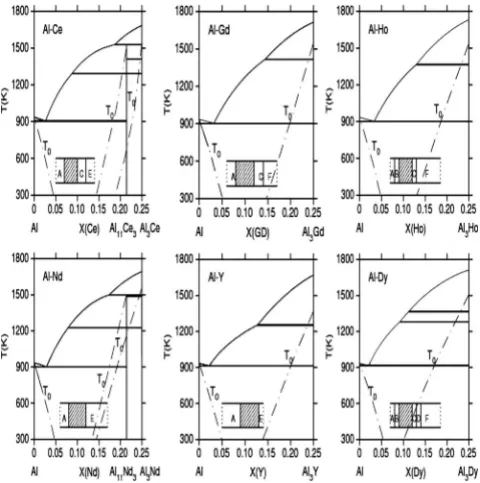
The calculatedT0curve results, plotted with the truncated Al-rich part phase diagrams for Al-Ce, Al-Gd, Al-Ho, Al-Nd, Al-Y, and Al-Dy, are shown in Fig. 1. The compositional dependence of structure for the corresponding rapidly solidi-fied Al-REbinary alloys are also shown as insets. Two right-side T0 curves are shown for Al-Ce and Al-Nd since there exist two competing phases with similar compositions. The shaded regions are the experimentally observed glass-forming composition ranges.2 Though the glass transition temperature,Tg, is not given, it is reasonable to assume that it is above 300 K. Down to 300 K, the partitioning zone
BRIEF REPORTS PHYSICAL REVIEW B81, 212202共2010兲
defined as the composition range bounded by the relevantT0 curves matches very well with the experimentally observed glass-forming range. For comparison, GFA predicted byTrg and TLR is peaked around the eutectic composition while Takeuchi’s Rc criterion28 favors the composition near 40 at. % of RE. Thus only ourT0 criterion gives a reason-able prediction in the systems investigated here. We empha-size that this crucial result should not be very sensitive to model thermodynamic parameters in use. Only Gibbs free-energy function values are needed to determineT0curves. In contrast, the calculation of equilibrium phase diagram in-volves the common tangent construction, where the deriva-tives of the Gibbs free-energy functions are used. Thus the error in determining theT0curve is much smaller than that in the usual phase diagram calculation. Therefore some varia-tion in theT0curves due to the inaccuracy of the fitted Gibbs free-energy functions will not affect our main conclusion. It should also be pointed out that the above-mentioned Trg, ⌬Txg, and␥criteria are generally not useful for GFA predic-tionsinceTgandTxare unknown for new systems, although GFA could still be predicted by assuming that the composi-tional dependence is dominated byTL.
Considering that partitionless crystallization requires only short-range atomic motion and that such a transition may occur at extremely high rates,39 we view the T
0 criterion as an upper bound 共i.e., a zero-driving force兲temperature limit for partitionless crystalline solidification, and, therefore, view the two relevant T0 curves in an eutectic system as operational inner bounds for the glass formation range. Ac-cordingly, we offer the present analysis as a means for
as-sessing the importance of chemical partitioning in the resis-tance to crystal phase formation. Instead of the traditional eutectic composition, around which it is often presumed that the glass-forming ability is particularly high, our results sug-gest that the partitioning range, bounded by the T0 curves, may offer a more relevant thermodynamic criterion for me-tallic glass formation tendency. It is interesting to note that the partitioning ranges for the systems we investigated here are all clearly off the eutectic compositions. Our theoretical predictions agree well with experiment that glass-forming ranges have been generally shifted to hypereutectic compo-sitions.
Indeed the concept of purely thermodynamic criteria for glass formation is not a new one.40However, theT
0criterion for metallic glass formation has not been thoroughly inves-tigated partly because previous solution-based models have not been adequate for accurate prediction of theT0 tempera-ture for metallic alloys. Our present study demonstrates that by combining a CALPHAD approach with first-principles methods for reliable computation of energies, more accurate and comprehensive description of alloy phases can be achieved.
While rudimentary thermodynamic treatments have shown promise in this regard, it should be noted that the above analysis does not account for the kinetics of partition-less solidification. Several investigators have combined ther-modynamic models with models for crystallization kinetics to assess critical-cooling rates41 and composition ranges for glass formation.40,42Zhuet al.43,44incorporated existing ther-modynamic treatments into analytical kinetic models to quantify nucleation and growth rates as a function of alloy composition for four Al-REalloys. In each case, they assume equilibrium chemical partitioning and compute the time 共兲 required for transformation of a “minimal” 共10−6兲 volume fraction as a function of composition. For the Al-Ce and Al-Gd systems, their results for T= 500 ° C show a strong correlation between long transformation times and experi-mental observation of glass formation. Less agreement is ob-served for Al-Y and rather poor agreement for Al-Nd. The good agreement between our results based on simpleT0 con-siderations with these more elaborate calculations and the observed experimental glass formation compositions indi-cates that the dominant factor affecting glass formation is the limitation of material diffusion in the liquid in these systems. If this premise, supported here by our results for several Al-REalloys, turns out to be true for a large class of mate-rials, favorable glass formation composition ranges could be estimated using purely thermodynamic models. Extension of our calculations into alloys with more components would be very interesting to test this hypothesis.
In conclusion, while accurate modeling of crystallization kinetics will ultimately be essential for reliable prediction of glass formation tendency over wide ranges of composition, it is scientifically prudent to examine, more completely, the implications of thermodynamic treatments before attempting to apply rigorous kinetic models. Indeed, any reliable kinetic treatment must include accurate thermodynamic descriptions of the relevant phases, including the undercooled liquid, and must account for the formation of the crystalline phase共s兲 over a continuous range of permissible compositions. More-FIG. 1. Calculated T0 curves with the truncated Al-rich part
phase diagrams for Al-Ce, Al-Gd, Al-Ho, Al-Nd, Al-Y, and Al-Dy. Inset: compositional dependence of structure in the corresponding rapid solidified Al-REbinary alloys taken from Ref.2. Shaded re-gions: amorphous, A: Al solid solution, B: amorphous+ Al, C: amorphous+X 共unidentified phase兲, D: Al+X共unidentified phase兲, E : Al+ Al11RE3, and F : Al+ Al3RE.
BRIEF REPORTS PHYSICAL REVIEW B81, 212202共2010兲
[image:5.609.53.293.68.309.2]over, we must recognize that relaxation kinetics are inte-grally linked to the phenomenon of phase selection itself and that the composition of the crystalline phase is a degree of freedom that nature may explore in her quest for more effi-cient transitions. Thus theT0serves as a clearly defined and calculable value representing a transition point in the balance between high and low transport requirements, where nature may choose to pay the energetic penalty associated with non-equilibrium partitioning or even completely diffusionless crystallization. From a temporal viewpoint, theT0 condition defines a completely partitionless limit to this behavior where the requirement for long-range diffusion vanishes; i.e., it provides a limit in multicomponent systems beyond which the kinetics mimic that of single-component systems for which no glassy solids have been observed. Consistent with the Al-RE and several other glass-forming systems,1–3 we note that the region bounded by the relevant T0 curves is quite naturally shifted toward the intermetallic phase, exhib-iting the most severe increase in Gibbs free energy as phase
composition moves away from the equilibrium value. Thus, the observed hypereutectic shift in the Al-REalloys can be attributed to the strong stoichiometric nature of the interme-tallic phases, as compared to the Al共fcc兲solution phase. We offer this simple criterion here as a fundamental limit in terms of both system thermodynamics 共⌬G= 0兲 and system kinetics, asserting that accurate calculation of such limits should precede more convoluted treatments, where the natu-ral selection of the dynamical transformation path, itself, be-comes a critical variable.
We are grateful to M. J. Kramer and J. Schmalian for many useful discussions and valuable suggestions. Work at the Ames laboratory was supported by the U.S. Department of Energy, Office of Basic Energy Science, including a grant of computer time at the National Energy Research Super-computing Center 共NERSC兲 at the Lawrence Berkeley
National Laboratory under Contract No.
DE-AC02-07CH11358.
1A. Inoue and A. Takeuchi,Mater. Trans. 43, 1892共2002兲. 2A. Inoue,Prog. Mater. Sci. 43, 365共1998兲.
3A. L. Greer,Science 267, 1947共1995兲.
4W. Klement, R. H. Willens, and P. Duwez,Nature共London兲 187,
869共1960兲.
5P. Duwez, R. H. Willens, and R. C. Crewdson,J. Appl. Phys. 36,
2267共1965兲.
6M. Marcus and D. Turnbull,Mater. Sci. Eng. 23, 211共1976兲. 7I. W. Donald and H. A. Davies, J. Non-Cryst. Solids 30, 77
共1978兲.
8D. Turnbull and M. H. Cohen,J. Chem. Phys. 34, 120共1961兲. 9W. Kauzmann,Chem. Rev. 43, 219共1948兲.
10D. Turnbull,Contemp. Phys. 10, 473共1969兲.
11H. A. Davies and B. G. Lewis,Scr. Metall. 9, 1107共1975兲. 12B. C. Giessen and S. H. Whang, J. Phys. Colloq. 41, C8-95
共1980兲.
13S. H. Whang,Mater. Sci. Eng. 57, 87共1983兲.
14Z. P. Lu, Y. Li, and S. C. Ng, J. Non-Cryst. Solids 270, 103
共2000兲.
15A. Inoue, T. Zhang, and T. Masumoto,J. Non-Cryst. Solids
156-158, 473共1993兲.
16T. D. Shen, Y. He, and R. B. Schwarz,J. Mater. Res. 14, 2107
共1999兲.
17T. D. Shen and R. B. Schwarz,Appl. Phys. Lett. 75, 49共1999兲. 18B. S. Murty and K. Hono, Mater. Trans., JIM 41, 1538共2000兲. 19A. Inoue, W. Zhang, T. Zhang, and K. Kurosaka,Acta Mater. 49,
2645共2001兲.
20Z. P. Lu and C. T. Liu,Acta Mater. 50, 3501共2002兲. 21Z. P. Lu and C. T. Liu,Phys. Rev. Lett. 91, 115505共2003兲. 22T. Egami,Mater. Trans., JIM 43, 510共2002兲.
23M. H. Cohen and D. Turnbull,J. Chem. Phys. 31, 1164共1959兲. 24D. Turnbull,J. Chem. Phys. 52, 3038共1970兲.
25A. I. Taub and F. Spaepen,Acta Metall. 28, 1781共1980兲. 26J. Jackle,Rep. Prog. Phys. 49, 171共1986兲.
27W. Gotze and L. Sjogren,Rep. Prog. Phys. 55, 241共1992兲. 28A. Takeuchi and A. Inoue, Mater. Sci. Eng., A 304-306, 446
共2001兲.
29H. J. Fecht and W. L. Johnson, Mater. Sci. Eng., A 375-377, 2
共2004兲.
30S. H. Zhou and R. E. Napolitano,Acta Mater. 54, 831共2006兲;J.
Phase Equilib. Diffus. 28, 328共2007兲;Phys. Rev. B 78, 184111
共2008兲.
31W. J. Boettinger, Rapidly Solidified Amorphous and Crysalline
Alloys, MRS Symposia Proceedings No. 8共Materials Research Society, Pittsburgh, 1982兲, p. 15.
32A. T. Dinsdale,CALPHAD: Comput. Coupling Phase Diagrams
Thermochem. 15, 317共1991兲.
33G. Cacciamani and R. Ferro, CALPHAD: Comput. Coupling
Phase Diagrams Thermochem. 25, 583共2001兲.
34G. Cacciamani, S. De. Negri, A. Saccone, and R. Ferro,
Inter-metallics 11, 1135共2003兲.
35J. Gröbner, H.-L. Lukas, and F. Aldinger,J. Alloys Compd. 220,
8共1995兲.
36Vienna ab initio simulation package. G. Kresse and J. Hafner,
Phys. Rev. B 47, 558共1993兲; G. Kresse and J. Furthmuller,ibid.
54, 11169共1996兲.
37G. Kresse and D. Joubert,Phys. Rev. B 59, 1758共1999兲. 38J. P. Perdew, K. Burke, and M. Ernzerhof,Phys. Rev. Lett. 77,
3865共1996兲.
39M. J. Aziz and W. J. Boettinger, Acta Metall. Mater. 42, 527
共1994兲.
40P. Nash and R. B. Schwarz,Acta Metall. 36, 3047共1988兲. 41D. R. Uhlmann,J. Non-Cryst. Solids 7, 337共1972兲.
42N. Saunders and A. P. Miodownik,J. Mater. Res. 1, 38共1986兲. 43A. Zhu, S. J. Poon, and G. J. Shiflet, Scr. Mater. 50, 1451
共2004兲.
44A. Zhu, G. J. Shiflet, and D. B. Miracle, Scr. Mater. 50, 987
共2004兲.
BRIEF REPORTS PHYSICAL REVIEW B81, 212202共2010兲