DOI: 10.22192/iajmr.2019.5.6.5
Indo – Asian Journal of Multidisciplinary Research
(IAJMR)
ISSN: 2454-1370
PROBLEMS WITH SCHOOLING OF SYRIAN IMMIGRANTS
(Sample of Turkey)
Fethi Kayalar*
Faculty of Education, Erzincan B. Y. University, Turkey
Abstract
The wars are destroying the habitable places through the destruction that the wars cause to the local economy and social life. As a natural consequence of this, mass migrations occur and the places that are thought to be lived may lose the identity of being livable even for those living there. The economic and social problems created by the migrations are deepened depending on the period of migration, thus other problems such as education and health are added to these problems. Turkey's geographical location makes the adventure of migration necessary. Due to the unstable management and internal conflicts in some neighbour countries such as Iraq and Syria, a density of population movements towards Turkey has been observed and experienced. The Turkish state has opened its doors to refugees from the Balkans as well as from Iraq and Syria due to the war. In the study, we tried to determine the problems with schooling of Immigrant children, as approximately half of the immigrant students are not registered to the schools and their parents are indifferent to this matter. In the light of the documents that we obtained from Migration Office in Turkey, we found out that the immigrant students have difficulty in learning Turkish Language as it is the only formal language in schools, the immigrant students in big cities are not easily admitted to the school, for native students have to take compulsory education and the capacities of the schools are accorded to the native students, immigrant students have orientation problems, as the education system in Turkey is totally different from that of Syria.
Key words Schooling, Immigrant students, Educational Right, Educational management and Syrians.
1. Introduction
Since the beginning of social life in human history, the concepts of asylum, refuge and immigration have gradually become an integral part of life (Börü and Boyacı, 2016; Göksu and Kayalar, 2018; Kayalar, Güler and Kayalar, 2018). In the twentieth century, the destruction of wars increased in a way that cannot be compared to the previous century, and the destruction and human dramas have increased on a large scale. In parallel, the fact that millions of refugees and asylum seekers find
*Corresponding author: Dr. Fethi Kayalar
E.mail: [email protected]
Received: 15.10.2019; Revised: 18.11.2019;
Accepted: 20.12.2019.
a country where they can live under more
humanitarian conditions without fear of
persecution has become an important test for the international community and international law. Filling the concepts of refugees and asylum seekers, which outweigh the human dimension and dramas, has become not a duty of a single country but of the international communityor the international legal system because of the enormous dimension of the problem.
and countries. In order to find a solution to this humanity problem in Europe, the international community signed the Geneva Convention on the Legal Status of Refugees in 1951 in order to find a solution to the drama of the refugees. This is a Convention to find solutions to the problem of refugees on the European continent. In the following years, its scope was expanded with some protocols. In the continent as a result of the continuous wars such as 100 year wars, 30 year wars, 7 year wars, European countries decided to end the pain and to make a "new beginning" in 1945. In doing so, however, they signed the above-mentioned 1951 Convention through the UN to eliminate the humanitarian destruction caused by the War and to find a solution to the refugee crisis, one of the grave consequences of the War. After this date, Europe is trying to maximize its national interests in different regions of the world by means of proxy wars to the maximum extent by keeping war geography as far away from the European continent as possible. As a matter of fact, the proxy war strategy played by global powers, including European countries, plays an important role in the growth of the Syrian civil war (Özcan, 2016).
The wars are destroying the inhabitable places through the destruction that the wars cause to the local economy and social life
(Orhan and Coşkun, 2016). As a natural consequence of this, mass migrations occur and the places that are thought to be lived may lose the identity of being liveable even for those living there. The economic and social problems created by the migrations are deepened depending on the period of migration, thus other problems such as education and health are added to these problems. In fact, the war in Syria, which can be defined as the cause of the recent mass migration, has added a political link to the phenomenon of migration. The resulting large-scale migration wave has turned into a political argument which can be used against Turkey and the European Unity. Turkey tried to resist this wave of migration to Turkey, while more concerned about the growth, EU countries are not inclined to accept even small groups, and they are engaged in political manoeuvring to accommodate the immigrantsin the territory of Turkey.
2. Syrian Immigrants in Turkey
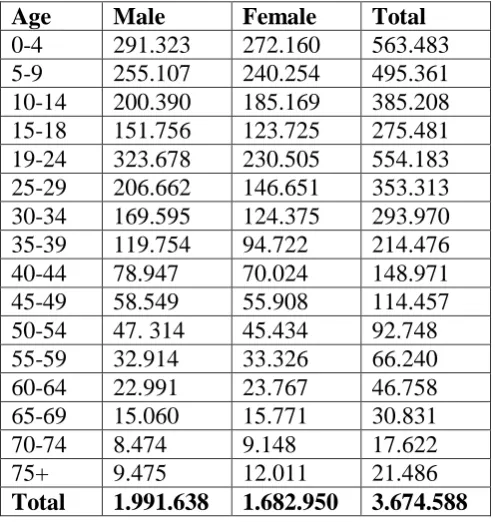
The number of registered Syrians in Turkey as of October 10, 2019 is 3.674.588. 1.991.638 of these people are male, 1.682.950 female. Table 1 indicates the number of total Syrian immigrants in terms of age and gender (Mülteciler Derneği, 2019).
Table - 1: The number of the Syrian Immigrants in terms of Age and Gender
Age Male Female Total
0-4 291.323 272.160 563.483
5-9 255.107 240.254 495.361
10-14 200.390 185.169 385.208
15-18 151.756 123.725 275.481
19-24 323.678 230.505 554.183
25-29 206.662 146.651 353.313
30-34 169.595 124.375 293.970
35-39 119.754 94.722 214.476
40-44 78.947 70.024 148.971
45-49 58.549 55.908 114.457
50-54 47. 314 45.434 92.748
55-59 32.914 33.326 66.240
60-64 22.991 23.767 46.758
65-69 15.060 15.771 30.831
70-74 8.474 9.148 17.622
75+ 9.475 12.011 21.486
46.79 % of Syrians in Turkey are in the 0-18 age range.
According to the age range table, there are 1.719.533 Syrians in the 0-18 age range.
The number of Syrians under 10 is
1.058.844.In other words, 28.81% of Syrians are under 10 years old.
The total number of women between the
ages of 0-18 is 2.581.175.
This number corresponds to 70.24 % of the
total number of Syrians.
Young Syrian Population Rate
There are 829.664 people in the 15-24 age
range defined as young population.
The ratio of young Syrian population to the total number of Syrians is 22.57 %.
Turkey's young population ratio is 15.8 %.
Average Age of Syrians
Average age of registered Syrians by age table is 22.13.
The average age of the population of Turkey
according to 2018 data 31.7.
The number of Syrian men is higher than that of women.
According to the table, the number of Syrian men is 308.688 more than the number of Syrian women.
The biggest difference between the number of men and women is between 19-24 years with 93.173 people.
This difference decreases as the number of age increases.
It is seen that the number of women in the age ranges above 55 is more than men.
The number of registered Syrians has
increased by 51.396 since December 31, 2018.
Number of Syrians Living in Camps (Temporary Accommodation Centres)
As of 10 October 2019, the number of
Syrians staying in the temporary
accommodation centres was announced to be 63.148.
This number was 63.187 people in
September 2019.
143,558 people at the beginning of 2019. At
the beginning of 2018, there were 228.251 people.
Accordingly, the number of Syrians living in the camps decreased by 80.410 in the first 10 months of 2019.
Only 1.71 % of Syrians live in camps.
Number of Syrians Living in Cities
As of 10 October 2019, the number of
Syrians living in the cities was 3 million 611.440.
The number of Syrians living in cities increased by 8,568 compared to the previous month.
98.29% of Syrians live in cities.
The migration administration decides in
which city the Syrians will live.
Some major cities, especially Istanbul, are closed to Syrian recruitment.
In recent years when the relations between Syria and Turkey are extremely tense, one of the important issues in the relations between the two countries that need to be settled down is Syrian citizens who have escaped from Civil War in Syria and immigrated to Turkey. Millions of people were forced to leave their homes in the Syrian Arab Republic in March 2011 as a result of flaring up conflicts and internal unrest.
citizens have no rights, and nor do they apply for asylum in a third country.
Providing training opportunities for asylum seekers by taking care of their language and culture differences as well as housing, health and food aid is of vital importance. Achieving this goal will prevent further difficulties in the future and will lead to a more healthy and problem-free relationship. It is a common opinion that the Syrian immigrants who settled in Turkey will not be able to return to their lands in a short time owing to the political instability and conflicts among ethnic groups in Syria. Accordingly, the Ministry of National Education decided not to admit students to temporary education centers after 2016. So, urgently Syrian children were planned to enroll in regular schools in Turkey. There were problems arising from the quality of education provided in temporary training centers. In these centers, only Turkish courses were given by Turkish teachers, while other courses were given by Syrian teachers. In the temporary training centers, the training program of Syria was implemented with some corrections and regulations. However, the training and teaching experiences of the Syrian teachers were not sufficient. As a result, instead of temporary training centers, the doors of formal schools were opened to Syrian children at school ages.
3. Education of Syrian Immigrants
From the first year when the immigrants came to Turkey, the Ministry of Education and Immigrant Office have worked on dealing with Syrian children to resume their education. As it was thought that the immigrants would return to their countries soon, the first step was to design temporary training centers under the leadership of other Non-Governmental Organizations (NGOs) so that they could resume their education by syrian teachers in Immigrants camps. These centers are primary and secondary education centers operating both inside and outside the camps, providing Arabic education by Syrian teachers adhering to the Syrian curriculum. These centers are very important in terms of compensating the interrupted education of children in emergencies. However, it is functional if Syrians return to their countries in a
short time. But the situation has changed as the civil war is still ongoing. After that, the functionality of temporary training centers decreased. Because the effect of temporary learning centers in Turkey is weak in terms of
compliance. The involvement of Syrian
immigrant students in Turkey's education system to adapt is inevitable.
Because the Syrians have been realized to be permanent in Turkey, Syrian children have been given the opportunity to study with native peers in public schools in Turkey. When we look at the immigration experiences in the world, it is seen that immigrant children are directly included in the schools where the language of the host country is adapted in order to adapt to the social, cultural and economic life of the country they go to. As a matter of fact, schools for immigrant children are not only places where they provide academic development, but also where socialization, integration and security are met. Thus, Syrian children to study with their peers in local public schools in Turkey is very important in terms of adaptation to the new environment.
According to the Ministry of National Education (MoNE) data, 595 thousand Syrian children are enrolled, of which 222,000 are in temporary education centers and 373,000 are in public schools. There are approximately 550 thousand school-age and 500 thousand Syrian children who are not attending school. The size of the number shows the importance of the steps to be taken in the field of education.
MoNE is working to ensure that Syrian children have access to education in public schools and for qualified education. The most important of these activities is the Project of Supporting the Integration of Syrian Children into the Turkish Education System with the EU. The project that has been carried out since October 2016 is funded by the EU to support Syrian refugees living in Turkey in terms of their health, psychosocial support, and education. This project includes some activities such as
teaching Turkish and Arabic languages,
compensation and support training courses,
transport services, providing educational
opportunities. In addition, in-service training is given to the teachers if they have Syrian students in their classroom. As a matter of fact, native teachers do not have the experience of teaching immigrant children whose mother tongue is different. For this reason, it is important to raise awareness of teachers about the education of refugee children and to provide and support professional development opportunities.
4. Conclusion
The most fundamental problem of the immigrants in Turkey, as in all the world, is the difference of language and alphabet (Güler Arı and Kayalar, 2016). Owing to the language problem, Syrian children cannot benefit from educational opportunities equally. Therefore, there is a need for professional collaborations on language education.
Secondly, there is a need for guidance training to raise awareness among all school staff, administrators, teachers, native students and parents who will take care of Syrian children and to increase their awareness and to avoid prejudice. Similarly Considering the immigrant children fleeing the war and going to a foreign country, it is essential to strengthen the school guidance to ensure their compliance with the training process and to improve these children's psychological trauma or other cases.
Thirdly, there is a need for informative studies on the educational processes so that the parents can give necessary help for their children. Lastly from the truth that there will be important actors both for the development of Turkey and for the reconstruction of Syria, there is a need for permanent, effective and efficient policies on immigrants’ education in order that immigrant children and youths at school age can get qualified education.
International community has often
expressed at every opportunity admirable and generous appreciation of the responsibilities that Turkey has undertaken in the face of crisis in Syria. However, the support of European Unity to relieve the burden of Turkey for Syrian immigrants is not enough. In addition, the fact that the international community focuses solely
on financial support and limits the aid to be material is also a matter to be criticized. As a matter of fact, there are not only financial barriers to the education of Syrian refugee children and youth. In addition, it is known to exist major problems such as teachers, physical
infrastructure, curriculum and educational
materials. Therefore, it is important for the
international community to take more
responsibility and contribute to a sustainable and quality education for Syrian immigrants.
5. References
1) Ağır, O and Sezik, M. (2015). Suriye’den Türkiye’ye Yaşanan Göç Dalgasından Kaynaklanan Güvenlik Sorunları, Birey ve Toplum. Bahar 2015, Cilt 5, Sayı 9.
2) Akgöz Çevik, S. (2016). The Effects of
Migration from Syria to Turkey.
Gümüşhane Üniversitesi Sağlık Bilimleri Dergisi, Cilt 5, Sayı 2.
3) Börü, N and Boyacı, A. (2016). Göçmen Öğrencilerin Eğitim-Öğretim Ortamlarında Karşılaştıkları Sorunlar: Eskişehir ili örneği.
Turkish Studies International Periodical for the Languages, Literature and History of Turkish or Turkic, Volume 11/14 Summer 4) Göksu, M. Z and Kayalar, F. (2018). Value
of Patriotism in the Perspective of Afghan Students Attending to Secondary Schools.
Journal of Social and Humanities Sciences Research, 5: 29.
5) Güler Arı, T and Kayalar, F. (2016). Türkiye’de Yaşayan Ahıskalı Öğrencilerin
Yazılı Anlatım Sorunları. Erzincan
Üniversitesi Uluslararası Ahıska Türkleri Sempozyumu 11-13 Mayıs 2017 Erzincan Bildiriler Cilt 2.
6) Kayalar, F., Güler, T and Kayalar, F. (2018). Suggestions of Language Instructors for Meskhetian Students Migrating to Turkey to Acquire Academic Language Skills. Proceedings of IBAD 2018 – 3rd International Scientific Research Congress on Humanities and Social Sciences, July 9-11, 2018 - Skopje, Macedonia.
8) Orhan, O and Şenyücel Gündoğar, S. (2015). Suriyeli Sığınmacıların Türkiye’ye
Etkileri, ORSAM Yayını, Rapor No: 195, Ankara: Ocak 2015.
9) Özcan, M. (2016). Avrupa Birliği’nin
Suriyeli Mülteci Politikasına Eleştirel Bir Bakış. Eğitime Bakış Eğitim Öğretim ve Bilim Araştırma Dergisi, Ocak / Şubat / Mart 2016 Yıl: 12 / Sayı: 36.
Access this Article in Online Quick Response Code
Website www.jpsscientificpublications.com
DOI Number DOI: 10.22192/iajmr.2019.5.6.5
Thomson Reuters Researcher ID K-4194-2016
ISI Impact Factor 3.652
How to Cite this Article:
Fethi Kayalar. 2019. Problems with Schooling of Syrian Immigrants (Sample of Turkey).
Indo - Asian Journal of Multidisciplinary Research, 5(6): 1951 – 1956.
DOI: 10.22192/iajmr.2019.5.6.5