An Efficient Method of Computation for Jammer
to Radar Signal Ratio in Monopulse Receivers
with Higher Order Loop Harmonics
Harikrishna Paik
V R Siddhartha Engg College, Vijayawada, India Email: [email protected]
N. N. Sastry and I. SantiPrabha
V R Siddhartha Engg College, Vijayawada, IndiaJ N T University, Kakinada, India
Email: [email protected], [email protected]
Abstract—Monopulse radar receivers are the most advanced tracking receivers which often employ phase locked loop (PLL) for coherent detection of the received echo signal to become jam resistance and clutter rejection. In this paper, the loop error in the monopulse receiver is characterized analytically taking several higher order harmonics of input signal phase into account. The effects of these harmonics in breaking the frequency lock in the receiver are studied. The phasor diagram is used as an index to determine input signal phase for the given voltage controlled oscillator (VCO) phase and loop phase error at different values of frequency separation between radar echo signal and interference signal. This allows in computing additional phase error and jammer to radar echo signal amplitude (J/S) ratio required for jamming the receiver. The result shows that for the given phase error, the receiver requires large J/S ratio for break-lock when several higher order harmonics are taken into account. It is also shown that the error results due to higher order harmonics is positive and linear. Thus, the additional J/S ratio required for break-lock can be predicted from the error when fundamental harmonics is considered alone. This reduces the complex computation of J/S ratio required for break-lock when higher order harmonics are considered in the loop analysis. The analysis of the loop taking higher order harmonics into account is carried out for typical loop damping ratio of 0.707 and 1.0.
Index Terms—monopulse receiver, loop phase error, phasor diagram, radar echo, tracking receivers
I. INTRODUCTION
There are several types of receivers which are in vogue for missile seeker applications. Missile borne monopulse radar receivers employing phase locked loop (PLL) are mainly used to determine the positional resolution of single target based upon Doppler frequency drift relative to the PLL bandwidth and relative amplitude of the radar echo and interference signal [1]. These monopulse receivers track the target in frequency, angle and range
Manuscript received September 16, 2013; revised May 9, 2014.
phase error, the receiver requires large J/S ratio to break the frequency lock. It is also seen that the loop phase error depends upon frequency separation between the radar echo and interference signal. The phase error in the loop is more when the frequency separation between the two signals is large.
II. MONOPULSE TRACKING PRINCIPLE
The mono pulse radar receiver system is shown in Fig. 1.
Figure 1. Monopulse receiver block diagram
As shown in the Fig. 1, the monopulse radar receiver employs two overlapping antenna patterns to obtain the angular error in one coordinate. The two overlapping antenna beams are generated with a single reflector or with a lens antenna illuminated by two adjacent feeds. The two adjacent antenna feeds are connected to the two arms of a hybrid junction. The sum and difference signals appear at the two arms of the hybrid. The sum pattern is used for transmission, while both the sum and difference patterns are used on reception. On reception, the outputs of the sum and difference arms are each heterodyned to an intermediate frequency and amplified as, in any superhetrodyne receiver. The transmitter is connected to the sum arm from which range information of the target is extracted. The signal received with the difference pattern provides magnitude of angle error. The output of the phase detector is an error signal whose amplitude is proportional to the angular error. The angular signal actuates a servo control system to position the antenna, and the range output from the sum channel feeds into an automatic tracking unit [10].
III. MATHEMATICAL MODELING OF LOOP
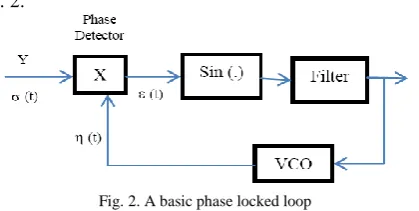
Let’s consider the basic phase locked loop as shown in Fig. 2.
Fig. 2. A basic phase locked loop
Let, the radar echo signal at the loop input is given by:
) sin( 1
1 X ift
A (1)
and the interference signal is
) sin(
2
2 X ift t
A
(2)
where, X1 and X2 are the amplitudes of desired radar echo signal and interfering signal respectively, if is the frequency of radar echo and is the frequency separation between the signals.
The input signal to the loop is given by
) sin( 2 ) sin( 1 )
(t X ift X ift t
Y
(3)
)] ( sin[
)
(t t t
X if
where, X(t) is the time varying amplitude of the loop input signal which is given by
t X X X X t X t
X() () 1( ) 2( ) cos 1
2
1 2
2
1 (4)
and (t) is time varying phase of loop input signal and is given by t X X t X X t cos ) ( 1 sin ) ( tan ) ( 1 2 1 2 1 (5)
Now, expanding the time varying phase of input signal in Fourier series [9]:
sin3 ..., 1
) 3 ( 2 sin ) 2 ( sin ) ( 1 ..., 3 sin ) 3 ( 2 sin ) 2 ( sin ) ( 3 2 3 2
1 t R t R t R
R t R t R t R t R t (6)
where, R is the jammer to radar signal amplitude ratio (J/S = X2/X1). With reference to Fig. 2, the loop phase
error (t) which is the difference between loop input phase (t) and VCO output phase (t) can be written as:
) ( ) ( )
(t t t
(7)
So, the input signal phase of the loop is given by
) ( ) ( )
(t t t
(8)
and the phasor equation for the above equation (7) can be written as:
(9)
where
,
and are the phasor of (t)
,
(t) and )(t
respectively.
IV. PHASE ERROR AND J/SRATIO COMPUTATION
than radar echo signal. For R>1, the mathematical analysis shows that, the phase detector output is written as:
180 sin
)
( 0
t t t
(10)
where, is the phase of (t) and is dc phase of VCO. So, the VCO output which is the filtered version of (t) is given by
) 180 sin
sin( )
( 0
t t t
(11)
Expanding (t) in terms of fundamental harmonics, second and higher order harmonics, it is given by equations (12), (13) and (14) respectively as:
t J
J
t
()[ 0 2]sin
(
12)t J
t J
J
t
()[ 0 2]sin 1sin2 (13)
... 3
sin 3 2
sin sin
] [ )
(t J0J2 tJ1 tJ 1 t
(14)
So, the input phasor equation (from equation (9)) for fundamental harmonics, second and higher order harmonics are obtained and are given in equation (15), (16) and (17) respectively as:
) ( ]
[ 0 2
J J G j
(15)
) 2 ( ) ( ]
[ 0 2 1
J J G j J G j (16)
... ) 3 ( 3 sin ) 2 ( ) ( ]
[ 0 2 1 2
J J G j J G j J tG j
(17)
where, J0
,
J1and
J2 is zero order, first and secondorder Bessel function respectively and G(j) is the loop transfer function and is given by:
)] ( ) (
2
) 2
( 2
1 [ ) (
B j B
j
G (18)
where, is loop damping ratio and B is loop bandwidth. So, from these phasor equations, the input signal phase is determined for a given loop phase error and then J/S ratio is obtained. From the equation (15), (16) and (17), the phasor diagram for = 0.707 & 1.0 and = 1.4B, 2B and 5B are shown in Fig. 3(a) and Fig. 3(b).
Figure 3. (a) Phasor diagram for = 0.707
Figure 3. (b) Phasor diagram for = 1.0
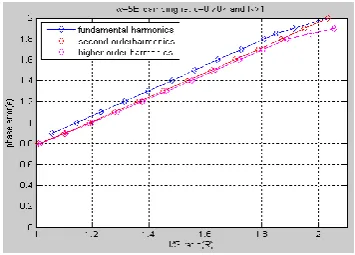
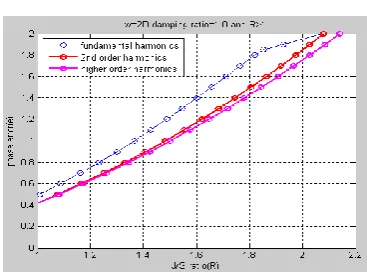
In the Fig. 3(a) and Fig. 3(b), the phasor diagram for loop input signal phasor is drawn in the complex plain with fundamental, second and higher order harmonics. From these phasor diagrams, the J/S ratio required for break-lock is determined for the given loop phase error as the input signal phase is expressed in terms of J/S ratio (equation (5)). The variation in phase error as a function of J/S ratio for = 0.707 & 1.0 and = 1.4B, 2B and 5B is shown in Fig. 4 and Fig. 5.
Figure 4. (a) Phase error Vs J/S ratio, = 0.707, = 1.4B
Figure 4. (b) Phase error Vs J/S ratio, = 0.707, = 2B
Figure 5. (a) Phase error Vs J/S ratio, = 1.0, = 1.4B
Figure 5. (b) Phase error Vs J/S ratio, = 1.0, = 2B
Figure 5. (c) Phase error Vs J/S ratio, = 1.0, = 5B
It is clear from the Fig. 4 and Fig. 5 that the phase error of the loop depends upon the frequency separation between the radar echo and interference signal. It is seen from these above figures that the phase error is typically 0.1, 0.4 and 0.8 when = 1.4B, 2B and 5B respectively. Thus, it is verified that when the frequency separation between the two signals is large, the phase error in the loop is more. It is also seen from fig. 4 and fig. 5 that for a given phase error, the J/S ratio required for break-lock in the receiver with higher order harmonics is large as compared to fundamental harmonics. The additional J/S ratio is computed for different values of loop error and is shown in Fig. 6(a) and Fig. 6(b).
It is clear from the Fig. 6(a) and Fig. 6(b) that the change in J/S ratio with loop phase error is positive and linear regardless of frequency separation between the radar echo and interference signal. So, from these results, one can predict the additional J/s ratio required for break-lock from the phase error when fundamental harmonics is considered alone. Hence, it eliminates the complex
computation of J/S ratio when several higher order harmonics are considered in the analysis.
Figure 6. (a) Phase error Vs additional J/S ratio, = 0.707
Figure 6. (b) Phase error Vs additional J/S ratio, = 1.0
V. CONCLUSION
In this paper, the loop phase error and J/S ratio required for break-lock have been computed and reported with several higher order harmonics of the input signal phase. It is verified that for the given loop phase error, the J/S ratio required for breaking the frequency lock in the receiver is large when several higher order harmonics are considered. It is verified that the change in additional J/S ratio with loop phase error is positive and linear regardless of frequency separation between the radar echo and interference signal. Thus, it allows in predicting additional J/S ratio required for break-lock in the receiver from the results when fundamental harmonics is considered alone. It is also verified that the loop error is more when the frequency separation between the radar echo and interference signal is large. So, it recommended that large frequency separation between these two signals should be maintained for effective jamming of the radar receiver. Hence, it can be concluded that higher order harmonics of the input signal should be taken into account when the receiver jamming is a serious issue and should not be neglected.
ACKNOWLEDGMENT
The author would thanks to Siddhartha Academy of General & Technical Education who provided the research facilities and technical support.
[1] S. M. Sherman, Monopulse Principles and Techniques, 2nd ed. Artech House, 1984.
[2] D. K. Barton, Monopulse Radar, Dedham, MA: Artech House, 1974.
[3] A. Kantak and F. Davarian, “Performance of PLL in the presence of a CW interferer,” in Proc. IEEE Global Telecommunications Conference, Antlata, GA, USA. Nov. 26-29, 1984, pp. 230-236. [4] J. Gao, F. Yang, Y. Wang, and X. Cao, “Analysis and verification
of anti-noise jamming capability for the monopulse radar seeker”,
Aero Weaponry, vol. 5, pp. 33-37, 2005.
[5] A. D. Serfer, “Monopulse radar angle measurement in noise.”
IEEE Transactions on Aerospace and Electronic Systems, vol. 30, pp. 950-957, 1994.
[6] M. F. Kuarsi, W. C. Lindsey, “Effects of CW interference on carrier tracking,” in Proc.MILCOM’94, 1994.
[7] T. Endo and T. Suzki, “Influence of an interfering target on a certain amplitude-comparison monopulse radar system”, in Proc. IEEE Global Telecommunications Conference, Atlanta, GA, USA, Nov. 26-29, 1984, pp. 224-229.
[8] B. K. Levitt, “Carrier tracking loop performance in presence of strong CW interference,” in DNS Progress Report, Pasadena, CA: Jet Propulsion Laboratory, 1979, pp. 130-137.
[9] I. E. Kliger and C. F. Olenberger, “Phase-Lock loop jump phenomenon in the presence of two signals”, IEEE Trans. Aerospace and Electronic systems, vol. AES-12, Jan. 1976. [10] A. I. Leonov and K. I. Fomichev, Monopulse Radar, Norwood,
MA: Artech House, 1986.
HariKrishna Paik was born on 27 July 1975. He obtained B.E from REC, Rourkela, M.Tech from JNTU and pursuing Ph.D. (Microwave and Radar) at JNTU, Kakinada. He is at present working as Assoc. Prof. in the Dept. of E& I Engg, V R Siddhartha Engg College, Vijayawada, AP. His area of interest is Microwave and Radar, Digital Signal Processing.
Dr. N. N. Sastry was born in Chirala; Prakasam Dist. A.P on 15 Sep 1945.He obtained B.Sc from Osmania Univ., B.E from IISC. M.Tech from JNTU, and Ph.D. (Statistical Sig. Proc) from OU. He joined Def. Elec. Res. Labs in 1968 and became scientist ‘G’ and Assoc. director in 1997. He handled a major Army programme SAMYUKTA as Assoc. Prog. Director for 8 years. He is at present Prof. and Head of the R&D Wing in V.R.S. Engg. College, Vijayawada. His area of work has been in Microwave antennas, Txs, Rxs. and EW systems. He is a member of IEEE society.