PERFORMANCE EVAL
PERFORMANCE EVAL
PERFORMANCE EVAL
PERFORMANCE EVALUATION
UATION
UATION OF A BIOMASS STOVE USING
UATION
OF A BIOMASS STOVE USING
OF A BIOMASS STOVE USING
OF A BIOMASS STOVE USING
PARTICULATE MATTER AND CARBON MONOXIDE
PARTICULATE MATTER AND CARBON MONOXIDE
PARTICULATE MATTER AND CARBON MONOXIDE
PARTICULATE MATTER AND CARBON MONOXIDE
EMISSION FROM BRIQUETTE AND FUEL WOOD
EMISSION FROM BRIQUETTE AND FUEL WOOD
EMISSION FROM BRIQUETTE AND FUEL WOOD
EMISSION FROM BRIQUETTE AND FUEL WOOD
A.
A.
A.
A. C.
C. Igboanugo
C.
C.
Igboanugo
Igboanugo
Igboanugo
11, , , , 11M. U
M. U....
M. U
M. U
Ajieh
Ajieh
Ajieh
Ajieh
2,*222,*,*,*and
and
and
and S. O
S. O.... Azi
S. O
S. O
Azi
Azi
Azi
33331 1 1
1 DEPARTMENT OF PRODUCTION ENGINEERING,UNIVERSITY OF BENIN,BENIN CITY,EDO STATE.NIGERIA 2
2 2
2NATIONAL CENTRE FOR ENERGY AND ENVIRONMENT (ENERGY COMM. OF NIGERIA),BENIN CITY,EDO STATE.NIGERIA 3
33
3 DEPARTMENT OF PHYSICS,FACULTY OF PHYSICAL SCIENCES,UNIVERSITY OF BENIN,BENIN CITY.EDO STATE.NIGERIA
E E E
E----mail addressmail addressmail addressmail addresseseses:::: es 1111 [email protected], 2222 [email protected], 3333 [email protected]
ABSTRACT ABSTRACT ABSTRACT ABSTRACT In most deve In most deve In most deve
In most developing countries like Nigeria, the use of biomass cooking stove is predominant. This is often done in a loping countries like Nigeria, the use of biomass cooking stove is predominant. This is often done in a loping countries like Nigeria, the use of biomass cooking stove is predominant. This is often done in a loping countries like Nigeria, the use of biomass cooking stove is predominant. This is often done in a poorly ventilated kitchen or thatched houses sometimes occupied by up to 3
poorly ventilated kitchen or thatched houses sometimes occupied by up to 3 poorly ventilated kitchen or thatched houses sometimes occupied by up to 3
poorly ventilated kitchen or thatched houses sometimes occupied by up to 3----7 households. 7 households. 7 households. Researchers have 7 households. Researchers have Researchers have Researchers have proved that smoke and other emissions
proved that smoke and other emissions proved that smoke and other emissions
proved that smoke and other emissions resulting from fuel wood in traditional stoves have led to increase in health resulting from fuel wood in traditional stoves have led to increase in health resulting from fuel wood in traditional stoves have led to increase in health resulting from fuel wood in traditional stoves have led to increase in health hazards
hazards hazards
hazards which includewhich include acute which includewhich includeacute acute acute carbon monoxide (carbon monoxide (carbon monoxide (COcarbon monoxide (CO)))) poisoningCOCO poisoningpoisoning diseasespoisoningdiseasesdiseasesdiseases, Acute Lower Respiratory Infections among , Acute Lower Respiratory Infections among , Acute Lower Respiratory Infections among , Acute Lower Respiratory Infections among others
others others
others. This study examines the emission of . This study examines the emission of . This study examines the emission of . This study examines the emission of particulate (particulate (particulate (particulate (PMPMPMPM)))) and CO and CO and CO and CO from briquette and fuel wood. Water Boiling from briquette and fuel wood. Water Boiling from briquette and fuel wood. Water Boiling from briquette and fuel wood. Water Boiling Test (WBT) was carried out
Test (WBT) was carried out Test (WBT) was carried out
Test (WBT) was carried out to test the performance of both fuelto test the performance of both fuelto test the performance of both fuelto test the performance of both fuelssss at ambient temperature and at ambient temperature and at ambient temperature and standard presat ambient temperature and standard presstandard presssssurestandard pres ureureure. . . . Test
Test Test
Test results results results results show the burning rate show the burning rate show the burning rate of show the burning rate of of of briquette fuel is 20.5g/min and that of fuel wood to be 16.8g/min. The briquette fuel is 20.5g/min and that of fuel wood to be 16.8g/min. The briquette fuel is 20.5g/min and that of fuel wood to be 16.8g/min. The briquette fuel is 20.5g/min and that of fuel wood to be 16.8g/min. The thermal efficiency of briquettes and fuel wood are 14.5% and 31.1% respectively.
thermal efficiency of briquettes and fuel wood are 14.5% and 31.1% respectively. thermal efficiency of briquettes and fuel wood are 14.5% and 31.1% respectively.
thermal efficiency of briquettes and fuel wood are 14.5% and 31.1% respectively. Thermal efficiency of 31.1% Thermal efficiency of 31.1% Thermal efficiency of 31.1% Thermal efficiency of 31.1% shows significant improvement when compared with available stoves. Increasin
shows significant improvement when compared with available stoves. Increasin shows significant improvement when compared with available stoves. Increasin
shows significant improvement when compared with available stoves. Increasing thermal efficiency will generally g thermal efficiency will generally g thermal efficiency will generally g thermal efficiency will generally reduce fuel requirement during cooking which implies less time and less exposure to PM and CO emissions. reduce fuel requirement during cooking which implies less time and less exposure to PM and CO emissions. reduce fuel requirement during cooking which implies less time and less exposure to PM and CO emissions. reduce fuel requirement during cooking which implies less time and less exposure to PM and CO emissions. Analysis of
Analysis of Analysis of
Analysis of test test test test result using MATLAB shows that result using MATLAB shows that result using MATLAB shows that result using MATLAB shows that fuel wood emitted more particulate matter than fuel wood emitted more particulate matter than fuel wood emitted more particulate matter than fuel wood emitted more particulate matter than briquette. Thebriquette. Thebriquette. The briquette. The mean
mean mean
mean distribution distribution distribution of particulate matter for briquette (PMdistribution of particulate matter for briquette (PMof particulate matter for briquette (PM----B) and that of fuel wood (PMof particulate matter for briquette (PMB) and that of fuel wood (PMB) and that of fuel wood (PMB) and that of fuel wood (PM----F) was analyzed F) was analyzed F) was analyzed using F) was analyzed using using using Paired Two Sample statis
Paired Two Sample statis Paired Two Sample statis
Paired Two Sample statistical test. tical test. tical test. COtical test. COCO emission for briquette (COCO emission for briquette (COemission for briquette (COemission for briquette (CO----B) and fuel wood (COB) and fuel wood (COB) and fuel wood (CO----F) was analyzed B) and fuel wood (COF) was analyzed F) was analyzed F) was analyzed respectively.
respectively. respectively.
respectively. The statisticalThe statistical analyses The statisticalThe statisticalanalyses analyses analyses shows highshows highshows highshows higher mean values for er mean values for er mean values for er mean values for PMPM----FPMPMFFF and COand COand COand CO----F and lower mean values for PMF and lower mean values for PMF and lower mean values for PM----B F and lower mean values for PMB B B and CO
and CO and CO
and CO----B B B B respectively. Highrespectively. Highrespectively. High thermal efficiency translates to less exposure to PM and CO emission which reduces respectively. Highthermal efficiency translates to less exposure to PM and CO emission which reduces thermal efficiency translates to less exposure to PM and CO emission which reduces thermal efficiency translates to less exposure to PM and CO emission which reduces significantly, risk to health accruing to the use of briquette and fuel wood on
significantly, risk to health accruing to the use of briquette and fuel wood on significantly, risk to health accruing to the use of briquette and fuel wood on
significantly, risk to health accruing to the use of briquette and fuel wood on ccccook stoveook stoveook stove.... ook stove
Keywords Keywords Keywords
Keywords: biomass stove, thermal efficiency, fuel wood, briquette, particulate matter, carbon monoxide, emissions, burning rate
1. 1. 1.
1. INTRODUCTIONINTRODUCTIONINTRODUCTION INTRODUCTION
Open fires and primitive stoves have been used for cooking since the beginning of human history. These stoves have come in various sizes and styles which require biomass as feed stock. Nearly 2 billion people, constituting about a third of humanity, continue to rely on biomass fuels and traditional technologies for cooking and heating [9, 1]. Biomass smoke contains a large number of pollutants and known health hazards which includes; particulate matter, carbon monoxide, nitrogen dioxide, formaldehyde and polycyclic organic matter, such as benzo [a] pyrene, a carcinogen, as described in Ezzati [21], Smith [13] and Zhang [16].
This is usually in a poorly ventilated space leading to exposure to air pollutants in form particulate matter (PM) especially those greater than 2.5ug/m3 in size and carbon oxides (CO and CO2) [13]. Report of Smith [22] suggests that emission from biomass presents a high health risk for acute lower respiratory infection (ALRI), chronic obstructive pulmonary disease (COPD), cataracts, lung cancer and cardiovascular disease. A publication of the World Health Organization (WHO) [10], estimates that emissions from fuel wood contributes nearly 3% to the total global burden of diseases resulting to 1.6 million premature deaths each year, including 900,000
Vol. 34 No. 3, July 2015, pp. 484 – 490 Copyright© Faculty of Engineering, University of Nigeria, Nsukka, ISSN: 0331-8443
485
children under the age of five (5). In addition, theseemingly unending perennial fuel crisis in Nigeria has drawn attention to the need for energy experts to concentrate on producing viable alternatives and/or complements kerosene and cooking gas for domestic cooking [11]. While many developed countries tend to focus on domestic energy security or decarburizing their energy mix, developing countries are still seeking to secure enough energy to meet basic human needs. In developing countries, access to affordable and reliable energy services is fundamental to reducing poverty and improving health, productivity, enhancing competitiveness and promoting economic growth. Despite these, billions of people are without basic modern energy services, lacking reliable access to either electricity or clean cooking facilities. Several research attempts have been done on stove designs and kitchen layout with the view to reducing carbon emissions and improving cross ventilation when cooking. Empirical study of Ezzati [21], shows that switching from conventional three-stone fire to improved clean cook stove can considerably reduce the risk of ARI and ALRI. Beside the economic and environmental considerations, the main reason motivating the various developmental efforts in the design of biomass improved clean cookstove is the health factor [7]. Venkataraman [6] strongly agrees with Joseph [7] and opines that clean cookstove technology is capable reducing half a million deaths due to respiratory and other illnesses linked with particulate and carbon emissions.
In Nigeria, there is the popular mud stove which is similar to the Kilakala stove in Tanzania [5, 12]. One of the major disadvantages of the mud stove is that it is not movable. The Kenya Ceramic Jiko (KCJ), one of the most successful urban stove projects in the Eastern African region, was reported to have a useful heat of about 25-40 % of the heat generated [8]. KCJ represents a significant increase when compared to three-stone open fire which directs only about 5-10% of the heat generated from the fire to the cooking pot. There have been commendable efforts from research centers of Energy Commission of Nigeria (ECN) on energy efficient cook stoves. One of such research attempts is the two-pot stove which is similar to the Improved Vented Mud stove (IVM) with chimney. The IVM has average thermal efficiency values between 10 to 23.5%.
Of these research efforts, very little have been done to assess the amount of emissions associated with the use of biomass fuel on stoves. Essentially, this paper focuses on the performance evaluation of fuel
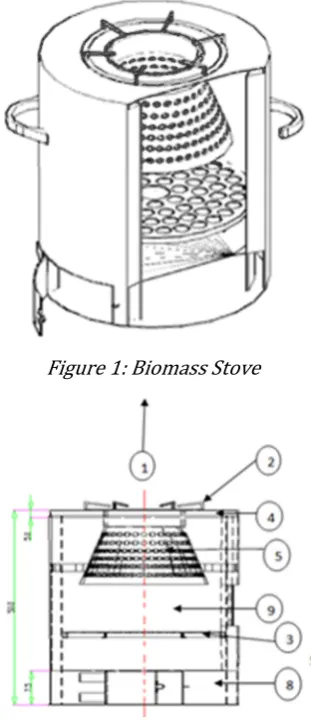
briquette and fuel wood on a rocket type biomass stove which was designed and fabricated at the National Centre for Energy and Environment (NCEE), a research Centre of the Energy Commission of Nigeria (ECN). In accordance with the WHO [10], health impacts associated solid wood based fuel is reduced through improvement and/or change of technology. Bailis [4] and Dutta [15] strongly agreed with emission reduction capacity of improved clean cookstove and fuel quality. Against this background, briquette and fuel wood were tested on NCEE Improved clean cookstove as shown in Figure 1 for particulates and carbon emissions in relation to their thermal efficiency. Water Boiling Test (WBT) using the Indoor Air Pollution (IAP) meter of the Aprovecho Research Centre which was installed at the International Centre for Energy, Environment and Development (ICEED), Afikpo for performance evaluation.
2. 2. 2.
2. MATERIALS AND METHODMATERIALS AND METHODMATERIALS AND METHODSMATERIALS AND METHODSSS 2.1
2.1 2.1
2.1 Description of the Biomass StoveDescription of the Biomass StoveDescription of the Biomass StoveDescription of the Biomass Stove
486
inlet and to ensure that any smoke associated with theheat is released before it reaches the pot. A drawer is incorporated at the base to facilitate the removal of ash and collected at the tray.
The ash filter is a metal frame, its function is to hold the fuel in position and more so, filter off the fuel ash which is collected and used for agricultural cultivation. It is made from mild steel sheet of 2cm thick. Sufficient holes were drilled on the plate for easy air passage. The ash filter is 25cm in diameter and supported by rods welded to the plate. The stove housing is 20cm in external diameter and 19cm internal diameter, welded to it is 5cm × 4cm L-shaped auxiliary which is mounted on the stove cove. A cone-like structure with circular holes was created in it with height of 15cm, 25cm diameter and an upper diameter of 15cm made up of steel materials welded to the housing unit with many holes drilled in it for ease of circulation of secondary air. The stove frame was fabricated from stainless steel sheet of 20mm in thickness; it is a hollow cylinder of 500mm in height and 200mm in diameter. Two handgrips are attached to the stove housing to ease carriage. The ash dissipated from combustion is filtered off and collected with the ash collector.
Figure 1: Biomass Stove
Figure 2: Stove skeletal frame
Table 1: Parts Description
Item No Item Description
1 Ash chamber gate
2 Stove cover
3 Ash filter
4 Pot suspender
5 Flame connector
6 Handle
7 Fuel gate
8 Ash collector unit
9 Fuel reservoir
The diameter of the combustion chamber is such that it is smaller than the pot seat or the external diameter of the smallest pot that can be used on the stove to ensure that the maximum amount of heat is transferred to the pot. The height of the flame connector is adjusted to allow for enough time for the combustion of the burning fuel before it reaches the base of the pot on the stove.
2.2 2.2 2.2
2.2 Water Boiling TestWater Boiling TestWater Boiling TestWater Boiling Test
487
A vacuum pump pulls a sample through the sampleline and the critical orifice, which holds the flow at a steady rate of 16.7 L/min. A cyclone particle separator is used to ensure that all particulate matters greater or equal to 2.5ug/m3 (PM2.5) are collected on a glass fiber filter while the pump is on. The filter is pre and post-weighed to calculate the total PM2.5 mass.
2.3 2.3 2.3
2.3 Fuel ConsiderationsFuel ConsiderationsFuel ConsiderationsFuel Considerations
In this experiment, two fuel types were considered namely; briquette sawdust and fuel wood. In accordance with European Standard (EN14961), briquette is a densified biofuel made with or without additives in the form of cubiform or cylindrical units (Ø ≥ 25mm) produced by compressing pulverized wood. In this case, the briquette was made from sawdust collected from sawmills. It was prepared by mixing known quantity of sawdust with water and starch as binder. The briquettes were sun dried to ensure proper curing and uniform moisture content. Fuel woods are cut and split oven ready pieces of wood usually between 100mm – 1000mm by size. Essentially, both fuels are from wood sources. Sawdust is a combination of several woods (soft or hard) generated from cutting wood to shapes and sizes. In other words, briquettes made from sawdust have similar chemical properties with that of wood except for variations in their moisture content. Wood is composed of many chemical components, primarily extractives, carbohydrates, and lignin, which are distributed non-uniformly as the result of anatomical structure. Lignins can be broadly divided into three classes: softwood (gymnosperm), hardwood (angiosperm) and grasses (graminaceous). Sawdust is a combination of soft and hardwood. Generally, guaiacyl lignin is found in softwoods while guaiacyl-syringyl lignin is present in hardwoods [14]. In several cases, sawdust has been used either in its raw state or in densified state to fire cook stoves. Concerns on emission resulting from its use or the use of fuel wood has led to several research attempts aimed as unraveling the differences in amount of carbon and particulate matters arising from wood based fuels when used for cooking.
In this study, equal volume of water (5L) was measured in consonance with equal weight of briquette and fuel wood respectively. Weighed fuel wood was introduced into the combustion chamber and ignited with small pieces of shavings. The briquette was ignited with kerosene after which sufficient time was allowed for fire to build strength
before subjecting it to the LEMS testing guidelines of the Aprovecho Research Centre, USA. The time, temperature of the surrounding and the initial temperature of the water were noted.
2. 2.2.
2.4444 Results and Discussions Results and Discussions Results and Discussions Results and Discussions
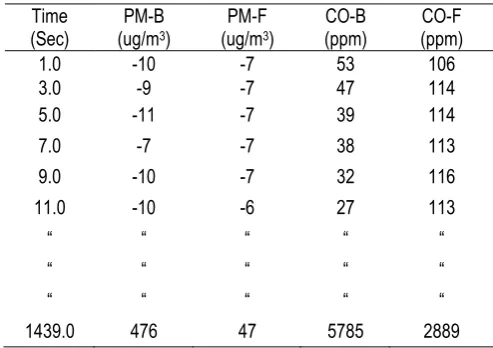
The PM and CO data for briquette and fuel wood were measured and recorded using LEMS at time intervals as shown in Table 2.
Table 2: PM and CO Data for Briquette and Fuel Wood
Time (Sec)
PM-B (ug/m3)
PM-F (ug/m3)
CO-B (ppm)
CO-F (ppm)
1.0 -10 -7 53 106
3.0 -9 -7 47 114
5.0 -11 -7 39 114
7.0 -7 -7 38 113
9.0 -10 -7 32 116
11.0 -10 -6 27 113
“ “ “ “ “
“ “ “ “ “
“ “ “ “ “
1439.0 476 47 5785 2889
Table 2 shows the result obtained for Water Boiling Test (WBT). Details of the test show that briquette took sixty minutes to boil 5L of water. At the same condition of test, it took twenty four minutes to boil the same quantity of water when fuel wood was used. Further result for fuels in terms of burning rate, thermal efficiency, specific fuel consumption, temperature corrected specific consumption; firepower and equivalent dry fuel consumed are shown in Table 3. The thermal efficiency of the stove when tested on briquette is 15% while that of fuel wood is 31%. Thermal efficiency of the stove suggests that this stove is suitable for use a fuel wood stove.
Table 3: Water Boiling Test (WBT) Results
Test Parameters Briquette
Fuel
Fuel Wood
Time to boil Pot (min) 60.0 24.0
Burning rate (g/min) 20.5 16.8
Thermal efficiency (%) 0.145 0.311
Specific fuel consumption
(g/litre) 297.45 88.37
Temp-corrected specific
consumption (g/litre) 322.85 92.82
Firepower (watts) 6298.40 5165.8
4 Equivalent Dry Fuel Consumed
(g) 1231.36 403.98
488
Comparison of the thermal efficiency with woodstoves like KCJ, IVM and other locally accessible stoves shows considerable improvement. In accordance with Grieshop [19], Traditional stoves can be improved in three ways namely; (i) increasing thermal efficiency, (ii) reducing specific emissions and (iii) increasing ventilation. Data generated from LEMS were plotted using MATLAB to examine the distribution of PM and CO. Figure 3 shows sinusoidal curve for both PM and CO. The spikes on the curve represent perturbations caused by fuel toggle in the cold start, hot start and/or simmering in other to sustain or increase firepower. At the point when the fire is perturbed, PMs are set in motion leading to formation of fly ash within the combustion chamber and through the fire exit.
Initially, particles of the fly ash experience poor combustion which increases the formation of CO. At increased firepower, the curve returns to a fairly normal sinusoidal curve. In addition, it took about eight minutes after fire start up for briquette to gain strength. This is due to the moisture content and effects of the binder which has the ability to influence the burning rate [20]. On the contrary, fuel wood picked up faster in terms of firepower which is largely responsible for the time differential in taking the water to boiling temperature at cold start.
Figure 3: PM for Briquette and Fuel Wood
Furthermore, plot of the PMs for both fuels were represented with box plot as shown in Figure 9. It shows that fuel wood has a mean percentile higher than that of briquette which again can be affected by type of stove as shown in Johnson [17] and Wang [22]. Comparison of both plot shows that fuel wood has more spikes at wider range which is a resultant of perturbation.
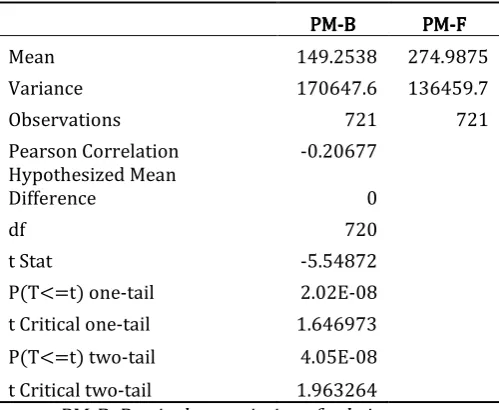
The distribution of PM for both fuels was fit using paired t-test as shown in Table 4.
Figure 4: Box Plot of PM for Briquette and Fuel Wood
Table 4: Paired Two Sample for Mean
PMPMPMPM----BBB B PMPMPMPM----FFF F
Mean 149.2538 274.9875
Variance 170647.6 136459.7
Observations 721 721
Pearson Correlation -0.20677
Hypothesized Mean
Difference 0
df 720
t Stat -5.54872
P(T<=t) one-tail 2.02E-08
t Critical one-tail 1.646973
P(T<=t) two-tail 4.05E-08
t Critical two-tail 1.963264
PM-B: Particulate emissions for briquette, PM-F: Particulate emissions for fuel wood
Particulate matters emission differ significantly between briquettes fuel and fuel wood. This implies that both feed stock exhibited varying emission level which is in line with Dutta [15] and Ezzati [21]. From the mean, PM-F emitted more particulate matter emissions when compared to emission from fuel briquette which corroborates the mean value of the box plot as shown in Figure 4.
489
Figure 10: CO for Briquette and Fuel Wood
Table 5: Paired Two Sample for Mean
CO-B CO-F
Mean 631.516 2191.877
Variance 1691823 1391547
Observations 721 721
Pearson Correlation 0.231847 Hypothesized Mean
Difference 0
Df 720
t Stat -27.2047
P(T<=t) one-tail 6E-113 t Critical one-tail 1.646973 P(T<=t) two-tail 1.2E-112 t Critical two-tail 1.963264
CO-B: Carbon monoxide emissions for briquette, CO-F: Carbon monoxide emissions for fuel wood
The mean of CO-F for fuel wood is 2191.877 and that of CO-B for briquette is 631.516. The implication is that fuel wood emitted more CO than briquette fuel. This means that carbon emissions differ significantly between briquettes fuel and Fuel wood. This result further shows that both feed stock exhibited varying emission level. Nonetheless, fuel wood took less time to boil when compared to briquette which suggests that over the time lag before the boiling temperature, briquette may have a higher cumulative CO than that of wood fuel for the same quantity of water which agrees with the publication of Zhang [16] on exposure potential of CO as well as in Ezzati [21]
3. 3. 3.
3. CONCLUSIONCONCLUSIONCONCLUSIONCONCLUSION
Water Boiling Test (WBT) was used to measure the overall performance of a cook stove using the IAP meter to monitor the emission of PM and CO from two fuel feed stocks namely; briquette and fuel wood. The
water was brought from cold start to boiling temperature under Laboratory Emission Monitoring System (LEMS). The LEMS model is an ideal test for kitchen environment and measures the total emissions produced during stove combustion. The result of tested stove shows that the burning rate of briquette fuel is 20.5g/min and that of fuel wood is 16.8g/min. The thermal efficiency of briquettes and fuel wood are 14.5% and 31.1% respectively. Thermal efficiency of stove shows a higher suitability fuel wood than briquette fuel. In addition, thermal efficiency of 31.1% shows significant improvement when compared with available stoves. Increasing thermal efficiency will generally reduce fuel requirement during cooking which implies less time and less exposure to PM and CO emissions. Particulates and carbon emissions are products of incomplete combustion which are hazardous to health. Less exposure to PM and CO emission is of considerable importance in the reduction of risks to health accruing to the use of briquette and fuel wood on cookstove. The particulate matter for briquette (PM-B) in Figure 4typically shows low thermal efficiency of the fuel while the particulate matter for fuel wood is higher with higher thermal efficiency. Essentially, increase or decrease in thermal efficiency is predicated on design considerations. The primary air inlet and secondary air inlet to the combustion chamber have a fundamental influence on the thermal efficiency which again, has appreciable influence on PM and CO emissions. The results of the WBT analyzed and plotted using MATLAB shows rise in the PM until perturbation occurred either in the cold start, hot start and simmering stage. The behavior of the CO was similar to that of PM. Test of hypotheses shows that in H0, there is no significance in the emission of PM between briquettes fuel and fuel wood. Again in H1, there is no significance in the emission of CO between briquettes fuel and fuel wood. Result of paired sample t-test shows that for both fuels, fuel wood emitted more PM and CO respectively.
4. 4. 4.
4. REFERENCEREFERENCEREFERENCESREFERENCESSS
[1] J.-F.K. Akinbami, M.O. Ilori, T.O. Oyebisi, I.O.
Akinwumi, and O. Adeoti. Biogas energy use in Nigeria: current status, future prospects and policy
implications. Renewable and Sustainable Energy
Reviews 5(1): 97-112 (2001). [2] Aprovecho Research Centre, USA
490
[4] R. Bailis, D. Ogle, N. MacCarty, and D. Still. The Water
Boiling Test (WBT) version 4.12, Household Energy and Health Programme, Shell Foundation (2003), revised (2009)....
[5] E. Crewe. Fuel wood stove project. Women Training
Center, Christian Council of Tanzania, Review and
Recommendations, Intermediate Technology
Development Group (ITDG), Rugby, UK (1990).
[6] P. Venkataraman and S.N. Srinivas (Eds.). Tata Energy Research Institute (TERI), New Delhi, India (1997).
[7] S.K. Joseph, P. Krishna and H.B. Van der Zann.
Bringing stovesto the people. ACTS Press and the Foundation for Wood Stove Dissemination (FWD), Nairobi, Kenya (1990).
[8] D.M. Kammen and B. Fayemi Kammen. Energy, food
preparation and health in Africa: The roles of technology, education, and resource management.
African Technology Forum 6(1): 11-14 (1992).
[9] S. Momoh and J. Soaga. Biomass energy consumption
in Nigeria: Integrating demand and supply. Nigerian Journal of Renewable Energy 7(1 & 2): 78-82 (1999)
[10] WHO. Pollution from Biomass Fuel. Working Papers
from a WHO Consultation, pp. 89-104. World Health Organization (WHO), Geneva, Switzerland (2006).
[11] A.O. Olorunsola. The development and performance
evaluation of a briquette burning stove. Nigerian Journal Renewable Energy 7(1 & 2): 91-5 (1999).
[12] T. Otiti. Improved stoves in Tanzania, Stove Notes 6,
FWD and ACTS Press, Nairobi, Kenya (1991).
[13] K.R. Smith. Fuel combustion, air pollution
exposure, and health: The situation in developing countries. Annual Review of Energy and Environment, 18: 529-66 (1993).
[14] C. Ververis, K. Georghiou, N. Christodoulakis, P.
Santas, R. Santas. Fiber dimensions, lignin and
cellulose content of various plant materials and their suitability for paper production. Industrial Crops and Products 19 (245–254).
[15] K. Dutta, K. N. Shield, R. Edward & K. R. Smith.
Impact of improved biomass cookstoves on indoor air quality near Pune, India.Energy for Sustainable Development, Volume XI No. 2 (2007).
[16] J. Zhang, K.R. Smith, R. Uma, Y. Ma, V.V.N. Kishore, K. Lata, M.A.K. Khalil, R.A. Rasmussen, S.T. Thorneloe.
Carbon monoxide from cookstoves in developing countries: 2. Exposure potentials. Chemosphere: Global Change Science 1 (1999) 367-375
[17] N. G. Johnson, K. M. Bryden. Factors affecting fuel
wood consumption in household cookstoves in an isolated rural West African village. Energy 46 (2012) 310 -321.
[18] World Bank: Household Cookstoves, Environment,
Health, and Climate Change: A New Look at an Old Problem (2011).
[19] A. P. Grieshop, J. D. Marshall, M. Kandlikar. Health
and climate benefits of cookstove replacement options. Energy Policy 39 (2011) 7530–7542
[20] G. Amaral-Labat, A. Szczurek, V. Fierro, N. Stein, C.
Boulanger, A. Pizzi, A. Celzard.Pore structure and
electrochemical performances of tannin-based carbon cryogels. Biomass and Bioenergy 39 (2012) 274 -282
[21] M. Ezzati and D. M. Kammen. Household Energy,
Indoor Ai r Pollution, and Public Health in Developing Countries. Resources for the Future, Washington DC, (2002) 0 2 – 2 6