ISSN 1392-2785 ENGINEERING ECONOMICS. 2006. No 2 (47)
THEECONOMICCONDITIONSOFENTERPRISEFUNCTIONING
Changes in the Imposition of Value Added Tax in Lithuania (1994-2004)
Danut
ė
Bendikien
ė
, Gintaras Šaparnis
Šiaulių universitetas
Vilniaus g. 88, LT-76285, Šiauliai
Value added tax (VAT) was introduced in Lithuania in May 1, 1994. It replaced basic excise duty. Basic ex-cise duty rate was 15 per from 1991, and from July 1, 1992 it was 18 per cent. For the goods sold in foreign countries for convertible currency the rate was 10 per cent When the VAT law came into force (Žin., 1994, Nr. 3-40) two rates were applied: 18 per cent on all goods and services, except VAT-exempt, and 0 per cent on ex-ported goods and services. Value added tax was not im-posed on food, fuel, coal, gas and heating of dwelling houses, education, health care, social, transport and other services. However, from January 1, 1995, tempo-rary 9 per cent rate was already imposed on food. From
1995 VAT became the main source of national budget and made up 34.3 per cent of all inflow, and in 1997 it was already 40.6 per cent, because temporary VAT rate
for food was doubled (from 9 per cent to 18 per cent) and the basis of assessment was widened.
The reduced 5 per cent rate was first applied in 2000. From May 1, 2000 it was imposed on shuttle passenger transport services. The reduced 9 per cent rate was in-cluded in the VAT law only in 2001: it was imposed on heating energy provided for inhabitants. According to the provisions of the VAT law, VAT payers pay to the state budget the difference between calculated tax sum for sold goods (services) and the sum of the tax paid for goods (services) provided by suppliers. Applying different rates, VAT rebate is paid to VAT payers. So the application of the reduced rates reduces VAT inflow to the state budget.
Since July 1, 2002 the new VAT law came to force (Žin., 2002, Nr. 35-1274). The European Union (EU) directives were already implemented and certain VAT exemptions continued to be removed: 5 per cent rate was imposed on part of medicine and medical services, 18 per cent rate was imposed on veterinary services, in-service training and reskilling services, land for construction and selling new buildings. 5 per cent rate was imposed on books, newspapers and magazines, and 18 per cent rate on newsprint in 2003.
When Lithuania became European Union Member State, from May 1, 2004 the new redaction of the VAT law came to force. The provisions of the Sixth Directive of the EU were implemented in it. The exemptions on biofuel and heating of dwelling houses, 5 per cent rate was imposed on medicine and medical services, 18 per cent rate was im-posed on scientific research. Other important changes not related to VAT exemptions also occurred.
In the European Union countries value added tax is imposed on different groups of goods, there are different rates and exemptions. However, these exemptions on areas
of vital importance were left: food is VAT-exempt in Ire-land and the United Kingdom; other countries apply the reduced rates of 3 per cent, 8 per cent and 12 per cent. Analogical exemptions are supposed for transport services. In Lithuania food, transport services and accommodation heating are taxed with the standard 18 per cent rate. Due to the rapid removal of exemptions and the widening of the basis of assessment VAT inflow to the state budget in-creased from 1148.1 million Lt in 1994 to 3930.1 million Lt in 2004 that is by 3.4 times. It is possible to state that in Lithuania the conditions of the imposition of VAT are not favourable because vital exemptions still applied in the majority of the EU countries were removed.
Keywords: imposition, tax, budget, inflow, law, VAT rate, VAT object, VAT deduction, VAT overpay-ment, Sale VAT, Purchase VAT.
Introduction
The invention of value added tax belongs to M.Lauré (France) who in 1954 described the scheme of this tax and suggested implementing it instead of turnover tax (Pajuodienė, 1993). In France VAT was implemented in 1968. Germany was the second country where value added tax came into force. In the present time, this tax is applied in 50 countries, including all countries of the European Union. VAT is an indirect tax on public and private consumption. It is collected and paid by compa-nies, however, all the burden of the tax is imposed on a consumer (Мещерякова, 1995).
VAT is popular because the aim is to get as much in-come as possible to the budget, and VAT is favourable for that. By the form of value added tax a part of added value that is created at each stage of the production proc-ess is taken to the budget (Лапуста, 2001). It is easily collected because the consumption is taxed directly.
According to the financial expert R. Vainienė „of all existing taxes VAT may be most easily transferred so that it performs the principles of pro-liberal tax system: it is functioning automatically and its application in regulating economy is complicated“(Vainienė, 1998). VAT usually helps to collect much income when rates are not big and without evident discouragement of the motivation of the activity (Buškevičiūtė, 2003). Value added tax is imposed on goods and services. According to the VAT law in Lithuania there is standard 18 per cent rate, two reduced 9 and 5 per cent rates and 0 per cent rate on export.
standard VAT rate of 15 per cent is set. It is applied in Cyprus, Luxembourg and Malta. The biggest 25 per cent VAT rate is in Denmark, Sweden and Hungary (UAB
“Pa-čiolis”, 2004). Usually two reduced rates are applied in the EU countries. The lowest is in France, 2.1 per cent, while the highest is in Finland, 17 per cent (Verslo steigimas ES šalyse, 2002). Tax value (rate) is an effective means of implementing state fiscal policy. By determining and specifying tax value (rate), the state can control tax collect-ing without changcollect-ing the basic tax system. In the world now the tendency of decreasing tax rate has become dis-tinct (Marcijonas, 2003). For several decades the efforts of the European Commission (EC) to equalize VAT rates have not brought any results because national governments opposed that. Because of possible negative political out-come some states did not agree to remove VAT exceptions either (Stačiokas, 2003). It was agreed to remove big VAT on luxury goods and to leave lower value added tax during transition period or not to set any.
The object of the research – the change in value added tax rates in Lithuania.
The aim of the research – the comparative analysis of value added tax rates in Lithuania and the European Union (EU) countries.
The methods of the research – the analysis of stan-dard documents, literature, statistical data, data grouping and comparative analysis.
VAT inflow to the budget in 1994 – 2004 According to the Department of Statistics, the income of the national budget increased from 4042.3 million Lt in 1994 to 13805.1 million Lt in 2004 that is 3.4 times. The main part of the income consists of tax income. In the sum expression they were constantly increasing: from 3766 million Lt in 1994 to 11086.6 million Lt in 2004 that is increased 2.9 times and in 2004 made up 80.3 per cent of all budget income.
Table 1
The income structure of the national budget (per cent) in 1994-2004
Year
Income-tax of natural
persons
Corporation tax of juridi-cal persons
VAT Excises Other taxes
1994 29.4 13.7 28.4 7.0 21.5 1995 29.3 9.6 34.3 10.7 16.1 1996 31.0 8.7 33.9 12.4 14.0 1997 23.8 7.5 40.6 14.1 14.0 1998 25.8 6.2 38.5 14.3 15.2 1999 28.7 4.0 38.6 14.7 14.0 2000 28.7 3.6 39.2 13.9 14.6 2001 27.1 2.8 37.9 14.0 18.2 2002 24.1 2.9 36.0 16.1 20.9 2003 23.5 6.9 33.7 15.5 20.4 2004 22.1 8.5 28.5 13.5 27.4
Source: Lietuvos Statistikos metraštis. – Vilnius, Statistikos departamentas prie LR Vyriausybės, Metodinis leidybinis cen-tras (1997, p.163; 1998, p.147; 2001, p.157-158; 2004, p.552). Statistikos departamentas. Lietuvos ekonominė ir socialinė raida. 2005/02, p.137.
National budget income in fact consisted of indirect tax payments. It is an exceptional feature of the tax struc-ture of our country (Stačiokas, 2004). In 1994-2004 the income from indirect taxes was constantly increasing, while the income from direct taxes was decreasing. In 2004 the income from indirect taxes slightly decreased and made up 42 per cent of all income (VAT was 28.5 per cent and excises were 13.5 per cent).
Non-tax income increased from 276.6 million Lt in 1994 to 2718.7 million Lt in 2004 that is increased 9.8 times and in 2004 made up 19.7 per cent of all budget income. This increase was determined by the EU sup-port which in 2004 made up 51.1 per cent of non-tax income and 10,1 per cent of all budget income (1389.8 million Lt).
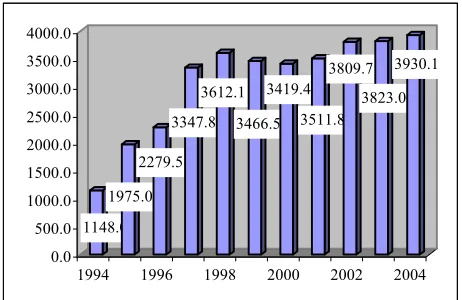
Since 1995 VAT became the main source of budget income (34.3 per cent of all inflow). VAT inflow to the national budget increased from 1148.1 million Lt in 1994 to 3930.1 million Lt in 2004 that is 3.4 times.
1148.0 1975.0
2279.5 3347.8
3612.1
3466.5 3419.4
3511.8 3809.7
3823.0 3930.1
0.0 500.0 1000.0 1500.0 2000.0 2500.0 3000.0 3500.0 4000.0
1994 1996 1998 2000 2002 2004
Figure 1. Change of VAT income in 1994-2004 (million Lt)
Source: Lietuvos Statistikos metraštis. – Vilnius, Statistikos departamentas prie LR Vyriausybės, Metodinis leidybinis cen-tras (1997, p.163; 1998, p.147; 2001, p.158; 2004, p.552). Statistikos departamentas. Lietuvos ekonominė ir socialinė raida. 2005/02, p.137.
The biggest growth of VAT inflow was in 1997. In one-year the budget income increased by 1068.3 million Lt, that is, by 46.9 per cent, and made 40.6 percent of all budget income. In 1997 VAT rate on agricultural produc-tion and food, combined fodder, fish and fish products was doubled. The basis of assessment was also widened. The pace of growth continued in 1998 too. In 1999 145.6 million Lt or 4 per cent less income was collected. This decrease was determined by the crisis in Russia and un-settled economic relationship with the CIS countries. In 2000 VAT income in comparison to 1999 decreased again by 47.1 million Lt or 1.3 per cent. This decrease was again determined by continuing crisis in Russia and export increase in Lithuania (in 2000 in comparison to 1999 export increased by 28.1 per cent, while import by 13 per cent). The smaller amount of VAT was collected also because the consumption in the home market de-creased due to small buying power of inhabitants and increased unemployment.
and made up 3809.7 million Lt. It was related to develop-ing economics of Lithuania, increasdevelop-ing investments and GDP growth. However, the widening of the basis of VAT assessment had big influence too. During the period of 2001-2003 quite large part of services and real estate were taxed with 18 per cent, 9 per cent or 5 per cent rates. In 2004 the exemptions for biofuel, heating of dwelling premises were removed, medicine and medical goods were taxed. The order of import imposition was changed. Therefore, the inflow to the budget increased 2.8 times and made up 3930.1 million Lt.
Change of VAT rates in Lithuania in 1994-2004
According to the 13 article of the VAT law No. 1-345, issued 22-12-1993, two VAT rates were applied: 18 per cent on all goods and services, except VAT-exempt and 0 per cent on exported goods and on services pro-vided outside the Republic of Lithuania.
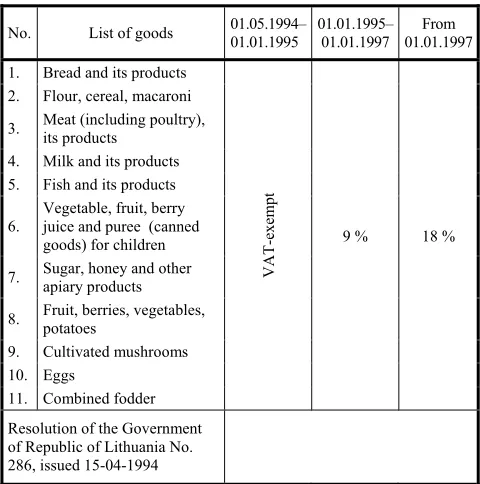
Goods and services listed in the article 38 of the law were not VAT-rated until 1 January, 1995: gas and heat-ing of dwellheat-ing houses and all food products. On 15 April, 1994 according to the Government Resolution No. 286 expanded lists of other VAT-exempt services and food products were approved. However, on 1 January, 1995 temporary 9 per cent rate was introduced on food sold by Lithuanian producers to the inhabitants and sell-ing companies.
Since January 1, 1997 all food goods were taxed with 18 per cent VAT rate.
Table 2
Imposition of food products with value added tax
No. List of goods 01.05.1994– 01.01.1995 01.01.1995– 01.01.1997 01.01.1997From
1. Bread and its products 2. Flour, cereal, macaroni
3. Meat (including poultry), its products
4. Milk and its products 5. Fish and its products
6. Vegetable, fruit, berry juice and puree (canned goods) for children
7. Sugar, honey and other apiary products
8. Fruit, berries, vegetables, potatoes
9. Cultivated mushrooms 10. Eggs
11. Combined fodder
VAT-exempt 9 % 18 %
Resolution of the Government of Republic of Lithuania No. 286, issued 15-04-1994
Source: Composed by the authors with reference to the amend-ments of the VAT law.
The reduced 9 per cent rate was included into the VAT law only in 2001, when heating provided for inhabi-tants was taxed.
Table 3
Change of VAT rates for heating energy provided for inhabitants
Service 01.05.1994 – 01.01.2001 01.01.2001– 01.01.2004 From 01.01.2004
Heating energy provided for inhabitants for heating
of dwelling premises VAT-exempt 9 % 18 %
Source: Composed by the authors with reference to the amend-ments of the VAT law.
During the period analysed the imposition of services provided by private health care institutions was also changed.
Table 4
Change of VAT rates in the area of health care in 1994-2004
Service 01.05.1995 – 01.01.1997 01.01.1997–01.01.2001 From 01.01.2001
Medical service provided by private health care and veterinary clinics
VAT-exempt 18 % VAT-exempt
Source: Composed by the authors with reference to the amend-ments of the VAT law.
Private health care institutions make up 40 per cent of all health care institutions in Lithuania, so their ex-emption from tax determined VAT decrease and from 2001 the budget has not received about 6 million Lt in-come annually.
VAT taxable value consists of sold goods and ser-vices. Having widened the basis of assessment, the sum of Sale VAT increases correspondingly. According to the data of VAT declarations, standard 18 per cent VAT rate makes up the biggest part (even about 98 per cent)
9791.9 10480.4 11772.9
13544.5 15746.5
0 5000 10000 15000 20000
2000 2001 2002 2003 2004
Figure 2. Change of 18 percent Sale VAT 2000-2004 (million Lt)
Source: Valstybinė mokesčių inspekcija 2004 m.
http://www.lrv.lt 2006
making juridical persons. Standard 18 per cent rate was also imposed on real estate: land for construction and selling new buildings. In 2003 VAT basis of assessment continued to be widened: 18 per cent rate was imposed on newsprint (it was VAT-exempt since October, 1997). In 2004 18 per cent rate instead of 9 per cent rate was im-posed on biofuel and heating of dwelling premises.
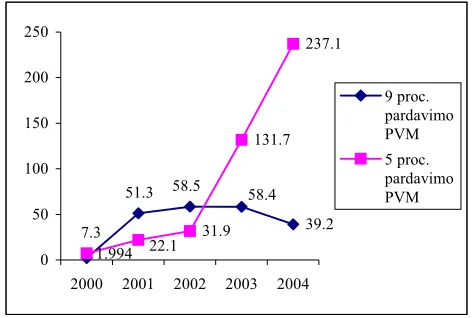
During the period of 2001-2004 the reduced 9 per cent and 5 per cent rates were applied more widely.
39.2 31.9
131.7 237.1
1.994
51.3 58.5 58.4
7.3
22.1 0
50 100 150 200 250
2000 2001 2002 2003 2004
9 proc. pardavimo PVM 5 proc. pardavimo PVM
Figure 3. Change of 9 per cent and 5 per cent Sale VAT rates in 2000-2004 (million Lt)
Source: Valstybinė mokesčių inspekcija 2004 m.
http://www.lrv.lt 2006
5 per cent VAT rate was first applied only in 2000. From May 1, 2000 this rate was imposed on shuttle pas-senger transport services for routes determined by the Ministry of Communication or local municipalities. Dur-ing eight months of the year 2000 five per cent Sale VAT made up 7.3 million Lt, while in 2001 it made up 22,1 million Lt. From July 1, 2002, 5 per cent rate was already applied for certain medicine (including veterinary) and medical goods. The rapid growth of 5 per cent Sale VAT was in 2003, because since January 1 it was imposed on books, newspapers and magazines (except publications of erotic and violent character); services of hotel type and special accommodation (tourism activity), certain medi-cine and medical goods. In 2004 5 per cent Sale VAT distinctly increased (80 per cent). It was much influenced by 5 per cent rate for the services of agricultural partner-ships, provided for their members; fresh and frozen fish, and by the imposition of the 5 per cent reduced rate on medicine and medical goods from 1 May, 2004.
9 per cent Sale VAT was applied from 2001. During 2001 it increased 26 times. By the amendment of the VAT law in 2001 this rate was imposed on heating energy pro-vided for inhabitants for heating of dwelling premises and biofuel made up of biomass of Lithuanian origin. During 2002 nine per cent Sale VAT increased 1.1 times. From July 1, 2002, this rate was imposed on denaturized ethyl alcohol and rape methyl (ethyl) ester, produced with ac-cordance to the requirements of the biofuel law of the Re-public of Lithuania. In 2003 the imposition was cancelled, which gives the explanation for the decrease of 9 per cent Sale VAT in 2003. In 2004 nine per cent Sale VAT de-creased by 32.8 per cent due to the imposition of standard 18 per cent rate instead of 9 per cent rate applied for
bio-fuel and heating of dwelling houses since May 1, 2004. Practice showed that while calculating and paying value added tax rather many mistakes were made, there was lack of explanations and comments (Pridėtinės vertės mokestis, 1996). The mechanism of the accounting and administration of this tax is very complicated and confus-ing (Ruchovienė, 2000). Therefore, State Tax Inspection (STI) in 1996 published methodical book, and in 2000 it published the comment on the VAT law, which com-prised the explanations of laws and sub-legal acts. It should be noted that the VAT law became one of the most complicated and most often modified standard acts. Valid until July 1, 2002, the law, according to the au-thors’ calculations was changed 41 times, and the main Government Resolution No. 546, issued 09-05-1996 was changed 21 times. Because of frequent change in many norms, inexact comments on the law companies pay many surcharges.
Changes of VAT imposition after Lithuania joined the European Union
When Lithuania joined the European Union, the EU legal acts- regulations of direct application came into force. They are compulsory for all EU legal subjects. The regulations are published in the „Official Publication“of the European Union. (Savčiuk, 2004). The directives are applied indirectly, that is they only formulate objectives and goals compulsory for all EU members. Countries themselves make resolutions on the application of the directives. The Sixth Council directive was enacted on May 17, 1977 (77/388/EEB). It is related with the ar-rangement of the turnover taxes, that is the common sys-tem of value added tax: a common basis of calculation (2004-01-15 PVM įstatymo papildymo įstatymas Nr. IX-1960). The provisions of the Sixth Directive were imple-mented in the VAT law.
Since May 1, 2004 VAT object is not only supplying goods and providing services in the territory of the state and goods import (goods import from 01-05-2004 is con-sidered as importing goods from the territory other than the European Community), but also obtaining goods for payment from other member state (Brasiūnaitė, 2004). Obtaining goods is only such kind of obtaining goods when goods are taken from supplying member state and brought to other member state. Transporting goods in-side the EU from one member state to another they are taxed not as import, but as a certain special category, that is obtaining goods inside the EU. There are no temporary expenses paying import VAT and no time wasted for import procedures. However, having eliminated customs checks between the EU states, companies lost possibility to include into the account paid-in import VAT. So pur-chasing goods from the EU state and selling them in Lithuania it is necessary to pay bigger value added tax to the state. Purchaser gains profit only exporting goods to another member state. Freely circulating goods to other member states are transported without any export for-malities, formalizing only VAT invoice (Rimkevičiūtė, 2004). VAT rate of 0 per cent is imposed on export.
total exemption from VAT will be substituted with the reduced VAT rate, in other cases there will not be any exemptions left (Šimonytė, 2004). Although the provi-sions concerning VAT imposition are strictly regulated in all the EU, however, in Lithuania from 01-05-2004 the VAT rate was reduced on certain spheres. In order to establish more favourable conditions for the activity of agricultural cooperatives, the reduced 5 per cent VAT rate instead of 18 per cent rate was applied for the ser-vices of these partnerships provided for their members.
The comparison of VAT exemptions in the EU countries and Lithuania
It should be noted that despite the fact that the com-mon market is created in the EU, the harcom-monization of VAT is not yet up to the level required, because in the member states this tax is imposed on different goods groups, there are different rates and exemptions. During four years in the EU countries the standard rate remained almost unchanged, and the number of reduced rates was modified: usually two rates were used (Buškevičiūtė, 2003). The lowest standard rates are in Cyprus, Luxem-bourg, Malta (15%), Germany and Spain (16%). Standard 18 % is applied in Estonia, Greece, Latvia and Lithuania. The highest VAT rate 25 % is in Denmark, Sweden and Hungary.
While imposing VAT tax exemptions are usually ap-plied for food, pharmacy and medical production, and in some EU states for industry production, clothes, footwear (Stačiokas, 2003). Because of various exemptions VAT is imposed on only 35 per cent of private consumption in Ireland, 44 per cent in the United Kingdom, while in other countries it is about 90 per cent (Buškevičiūtė, 2003). So, the harmonization of VAT in the EU countries should be further developed.
VAT as indirect tax which is imposed on the newly created product value and is one of the main sources of the budget income in the European Union. Until 1999 1.4 per cent of value added taxes collected in the member states was transferred to common EU budget. Now this number is reduced to 1 per cent. The implementation of the Community VAT application principles is one of the conditions of the membership, and the directives related to the value added tax were included in the White Book meant for the preparation of the associate states of Mid-dle and Eastern Europe for the integration to the home market of the Union. (Europos Sąjunga, 2002).
Since May 1, 1994 in Lithuania the list of VAT-exempt goods and services underwent frequent changes, and in 2002 the list was created according to the main legal act regulating VAT application in all the EU, that is, the Council directive 77/388/EEC. This list remained in 2004 redaction of the VAT law too.
Many VAT-exempt goods and services as tax objects were listed in the law (PVM įstatymas 20-33 straipsniai). Certain exemptions are supposed for foreign diplomatic and consular offices, various international organizations, when the goods or services they provide are directly re-lated to the activity for the good of Lithuania. It moti-vates the development of the activity of foreign organiza-tions in Lithuania and raises the country‘s prestige. The
application of the zero rate is also an exemption motivat-ing Lithuania‘s export to other countries. Moreover, ex-emptions are applied for farmers (compensatory rate).
Table 5
VAT exemptions in the EU countries
Educa-tion
Health care services
Medicine Transport services Food
Ireland - - 0 % - 0 %
Belgium - - - 6 % 6 %
Denmark exempt exempt - exempt -
Greece - - 8 % - 8 %
Spain exempt exempt 7 % 7 % 7% (4%)
Italy - exempt - - 4 %
United Kingdom exempt exempt - 0 % 0%
Luxembourg - 3 % - 3 % 3 %
Netherlands exempt exempt 6 % 6 % 6 %
Portugal - - 5 % - (5%) 12%
France exempt (2.1%) 5.5% - 5.5 % 5.5 %
Finland exempt exempt 8 % 8 % 17 %
Sweden - - - 12 % 12 %
Germany - exempt - - 7 %
Lithuania exempt exempt 5 % - -
Source: Composed according to: Verslo steigimas Europos Sąjungos šalyse. Vilnius, Europos komitetas prie LRV, 2002. Lietuvos Respublikos Pridėtinės vertės mokesčio įstatymas (20-33 str.)
According to the model of the European Union part of services may be not taxed at all: such as insurance, finan-cial, health and education services. Many EU countries apply this model.. Education services are VAT-exempt in Denmark, Spain, the United Kingdom, the Netherlands, France, Finland and Lithuania. Health care services are VAT-exempt in Denmark, Italy, the United Kingdom, Germany and Lithuania. Food is VAT-exempt in Ireland and the United Kingdom. In all other countries food is taxed with reduced VAT rates: from 3 % to 8 %, only in Portugal, Sweden and Finland they are slightly higher – 12 % and 17 %. In Lithuania all food is taxed with 18 % rate. Many EU countries apply reduced VAT rates for transport services (0 % in the United Kingdom). In Lithuania stan-dard 18 % rate is imposed on transport services.
The most favourable imposition conditions are in the United Kingdom: standard VAT rate is only 17.5 % and vital life areas such as education, health care, food and transport services are VAT-exempt. In Denmark only one standard 25 % rate is applied, reduced taxes are not ap-plied, however, many services are not taxed at all.
Western Europe, only Denmark imposes the standard rate on food, but does not impose any tax on transport ser-vices. It is possible to state that in Lithuania the condi-tions of VAT imposition are the least favourable, because vitally important exemptions, applied by many EU coun-tries to their inhabitants, were removed.
Conclusions
1. Value added tax became the main income source of Lithuanian national budget, and during 11 years it increased 3.4 times and in 2004 made up 28.5 of all budget income.
2. In Lithuania standard 18 per cent rate and two re-duced 9 per cent and 5 per cent rates are applied. 0 per cent rate is applied for export.
3. In the European Union countries 15 per cent stan-dard rate is recommended. In different countries it varies from 15 per cent to 25 per cent. The EU countries also apply reduced rates (usually two). In different countries they are different.
4. According to the EU model certain services such as education, health care, insurance, financial ser-vices may be VAT-exempt. According to the pro-gramme of VAT implementation, countries may also apply other exemptions. They are usually ap-plied for food, books, pharmacy and medicine products, hotel and public transport services. 5. Having analyzed VAT rates of the EU countries and
the exemptions applied, it is possible to state that the most favourable VAT imposition conditions are in the United Kingdom: standard VAT rate applied is not high, 17.5 % and education, health care, food and transport services are VAT-exempt.
6. The least favourable imposition conditions are in Sweden: the highest standard VAT rate is 25 %, all services and all goods VAT-rated, high reduced 12 per cent rate is imposed only on transport ser-vices and food.
7. Having analyzed the VAT rates and exemptions applied in Lithuania, it is possible to state that in Lithuania the conditions of VAT imposition are the least favourable. The exemptions are not ap-plied for food and transport services. They are taxed with standard 18 per cent rate (of all West-ern EU countries only Denmark imposes standard rate on food) Reduced rate on heating was re-moved; medicine was taxed with 5 per cent rate.
References
1. Aktualūs naujojo PVM įstatymo nuostatų, įsigaliojančių nuo 2004-04-01, klausimai. Teminio seminaro dalomoji medžiaga. Vilnius:
Pa-čiolis, 2004. 3 p.
2. Brasiūnaitė, D. Naujosios PVM Įstatymo nuostatos. Apskaitos ir mokesčių apžvalga, 2004, No. 5. 17 p.
3. Buškevičiūtė, E. Mokesčių sistema. Kaunas: Technologija, 2003, 79-101 p. 4. Europos Sąjunga. Enciklopedinis žinynas. Vilnius: Eugrimas, 2002.
5. Лапуста, М. Предпринимательство: Учебник/ М.Г.Лапуста, А.Г.
Лапуста, А.Г. Поршнев, Ю.Л. Старостинидр. Москва: Цифра
-М, 2001. 331 с.
6. Marcijonas A. Mokesčių teisė. A. Marcijonas, B. Sudavičius. Vil-nius: Teisinės informacijos centras, 2003. 44 p.
7. Мещерякова, О. Налоговые системы развитых стран мира.
Справочник. Москва: Фонд «Правоваякультура», 1995, 91-116 с.
8. Lietuvos ekonominė ir socialinė raida. Statistikos departamentas. Vilnius, 2005/02 137 p.
9. Lietuvos Respublikos pridėtinės vertės mokesčio įstatymas 1993-12-22. Nr. I-345 (Valstybės žinios, 1994, Nr. 3-40).
10. Lietuvos Respublikos pridėtinės vertės mokesčio įstatymas 2002-03-05 Nr. IX-751 su vėlesniais pakeitimais. Norminių aktų sąvadas. Vil-nius: Pačiolis, 2005.
11. Lietuvos statistikos metraštis. Vilnius: Statistikos departamentas prie LR Vyriausybės. Metodinis leidybinis centras, 1977. 163 p.; 1998. 147 p.; 2001. 158 p.; 2004. 552 p.
12. LR Vyriausybės 1994 m. balandžio 15 d. nutarimas Nr. 286 ,,Dėl pridėtosios vertės mokesčio. Valstybės žinios, 1994, Nr. 29-523. 13. LR Vyriausybės 1996-05-09 nutarimas Nr. 546 ,,Dėl pridėtinės vertės
mokesčio. Valstybės žinios, 1996, Nr. 60 -2429.
14. Pajuodienė, G.M. Mokesčių sistemos formavimas išsivysčiusiose šalyse. Vilnius: Lietuvos informacijos institutas, 1993, p. 29-33. 15. Pridėtinės vertės mokesčio mokėjimo 2004 m. tendencijų apžvalga.
p. 1-5. Prieiga per internetą:
<http//ww.lrv.lt/main.php?cat=3068<gr=38<d=3004>
16. Pridėtinės vertės mokestis. Metodinė medžiaga mokesčių mokė to-jams. Vilnius: VMI prie LR finansų ministerijos, 1996. 3 p.
17. Rimkevičiūtė, G. Naujosios PVM įstatymo nuostatos. Apskaitos ir mokesčių apžvalga, 2004, Nr. 6. p. 36-37.
18. Ruchovienė, D. Lietuvos mokesčių sistemos įtaka verslo įmonių
kaštų strategijai. Daktaro disertacijos santrauka. Kauno technologijos universitetas, 2000. 21 p.
19. Savčiuk, O. Svarbiausios pridėtinės vertės mokesčio ir muitinės procedūrų taikymo naujovės. Apskaitos ir mokesčių apžvalga, 2004, No. 10. 20-21 p.
20. Stačiokas, R. Apmokestinimas ir mokesčiai Europos Sąjungoje. Kaunas: Technologija, 2003, 20-21, 30-65 p.
21. Stačiokas, R. Mokesčiai: teorija ir praktika/R. Stačiokas, J. Rimas// Kaunas: Technologija. 2004. 110 p.
22. Šimonytė, I. Apmokestinimo tvarkos pasikeitimai, Lietuvai tapus Europos Sąjungos nare. Ekonominės informacijos apžvalga, 2004. p.32-35.
23. Vainienė, R. Iš mokesčių aibės – į mokesčių sistemą// Laisvoji rinka, 1998, Nr. 1(26). 6 p.
24. Valstybinė mokesčių inspekcija prie LR Finansų ministerijos. Prekiau-jantiems su Europos Sąjungos valstybių PVM mokėtojais, 2004. 3p. 25. Verslo steigimas Europos Sąjungos šalyse. Vilnius. Europos
Komite-tas prie LRV, 2002. 393 p.
Danutė Bendikienė, Gintaras Šaparnis
Apmokestinimo pridėtinės vertės mokesčiu pokyčiai Lietuvoje 1994-2004 metais
Santrauka
Pridėtinės vertės mokestis (PVM) Lietuvoje įvestas 1994 m. gegu-žės 1 d. Jis pakeitė bendrąjį akcizo mokestį. PVM yra netiesioginis mokestis. Nuo 1995 m. jis tapo svarbiausiu biudžeto pajamų šaltiniu. Tam turėjo įtakos mokestinės bazės plėtimas ir PVM lengvatų naikini-mas. Pridėtinės vertės mokestį moka verslo įmonės, tačiau reali mokė -jimo našta gula ant gyventojų pečių. PVM taiko apie 50 šalių, iš jų
visos Europos Sąjungos (es) šalys. Dažniausiai taikomi du lengvatiniai ir standartinis tarifai. Kai kurios prekės ir paslaugos iš viso neapmokes-tinamos. ES nustatytas minimalus leidžiamas 15 proc. standartinis tarifas. Lengvatiniai tarifai nereglamentuojami. Mažiausias yra Prancū -zijoje 2,1 proc., o didžiausias 17 proc. – Suomijoje. Lengvatos dažniau-siai taikomos maisto, farmacijos, medicinos gaminiams ir transporto paslaugoms. Tarp ES valstybių dėl PVM taikymo taisyklių rastas kompromisas (nustatytos tam tikros išimtys ir pereinamieji laikotar-piai). Lietuva nuo 1994 iki 2004 metų panaikino daug lengvatų, apmo-kestino aukščiausiu 18 proc. tarifu maisto prekes, transporto paslaugas, butų šildymą. Iš ES šalių tik Danija apmokestina standartiniu tarifu maisto produktus. Lietuvoje yra nepalankiausios PVM apmokestinimo sąlygos, nes panaikintos gyvybiškai svarbios lengvatos, kurias lig šiol taiko savo gyventojams daugelis ES šalių.
Tyrimo tikslas – Lietuvos ir Europos Sąjungos (ES) šalių pridėtinės vertės mokesčio tarifų lyginamoji analizė.
Tyrimo metodai – norminių dokumentų, literatūros, statistinių
duomenų analizė, duomenų grupavimas ir lyginamoji analizė.
PVM įplaukos į biudžetą 1994-2004 metais
Nacionalinio biudžeto pajamos nuo 4042,3 mln. Lt 1994 m. padidėjo iki 13805,1 mln. Lt 2004 m., t.y. 3,4 karto. Pagrindinęįplaukų
dalį sudarė pridėtinės vertės mokestis: nuo 1148,1 mln.Lt 1994 m. jos padidėjo iki 3930,1 mln. Lt 2004 m., t.y. 3,4 karto. Didžiausias PVM
įplaukų augimas buvo 1997 metais, jos sudarė 40,6 proc. visų biudžeto pajamų. 1997 m. padvigubintas (nuo 9 proc. iki 18 proc.) PVM tarifas žemės ūkio produkcijai ir iš jos pagamintoms maisto prekėms. Išplėsta ir apmokestinimo bazė: 18 proc. tarifu apmokestinta nemaža dalis paslaugų. Dėl krizės Rusijoje ir išaugusio nedarbo 1999 ir 2000 m.
įplaukų iš PVM surinkta mažiau.
Nuo 2002 m. liepos 1 d. įsigaliojo naujas PVM įstatymas, kuriame jau įgyvendinamos ES direktyvos. Dėl panaikintų lengvatų ir gerė
jan-čios ekonomikos 2002 m. PVM įplaukos viršijo 1998 m. lygį ir sudarė
3809,7 mln. Lt. Lietuvai įstojus į ES, nuo 2004 m. gegužės 1 d. į gy-vendinama šeštoji ES direktyva, panaikinama dalis PVM lengvatų ir keičiama importo apmokestinimo tvarka. Dėl to įplaukos į biudžetą
išaugo 2,8 proc. ir sudarė 3930,1 mln. Lt.
PVM tarifų kitimas Lietuvoje 1994-2004 metais Nuo 1994 m. gegužės 1 d. taikyti tik du PVM tarifai: 18 proc. ir 0 proc. eksportui. Daug prekių ir paslaugų buvo iš viso nepamokestinama pridėtinės vertės mokesčiu. Tačiau nuo 1995-01-01 jau įvedamas lai-kinasis 9 proc. PVM tarifas maisto produktams, kuris nuo 1997-01-01 keičiamas į 18 proc. Išplėsta ir apmokestinimo bazė: 18 proc. PVM tarifu apmokestintos turizmo paslaugos, medicinos paslaugos, kurias teikia privačios sveikatos priežiūros ir veterinarinio aptarnavimo į stai-gos, gyvenamiesiems namams ir butųūkiui teikiamos dujos, vanduo, elektros ir šiluminė energija, kanalizacijos ir kitos butųūkio paslaugos, branduolinis kuras, akmens anglis, suskystintos ir gamtinės dujos, nafta, kuras, mazutas, malkos. Pagal PVM deklaracijų duomenis stan-dartinis 18 proc. PVM tarifas sudaro didžiausią dalį (net apie 98 proc.). 5 proc. PVM tarifas pradėtas taikyti tik 2000 metais. Nuo 2000 m. gegužės 1 d. šiuo tarifu apmokestintos maršrutinio keleivinio transporto paslaugos Susisiekimo ministerijos ir vietos savivaldos institucijų nustaty-tais maršrunustaty-tais. Nuo 2002 m. liepos 1 d. 5 proc. tarifas jau taikomas ir kai kuriems vaistams (įskaitant veterinarinius) ir medicinos prekėms. Spartus 5 proc. pardavimo PVM augimas buvo 2003 metais, nes nuo sausio 1 d. šiuo tarifu apmokestintos knygos, laikraščiai ir žurnalai (išskyrus erotinio ir smurtinio pobūdžio leidinius); viešbučio tipo ir specialaus apgyvend-inimo paslaugos (turizmo veikla), kai kurie vaistai ir medicinos prekės. 2004 metais 5 proc. Pardavimo PVM ženkliai išaugo (80 proc.). Didelę įtaką tam turėjo taikomas nuo 2004 m vasario 1 d. 5 proc. tarifas žemės
ūkio bendrovių paslaugoms, teikiamoms savo nariams, šviežioms ir atšaldytoms žuvims bei nuo 2004 m. gegužės 1 d. vaistų ir medicinos prekių apmokestinimas 5 proc. lengvatiniu tarifu.
9 proc. pardavimo PVM taikomas nuo 2001 m. Per 2001 metus jis padidėjo 26 kartus. PVM įstatymo pakeitimu 2001 metais šiuo tarifu apmokestinta gyventojams teikiama šiluminė energija, skirta gyvena-mosioms patalpoms šildyti ir biokuras, pagamintas iš LR kilmės bio-masės. 2004 metais 9 proc. pardavimo PVM sumažėjo 32,8 proc., nes biokurui ir gyvenamųjų namų šildymui nuo 2004-05-01 vietoj 9 proc. taikomas standartinis 18 proc. tarifas.
PVM apmokestinimo pasikeitimai, Lietuvai įstojus į
Europos Sąjungą
Lietuvai įstojus į Europos Sąjungą (ES), šalyje įsigaliojo tiesioginio taikymo ES teisės aktai-reglamentai. Direktyvos taikomos netiesiogiai, t.y. jos tik suformuluoja uždavinius ir tikslus. Šalys pačios priima sprendimus dėl direktyvų taikymo. Šeštosios direktyvos nuostatos į gy-vendintos PVM įstatyme. Nuo 2004-05-01 PVM objektas yra ne tik prekių ir paslaugų tiekimas šalies teritorijoje, bet ir prekiųįsigijimas už atlygį iš kitos valstybės narės. ES viduje gabenant prekes iš vienos val-stybės narės į kitą jos apmokestinamos ne kaip importas, o kaip tam tikra speciali kategorija – prekiųįsigijimas ES viduje. Nereikia mokėti importo PVM ir gaišti laiko importo procedūroms. Tačiau, panaikinus muitinius tikrinimus tarp ES valstybių, įmonės neteko galimybės įtraukti į atskaitą
sumokėtų importo PVM. Todėl perkant prekes iš ES valstybės ir realizuo-jant jas Lietuvoje tenka valstybei mokėti didesnį pridėtinės vertės mokestį. Pirkėjas išlošia tik eksportuodamas prekes į kitą valstybę narę.
PVM lengvatų ES šalyse ir Lietuvoje palyginimas Pažymėtina, kad, nors ES ir sukurta bendra rinka, tačiau PVM harmonizavimas dar nėra pakankamo lygio, nes šalyse narėse šiuo mokesčiu apmokestinama nevienodos prekių grupės, skirtingi tarifai, lengvatos. Mažiausi standartiniai tarifai yra Kipre, Liuksemburge, Maltoje (15%), Vokietijoje ir Ispanijoje (16%). Standartinį 18 % taiko Estija, Graikija, Latvija ir Lietuva. Didžiausias standartinis PVM tarifas 25 % yra Danijoje, Švedijoje ir Vengrijoje. Apmokestinant PVM, mokestinės lengvatos dažniausiai taikomos maisto, farmacijos ir medi-cinos gaminiams, o kai kuriose ES valstybėse narėse – pramonės pro-dukcijai, drabužiams, avalynei.
Įstatyme išvardyta daugelis neapmokestinamųjų prekių ir paslaugų
kaip mokesčių objektų (PVM įstatymas 20–33 straipsniai). Kai kurios lengvatos numatomos užsienio šalių diplomatinėms ir konsulinėms atstovybėms. Nulinio tarifo taikymas eksportuojamoms prekėms irgi yra lengvata, skatinanti Lietuvos eksportąį kitas šalis. Be to, lengvatos taikomos ūkininkams (kompensacinis tarifas).
Pagal Europos Sąjungos modelį gali būti iš viso neapmokestinama dalis paslaugų – tokių kaip draudimo, finansinių, sveikatos ir švietimo. Daugelis ES šalių taiko šį modelį. Švietimo paslaugos neapmokestina-mos pridėtiniu vertės mokesčiu Danijoje, Ispanijoje, Jungtinėje Kara-lystėje, Nyderlanduose, Prancūzijoje, Suomijoje ir Lietuvoje. Sveikatos priežiūros paslaugos neapmokestinamos Danijoje, Italijoje, Jungtinėje Karalystėje, Vokietijoje ir Lietuvoje. Maisto prekės neapmokestinamos Airijoje ir Jungtinėje Karalystėje. Visose kitose šalyse maisto produk-tams taikomi lengvatiniai PVM tarifai: nuo 3 % iki 8 %, tik Portugali-joje, Švedijoje ir Suomijoje jie yra šiek tiek didesni – 12 % ir 17 %. Lietuvoje visos maisto prekės apmokestinamos 18 % tarifu. Daugelis ES šalių taiko lengvatinius PVM tarifus ir transporto paslaugoms (Jung-tinėje Karalystėje 0 %). Lietuvoje transporto paslaugos apmokestina-mos standartiniu 18 % tarifu.
Nuo 1994 iki 2004 metus Lietuva panaikino daug lengvatų, ap-mokestino aukščiausiu 18 proc. tarifu maisto produktus, transporto paslaugas, butų šildymą. Iš Vakarų Europos šalių tik Danija apmokes-tina standartiniu tarifu maisto produktus, tačiau transporto paslaugų ji iš viso neapmokestina. Galima teigti, kad Lietuvoje yra nepalankiausios PVM apmokestinimo sąlygos, nes panaikintos gyvybiškai svarbios lengvatos, kurias ligi šiol taiko savo gyventojams daugelis ES šalių.
Išvados
1. Pagrindiniu Lietuvos nacionalinio biudžeto pajamų šaltiniu tapo pridėtinės vertės mokestis, kuris per 11 metų išaugo 3,4 karto ir 2004 metais sudarė 28,5 proc. visų biudžeto pajamų. 2. Lietuvoje taikomas standartinis 18 proc. tarifas ir du
lengva-tiniai – 9 proc. ir 5 proc., 0 proc. tarifas taikomas eksportui. 3. Europos Sąjungos šalyse rekomenduojamas 15 proc.
stan-dartinis tarifas. Įvairiose šalyse jis svyruoja nuo 15 proc. iki 25 proc. ES šalys taip pat taiko ir lengvatinius tarifus (dažniausiai du). Skirtingose šalyse jie yra skirtingi.
4. Išanalizavus ES šalių PVM tarifus ir taikomas lengvatas, galima teigti, kad palankiausios PVM apmokestinimo sąlygos yra Jungtinėje Karalystėje: taikomas nedidelis 17,5 proc. stan-dartinis tarifas, neapmokestinamos švietimo, sveikatos
prieži-ūros ir transporto paslaugos, neapmokestinamos maisto prekės. 5. Nepalankiausios PVM apmokestinimo sąlygos yra Švedijoje:
aukščiausias 25 proc. standartinis tarifas, apmokestinamos vi-sos paslaugos ir prekės, aukštas 12 proc. lengvatinis tarifas tai-komas tik transporto paslaugoms ir maisto prekėms.
6. Išanalizavus Lietuvos PVM tarifus ir taikomas lengvatas, galima teigti, kad Lietuvoje yra nepalankiausios PVM ap-mokestinimo sąlygos. Netaikomos lengvatos maisto prekėms, transporto paslaugoms. Jos apmokestinamos standartiniu 18 proc. tarifu (iš visų Vakarų ES šalių maisto produktus ap-mokestina standartiniu tarifu tik Danija). Panaikintas lengva-tinis tarifas šildymui, apmokestinti 5 proc. tarifu vaistai.
Raktažodžiai: apmokestinimas, mokestis, biudžetas, įplaukos, įstatymas, PVM tarifas, PVM objektas, PVM atskaita, PVM permoka, pardavimo PVM, pirkimo PVM.
The article has been reviewed.