The Instruction Efficacy of Major Courses in Customs Administration Program
Author Details: Rowell Agliones Diaz, MBA
Former Business Coordinator & Faculty Member, College of Customs Administration, MMFI Faculty Member, College of Management and Business Technology (CMBT),
Nueva Ecija University of Science and Technology – San Isidro Campus Nueva Ecija, Philippines
Abstract
The study was conducted to determine the instruction efficacy of major courses in the program of Customs Administration in Midway Maritime Foundation, Inc. in terms of mastery of the subject matter, planning, and organization, classroom management, methods/techniques in teaching and assessment of students’ learning. The respondents of the study were 160 students and 3 instructors. The study used a descriptive correlational research method. The data were gathered through a survey questionnaire. The data were analyzed using percentage, weighted mean, t-test, and Pearson product moment correlation.
The results of the study revealed the following: there is a significant relationship between the profile variables of the respondents and their perception; there is a significant difference in the students’ perception when grouped according to year level; there is no significant difference between the perceptions of the two groups of respondents; the academic performance of the student-respondents is fairly satisfactory; the two groups of respondents agreed that the teaching effectiveness might be described as very satisfactory.
Keywords: Instruction efficacy, mastery, Customs Administration
Introduction
For many years, educational administrators have been evaluating their faculty in efforts to determine the relative effectiveness of instructors and identify those characteristics predictive of effective teaching. Since then, instructor evaluation, though critical and difficult has remained one of the most important factors to the learning of the students.
The instructors’ evaluation, just like other types of evaluation, serves many purposes. With the assumption that it provides an accurate index of instructors’ effectiveness, the results of the evaluation are used in making an important decision that affects the general welfare of the instructors and in return, affects the way how the needs and demands of the students are addressed.
The need to evaluate instructor’s performance is rooted in the assumption that both school administrator and instructors derive benefits from knowing well how the instructors perform in teaching-related functions. School administrators benefit because this provides a current record of the instructor’s performance and can be used in making intelligent administrative actions. Also, instructors benefit from the evaluation of their performance that may guide them to improve their abilities and develop their teaching competencies which are applicable in the learning of the students.
The students, being the center of the educative process, should always be the principal concern in an educational setting. With this being said, academicians recognize the importance of anchoring most of the needs of the students with regard to the teaching of a specific course in order for the educational institution to be able to provide the best teaching to the students.
In a general sense, it is the students who would primarily benefit on the evaluation of teaching effectiveness. As mentioned, such evaluation is geared towards the improvement of teaching effectiveness. Consequently, the improvement of teaching effectiveness will ideally result in the improvement of learning effectiveness. After all, the students are the customers of the university or any educational institution (Huang 2009,p.3).
It is the primary objective of this study to generate a positive outcome in the quality of education provided to those enrolled under the Bachelor of Science in Customs Administration program of Midway Maritime Foundation, Inc. (MMFI).
competitive Licensed Customs Brokers.Through this endeavor, it is hoped that this will eventually create an impact on the school’s mission of providing quality service through quality education.
Statement of the Problem
It specifically sought to answer the following questions:
1. How may the profile of the student-respondents be described in terms of: 1.1 age;
1.2 gender; and 1.3-year level?
2. How do the student-respondents perceive the effectiveness of the instructors handling Tariff and Customs courses in terms of the following areas:
2.1 mastery of subject matter; 2.2 planning and organization; 2.3 classroom management;
2.4 methods/techniques of teaching; and 2.5 assessment of students’ learning?
3. Is there a significant relationship between the profile variables of the student-respondents and their perceived effectiveness of the instructors handling Tariff and Customs courses?
4. Is there a significant difference in the student-respondents’ perception of the teaching effectiveness of Tariff and Customs courses when grouped according to year level?
5. What is the level of academic achievement of the student-respondents?
6. Is there a significant relationship between the level of academic achievement of the student-respondents and their perceived effectiveness of the instructors handling Tariff and Customs courses?
7. How may the profile of the instructor-respondents be described in terms of: 7.1 age;
7.2 gender;
7.3 civil status; and
7.4 years of teaching experience?
8. How do the instructor-respondents perceive their effectiveness of teaching Tariff and Customs courses in terms of the following areas:
8.1 mastery of subject matter; 8.2 planning and organization; 8.3 classroom management;
8.4 methods/techniques of teaching; and 8.5 assessment of students’ learning?
9. Is there a significant relationship between the profile variables of the instructor-respondents and their perceived effectiveness of teaching Tariff and Customs courses?
10.Is there a significant difference between the perception of the student-respondents and the perception of instructor-respondents about the teaching effectiveness of Tariff and Customs courses?
11.Based on the findings of the study, what action plan can the researchers recommend in order to enhance the teaching effectiveness of Tariff and Customs courses?
Hypotheses
This research was guided by the following hypotheses:
1. There is no significant relationship between the profile variables of the student-respondents and their perceived effectiveness of the instructors handling Tariff and Customs courses.
2. There is no significant difference in the student-respondents’ perception of the teaching effectiveness of Tariff and Customs courses when grouped according to year level.
4. There is no significant relationship between the profile variables of the instructor-respondents and their perceived effectiveness of teaching Tariff and Customs courses.
5. There is no significant difference between the perception of the student-respondents and the perception of instructor-respondents about the teaching effectiveness of Tariff and Customs courses.
LITERATURE REVIEW
According to Corpuz (1998), teaching effectiveness can be evaluated by current students, former students, the teacher himself or herself, colleagues, administrators, or trained observers. Teachers' self-evaluations are useful because they can be collected in all educational settings, are likely to be persuasive for at least the teachers evaluating their own teaching, may be important in interventions designed to improve teaching, and provide insight into how teachers view their own teaching. And how the students perceived by the teaching of the instructors. Effective teachers are those willing to consider new ideas and methods that will improve their practice. Research into teacher effectiveness has also included the study of teachers’ beliefs and attitudes about teaching and learning. Work by Brighton (2003) found that teachers’ dispositions about teaching had a direct effect on their eagerness to participate in professional development and implement new ideas gained in these learning experiences.
Saladan, (2012) stressed that instructor lays the groundwork by initially establishing a conducive learning environment, selects the appropriate subject matter, and matches it with a well-designed plan in order to achieve the desired goals. Tootoonchi et al. (2002) further underscored the character of knowledge of the subject matter as they noted that it is of paramount importance if instructors wish to be successful. They further emphasized attitudes and communication and innovation skills as important attributes that a good teacher must possess.it also notes that instructor will perform depends to a large extent on who she is, what she can do to do the best of her ability and how she can tell tactfully another child with genuine love and care.
Foreign Literature
Research about teaching has also included the study of teachers’ beliefs and attitudes about teaching and learning. Work by Brighton (2003) found that teachers’ dispositions about teaching had a direct effect on their eagerness to participate in professional development and implement new ideas gained in these learning experiences. The beliefs teachers have about learning are often difficult to change; many enter the practice of teaching with preconceived ideas about what is, and is not effective teaching.
METHODOLOGY
This study utilized the descriptive method of research which attempts to describe, explain and interpret conditions of the present, i.e. “what is.” The purpose of descriptive research is to examine a phenomenon that is occurring at a specific place(s) and time. Descriptive research is concerned with conditions, practices, structures, differences or relationships that exist, opinions held, processes that are going on or trends that are evident (Creswell, 2007).
A total of 163 respondents participated in the study. These were the second year and third year BSCA students and the instructors who are currently handling Tariff and Customs courses. The total sampling procedure was used by the researchers. It means that all 2nd and 3rd-year students, and all the instructors handling Tariff and Customs courses were included in the study.
A questionnaire/checklist adopted from the study of Fajardo (1998) was used for the data gathering for this study. Some modifications on the said questionnaire were made. The questionnaire was divided into two parts. The first part of the research questionnaire was made to gather information about the personal profile of the student-respondents such as age, gender, year level, and academic achievement. On the other hand, the first part of the questionnaire for the instructor-respondents was made to gather information about the age, gender, year/years of teaching and civil status.
The second part of the questionnaire was intended to obtain data about the perception of the instructor-respondents and student-instructor-respondents on the effectiveness of teaching Tariff and Customs courses.
1. Profile of the Student-Respondents 1.1 Age
There were 80 (50%) respondents who belonged to the age that ranges from 19 to 21; 77 respondents (48.10%) who belonged to the age bracket 16 to 18; and 3 (1.90%) respondents belonged to the age bracket 22 and above.
1.2 Gender
The student-respondents who participated in this study were and 83 (51.90%) females and 77 (48.10%) males.
1.3 Year level
74 or 46.30% of the respondents were the second year and 86, or 53.80% were the third year. 2. Teaching Effectiveness of the Instructors Handling Tariff and Customs courses as Perceived by the
Student-Respondents
The overall weighted mean for the teaching effectiveness of Tariff and Customs courses as perceived by the student-respondents was 3.79 which can be interpreted as “very satisfactory.”
3. The relationship between the Student-Respondents’ Profile Variables and their Perceived Teaching Effectiveness of Tariff and Customs Courses
Table 3.1
The relationship between the Student-Respondents’ Profile Variables and Perceived Effectiveness of Teaching Tariff and Customs Courses
Variable MSM VI PAO VI CM VI MTT VI ASL VI
Age 0.041 NS 0.071 NS -0.078 NS 0.025 NS 0.043 NS
Gender -0.063 NS -0.084 NS -.205** S -.191* S -0.088 NS
Year level .227** S .210** S 0.117 NS .250** S .236** S
** Correlation is significant at the 0.01 level (2-tailed). * Correlation is significant at the 0.05 level (2-tailed). Legend: MSM – Mastery of the Subject Matter
PAO – Planning and Organization CM – Classroom Management
MTT – Methods/Techniques of Teaching ASL – Assessment of Students’ Learning VI – Verbal Interpretation
S – Significant NS- Not Significant
The student-respondents’ gender and year level have a significant relationship with their perceived teaching effectiveness.
4. The difference of the Perception of the Student-Respondents When Grouped According to Year Level
Table 4.1
The difference of the Perception of the Student-Respondents When Grouped According to Year Level
2nd Year 3rd Year t value P value VI
N = (74) N = (86)
OWM OWM
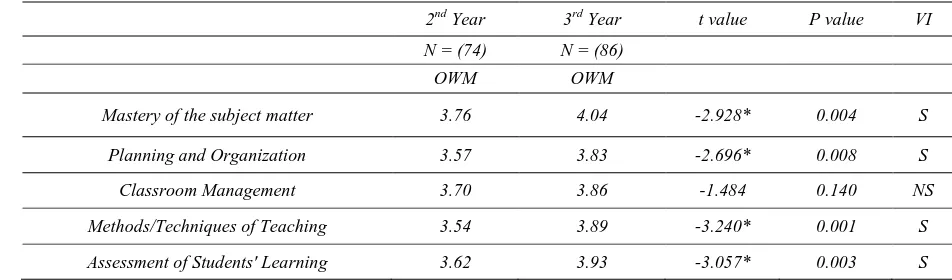
Mastery of the subject matter 3.76 4.04 -2.928* 0.004 S
Planning and Organization 3.57 3.83 -2.696* 0.008 S
Classroom Management 3.70 3.86 -1.484 0.140 NS
Methods/Techniques of Teaching 3.54 3.89 -3.240* 0.001 S
Assessment of Students' Learning 3.62 3.93 -3.057* 0.003 S
Legend:
OWM = Overall Weighted Mean VI = Verbal Interpretation S = Significant
NS = Not Significant
Results explain that the perceptions of second and third year students on the teaching effectiveness of Tariff and Customs courses significantly differed. The result further denotes that third year students gave a higher rating. This is probably because most of their present instructors were also their previous instructors. This being the case, they are probably more adjusted to the instructors’ style of teaching. Thus, they tend to view their instructors’ effectiveness higher than they used to.
There is a significant difference in the perception of the student-respondents when grouped according to year level.
5. Level of Academic Achievement of the Student-Respondents
The computed average grade of the student-respondents was 82 and was interpreted as “fairly satisfactory.”
6. Relationship of the Student-Respondents’ Level of Academic Achievement and their Perceived Effectiveness of Teaching Tariff and Customs Courses
Table 6.1
Relationship of the Student-Respondents’ Level of Academic Achievement and Their Perceived Effectiveness of Teaching Tariff and Customs Courses
Variable MSM VI PAO VI CM VI MTT VI ASL VI
Academic Achievement -0.020 NS -0.028 NS -0.012 NS -0.026 NS -0.059 NS
** Correlation is significant at the 0.01 level (2-tailed). * Correlation is significant at the 0.05 level (2-tailed).
Legend: MSM – Mastery of the Subject Matter PAO – Planning and Organization CM – Classroom Management
MTT – Methods/Techniques of Teaching ASL – Assessment of Students’ Learning VI – Verbal Interpretation
S – Significant NS- Not Significant
This implies that the level of the academic achievement of the students does not influence their perceived teaching effectiveness. Moreover, the student-respondents’ academic achievement does not necessarily reflect their perceived effectiveness of the instructors handling Tariff and Customs courses. Regardless of their attained academic achievement, whether it is failed or outstanding or in between, it does not reflect their perceived effectiveness. Therefore, the results imply that if a student is really focused on his/her studies, and has good academic achievement, it does not necessarily mean that the student has a higher perception on the instructors’ teaching effectiveness. Similarly, when a student has lower academic achievement, it does not necessarily mean that the students have a lower perception on the teaching effectiveness.
This is in contrast to what Stallings (1985) claimed that the most consistently replicated findings of teacher effectiveness studies conducted in different countries link student achievement to teaching effectiveness.
There is no significant relationship between the level of academic achievement of the student-respondents and their perceived teaching effectiveness of Tariff and Customs courses.
7. Profile of the Instructor-Respondents 6.1 Age
The instructors of Tariff and Customs courses have the ages, 21, 24 and 28.
The instructors of Tariff and Customs Courses are 2 females and 1 male. 6.3 Civil Status
There are only one married instructor and two single instructors handling Tariff and Customs courses at Midway Maritime Foundation, Inc.
6.4 Year/years of Teaching Experience
One instructor has been teaching for 4 years already, the other one has been teaching for a year, and another one has been teaching for 8 months.
8. Instructor-Respondents’ Perception of the Effectiveness of Teaching Tariff and Customs Courses
The average weighted mean of the instructor-respondents perceived teaching effectiveness of Tariff and Customs courses was 3.9 which can be interpreted as “very satisfactory.”
9. The relationship between the Instructor-Respondents’Profile Variablesand their Perceived Teaching Effectiveness of Tariff and Customs Courses
Table 9.1
The relationship between Instructor-Respondents and Perceived Effectiveness of Teaching Tariff and Customs Courses
Variables MSM VI PAO VI CM VI MTT VI ASL VI
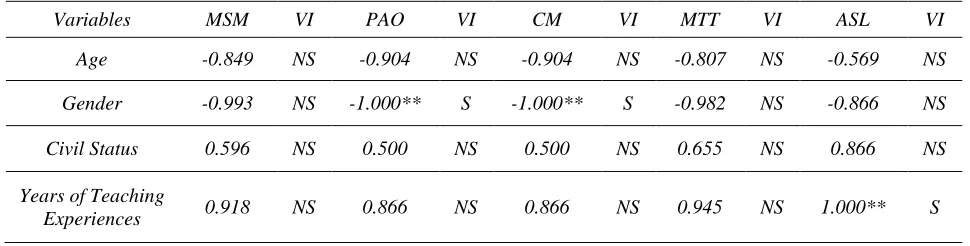
Age -0.849 NS -0.904 NS -0.904 NS -0.807 NS -0.569 NS
Gender -0.993 NS -1.000** S -1.000** S -0.982 NS -0.866 NS
Civil Status 0.596 NS 0.500 NS 0.500 NS 0.655 NS 0.866 NS
Years of Teaching
Experiences 0.918 NS 0.866 NS 0.866 NS 0.945 NS 1.000** S
** Correlation is significant at the 0.01 level (2-tailed). * Correlation is significant at the 0.05 level (2-tailed).
Legend: MSM – Mastery of the Subject Matter PAO – Planning and Organization CM – Classroom Management
MTT – Methods/Techniques of Teaching ASL – Assessment of Students’ Learning VI – Verbal Interpretation
S – Significant NS- Not Significant
Table 9.1 shows the result of this relationship. Among the profile variables tested for correlation, there are two variables found significantly correlated namely: gender and years of teaching experiences. Thus, the null hypothesis was rejected.Gender was negatively correlated but significant with planning and organization (r = -1.000) and classroom management (r = --1.000). Also, years of teaching experiences were correlated with the assessment on students learning.
The results imply that male instructor-respondents were more likely prepared, and organized for their lessons. Also, an instructor who has been teaching longer is more likely to rate his/her teaching effectiveness higher.
Gender and year/years of teaching of the instructor-respondents are significantly related to their perceived teaching effectiveness.
10.Difference between the Perception of the Student-Respondents and the Perception of the Instructor-Respondents about the Teaching Effectiveness of Tariff and Customs Courses
Difference between the Perception of the Student-Respondents and Instructor-respondents in the The effectiveness of Tariff and Customs Courses
Students Teachers t value p value VI
N = (160) N = (3)
Mastery of the Subject Matter 3.91 4.25 -0.922 0.115 NS
Planning and Organization 3.71 3.67 0.119 0.753 NS
Classroom Management 3.79 3.83 -0.118 0.912 NS
Methods/Techniques of Teaching 3.73 3.75 -0.050 0.834 NS
Assessment of Students' Learning 3.79 4.00 -0.556 0.130 NS
OWM 3.79 3.90
*Significant at the 0.05 level Legend:
OWM = Overall Weighted Mean VI = Verbal Interpretation S = Significant
NS = Not Significant
This implies that the mastery of the subject matter could be considered the greatest strength of the instructors handling Tariff and Customs courses. The instructors are probably equipped with vast knowledge of the topics covered. As explained by Salandan (2012), “As a professional, an instructor is expected to be knowledgeable about the subject she is supposed to teach. She must possess not only substantial knowledge but deeper and more advanced in order to be able to teach with confidence and accuracy.” Moreover, Corpuz and Salandan (2011) discussed, “To facilitate learning, the teacher must be expert in her/his subject and skilled in the science and art of teaching.
However, the results also imply that the instructors could still improve their planning and organizing skills. This could be a reminder that although mastery of the subject matter is an essential factor in the teaching effectiveness, it is also important to incorporate proper planning and organizing skills. As Salandan (2012) emphasized, “Planning and organizing daily lesson are tasks that necessitate a smooth integration of the content to be studied and the learning activities that will be undertaken.”
There is no significant difference between the perceptions of the two groups of respondents. Conclusions
Based on the findings, the following conclusions are drawn:
1.The typical student-respondent of this study is 19 years old female who is now in the third year pursuing Bachelor of Science in Customs Administration.
2.The teaching effectiveness of Tariff and Customs courses, as perceived by the student-respondents, is good enough; but it still can be improved.
3.The student-respondents’ gender and year level are influencing factors to their perceived teaching effectiveness.
4.The student-respondents’ year level accounts for the differences in perceived teaching effectiveness.
5.The academic achievement of the student-respondents is still wanting.
6.The student-respondents’ academic achievement does not necessarily reflect their perceived teaching effectiveness of Tariff and Customs courses.
7.The instructors of Tariff and Customs courses in Midway Maritime Foundation, Inc. have varied characteristics in terms of age, gender, civil status and year/s of teaching experience.
9.Gender and year/s of teaching experience of the instructor-respondents are influencing factors to their perceived teaching effectiveness.
10. The two groups of respondents agreed that the teaching effectiveness of Tariff and Customs courses can still be developed and enhanced.
Recommendations
Based on the findings drawn and the conclusions arrived at, the following recommendations are then forwarded. 1. As revealed by the findings, the two groups of respondents agreed that the teaching effectiveness of Tariff and Customs courses can still be improved; therefore, the researchers recommend to the school administrators some actions that are geared towards the improvement of the instructors’ teaching effectiveness. These actions include, but are not limited to, the following:
a. Conduct training, workshops, and seminars that will focus on the development and improvement of the instructors’ teaching-related skills such as teaching methodologies, planning and organization, assessment/evaluation techniques, and classroom management. These should particularly involve instructors who are not graduates of Education courses. They are the ones who do not have a technical background about those areas. This should be done to equip them with the pedagogical skills that, when applied to daily teaching together with their expertise on the subject matter, will more likely increase their teaching effectiveness.
b. Provide scholarship grants to deserving faculty members for them to enroll in the Teacher Certificate Program or any equivalent course. This is to give them the opportunity to acquire knowledge of different Professional Education subjects that will train them to become better teachers when it comes to pedagogical skills.
c. Conduct regular class observations among the faculty members. Evaluate the teaching effectiveness, particularly focusing on the areas in this study where the instructors got low ratings. Utilize the feedbacks and comments from these observations as a basis for regularly mentoring the concerned instructors.
d. Revisit the school plan on maintaining a classroom environment that is conducive to learning. Consider ways of improving the physical condition of the classroom.
2. The instructors, as an important part of the teaching-learning process, should be aware of the importance of their role in improving the teaching effectiveness on the courses they are handling. Thus, these recommendations are offered:
a. Consider the results of this study in reflecting on their teaching effectiveness. The statements that got the highest ratings should be continuously applied to everyday teaching. On the other hand, those that got the lowest ratings should be considered as areas for improvement.
b. Advocate for continuing professional education. The instructors must subject themselves to opportunities on acquiring the needed pedagogical skills. These include, but are not limited to: attending seminars, training and workshops; and earning units on Education courses.
3. Although academic achievement was found to be not significantly related to the perceived teaching effectiveness, it is still a concerning issue to discover that the academic achievement of the student-respondents was only fairly satisfactory. Thus, to help them improve their academic achievement, the following actions were recommended:
a. Conduct regular makeup/tutorial classes. These sessions should particularly involve low-performing students as identified by their instructors. Their attendance in the said sessions shall be considered part of their class attendance.
b. Establish an academic support system for academically-challenged students. This may include peer tutoring, study groups, and the likes.
4. Further research should be done by: a. Using different and larger population;
b. Considering other variables that could possibly have relationships on teaching effectiveness; c. Considering other factors that could possibly influence teaching effectiveness.
i. Ampadul, E. (n.d.). Google. Retrieved January 2016, from
http://www.google.com.ph/url?sa=t&rct=j&q=&esrc=s&source=web&cd=2&cad=rja&uact=8&ved= 0ahUKEwjryaTBh7jKAhXBo5QKHYepCAEQFgglMAE&url=http%3A%2F%2Fwww.acarindex.com%2 Fdosyalar%2Fmakale%2Facarindex-1423904313.pdf&usg=AFQ
jCNGB3xS_ogs3K9VC8V2DdAPrzITrAw&bvm=bv.112064104,d.dGo ii. Aregbeyen, O. (n.d.). Google. Retrieved February 2016, from
http://www.medwelljournals.com/fulltext/?doi=pjssci.2010.62.69.
iii. B. Corpuz (1998). Relationship of Teachers’ Personality traits to Students’ Academic Performance: A basis for Teachers’ Personality Development Program.
iv. Brenda Corpuz & Gloria Saladan, (2011). Principle Of Teaching. Quezon City: Lorimar Publishing, Inc.
v. Carroll, S. D. (2015) Instrument Validity Retrieved from http://www.dissertation-statistics.com/instrument-validity.html.
vi. Chang,Y.-C (n.d.). Retrieved February 2016, from
http://trace.tennessee.edu/cgi/viewcontent.cgi?article=1835&context=utk_gradthes vii. Chung,W.-H.K., & Feng-Ming. (n.d.). Google. Retrieved February 2016, from
http://www.sciedu.ca/journal/ index. php/wje/article/download/5497/3254 viii. Creswell, J.W. (2009) Research Design and Methodology Retrieved from
http://ncbaeryk.yolasite.com/resources/ John%20W.%20Creswell-Research%20Design_%20Qualitative,
%20Quantitative,%20and%20Mixed%20Methods%20Approaches-SAGE%20Publicat ions,%20Inc%20(2009).pdf
ix. D.J. Cacayan, A.R. Condes, G. Cortez, A.J. Estipona, H. Impas and M.B. Magbitang (March 2015). Customer’s Satisfaction in the Quality of Products and Services of A-1 Agro Fertilizer ang Chemical Supply. Nueva Ecija.
x. Delaney, J., Johnson, A., Johnson, T., & Treslan, D. (n.d.). Google. Retrieved February 2016, from http://www.google.com.ph/url?sa=t&rct=j&q=&esrc=s&source=web&cd=16&cad=rja&uact=8&ved =0ahUKEwiep8aiibjKAhWGJJQKHdyNDfE4ChAWCC0wBQ&url=http%3A%2F%2Fwww.mun.ca%2 Feduc%2Ffaculty%2Fmwatch%2Flaura_treslan_SPETHE_Paper.pdf&usg=AFQjCNGxIDYCPvRonX5 A1G-1NB4Y4luUfA&bvm=bv.1120641 04,d.dGo
xi. Dey,A., Choudhury,M.,Mollah,S., & Kim,M.-H. (n.d.). Retrieved February 2016, from http://aeijmr. com/Evaluation%20of%20teaching%20methods%20on%20students%E2%80%99%20academic%20Per formance%20in%20the%20University%20of%20Dhaka.pdf
xii. Edgardo L. Aguinaldo (June 2009). Teachers Motivational Strategies and Students Attitudes in Mathematics Edgardo L. Aguinaldo. Cabanatuan City.
xiii. E.Fardo, A.R. Aquino, A.R Ancheta and J.V. Trinidad ( March 1998). Perception of CAS Students towards the CLSU Faculty Performance Evaluation. Munoz, Nueva Ecija.
xiv. Ely, A.L. (n.d.). Google. Retrieved February 2016, from
http://dc.ewu.edu/cgi/viewcontent.cgi?article=1079&context=theses xv. Farlex F.D. (2015), Descriptive Research Retrieved from
http://medical-dictionary.thefreedictionary.com/Descri ptive+research.
xvi. Gloria Salandanan (2012). Elements of Teaching. Quezon City: Lorimar Publishing, Inc. xvii. Gloria Salandanan, (2012). Methods of Teaching. Quezon City: Lorimar Publishing, Inc
xviii. Lucas, Ph D & Brenda B. Corpuz Ph D, (2011). Facilitating Learning: A Metacognitive Process. Quezon City: Lorimar Publishing, Inc.
xix. Lynn, E. M. & C. E. Lynn (2015) Descriptive Research from
xx. Melloso, C., Cuenca,M., Argallon,J., & Reubal, A. (n.d.). Google. Retrieved February 2016, from http://www.slideshare.net/cristymelloso/educations-students-perception-on-the-professional-qualities-of-cup-teachers-sy-20152016-59143438
xxi. Milagros Borabao, Ph.D. & Heidi Grace Lim- Borabao, Ph. D
a. (2015).Interactive and Innovative Teaching Strategies. Quezon City: Lorimar Publishing, Inc. xxii. Purita P. Bilbao, Brenda B. Corpus, Avelina T. llagas and Gloria G. Salandan, (2012). The
Teaching Profession. Quezon City, Metro Manila: Lorimar Publishing, Inc. xxiii. Shinn, Y.H. (n.d.). Retrieved February 2016, from
http://www.google.com.ph/url?sa=t&rct=j&q=&esrc=s&source=web&cd=20&cad=rja&uact=8&ved =0ahUKEwiep8aiibjKAhWGJJQKHdyNDfE4ChAWCEowCQ&url=http%3A%2F%2Flib.dr.iastate.edu
%2Fcgi%2Fviewcontent.cgi%3Farticle%3D13243%26context%3Drtd&usg=AFQjCNGrCKH9-cB3_vyl_1E_fFGrG7TUlw&bvm=bv. 112064104,d.dGo xxiv. Sutcliff, C.P.(n.d.). Google. Retrieved February 2016, from
http://digitalcommons.georgiasouthern.edu/cgi/viewcontent.cgi?article=1391&context=etd