ADMIXTURE IN CONCRETE
F. O. Okafor
Department of Civil Engineering University of Nigeria, Nsukka.
ABSTRACT
The potentials of cassava flour as a set-retarding admixture in concrete were investigated. Concrete mix proportion of 1:2:4 by weight of cement, sand and coarse aggregate and, water/cement ratio of 0.46 was made with six different dosage levels of cassava flour as admixture. The properties tested include setting time, workability of the fresh concrete and compressive strength of the hardened concrete. These properties were compared with those of similar concrete mix made without cassava flour admixture. It was observed that cassava flour considerably improved the workability of the fresh concrete and delayed the setting time of cement by up to 6 hours. Results of the tests also show that while cassava flour reduced the early strength of concrete, the long-term strength was improved. Cassava flour dosage level of 3% was also found to be the optimum level of addition of the admixture.
KEYWORDS: Admixture; Cassava Flour; Compressive Strength; Retardation; Setting Time; Workability.
1.0 INTRODUCTION
Set-retarding admixtures are chemical additives for concrete. These admixtures generally delay the setting time and reduce the subsequent rate of hydration of cement. Several compounds have been found to exhibit retarding action in concrete and their performance is covered in the part 1 of the British Standard, BS 5075 [1]. Some of these compounds include soluble zinc salts, soluble borates, sugar and carbohydrate derivatives. The performance of retarding admixtures in concrete has been investigated by many researchers [2 – 16] and has been found to offer several advantages in concrete. Retarders are useful in hot weather concreting to offset the effect of high temperatures, which decrease
setting times, or to avoid complications when unavoidable delays between mixing and placing occur. Another important application is in concrete pavement construction [17], where retarders enable farther hauling, thus eliminating the cost of relocating central mixing plants; allows more time for texturing or plastic grooving of concrete; and helps eliminate cold joints in two-course paving.
concrete structures. As a contribution towards reversing this trend, the potentials of cassava flour as a set-retarder are investigated. Cassava tubers are very rich in carbohydrate, relatively cheap, produced locally in very large quantities and the production of flour from these tubers does not require any complicated technology.
This paper is a discussion of the results of an investigation on the potentials of cassava flour as a set-retarding admixture in concrete.
2.0 MATERIALS AND PROCEDURES
2.1 Cassava Flour
Fresh cassava tubers were peeled and chopped into thin slices, washed and sun dried to constant weight. The dried cassava chips were then ground to a fine texture in a mill and the flour obtained sieved with BS sieve No. 85 to remove any chaff present in the flour. The processed flour was then stored in plastic bags. Chemical analysis of the cassava flour gave the follow results. Starch content: 93.24%
Solubility: 8.6% (8.6 g/100 ml of water)
pH (1 gm in 100 ml of water): 6.27 (slightly acidic)
Cyanide content: 4.86%.
2.2 Cement
The cement used in the investigation is ordinary Portland cement marketed by Dangote (Nig.) Ltd and has successfully been in use for laboratory investigations.
2.3 Aggregates
The grading of the river sand used in the tests conformed to the zone 3 requirements
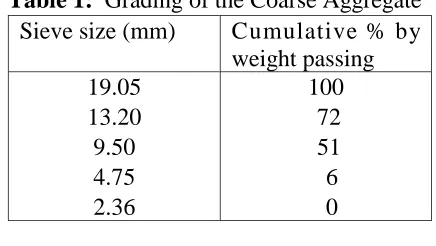
of BS 882 [18]. The coarse aggregate used is natural gravel of lateritic origin with particles size distribution shown in Table 1. The sieve analysis was carried out in accordance with BS 812 [19].
Table 1: Grading of the Coarse Aggregate Sieve size (mm) Cumulative % by
weight passing 19.05
13.20 9.50 4.75 2.36
100 72 51 6 0
2.4 Preparation of Specimens
The mix proportion adopted was 1:2:4 by weight of cement, fine and coarse aggregate and free water/cement ratio of 0.46. Concrete mixes were prepared with cassava flour admixture dosage of 1%, 2%, 3%, 5%, 7% and 10% by weight of cement. For comparisons of properties of the various concretes, control concrete without admixture was also made.
Mixing and compaction was by hand. The required weight of cassava flour admixture was first mixed with cement followed by the addition of fine and coarse aggregate and then water. Workability measurements were carried out on the various concretes by two of three BS1881 [20] standard test methods (slump and compacting factor).
All test specimens were kept under cover with wet jute bags in the laboratory until demoulding at 24 hours after which they were transferred to curing water at room temperature.
on 100 mm cubes, three samples being tested at each age of 3 days, 7 days, 14 days, 28 days and 56 days.
The setting time of cement for the various dosage level of cassava flour was determined in accordance with BS 4550 [21].
3.0 RESULTS AND DISCUSSION
3.1 Setting Time
The results of the setting time tests are presented in Table 2. The results indicate a markedly delay in both the initial and final setting time of cement by the addition of cassava flour up to 3% of the weight of cement. The delay in the initial and final setting time increases with increase in the dosage level of the admixture. Within the range of 3% dosage level, the delay in the initial and final setting time was of the order of about 5 hours and 6 hours respectively.
However, above 3% level of addition of cassava flour there was a decrease in the initial setting time of cement. While shortening of the initial setting time increases with increase in the dosage level of cassava flour, the trend of the final setting time remains unaffected. The observed acceleration of the initial setting time may be attributed to the increased cyanide content of the cement due to the increased quantity of cassava flour. The cyanide probably altering appreciably the alkalinity of the cement environment with consequent acceleration of the initial setting time. However, this condition appears to cease as cyanide becomes exhausted and the retarding action of the carbohydrate restored, hence, the
final setting time remains unaffected. There appears to be an optimum dosage level of cassava flour as a set-retarding admixture. The observed delay in the setting time of cement achieved by the addition of up to 3% cassava flour is within the requirements by the relevant British Standard [1, 22]. Furthermore, acceleration of the initial setting time occurs when the dosage level of cassava flour exceeds 3%, hence, 3% cassava flour by weight of cement appears to be the optimum dosage level of the admixture.
Table 2: Effects of Cassava Flour on the Setting Time of Cement
Cassava Flour Dosage Level Initial Setting Time Final Setting Time
(%) Hrs. Min . Hrs. Min. 0 1 2 3 5 7 10 02 04 06 07 02 01 00 15 10 40 00 10 00 50 03 05 08 09 11 13 -30 40 50 10 30 20
-3.2 Workability
flour which are absorbed on the cement particles giving them a negative charge, and leads to repulsion between the particles with resultant dispersion and greater particle mobility [23]. The degree of improvement of workability of concrete by cassava flour admixture is appreciable,
typically raising the slump and compacting factor from 5 mm and 0.79 to 40 mm and 0.89 respectively for 3% admixture dosage level.
Figu re 1: Effec
t of Cassava Flour Upon Slump and Compacting Factor
It was also observed that the addition of cassava flour in concrete markedly increased the cohesion and plasticity of the mix giving the concrete a better surface finish. This observation was confirmed during the compacting factor tests, as concretes with admixture dosage levels of 3% and above tend to stick in the hoppers and had to be eased by poking with a steel rod.
3.3 Saturated Density
The saturated density results for all mixes
at different ages are presented in Table 3. The results generally showed small increases in saturated density (up to about 24 kg/m ) with increasing time of storage in3
the resulting increase in density. Another factor which may have contributed to the enhanced density of the test concrete may include the effect of the delayed setting resulting to the formation of denser gel [24].
Table 3: Density Test Results
Cassava Flour Dosage
Level, (%)
Saturated density (kg/m ) at3
3 days 7 days 14 days
28 days
56 days
0 2529 2531 2530 2537 2542
1 2536 2532 2548 2554 2558
2 2550 2552 2559 2561 2574
3 2565 2563 2566 2568 2573
5 2558 2555 2561 2563 2665
7 2552 2556 2557 2560 2562
10 2554 2556 2560 2571 2574
3.4 Compressive Strength
Results for the development of compressive
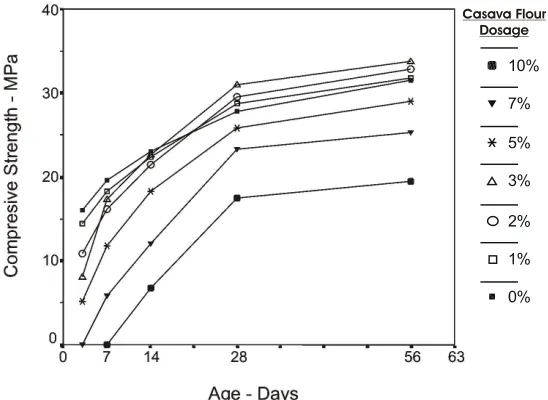
strength up to an age of 56 days for all mixes are shown in Figure 2. It is observed from these results that the trend of compressive strength development with age for concrete containing cassava flour admixture is similar to that obtained for the control concrete. In all cases, the compressive strength continues to increase with age and that, for concretes containing cassava flour in excess of 3% dosage level, the strength remain much lower than the control concrete at all ages. The lower strength is attributed to the prolonged retarding action of cassava flour due to the high dosage level of the admixture. These high dosage levels of cassava flour admixture are detrimental to the strength of concrete as no recordable strength is developed after 3 days and 7 days of age by concretes containing 7% and 10% dosage level of the admixture respectively.
Figure 2: Relationship
However, the compressive strength of concretes with admixture dosage level of 1% to 3% are observed to be much closer to the control concrete, reduction in strength of these concretes being only at the early ages. A closer examination of Figure 2 further shows that concretes with admixture dosage of 1% to 3% developed higher strengths than the control concrete after about 14 days. The higher strength exhibited by the concretes at these ages suggests that the residual retarding effect of
cassava flour is less significant after about 14 days, and strength development at this age is governed by other factors. The major factor contributing to the higher strength development is the enhanced workability and improved degree of compaction achieved by the addition of cassava flour in concrete. Other factors may include the effect of dispersion of cement particles and the formation of denser gel due to delayed setting [23, 24], as also may be observed from the density test results.
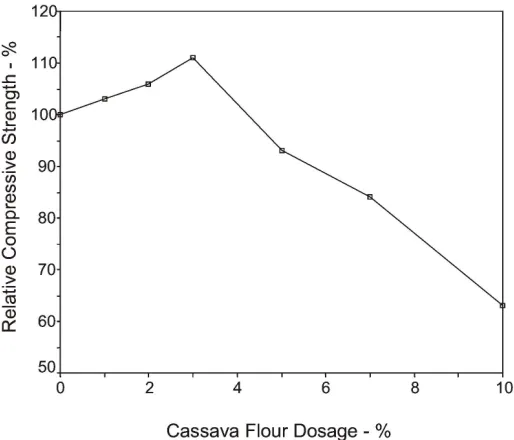
Figure 3: Effect of Cassava
Flour Upon Relative Compressive Strength.
Figure 3 shows the effect of cassava flour dosage level upon the relative compressive strengths of various test concretes, expressed as a percentage of the strength of control concrete at test age of 28 days. The results show that the relative compressive strength of concrete increases with increase in dosage level of cassava flour up to 3%. As the admixture dosage level exceeds 3%,
cement.
4.0 CONCLUSIONS
The flowing main conclusions are drawn from the study:
(1) Cassava flour delays the setting time of cement by up to 6 hours at dosage level not exceeding 3% by weight of cement.
(2) Enhanced workability, compaction and higher density are achieved by the use of cassava flour as admixture in concrete.
(3) Cassava flour exhibits plasticizing effect in concrete and can be used to a d v a n t a g e a s s o c i a t e d w i t h plasticizing admixtures.
(4) Higher long-term compressive strength can be achieved in concrete by the use of cassava flour as admixture.
(5) The optimum dosage level of cassava flour as a set-retarding admixture is 3% by weight of cement.
(6) On the basis of this investigation, it would appear that cassava flour perform satisfactorily as a set-retarding admixture in concrete.
5.0 REFERENCES
[1] BS 5075: Part 1, Specification of Accelerating Admixtures, Retarding Admixtures and Water Reducing Admixtures, British Standard Institution, London, 1982.
[2] N. I. Fattuhi, Influence of Air Temperature on the Setting of Concrete Containing set Retarding
Admixtures, Cem Concr Aggr 7 (1), 1958, 15 – 18.
[3] R. Ashworth, Some Investigations into the use of Sugar as an Admixture to Concrete, Proc. Inst. C.E., London, 31, 1965, 129 – 145.
[4] J. R. Young, A review of the Mechanisms of Set-Retardation of Cement Pastes Containing
Organic Admixtures, Cem Concr Res 2 (4), 1972, 415 – 433.
[5] V. H. Dodson and E. Farkas, Delayed Addition of Set-Retarding Admixtures to Portland
Cement Concrete, Proc. Amer. Soc. For Testing and Materials, 64, 1964, 816 – 829.
[6] C. A. Volick, Effect of Water-reducing Admixtures and Set-retarding Admixtures on the Properties of Plastic Concrete, ASTM Special Tech. Publ. 266, 1960, 170 – 179.
[7] C. F. Scholar, The Influence of Retarding Admixtures on Volume Changes in Concrete, Joint Highway Res. Project Report JHRP – 75 – 21, Purdue University, 1975. [8] A. M. Alshamsi, A. R. Sabouni and
A. H. Bushlaibi, Influence of Set-Retarding Superplasticisers and Microsilica on Setting Times of Pastes at Various Temperatures, Cem Concr Res, 23 (3), 1993, 592-598. [9] I. Soroka and D. Ravina, Hot
W e a t h e r C o n c r e t i n g W i t h Admixtures, Cem Concr Comp, 20 (2-3), 1998, 129-136.
Admixtures on the Setting Times of High-Strength Concrete, Cem Concr Comp, 22 (4), 2000, 293-301. [11] J. D. Bapat, Performance of Cement
Concrete with Mineral Admixtures, Adv Cem Res, 13 (4), 2001, 139-155.
[12] Z. Apagyi and L. J. Csetenyi,Effect of Potassium on Setting Times of Borate Admixed Cement Pastes,
Adv Cem Res, 14 (3), 2002, 127-134.
[13] K. S. Chia and M. H. Zhang, Effect of Chemical Admixtures on Rheological Parameters and Stability of Fresh Lightweight Aggregate Concrete, Mag Concr Res, 56 (8), 2004, 465-473.
[14] Amanmyrat Jumadurdiyev, M. Hulusi Ozkul, Ali R. Saglam and Nazmiye Parlak, The Utilization of Beet Molasses as a Retarding and Water-Reducing Admixture for Concrete, Cem Concr Res, 35, (5), 2005, 874-882.
[15] I. Aiad, Influence of Some Organic Admixtures on the Rheological and Mechanical Properties of Cement Pastes, Adv Cem Res, 18 (4), 2006, 171-177.
[16] F. Raupp-Pereira, L. Silva, A.M. Segadães, D. Hotza and J.A. Labrincha, Potable Water Filtration Sludge: Use as Set Retarder in One-coat Plastering Mortars, Constr and
Build Mat, 21 (3), 2007, 646-653. [17] U. S. Department of Transport,
Federal Highway Administration, Portland Cement Concrete Materials Manual, Report No. FHWA–Ed–89–006, Washington, 1990.
[18] BS 882: Part 2, Specification for Aggregate from Natural Sources for Concrete, British Standards Institution, London, 1983.
[19] BS 812: Part 2, Methods of Sampling and Testing Mineral Aggregates, Sand and Fillers, British Standard Institution, London, 1975.
[20] BS 1881: Part 102, Method for Determination of Slump; Part 103, Method for Determination of C o m pact i ng Fac t o r , Bri t i s h Standard Institution, London, 1983. [21] BS 4550: Part 3, Physical Tests on
C e m e n t , B r i t i s h S t a n d a r d Institution, London, 1978.
[22] BS 12, Ordinary and Rapid-Hardening Portland Cement, British Standard Institution, London, 1978.
[23] A. M. Neville and J. J. Brooks, Concrete Technology, Longman Group Ltd, London, 1987, p. 155. [24] A. M. Neville, Properties of