December 2016, Vol. 4, No. 2, pp. 152-157
ISSN: 2374-2380 (Print), 2374-2399 (Online)
Copyright © The Author(s). 2015. All Rights Reserved.
Published by American Research Institute for Policy Development
DOI: 10.15640/jpbs.v4n2a14
URL: https://doi.org/10.15640/jpbs.v4n2a14
The Use of Virtual Reality as Interactive Media to Support Web-based Navigation
Performance for the Older Adult
Dyi-Yih Michael Lin
1& Yu-Fei Hsu
1Abstract
The feature of virtual reality in displaying three-dimensional digital contents may present particular benefits for the older adult in web-based navigation as spatial cognition has been shown declined with age. Sixteen subjects were recruited in an experiment where age (older vs. young) and web interface (two-dimensional vs. virtual reality) were manipulated as a between-subject and a repeated measure factor respectively. Performances were evaluated in terms of recall accuracy and the number of navigation errors when browsing the web contents. The results indicated the main effects of age and interface were both significant, and so was the interaction. For recall accuracy, the older subject achieved a performance level comparable to that for the young counterpart but only when the virtual reality interface was employed. For navigation error, the virtual reality interface assisted the older subject significantly so that the browsing orientation with this Euclidean space presentation even outperformed the orientation with two-dimensional web pages. Implications for designing web-based media that accommodate age considerations were discussed in details.
Keywords: virtual reality, cognitive aging, navigation, world-wide web, human-computer interaction.
1. Introduction
With rapid advances in computer technology, the World Wide Web (WWW) has evolved into a pervasive information platform on which a wide array of daily business is taking place. Prominent examples include electronic commerce, homepages and information search engines, etc. (Miles & Howes, 2000). Information in WWW is typically presented to the users by web pages that can be cross-referenced (Nielsen, 1990). Although the hyperlinked data structure enables the reader to browse the web contents in a rapid and nonlinear fashion, it often results in a commonly reported problem where the reader is likely to get disoriented in the process of web navigation (Conklin, 1987). The spatial metaphor theory maintained that web navigation consumes mental resources in spatial processing and the activity can be compared to how humans orient themselves in a physical world (Kim & Hirtle, 1995).
The disorientation problem can be very detrimental to a particular group of web users–the older adult. The concurrent trends of population aging and prevalent use of information technology have created a situation where an increasing number of senior citizens will have to deal with computer-based work in their daily routines. The human computer interaction guidelines designed for ordinary users will have to be reexamined because the literature in aging has shown that age is normally associated with declined cognitive functioning (Park, 2000). The reduced cognition with aging can be accounted for by four basic mechanisms, including processing speed (Salthouse, 1996), working memory (Craik, 2014), sensory function (Lindenberger & Baltes, 1994) and inhibition (Hasher, Stoltzfus, Zacks & Rypma, 1991). The disadvantaged cognitive abilities impede older adults from effective interaction with computer-based activities.
1
For example, older adults were less successful in WWW search activities (Mead, Spaulding, Sit, Meyer & Walker, 1997). Older adults were slower and less accurate than their younger counterpart in information seeking in a hierarchical menu (Freudenthal, 2001).
Among the various cognitive functions, spatial ability has been identified as the most promising factor that mediates the age-related change (Kelly & Charness, 1995). In light of the spatial metaphor theory, the reduced spatial cognition thus gives rise to the possibility of using virtual reality/VR as interactive media to support the disadvantaged older adult in web navigation. The hypothesis rests on the idea that VR is a class of computer technology that enables three-dimensional, Euclidean presentation of information contents that can otherwise be expressed only in a traditional two-dimension display (Wilson, 1999). Issues that need to be resolved begin with a fundamental query. If web pages are presented by media enabling virtual three-dimensional display, will the extra processing of spatial metaphor on the browsed contents be saved? Are the saved mental resources in spatial processing transferable and therefore to help improve the performance in retaining the browsed materials? To what extent can this saved mental resources support the disadvantaged older adults in web navigation and retention as a result? By addressing these issues, the present study was aimed at examining the role of an interactive VR interface in assisting the older adult in web-based navigation.
2. Methodology
2.1 Experimental Design
The present study adopted a 2 x 2 mixed factorial design with age and web interface as the two independent variables. Age was defined as a quasi between-subject factor consisting of two treatment levels, namely, older and young groups. Web interface was designed as a repeated-measure variable where virtual reality-based presentation and tow-dimensional traditional presentation were the two treatments. Two aspects of navigation performance in web browsing were assessed. One was concerned with the extent to which the disorientation would occur, and it was operationally defined by the frequency of not visiting the desired web pages, i.e., navigation error. The other aspect evaluated how well the web contents can be retained. As the length of exposure to the experimental stimuli (i.e., web contents) varied from individual to individual, retention accuracy was operationally defined by the hit rate adjusted by a time factor that considers the actual period of reading the web contents by each individual participant divided by the averaged period of the subject group the individual participant belonged to. The recall accuracy measure can thus be expressed mathematically as ARi= Ri* (Ti/Tg), where ARi denotes the adjusted hit rate by subject i who scored an original hit rate of Ri by spending a period of Ti, as compared with the mean period of time Tg spent by the subject group the participant assigned to.
2.2 Participants
Eight older adults and eight college students participated in the experiment. The older subjects aged between 68 and 82 with a mean age of 76. The young subjects aged between 20 and 30 with a mean age of 24. The older subjects were recruited from the students taking part in a computer class administered by a local social welfare program. Five of the older subjects were high school graduates and three of them received college degrees. All the senior participants were Mandarin literate and proficient at basic computer operations such as controlling the mouse and keyboard. Some of the senior participants reported vision problems, which were all resolved prior to entering the experimental session by providing the subjects with vision-corrected glasses. The young subjects were all skilled at operating computer hardware. Each subject was paid for participation at an hourly rate 150 New Taiwan Dollars (approximately 5 US Dollars).
2.3 Materials/ Development of the web interfaces
According to the aforementioned definition of independent variables, two web systems associated with the virtual reality interface and the traditional two-dimensional interface were developed. Healthcare knowledge was selected as the application domain as information of this kind bears practical meanings for the older adults in particular.
As web interface was defined as a repeated measure factor, the experimental materials were designed in such a manner that the contents associated with each browsing path were different from each other to exclude confounding due to the learning-curve transfer. The respective mechanisms of the two web interfaces are described in details as follows.
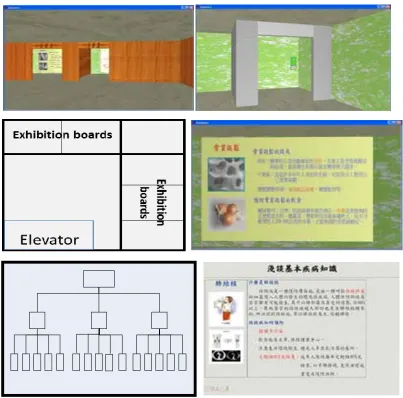
The virtual reality media: The VR system presented the web contents with a presentation style based on spatial metaphor of showrooms and elevators, as illustrated in Figure 1. Specifically, by using 3D Studio and EON, the system developed a three-floor building where elevators connected the floors with each floor consisting of 5 showrooms. The total 15 showrooms were associated with the 15 healthcare topics, each of which was displayed on an exhibition board in the room. Figure 2 shows the floor plan and the exhibition board. Browsing particular web topics requires the user to accurately navigate through the virtual Euclidean space.
Figure 3: The hierarchical structure of the web page interface and one sample web content
2.4 Procedures
During each task, the subject was allowed to take a short break should fatigue occurred (e.g., motion sickness from the virtual reality interface) and was also allowed to ask for assistance for hardware operations. The time spent in breaks and assistance was excluded from the elapsed task time. A five-minute break was proved to the subjects before they took the retention test that was in the form of 10 questions, to which the answers were the information shown in the web contents.
3. Results and Analysis
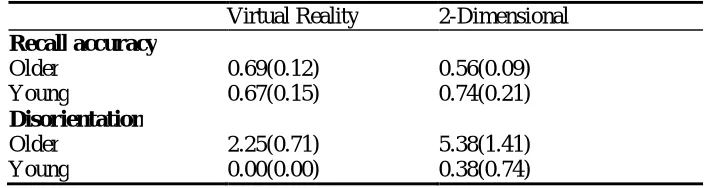
Table 1 shows the descriptive statistics for both measures of recall accuracy and disorientation under the manipulation of age differences and web interface. These data were obtained on the basis that the two age groups shared equal familiarity in the knowledge of the test material. This was evidenced by a pretest that consisted of general healthcare questions, which showed no significant differences on the test scores between the older and young subject (0.525 vs.538, t[12] = 1.02 with equal variance, p < 0.76).
Table 1: Means and (standard deviations) for recall accuracy and disorientation
Virtual Reality 2-Dimensional Recall accuracy
Older 0.69(0.12) 0.56(0.09)
Young 0.67(0.15) 0.74(0.21)
Disorientation
Older 2.25(0.71) 5.38(1.41)
Young 0.00(0.00) 0.38(0.74)
Before conducting ANOVA for the two performance measures, data normality and equal variance were tested by using the Shapiro-Wilk test (W) and Levene’s test (L) respectively. For data normality, the Statistics confirmed that both recall accuracy and disorientation met the requirement of normal distribution, evidence by the p values for the four (2x2) factor combinations that were all larger than 0.10. As far as equal variance is concerned, the p values of L statistics for recall accuracy and disorientation were 0.12 and 0.07, indicating there is no significant difference in internal variances for each of the two measures. The above prerequisites justified the use of ANOVA to examine the impacts of the factors. Because we treated subject as a random-effect variable nested within the age variable (subject (age)), the ANOVA used subject (age) as an error term to test the main effect of age, and used interface x subject (age) as an error term to test the main effect of interface and the age x interface interaction effect.
3.1 Recall Accuracy
Figure 4: The interaction between age and interface for Recall Accuracy
3.2 Disorientation
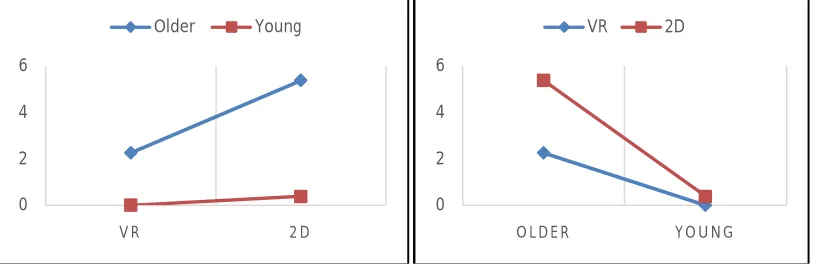
The ANOVA indicated that the main effects of age and interface were both significant (F[1,14] = 106.07, p < 0.0001F[1,14] = 46.51, p < 0.0001 respectively). However, the significant main effects need to be further justified due to the presence of a significant interaction (F [1, 14] = 28.71, p < 0.0001). Figure 5 illustrates the interaction. When the interaction was examined at each age level, the post-hoc Tukey test pointed out that the source of significance was derived from the difference between the virtual reality and traditional interfaces only when the older subject carried out the task. Specifically, the young subject resulted in the same orientation performance regardless of the type of web interfaces employed; nonetheless, whether the interface used is a 3D or 2D presentation did make a difference. The older subject who experienced virtual reality presentation made significant lower navigation errors than when experiencing the traditional interface (2.25 vs. 5.38, p < 0.0001). When the analysis was conducted at each level of presentation media, the post-hoc Tukey test showed that the older subjects were indeed at disadvantage. Specifically, when the traditional interface was employed, the older subject experienced severer disorientation than the young subject, which was evidenced by the significantly higher frequency of navigation errors by the older subject (5.38 vs. 0.38, p < 0.0001). By the same token, the greater difficulty confronting the older subject was also present even when the virtual reality presentation was used (2.25 vs. 0.00, p < 0.0001).
Figure 5: The interaction between age and interface for Disorientation
4. Discussion
In general, the results confirmed the hypothesis of the present study. Older adults are indeed disadvantaged in web-based browsing; nevertheless, the inferior situation can be improved when older readers navigate through web pages by using virtual reality as interactive media. The discussion will begin with how the two subject groups fare with the different browsing interfaces with respect to retention performance. As indicated by the results, when the traditional interface was used, the older subject scored the recall test significantly lower than the young counterpart. This disadvantaged performance pattern is consistent with the existing literature in human-computer interaction for the elderly. However, it appears from the results that the virtual reality interface plays a supporting role for older adults in the browsing task, as evidenced by the difference in the retention scores that is only due to a chance result.
0 0.5 1 1.5
V R 2 D
Older Young
0 0.5 1 1.5
O L D E R Y O U N G
VR 2D
0 2 4 6
V R 2 D
Older Young
0 2 4 6
O L D E R Y O U N G
Because the web contents for both interface groups were presented on an exhibition board, it is most likely that the source for the improved retention performance would be the simulated real-world scenery provided by the VR interface. We postulate that the VR presentation may prevent the older reader from paying extra efforts in processing the web pages as to the hierarchical relationships among the 15 topics. This saved orientation processing would in turn allow the older reader more and sufficient mental resources to carry out the retention task, therefore resulting in higher recall accuracy.
As far as the performance of orientation is concerned, the results also point to a direction where the older subject who experienced the VR presentation have a better chance of visiting the correct web pages than those who experienced the traditional interface. We postulate that the benefit is derived from the Euclidean presentation of the VR media that is visibly available to the users. Specifically, the VR interface presents the web pages (topics) based on the showroom spatial metaphor so that by virtually walking through theses showrooms, readers can easily develop a cognitive map concerning the hierarchy that defines the relationships among the topics. People who are equipped with a comprehensive and accurate cognitive map fare better in an orientation task, which explains why for both age groups, the VR interface significantly outperforms the traditional counterpart.
Despite the supporting role of the VR interface, the age difference result indicates that the older adult is still not able to catch up with the level of orientation that is comparable to that of the young readers. This data pattern is in line with the literature in cognitive aging, and once again confirms that older adults are indeed disadvantaged particularly in terms of spatial ability. The result suggests that providing an interface alone may not an effective design solution for the older users. Some supplementary strategies such as a wider variety of interface aiding tools and appropriate training may have to come into play if equal access to the web resources for the aged population is to be achieved.
In conclusion, the present study provides empirical evidence concerning the impact of VR presentation on web-based navigation with age difference considerations. It appears from the results that VR does assist the older adults for better retention and orientation in web browsing, and therefore should be considered as supportive interactive media. There are a number of caveats, however, need to be noted. First, the present study recruited only eight participants for each age group and the sample size is not sufficiently large. Secondly, virtual reality presentation can take in a much wider form, such as with a bird-view display. Future research calls for incorporation of more sophisticated VR systems to further examine differentiated impacts on web- based navigation.
References
Conklin, J. (1987). Hypertext: an introduction and survey. IEEE Computers, 20, 17-41. Craik, F. (2014). Aging and cognitive processing. Heidelberg, Germany: Springer.
Freudenthal, D. (2001). Age differences in the performance of information retrieval tasks. Behaviour and Information Technology, 20, 9-22.
Hasher, L., Stoltzfus, E. R., Zacks, R. T. & Rypma, B. (1991). Age and inhibition. Journal of Experimental Psychology: Learning, Memory and Cognition, 17, 163-169.
Kelly, C. L. & Charness, N.: Issues in training older adults to use computers. Behaviour and Information Technology, 14, 107-120.
Kim, H. & Hirtle, S.C. (1995). Spatial metaphor and disorientation in hypertext browsing. Behaviour and Information Technology, 14, 239-250.
Lindenberger, U. & Baltes, P.B. (1994). Sensory functioning and intelligence in old age: A strong connection. Psychology and Aging, 9, 339-355.
Mead, S. E., Spaulding, V. A., Sit, R. A., Meyer, B. & Walker, N. (1997). Effects of age training on World Wide Web navigation strategies. Proceedings of the Human Factors and Ergonomics Society 41st Annual Meeting, 152-156. Miles, G.E. & Howes, A. (2000). A framework for understanding human factors in web-based electronic commerce.
International Journal of Human-Computer Studies, 52, 131-163.
Nielsen, J (1990). Hypertext and hypermedia: The Internet and beyond. Boston, MA: Academic Publishing.
Park, D.C. (2012). The basic mechanisms accounting for age-related decline in cognitive function. In D.C. Park & N. Schwarz (Eds.), Cognitive Aging: A Primer. New York: Psychology Press (pp. 3-21).
Salthouse, T.A. (1996). The processing-speed theory of adult age differences in cognition. Psychological Review, 103, 403-428.