Can We Determine Debt To Equity Levels In Non-Profit Organisations? Answer
Based On Polish Case
Grzegorz Michalski
1, Guenter Blendinger
2, Zoltan Rozsa
3, Anna Cierniak-Emerych
4, Maria
Svidronova
5, Jan Buleca
6, Hemantkumar Bulsara
71,4Wroclaw University of Economics
Komandorska 118/120, PL53345 Wroclaw, Poland
[email protected],[email protected]
2,6TUKE – Technical University of Kosice
Nemcovej 32, Kosice, Slovakia
[email protected], [email protected]
3School of Economics of Public Administration Management in Bratislava
851 04 Bratislava, Furdekova 16, Slovakia
5Univerzita Mateja Bela
Tajovskeho 10, Banska Bystrica, Slovakia
7S.V. National Institute of Technology
Ichchhanath, Surat-395007, Gujarat – India [email protected]
http://dx.doi.org/10.5755/j01.ee.29.5.19666
The goal of the article is to find the answer whether it is possible to propose a model for fixing the best debt levels in the capital structure of non-profit organisations. Capital structure is an indicator that corroborates the level of financial risk. Non-profit organisations are an essential part of the general social policy. When considering the efficiency of non-profit entities from a donor perspective, it is important to take into account the way management uses the resources of a non-profit organisation as well as efficiency of that management activity. Non-profit organisation efficiency should be considered in the context of risk. One of the most important ways to increase probability to face financial distress is too high debt to equity relation. The paper illustrates the relationship between debt and equity in 1,560 Polish non-profit entities. The model which can fix optimal capital structure for a non-profit organisation in its current environment was delivered. The proposal of the paper includes a model which helps to find the optimal level of debt for non-profit organisation environmental conditions. The novelty of the model is based on the full costs of debt financing non-profit entities in the context of donor expectations, which in the Polish social and economic environment means that costs indirectly linked with the realisation of the main aim of the social entity cannot be higher than 10 % of the collected money sources. An additional point of our findings is that in comparison with the current state, Polish non-profit organisations need to improve their way of fixing capital structure.
Keywords: Equity; Foreign Capital; Non-Profit Organisations; Efficiency of NGO.
Introduction
The research question of the paper is about the way to fix capital structure for non-profit organisations which operate with a defined, social economy positive, mission. Wedig et al. (1996) claim that the availability of tax-exempt financing provides tax-based incentives to non-profit entities to issue debt. They also developed a theoretical model in which non-profit entities behave as if they have target levels of tax-exempt debt. The relationship between debt financing and donation levels was also investigated by Kuo et al. (2014). Firstly, they noticed that, according to Magnus et al. (2003) and Yetman (2007), debt financing could have an adverse impact on the charitable donations of
non-profit entities. Secondly, their empirical results proved that debt financing has both a in effect and crowd-out effect on non-profit entity donations. Thirdly, they showed that the crowd-in effect tends to exist in low debt ratio non-profit entities, and the crowd-out effect is often found to exist in not-for-profit entities with higher debt ratios (Kuo et al., 2014). Our findings in the paper are moving in a similar direction, and we have included a model proposed in the paper.
Hemantkumar Bulsara. Can we Determine Debt to Equity Levels in Non-Profit Organisations? Answer Based on Polish Case
significantly and substantially more indebted than non-profit entities. Calabrese (2011b) analysed the static trade-off and pecking order capital structure theories and applied them to non-profits. He examined how non-profits adjust their debt to equity relation over time and also analysed the static trade-off and pecking order of capital structure theories and applied them to non-profit entities. He described how non-profits adjust their debt to equity relation over time and found that non-profit capital structure choices are best explained using the pecking order theory in which internal funds are preferred over external borrowing (Vunjak et al., 2015; Calabrese, 2011b; Smith, 2010). Rosen and Sappington (2016) investigate the decisions of non-profit entities to issue debt, and they test whether the expected value and uncertainty of a profit entity non-financial income affects its capital structure. They also find that debt to equity increase is negatively related to both the expected value and the uncertainty.
Szymanska and Jegers (2016) theoretically described social enterprises taking into consideration their main aims and pointed out the direction which social enterprises should follow to obtain the highest value of their objective functions. Wedig (1994) pointed out that non-profit entities are similar to proprietary firms except that their financial residuals are expensed on a philanthropic activity which is similar to a dividend-in-kind for donors. He also showed how the constraint against paying cash dividends affects the intertemporal paths of capital structure and thus the non-profits dividend-in-kind are similar to dividends in for-profit firms. Non-profit entities are risk-averse over cash flows and fund balance and behave like a risk-averse consumer rather than a risk-neutral firm (Wedig, 1994). Wedig (1994) also used a dynamic model to derive closed-form expressions for the time paths of debt and in comparison with empirical data and confirmed the hypothesis of risk aversion.
Grizzle (2015) examined organisational factors that impact the level of operating reserves in non-profit entities and the relationship of operating reserves with organisational demographics and financial health variables. Tuckman and Chang (1993) analysed why non-profits accrue debt and whether the funds they borrow are used productively. Their work distinguished between productive, problematic, and deferred debt. They also examined the pervasiveness of non-profit debt and the relationship between this debt and non-profit financial health. They found that over 70 percent of the non-profits hold debt, the distribution of this debt is highly concentrated, and the level of debt and leverage varies with asset size and type of activity which is in accord with the findings of that paper. According to them, non-profit entities with higher debt levels are financially healthier than those with lower levels. Long (1976) found that debt to equity decisions must be based on many inputs, including financial valuation, which has not been traditionally applied in the non-profits sector. Reiter et al. (2000) claim that decisions about capital structure in non-profits have the same rules as in for-profit entities (Zietlow, 2010; Marchioni & Magni, 2018).
Schrötgens and Boenigk (2017) and Strydom (2014) suggest that donor-funded non-profit entities have the primary objective of donor utility maximisation to ensure that the resources provided by the donor are utilised in the
most efficient manner possible. Upadhyay et al. (2015) studied the relationship between non-profits’ profitability and cash tied in operational activity.
Rauscher and Wheeler (2012) claim that increased financial pressures on non-profit entities have elevated the importance of working capital management. Efficient working capital management allows non-profit entities to reduce their holdings of current assets and that cash inflows can be used to reduce borrowing. They also examine the relationship between non-profit entity profitability and their performance at managing accounts payable. Singh and Wheeler (2012) investigated the data for 1,397 bond-issuing, not-for-profit US entities within the period 2000 to 2007. They also analysed the relationship between non-profit entity performance at managing the revenue cycle and their profitability and ability to build equity capital. Singh and Wheeler (2012) model four different measures of profitability and equity capital as functions of two key financial indicators. Their results indicated that higher amounts of revenue to a non-profit entity assets were associated with statistically significant increases in equity capital (p < 0.01 for all four models). The authors claim that non-profit entities which generated more revenue per invested assets reported improved financial performance (Singh & Wheeler, 2012). According to them, a statistically significant link exists between lower revenue collection periods and equity (p < 0.01 for three models; p < 0.05 for one model): non-profit entities that collected faster on their revenue reported larger equity values. The findings of Singh and Wheeler (2012) mean that non-profit organisations can enhance their financial viability by improving profitability and enabling equity growth.
Wheeler and Smith (1988) show that the appropriate discount rate for evaluation of capital expenditures depends on risk, leverage, and cost-based reimbursement (Habibpour
et al., 2018). The method presented by Wheeler and Smith can be used to account for these effects that are both practical and consistent with theory. Wacht (1978) deals with the financial problem of integrating debt financing and fund-raising campaigns in non-profit equities. The objective of Wacht´s findings is the model of the capital budgeting process for non-profit entities. Non-profit institutions, as claimed by Wacht, cannot use orthodox cost-benefit tests because of inappropriateness and impracticableness due to the multi-dimensional character of the capital structure decision.
non-profit finances. Woronkowicz’s findings have implications for the financial management of non-profit entities costs of capital (Woronkowicz, 2016).
Wacht (1984) claims that the characteristics of non-profit entities prevent the transfer and successful application of standard financial management solutions to financial management decisions in the non-profit context. Such characteristics include a dual management structure composed of professional and financial managers, restrictions on the disposition of assets and earnings, and the constant threat of illiquidity as the result of the uncoupling of organisational goals and cash flows. The theory of financial management separates the financial management goals from the professional goals (Wacht, 1978). A non-profit entity can survive financially through time while its professional manager pursues utility‐ denominated goals delineated by the organisation's tax‐ exempt status (Wacht, 1984).
Tuckman and Chang (1992) claim that non-profit decision makers have an incentive to earn and accumulate surpluses. They also developed a behavioural model and used it to derive a demand function for equity. They applied such a model to a national sample of 6,168 charitable non-profits and established the hypothesis that non-profit decision makers consciously plan to increase their organisation's equity (Tuckman & Chang, 1992).
Prentice (2016b) claims that financial measures are used in non-profit research to predict funding opportunities. The findings of Prentice suggest that using debt to equity measures in non-profit entities do not guarantee to find the searched answer.
A non-profit organisation may be defined as an entity that is concerned with its activities about the realisation of social value adding mission. Such a mission is realised thanks to sources collected through donations from donors. A donor is an individual (person, firm, other entity) who appreciates social value generated by the realisation of missions by the non-profit organisation. Such appreciation results in supporting non-profit organisations by means of donor donations. A donation is supporting non-profit organisation activities by an amount of money, other assets or volunteer work that the donor delivers to the supported non-profit organisation. The presented discussion contributes to the corporate finance theory in its narrower area concerned about the non-profit entity model of financial management in financial liquidity with efficiency measures as the context. That context is seen by some authors as controversial, especially from the technical point of view. Some authors claim that non-profit finance and its managerial decisions in them are not any different from for-profit business decisions (Hansmann, 1987; Jegers, 2011; Gavurova & Korony, 2016). Such a position is only partially correct. Sloan et al. (1988) and Wedig (1994; 1996) use financial management portfolio theory with modifications to non-profit organisation financial management (see also Jegers & Verschueren, 2006; Soltes & Gavurova, 2015). In this paper, the model of financial debt management in non-profit entities is used from the perspective which states that the primary financial target of the non-profit organisation is the best financially efficient implementation of the mission that causes the donors to support the non-profit organisations (as can be found for example in the works of Leone & Van Horn, 2005; Eldenburg et al., 2011.
Non-profit organisation financial debt management decisions need to take into account the relationship between future effects in the context of risk as debt financing in a specific form that increases financial risk (Bem, 2015). That perspective is close to the creation of for-profit firms’ value (Chapelle, 2010; Siedlecki & Bem, 2016). The requirements for net-working capital linked with the elements shaping it, such as the level of cash tied up in inventories, accounts receivable, cash and near cash assets, the early settlement of accounts payable, are those where the difference can be seen. Not many non-profit entities have to deal with all aspects of debt decisions. Some non-profit entities use only equity and sources from direct donations, redistributing it from the donors to the beneficiaries. Other non-profit entities collect free of charge goods for resale, using incomes for realising the mission (Banociova & Martinkova, 2017). Many non-profit entities are almost identical in operating processes with for-profit businesses but are non-profit because of their mission.
Non-profit entities are an important part of the general social policy in the Polish economy. Numerous targets in education, healthcare, and many other socially key areas are realised by them. It should be remembered, considering the efficiency of non-profit entities from the donor’s perspective, that it is important how the management team uses the resources of the non-profit organisation and if they are used efficiently. The efficiency of a non-profit organisation should be considered in the context of the risk. The lack of financial flexibility is one of the most important reasons for winding up a business. The relationship between debt measures is considered in the paper. Those relationships are also illustrated with data from Polish non-profit entities.
Research
Goal,
Research
Sample
and
Methodology
Hemantkumar Bulsara. Can we Determine Debt to Equity Levels in Non-Profit Organisations? Answer Based on Polish Case
non-profit organizations. Firstly, the paper introduction discusses the current state of the field, next the theoretical model is presented and is confronted with empirical data. A set of Polish data collected from Polish non-profit organizations is used as a research sample in the paper.
The NOFDEL Model
Holding financial debt level at a level defined by the organisation provides advantages rather than negatives, and therefore causes the growth of efficiency. (Garcia-Teruel & Martinez-Solano, 2007; Ranjith, 2008). To measure the effects that changes in financial debt levels produce we can use the NOFDEL model (for non-profit entity financial debt to equity levels). The model is based on the assumption that the non-profit organisation efficiency is the sum of the future free cash flows (FCNPO) discounted by the rate of the cost of the financing capital, which is used for the realisation of a non-profit organisation mission:
n t n t n t t t t t t t npo t t t t CoC HVI CoC SVI CoC FCNPO V FCNPO CAPEX NWR CE EREV p1 1 1 1 1 1
)
( (1)
where SVI – social value indicator, HVI – hedonistic value index, EREV - expected revenues of non-profit organisation, p - probability of realisation expected revenues, CE - cash expenditures (fixed and variable costs), NWR - net working capital requirements, ∆NWR – net working capital requirements increase, CAPEX - capital expenditures resulted from long-term operational investments; ∆Vnpo - non-profit organisation efficiency increase; ∆FCNPOt - future free cash flow growth in period t; and CoC - discount rate equal to cost of the capital rate.
The acceptation of a discount rate to the amount of the average weighted cost of capital (CoC) is needed to estimate the changes in efficiency. Results of the mentioned changes are long-term in their character and strategic in some meaning, although they refer to financial debt level and traditionally short run area decisions, see: (Maness, 2016). We note that the primary financial target of a non-profit organisation is not the enterprise value creation but as close as possible to the realisation of the mission (Zietlow et al., 2007; Bachmann, 2012). Although it may be, for the above reason, controversial to use similar rules for for-profit enterprises, such a solution is proposed in textbook literature (Brigham & Daves, 2004; Khouri et al., 2017; Brigham, 2006).
A modified version of that classical approach is used in the paper is used because the higher risk should be linked with the higher capital cost used to evaluate the future results of the current decision. That approach is also positively connected with the level of efficiency and effectiveness in the realisation of the non-profit organisation mission (Gavurova et al., 2017), while effectiveness is understood here as the more accurate realisation of non-profit organisation donors. The donors spent their money by issuing the organisation the capital and by the revenues sourced in answer as to how the organisation’s mission appeals to their social aims. The cost of financing financial debt level policy is a result of the risk included in the organisation strategy of financing and/or investment in the financial debt level.
The holding and increasing of financial debt level ties up money used for financing financial debt level. On the basis of that it is possible to make an estimation of the free cash flows which are treated as the free amount of money after cash expenses which could be used for future non-profit organisation activities (Trussel, 2012; Hroncova Vicianova, et al., 2017). Non-profit organisation growth usually necessitates increased levels of debt of a non-profit organisation.
The remaining money requirements (that are noted as net working capital requirements growth, ΔNWR) will require a different form of financing. In Figure 1, the influence of financial debt level policy changes on non-profit organisation efficiency is presented. The following decisions change: future free cash flows generated by non-profit organisation operations (FCNPO), time of the organisation life (t) and rate of the cost of capital financing the non-profit organisation operations (CoC). Changes to these three components influence the efficiency of a non-profit organisation (ΔVnpo = non-non-profit organisation efficiency increase). Financial debt level policy decisions changing the terms of realisation of operating cycle create a new financial capital requirements level. Consequently, financial debt level policy has an influence on non-profit organisation efficiency. This comes about as a result of alternative costs of money needed to cover burdens connected with financial debt level and general costs associated with managing financial debt level. Both the first and the second involve modification of the future cost of the capital rate and as a consequence, the non-profit organisation efficiency changes.
Figure 1. The Debt Policy Influence on Non-Profit Organisation
Efficiency
where: EREV - expected revenues of the non-profit organisation, CR - cash revenues, CE - cash expenses (cash expenditures), CAPEX - capital expenditures linked with investing in fixed operating assets; PAR - projected accounts receivable level in the non-profit organisation; ∆NWR – changes in net working capital requirements; p - probability of expected revenues realisation; and t - the time the decision is taken and their results on FCNPO and ∆Vnpo.
Source: own study based on Holmstrom and Tirole (1996, 2000 and 2001), Garcia-Rodriguez and Jegers (2017), Siekelova et al. (2017).
Figure 2. D/E Levels in Polish and European Non-Profit Entities
Source: own study based on data from 1560 Polish Non-profit Entities reported in Database Amadeus product of Bureau van Dijk, [date: 2016
Non-profit entities are a kind of entity that are almost identical as for-profit businesses from the organisational side (Garcia-Rodriguez & Jegers, 2017, Rahman et al.,
2017a). Such entities offer unpaid and paid products and services, and as non-profit entities, they are allowed to generate even large revenues which are sufficient to cover the costs of realisation of their mission, but non-profit entities have no right to collect equity capital through stock issuing and have no stockholders. The main difference between non-profit organisations and for-profit businesses is an economic calculation and the financial motivation of the staff, capital providers, and the whole group of stakeholders. In our results (Figure 2) we can see that the relationship between debt and equity between 2012 and 2015 decreases for Polish non-profit entities. These results provide the information that we can expect a smaller financial risk in such organisations. Similar information is presented in Figure 3., where the same decreasing tendency is illustrated.
Figure 3. The Debt Policy Influence on Non-Profit Organisation
Efficiency
Source: own study based on data from 300 Polish non-profit entities reported in Database Amadeus product of Bureau van Dijk, [date: 2017
MAR 01]
Figure 3. illustrates a Polish non-profit organisation anomaly, where it is clear that many surveyed Polish non-profit organizations want to have debt levels higher than the
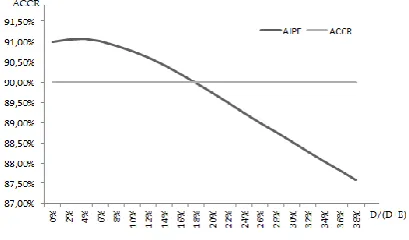
NOFDEL model suggests,. Figure 3 presents the results of the survey among Polish non-profit organisations and can be used as a warning signal about the condition of Polish non-profit organization management teams in the surveyed organisations. Using the rule from equation (1) we can make a simulation for the most suitable debt to capital {D / (D+E)} relationship. In the case of Polish conditions, for 2016, the risk-free rate was about 1.2 % and the endowment rate of return was about 2 %.
Figure 4. Debt to Capital Rate for 2016 Data
Where: ACCR = accepted level of aim performance, AIPE = rate of performance in realization of main goal of social economy entity (according to Polish reality it is not socially accepted if that level is less than 90 %).
Source: own calculations combined with Polish macroeconomic data for 2016.
As presented in Table 1, there is the NOFDEL model mechanism that can be used to fix the best debt share in non-profit organisation. Table 1, together with Fig. 4, shows that, thanks to the knowledge provided by the macroeconomic data about risk free rate and the cost of holding and management of endowment, if there are borderline expectations in indirect expenses for non-profit organisations, debt share cannot provoke crossing that borderline. In 2016 (as presented in Table 1), such a borderline NOFDEL model fixed the expected debt share for the average Polish non-profit organization at a higher level than in 2014. The main source of that difference was the macroeconomic environment represented by a higher financial risk in 2014 than in 2016.
Table 1
Debt to Capital Relationship Influence on Future Performance in Goal Realisation for 2016 Data
k (rf) 1.2 1.2 1.2 1.2 1.2 1.2 1.2 1.2 1.2 1.2 1.2
k (end) 2.0 2.18 2.33 2.43 2.45 2.45 2.43 2.38 2.31 2.21 2.10
Debt share 0 2 4 6 8 10 12 14 16 18 20
k(d) 4 4.06 4.12 4.18 4.24 4.31 4.38 4.46 4.53 4.61 4.70
Indirect expenses 11 11 11 11 11 11 11 11 11 11 11
Endowment share 100 98 96 94 92 90 88 86 84 82 80
Where: k(rf) = risk free rate estimated as the Polish government bonds rate of return, k(end) = productivity of endowment kept by social economy entities, DEBT = share of debt in whole social economy entity capital, k(d) = rate of cost of debt financing social economy entity, Indirect expenses = information about expenses of a social economy entity that are not mutually linked with the main goal for which the organisation operates, Endowment share = information how large is the endowment part in capital involved in a social economy entity, Aim performance (AIPE) = rate of performance in realization of the main goal of a social economy entity (according to Polish reality it is not socially accepted if that level is less than 90 %).
Source: own calculations combined with Polish macroeconomic data for 2016.
As we can see, when the accepted level of aim performance is not less than 0.9 (ACCR = min 90 %), then
non-Hemantkumar Bulsara. Can we Determine Debt to Equity Levels in Non-Profit Organisations? Answer Based on Polish Case
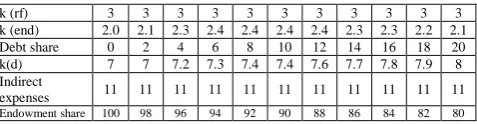
profit social economy entities under Polish conditions with a risk-free rate of 1.2 % and the average unleveraged cost of debt at a level of 4.0 %. If the risk-free rate will be similar to that in Poland in 2014, i.e. 3 % and the average unleveraged cost of debt at a level of 7.0 %, then the situation with the choice should be the same as that in table 2.
Figure 5. Debt to Capital Rate for 2014 Data
Source: own calculations combined with Polish macroeconomic data for 2014.
Table 2
Debt to Capital Rate Influence on Future Performance in Goal Realisation for 2014 Data
k (rf) 3 3 3 3 3 3 3 3 3 3 3
k (end) 2.0 2.1 2.3 2.4 2.4 2.4 2.4 2.3 2.3 2.2 2.1
Debt share 0 2 4 6 8 10 12 14 16 18 20
k(d) 7 7 7.2 7.3 7.4 7.4 7.6 7.7 7.8 7.9 8
Indirect
expenses 11 11 11 11 11 11 11 11 11 11 11
Endowment share 100 98 96 94 92 90 88 86 84 82 80
Source: own calculations combined with Polish macroeconomic data for 2014
As we can see in Fig. 5 and Table 2, when the accepted level of the aim performance (ACCR) is no smaller than 90 %, the debt to capital (D/{D+E}) relationship should not be higher than 12 %. That level should be recommended for non-profit social economy entities under Polish conditions with a risk-free rate at 3 % and the average unleveraged cost of debt at a level of 7 %.
Practical Consequences for Non-Profit Entities
There are the differences in treating the entitlements of people who control entities in prohibiting the distribution of earnings and excess of revenues over expenses of the organisation: Equity type capital providers can expect a return on money in case the business makes an excess of revenues over expenses from operations (Bayaraa, 2017). Non-profit entities do not have the right to issue stock whereas the equity of non-profit entities is issued by donors and persons who have no right to express control over the non-profit organisation (Rahman et al., 2017b; Dubravska
et al., 2015). Equity type capital providers of non-profit entities in the case of non-profit organisations generate money or excess of revenues over expenses from operations and can consider future support for the organisation but cannot withdraw the money previously tied in the organisation (Calabrese & Grizzle, 2012; Aregbeyen, 2013). In non-profit entities, there is no equity capital, but non-profit entities collect fund capital, which is the
equivalent of equity capital. Fund capital is collected in non-profit entities by earning an excess of revenues over expenses, which are forced by regulation as money, which should be retained within the non-profit organisation. Another source of fund capital is by receiving contributions from individual persons, from private or public entities, and from for-profit businesses. The last possibility to collect fund capital is money from grants received by non-profit entities from governmental entities. Calabrese (2011a; 2011b); indicates that non-profit capital structure choices are best explained using the pecking order theory, which means that in non-profit entities their internal funds are used more likely than external borrowing (Zwolak, 2016).
Non-profit entities act because of expected future advantages measured by the realisation of ideas and missions that are an expression of the donors’ vision of the world. Both non-profit and for-profit entities have an aim, which is a result of its owner’s preferences (Pope, et. al. 2014). For-profit entities are active because of expected future advantages measured in money; non-profit entities do their business because of expected future advantages measured by the degree of realisation of their mission (Stryckova, 2017; Mura et al., 2017; Duda et al., 2017).
Non-profit entities serve in each area of social activities and depending on their size can be registered or not with the internal revenue authorities. Types of non-profit entities are, for example, educational businesses like universities or schools, healthcare entities like hospitals, and charities working as branches of religious institutions.
Conclusion
According to our model, Polish non-profit organizations should use debt levels of around 18–20 %. That is a smaller debt level than they use now. According to our survey data, the surveyed non-profits wished to have higher than 30 percent of debt in their capital structure, these are levels also reported in other European studies. Garcia-Rodriguez and Jegers (2017) found that average levels for the EU non-profits analysed in their study are more than 32 percent of debt (for Belgium, Spain and the United Kingdom). In our study, we have used macroeconomic indicators for 2014 and 2016 for the Polish environmental conditions. The 2016 data is the most recent possible data, whereas the 2014 data was the first earlier data which significantly differs from the most recent one.
Polish non-profit entities are an important part of general social policy in the Polish economy. They realise important aims in healthcare, in education and many other socially important areas. When considering any efficiency of non-profit organisations it should be remembered that from the donor perspective, it is important the way the management team uses the resources of the non-profit
organisation and if they are used as efficiently as possible. The non-profit organisation efficiency should be considered in the context of risk (Gaver et al., 2016). One of the most important ways to be out of business is the lack of money for the realisation of the aim of the organisation. The paper considered the relationship between debt measures. That relationship was also illustrated for the data of Polish non-profit entities.
Our research goal was reached, and we can conclude that it is possible to determine the capital structure of non-profit organisations if we know the habits among the donors of non-profit organisations and the macroeconomic data from the environment in which the non-profit organisation operates. Thanks to our findings it is possible to be closer to a much more efficient management of non-profit organisation debt, which is necessary to have a much more efficient non-profit sector in society. The policy makers, who should be interested in the efficiency in realisation of the mission of social economy entities, can influence part of the indicators which describe the environment of non-profits and they have the possibility to increase social effects through economic indicator engineering.
Acknowledgments
The presented work and results are part of a monothematic cycle realised as part of the grant titled: Determinants of capital structure in non-profit organisations. The work is supported by the National Science Centre and financed from Polish budget resources in the period 2016-2019 in accordance with contract UMO-2015/19/B/HS4/01686 as the research project DEC-2015/19/B/HS4/01686
References
Aregbeyen, O. (2013). The effects of working capital management on the profitability of Nigerian manufacturing firms.
Journal of Business Economics and Management, 14(3), 520–534. https://doi.org/10.3846/16111699.2011.651626
Bachmann, P. (2012). Some problems of Czech non-profit sector transparency. E a M: Ekonomie a Management, 15(2), 104–114.
Banociova A., & Martinkova S. (2017). Active Labour Market Policies of Selected European Countries and Their Competitiveness. Journal of Competitiveness 3/2017, Sep, https://doi.org/10.7441/joc.2017.03.02
Bayaraa B. (2017). Financial Performance Determinants of Organizations: The Case of Mongolian Companies. Journal of Competitiveness 3/2017, Sep.https://doi.org/10.7441/joc.2017.03.02
Bem, A. (2015). Hospital profitability vs. selected healthcare system indicators. CEFE 2015–Central European Conference in Finance and Economics, 52–61.
BOPP. (2011). Database of Polish NPO’s (online) 2011. (cit. December 2011) <https://bopp.pozytek.gov.pl>; < http://dx.doi.org/10.6084/m9.figshare.95454 >.
Borlea, S. N., Achim, M. V., & Mare, C. (2017). Board characteristics and firm performances in emerging economies. lessons from Romania. Economic Research-Ekonomska Istrazivanja, 30(1), 55–75. https://doi.org/10.1080/13316 77X.2017.1291359
Brigham E. F. (2006). Financial Management 11e, http://www.swlearning.com/finance/brigham/theory11e/web_chapters/ bri59689_ch30_web.pdf (last visit: April 2011).
Brigham E. F., & Daves, P. (2004). Intermediate Financial Management, Thomson, Mason.
Burak Guner, A., Malmendier, U., & Tate, G. (2008). Financial expertise of directors. Journal of Financial Economics, 88(2), 323–354. https://doi.org/10.1016/j.jfineco.2007.05.009
Calabrese, T., & Grizzle, C. (2012). Debt, donors, and the decision to give, Journal of Public Budgeting. Accounting and
Financial Management, 24(2), 221–254
Calabrese, T. D. (2011). Testing competing capital structure theories of non-profit organizations. Public Budgeting & Finance, 31(3), 119–143.https://doi.org/10.1111/j.1540-5850.2011.00989.x
Hemantkumar Bulsara. Can we Determine Debt to Equity Levels in Non-Profit Organisations? Answer Based on Polish Case
Chapelle, K. (2010). Non-profit and for-profit entrepreneurship: a trade-off under liquidity constraint. International Entrepreneurship and Management Journal, 6(1), 55–80. https://doi.org/10.1007/s11365-007-0071-y
Dubravska, M., Mura, L., Kotulic, R., & Novotny, J. (2015). Internationalization of entrepreneurship - motivating factors: Case study of the Slovak republic. Acta Polytechnica Hungarica, 12(5), 121–133.
Duda, J., Gasior, A., & Alebaite, I. (2017). Innovation of Polish micro and small enterprises and trade credit. Transformations in Business and Economics, 16(3), 89–108.
Eldenburg L. G., Gunny K. A., Hee K. W., & Soderstrom N. (2011). Earnings management using real activities: evidence from non-profit hospitals. The Accounting Review, 86(5), 1605–1630.https://doi.org/10.2308/accr-10095
Gaver, J. J., Harris, E. E., & Im, S. M. (2016). Determinants and consequences of non-profit debt ratings. Accounting Horizons, 30(3), 363–378. https://doi.org/10.2308/acch-51456
Gavurova, B., Belas, J., Kocisova, K., Dapkus, R., & Bartkute, R. (2017). Revenue and cost efficiency of banking sectors in the European union countries: do they depend on size, location or crisis period?, Transformations in business & economics 16(2), 124–146.
Gavurova, B., & Korony, S. (2016). Efficiency of day surgery in Slovak regions during the years 2009–2014, Economic Annals-XXI, 159 (5/6), 80–84. https://doi.org/10.21003/ea.V159-17
Garcia-Rodriguez, I., Jegers, M. (2017). Capital Structure of Nongovernmental Development Organizations: First Cross-Country Evidence. Non-profit Management and Leadership 28(2), 175–194. https://doi.org/10.1002/nml.21275 Garcia-Teruel, P. J., & Martinez-Solano, P. (2007). Effects of working capital management on SME profitability.
International Journal of Managerial Finance, 3(2), 164–177. https://doi.org/10.1108/17439130710738718
Gonzales-Bustos, J. P., & Hernandez-Lara, A. B. (2016). Corporate governance and innovation: A systematic literature review. Corporate Ownership and Control, 13(3), 33–45. https://doi.org/10.22495/cocv13i3p3
Grizzle, C., Sloan, M., & Kim, M. (2015). Financial factors that influence the size of non-profit operating reserves, Journal of Public Budgeting. Accounting and Financial Management, 27(1), 1 March 2015, 67–97.
Habibpour, M. M., Peiffer, M., Pepermans, R., & Jegers, M. (2018). How giving affects giving: A long-term analysis of donations. Applied Economics, 50(21), 2402–2413. https://doi.org/10.1080/00036846.2017.1397853
Hansmann, H. B. (1987). Economics theories of non-profit organization. In: Powell, W.W. (Ed.). The non-profit sector: a research handbook. Yale University Press, New Haven, CN, 27–42.
Holmstrom, B., & Tirole, J. (1996). Modelling Aggregate Liquidity, The American Economic Review, 86(2), Papers and Proceedings of the Hundredth and Eighth Annual Meeting of the American Economic Association San Francisco, CA, January 5–7, 1996. (May, 1996), 187–191.
Holmstrom, B., & Tirole, J. (2000). Liquidity and Risk Management. Journal of Money, Credit and Banking, 32(3), Part 1. (Aug. 2000), 295–319.https://doi.org/10.2307/2601167
Holmstrom B., Tirole J., (2001). LAPM: A Liquidity-Based Asset Pricing Model, The Journal of Finance, 56(5). (Oct. 2001), 1837–1867.https://doi.org/10.1111/0022-1082.00391
Hroncova Vicianova, J., Jaďuďova, J., Hronec, M., & Rolikova, S. (2017). Developing eco-innovation in business practice in Slovakia. Journal of Business Economics and Management, 18(5), 1042–1061. https://doi.org/10.3846/16111 699.2017.1381146
Jegers M. (2011). Financing constraints in non-profit organisations: A Tirolean approach. Journal of Corporate Finance, 17 (2011), 640–648.https://doi.org/10.1016/j.jcorpfin.2010.11.002
Jegers M., Verschueren I., (2006). On the capital structure of non-profit organisations: an empirical study for Californian organisations. Financial Accountability and Management, 22(4), November 2006, 309–329. https://doi.org/10.1111/j.1468-0408.2006.00428.x
Khouri, S., Sandorova, K., Cehlar, M., & Horansky, K. (2017). Expected life expectancy and in selected European countries,
Transformations in Business and Economics, 16(2B), 638–655.
Kuo, J., Ho, Y., & Lo, K. (2014). The relation between debt financing and not-for-profit hospitals' donations, NTU
Management Review 24(2), 151–180.
Leone A. J., & Van Horn, R. L. (2005). How do non-profit hospitals manage earnings?, Journal of Health Economics, 24, 815–837.https://doi.org/10.1016/j.jhealeco.2005.01.006
Long, H. (1976). Valuation as a criterion in not-for-profit decision-making. Health Care Management Review 1(3), Summer 1976, 34–46.https://doi.org/10.1097/00004010-197600130-00007
Magnus, S., Smith, D., & Wheeler, J. (2003). Agency implications of debt in not-for-profit hospitals: A conceptual framework and overview. Research in Healthcare Financial Management 8(1), 7–17.
Marchioni, A., & Magni, C. A. (2018). Investment decisions and sensitivity analysis: NPV-consistency of rates of return.
European Journal of Operational Research, 268(1), 361–372. https://doi.org/10.1016/j.ejor.2018.01.007
McGuinness, G., Hogan, T., & Powell, R. (2018). European trade credit use and SME survival. Journal of Corporate Finance, 49, 81–103. https://doi.org/10.1016/j.jcorpfin.2017.12.005
Mura, L., Kljucnikov, A., Tvaronaviciene, M., & Androniceanu, A. (2017). Development trends in human resource management in small and medium enterprises in the Visegrad group. Acta Polytechnica Hungarica, 14(7), 105–122. Peter Smith, G. (2010). What are the capital structure determinants for tax-exempt organizations? Financial Review, 45(3),
845–872. https://doi.org/10.1111/j.1540-6288.2010.00274.x
Pope, J. A., Saigal, A., & Key, K. A. (2014). Do small non-profit organizations outsource? A first look. Voluntas 26(2), 553–573. https://doi.org/10.1007/s11266-014-9447-0
Prentice, C. (2016a). Understanding Non-profit Financial Health: Exploring the Effects of Organizational and Environmental Variables. Non-profit and Voluntary Sector Quarterly 45(5), 888–909. https://doi.org/10.1177/0899764015601243
Prentice, C. (2016b). Why So Many Measures of Non-profit Financial Performance? Analyzing and Improving the Use of Financial Measures in Non-profit Research. Non-profit and Voluntary Sector Quarterly 45(4), 715–740.
https://doi.org/10.1177/0899764015595722
Rahman, A., Belas, J., Kliestik, T., & Tyll, L. (2017). Collateral requirements for sme loans: empirical evidence from the visegrad countries. Journal of business economics and management 18 (4), 650–675. https://doi.org/10.3846/161116 99.2017.1357050
Rahman, A., Rahman, M., & Belas, J. (2017). Determinants of SME Finance: Evidence from Three Central European Countries. Review of economic perspectives, 17 (3), 263–285. https://doi.org/10.1515/revecp-2017-0014
Ranjith A. B. A. (2008). The Impact of Firms’ Capital Expenditure on Working Capital Management: An Empirical Study across Industries in Thailand. International Management Review, 4(1), 8–21.
Rauscher, S., & Wheeler, J. (2012). The importance of working capital management for hospital profitability: Evidence from bond-issuing, not-for-profit U.S. hospitals. Health Care Management Review, 37(4), 339–346. https://doi.org/10. 1097/HMR. 0b013e3182224189
Reiter, K., Smith, D., Wheeler, J., & Rivenson, H. (2000). Capital investment strategies in health care systems, Journal of
Health Care Finance 26(4), June 2000, 31–41.
Rosen, H., & Sappington, A. (2016). To borrow or not to borrow? An analysis of university leverage decisions. Research in Economics 70(1), 170–185.https://doi.org/10.1016/j.rie.2015.10.005
Schrotgens, J., & Boenigk, S. (2017). Social impact investment behavior in the non-profit sector: First insights from an online survey experiment, 28(6), 2658–2682.
Seifert, D., Seifert, R. W., & Protopappa-Sieke, M. (2013). A review of trade credit literature: Opportunities for research in operations. European Journal of Operational Research, 231(2), 245–256. https://doi.org/10.1016/j.ejor.2013.03.016 Siekelova, A., Kliestik, T., Svabova, L., Androniceanu, A., & Schonfeld, J. (2017). Receivables management: The
importance of financial indicators in assessing the creditworthiness. Polish Journal of Management Studies, 15(2), 217–228. https://doi.org/10.17512/pjms.2017.15.2.20
Siedlecki, R., & Bem, A. (2016). Rural Versus Urban Hospitals in Poland. Hospital's Financial Health Assessment.
Procedia-Social and Behavioral Sciences, 220, 444–451. https://doi.org/10.1016/j.sbspro.2016.05.519
Singh, S., & Wheeler, J. (2012). Hospital financial management: What is the link between revenue cycle management, profitability, and not-for-profit hospitals' ability to grow equity?, Journal of Healthcare Management 57(5), 325–339.
https://doi.org/10.1097/00115514-201209000-00007
Sloan F. A., Valvona M., Hassan M., & Morrisey M. A., (1988). Cost of capital to the hospital sector, Journal of Health
Economics, 7(1), 25–45.https://doi.org/10.1016/0167-6296(88)90003-3
Soltes, M., & Gavurova, B. (2015). Quantification and Comparison of Avoidable Mortality – Causal Relations and Modification of Concepts. Technological and Economic Development of Economy, 21 (6), 917–938. https://doi.org/10.3846/20294913.2015.1106421
Stryckova, L. (2017). The Relationship between Company Returns and Leverage Depending on the Business Sector: Empirical Evidence from the Czech Republic. Journal of Competitiveness 3/2017, Sep. https://doi.org/10.7441/joc.2017.03.07
Strydom, B., & Stephen, T. (2014). Financial Management in Non-Profit Organisations: An Exploratory Study.
MediterraneanJournal of Social Sciences 5(15), 55–66.https://doi.org/10.5901/mjss.2014.v5n15p55
Szymanska, A., & Jegers, M. (2016). Modelling social enterprises. Annals of Public and Cooperative Economics 87(4), 501– 527.https://doi.org/10.1111/apce.12127
Hemantkumar Bulsara. Can we Determine Debt to Equity Levels in Non-Profit Organisations? Answer Based on Polish Case
Tuckman, H., & Chang, C. (1992). Non-profit equity: A behavioural model and its policy implications. Journal of Policy Analysis and Management 11(1), 76–87.https://doi.org/10.2307/3325133
Tuckman, H., & Chang, C. (1993). How well is debt managed by non-profits?, Non-profit Management and Leadership
3(4), 347–361.https://doi.org/10.1002/nml.4130030403
Turner, J., Broom, K., Elliot, M., & Lee, J. (2015). A comparison of capital structure: The use of debt in investor owned and not-for-profit hospitals. Journal of Health Care Finance 41(4).
Upadhyay, S., Sen, B., & Smith, D. (2015). The cash conversion cycle and profitability: A study of hospitals in the state of Washington. Journal of Health Care Finance 41(4).
Wacht, R. (1984). A financial management theory of the non-profit organization. Journal of Financial Research 7(1), Spring 37–45.https://doi.org/10.1111/j.1475-6803.1984.tb00352.x
Wacht, R., (1978). A capital budget planning model for non-profit hospitals. Inquiry 15(3), 234–245.
Wedig, G., Hassan, M., & Morrisey, M. (1996). Tax-exempt debt and the capital structure of non-profit organizations: An application to hospitals. Journal of Finance 51(4), 1247–1283.https://doi.org/10.1111/j.1540-6261.1996.tb04069.x Wedig, G. J. (1994). Risk, leverage, donations and dividends-in-kind: a theory of non-profit financial behaviour.
International Review of Economics and Finance, 3(3), 257–278.https://doi.org/10.1016/1059-0560(94)90011-6 Wheeler, J., & Smith, D. (1988). The discount rate for capital expenditure analysis in health care. Health Care Management
Review 13(2), 43–51.https://doi.org/10.1097/00004010-198813020-00006
Woronkowicz, J. (2016). Is Bigger Really Better? The Effect of Non-profit Facilities Projects on Financial Vulnerability.
Non-profit Management and Leadership 27(1), 79–94.https://doi.org/10.1002/nml.21209
Vunjak, N., Milenkovic, N., Andrasic, J., & Pjanic, M. (2015) Stress test model for measuring the effects of the economic crisis on the capital adequacy ratio. Acta Polytechnica Hungarica, 12(5), 173–190.
Yetman, R. (2007). Borrowing and debt, Financing Non-profits: Putting Theory into Practice, Young, D. Ed., Lanham, MD: AltaMira Press, 243–268.
Zietlow J. (2010). Non-profit financial objectives and financial responses to a tough economy. Journal of Corporate Treasury Management, 3(3)., Henry Steward Publications, 238–248.
Zietlow J., J. A. Hankin, A., & Seidner. G. (2007). Financial Management for Non-profit Organizations, Wiley, New York, 6–7.
Zwolak, J. (2016). Innovative undertakings in the polish industry. Zbornik Radova Ekonomskog Fakultet Au Rijeci, 34(1), 147–160.