Use of Low-Cost Pest Exclusion Net to Control Tuta absoluta
Infestation and Boost the Yield of Tomato in Surkhet and Dang
Districts of Nepal
*Kiran Bhusal
1, Sagar G.C
2, Kamana Bhattarai
31Department of Entomology, Institute of Agriculture and Animal Science, Kritipur, Kathmandu, Nepal 2Department of Pathology, Agriculture and Forestry University, Rampur, Chitwan, Nepal
3Department of Agri-economics, Himalayan College of Agricultural Sciences and Technology, Sanepa, Lalitpur, Nepal
Low cost pest exclusion nets (PENs) of 0.4 mm mesh sizes was evaluated to determine their efficacy in reducing Tuta absoluta infestation and enhancing yields of tomato (Solanum
lycopersicum Miller) at Dang and Surkhet of Nepal, from December, 2016 to June, 2017 at field
production levels. The PENs efficiency was compared with no net (control) in a randomized complete block design with 14 replications. Results showed the lower tomato leaf miner (Tuta
absoluta) infestation (P<0.05) with higher yield (P<0.05) on tomato grown under PENs with high
incomes. The results revealed that the farmers can adopt the use of PENs for pest management in tomato production to easily control the invasive pest of tomato and obtain the higher yield. Hence, farmers can use low cost pest exclusion nets to control the invasive insects of tomato.
Key words: Invasive, Solanum lycopersicum Miller, Pest Exclusion Net, Tuta absoluta
INTRODUCTION
Tomato (Solanum lycopersicum Miller) is an important vegetable grown in Nepal, but its production is constrained by several pests and diseases. Tomato is usually grown under commercial and subsistence agriculture, characterized by high use of pest control products, water and fertility management options. However, its annual production in Nepal is 19.3 metric tons (MT) per ha, (MoAD, 2015/16) which is far below worldwide production of 37.46 MT per ha. (FAOSTAT Database, 2016). The highest marketable yield was recorded from all-rounder (86.6 t/ha) followed by Srijana (80.8 t/ha) in Nepal under tunnel house (Chapagain et al., 2011). South American tomato leaf miner, Tuta absoluta (Meyrick) (Lepidoptera: Gelechiidae) is an invasive and devastating pest of tomato. The species has a particular preference for tomato although it is also able to attack and cause damage on different genera and species of the Solanaceae Family. This pest can reduce 80-100 percent of tomato yield in newly invaded areas if control measures are not applied (Desneux et al., 2010). The pest has appeared as a havoc causing higher crop loss with higher economic importance in Nepal. This pest was recorded for first time in Nepal from Kathmandu valley during May, 2016 and found spread into
tomato growing areas near Kathmandu valley and surrounding districts; Kavrepalanchowk, Dhading and Nuwakot (Bajracharhya et al., 2016). The impact of T. absoluta on tomato crops, during the first years after its detection, has led European and North African growers to use insecticides extensively (Sannino & Espinosa, 2010, Speranza & Sannino, 2012, Urbaneja et al., 2012). Chemical control is often very effective as a short-term solution; by contrast, its major drawbacks are the high costs, the non-target effects, and the possibility of the pest species developing resistance (Desneux et al., 2007, Lu et al., 2012). A potential means to break the reliance on pesticides is physical exclusion of pests using nets with a fine mesh screen as part of an integrated pest management (IPM) approach (Vidogbéna et al., 2015).
*Corresponding Author: Kiran Bhusal, Department of Entomology, Institute of Agriculture and Animal Science, Kritipur, Kathmandu, Nepal. Tel: 9851226246
Email: [email protected]
Co-Authors Email: 2[email protected];
Research Article
Insect nets enable passive control of flying insect pests of vegetable crops by creating a physical barrier between the plants and pests (Vincent et al. 2003; Boiteau and Vernon 2004), thus reducing the need for pesticide sprays (Martin
et al. 2006; Licciardi et al. 2008; Weintraub 2009). Recent reports on the effectiveness of mosquito nets against DBM (Diamond Back Moth) (Licciardi et al., 2008; Martin et al., 2013) opened a window for exploring the use of low cost pest exclusion nets (PENs) in managing the invasive pest by smallholder farmers. Additional advantages of such nets include moderation of microclimate, which is known to improve the crop performance (Briassoulis et al., 2007). However, the possibility of using the nets in the plastic tunnels to control T. absoluta has received limited attention. Therefore, this study was carried out to test the efficiency of the PENs in managing invasive tomato pests and PENs contribution to increased tomato yields.
MATERIALS AND METHODS
Study area
The study was conducted on farmer's field at Thulo Harre, Surkhet and Satbariya, Dang. Surkhet and Dang are located northwest of capital of Nepal comprising 82.00º to 82.46º E longitudes, 27.45º to 27.67º N latitude and 81.36º to 84.00º E longitudes, 28.00º to 28.36º N latitude respectively. Thulo Harre, Surkhet is located at 900 m above sea level,(A.S.L) with the annual average temperature ranging from 5°C to 38°C while Satbariya, Dang is located at 253 m above sea level, with annual average temperature ranging from 9°C to 40°C.
Nursery and Land Preparation, Sowing and Transplanting
Tomato var., All-rounder F1 was sown in the nurseries at the Dang and Surkhet farmers' field on Dec 30, 2016 at a spacing of 1 cm × 10 cm and covered with PEN so as to produce insect damage free seedlings. A bio fungicide,
Trichoderma viridae was applied as a drench at the rate of 5 gm in 1 liter of water, for the control of fungal diseases (damping off and blights). Field trials were carried out after about 5 weeks of nursery preparation in which healthy seedlings were used. Crops were transplanted on the main field on 1st week on January on both the districts.
Plants were grown with fertilizers 120:100:60 Kg NPK and 15 Ton compost per hectare. Plots were watered to supplement rains in all the sites as needed.
PEN structure
PEN structures were prepared in all the sites by covering the tunnels made up off bamboos by the low-cost pest exclusion nets which were made up off nylon. These structures were generally prepared by using the locally available materials to make it low cost and easily
accessible and affordable by the marginalized farmers. The heights of the tunnels were 10 feet at the center while it was 8.5 feet on the slope ended sides. The net house was prepared with the single door system. The size of the net was 0.04mm mesh size so that it helps to restrict the entry of the Tomato Leaf Miner (TLM) moths along with other small insects like aphids, whiteflies etc.
Treatments and experimental design
The treatments included: Tunnel with PEN of 0.4 mm mesh size and open field condition (Control). Both the treatments differ from each other only in case of the presence and absence of the exclusion net. Replicates (14) were used in a Randomized Complete Block Design (RCBD) in each district with a total of 28 replicates on two districts. In each districts 14 PEN plots and 14 control plots were considered for the data collection. The plots measured 5 X 10 m where plants were cultivated at the row to row (R X R) distance of 1 m and plant to plant (P X P) distance of 0.6 m.
Data collection and yield assessment
Data collection started one week after transplanting, and continued on a weekly basis until the termination of the trial. The data included records of in situ collection of Tuta absoluta in the TLM lure with Wota-T-Trap and yield on 10 plants selected randomly from PEN and control plots. Two TLM lure traps were set per plots and were kept at the height of 60 cm above the ground surface. The lures in the traps were changed every two months interval. Tomato was harvested and weighed, 12–16 weeks after transplanting. The weight of marketable and unmarketable fruits was recorded and the cause of damage was documented.
Statistical analysis
Data were subjected to student t-test using R-Studio. Means of pest infestation, crop damage and yields were compared across the treatments. Statistical significance was tested at 95% level of confidence limit.
RESULT AND DISCUSSION
Higher significant difference in insect infestation between two different treatments was observed at Harre, Surkhet. The infestation of the pest was higher on the control plots when it was lower in PEN plots. The crop was transplanted on the 1st week of January, the
infestation of the pest was observed from last week of March (11th week after transplanting) while highest pest
population was observed on 4th week of May followed
by 1st week of June which gradually decreased with the
Table 1: Infestation of Tuta absoluta under PEN and control condition at Harre, Surkhet
Treatment
Insect infestation (Weeks after transplanting (WAT)) (4th week March) 11th WAT (1st week April) 12th WAT (2nd week April) 13th WAT (3rd week April) 14th WAT (4th week April) 15th WAT (1st week May) 16th WAT (2nd week May) 17th WAT (3rd week May) 18th WAT (4th week May) 19th WAT (1st week June) 20th WAT (2nd week June) 21st WAT (3rd week June) 22nd WAT (4th week June) 22nd WAT
PEN 1b±0 1.35b
±0.07 1.42b ±0.07 1.35b ±0.14 1.28b ±0.07 1.50b ±0.14 1.42b ±0.14 2.07b ±0.21 2.92b ±0.21 2.64b ±0.21 1.42b ±0.21 1.28b ±0.07 1.14b ±0.07
Control 7.5a±0.5 16.355a
±0.71
27.00 a
±1.71 35.00a ±1.57 46.21a ±1.64 58.21a ±1.57 66.21a ±1.71 74.50a ±1.78 84.72a ±1.71
84.50 a
±1.85 74.07a ±2.00 59.42a ±1.57 42.35a ±1.50
P value 6.05e- 09 *** 2.84e- 10*** 4.02e- 09 *** 2.17e- 11 *** 2.73e- 13 *** 1.45e- 13 *** 5.73e- 15 *** 9.25e- 15 *** 2.76e- 15 *** 1.33e- 14 *** 3.97e- 14 *** 1.28e- 13 *** 1.96e- 12 ***
CV 26.43 26.01 28.61 23.41 16.98 16.23 12.73 13.05 11.72 13.33 14.86 16.21 19.84
LSD 1.05 1.88 4.01 3.47 3.29 3.95 3.51 4.08 4.19 4.74 4.58 4.01 3.52
GM 4.25 8.85 14.21 18.17 23.75 29.85 33.82 38.28 43.82 43.57 37.75 30.35 21.75
CV: Coefficient Variation; LSD: Least Significance Difference; GM: Grand Mean
Table 2: Infestation of Tuta absoluta under PEN and control condition at Satbariya, Dang
Treatments Insect infestation (Weeks after transplanting)
(3rd week
March) 10th WAT
(4th week
March) 11th WAT
(1st week
April) 12th
WAT
(2nd week
April) 13th WAT
(3rd week
April) 14th WAT
(4th week
April) 15th WAT
(1st week
May) 16th WAT
(2nd week
May) 17th WAT
(3rd week
May) 18th WAT
(4th week
May) 19th WAT
PEN 1b ±0.00 1.35 ±0.07 1.42b ±0.07 1.57b ±0.07 1.42b ±0.14 3.00b ±0.14 2.28b ±0.21 1.64b ±0.14 1.07b ±0.07 1.00b ±0.00
Control 10.42a
±0.50 19.57a ±0.71 30.87a ±0.50 38.28a ±0.64 48.92a ±1.50 67.71a ±0.92 62.28a ±0.64 51.14a ±1.14 39.78a ±0.85 31.71a ±1.00
P value 4.24e-
10*** 1.09e- 12*** 2.87e- 15*** <2e- 16*** 5.61e- 14*** <2e- 16*** <2e- 16*** 3.12e- 16*** 1.18e- 15*** 8.51e- 14***
CV 26.45 17.41 11.48 8.51 14.97 6.59 6.48 9.95 11.14 15.39
LSD 1.23 1.48 1.51 1.38 3.07 1.90 1.70 2.14 1.85 2.05
GM 5.71 10.46 16.14 19.92 25.17 35.35 32.28 26.39 20.42 16.35
CV: Coefficient Variation; LSD: Least Significance Difference; GM: Grand Mean
The table 2 above shows the high significant difference in insect infestation on two different treatments at Satbariya, Dang. The infestation of the pest was higher on the control plots when it was lower in PEN plots. The crop was transplanted on the 1st week of January, the infestation of
the pest was observed from 3rd week of March (10th week
after transplanting) while highest pest population was observed on last week of April and 1st week of May which
gradually decreased with the onset of the monsoon.
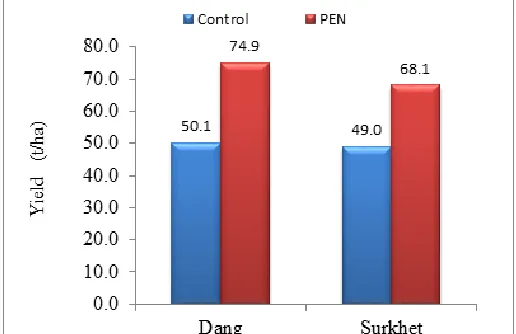
Figure 1: Yield of the crop under PEN and control plots at Dang and Surkhet districts of Nepal
In this study use of low cost PEN structure to control the invasive pest and yield was mainly focused. The result showed that PENs are effective pest management tools to control the Tuta absoluta on both the field conditions at Dang and Surkhet. This result is in agreement with earlier finding by Majumdar (2010), where the insect netting was highly effective against moths and caterpillars. The study showed the pest population was highest during the month of May at both the conditions similar result for the pest was reported in the tomato growing areas of Nepal by Bajracharhya et al. (2016).
CONCLUSION
The finding shows that there are benefits of low cost PENs in controlling the crops from tomato leaf miner and boost the yield. The higher infestation was recorded during May so proper management tactics before May under controlled condition could help to reduced higher crop damage. Increased yield and damage free production of the crop leads to the higher economic return under PEN plot. Hence, the uses of low cost PEN structures are beneficial in increasing yield and controlling the flying insects like Tuta absoluta.
LIMITATIONS OF THE STUDY
Budget was the major limitations during the study as there were no any sponsors to carry out the research activity. The research was carried out on the sole interest of the researchers. The lack of easy access to the TLM lure in the area as the pest was new to the country.
DATA AVAILABILITY
The data used to support the findings of this study are available from the corresponding author upon written request.
CONFLICTS OF INTEREST
The author(s) declare(s) that there is no conflict of interest regarding the publication of this paper.
ACKNOWLEDGEMENTS
Farmers from Satbariya, Dang and Harre, Surkhet are highly acknowledged for providing field facilities and support for this study.
REFERENCES
Bajracharya ASR, Mainali RP, Bhat B, Bista S, Shashank PK Meshram NM. (2016). The First Record of South American Tomato Leaf Miner, Tuta absoluta
(Meyrick1917) (Lepidoptera: Gelechiidae) in Nepal. Journal of Entomology and Zoology Studies.4 (4): 1359- 1363.
Boiteau G, Vernon RS. (2004). Physical barriers for the control of insect pests, In: Horowitz AR, Ishaaya I, editors. Insect pest management. Berlin: Springer. : 224-247.
Briassoulis D, Mistriotis A, Eleftherakis D. (2007). Mechanical behavior and properties of agricultural nets – Part I: Testing methods for agricultural nets. Polym.
Chapagain TR, Khatri B B, Mandal JL. (2011). Performance of Tomato Varieties during Rainy Season under Plastic House Conditions. Nepal Journal of Science and Technology.12: 17- 22.
Desneux N, Wanjeberg E, Wyckhuys AGK, Burgio G, Arpaia S, Consuelo A, Vasquez N, Cabrera J.G, Ruescas C, Tabone E, Frandon J, Pizzol J, Poncet C, Urbaneja A. (2010). Biological invasion of European toamto crops by Tuta absoluta: ecology, geographic expansion and prospects for biological control. J. Pest Science. 83:197-215.
Desneux N, Decourtye A, Delpuech JM. (2007). The sub lethal effects of pesticides on beneficial arthropods.
Ann. Rev. Entomol. 52: 81-106.
FAOSTAT. (2016). Food and Agriculture Organization, United Nations
Gogo EO, Saidi M, Itulya FM, Martin T, Ngouajio M. (2012). Microclimate and modification using eco-friendly nets for high quality tomato transplant production by small scale farmers in East Africa. Hort. Tech. 22: 292–298.
Kiptoo J, Kasina M, Wanjala F, Kipyab F, Wasilwa LA, Ngouajio M, Martin T. (2015). Use of low-cost pest exclusion nets can boost cabbage yield, East African Agricultural and Forestry Journal, 81: 112-119
Licciardi S, Assogba-Komlan F, Sidick I, Chandre F, Hougard JM, Martin T. (2008). A temporary tunnel screen as an eco-friendly method for small-scale growers to protect cabbage crop in Benin. International Journal of Tropical Insect Science. 27: 152–158. Lu Y H, Wu KM, Jiang Y Y , Guo YY, Desneux N. (2012).
Widespread adoption of Bt cotton and insecticide decrease promotes biocontrol services. Nature 487: 362-365.
Majumdar A. (2010). Large scale net-house for vegetable production: Pest management successes and challenges for a new technology. Alabama Cooperative Extension System, Auburn, AL.
Martin T, Palix R, Kamal A, Deletre E, Bonafos R, Simon S, Ngouajio M(2013). A repellent treated netting as a new technology for protecting vegetable crops. Journal of Economic Entomology. 106: 1699 – 1706.
Martin T, Assogba-Komlan F, Houndete T, Hougard JM, Chandre F. (2006). Efficacy of mosquito netting for sustainable small holders’ cabbage production in Africa. J. Econ. Entomol. 99: 450–454.
MoAD. (2015/16). Statistical Information on Nepalese Agriculture, Agribusiness Promotion and Statistics Division, Singh Darbar, Kathmandu.
Muleke EM, Saidi M, Itulya FM, Martin T, Ngouajio M. (2013). The assessment of the use of eco-friendly nets to ensure sustainable cabbage seedling production in Africa. Agronomy. 3:1 –12.
Sannino L, Espinosa B. (2010). Tuta absoluta, guida alla conoscenza e recenti acquisizioni per una corretta difesa. L‟Informatore Agrario, 66 Supplement. 1: 113. Speranza S, Sannino L. (2012). The current status of Tuta
Ngouajio M, Martin T, Zander KK. (2015). Control of vegetable pests in Benin–Farmers' preferences for eco-friendly nets as an alternative to insecticides. Journal of Environmental Management.147: 95-107.
Vincent C, Hallman G, Panneton B, Fleurat-Lessard F. (2003). Management of agricultural insects with physical control methods. Annu Rev Entomol. 48:261-281.
Urbaneja A, Gonzalez-Cabrera J, Arno J, Gabarra R. (2012). Prospects for the biological control of Tuta absoluta in tomatoes of the Mediterranean basin. Pest Manag. Sci. 68: 1215- 1222.
Weintraub P. (2009). Physical control: an important tool in pest management programs. In: Isahaaya I, Horowitz AR, editors. Biorational control of arthropod pests. Netherlands: Springer:317-32.
Accepted 27 May 2019.
Citation: Bhusal K, Sagar GC, Bhattarai K (2019). Use of Low-Cost Pest Exclusion Net to Control Tuta absoluta
Infestation and Boost the Yield of Tomato in Surkhet and Dang Districts of Nepal. World Research Journal of Agricultural Sciences, 6(2): 162-166.