Efficacy of some Plant Essential Oils as Green Insecticides
to Control Whitefly,
Bemisia tabaci
(Gennadius)
1
Heba Youssif El-Sayed Ibrahim* and Mohamed El-Hoseiny Mostafa
21,2Plant Protection Research Institute, Agriculture Research Center (ARC), Dokki, Giza, 12618, Egypt.
Ten plant essential oils were extracted and then tested for their activity as natural insecticides against the whitefly, Bemisia tabaci (Gennadius). In-vitro bioassay, the contact toxicity of the tested essential oils to eggs and 3rd instar nymphs was determined. The most effective of tested
essential oils as ovicides were Artemisia absinthium, Cyperus articulates, and Thyme vulgaris
with LC50: 0.157, 0.305 and 0.334 ppm, respectively. Also, the most effective oils against 3rd instar
nymphs were A. absinthium followed by C. articulates, and T. vulgaris with LC50: 7.268, 7.865 and
8.989 ppm respectively. Repellency effect and oviposition deterrency of the tested essential oils were studied through choice and no-choice tests. The most repellents and anti-oviposition oils were A. absinthium, T. vulgaris, C. articulates and Pluchea dioscoridis in both choice and no-choice tests. Also, the efficacy of the most effective oils in the laboratorial experiments were tested against B. tabaci in open field conditions. The most efficient one was A. absinthium which showed great reduction percentage of B. tabaci populations (87.6%), followed by C. articulates
(85.0%), T. vulgaris (81.9%), Mentha longifolia (78.6%) then Syzygium aromaticum (51.7%).
Keywords: Bemisia tabaci, Essential oils, contact toxicity, repellency and oviposition deterrency.
INTRODUCTION
The sweet potato whitefly, Bemisia tabaci (Gennadius) (Hemiptera: Aleyrodidae) is a polyphagous and multivoltine insect pest in the field and greenhouses (Oliveira et al., 2001) with great economic impacts on many crops such as cotton, vegetables, fruit crops and ornamentals (Gerling, 1990 and Omid Bakhsh et al., 2010). Whiteflies damage plants directly by sucking plant sap causing the silvering of leaves, irregular colour of fruits and growth stunting especially in young plants. And indirectly, whiteflies transmit several plant viruses (Lapidot and Polston, 2006).
B. tabaci transmits plant viruses in seven distinct groups including: potyviruses, geminiviruses, carlaviruses, closteroviruses, nepoviruses, luteoviruses and DNA-containing rod-shaped virus (Thompson, 2011). Also, they excrete honeydew which stimulate the growth of sooty mold hindering the photosynthesis process (Byrne and Bellows, 1991).
The excessive use of synthetic chemical insecticide led to many environmental problems, besides developmnt of insect resistance with subsequent population outbreaks
(Palumbo et al., 2001). Therefore, it became necessary to seek for secure alternatives. Some plant derived compounds showed promising efficiency against insecticide-resistant insect pests (Ahn et al., 1997). Essential oils play an important role as safe alternatives having insecticidal activity against wide spectrum of insect pests. They may act as repellents (Park et al., 2006, Nagassoum et al., 2007 and Abd-Elhady, 2012), antifeedants (Isman, 2002 and Hernandez-Lambrano et al., 2014), molting and growth inhibitors (Athanassiou et al. 2014 and Aziza et al., 2014), fecundity inhibitors or toxins (Enan, 2001; Isman, 2006; and Baldin et al., 2013). This study aimed to test the efficacy of ten essential oils extracted from local Egyptian available plants against different stages of B. tabaci. The repellency effects of female settlement and oviposition was also assessed.
*Corresponding author: Heba Youssif El-Sayed Ibrahim, Plant Protection Research Institute, Agriculture Research Center (ARC), Dokki, Giza, 12618, Egypt. Email: [email protected]
International Journal of Entomology and Nematology
Vol. 4(2), pp. 085-092, December, 2018. © www.premierpublishers.org. ISSN: 2326-7262
MATERIALS and METHODS
Plant Materials and Essential Oils Extraction
The seeds of Artemisia absinthium L. (Asteraceae); tubers of Cyperus articulates L. (Cyperaceae); aerial parts of
Anethum graveolens L. (Apiaceae); Leaves of Pluchea dioscoridis L. (Asteraceae), Mentha longifolia (L). Huds. (Lamiaceae), Lantana camara L. (Verbenaceae); and whole plant of Thyme vulgaris L. (Lamiaceae) were collected from Mansoura University farm while roots of
Zingiber officinale Rosc. (Zingiberaceae); seeds pods of
Elettaria cardamomum maton. (Zingiberaceae); and buds of Syzygium aromaticum (L.) Merr. & Perry (Myrtaceae) were acquired from herbal markets of Mansoura, Egypt. All plant materials were identified at Plant Department, Faculty of Science, Mansoura University. Essential oils of different plant materials were extracted by hydro-distillation for 4 hours in Clevenger-type apparatus. Then they were dried over anhydrous sodium sulphate and kept frozen in dark glass tubes until application. All essential oils were formulated as emulsion in water and 0.1% triton X-100. Four concentrations of each essential oil were tested immediately after preparation.
Pure culture of Whitefly B. tabaci and Host Plants
A pure culture of B. tabaci biotype B was obtained from a colony reared on cabbage, Brassica oleracea var. capitata under glass greenhouse at Faculty of Agriculture, Mansoura Univ. The whitefly strain was transferred to the laboratory and reared on cabbage seedlings planted in small pots 25cm (diameter) and kept under plastic greenhouse conditions of 27±2 oC, 70±5 RH and 14:10 Light: Dark. For the in vitro bioassay experiments, cabbage seeds were grown in plastic pots (15cm diameter) under plastic greenhouse to avoid any insect infestation. The seedlings were allowed to reach 20-25 cm high, with 4-5 fully expanded leaves.
In-vitro Bioassay
Bioassay for contact toxicity
All developmental stages of B. tabaci were obtained by releasing adults (≈ 100 individuals per plant) on cabbage seedlings free from any insect infestation in plastic cages, and were allowed to deposit eggs. After 24 hours, adults were removed, and the deposited eggs developed to the suitable stages for assessment.
Thirty individuals of the tested developmental stages were counted under dissecting microscope and marked with a water proof pen to be considered as a replicate. Each concentration had three replicates in addition to control which was sprayed with water and 0.1% triton X-100 using a hand sprayer. The sprayed leaves containing marked developmental stages were individually placed in test tubes filled with water to maintain leaves freshness along the experiment, and kept under plastic cages with fine polyester netting side panels for ventilation. All laboratorial
experiments were conducted in stable conditions of 27±2 oC, 70±5 RH and 14:10 L: D.
Effect of the tested essential oils on B. tabaci eggs
Immediately after adults’ removal, the fresh eggs were counted, then treated with the tested essential oils formulations and observed daily along 10 days until eggs hatching was completed. The ovicidal effect was determined by the number of unhatched eggs.
Effect of the tested essential oils on nymphal stage
When the hatched eggs developed to the third instar stage-nymphs, they were treated with different concentrations of the essential oils. The mortality percentages were calculated after five days. Dried and shrunk brown nymphs were considered as dead.
For contact toxicity, the average of mortality percentages of
B. tabaci was estimated and corrected using Abbott’s formula (1925). The corrected mortality percentage of each tested oil was statistically calculated according to Finney (1971). The corresponding concentration probit lines (LC-p lines) were estimated in addition to determination of 50 and 90% mortalities, slope values of the tested oils were also estimated. In addition, the efficiency of different tested fungi was measured by comparing the tested oils with the most effective one by using Sun’s equation (1950).
Bioassay for repellency effect and oviposition deterrency
Choice test
Also, oviposition deterrence index (ODI.) (Hang et al. 1982) was calculated according to the equation: ODI= [(T-C)]/ (T+C)] x 100, where T is the number of eggs counted on the treated plants, and C is the number of eggs counted on the control plants. ODI values vary from +100 (very attractive) to -100 (complete deterrence). RIs and ODIs values of choice and no-choice test were separately analyzed by Two-Way ANOVA using CoStat Software (2004).
No choice test
Cabbage seedlings with three leaves were individually placed in net cages (30 cm × 30 cm × 60 cm), and each cage contained one cabbage plant. Three cages were used as replicates for each oil treatment, in addition to three cages as controls. The treated plants were sprayed with LC90 of nymphal stage. Fifty adult whiteflies were released into each cage after an hour of treatment. The adults were counted at 12, 24, and 48 h after release. Also, the eggs deposited were counted under a dissecting microscope at 48 h after the whiteflies release. Both RI and ODI were calculated.
Field Bioassay
The five most efficient oils were tested against B. tabaci on cabbage, B. oleraceae var. capitata in open field conditions. The field was divided into equal blocks, and each oil was sprayed on four blocks (four replicates) with invitro-LC90 of 3rd instar-nymphs in addition to another four replicates as controls. The blocks were in completely random arrangement. Thirty leaves from cabbage seedlings in each replicate were examined directly for counting the adults and under a dissecting microscope for counting the other stages. The effect of the tested oils was observed daily till 3rd day after treatment. Efficiency of the tested essential oils were calculated according to Henderson-Tilton (1955).
RESULTS AND DISCUSSION
Bioassay for contact toxicity
In vitro bioassay showed that all the tested oils significantly suppressed the B. tabaci eggs hatchability by contact toxicity. A. absinthium was the most efficient oil followed by
C. articulates, T. vulgaris, M. longifolia, S. aromaticum, A. graveolens, E. cardamomum, L. camara, Z. officinal and P. discoridis that showed the lowest activity. LC50, LC90 values and toxicity index obtained from probit analysis for mortality values are presented in Table 1. It was noticed that the oils affected the eggs hatchability without any morphological changes by disrupting or inhibiting embryogenesis and making them unable to come out of the egg shells. Also, the susceptibility of the 3rd instar of B. tabaci nymphs to the tested essential oils was tested. It was found that A. absinthium was the most efficient oil followed by C. articulates, T. vulgaris, M. longifolia, S. aromaticum, A.
graveolens, Z. officina, L. camara, E. cardamomum, while,
P. discoridis showed the lowest activity. LC50, LC90 values and toxicity index were mentioned in Table 2. Our results about high contact toxicity of T. vulgaris essential oil against
B. tabaci biotype B. are agreed with those presented by Yang et al. (2010) and Kim et al., (2011). Also, the present results are in accordance with those presented by Yarahmadi et al. (2013). They illustrated the contact toxicity and significantly population reduction of Bemisia tabaci by
Artemisia essential oil.
Data clearly demonstrated that eggs were found to be more susceptible to the tested essential oils than nymphs. Moreover, the tested essential oils varied in their activity, this may be due to variation of their chemical constituents. Several studies pointed out the neurotoxic action of essential oils by acetylcholinesterase (AChE) inhibition or by blocking the octopamine receptors (Enan 2001). Terpenoids, the major constituents of essential oils and the responsible for their insecticidal toxicity, are highly selective to insects since they are targeted to the insect-selective octopaminergic receptor, a non-mammalian target. Also, essential oils interfere with ˠ-aminobutyric acid (GABA) gate chloride channels in insects (Priestley et al. 2003).
Bioassay for repellency effect and oviposition deterrency
In choice test, the repellency of the tested essential oils against B. tabaci adults were studied. It was observed that almost all tested essential oils showed repellency effect except two oils, S. aromaticum and L. camara that showed slight attractant effect. There were high significant differences among the tested oils (F: 1330.85; df: 9; p< 0.01).
Taking time after adults introduction into consideration, (Fig. 1- 3), at 12 and 24 hours after adult introduction, A. absinthium showed the highest repellency that followed by
C. articulates, T. vulgaris, P. discoridis, M. longifolia, A. graveolens, E. cardamomum then Z. officina which showed slight repellency effect. At 48 hours after adults-introduction, observations showed that the repellency effects of the tested oils decreased to some extent. Also, the attraction effects of S. aromaticum and L. camara
decreased to values that were comparable to the control or even less. There were high significant differences among the experimental counting periods (F: 1198.97; df: 2; p< 0.01).
Table 1: Ovicidal effects of plant essential oils against B. tabaci eggsafter 10 days of treatment.
Essential oils
Eggs LC50 (ppm)
and confidence limits at 95%
LC90 (ppm)
and confidence limits at 95% Slope ± SE X2
Toxicity index
A. absinthium 0.157 5.753 0.820± 0.186 1.20 100.00
0.036 0.342 2.311 41.692
T. vulgaris 0.334 7.640 0.943± 0.198 1.058 47.006
0.135 0.634 3.087 51.507
C. articulates 0.305 2.776 1.335± 0.277 0.618 51.475
0.163 0.505 1.378 11.925
M. longifolia 0.452 35.551 0.676± 0.171 3.759 34.735
0.095 1.171 8.9 1299.886
S. aromaticum 0.603 7.422 1.176± 0.194 0.424 26.036
0.336 1.004 3.685 24.986
Z. officinal 2.42 40.774 1.045± 0.191 1.73 6.488
1.384 4.864 15.078 289.579
A. graveolens 0.612 44.324 0.689± 0.166 0.624 25.654
0.21 1.37 11.014 1586.074
L. camara 1.085 32.453 0.868± 0.173 1.572 14.470
0.541 2.175 10.778 332.328
E. cardamomum 0.726 16.711 0.941± 0.177 0.223 21.625
0.361 1.342 6.578 104.749
P. discoridis 7.33 65.906 1.344± 0.323 1.251 2.142
4.341 18.928 23.423 993.05
Table 2: Toxicity of plant essential oils against 3rd instar nymphs of B. tabaci after 5 days of treatment.
Essential oils
3rd instar
LC50 (ppm)
and confidence limits at 95%
LC90 (ppm)
and confidence limits at 95% Slope ± SE X2 Toxicity
index
A. absinthium 7.268 43.856 1.642± 0.390 1.578 100
3.816 10.343 26.652 146.109
T. vulgaris 8.989 37.337 2.072± 0.408 3.133 80.854
6.119 11.865 25.193 81.742
C. articulates 7.865 34.502 1.996± 0.411 2.133 92.409
4.998 10.551 23.194 77.845
M. longifolia 9.491 36.013 2.213± 0.415 1.98 76.578
6.75 12.331 24.90 72.943
S. aromaticum 12.825 43.5 2.416± 0.416 5.426 56.671
9.861 16.441 30.293 84.225
Z. officinal 17.667 88.044 1.837± 0.384 0.387 41.139
12.988 25.679 49.532 319.415
A. graveolens 16.339 118.929 1.487± 0.367 0.107 44.483
11.107 25.855 56.193 912.20
L. camara 21.383 108.436 1.818± 0.389 0.059 33.99
15.712 33.19 57.887 463.203
E. cardamomum 22.9 210.424 1.331± 0.367 0.064 31.738
15.236 48.401 78.930 4903.562
P. discoridis 36.996 135.29 2.276± 0.634 0.006 19.645
27.199 75.664 69.158 1195.897
cardamomum showed slight attractant effects. There were high significant differences among the tested essential oils ODI (F: 357.364; df: 9; p< 0.01). It was clear that there was positive correlation between RI and ODI. This agreed with Silva et al. 2012, who suggested that the repellency effect is a factor of oviposition inhibition.
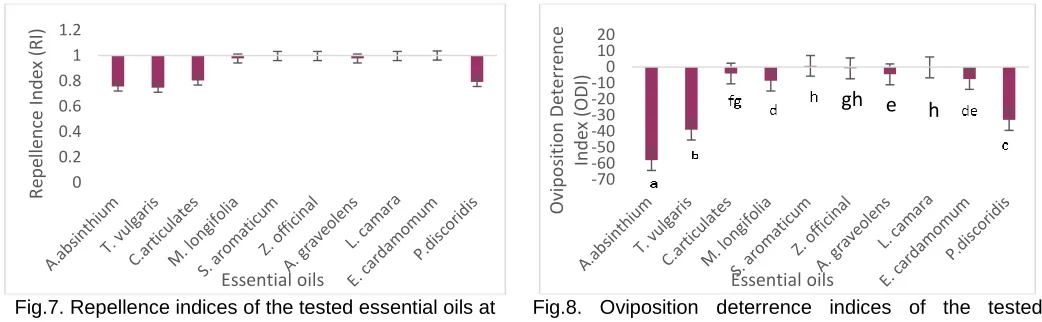
In no-choice test, all the tested essential oils showed repellency effects and varied in repellency degree, (Fig. 5-7). At 12h after adult`s introduction, A. absinthium showed the highest repellency followed by P. discoridis, T. vulgaris,
C. articulates, A. graveolens, M. longifolia, E. cardamomum
showed slight repellency effect. All repellency effects of the tested essential oils decreased at 24h after adults-introduction and continued decreasing at 48h. It was observed that almost all oils lose their repellency effects at 48 after adults-introduction except A. absinthium, T. vulgaris, C. articulates and P. discoridis. There were significant effects of the essential oils and time (F: 366.63; df: 9; p< 0.01), (F: 694.94; df: 2; p< 0.01), respectively. Previous data showed that repellency (RIs) of the tested essential oils in no-choice test was less than that of choice test. In no-choice test, there was no alternative nutrition source for B. tabaci adults except for the plants treated with
essential oils, so, the adults forced themselves to settle on the treated plants for feeding with frequent changing of feeding sites.
All tested essential oils showed oviposition deterrency against B. tabaci adults except S. aromaticum which showed no effect. As shown in Fig. 8, the highest oviposition deterrency effect was showed by A. absinthium
(-57.93%) followed by T. vulgaris (-38.98%) and P. discoridis (-32.93%). There were high significant differences of the tested essential oils ODI (F: 618.774; df: 9; p< 0.01).
Fig.1. Repellence indices of the tested essential oils at 12h after adults introduction in choice-test
Fig.2. Repellence indices of the tested essential oils at 24h after adults introduction in choice-test
Fig.3. Repellence indices of the tested essential oils at 48h after adults introduction in choice-test
Fig.4. Oviposition deterrence indices of the tested essential oils at 48h after adults introduction in
choice-test
Fig.5. Repellence indices of the tested essential oils at 12h after adults introduction in no-choice test
Fig.7. Repellence indices of the tested essential oils at 48h after adults introduction in no-choice test
Fig.8. Oviposition deterrence indices of the tested essential oils at 48h after adults introduction in no-choice test
Table 3: Reduction % averages of B. tabaci treated with tested essential oils in open field conditions
Insecticide Pre-spray
Mean population per plant and percent reduction Days after insecticide treatment
Overall Mean
1 2 3
Mean
No. % Red. Mean No. % Red. Mean No. % Red.
Mean No.
% Red.
A. absinthium 592.3a 60.3c 90.3 68.5c 89.3 109.0d 83.3 79.3c 87.6
C. articulates 493.5a 57.5c 88.9 76.3c 85.7 105.8d 80.5 79.8c 85.0
T. vulgaris 542.3a 80.0c 85.9 99.8c 83.0 138.0cd 76.9 105.9c 81.9
M. longifolia 499.5a 80.5c 84.6 107.3c 80.1 158.0c 71.2 115.3c 78.6
S. aromaticum 515.3a 326.0b 39.6 212.8b 61.8 262.3b 53.7 267.0b 51.7
Control 525.8a 550.8a 567.8a 578.0a 565.5a
LSD 0.05 134.9 61.6 40.6 44.8 61.2
Field Bioassay
The field experiment clarified the great suppression of B. tabaci populations by application of essential oils as natural insecticides. The pre-treatment counts recorded an hour before spraying indicated that there was no significant difference in the whitefly populations in all blocks. At the 1st day after treatment, A. absinthium showed the highest population reduction followed by C. articulates, T. vulgaris,
M. longifolia, and S. aromaticum with mean reduction %: 90.3, 88.9, 85.9, 84.6 and 39.6%, respectively as shown in Table 3. At the 3rd day after treatment, the population reduction was 83.3, 80.5, 76.9, 71.2 and 53.7%, respectively. The average reduction percentages of the selected essential oils were 87.6, 85.0, 81.9, 78.6 and 51.7%, respectively.
All tested essential oils except S. aromaticum, had the same behavior of whitefly population reduction% that decreased during the experiment period. S. aromaticum
had different behavior since it recorded the lowest reduction at 1st day after treatment then it showed more reduction at the 2nd day and the reduction% decreased again at 3rd day after treatment. This was because S. aromaticum showed contact toxicity to both eggs and immature stages but acted as adults-attractant at the beginning, then it lost this attraction property by time, which led to fluctuating reduction% along the experiment period.
All previous data emphasized that essential oils are promising factors that can act as insecticides, ovicides, repellent and insect-oviposition deterrent. Therefore, essential oils are worthy of further studies in order to develop their application in wide scales as environmental- friendly insecticides.
CONCLUSION
The present study highlighted the importance of the essential oils as green insecticides. Our results illustrated that A. absinthium, C. articulates and T. vulgaris showed high contact toxicity, repellency effect and oviposition deterrency against the whitefly, B. tabaci. Therefore, they are recommended to be used in wide scales in B. tabaci
control.
REFERENCES
Abbott WS (1925). A method for computing the effectiveness an insecticide. J. Econ. Entomol., 18: 265-267.
Abd-Elhady H (2012). Insecticidal activity and chemical composition of essential oil from Artemisia Judaica L. against Callosobruchus maculatus (F.) (Coleoptera: Bruchidae). J. Plant Protect. Res., 52: 347-352.
0 0.2 0.4 0.6 0.8 1 1.2
Re
p
ell
en
ce
In
d
ex (RI)
Essential oils
-70 -60 -50 -40 -30 -20 -100 10 20
Ov
ip
o
sitio
n
De
terre
n
ce
In
d
ex
(ODI)
Essential oils
Ahn YJ, Kwon M, Park HM, Han CG (1997). Potent insecticidal activity of Ginkgo biloba-derived trilactone terpenes against Nilaparvata lugens, pp. 90- 105. In Hedin P A, Hollingworth R M, Masler E P, Miyamoto J and Thompson DG [eds.], Phytochemical pest control agents. Am. Chem. Soc. Symp. Ser. 658.
Athanassiou CG, Rani PU, Kavallieratos NG (2014). The use of plant extracts for stored product protection. In: Advances in Plant Biopesticides, Singh, D. (Ed.) Springer, New York, U.S.A., 131-147.
Aziza S, Rahman HA, Abdel-Aziz S, Moawad S (2014). Natural plant oils and terpenes as protectors for the potato tuber against Phthorimaea operculella (Zeller) infestation by different application methods. Egypt. J. Biol. Pest Control, 24: 265-274.
Baldin ELL, Lara FM (2001). Attractiveness and leaf consumption by adults of Diabrotica speciosa (Germ.) (Coleoptera: Chrysomelidae) in different squash genotypes. Neotropical Entomology, 30: 675–679. Baldin ELL, Crotti AEM, Wakabayashi KAL, Silva JPGF,
Aguiar GP, Souza ES, Veneziani RCS, Groppo M (2013). Plant-derived essential oils affecting settlement and oviposition of Bemisia tabaci (Genn.) biotype B on tomato. J. Pest Sci., 86: 301–308.
Byrne DN, Bellows TS Jr (1991). Whitefly biology. Ann. Rev. Entomol., 36: 431-457.
CoStat Software (2004). Microcomputer program analysis Version 4.20, CoHort Software Berkeley, CA.
Enan E. (2001). Insecticidal activity of essential oils: Octopaminergic sites of action. Comp. Biochem. Physiol. Part C: Toxicol. Pharmacol., 130: 325-337. Finney DJ (1971). Probit analysis. A Statistical Treatment
of the Sigmoid Response Curve. 7th Ed., Cambridge Univ. Press, England.
Gerling D (1990). Whiteflies: Their Bionomics, pest status and management. Intercept Ltd., UK. : 348.
Hang YS, Schultz GW, Axelord H, Krame WL, Mulla MS (1982). Ovipositional repellency of fatty acids and their derivatives against Culex and Aedes mosquitos.
Eviron.Entomol. 11: 223-226.
Henderson CF, Tilton EW (1955). Tests with acaricides against the brown wheat mite. J. Econ. Entomol., 48: 157-161.
Hernandez-Lambrano R, Caballero-Gallardo K, Olivero-Verbel J (2014). Toxicity and antifeedant activity of essential oils from three aromatic plants grown in Colombia against Euprosterna elaease and Acharia fusca (Lepidoptera: Limacodidae) Asian Pac. J. Trop. Biomed.,4: 695-700.
Isman MB (2002). Insect antifeedants. Pest. Outlook, 13: 152-157.
Isman MB (2006). Botanical insecticides, deterrents and repellents in modern agriculture and an increasingly regulated world. Annu. Rev. Entomol., 51: 45-66. Kim SI, Chae SH, Youn HS, Yeon SH, Ahn YJ (2011).
Contact and fumigant toxicity of plant essential oils and efficacy of spray formulations containing the oils against
Band Q-biotypes of Bemisia tabaci. Pest Manag Sci., 67:1093-1099.
Lapidot M, Polston JE (2006). Resistance to tomato yellow leaf curl virus in tomato, pp. 503–540. In (eds.) Loebenstein, G. & Carr, J. P. Natural Resistance Mechanisms of Plants to Viruses, Springer Verlag, New York.
Nagassoum MB, Tinkeu NSL, Ngatanko I, Tapondjou AL, Lognay G, Malaisse F, Hance T (2007). Chemical composition, insecticidal effects and repellent activity of essential oils of three aromatic plants, alone and in combination towards Sitophilus oryzae L. (Coleoptera: Curculionidae). Nat. Prod. Commun. 2: 1229-1232. Oliveira MRV, Henneberry TJ, Anderson P (2001). History,
current status, and collaborative research projects for
Bemisia tabaci. Crop Protection, 20, 709-723. Omid Bakhsh M, Jemsi GR, Kocheili F. 2010. Effect of
common pesticides on sweet potato whitefly Bemisia tabaci (Hem.: Aleyrodidae) in fall cucumber at Ahwaz. Plant Prot. J., 2: 1-11
Palumbo JC, Horowitz, AR, Prabhaker N (2001). Insecticidal control and resistance management for
Bemisia tabaci. Crop protect. 20, 739-765.
Park IK, Kim LS, Choi I H, Lee YS, Shin SC (2006) Fumigant activity of plant essential oils and component from Schizonepeta tenuifolia against Lycoriella ingenua
(Diptera: Sciaridae). J. Econ. Entomol., 99: 1717-1721. Priestley CM, Williamson EM, Wafford KA, Sattelle DB
(2003). Thymol, a constituent of Thyme essential oil, is a positive allosteric modulator of human GABA receptors and a homo-oligomeric GABA receptor from
Drosophila melanogaster. Br. J. Pharmacol., 140: 1363-1372.
Schilick-Souza EC, Baldin ELL, Lourencao AL (2011). Variation in the host preferences and responses of Ascia monuste orseis Godart (Lepidoptera: Pieridae) to cultivars of collard greens Brassica oleracea (L.) var.
acephala‟, Journal of Pest Science, 84: 429–436.
Silva MA, Bezerra-Silva GCD, Vendramim JD, Mastrangelo T (2012). Inhibition of oviposition by neem extract:A behavioral perspective for the control of the Mediterranean fruit fly (Diptera: Tephritidae). The Florida Entomol., 95: 333-337.
Sun YP (1950). Toxicity index an improved method of comparing the relative toxicity of insecticides. J. Econ. Entomol., 43: 45-53.
Thompson WMO (2011). The whitefly, Bemisia tabaci
(Homoptera: Aleyrodidae) Interaction with Gemnivirus-infected host plants. Springwe, Netherland: 77-78. Yang NW, Li AL, Wan FH, Liu WX, Johnsom D. 2010.
Effects of on essential oils on immature and adult sweet potato whitefly, Bemisia tabaci biotype B. Crop prot., 29:1200-1207.
Yarahmadi F, Rajabpour A, Sohani NZ, Ramezani L (2013). Investigating contact toxicity of Geranium and Artemisia
Accepted 3 December 2018
Citation: Ibrahim HYE, Mostafa ME (2018). Efficacy of some Plant Essential Oils as Green Insecticides to Control Whitefly, Bemisia tabaci (Gennadius). International Journal of Entomology and Nematology, 4(2): 085-092.