Trends and pattern of the utilization of
cardiovascular medicines in Lithuania in 2003–2012
Ingrida Lisauskienė
1,
Kristina Garuolienė
1, 2,
Jolanta Gulbinovič
1, 31 Department of Pathology,
Forensic Medicine and Pharmacology, Faculty of Medicine,
Vilnius University, Lithuania
2 National Health Insurance Fund under the Ministry of Health, Lithuania
3 State Medicines Control
Agency under the Ministry of Health, Lithuania
Background. Despite the wide use of cardiovascular (CV) drugs, CV dis-eases are still the leading cause of mortality and morbidity. Analysis of drug utilization gives a possibility to evaluate effectiveness of interventions.
Materials and methods. The aim of the study was to evaluate CV med-icines consumption in Lithuania in 2003–2012. Data was retrieved from the SVEIDRA database of the National Health Insurance Fund. Utilization of the following groups of CVM (ATC group C) was analyzed: C02 – an-tihypertensive drugs, C03 – diuretics, C07 – beta blocking agents (BBs), C08 – calcium channel blockers (CCBs), C09 – agents acting on the re-nin–angiotensin system, C10 – lipid modifying agents. ATC/DDD meth-odology was used. Data was expressed as a number of DDD per 1 000 inhabitants per day (DDD/TID).
Results. Consumption of CVM went from 134.5 DDD/TID in 2003 to 352.2 in 2012. Angiotensin converting enzyme inhibitors (ACEI) were the most consumed ones (66–114.8 DDD/TID), followed by CCBs (19.4–38.8 DDD/TID) and BBs (12.5–52.6 DDD/TID).There was high consumption of antihypertensives (4.7–23.9 DDD) and low consumption of diuretics (9.4–16.9 DDD/TID) and lipid modyfing agents (0.4–7.4 DDD/TID). In-creasing utilization was noticed in the angiotensin II antagonist (ARBs) group (42 DDD/TID), ACEI combinations (38.6 DDD/TID) and ARBs combinations (12.9 DDD/TID) in 2012.
Conclusions. Utilization of CV medicines increased in Lithuania in 2003–2012. ACEI held the first position. An extremely low utilization of lipid modifying agents, diuretics and high consumption of alpha-receptor blockers showed the need of actions on changing the prescribing pattern of CV drugs.
Key words: drug utilization (trends), cardiovascular medicines, hyper-tension medication, Lithuania
INTRODUCTION
Cardiovascular diseases (CVD) remain the main
cause of death in the majority of countries (1, 2).
European Guidelines on Cardiovascular Disease
Prevention in Clinical Practice (version 2012)
have promoted the treatment of all the reversible
risk factors identified and the appropriate
manage-ment of the raised blood pressure (BP)
per se
(3).
The recent decrease in cardiovascular mortality in
high-income countries is associated with a rise in
the numbers of patients living with cardiovascular
disease and the wider use of preventive drugs.
Corespondence to: Ingrida Lisauskienė, Department ofIn the past decades most European
coun-tries have developed administrative databases to
monitor drug utilization by measuring volume
and expenditures of medicines and the quality of
prescribing on a national level. The ultimate goal
of drug utilization research is an assessment of
drug therapy rationality. Only few data were
pub-lished on prevalence, awareness and management
of CVD in Lithuania. The aim of our study was
to evaluate the trends and pattern of the use of
cardiovascular (CV) medicines in Lithuania in
2003–2012.
MATERIALS AND METHODS
The use of reimbursed medicines, acting on the
cardiovascular system, during the period of ten
years – 2003–2012 was studied. CV drugs were
classified according to the
Anatomical-Therapeu-tic-Chemical (ATC) classification. The list of
an-alysed CV medicines groups and cardiovascular
drugs is presented in the Table.
The data of purchased reimbursed medicines
was retrieved from the SVEIDRA database of the
National Health Insurance Fund (NHIF). Drug
uti-lization was calculated using the Anatomical
Thera-peutic Chemical / Defined Daily Dose (ATC/DDD)
methodology, and data was expressed as a number
of DDD per 1 000 inhabitants per day (DDD/TID),
using the ATC/DDD Index 2014 (4, 5, 6).
RESULTS
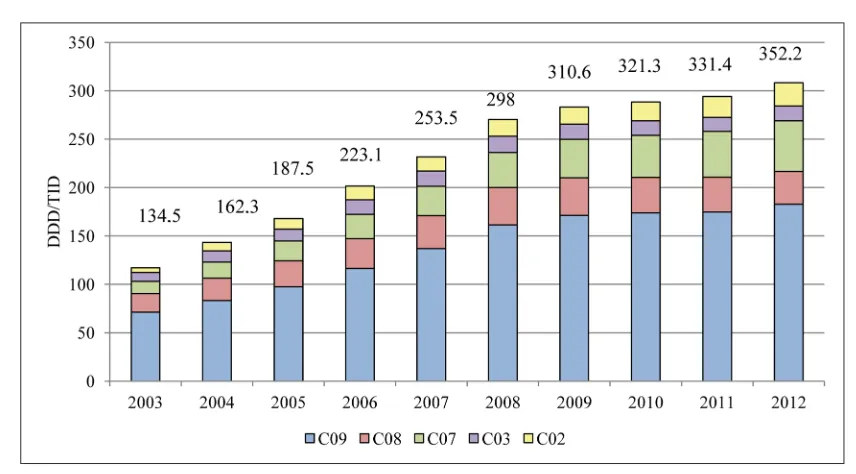
The utilization of CV drugs in Lithuania during the
period 2003–2012 is shown in Fig. 1. The data
in-dicates continuous growth in the use of CV drugs
over the time, from 134.5 DDD/TID in 2003 to
352.2 DDD/TID in 2012 (growth percentage per
Table. The list of analysed CV drugs groups and cardiovascular drugs
ATC grp. code and name Medicines name and ATC code
C02 – Antihypertensives Methyldopa (C02AB01); clonidine (C02AC01); moxonidine (C02AC05); prazosin (C02CA01); doxazosin (C02CA04).
C03 – Diuretics semide (C03CA01); torasemide (C03CA04); spironolactone (C03DA01).Hydrochlorothiazide (HCT) (C03AA03); indapamide (C03BA11);
furo-C07 – Beta blocking agents (BBs)
Propranolol (C07AA05); metaprolol (C07AB02); atenolol (C07AB03); betaxolol (C07AB05); bisoprolol (C07AB07); nebivolol (C07AB12);
carve-dilol (C07AG02); bisoprolol and HCT (C07BB07); nebivolol and HCT (C07BB12).
C08 – Calcium channel blockers (CCBs)
Amlodipine (C08CA01); felodipine (C08CA02); nifedipine (C08CA05); nitrendipine (C08CA08); lacidipine (C08CA09); lercanidipine (C08CA13);
verapamil (C08DA01); diltiazem (C08DB01). C09A – Angiotensin converting
enzyme inhibitors, plain (ACEI)
Captopril (C09AA01); enalapril (C09AA02); lisinopril (C09AA03); perin-dopril (C09AA04); ramipril (C09AA05); quinapril (C09AA06); fosinopil (C09AA09); trandolapril (C09AA10); spirapril (C09AA11); zofenopril
(C09AA15).
C09B – ACEI, combinations
Enalapril and HCT (C09BA02); perindopril and indapamide (C09BA04); ramipril and HCT (C09BA05); quinapril and HCT (C09BA06); fosinopril and HCT (C09BA09); lisinopril and amlodipine (C09BB03); perindopril
and amlodipine (C09BB04); verapamil and trandolapril (C09BB10). C09C – Angiotensin II
antago-nists, plain (ARB)
Losartan (C09CA01); eprosartan (C09CA02); valsartan (C09CA03); irbesartan (C09CA04); candesartan (C09CA06); telmisartan (C09CA07);
olmesartan medoxomil (C09CA08).
C09D – ARB, combinations
Losartan and HCT (C09DA01); eprosartan and HCT (C09DA02); valsar-tan and HCT (C09DA03); telmisarvalsar-tan and HCT (C09DA07); olmesarvalsar-tan medoxomil and HCT (C09DA08); amlodipine and valsartan (C09DB01);
olmesartan medoxomil and amlodipine (C09DB02).
study period (G%) = 162%; annual growth
percent-age (AG%) = 16.2%).
The most used medicines were the agents acting
on the renin-angiotensin system (RAS), followed
by beta blocking agents (BBs) and calcium channel
blockers (CCBs).
The consumption of antihypertensive medicines
went from 4.7 to 23.9 DDD/TID (G% = 406%).
The utilization of moxonidine grew by between
2 to 16.1 DDD/TID. The utilization of
doxazos-in also doxazos-increased 3.5 times durdoxazos-ing the study
pe-riod (2.2–7.8 DDD/TID). The consumption of
methyldopa (<0.01 DDD/TID) and prazosin (<0.1
DDD/TID) was very low.
The consumption of plain diuretics was stable and
low in Lithuania (9.4–15.2 DDD/TI). The utilization
of indapamide was rather stable during the study
period (5–8.2 DDD/TID); on the contrary, the
aug-mentation of consumption of torasemide (1.1–6.4
DDD/TID) and spironolactone (1.2–3.4 DDD/TID)
was noticed. The consumption of furosemide and
hydrochlorothiazide (HCT) was <0.6 DDD/TID.
The consumption of BBS increased gradually
every year (12.5–52.6 DDD/TID; G% = 321.3). The
most often prescribed medicines were
metapro-lol (5.3–15.7 DDD/TID), nebivometapro-lol (3–28.2 DDD/
TID), betaxolol (2.5–4.8 DDD/TID) and carvedilol
(0.7–1.7 DDD/TID). The combined preparation of
nebivolol and HCT was introduced in 2011 and its
consumption achieved 2 DDD/TID in 2012.
The highest consumption of CCBs (38.5–38.8
DDD/TID) was noticed in 2008–2009 and the
de-cline in these drugs utilization to 33.8 DDD/TID
was registered in 2010–2012 (G% = 74.3). The most
often prescribed CCBs were amlodipine (7.1–13.6
DDD/TID), lercanidipine (0.6–14.8 DDD/TID),
and lacidipine (3.3–6 DDD/TID). The following
re-duction was registered in the consumption of other
CCBs during the study period: felodipine – 1.8–0.5
DDD/TID; nitrendipine – 2.9–0.4 DDD/TID;
ve-rapamil – 1.4–0.7 DDD/TID; diltiazem – 3.1–1.5
DDD/TID; nifedipine – 0.6–0.1 DDD/TID.
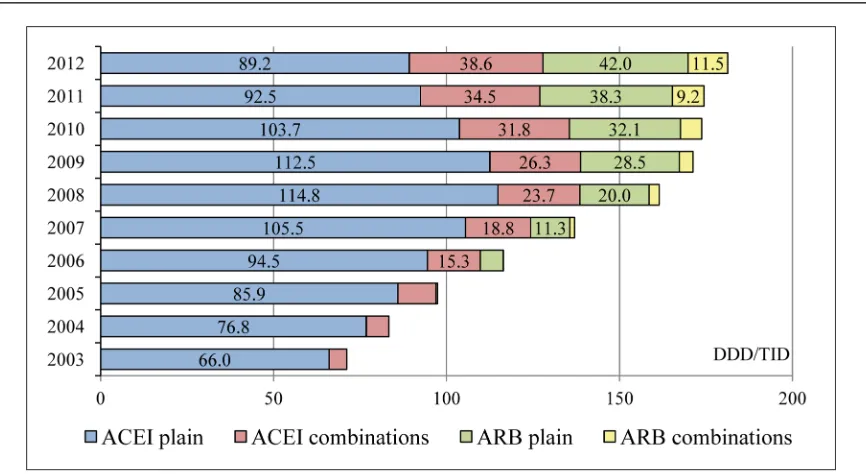
The group of agents acting on RAS was the most
consumed CV medicines. We analyzed separately
the utilization of ACEI and ARB, plain and
combi-nations. The utilization of the plain ACEI increased
from 66 DDD/TID in 2003 to 114.8 DDD/TID in
2008 followed by the reduction to 89.2 DDD/TID
in 2012 (G% = 35.1). This decrease was
compen-sated by an augmentation in consumption of
com-bined preparations with ACEI (5.2–38.6 DDD/
TID; G% = 648.7), plain ARB (0.5–42 DDD/TID;
G% = 8 615.7) and ARB combinations (1.4–12.9
DDD/TID; G% = 809.4) (Fig. 2).
(0.8–8.2 DDD/TID). The consumption rate of other
ACEI such as lisinopril, trandolapril and spirapril
was low (<2 DDD/TID).
ARBs were introduced in the Lithuanian
mar-ket in 2006 and their utilization increased quickly
influencing the utilization of the ACEI group.
Lo-sartan was a very popular drug until 2010 (5 DDD/
TID in 2006 – 17.5 DDD/TID in 2010 – 10.4 DDD/
TID in 2012). The prescription of other ARB drugs
increased as follows: valsartan – 0.6–18.5 DDD/
TID and telmisartan – 0.1–11.8 DDD/TID.
Combined preparations of ACEI and diuretics
became very popular in Lithuania. The most
con-sumed combined preparations were combinations
of enalapril and HCT (5.2–0.4 DDD/TID),
per-indopril and indapamide (0.4–18.6 DDD/TID),
quinapril and HCT (0.8–6.7 DDD/TID). ARB and
diuretics combinations were started to use from
2006. Valsartan and HCT consumption reached
7.3 DDD/TID in 2012 and losartan and HCT
con-sumption was 3.7 DDD/TID in 2010. The
combi-nations of agents acting on RAS and CCBs were
not so popular during the study period, but their
utilization increased from 2008. The most popular
such combination was perindopril and amlodipine,
which utilization reached 10.7 DDD/TID in 2012.
The utilization of lipid modifying agents was
extremely low – 0.4 DDD/TID in 2003 and 2004,
0.6 DDD/TID in 2005, 0.7 DDD/TID in 2006,
0.8 DDD/TID in 2007, 1 DDD/TID in 2008,
1.9 DDD/TID in 2009, 3.4 DDD/TID in 2010,
5.4 DDD/TID in 2011 and 7.4 DDD/TID in 2012.
Only one drug – atorvastatin was widely used
dur-ing the study period. The utilization of other lipid
modifyng drugs was <0.1 DDD/TID.
DISCUSSION
The aim of this study was to evaluate the trends and
pattern of utilization of CV medicines in Lithuania
in 2003–2012. The idea was that the total amount
and pattern of CV drugs used in Lithuania can
relatively reflect the aggressiveness in arterial
hy-pertension and other CVD treatment. Evidence
favouring the administration of BP-lowering drugs
to reduce the risk of major clinical CV outcomes
(fatal and nonfatal stroke, myocardial infarction
(MI), heart failure and other CV deaths) in
hyper-tensive individuals results from a number of RCTs,
recent meta-analysis (7–11). In the 2007 and 2013
versions of the Guidelines of the European Society
of Hypertension (ESH) and of the European
Soci-ety of Cardiology (ESC) it was concluded that the
main benefits of antihypertensive treatment are
due to lowering of BP
per
se
and are largely
inde-pendent of the drugs employed (12, 13).
that the most frequently prescribed drugs had been
ACEI (75.3% of patients), BBs (61.1%), diuretics
(47.6%), CCBs (36.1%), alpha-receptor blockers
(8.4%) (16). In addition, our data showed high
consumption of centrally active antihypertensive
agents and alpha-receptor blockers in Lithuania
(3.51–6.79% of all prescribed CV drugs). A similar
trend could be observed in Latvia where the
uti-lization of these drugs also reached 3.7–5% of all
CV drugs (17). On the contrary, the utilization of
alpha-receptor blockers is very low in
Scandinavi-an countries – less thScandinavi-an 1% in Sweden, Denmark
and Finland – and in Estonia (18, 19, 20, 21, 23).
Alpha-receptor blockers are recommended as the
third-line therapy or in multiple drug combinations
when other treatment options failed (24). None of
studies have shown superiority of these medicines
compared to others. Future analysis on the patient
level has to be performed for the explanation of this
phenomenon in Lithuania.
Diuretics remain the cornerstone of
antihyper-tensive treatment and are recommended by the ESH/
ESC Guidelines as the first-choice drugs used either
as monotherapy or in some combinations (13).
The evidence proves that thiazides reduce
mortali-ty (RR 0.89, 95% CI 0.83, 0.96), incidence of stroke
(RR 0.63, 95% CI 0.57, 0.71), coronary heart
dis-ease (CHD) (RR 0.84, 95% CI 0.75, 0.95) and
car-diovascular events (RR 0.70, 95% CI 0.66, 0.76) (9).
The use of plain diuretic medicinal products was
not frequent in Lithuania despite guidelines on
hypertension treatment. The use of plain diuretics
made up about 5.75% of all prescribed CV drugs
DDD/TID compared with 22.5–16.5% in Sweden
in 2006–2012 (18) and 36–18.4% in Denmark (19)
in 2003–2012. We found out that the reduction of
plain diuretics utilization was compensated by
in-creased use of the combined preparation of
diuret-ics and other antihypertensive agents, reaching on
the average 11.3% of all used CV drugs DDD/TID
in Lithuania in 2012. The same trend of increased
utilization of the combinations was observed in
Norway, Denmark, Estonia and Finland (8.9–11%
of all CV medicines DDD/TID) (19–22). Only in
Sweden the utilization of combined preparations
remained low and stable (4% of all CV medicines
DDD/TID) in 2006–2012 (18).
The increasing utilization of beta blockers was
registered during the study period (on the average
9.3–14.9% of all CV drugs). A similar utilization
rate was observed in Scandinavia and other Baltic
countries (7–15%) (17–23).
The utilization of calcium antagonists was
de-creasing in Lithuania from 2008 composing 14.4–
9.6% of used all DDD/TIDs. The use of CCBs was
higher and is still increasing in all Scandinavian
countries (12.8–16.3%) and in Latvia (16.8–20.1%)
(17–23). Some data shows that CCB may reduce
incidence of cardiovascular events (RR 0.71, 95%
CI 0.57, 0.87), but not CHD (RR 0.77 95% CI 0.55,
1.09) or cardiovascular mortality (RR 0.86, 95%
CI 0.68, 1.09) (9), cardiovascular complications in
hypertensive diabetics (25) and in patients with
met-abolic syndrome (26).
The ACEI are the most popular CV medicines.
Clinical trials showed that they have not only lower
BP, but also improve outcomes and survival in
tients with heart failure, with prior MI, and in
pa-tients with diabetes type 1 and kidney diseases (9, 27,
28). Our data showed that ACEI were the mostly
pre-scribed CV drugs in Lithuania (49.1%–36.3% of all
CV drugs DDD/TID), although decrease in the use
of plain ACEI was noticed that was compensated by
using combined ACEI preparations (10.97% of all CV
drugs in 2012). The same tendency was observed in
Latvia and Estonia: plain ACEI made up 20.7–30.3%
and ACEI combination 6.5–20.9% of all CV drugs
DDD/TID (17, 21). Data from other countries
con-firmed lower utilization of plain ACEI (14.7–18.4%
of all CV medicines DDD/TID in Scandinavia) and
combined ACEI (1–1.5% in Sweden, 1.2–3.8% in
Denmark, Finland and Norway) (18, 19, 20, 22).
The consumption of ARB, plain and
combina-tions was increasing in our country. The plain ARBs
compose 11.9% and ARB combinations make up
3.3% of all CV drugs DDD/TID. An increase in the
use of ARB is also noticed in other countries despite
prescribing restrictions by the authorities (29).
Our study has a number of limitations. We have
not analyzed the utilization of the CVM at the
pa-tient level, thus we are not able to say whether all
purchased medicines were utilized, whether
pa-tients were compliant, and whether drugs were
pre-scribed according to the guidelines. We also have
not analysed what indications CV drugs were
pre-scribed for. Nonetheless, despite the limitations our
study shows the trends and patterns of CV drug
use. Further studies are needed to find out whether
changes in the use of CV medicines has any impact
on mortality from CV diseases.
CONCLUSIONS
The utilization of CV medicines increased in
Lith-uania in 2003–2012. The ACEI group held the first
position during the study period, but utilization of
combined preparations is growing every year. An
extremely low utilization of lipid modifying agents,
plain diuretics and high consumption of
alpha-re-ceptor blockers showed the need of some actions
on changing the prescribing pattern of CVM in
or-der to achieve better quality of care.
Received 24 September 2014 Accepted 22 October 2014
References
1. Nichols M, Townsend N, Luengo-Fernandez R, Leal J, Gray A, Scarborough P, et al. European Cardiovascular Disease Statistics 2012. European Heart Network and European Society of Cardiolo-gy; September 2012.
2. Mortality Indicator Database: Mortality Indicators by 67 Causes of Death, Age and Sex (HFA-MDB) [Internet]: WHO Regional Office for Europe, Co-penhagen, Denmark – [cited 2014 Apr]. Available from: http://data.euro.who.int/hfamdb
3. Perk J, De Backer G, Gohlke H, Graham I, Rei-ner Z, Verschuren M, et al. European Guidelines on Cardiovascular Disease Prevention in Clinical Practice (Version 2012). The Fifth Joint Task Force of the European Society of Cardiology and Other Societies on Cardiovascular Disease Prevention in Clinical Practice (constituted by representatives of nine societies and by invited experts). Eur Heart J. 2012; 33: 1635–701.
4. WHO Collaborating Centre for Drug Statistics Methodology. Guidelines for ATC Classification and DDD Assignment 2014. Oslo; 2013.
5. WHO International Working Group for Drug Sta-tistics Methodology, WHO Collaborating Centre for Drug Utilization Research and Clinical Phar-macological Services. Introduction to Drug Utili-zation Research [Internet]; 2003 [cited 2014 Jul 9]. Available from: http://www.whocc.no/filearchive/ publications/drug_utilization_research.pdf 6. ATC/DDD Index 2014 [Internet]. WHO
Interna-tional Working Group for Drug Statistics Meth-odology 2014 [cited 2014 Jul 9]. Available from: http://www.whocc.no/atc_ddd_index/
7. Ward AM, Takahashi O, Stevens R, Heneghan C. Home measurement of blood pressure and cardio-vascular disease: systematic review and meta-anal-ysis of prospective studies. J Hypertens. 2012 Mar; 30(3): 449–56.
8. Psaty BM, Lumley T, Furberg CD, Schellenbaum G, Pahor M, Alderman MH, et al. Health outcomes associated with various antihypertensive therapies used as first-line agents: a network meta-analysis. JAMA. 2003 May 21; 289(19): 2534–44.
9. Wright JM, Musini VM. First-line drugs for hyper-tension. Cochrane Database Syst Rev. 2009 Jul; (3): CD001841. doi: 10.1002/14651858.CD001841. 10. Lewington S, Clarke R, Qizilbash N, Peto R,
Col-lins R. Age-specific relevance of usual blood pres-sure to vascular mortality: a meta-analysis of indi-vidual data for one million adults in 61 prospective studies. Lancet. 2002; 360: 1903–13.
11. Law MR, Morris JK, Wald NJ. Use of blood pres-sure lowering drugs in the prevention of cardio-vascular disease: meta-analysis of 147 randomised trials in the context of expectations from prospec-tive epidemiological studies. BMJ. 2009 May 19; 338: b1665.
12. Mancia G, De Backer G, Dominiczak A, Cifko-va R, Fagard R, Germano G, et al. 2007 Guidelines for the Management of Arterial Hypertension: The Task Force for the Management of Arterial Hyper-tension of the European Society of HyperHyper-tension (ESH) and of the European Society of Cardiology (ESC). J Hypertens. 2007; 25: 1105–87.
(ESH) and of the European Society of Cardiology (ESC). J Hypertens. 2013 Jul; 31(7): 1281–357. 14. Reklaitiene R, Tamosiunas A, Virviciute D,
Bace-viciene M, Luksiene D. Trends in prevalence, awareness, treatment, and control of hypertension, and the risk of mortality among middle-aged Lith-uanian urban population in 1983–2009. BMC Car-diovasc Disord. 2012; 12: 68.
15. Raskeliene V, Babarskiene MR, Macijauskiene J, Seskevicius A. Impact of duration and treatment of AH on health-related quality of life. Medicina (Kaunas). 2009; 45(5): 405–11.
16. Petrulionienė Z, Apanavičienė DA. Evaluation of arterial hypertension control and treatment in daily practice of family physicians. Medicina (Kau-nas). 2010; 46(10): 657–63.
17. Reimbursable Drug Consumption [Internet]. Lat-via National Health Service. c2006–2012 – [cited 2014 May 8]. Available from: http://www.vmnvd. gov.lv/lv/kompensejamie-medikamenti/statistika 18. Medicines Consumption Database [Internet].
Na-tional Board of Health and Welfare under the Min-istry of Health and Social Affairs (Socialstyrels-en) – [cited 2014 May 8]. Available from: http:// www.socialstyrelsen.se/statistik/statistikdatabas 19. Denmark Medicines Statistics Registry [Internet].
Statens Serum Institute under the Danish Minis-try of Health – [cited 2014 May 8]. Available from: http://www.medstat.dk
20. Kelasto Statistical Database [Internet]. Finnish Medicines Agency Fimea – [cited 2014 June 12]. Available from: http://www.kela.fi/web/en/statisti-cal-database-kelasto_contents
21. Medicines Consumption Database [Internet]. Estonian State Agency of Medicines (Ravimia-met) – [cited 2014 June 12]. Available from: http:// www.ravimiamet.ee/en/statistics-medicines 22. Nor PD (Norwegian Prescription Database)
[In-ternet]. The Norwegian Institute of Public Health (NIPH) – [cited 2014 June 12]. Available from: http://www.norpd.no
23. Stalk P, Van Wink BLG, Lukens HGM, Herding ER. Between-country variation in the utilization of an-tihypertensive agents: guidelines and clinical prac-tice. J Hum Hypertens. 2006; 20: 917–22.
24. Chapman N, Chang CL, Dahlöf B, Sever PS, Wed-dle H, Pouter NR. Effect of doxazosin gastrointes-tinal therapeutic system as third-line antihyper-tensive therapy on blood pressure and lipids in
the Anglo-Scandinavian Cardiac Outcomes Trial. Circulation. 2008; 118: 42–8.
25. Mancia G, Brown M, Castaigne A, de Leeuw P, Palmer CR, Rosenthal T, et al.; INSIGHT. Out-comes with nifedipine GITS or Co-amilozide in hypertensive diabetics and nondiabetics in Inter-vention as a Goal in Hypertension (INSIGHT). Hypertension. 2003 Mar; 41(3): 431–6.
26. Israili ZH, Lyoussi B, Hernández-Hernández R, Velasco M. Metabolic syndrome: treatment of hypertensive patients. Am J Ther. 2007 Jul–Aug; 14(4): 386–402.
27. Jafar TH, Stark PC, Schmid CH, Landa M, Maschio G, de Jong PE, et al. AIPRD Study Group. Progression of chronic kidney disease: the role of blood pressure control, proteinuria, and ACE in-hibition: a patient-level meta-analysis. Ann Intern Med. 2003 Aug 19; 139(4): 244–52.
28. Køber L, Torp-Pedersen C, Carlsen JE, Bagger H, Eliasen P, Lyngborg K, et al. A clinical trial of the ACE inhibitor trandolapril in patients with left ventricular dysfunction after myocardial infarc-tion. Trandolapril Cardiac Evaluation Study Group. N Engl J Med. 1995 Dec 21; 333(25): 1670–6. 29. Vončina L, Strizrep T, Godman B, Bennie M,
Bish-op I, Campbell S, et al. Influence of demand-side measures to enhance renin–angiotensin prescrib-ing efficiency in Europe: implications for the fu-ture. Expert Rev Pharmacoecon Outcomes Res. 2011; 11: 469–79.
30. Petursson H, Getz L, Sigurdsson JA, Hetlevik I. Can individuals with a significant risk for cardio-vascular disease be adequately identified by com-bination of several risk factors? Modelling study based on the Norwegian HUNT 2 population. J Eval Clin Pract. 2009 Feb; 15(1): 103–9.
31. Stone JN, Robinson JG, Lichtenstein AH, Merz CNB, Blum CB, Eckel RH, et al. 2013 ACC/ AHA Guidelines on the Treatment of Blood Cho-lesterol to Reduce Atherosclerotic Cardiovascular Risk in Adults: A Report of the American College of Cardiology / American Heart Association Task Force on Practice Guidelines. Circulation. 2014; 129: S1–45.
33. Nilsson S, Mölstad S, Karlberg C, Karlsson JE, Persson LG. No connection between level of ex-position to statins in the population and the inci-dence / mortality of acute myocardial infarction: An ecological study based on Sweden’s municipa-lities. J Negat Results BioMed. 2011; 10: 6.
Ingrida Lisauskienė, Kristina Garuolienė, Jolanta Gulbinovič
ŠIRDIES IR KRAUJAGYSLIŲ SISTEMĄ VEIKIANČIŲ VAISTŲ SUVARTOJIMAS LIETUVOJE 2003–2012 M.
Santrauka
Įvadas. Nepaisant didėjančio širdies ir kraujagyslių sistemą veikiančių vaistų (ŠKSV) vartojimo širdies ir kraujagyslių ligos išlieka dažniausia mirštamumo ir ser-gamumo priežastimi. Vaistų suvartojimo tyrimai leidžia įvertinti gydymo efektyvumą.
Medžiaga ir metodai. Tyrimo tikslas yra įvertin-ti ŠKSV vartojimo pokyčius Lietuvoje 2003–2012 m. Duomenys gauti iš Valstybinės ligonių kasos duomenų bazės SVEIDRA. Tirtas šių ŠKSV suvartojimas (ATC klasifikacija C grupė): C02 – antihipertenziniai vaistai, C03 – diuretikai, C07 – beta blokatoriai (BBs),
C08 – kal-cio kanalų blokatoriai (CCBs), C09 – renino – angioten-zino sistemą veikiantys vaistai, C10 – riebalų apykaitą reguliuojantys vaistai. Tyrime naudota ATC/numatytos paros dozės (DDD) metodika. Duomenys pateikti DDD skaičiumi 1 000 gyventojų per dieną (DDD/TID).
Rezultatai. ŠKSV suvartojimas didėjo nuo 134,5 DDD/ TID 2003 m. iki 352,2 DDD/TID 2012 m. Dau-giausia suvartota angiotenziną konvertuojančio fermen-to inhibifermen-torių (ACEI) (66–14.8 DDD/TID), CCBs (19.4– 38.8 DDD/TID) ir BBs (12.5–52.6 DDD/TID). Stebėtas itin didelis antihipertenzinių vaistų (4.7–23.9 DDD), mažas diuretikų (9.4–16.9 DDD/TID) ir riebalų apy-kaitą reguliuojančių vaistų (0.4–7.4 DDD/TID) suvar-tojimas. 2012 m. registruotas didėjantis angiotenzino II antagonistų (ARBs) (42 DDD/TID), kombinuotų pre-paratų su ACEI (38.6 DDD/TID) ir ARBs (12.9 DDD/ TID) suvartojimas.
Išvados. 2003–2012 m. Lietuvoje didėjo ŠKSV su-vartojimas, didžiausias – ACEI. Mažas riebalų apykaitą reguliuojančių vaistų, diuretikų ir didelis alfa receptorių blokatorių vartojimas atskleidė, kad reikalingos povei-kio priemonės siekiant racionalizuoti ŠKSV vartojimą.