R E S E A R C H
Open Access
Association between copy number variation of
complement component
C4
and Graves
’
disease
Yu-Huei Liu
1,2, Lei Wan
1,3,4, Chwen-Tzuei Chang
5,6, Wen-Ling Liao
1, Wen-Chi Chen
2, Yuhsin Tsai
3, Chang-Hai Tsai
7,8and Fuu-Jen Tsai
1,3,7,9,10,11*Abstract
Background:Gene copy number of complement componentC4, which varies among individuals, may determine
the intrinsic strength of the classical complement pathway. Presuming a major role of complement as an effecter in peptide-mediated inflammation and phagocytosis, we hypothesized thatC4genetic diversity may partially explain the development of Graves’disease (GD) and the variation in its outcomes.
Methods:A case-control study including 624 patients with GD and 160 healthy individuals were enrolled. CNV of C4isotypes (C4AandC4B) genes were performed by quantitative real-time polymerase chain reaction analysis. Statistical comparison and identification of CNV of totalC4, C4isotypes (C4AandC4B) andC4polymorphisms were estimated according to the occurrence of GD and its associated clinical features.
Results:Individuals with 4, 2, and 2 copies ofC4,C4AandC4Bgenes, especially those with A2B2 polymorphism may associate with the development of GD (p = 0.001, OR = 10.994, 95% CI: 6.277-19.255; p = 0.008, OR = 1.732, 95% CI: 1.190-2.520; p = 2.420 × 10⁻⁵, OR = 2.621, 95% CI: 1.791-3.835; andp= 1.395 × 10⁻⁴, OR = 2.671, 95% CI: 1.761-4.052, respectively). Although the distribution of copy number for totalC4,C4isotypes as well asC4
polymorphisms did not associate with the occurrence of goiter, nodular hyperplasia, GO and myxedema, <2 copies ofC4Amay associate with high risk toward vitiligo in patients with GD (p= 0.001, OR = 5.579, 95% CI:
1.659-18.763).
Conclusions:These results may be further estimated for its clinical application on GD and the vitiligo in patients with GD.
Background
Graves’disease (GD) is an organ-specific autoimmune thyroid disease [1]. It has been known that multiple fac-tors, including the host’s genetic factors as well as environ-mental factors, contribute to the etiology and severity of GD [2,3]. However, other forms of variation that might affect gene expression should also be considered.
A new paradigm in human genetics is high frequencies of interindividual variation in the copy number (CN) of specific genomic DNA segments. Copy number variation (CNV) loci often contain genes engaged in host-environ-ment interactions, including those involved in immune functions, which results in susceptibility or resistance to
autoimmune diseases [4-7], however, no significant asso-ciation has been found between CNV and GD [6].
Complement component C4(C4), located on chromo-some 6q21.3, is encoded by 2 separate loci in the major histocompatibility complex class III region and derives 2
functionally distinct C4A andC4B isoforms [8]. The
complement system is the main element of innate immu-nity and is regarded as the first line of defense against intrinsic and extrinsic antigens, leading to peptide-mediated inflammation, opsonization leading phagocyto-sis, the direct lysis of antigens [9]. Presuming a major role of complement as an effecter in peptide-mediated inflammation and phagocytosis, we hypothesized thatC4 genetic diversity may partially explain the development of GD as well as the variation in its outcomes. Here we investigated the polymorphic variants ofC4that correlate with predisposition to this disease.
* Correspondence: [email protected]
1
Department of Medical Genetics and Medical Research, China Medical University Hospital, Taichung, Taiwan
Full list of author information is available at the end of the article
Methods
Patients and healthy individuals
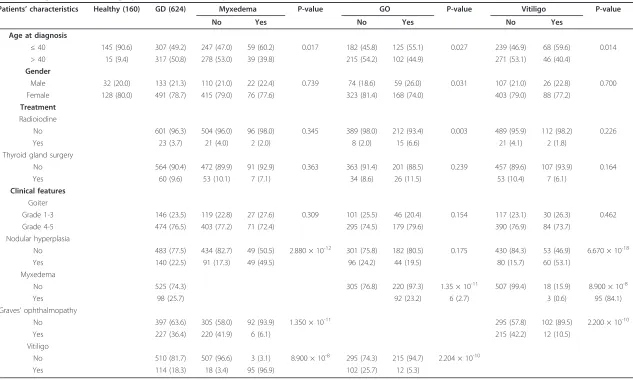
A total of 624 patients (227 with GO and 397 without GO) with a confirmed diagnosis of GD and an appropriate con-trol group with 160 healthy volunteers from China Medi-cal University Hospital in Taiwan were enrolled and followed actively. All individuals provided informed con-sent as approved by the ethics committee of China Medi-cal University Hospital. For the patients, diagnosis of GD and GO was followed the criteria set previously [10]. Full medical record abstraction was conducted to obtain demographics (age and gender); treatment and clinical fea-tures are summarized in Table 1. For the healthy indivi-duals, those with matched for gender according to the female predominance of GD including 32 male (20.0%) and 128 female (80.0%). Age was different in healthy (27.4 ± 6.4 years) as compared to the patients with GD (41.1 ± 12.9 years) (p = 1.96 × 10⁻³⁴).
Genomic DNA extraction and quantification gene dosage ofC4AandC4B
Genomic DNA was extracted from peripheral blood fol-lowing the manufactory’s suggestions (Qiagen).C4gene dosage was assessed by quantitative real-time TaqMan® PCR analysis (Applied Biosystems) as described in the previously published protocols with some modification [11]. Real-time PCR analysis was performed in 96-well optical plates on a 7900HT real-time PCR system (Applied Biosystems). Primers and probes specific for
C4A, andC4B(commonC4AandC4Bforward primer
“C4F": 5’-GCA GGA GAC ATC TAA CTG GCT TCT-3’; commonC4AandC4Breverse primer“C4R": 5’-CCG
CAC CTG CAT GCT CCT-3’; probe“C4A“: FAM-ACC
CCT GTC CAG TGT TAG; probe“C4B“: FAM-ACC
TCT CTC CAG TGA TAC. TaqMan® Universal PCR
Master Mix, No AmpErase® uracil-DNA glycosylase
(ABI catalog number 4326614), VIC-conjugated Taq-Man®RNase Pcontrol reagents (ABI catalog number 4316844), 250 nM of the respective FAM-conjugated TaqMan®probes (C4AorC4B), the particular primers (300 nMC4AorC4B) in distilled water was contained in each of the distinct PCR batches. Appropriately predi-luted genomic DNA (threshold cycle [CT] values for RNase Pbetween 24 and 30) was added before start. CN of each target gene in each sample was determined from three separated experiments. Thermal cycler conditions were adjusted as follows: initial denaturation step for 10 minutes at 95°C; 40 cycles including denaturation for 15 seconds at 95 °C; and annealing/extension for 1 minute for 60°C. The data were analyzed using SDS 2.3 software (Applied Biosystems).
The CTvalue of RNase P, C4AorC4B was converted
into a raw gene dosage by the formula nRAWC4X= 2
(CTRNase P)-(CTC4X)+1
, whereC4Xreferred to C4AorC4B.
Raw gene dosages of positive controls selected from the reference panel were plotted versus the actual gene dosages, and the resulting calibration curve served for determination of the actual copy number of unknown samples of this particular run.
Statistical analysis
Statistical analysis was performed using the statistical package PASW for Windows (version 18.0; SPSS Inc.). The demographics of patients and healthy individuals were analyzed by the chi-square analysis. For those with 2 × 2 contingency tables, differences in the incidence of
individuals with C4 gene CNs above and below the
median or C4A-C4B polymorphisms between patients
with or without indicated feature were evaluated using Fisher’s exact test. For those above 2 × 2 contingency tables, differences in the incidence of individuals with
C4gene CNs above and below the median orC4A-C4B
polymorphisms between patients with or without indi-cated feature were evaluated using Fisher’s exact test,
and the two-tailed p value was estimated by 100,000
Monte Carlo simulations with 99% confidence intervals (CI) (99% confidence for the simulation result). Odds ratios (ORs) and 95% CIs were estimated from logistic regression models adjusting for confounding variables as shown in Table 1.
Results
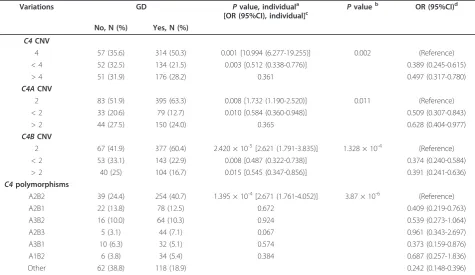
CNV ofC4genes is associated with susceptibility to GD The distribution of copy number for totalC4,C4isotypes as well asC4polymorphisms according to the presence of GD is shown in Table 2. No individuals had a full defi-ciency ofC4 alleles. After adjusting for age, individuals with 4 copies ofC4gene were more susceptible to GD (p= 0.001, OR = 10.994, 95% CI: 6.277-19.255) as com-pared to those without, whereas those with <4 copies of
C4gene tended to prevent from GD (p= 0.003, OR =
0.512, 95% CI: 0.338-0.776) as compared to those with-out. The distribution ofC4AandC4Bamong individuals with or without GD was further investigated. ForC4A gene, individuals with 2 copies ofC4Aincreased the risk toward GD (p= 0.008, OR = 1.732, 95% CI: 1.190-2.520) whereas those with <2 copies ofC4Areduced the risk toward GD (p= 0.01, OR = 0.584, 95% CI: 0.360-0.948). ForC4Bgene, individuals with 2 copies ofC4Bincreased the risk toward GD (p= 2.420 × 10⁻⁵, OR = 2.621, 95% CI: 1.791-3.835) whereas those without 2 copies ofC4B reduced the risk toward GD (p= 0.008, OR = 0.487, 95% CI: 0.322-0.738 for those with <2 copiesC4B;p= 0.015, OR = 0.545, 95% CI: 0.347-0.856 for those with >2 copies C4Brespectively). Polymorphism analysis indicated tat individuals with the most common polymorphism (37.3%), A2B2, with 2.671-fold risk toward GD (p= 1.395 × 10⁻⁴, OR = 2.671, 95% CI: 1.761-4.052) as compared to Liuet al.Journal of Biomedical Science2011,18:71
http://www.jbiomedsci.com/content/18/1/71
Table 1 Background and demographic characteristics of patients with Graves’disease
Patients’characteristics Healthy (160) GD (624) Myxedema P-value GO P-value Vitiligo P-value
No Yes No Yes No Yes
Age at diagnosis
≤40 145 (90.6) 307 (49.2) 247 (47.0) 59 (60.2) 0.017 182 (45.8) 125 (55.1) 0.027 239 (46.9) 68 (59.6) 0.014
> 40 15 (9.4) 317 (50.8) 278 (53.0) 39 (39.8) 215 (54.2) 102 (44.9) 271 (53.1) 46 (40.4)
Gender
Male 32 (20.0) 133 (21.3) 110 (21.0) 22 (22.4) 0.739 74 (18.6) 59 (26.0) 0.031 107 (21.0) 26 (22.8) 0.700
Female 128 (80.0) 491 (78.7) 415 (79.0) 76 (77.6) 323 (81.4) 168 (74.0) 403 (79.0) 88 (77.2)
Treatment
Radioiodine
No 601 (96.3) 504 (96.0) 96 (98.0) 0.345 389 (98.0) 212 (93.4) 0.003 489 (95.9) 112 (98.2) 0.226
Yes 23 (3.7) 21 (4.0) 2 (2.0) 8 (2.0) 15 (6.6) 21 (4.1) 2 (1.8)
Thyroid gland surgery
No 564 (90.4) 472 (89.9) 91 (92.9) 0.363 363 (91.4) 201 (88.5) 0.239 457 (89.6) 107 (93.9) 0.164
Yes 60 (9.6) 53 (10.1) 7 (7.1) 34 (8.6) 26 (11.5) 53 (10.4) 7 (6.1)
Clinical features
Goiter
Grade 1-3 146 (23.5) 119 (22.8) 27 (27.6) 0.309 101 (25.5) 46 (20.4) 0.154 117 (23.1) 30 (26.3) 0.462
Grade 4-5 474 (76.5) 403 (77.2) 71 (72.4) 295 (74.5) 179 (79.6) 390 (76.9) 84 (73.7)
Nodular hyperplasia
No 483 (77.5) 434 (82.7) 49 (50.5) 2.880 × 10⁻¹² 301 (75.8) 182 (80.5) 0.175 430 (84.3) 53 (46.9) 6.670 × 10⁻¹⁸
Yes 140 (22.5) 91 (17.3) 49 (49.5) 96 (24.2) 44 (19.5) 80 (15.7) 60 (53.1)
Myxedema
No 525 (74.3) 305 (76.8) 220 (97.3) 1.35 × 10⁻¹¹ 507 (99.4) 18 (15.9) 8.900 × 10⁻⁸
Yes 98 (25.7) 92 (23.2) 6 (2.7) 3 (0.6) 95 (84.1)
Graves’ophthalmopathy
No 397 (63.6) 305 (58.0) 92 (93.9) 1.350 × 10⁻¹¹ 295 (57.8) 102 (89.5) 2.200 × 10⁻¹⁰
Yes 227 (36.4) 220 (41.9) 6 (6.1) 215 (42.2) 12 (10.5)
Vitiligo
No 510 (81.7) 507 (96.6) 3 (3.1) 8.900 × 10⁻⁸ 295 (74.3) 215 (94.7) 2.204 × 10⁻¹⁰
Yes 114 (18.3) 18 (3.4) 95 (96.9) 102 (25.7) 12 (5.3)
Abbreviations: GD, Graves, disease; GO, Graves’ophthalmopathy; SD, standard deviation; N, number.
of
Biomedical
Science
2011,
18
:71
m/content/1
8/1/71
Page
3
of
those without. These results indicate that individuals with 4, 2 and 2 copies ofC4,C4AandC4Bgenes, espe-cially those with A2B2 polymorphism may have higher risk, whereas those with<4, <2 and≠2 copies ofC4,C4A
and C4B genes may have lower risk toward GD,
respectively.
CNV ofC4genes did not significantly associated with myxedema and GO
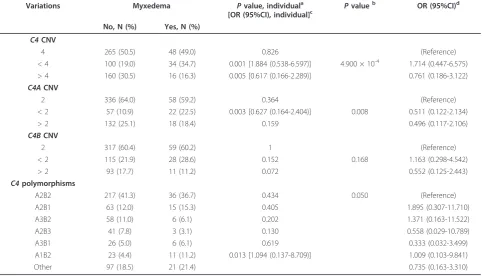
We also estimated the association between polymorph-ism ofC4genes and clinical features of GD. CNV ofC4 genes showed association with susceptibility toward GO, vitiligo and myxedema, but not goiter or nodular hyper-plasia as estimated by Fisher’s exert test (data not shown). After adjusting for age, nodular hyperplasia, GO, and vitiligo, the distribution of copy number for totalC4, C4isotypes as well asC4polymorphisms did not associ-ate with the occurrence of myxedema (Table 3).
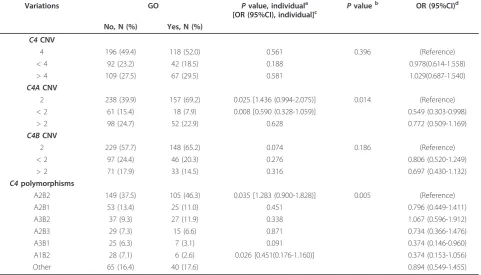
The distribution of copy number for totalC4,C4 iso-types as well asC4polymorphisms according to the pre-sence of GO is shown in Table 4. The relationship betweenC4CNV status and GO was not significant (p=
0.396). The distribution ofC4A andC4B among GD
patients with and without GO were further investigated. After adjusting for age, gender, radioiodine treatment, vitiligo and myxedema, neither isotypes nor polymorph-isms ofC4was significantly associated with GO, although GD patients with <2 copies (0 or 1) of theC4Agene were less susceptible to GO (p= 0.014, OR = 0.549, 95% CI: 0.303-0.998) as compared to those with 2 copies ofC4A, and those with A3B1 polymorphism were less susceptible to GO (p= 0.001, OR = 0.374, 95% CI: 0.146-0.960) as compared to those with A2B2 polymorphism. These results indicate that neither isotypes nor polymorphisms ofC4was significantly associated with GO, however, as compared to GD patients with 2 copies ofC4Aor those with A2B2 polymorphism, those with <2 copies ofC4A or those with A3B1 might be protected against the devel-opment of GO, respectively.
GD patients with <2 copies ofC4Ahad higher risk toward vitiligo
The distribution of copy number for totalC4,C4isotypes as well asC4polymorphisms according to the presence of vitiligo is shown in Table 4. After adjusting with age, nodular hyperplasia, GO and myxedema, patients with Table 2 Distribution ofC4polymorphisms in individuals with or without Graves’disease
Variations GD Pvalue, individuala
[OR (95%CI), individual]c P
valueb OR (95%CI)d
No, N (%) Yes, N (%)
C4CNV
4 57 (35.6) 314 (50.3) 0.001 [10.994 (6.277-19.255)] 0.002 (Reference) < 4 52 (32.5) 134 (21.5) 0.003 [0.512 (0.338-0.776)] 0.389 (0.245-0.615)
> 4 51 (31.9) 176 (28.2) 0.361 0.497 (0.317-0.780)
C4ACNV
2 83 (51.9) 395 (63.3) 0.008 [1.732 (1.190-2.520)] 0.011 (Reference) < 2 33 (20.6) 79 (12.7) 0.010 [0.584 (0.360-0.948)] 0.509 (0.307-0.843)
> 2 44 (27.5) 150 (24.0) 0.365 0.628 (0.404-0.977)
C4BCNV
2 67 (41.9) 377 (60.4) 2.420 × 10⁻⁵[2.621 (1.791-3.835)] 1.328 × 10⁻⁴ (Reference)
< 2 53 (33.1) 143 (22.9) 0.008 [0.487 (0.322-0.738)] 0.374 (0.240-0.584) > 2 40 (25) 104 (16.7) 0.015 [0.545 (0.347-0.856)] 0.391 (0.241-0.636)
C4polymorphisms
A2B2 39 (24.4) 254 (40.7) 1.395 × 10⁻⁴[2.671 (1.761-4.052)] 3.87 × 10⁻⁶ (Reference)
A2B1 22 (13.8) 78 (12.5) 0.672 0.409 (0.219-0.763)
A3B2 16 (10.0) 64 (10.3) 0.924 0.539 (0.273-1.064)
A2B3 5 (3.1) 44 (7.1) 0.067 0.961 (0.343-2.697)
A3B1 10 (6.3) 32 (5.1) 0.574 0.373 (0.159-0.876)
A1B2 6 (3.8) 34 (5.4) 0.384 0.687 (0.257-1.836)
Other 62 (38.8) 118 (18.9) 0.242 (0.148-0.396)
Abbreviations: GD, Graves’disease; CNV, copy number variation; OR, odds ratio; CI, confidence interval; N, number. a
IndividualC4CNVs and polymorphisms between individuals with or without GD were evaluated by Fisher’s exact test using 2 × 2 contingency tables. b
CNV ofC4, C4A and C4Bbetween individuals with or without GD were evaluated by Fisher’s exact test using 3 × 2 contingency tables.C4polymorphisms between individuals with or without GD were evaluated by Fisher’s exact test using 7 × 2 contingency tables. Thepvalue was estimated by 100,000 Monte Carlo simulations with 99% confidence intervals (CI).
c
ORs and 95% CIs were estimated from logistic regression models adjusting for age. d
ORs and 95% CIs were estimated from logistic regression models adjusting for age. Liuet al.Journal of Biomedical Science2011,18:71
http://www.jbiomedsci.com/content/18/1/71
<2 copies ofC4Ahad a 5.153-fold increased risk of viti-ligo (p= 2.650 × 10⁻⁴, OR = 5.153, 95% CI: 1.629-16.300). It remained significant even when compared with GD patients with 2 copies ofC4A(p= 0.001, OR = 5.579, 95% CI: 1.659-18.763, Table 5). These results indicate that <2 copies ofC4Amay increase the risk for vitiligo in patients with GD.
Discussion
Several functionally relevant single nucleotide polymorph-isms are characteristic of GD and GO [12,13], but no rele-vant CNV has been reported [14]. In the present study, we
found that the CNV ofC4,C4AorC4Bmay associate
with the development of GD. In addition, <2 copies of C4Amay associate with development of vitiligo in patients with GD. To the best of our knowledge, this is the first study to report that the linkage among CNV ofC4genes, GD and GD-associated vitiligo. Our results provide new information which may be applied clinically.
C4 involves in the classical pathway which is triggered by interaction of the Fc portion of an antibody or C-reac-tive protein with C1q. It has been shown that the copy number ofC4,C4AorC4Bpositively correlated with the
protein levels of total C4, C4A or C4B, respectively [7]. In our results, individuals with 4, 2, and 2 copies ofC4,C4A orC4Bhave higher risk whereas those with deficiencies of C4,C4AorC4Bhave lower risk toward GD. One possibi-lity is that a deficiency of complement may lead to ineffec-tive opsonization, lytic activity or impairment of B-cell memory, by which reduce tissue injury [15]. Unfortu-nately, the mechanisms by whichC4abnormality contri-butes to the protection of organ-specific autoimmunity are poorly understood. Nevertheless, whether a potential gene-gene or gene-environment interaction is involved in susceptibility to GD needs to be further investigated [16]. This study provides a substantial amount of data that may help to clarify the role ofC4genes in this disorder. It is only through investigations of diverse populations that researchers can expect to dissect the complex genetics involved. In addition, functional studies of susceptibility genes using appropriate animal models could allow for an assessment of their role in the disease process.
However, it may play a different regulatory role in sys-temic autoimmune diseases. Low level of C4 comple-ments in sera has been found in several autoimmune diseases [17-21]. In addition, the presence ofC4Anull Table 3 Distribution ofC4polymorphisms in Graves’disease patients with or without myxedema
Variations Myxedema Pvalue, individuala
[OR (95%CI), individual]c P
valueb OR (95%CI)d
No, N (%) Yes, N (%)
C4CNV
4 265 (50.5) 48 (49.0) 0.826 (Reference)
< 4 100 (19.0) 34 (34.7) 0.001 [1.884 (0.538-6.597)] 4.900 × 10⁻⁴ 1.714 (0.447-6.575) > 4 160 (30.5) 16 (16.3) 0.005 [0.617 (0.166-2.289)] 0.761 (0.186-3.122)
C4ACNV
2 336 (64.0) 58 (59.2) 0.364 (Reference)
< 2 57 (10.9) 22 (22.5) 0.003 [0.627 (0.164-2.404)] 0.008 0.511 (0.122-2.134)
> 2 132 (25.1) 18 (18.4) 0.159 0.496 (0.117-2.106)
C4BCNV
2 317 (60.4) 59 (60.2) 1 (Reference)
< 2 115 (21.9) 28 (28.6) 0.152 0.168 1.163 (0.298-4.542)
> 2 93 (17.7) 11 (11.2) 0.072 0.552 (0.125-2.443)
C4polymorphisms
A2B2 217 (41.3) 36 (36.7) 0.434 0.050 (Reference)
A2B1 63 (12.0) 15 (15.3) 0.405 1.895 (0.307-11.710)
A3B2 58 (11.0) 6 (6.1) 0.202 1.371 (0.163-11.522)
A2B3 41 (7.8) 3 (3.1) 0.130 0.558 (0.029-10.789)
A3B1 26 (5.0) 6 (6.1) 0.619 0.333 (0.032-3.499)
A1B2 23 (4.4) 11 (11.2) 0.013 [1.094 (0.137-8.709)] 1.009 (0.103-9.841)
Other 97 (18.5) 21 (21.4) 0.735 (0.163-3.310)
Abbreviations: GD, Graves’disease; GO, Graves’ophthalmopathy; CNV, copy number variation; OR, odds ratio; CI, confidence interval; N, number. a
IndividualC4CNVs and polymorphisms between GD patients with or without myxedema were evaluated by Fisher’s exact test using 2 × 2 contingency tables. b
CNV ofC4, C4A and C4Bbetween GD patients with or without myxedema were evaluated by Fisher’s exact test using 3 × 2 contingency tables.C4
polymorphisms between GD patients with or without myxedema were evaluated by Fisher’s exact test using 7 × 2 contingency tables. Thepvalue was estimated by 100,000 Monte Carlo simulations with 99% confidence intervals (CI).
c
ORs and 95% CIs were estimated from logistic regression models adjusting for age, nodular hyperplasia, GO and vitiligo. d
allele that results in partial C4 deficiency have shown to be risk factor for susceptibility in systemic lupus erythe-matosus (SLE) and the SLE-related renal damage [7,19]. A hypothesis is that complement may participate in the presentation of self-antigens to developing B cells by which protects against responses to self-antigens and subsequence promoting the elimination of self-reactive lymphocytes [9]. The pathogenesis of vitiligo, similar to SLE, is characterized by the destruction of cutaneous melanocytes which due to another antibody-induced hypopigmentation. Experiments in knockout mice have demonstrated that complement deficient can cause the destruction of pigment cells leading to vitiligo-like depig-mentation [21]. Our results revealed that deficiency of
C4A may enhance the development of vitiligo in GD
patients, implying exist of an alternative pathway for the deficiency of complement.
What is interesting is that although we explored the relationship ofC4CNV to GD as well as other GD clini-cal features, only the lower copies ofC4A, but notC4B, were associated with higher risk of vitiligo. Because it appears that C4A binds to amino group-containing anti-gens such as immune complex, whereas C4B binds to
hydroxyl group-containing antigens such as bacteria, this result may provide another view to support the hypoth-eses that the pathogenesis of vitiligo may be more rele-vant to the existence of the immune complex than the pathogen. In addition, recent studies have identified that the risk locus within the major histocompatibility com-plex region on chromosome 6q may be associated with vitiligo in both Chinese Han population and American population [22,23]. It may be interesting to investigate the gene-gene interaction betweenC4polymorphism and the vitiligo risky locus. Moreover, although confirmation of these results in larger samples is warranted, it would be interesting to further investigate the functional role of C4Ain the development of vitiligo.
Conclusion
This study provides evidence that the CNV of C4, C4A
or C4Bmay associate with the development of GD and
<2 copies of C4A may associate with development of vitiligo in patients with GD. These results may be further estimated for its application on predicting the occurrence of GD and the clinical outcome in patients Table 4 Distribution ofC4polymorphisms in Graves’disease patients with or without Graves’ophthalmopathy
Variations GO Pvalue, individuala
[OR (95%CI), individual]c P
valueb OR (95%CI)d
No, N (%) Yes, N (%)
C4CNV
4 196 (49.4) 118 (52.0) 0.561 0.396 (Reference)
< 4 92 (23.2) 42 (18.5) 0.188 0.978(0.614-1.558)
> 4 109 (27.5) 67 (29.5) 0.581 1.029(0.687-1.540)
C4ACNV
2 238 (39.9) 157 (69.2) 0.025 [1.436 (0.994-2.075)] 0.014 (Reference) < 2 61 (15.4) 18 (7.9) 0.008 [0.590 (0.328-1.059)] 0.549 (0.303-0.998)
> 2 98 (24.7) 52 (22.9) 0.628 0.772 (0.509-1.169)
C4BCNV
2 229 (57.7) 148 (65.2) 0.074 0.186 (Reference)
< 2 97 (24.4) 46 (20.3) 0.276 0.806 (0.520-1.249)
> 2 71 (17.9) 33 (14.5) 0.316 0.697 (0.430-1.132)
C4polymorphisms
A2B2 149 (37.5) 105 (46.3) 0.035 [1.283 (0.900-1.828)] 0.005 (Reference)
A2B1 53 (13.4) 25 (11.0) 0.451 0.796 (0.449-1.411)
A3B2 37 (9.3) 27 (11.9) 0.338 1.067 (0.596-1.912)
A2B3 29 (7.3) 15 (6.6) 0.871 0.734 (0.366-1.476)
A3B1 25 (6.3) 7 (3.1) 0.091 0.374 (0.146-0.960)
A1B2 28 (7.1) 6 (2.6) 0.026 [0.451(0.176-1.160)] 0.374 (0.153-1.056)
Other 65 (16.4) 40 (17.6) 0.894 (0.549-1.455)
Abbreviations: GD, Graves’disease; GO, Graves’ophthalmopathy; CNV, copy number variation; OR, odds ratio; CI, confidence interval; N, number. a
IndividualC4CNVs and polymorphisms between GD patients with or without GO were evaluated by Fisher’s exact test using 2 × 2 contingency tables. b
CNV ofC4, C4A and C4Bbetween GD patients with or without GO were evaluated by Fisher’s exact test using 3 × 2 contingency tables.C4polymorphisms between GD patients with or without GO were evaluated by Fisher’s exact test using 7 × 2 contingency tables. Thepvalue was estimated by 100,000 Monte Carlo simulations with 99% confidence intervals (CI).
c
ORs and 95% CIs were estimated from logistic regression models adjusting for age, gender, ever received radioiodine treatment, myxedema and vitiligo. d
ORs and 95% CIs were estimated from logistic regression models adjusting for age, gender, ever received radioiodine treatment, myxedema and vitiligo. Liuet al.Journal of Biomedical Science2011,18:71
http://www.jbiomedsci.com/content/18/1/71
with GD which might aid in the diagnosis of the disease and the development of therapeutic strategies.
List of abbreviations
(GD): Graves’disease; (GO): Graves’ophthalmopathy; (CNV): copy number variation; (CN): copy number; (SLE): systemic lupus erythematosus.
Acknowledgements
We thank Hsin-Hui Chen for the technical assistance in preparation of DNA and analyzing the variations. This study was supported by grants from the National Science Council (96-2628-B-039-002-MY3 and 98-2320-B-039-008-MY3), Taipei, Taiwan, and grants from the China Medical University Hospital (DMR-100-162), Taichung, Taiwan.
Author details
1Department of Medical Genetics and Medical Research, China Medical
University Hospital, Taichung, Taiwan.2Graduate Institute of Integrated
Medicine, China Medical University, Taichung, Taiwan.3School of Chinese
Medicine, China Medical University, Taichung, Taiwan.4Department of Health and Nutrition Biotechnology, Asia University, Taichung, Taiwan.5Division of
Endocrinology and Metabolism, Department of Medicine, China Medical University Hospital, Taichung, Taiwan.6Department of Endocrinology and
Metabolism, College of Chinese Medicine, China Medical University, Taichung, Taiwan.7Department of Pediatrics, China Medical University
Hospital, Taichung, Taiwan.8Department of Biotechnology, Asia University,
Taichung, Taiwan.9School of Post-Baccalaureate Chinese Medicine, China
Medical University, Taichung, Taiwan.10Department of Biotechnology, Asia
University, Taichung, Taiwan.11Department of Biotechnology and
Bioinformatics, Asia University, Taichung, Taiwan.
Authors’contributions
YHL designed the study, managed the literature searches, undertook the statistical analysis, and wrote the draft of the manuscript. LW designed and performed the experiments. CTC and WCC recruited and maintained the clinical information of participants. LWLL and TYT undertook the statistical analysis. CHT and FJT directed the study and reviewed the results. All authors contributed to and have approved the final manuscript.
Competing interests
The authors declare that they have no competing interests.
Received: 22 February 2011 Accepted: 26 September 2011 Published: 26 September 2011
References
1. Mishra A, Mishra SK:Multicentre study of thyroid nodules in patients with Graves’disease (Br J Surg 2000; 87: 1111-13).Br J Surg2001,88(2):313. 2. Tomer Y, Huber A:The etiology of autoimmune thyroid disease: a story
of genes and environment.J Autoimmun2009,32(3-4):231-239. 3. McGrogan A, Seaman HE, Wright JW, de Vries CS:The incidence of
autoimmune thyroid disease: a systematic review of the literature.Clin Endocrinol (Oxf)2008,69(5):687-696.
4. Fanciulli M, Petretto E, Aitman TJ:Gene copy number variation and common human disease.Clin Genet77(3):201-213.
5. Schaschl H, Aitman TJ, Vyse TJ:Copy number variation in the human genome and its implication in autoimmunity.Clin Exp Immunol2009,156(1):12-16.
Table 5 Distribution ofC4polymorphisms in Graves’disease patients with or without vitiligo
Variations Vitiligo Pvalue, individuala
[OR (95%CI), individual]c P
valueb OR (95%CI)d
No, N (%) Yes, N (%)
C4CNV
4 258 (50.6) 56 (49.1) 0.836 0.002 (Reference)
< 4 97 (19.0) 37 (32.5) 0.002 [1.297 (0.434-3.874)] 1.334 (0.415-4.289) > 4 155 (30.4) 21 (18.4) 0.011 [0.987 (0.362-2.691)] 1.076 (0.370-3.133)
C4ACNV
2 330 (64.7) 65 (57.0) 0.133 (Reference)
< 2 52 (10.2) 27 (23.7) 2.650 × 10⁻⁴[5.153 (1.629-16.3000] 0.001 5.579 (1.659-18.763)
> 2 128 (25.1) 22 (19.3) 0.225 1.289 (0.414-4.013)
C4BCNV
2 310 (60.8) 67 (58.8) 0.751 (Reference)
< 2 112 (22.0) 31 (27.2) 0.267 0.414 1.133 (0.355-3.614)
> 2 88 (17.3) 16 (14.0) 0.487 2.107 (0.687-6.467)
C4polymorphisms
A2B2 213 (41.8) 41 (36.0) 0.292 0.03 (Reference)
A2B1 62 (12.2) 16 (14.0) 0.638 0.889 (0.175-4.524)
A3B2 57 (11.2) 7 (6.1) 0.125 0.756 (0.132-4.335)
A2B3 40 (7.8) 4 (3.5) 0.154 1.111 (0.151-8.205)
A3B1 25 (4.9) 7 (6.1) 0.638 1.484 (0.199-11.089)
A1B2 22 (4.3) 12 (10.5) 0.019 [2.035(0.335-12.368)] 2.745 (0.384-19.599)
Other 91 (17.8) 27 (23.7) 3.471 (1.046-11.525)
Abbreviations: GD, Graves’disease; GO, Graves’ophthalmopathy; CNV, copy number variation; OR, odds ratio; CI, confidence interval; N, number. a
IndividualC4CNVs and polymorphisms between GD patients with or without vitiligo were evaluated by Fisher’s exact test using 2 × 2 contingency tables. b
CNV ofC4, C4A and C4Bbetween GD patients with or without vitiligo were evaluated by Fisher’s exact test using 3 × 2 contingency tables.C4polymorphisms between GD patients with or without vitiligo were evaluated by Fisher’s exact test using 7 × 2 contingency tables. Thepvalue was estimated by 100,000 Monte Carlo simulations with 99% confidence intervals (CI).
c
ORs and 95% CIs were estimated from logistic regression models adjusting for age, nodular hyperplasia, myxedema and GO. d
6. Fanciulli M, Norsworthy PJ, Petretto E, Dong R, Harper L, Kamesh L, Heward JM, Gough SCL, de Smith A, Blakemore AIF, Owen CJ, Pearce SHS, Teixeira L, Guillevin L, Graham DSC, Pusey CD, Cook HT, Vyse TJ, Aitman TJ:
FCGR3B copy number variation is associated with susceptibility to systemic, but not organ-specific, autoimmunity.Nature Genetics2007,
39(6):721-723.
7. Yang Y, Chung EK, Wu YL, Savelli SL, Nagaraja HN, Zhou B, Hebert M, Jones KN, Shu Y, Kitzmiller K, Blanchong CA, McBride KL, Higgins GC, Rennebohm RM, Rice RR, Hackshaw KV, Roubey RA, Grossman JM, Tsao BP, Birmingham DJ, Rovin BH, Hebert LA, Yu CY:Gene copy-number variation and associated polymorphisms of complement component C4 in human systemic lupus erythematosus (SLE): low copy number is a risk factor for and high copy number is a protective factor against SLE susceptibility in European Americans.Am J Hum Genet2007,80(6):1037-1054.
8. Yu CY, Whitacre CC:Sex, MHC and complement C4 in autoimmune diseases.Trends Immunol2004,25(12):694-699.
9. Carroll MC:The role of complement and complement receptors in induction and regulation of immunity.Annu Rev Immunol1998,
16:545-568.
10. Liu YH, Chen RH, Chen WC, Tsai Y, Wan L, Tsai FJ:Disease association of the CD103 polymorphisms in Taiwan Chinese Graves’ophthalmopathy patients.Ophthalmology117(8):1645-1651.
11. Szilagyi A, Blasko B, Szilassy D, Fust G, Sasvari-Szekely M, Ronai Z:Real-time PCR quantification of human complement C4A and C4B genes.BMC Genet2006,7:1.
12. Zeitlin AA, Simmonds MJ, Gough SC:Genetic developments in autoimmune thyroid disease: an evolutionary process.Clin Endocrinol (Oxf)2008,68(5):671-682.
13. Jacobson EM, Tomer Y:The genetic basis of thyroid autoimmunity.
Thyroid2007,17(10):949-961.
14. Fanciulli M, Norsworthy PJ, Petretto E, Dong R, Harper L, Kamesh L, Heward JM, Gough SC, de Smith A, Blakemore AI, Froguel P, Owen CJ, Pearce SH, Teixeira L, Guillevin L, Graham DS, Pusey CD, Cook HT, Vyse TJ, Aitman TJ:FCGR3B copy number variation is associated with susceptibility to systemic, but not organ-specific, autoimmunity.Nat Genet2007,39(6):721-723.
15. Markiewski MM, Lambris JD:The role of complement in inflammatory diseases from behind the scenes into the spotlight.Am J Pathol2007,
171(3):715-727.
16. Davies EJ, Steers G, Ollier WE, Grennan DM, Cooper RG, Hay EM, Hillarby MC:Relative contributions of HLA-DQA and complement C4A loci in determining susceptibility to systemic lupus erythematosus.Br J Rheumatol1995,34(3):221-225.
17. Lachmann PJ:Complement deficiency and the pathogenesis of autoimmune immune complex disease.Chem Immunol1990,49:245-263. 18. Beurskens FJ, van Dijk H, Robins DM:Does complement component C4A
protect from autoimmune disease?Immunol Today1997,18(4):199. 19. Seelen MA, Daha MR:The role of complement in autoimmune renal
disease.Autoimmunity2006,39(5):411-415.
20. Chen M, Daha MR, Kallenberg CG:The complement system in systemic autoimmune disease.J Autoimmun34(3):J276-286.
21. Trcka J, Moroi Y, Clynes RA, Goldberg SM, Bergtold A, Perales MA, Ma M, Ferrone CR, Carroll MC, Ravetch JV, Houghton AN:Redundant and alternative roles for activating Fc receptors and complement in an antibody-dependent model of autoimmune vitiligo.Immunity2002,
16(6):861-868.
22. Jin Y, Birlea SA, Fain PR, Gowan K, Riccardi SL, Holland PJ, Bennett DC, Herbstman DM, Wallace MR, McCormack WT, Kemp EH, Gawkrodger DJ, Weetman AP, Picardo M, Leone G, Taieb A, Jouary T, Ezzedine K, van Geel N, Lambert J, Overbeck A, Spritz RA:Genome-Wide Analysis Identifies a Quantitative Trait Locus in the MHC Class II Region Associated with Generalized Vitiligo Age of Onset.J Invest Dermatol2011,
Jun;131(6):1308-12, Epub 2011 Feb 17.
23. Quan C, Ren YQ, Xiang LH, Sun LD, Xu AE, Gao XH, Chen HD, Pu XM, Wu RN, Liang CZ, Li JB, Gao TW, Zhang JZ, Wang XL, Wang J, Yang RY, Liang L, Yu JB, Zuo XB, Zhang SQ, Zhang SM, Chen G, Zheng XD, Li P, Zhu J, Li YW, Wei XD, Hong WS, Ye Y, Zhang Y, Wu WS, Cheng H, Dong PL, Hu DY, Li Y, Li M, Zhang X, Tang HY, Tang XF, Xu SX, He SM, Lv YM, Shen M, Jiang HQ, Wang Y, Li K, Kang XJ, Liu YQ, Sun L, Liu ZF, Xie SQ, Zhu CY, Xu Q, Gao JP, Hu WL, Ni C, Pan TM, Yao S, He CF, Liu YS, Yu ZY, Yin XY, Zhang FY, Yang S, Zhou Y, Zhang XJ:Genome-wide association
study for vitiligo identifies susceptibility loci at 6q27 and the MHC.Nat Genet42(7):614-618.
doi:10.1186/1423-0127-18-71
Cite this article as:Liuet al.:Association between copy number variation of complement componentC4and Graves’disease.Journal of Biomedical Science201118:71.
Submit your next manuscript to BioMed Central and take full advantage of:
• Convenient online submission
• Thorough peer review
• No space constraints or color figure charges
• Immediate publication on acceptance
• Inclusion in PubMed, CAS, Scopus and Google Scholar
• Research which is freely available for redistribution
Submit your manuscript at www.biomedcentral.com/submit Liuet al.Journal of Biomedical Science2011,18:71
http://www.jbiomedsci.com/content/18/1/71