D E B A T E
Open Access
Defining
“
mutation
”
and
“
polymorphism
”
in the era of personal genomics
Roshan Karki
1, Deep Pandya
1, Robert C. Elston
2and Cristiano Ferlini
1*Abstract
Background:The growing advances in DNA sequencing tools have made analyzing the human genome cheaper and faster. While such analyses are intended to identify complex variants, related to disease susceptibility and efficacy of drug responses, they have blurred the definitions of mutation and polymorphism.
Discussion:In the era of personal genomics, it is critical to establish clear guidelines regarding the use of a reference genome. Nowadays DNA variants are called as differences in comparison to a reference. In a sequencing project Single Nucleotide Polymorphisms (SNPs) and DNA mutations are defined as DNA variants detectable in >1 % or <1 % of the population, respectively. The alternative use of the two terms mutation or polymorphism for the same event (a difference as compared with a reference) can lead to problems of classification. These problems can impact the accuracy of the interpretation and the functional relationship between a disease state and a genomic sequence.
Summary:We propose to solve this nomenclature dilemma by defining mutations as DNA variants obtained in a paired sequencing project including the germline DNA of the same individual as a reference. Moreover, the term mutation should be accompanied by a qualifying prefix indicating whether the mutation occurs only in somatic cells (somatic mutation) or also in the germline (germline mutation). We believe this distinction in definition will help avoid confusion among researchers and support the practice of sequencing the germline and somatic tissues in parallel to classify the DNA variants thus defined as mutations.
Keywords:Personal genomics, Precision medicine, DNA sequencing, DNA variants, Human genome
Background
The human genome consists of over 3 billion base pairs which reside in every nucleated cell of the body [1, 2]. The genome, which has remained well conserved throughout evolution, is at least 99.5 % identical be-tween any two humans on the planet [3]. Modern genomic tools have revealed that it is more complex, diverse, and dynamic than previously thought, even though the genetic variation is limited to between 0.1 % [4–6] and 0.4 % [7] of the genome. Sequence variations, even in non-protein coding regions of the DNA, have begun to alter our understanding of the human genome. While some studies have linked cer-tain variants to being predictive of disease susceptibil-ity and drug response, the majorsusceptibil-ity of diseases have a
very complex genetic signature (reviewed in [8, 9]). Biomedical research is shifting towards understanding the functional importance of many such variations and their association with human diseases.
At the heart of these novel discoveries are the modern DNA sequencing tools, which continue to evolve at a rapid pace. The new sequencing technologies continue to become cheaper and more precise, and facilitate novel medical and biological breakthroughs all over the world [10, 11]. Scientific research has become nearly incon-ceivable without employing sequencing technology but, with the progress of technology and the increas-ing sequencincreas-ing of individuals, a massive amount of data is being generated. However, any data without context and analysis is useless. The data from sequen-cing must be carefully annotated, securely stored, and easily accessible from repositories when needed. Such arduous tasks require functional collaboration among clinicians, researchers, and health professionals [12]. * Correspondence:[email protected]
1
Danbury Hospital Research Institute, Western Connecticut Health Network, 131 West Street, Danbury, CT 06810, USA
Full list of author information is available at the end of the article
In a recent thread in the ResearchGate portal [13], an ongoing discussion on the difference between a muta-tion and a polymorphism elicited a response from more than three hundred participants from various scientific backgrounds. The variety of responses prompted us to write this document as a paper aimed at stimulating the discussion further and possibly finding a consen-sus on the usage of the terms mutation and poly-morphism in the context of a reference sequence in a personal genome project.
Discussion
The rise of genomics and its impact on human health Established in 1990, the Human Genome Project was one of the most expensive and collaborative ventures ever undertaken in science. Ten years since its comple-tion, it has continued to provide a wealth of novel in-formation, the implications of which are not yet fully understood [8]. The open-access nature of the project has stimulated scientists, as well as scientific companies, to develop better sequencing tools and accompanying analytical software. The ensuing innovations have helped to mark down the price of whole genome sequencing over the years, from nearly $3 billion at its inception to under $3,000, making it accessible to researchers from different biomedical disciplines [14].
Sequencing tools will play an important role in the de-velopment of personalized medicine. Some sequencing technologies are already used in clinics to test genetic conditions, diagnose complex diseases, or screen patient samples for rare variants. These tests allow health pro-fessionals to accurately diagnose a disease and prescribe appropriate medication specific to the patient [15, 16]. With the recent support of NIH grants in the US, neo-natal sequencing is being explored to probe rare and complex disorders of newborn babies [17, 18]. There are technologies in development that allow non-invasive ways of sequencing a genome of an unborn child [19]. Personalized genome sequencing will transform the future of the healthcare landscape. However, the rise in the number of sequenced genomes is creating new pro-blems. In particular, the way the genome analysis soft-ware works is through comparison of the obtained sequences with a reference. Because the human genome is different between different individuals, what is the reference sequence? What is the threshold to distinguish common from rare DNA variants?
Amid all these interesting implications of genome se-quencing, the debate concerning the correct use of scien-tific terminology remains. Specifically, the nomenclature “mutation” and “polymorphism”, and also “point muta-tion”versus“SNP”, can be independently used to describe the same event, namely a difference in the sequence as compared with a reference. From a strictly grammatical
and etymological point of view, a mutation is an event (of mutating) and a polymorphism is a condi-tion or quality (of being polymorphic); but these terms by extension quickly came to mean the result-ing event or condition itself. In principle, a point DNA variant can be labeled as a mutation or SNP. Since no clear rules are available, currently used soft-ware tools used for genome sequencing make no as-signment and label the difference simply as DNA variant, blurring the distinction between the two categories.
“Mutation”and“polymorphism”: earlier definitions The uniform and unequivocal description of sequence var-iants in human DNA and protein sequences (mutations, polymorphisms) were initiated by two papers published in 1993 [20, 21]. In this context, any rare change in the nu-cleotide sequence, usually but not always with a disease causing attribute, is termed a“mutation”[22]. This change in the nucleotide sequence may or may not cause pheno-typic changes. Mutations can be inherited from parents (germline mutations) or acquired over the life of an indi-vidual (somatic mutations), the latter being the principal driver of human diseases like cancer. Germline mutations occur in the gametes. Since the offspring is initially de-rived from the fusion of an egg and a sperm, germline mu-tations of parents may also be found in each nucleated cell of their progeny. Mutations usually arise from unrepaired DNA damage, replication errors, or mobile genetic ele-ments. There are several major classes of DNA mutations. A point mutation occurs when a single nucleotide is added, deleted or substituted. Along with point mutations, the whole structure of a chromosome can be altered, with chromosomal regions being flipped, deleted, duplicated, or translocated [23]. Another kind of DNA mutation is defined as “copy number variation”. In this case, the ex-pression of a gene is amplified (or reduced) through in-creased (dein-creased) copy number of a locus allele [24, 25].
The anatomy of the problem
In the era of advanced DNA sequencing tools and personal genomics, these earlier definitions of mutation and polymorphism are antiquated. Before multiple parallel sequencing was developed, it was impossible to sequence multiple times the genome of the same patient. For these reasons at that time it was required to use a reference sequence coming from the assembly of multiple genomes. In the preparation of the consen-sus sequence, an arbitrary threshold of 1 % was estab-lished to distinguish common (polymorphism) from rare (mutation) variants [26].
The 1 % or higher frequency associated with a poly-morphism is an arbitrary number [30] recommended by scientists prior to the era of Next Gen Sequencing. The threshold being arbitrary, redefining the popula-tion itself may affect the classificapopula-tion, with rare variants becoming polymorphisms or polymorphisms becoming rare variants according to the population analyzed. For decades, the use of this frequency to develop population models was preferred to the use of sequencing tools, which at that time were error-prone and labor-intensive. With the advent of new se-quencing technologies and the subsequent sese-quencing of individuals, a very different picture of population dynamics has begun to emerge. Mutations that were thought to be rare in a population have been found to exceed the frequency threshold set at 1 % [31]. Even more surprising, there is a lack of association of some of these rare mutations with human diseases. When comparing populations separated by geographic and physical barriers, a disease-causing mutation in one population is found to be harmless in another, and vice versa [32].
For instance, sickle-cell anemia is caused by a nucleo-tide change (SNP rs334) in a gene coding for the beta chain of the hemoglobin protein [33]. In fact, rs334 is classified as a SNP, since its minor allele frequency in the population is >1 %. The disease manifests in people who have two copies of the mutated gene (rs334(T;T) genotype). Sickle cell anemia is usually rare (<1 %) in the populations of developed nations [34]. However, the heterozygous form of the gene (rs334(A;T) genotype) is persistent in populations of Africa, India, and other de-veloping nations, where malaria is endemic [33]. In these geographic locations, heterozygote carriers of rs334 have a survival advantage against the malaria pathogen, and therefore this beneficial mutation is passed through the offspring to succeeding generations [35–37]. Here, a rare variant, which in one population (developed nations) causes a severe disease in homozygosis, can persist in another population to confer a survival advantage as a polymorphism in heterozygosis [38]. Such exceptions are increasing and show the need to redefine the terms
mutation and polymorphism. The distinction between mutation and polymorphism on the basis of their disease-causing capacity is further complicated. Al-though Al-thought to be naturally occurring, recent re-search into SNPs has shown that they can be associated with diseases like diabetes and cancers. At least 40 SNPs have been shown to associate with type-2 diabetes alone [39]. In short, it is not possible to classify the functional role of variations according to frequency in the popula-tion or their capability to cause a disease.
Context of personal genomics
This debate on “mutation” and “polymorphism” needs urgent evaluation in the era of Next Gen Sequencing and precision medicine. Multiple international collabora-tive projects like ENCODE (Encyclopedia of DNA ele-ments) and HapMap (Haplotype Map) have ensued to map all the genes, genetic variation, and regulatory ele-ments of the genome, to find associations with human biology, personal traits, and diseases [40].
In this climate, commercial companies like Illumina and Roche are developing advanced and robust plat-forms that tailor to the need of both small and large research facilities. The increasing competition among these companies has resulted in many different tech-nologies, which are now available to facilitate new insights into genomics [11]. Similarly, advanced genomic tools and analytical software have been developed that can function independently of the particular platform. Researchers using tools like CLC genomics, Next Gene and Geno Matrix, can access and download sequencing datasets for their own streamlined research. The primary goal of such research is to look for subtle, complex, and dynamic sequence variations. The lack of consistent defi-nitions and a uniform scientific language can hamper this upcoming field, where genomic platforms may for-mulate incorrect hypotheses and researchers may misin-terpret data based on earlier definitions.
be a toxic effect, since the targeted treatment will impact both cancer and noncancerous cells carrying the same genetic variant. This problem is prevented if both germline and somatic cancer genomes would be sequenced in the same patient.
Another important reason underlying the need of such distinction is that a disease may originate with two sub-sequent mutations according to the two-hit hypothesis [42]. Within a population, a germline mutation (first hit) may predispose a subset of patients to a second, somatic, mutation whose effects will create the diseased pheno-type [43]. In this context, in order to identify popula-tions at risk it would be extremely helpful to distinguish between somatic and germline mutations. For example, multiple meningiomas occur in <10 % of meningioma patients. A first germline mutation in the SMARCB1 gene will predispose to meningioma, but this will occur only when a somatic mutation in the NF2 gene inter-venes [44]. In the absence of a clear distinction between somatic and germline variants this kind of pathogenic discovery may be impossible.
This approach is now supported by a recent study. Jones et al. evaluated 815 tumor-normal paired samples coming from 15 different tumor types [45] using Next Gene Sequencing. Library preparation was performed with two methods, whole exome preparation and tar-geted amplification, for 111 genes. Analyses were then conducted either as if only the cancer tissue was sequenced (reference human genome assembly GRch37-lite) or taking as reference the germline DNA of the same patient. With the first analysis, the authors reported a very high rate of false-positive variants (31 % and 65 % in exome and targeted libraries, respectively). Furthermore, they identified germline mutations in 3 % of the cancers, even if they came from a cohort without family history (sporadic cancer). Now that the new sequencing technologies have dramatically reduced the cost of sequencing, precision medicine and personal genomics require that the reference of the DNA sequen-cing project should be obtained from the germline DNA of the same patient.
Ongoing debate and HGVS (Human Genome Variation Society) recommendations
The ongoing debate among scientists to resolve the nomenclature mutation and polymorphism is a step in the right direction. The HGVS, an alliance of 600 members from 34 countries, incorporates discussion and recommendations to establish consensus defini-tions and descripdefini-tions of generic terms that are ac-cepted worldwide. Since the early 1990s, the HGVS has been instrumental in its push to standardize the mutation nomenclature. The recommendations of the
HGVS have been based on extensive discussions among scientists over the years.
The papers published on this topic for the last 20 years show that HGVS was visionary to recommend new changes and extensions based on discoveries of relatively complex variants. In 2002, several researchers tried to address this nomenclature problem and the challenges to make more inclusive definitions.A special article by Condit et al. found that mutation had become increas-ingly negative in connotation since its use in the bio-logical sciences, but particularly over the course of the 20th century [22]. This negativity of the term became entrenched with radiation experiments and the use of atomic weapons during the IIndworld war, and later with science fiction books and movies. The paper suggested that a better term like“variation” and “alteration” might be useful, but its inconsistent usage in the scientific world makes it problematic.
More recently, additional papers have highlighted the urgency of a “consensus” guiding the selection of the sequencing methods (data collection) and reporting. These studies point out that the accurate classification of pathogenic variants requires a standardized approach and the building of data repositories including all these data [46]. In this context, Richards et al. on the behalf of the American College of Medical Genetics and Genom-ics (ACMG) have noted that the terms “mutation” and “polymorphism” often lead to confusion because of in-correct assumptions of pathogenic and benign effects, respectively. Thus, they recommended that both terms be replaced by the term “variant” with the following modifiers: (i) pathogenic, (ii) likely pathogenic, (iii) un-certain significance, (iv) likely benign, or (v) benign [47].
Summary
Despite this rhetoric to better define the terms, there is no consensus in research papers or HGVS recom-mendations on how a mutation is different from a polymorphism. The lack of a consensus is creating a problem in the interpretation of data coming from personal genome software analysis, as described above. What is the reference? What is the threshold to distinguish common from rare DNA variants? This problem is not trivial when looking at the down-stream effects. In fact, the term mutation is com-monly conceived (wrongly) to carry an intrinsic negative impact on the function of a given gene.
not inherited by their offspring. Alterations in the DNA of germ cells –sperms and eggs –can be inherited by off-spring and are currently called germline mutations. In this case, the term mutation should be used only if the germ-line “variant” has been detected using as a reference the germline DNA of the same individual. While germline mutations can also increase the likelihood of succumbing to certain diseases, the signature of such mutations is found in each and every cell of the offspring [48]. This is because the original embryo (first cell in the body) is formed through the fusion of germ cells, from where all the somatic cells arise. So in essence, while these alter-ations in the parents’germ cells are appropriately termed germline mutations, calling both somatic and germline mutations simply “mutations” seems incongruent. The variation of genotypes among individuals, inherited from parents but still present in the DNA of each cell in the
body, is the classic definition of a genetic polymorphism and we propose going back to this original definition: a polymorphism occurs in a population when the observed variation from individual to individual is not maintained by recurrent mutation.
Whereas it is perhaps not unreasonable to use the term mutation for the result of a mutation event, there is no analogy that would imply using the term poly-morphism for a common variant because polypoly-morphism is a condition found in a population, not an event. Gen-etic polymorphism, just like any other biological poly-morphism (e.g. the siphonophores) occurs when members of a species differ in form [49]. When the notion that the different forms could be genotypes rather than phenotypes was first introduced [49], the focus was on the least fre-quent genotype not being due to recurrent mutation, and hence the arbitrary 1 % threshold; but a genetic locus with
a thousand equi-frequent alleles would be considered extremely polymorphic. Most SNPs are tri-morphic, but are appropriately called polymorphisms in contrast to being mono-morphic.
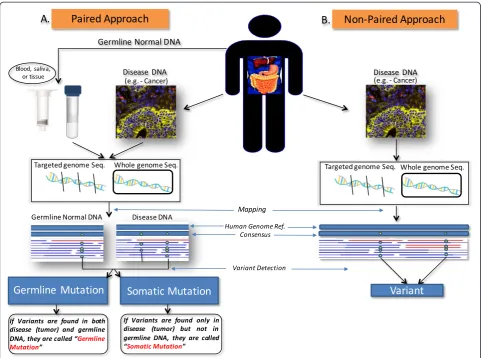
Different from diseases associated with SNPs, which are expressed in all the cells of an organism, some dis-eases, like cancer, are caused by genetic variations typical of a small subset of somatic cells. In order to keep the difference between the two categories of DNA variants, we propose a clear distinction between a SNP and a somatic mutation. A tumor sample and a normal tissue sample from the same individual can be sequenced for analysis of genetic variations. For statistical and comput-ing power, additional sequences comcomput-ing from buccal swabs or peripheral blood DNA can be used to sequence the germline reference of a patient (paired approach). Since the tumor samples have additional genetic changes as compared with the specific individual’s germline refer-ence, these changes will serve as key attributes to under-standing the cancer of this specific individual.
It is possible that germline sequences between this indi-vidual and others also differ, and this would constitute a polymorphism in the population, as originally defined. The genotypes/alleles that constitute a polymorphism should be called variants but never, without attribute, sim-ply “mutations”. In our proposal, the term “mutation” should be used only if the sequencing project used the germline reference (Fig. 1a). In this context, in order to have a mutation it is not only required to detect a vari-ation as compared with the reference, but also the refer-ence needs to be represented by the germline cells of the same individual. Accordingly, the term“mutation” should always be accompanied by a qualifying prefix indicating if the“mutation” occurs only in somatic cells (somatic mu-tation) or also in the germ line cells (germline mumu-tation) (Fig. 1a). This would prevent mutations and polymor-phisms from being incorrectly annotated in a sequencing project, with potential deleterious effects on the efficacy of genomics applied to precision medicine, as recently highlighted in recent studies [45–47].
In the case a sequencing project did not include as a reference the germ-line DNA of an individual, the term “mutation” could not be used and should be re-placed by the neutral term “variant” (Fig. 1b), as pre-viously suggested [47]. Therefore, in the sequencing report the alternative use of the term “mutation” or “variant” will also clarify which kind of reference was adopted. We anticipate that this approach will encourage the use of referencing germline DNA in a sequencing pro-ject and will allow an immediate comparison between studies that used the same referencing method. Import-antly, the term “polymorphism” should only be used in the context of a population. Accordingly, this term cannot be approved to classify variants in personal genomics.
Abbreviations
SNP:Single nucleotide polymorphism; HGVS: Human Genome Variation Society.
Competing interests
The authors declare that they have no competing interests.
Authors’contributions
RK, DP, RCE and CF conceived and wrote the manuscript. All authors read and approved the final manuscript.
Acknowledgements
We thank Dr. Oliver Schildgen for prompting us to write this white paper aimed at forming a consensus of these terms and editing some portions of the manuscript. We also thank all the participants of the Research Gate thread for the useful and stimulating contributions, which we have tried to summarize in this manuscript.
Author details
1Danbury Hospital Research Institute, Western Connecticut Health Network,
131 West Street, Danbury, CT 06810, USA.2Department of Epidemiology and
Biostatistics, Case Western Reserve University School of Medicine, Cleveland, OH, USA.
Received: 2 October 2014 Accepted: 6 July 2015
References
1. Venter JC, Adams MD, Myers EW, Li PW, Mural RJ, Sutton GG, et al. The sequence of the human genome. Science. 2001;291:1304–51.
2. Lander ES, Linton LM, Birren B, Nusbaum C, Zody MC, Baldwin J, et al. Initial sequencing and analysis of the human genome. Nature. 2001;409:860–921. 3. Levy S, Sutton G, Ng PC, Feuk L, Halpern AL, Walenz BP, et al. The diploid
genome sequence of an individual human. PLoS Biol. 2007;5:e254. 4. Sachidanandam R, Weissman D, Schmidt SC, Kakol JM, Stein LD, Marth G,
et al. A map of human genome sequence variation containing 1.42 million single nucleotide polymorphisms. Nature. 2001;409:928–33.
5. Schneider JA, Pungliya MS, Choi JY, Jiang R, Sun XJ, Salisbury BA, et al. DNA variability of human genes. Mech Ageing Dev. 2003;124:17–25.
6. Jorde LB, Wooding SP. Genetic variation, classification and‘race’. Nat Genet. 2004;36:S28–33.
7. Tishkoff SA, Kidd KK. Implications of biogeography of human populations for‘race’and medicine. Nat Genet. 2004;36:S21–7.
8. Lander ES. Initial impact of the sequencing of the human genome. Nature. 2011;470:187–97.
9. Gonzaga-Jauregui C, Lupski JR, Gibbs RA. Human genome sequencing in health and disease. Annu Rev Med. 2012;63:35–61.
10. Metzker ML. Emerging technologies in DNA sequencing. Genome Res. 2005;15:1767–76.
11. Metzker ML. Sequencing technologies - the next generation. Nat Rev Genet. 2010;11:31–46.
12. Kircher M, Kelso J. High-throughput DNA sequencing–concepts and limitations. Bioessays. 2010;32:524–36.
13. What is the difference between polymorphism and a mutation? [http://www.researchgate.net/post/What_is_the_difference_between_ polymorphism_and_a_mutation]
14. Cordero P, Ashley EA. Whole-genome sequencing in personalized therapeutics. Clin Pharmacol Ther. 2012;91:1001–9.
15. Shendure J, Lieberman Aiden E. The expanding scope of DNA sequencing. Nat Biotechnol. 2012;30:1084–94.
16. Boyd SD. Diagnostic applications of high-throughput DNA sequencing. Annu Rev Pathol. 2013;8:381–410.
17. Knoppers BM, Senecal K, Borry P, Avard D. Whole-genome sequencing in newborn screening programs. Sci Transl Med. 2014;6:229cm222. 18. Landau YE, Lichter-Konecki U, Levy HL. Genomics in newborn screening.
J Pediatr. 2014;164:14–9.
19. Snyder MW, Simmons LE, Kitzman JO, Santillan DA, Santillan MK, Gammill HS, et al. Noninvasive fetal genome sequencing: a primer. Prenat Diagn. 2013;33:547–54.
21. Beutler E. The designation of mutations. Am J Hum Genet. 1993;53:783–5. 22. Condit CM, Achter PJ, Lauer I, Sefcovic E. The changing meanings of
“mutation:”A contextualized study of public discourse. Hum Mutat. 2002;19:69–75.
23. Vissers LE, de Vries BB, Osoegawa K, Janssen IM, Feuth T, Choy CO, et al. Array-based comparative genomic hybridization for the genomewide detection of submicroscopic chromosomal abnormalities. Am J Hum Genet. 2003;73:1261–70.
24. Iafrate AJ, Feuk L, Rivera MN, Listewnik ML, Donahoe PK, Qi Y, et al. Detection of large-scale variation in the human genome. Nat Genet. 2004;36:949–51.
25. Sebat J, Lakshmi B, Troge J, Alexander J, Young J, Lundin P, et al. Large-scale copy number polymorphism in the human genome. Science. 2004;305:525–8.
26. Brookes AJ. The essence of SNPs. Gene. 1999;234:177–86. 27. Aerts J, Wetzels Y, Cohen N, Aerssens J. Data mining of public SNP
databases for the selection of intragenic SNPs. Hum Mutat. 2002;20:162–73. 28. Lee EK, Gorospe M. Coding region: the neglected post-transcriptional code.
RNA Biol. 2011;8:44–8.
29. Chanock S. Candidate genes and single nucleotide polymorphisms (SNPs) in the study of human disease. Dis Markers. 2001;17:89–98.
30. Schildgen V, Schildgen O. How is a molecular polymorphism defined? Cancer. 2013;119:1608.
31. Auer PL, Johnsen JM, Johnson AD, Logsdon BA, Lange LA, Nalls MA, et al. Imputation of exome sequence variants into population- based samples and blood-cell-trait-associated loci in African Americans: NHLBI GO Exome Sequencing Project. Am J Hum Genet. 2012;91:794–808.
32. Myles S, Davison D, Barrett J, Stoneking M, Timpson N. Worldwide population differentiation at disease-associated SNPs. BMC Med Genomics. 2008;1:22.
33. Piel FB, Patil AP, Howes RE, Nyangiri OA, Gething PW, Williams TN, et al. Global distribution of the sickle cell gene and geographical confirmation of the malaria hypothesis. Nat Commun. 2010;1:104.
34. Hassell KL. Population estimates of sickle cell disease in the U.S. Am J Prev Med. 2010;38:S512–21.
35. Lanclos KD, Oner C, Dimovski AJ, Gu YC, Huisman TH. Sequence variations in the 5’flanking and IVS-II regions of the G gamma- and A gamma-globin genes of beta S chromosomes with five different haplotypes. Blood. 1991;77:2488–96.
36. Oner C, Dimovski AJ, Olivieri NF, Schiliro G, Codrington JF, Fattoum S, et al. Beta S haplotypes in various world populations. Hum Genet. 1992;89:99–104. 37. Lapoumeroulie C, Dunda O, Ducrocq R, Trabuchet G, Mony-Lobe M, Bodo JM, et al. A novel sickle cell mutation of yet another origin in Africa: the Cameroon type. Hum Genet. 1992;89:333–7.
38. Salih NA, Hussain AA, Almugtaba IA, Elzein AM, Elhassan IM, Khalil EA, et al. Loss of balancing selection in the betaS globin locus. BMC Med Genet. 2010;11:21.
39. McCarthy MI. Genomics, type 2 diabetes, and obesity. N Engl J Med. 2010;363:2339–50.
40. Consortium TEP. An integrated encyclopedia of DNA elements in the human genome. Nature. 2012;489:57–74.
41. Tuxen IV, Jonson L, Santoni-Rugiu E, Hasselby JP, Nielsen FC, Lassen U. Personalized oncology: genomic screening in phase 1. Apmis. 2014;122:723–33.
42. Knudson Jr AG. Mutation and cancer: statistical study of retinoblastoma. Proc Natl Acad Sci U S A. 1971;68:820–3.
43. Knudson AG. Two genetic hits (more or less) to cancer. Nat Rev Cancer. 2001;1:157–62.
44. Christiaans I, Kenter SB, Brink HC, van Os TA, Baas F, van den Munckhof P, et al. Germline SMARCB1 mutation and somatic NF2 mutations in familial multiple meningiomas. J Med Genet. 2011;48:93–7.
45. Jones S, Anagnostou V, Lytle K, Parpart-Li S, Nesselbush M, Riley DR, et al. Personalized genomic analyses for cancer mutation discovery and interpretation. Sci Transl Med. 2015;7:283ra253.
46. MacArthur DG, Manolio TA, Dimmock DP, Rehm HL, Shendure J, Abecasis GR, et al. Guidelines for investigating causality of sequence variants in human disease. Nature. 2014;508:469–76.
47. Richards S, Aziz N, Bale S, Bick D, Das S, Gastier-Foster J, et al. Standards and guidelines for the interpretation of sequence variants: a joint consensus recommendation of the American College of Medical Genetics and Genomics and the Association for Molecular Pathology. Genet Med. 2015;17:405–23.
48. Hoenigsberg H. Cell biology, molecular embryology, Lamarckian and Darwinian selection as evolvability. Genet Mol Res. 2003;2:7–28. 49. Ford EB. Polymorphism and taxonomy. Oxford: Clarendon; 1940.
Submit your next manuscript to BioMed Central and take full advantage of:
• Convenient online submission
• Thorough peer review
• No space constraints or color figure charges
• Immediate publication on acceptance
• Inclusion in PubMed, CAS, Scopus and Google Scholar
• Research which is freely available for redistribution