M E T H O D O L O G Y
Open Access
Development of measurement system for task
oriented step tracking using laser range finder
Tetsuya Matsumura
1†, Toshiki Moriguchi
2†, Minoru Yamada
3, Kazuki Uemura
4, Shu Nishiguchi
3,
Tomoki Aoyama
3and Masaki Takahashi
5*†Abstract
Background:Avoiding a fall requires fast and appropriate step responses, stepping speed as a fall risk indicator has only been assessed in older adults. We have developed a new measurement system that applies a laser range finder to assess temporal and spatial parameters of stepping performance such as step speed, length, and accuracy. This measurement system has higher portability, lower cost, and can analyze a larger number of temporal and spatial parameters than existing measurement systems. The aim of this study was to quantify the system for measuring reaction time and stride duration by compared to that obtained using a force platform.
Methods:Ten healthy young adults performed steps in response to visual cues. The measurement system applied a laser range finder to measure the position and velocity of the center of each leg and of both legs.
We applied the developed measurement system to the rhythmic stepping exercise and measured reaction time and stride duration. In addition, the foot-off time and foot-contact time were quantified using the measurement system, and compared to the foot-off time and foot-contact time quantified using a force platform.
Results:We confirmed that the measurement system can detect where a participant stood and measured reaction time and stride duration.
Remarkable consistency was observed in the test-retest reliability of the foot-off time and foot-contact time quantified by the measurement system (p< 0.001). The foot-off time and foot-contact time quantified by the measurement system were highly correlated with the foot-off time and foot-contact time quantified by the force platform (reaction time:r= 0.997, stride duration:r= 0.879;p< 0.001).
Conclusions:The new measurement system provided a valid measure of temporal step parameters in young healthy adults.
The validity of the system to measure reaction time and stride duration was evaluated, and confirmed by applying to the rhythmic stepping exercise.
Keywords:Fall, Stepping performance, Measurement system, Laser range finder
Background
One-third of community-dwelling individuals, aged over 75 years experience at least one fall a year [1]. Falling occurs in various situations of daily life and generally re-sults from an interaction of multiple and diverse risk fac-tors [2,3]. Falling is a common problem in the growing elderly population and there is a need for effective and
convenient fall-risk assessment tools that can be used in community-based fall prevention programs.
Avoiding a fall requires fast and appropriate step re-sponses. Many previous articles have reported that reac-tion time can identify elderly individuals at risk of falling [4-8]. The step responses used to avoid a fall involve motor functions, cognitive functions, and visuospatial skills. In previous studies, reaction time, step length, and cognitive function including visuospatial skills and visuo-spatial working memory affected balance control and were important indicators of fall risk [9-15]. Effective fall risk assessment may therefore require the analysis of * Correspondence:[email protected]
†Equal contributors
5
Department of System Design Engineering, Keio University, 3-14-1 Hiyoshi, Kohoku-ku, Yokohama, Kanagawa 223-8522, Japan
Full list of author information is available at the end of the article
multiple parts of stepping performance such as stepping speed, reaction time, step length and step accuracy, ra-ther than only one individual parameter. In this paper, step accuracy means whether the participant moved to the instructed target square.
Stepping performance is typically measured using a force platform, which is a useful tool with which to as-sess dynamic balance function and has good reliability [16]. However, this conventional measurement system is fixed and has been used for assessing only stepping speed as a fall risk indicator in elderly. In addition, the use of force platforms is inconvenient, expensive, and can measure only a limited number of parameters for stepping performance.
We have developed a new system for measuring step performance. The system uses a laser range finder (LRF) to assess the position and velocity of the center of each leg and of both legs, and uses this information to deter-mine temporal and spatial parameters of the step includ-ing step speed, step length, and step accuracy. The LRF is smaller, less expensive, and more portable than force platforms, and the measurement system may therefore be useful for measuring stepping performance in a community-based fall prevention program.
The aim of this study was to investigate the test-retest reliability and validity of temporal and spatial parameters determined by this new measurement system during vol-untary stepping in healthy adults.
Methods Subjects
Students of Kyoto University were recruited as partici-pants for this study. Ten men volunteered, none of who reported present or previous diseases or injuries associ-ated with gait and/or balance impairments. Informed consent was obtained from all participants prior to par-ticipation, in accordance with the guidelines approved by the Kyoto University Graduate School of Medicine (approval number E-880) and the Declaration of Human Rights, Helsinki, 1975.
Verification environment
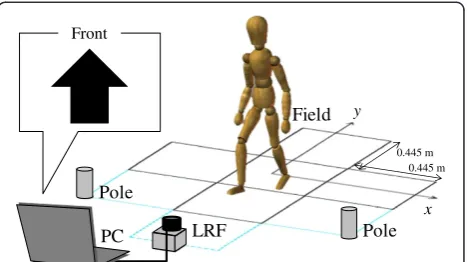
Participants performed a rhythmic stepping exercise (RSE) [17]. The measurement system for the RSE is shown in Figure 1. At the beginning of the RSE, partici-pants stood upright in the center of five squares (each 44.5 cm × 44.5 cm) arranged in a plus shape as shown in Figure 1. A visual cue was displayed on a monitor, and upon perceiving the visual cue participants were instructed to quickly move both legs into one of the four squares arranged around the starting position, and then return both legs to the center square. Performing this RSE under cognitive conditions may help improve dual-task ability, which simultaneously requires both cognitive
functions such as reaction and short-term memory, and motor functions such as stepping in multiple directions. Stepping trajectory (position and velocity of each leg) and stepping performance (accuracy of step relative to the target square) were determined using the measure-ment system.
System summary
The measurement system is manufactured by Murata Machinery Ltd. and consists of a LRF, a personal com-puter (PC), and two calibration poles. The scan period of the LRF is 0.1 s. The LRF can measure the distance within the error ±0.06 m in the stepping field. The cen-ter of the stepping field is calibrated by using the two poles. Thus, the environment required for the RSE is easily prepared and do not require the accurate installa-tion of the LRF.
The system measured reaction time after the visual cue was displayed before the participant started to step as a cognitive parameter, and stride duration after the visual cue was displayed before the participant stopped to step as a temporal parameter. The system measured the positions and velocities of the center of each leg and of both legs and determined the accuracy with which the participant performed the task, i.e., stepped to the instructed target as spatial parameters. When a force platform is used to measure them, more than one force platform is needed because commonly-used force plat-forms do not cover the entire stepping field. However, by using the measurement system, we can measure movement parameters simply and inexpensively (the cost of LRF is about 1,000 dollars and the cost of a force platform is about 50,000 dollars). This system may be useful for measuring the stepping performance and can be used in community-based fall prevention programs.
The PC acquires data from the LRF, calculates the leg de-tection algorithm and displays a visual cue on a monitor.
Front
PC LRF Pole
Pole Field 0.445 m 0.445 m x y
The process followed by the measurement system is shown in Figure 2, and is divided into three parts: cali-bration phase, main loop phase and stepping perform-ance evaluation phase.
Calibration phase
In the calibration phase, the coordinate system for the stepping field was configured and the parameters re-quired for the leg detection algorithm were identified.
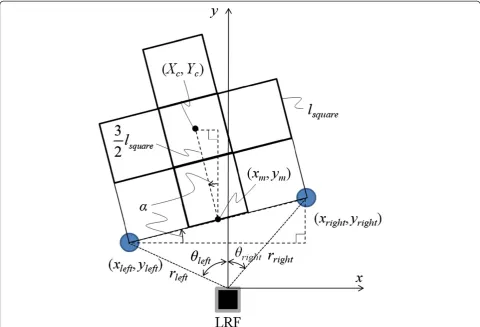
The coordinate system for the stepping field was con-figured based on the two calibration poles that were symmetrically placed at the left- and right front corners of the stepping field as shown in Figure 1. The position of the poles was detected by the LRF at the beginning of
the RSE and used to calculate the center and angle of the stepping field by using distance and angle to the poles obtained from the LRF. Even though the stepping field was not at the front of the LRF, the coordinate tem was converted to the stepping field coordinate sys-tem as shown in Figure 3.
The coordinates of the poles, (xright, yright) and (xleft,
yleft), was determined from distance and angle data
obtained from the LRF. As shown in Figure 3, the angle of the fieldαwas calculated as follows:
α¼ arctan yright−yleft xright−xleft
ð1Þ
The coordinate of center of the poles (xm,ym) was cal-culated as follows:
xm;ym
ð Þ ¼ xrightþxleft
2 ;
yrightþyleft 2
ð2Þ
The coordinate of the center of the field (Xc,Yc) was calculated as follows:
Xc;Yc
ð Þ ¼ xm−3
2lsquaresinα;ym− 3
2lsquarecosα
ð3Þ
Where, lsquare is the length of one square. Thus, the environment required for the RSE was easily prepared and did not require the accurate installation of the LRF.
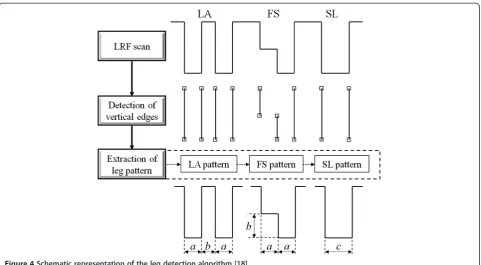
As shown in Figure 4, the width of each participant’s leg was identified as parameters (a,b andc) used in the leg detection algorithm [18]. The legs of the participant who stood upright in the center were detected by the LRF before the start of the RSE, which was performed simultaneously with the configuration of the coordinate system fixed for the stepping field. The LRF used dis-tance and angle data to determine the width of each leg and the parameter values were determined from the
scan data on average ten times. RSE could then be performed without considering the differences in leg width of each participant. This allowed for the accurate measuring of step performance even if a large number of participants were targeted.
Main loop phase
The main loop phase consisted of three parts: leg detec-tion by LRF data, the judgement of whether the partici-pant moved to the target square and the display of the next visual cue if the participant stood upright in the center.
Leg detection by the LRF data (leg coordinate data and the center-of-leg coordinates) was determined from dis-tance and angle data obtained from the LRF scan, and was used in the leg detection algorithm proposed by Bellotto [18]. The leg detection algorithm in [18] mea-sures only the position of the center of the legs; how-ever, the leg detection algorithm in the measurement system measures not only the position of the center of the legs but also the positions of both legs. This is expected to improve the accuracy of the step perform-ance measurements.
The leg detection algorithm is shown in Figure 4. We classified the legs into three leg patterns: LA (two Legs Apart), FS (Forward Straddle) and SL (Single Leg). In clas-sifying the legs into the three leg patterns, we definea,b andc, which are, respectively, the leg width, the maximum step length and the width of the two legs together. These were identified in the calibration phase. First, we scanned a two-dimensional surface with the LRF. Next, the vertical edges were extracted from LRF data. Then, the leg pattern was detected by using three leg parameters and the com-bination of the arrangement of the edges. Finally, we calculated the position and velocity of the center of each leg and of both legs together using LRF data.
The square on which the participant moved to was de-termined using the position of the center of each leg and of both legs calculated in the leg detection algorithm and the coordinate system fixed for the stepping field. If the legs of the participant were inside the target square, the symbol“Ο”was displayed. On the other hand, if the
leg was outside the target square, the symbol “Δ” was
displayed, or if both legs were outside the target square, the symbol“×”was displayed.
We evaluated whether the participant moved to the exact target, and displayed the next visual cue when the participant returned and stood upright in the center of the stepping field.
Figure 4Schematic representation of the leg detection algorithm [18].
Stepping performance evaluation phase
A stepping trajectory of the center of each leg and of both legs from a single participant is shown in Figure 5. Figure 6 shows the x-directional position and velocity between 0.0 and 4.0 s.
The stepping trajectory obtained by the leg detection algorithm is shown in Figure 5. We measured foot-off time and foot-contact time from the position and vel-ocity shown in Figure 6. The foot-off time of the leading leg (TFO1) was defined as the point at which the velocity started to increase. The foot-contact time of the leading leg (TFC1) was defined as the point at which the velocity is less than the threshold. In this paper, the threshold is 0.25 m/s. The reaction time of the leading leg (TR1) was calculated from the time that visual cue was displayed
(TCUE) and TFO1. Stride duration of the leading leg
(TSD1) was calculated from TFO1and TFC1. Stride length was calculated from the positions at TFO1and TFC1.
Thus, in the stepping performance evaluation phase, the velocity was calculated from the positional data of the center of each leg and of both legs after RSE ended. TR1, TSD1and stride length were calculated from the vel-ocity and displayed immediately on the PC.
Test 1: application to the rhythmic stepping exercise
In order to verify the developed measurement system described above, we applied the system to the RSE and measured the stepping trajectories and stepping per-formance. Ten participants stepped forward, backward, and sideways (a total of 4 steps), and we measured their steps.
Test 2: statistical analysis of the test using a force platform and the measurement system simultaneously
In order to verify the efficacy of TR1and TSD1that were
obtained by the developed measurement system, TR1
and TSD1were measured by using a force platform and
the system simultaneously. The force platform was a portable Kistler 9286 Force Platform. In case of the force
platform, TR1 and TSD1 were calculated according to
methods of Melzer et al. [16]. Ten participants stepped forward after the visual cue was displayed four times.
The test-retest reliability of TR1 and TSD1 determined by the system was assessed using the intraclass correl-ation coefficients ICC1, 1 with TR1 and TSD1 calculated using the force platform data. The criterion-related
val-idity was determined using the Spearman’s correlation
coefficient between TR1and TSD1obtained by the
meas-urement system and TR1 and TSD1 obtained from the
force platform. Data were analyzed using the Statistical Package for the Social Sciences (Windows version 19.0).
Results
Test 1: application to the rhythmic stepping exercise
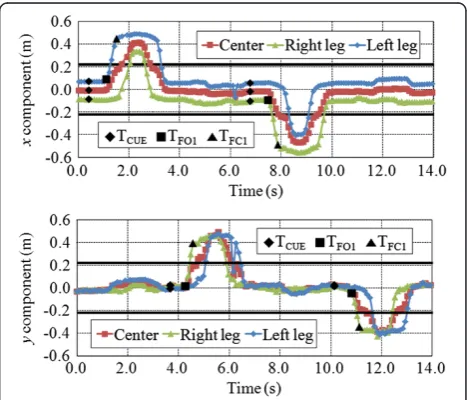
The results of one participant are shown in Figure 7 as
an example. Figure 7 shows the x-coordinate
compo-nents and y-coordinate components of the center of
each leg and of both legs, TCUE, TFO1 and TFC1. From
Figure 6Trajectory and velocity ofxbetween 0.0 s and 4.0 s.
the results, we confirmed that TFO1 and TFC1 can be measured in any case when the visual cues are forward, backward and sideways. Thereby, the stepping perform-ance such as TR1and TSD1were obtained.
In addition, we confirmed that we can detect which square the participant stands using data of the center of each leg and of both legs. If we use only data of the cen-ter of both legs, we can not judge whether the partici-pant moves to the exact target square.
Test 2: statistical analysis of the test using a force platform and the measurement system
simultaneously - test-retest reliability
There was high test-retest reliability of the stepping performance obtained by the measurement system (p< 0.001): TR1(ICC1, 1= 0.810; 95% confidence interval
(CI), 0.485–0.951); TSD1 (ICC1, 1= 0.831; 95% CI,
0.542–0.957).
Test 2: statistical analysis of the test using a force platform and the measurement system
simultaneously - criterion-related validity
TR1and TSD1 determined using the developed
measure-ment system were highly correlated with TR1 and TSD1
determined using the force platform: TR1 (r= 0.997,
p< 0.001); TSD1 (r= 0.879, p< 0.001).
Discussion
The results indicate that stepping performance was ac-curately and reliably measured by the developed system. There was a strong relation between reaction time and stride duration determined using the measurement sys-tem and the force platform. The magnitude of reliability was nearly equal to intraclass correlation coefficients of the stepping performance reported by Melzer et al. [16], who reported ICC of 0.91 for foot-off time and 0.76 for foot-contact time measured using a force platform. As a result, the measurement performance of the developed measurement was equivalent to that of a force platform. The measurement system has many advantages in terms of convenience, cost, and the number of parameters that can be obtained.
Compared to other step performance assessment sys-tems, the measurement system offers several important advantages for fall prevention in communities. It is small, relatively in expensive, highly portable, and has minimal setup meaning that stepping tests can be performed quickly even if a large number of participants are targeted. These advantages make the measurement system ideal for measuring stepping in community set-tings. The system can obtain spatial parameters such as the stepping trajectory that is difficult to obtain by other step performance assessment systems.
Stepping performance measured by the measurement system can be used as assessment parameters [4-8]. Therefore, the system may be useful for assessing fall risk in fall prevention programs in the future. The rela-tion between the stepping performance measured using the developed measurement system and a fall risk in eld-erly is under survey, and it is expected to be reported in next paper.
Dynamic balance assessments using force platforms have identified factors that are associated with fall risk and have contributed to the development of rehabilita-tion programs. Force platform measurements indicated that the increase in step execution time that occurs under dual-task conditions was greater in elderly fallers than in elderly non-fallers [5], and that step training im-proved the speed of voluntary step initiation [19]. The measurement system evaluated in the present study may enable researchers and therapists to investigate further details of balance control deficits associated with falling and verify the effects of training programs in elderly and patients at clinical sites conveniently.
Conclusions
We tested the validity of a new measurement system that applied a laser range finder and allowed for con-venient assessment of stepping performance. The meas-urement system is advantageous over current systems of measuring stepping performance in terms of conveni-ence, cost, and the number of parameters that can be obtained. In this study, we applied the leg detection al-gorithm, and determined temporal and spatial step pa-rameters from the position and velocity of the center of each leg and of both legs. The validity of the system to measure reaction time and stride duration was evaluated according to force platform measures, and was con-firmed. This measurement system may be helpful for assessing fall risk indicators in elderly in community and clinical settings.
Competing interests
Toshiki Moriguchi is an employee of Murata Machinery. The other authors have no competing interests.
Authors’contributions
Acknowledgements
This work was supported in part by JSPS KAKENHI Grant Number 25709015. We would like to thank the students of the Department of Human Health Sciences at Kyoto University for their help with data collection.
Author details
1Graduate School of Science and Technology, Keio University, 3-14-1 Hiyoshi,
Kohoku-ku, Yokohama, Kanagawa 223-8522, Japan.2Research &
Development Division, Murata Machinery, LTD, 136, Takeda-Mukaishiro-cho, Fushimi-ku, Kyoto 612-8686, Japan.3Department of Physical Therapy, Human Health Sciences, Graduate School of Medicine, Kyoto University, 53 Kawahara-cho, Shogoin, Kyoto, Sakyo-ku 606-8507, Japan.4Department of Physical Therapy, Graduate School of Medicine, Nagoya University, 65 Tsurumai-cho, Showa-ku, Nagoya 466-8550, Japan.5Department of System Design Engineering, Keio University, 3-14-1 Hiyoshi, Kohoku-ku, Yokohama, Kanagawa 223-8522, Japan.
Received: 14 March 2012 Accepted: 17 May 2013 Published: 22 May 2013
References
1. Tinetti ME, Speechley M, Ginter SE:Risk factors for falls among elderly persons living in the community.N Engl J Med1988,319:1701–1707. 2. Blake AJ, Morgan K, Bendall MJ,et al:Falls by elderly people at home:
prevalence and associated factors.Age Ageing1988,17:365–372. 3. American Geriatrics Society, British Geriatrics Society, American Academy of
Orthopaedic Surgeons Panel on Falls Prevention:Guideline for the prevention of falls in older persons.J Am Geriatr Soc2001,49:664–672. 4. St George RJ, Fitzpatrick RC, Rogers MW, Lord SR:Choice stepping
response and transfer times: effects of age, fall risk, and secondary tasks.
J Gerontol A Biol Sci Med Sci2007,62:537–542.
5. Melzer I, Kurz I, Shahar D, Levi M, Oddsson L:Application of the voluntary step execution test to identify elderly fallers.Age Ageing2007, 36:532–537.
6. Pijnappels M, Delbaere K, Sturnieks DL, Lord SR:The association between choice stepping reaction time and falls in older adults–a path analysis model.Age Ageing2010,39:99–104.
7. Melzer I, Oddsson LI:The effect of a cognitive task on voluntary step execution in healthy elderly and young individuals.J Am Geriatr Soc2004, 52:1255–1262.
8. Lord SR, Fitzpatrick RC:Choice stepping reaction time: a composite measure of falls risk in older people.J Gerontol A Biol Sci Med Sci2001, 56:M627–M632.
9. Woolley SM, Czaja SJ, Drury CG:An assessment of falls in elderly men and women.J Gerontol A Biol Sci Med Sci1997,52:M80–M87.
10. Lord SR, Clark RD:Simple physiological and clinical tests for the accurate prediction of falling in older people.Gerontology1996,42:199–203. 11. Hsiao-Wecksler ET, Robinovitch SN:The effect of step length on young
and elderly women’s ability to recover balance.Clin Biomech2007, 22:574–580.
12. Lindemann U, Lundin-Olsson L, Hauer K, Wengert M, Becker C, Pfeiffer K: Maximum step length as a potential screening tool for falls in non-disabled older adults living in the community.Aging Clin Exp Res2008, 20:394–399.
13. Maylor EA, Allison S, Wing AM:Effects of spatial and nonspatial cognitive activity on postural stability.Br J Psychol2001,92:319–338.
14. Sturnieks DL, St George R, Fitzpatrick RC, Lord SR:Effects of spatial and nonspatial memory tasks on choice stepping reaction time in older people.J Gerontol A Biol Sci Med Sci2008,63:1063–1068.
15. Liu-Ambrose TY, Ashe MC, Graf P, Beattie BL, Khan KM:Increased risk of falling in older community-dwelling women with mild cognitive impairment.Phys Ther2008,88:1482–1491.
16. Melzer I, Shtilman I, Rosenblatt N, Oddsson LI:Reliability of voluntary step execution behavior under single and dual task conditions.J Neuroeng Rehabil2007,4:16.
17. Yamada M, Tanaka B, Nagai K, Aoyama T, Ichihashi N:Rhythmic stepping exercise under cognitive conditions improves fall risk factors in
community-dwelling older adults: Preliminary results of a cluster-randomized controlled trial.Aging Ment Health2011,15:647–653. 18. Bellotto N, Housheng H:Multisensor-Based Human Detection and
Tracking for Mobile Service Robots.IEEE Transactions on Systems, Man and Cybernetics, Part B2009,39:167–181.
19. Rogers MW, Johnson ME, Martinez KM, Mille ML, Hedman LD:Step training improves the speed of voluntary step initiation in aging.J Gerontol A Biol Sci Med Sci2003,58(1):46–51.
doi:10.1186/1743-0003-10-47
Cite this article as:Matsumuraet al.:Development of measurement system for task oriented step tracking using laser range finder.Journal of NeuroEngineering and Rehabilitation201310:47.
Submit your next manuscript to BioMed Central and take full advantage of:
• Convenient online submission
• Thorough peer review
• No space constraints or color figure charges
• Immediate publication on acceptance
• Inclusion in PubMed, CAS, Scopus and Google Scholar
• Research which is freely available for redistribution