Interleaver Design of Turbo code
Chandan Mishra & Aashish Hiradhar
Dr,C V Raman University Kargi Road Kota,Bilaspur (C.G)
1.
INTRODUCTION
The performance of turbo codes is different with different interleaver types since its first introduction in 1993 [1]. The interleaver is a critical component of a turbo code since it reduces correlation between each constituent decoder so that improvement can be made with each iteration. It also performs the function of spectral thinning which allows the medium input weight spectral lines to dominate the BER performance at low SNR. This is the reason why turbo codes can have outstanding performance at low SNR. However, at high SNR performance is reduced due to the small minimum distance of the constituent codes used. The various interleavers, which are used for concatenated codes design, are mention below.
1.
Block Interleaver.2.
Circular Interleaver.3.
Block helical Interleaver.4.
Pseudo-random Interleaver.5.
Symmetric Interleaver.2.CCSDS
PCCC
SI
NTERLEAVERSStandardization of turbo codes by the CCSDS organization is remarkably efficient process, because there are relatively few parameters that must be determined to define a turbo code. In few than six years from the initial discovery of turbo codes in late 1993, a CCSDS standard has been issued the family of turbo codes that are depicted in Figure 1. The turbo codes parameters that are chosen for CCSDS (Consultative Committee for Space
ABSTRACT : It is well known that an interleaver with random properties, quite often generated by
pseudo-random algorithms, is one of the essential building blocks of turbo codes, however, pseudo-randomly generated interleavers has a lack of a compact representation that leads to a simple implementation. Especially for satellite application, we avoid using memories to save a look-up table, but the best way to do is to generate these interleavers on the fly from simple algorithms. One of those algorithmic interleavers is used by CCSDS (Consultative Committee for Space Data Systems). In this paper, a new deterministic interleavers will be suggested of length matched with CCSDS standards to be used in the satellite applications and their performances were compared with CCSDS interleaver performance. The minimum Hamming distance and their multiplicities are the criteria for comparison. The suggested deterministic interleaver can be used in turbo code systems without any encoder/decoder configurations change or adding any system complexity. The simulation is applied for frame length 1784, and code rate ½.
The interleaver plays a crucial role in performance of concatenated convolutional code structure. There are various types of interleaver used in concatenated code design. In this paper, we have also mentioned the CCSDS compliant interleaver related to turbo code design. The input output distribution of CCSDS compliant interleaver is mention in this paper. We have found that distribution of CCSDS compliant interleaver is not uniform throughout the frame. A better uniform distributed interleaver design for concatenated codes has proposed.
polynomials, puncturing pattern and the interleaver type. Table 1 summarizes the CCSDS turbo code parameters [2].The CCSDS interleaver is an algorithmic interleaver. Figure.2 shows the CCSDS deterministic interleaver algorithm and its permutation distribution for the frame length 1784.
Table 1: CCSDS Turbo Codes Standard
Figure 1: CCSDS recommended Turbo Encoder [2]
The interleaver permutation laws π : Zk→ Zk were proposed by Berrou et al.[1], and are
generated by the following algorithm :
• First express k as k = k1k2where k1 = 8 and k2 = k/8.
𝑚 = 𝑠 𝑚𝑜𝑑 2
𝑖 = 𝑓𝑙𝑜𝑜𝑟 𝑠
2𝑘2
𝑗 = 𝑓𝑙𝑜𝑜𝑟 𝑠
2 − 𝑖𝑘2
𝑡 = 19𝑖 + 1 𝑚𝑜𝑑 4
𝑞 = 𝑡 𝑚𝑜𝑑8 + 1 𝑐 = 𝑃𝑞 𝑗 + 21𝑚 𝑚𝑜𝑑 𝑘2 𝜋 𝑠 = 2𝑡 + 8𝑐 + 1 − 𝑚
Where pq denotes one of the following eight prime integers:
p1 = 31; p2 = 37; p3 = 43; p4 = 47; p5 = 53; p6 = 59; p7 = 61; p8 = 67.
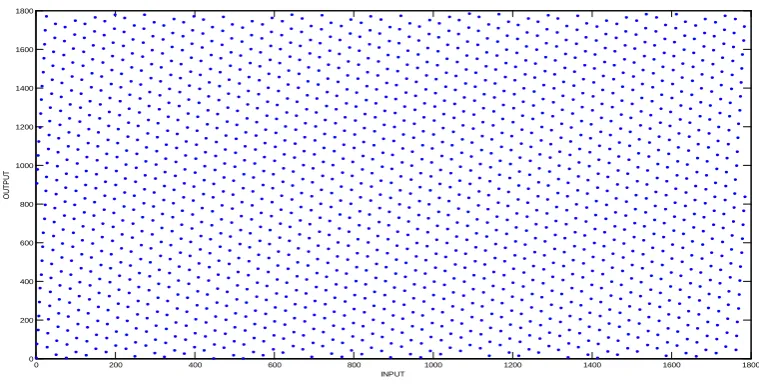
It is worthwhile to mention that an algorithmically generated permutation law of turbo code interleavers is important for space applications to avoid onboard large memory storage. In space, cosmic rays may alter the memory content. In case of single event upset of this kind, it would be easier to re-transmit to the spacecraft the generating algorithm than the whole permutation law. Figure 2 shows the input output distribution of CCSDS compliant interleaver for the frame length 1784.
Figure 2: Input / Output distribution of CCSDS Interleaver
3.
P
ROPOSEDI
NTERLEAVER:-
The proposed interleaver is based on the Gaussian distribution function[3,4]. The selection criteria of these models are based on the minimum distance and multiplicities for all the suggested algorithmic interleavers and polynomials used for turbo codes. The minimum hamming distance and their multiplicities are the criteria for comparison. The minimum distance calculation and its multiplicity were calculated based on the method proposed in Garello et al. [5]. In the region of high signal-to noise ratio, the performance of any binary code is dominated by its minimum distance dmin (the minimum Hamming distance between code words) and its
multiplicity values, Amin (number of code words with weight dmin) and Wmin (sum of the Hamming weights of
0 200 400 600 800 1000 1200 1400 1600 1800
0 200 400 600 800 1000 1200 1400 1600 1800
INPUT
O
U
T
P
U
rates, the code performance practically coincides with the union bound, truncated to the contribution of the minimum distance. The proposed deterministic interleaver model is mentioned below.
m=mod((h-1),2); i=floor((h-1)/446);
j= floor((h-1)/2)- (i*223);
t=mod((19*i+1),4);
q= mod(t,8)+1;
c=mod((9*j+113*m),223);
position1=(2*(t+(c*4)+1))-m;
pot(h)=position1;
The input output distribution of proposed interleaver is shown in Figure 3.
Figure 3: Input / Output Distribution of Proposed Interleaver
The advantages of proposed interleaver with respect to CCSDS interleaver are following.
There is no need to store 8 prime integers value in hardware. Since It has only one fixed value.
The S distance property is better compared to CCSDS interleaver.
The minimum hamming distance dmin and its multiplicity values, Amin is better compared to
CCSDS standard as shown in Table 2.
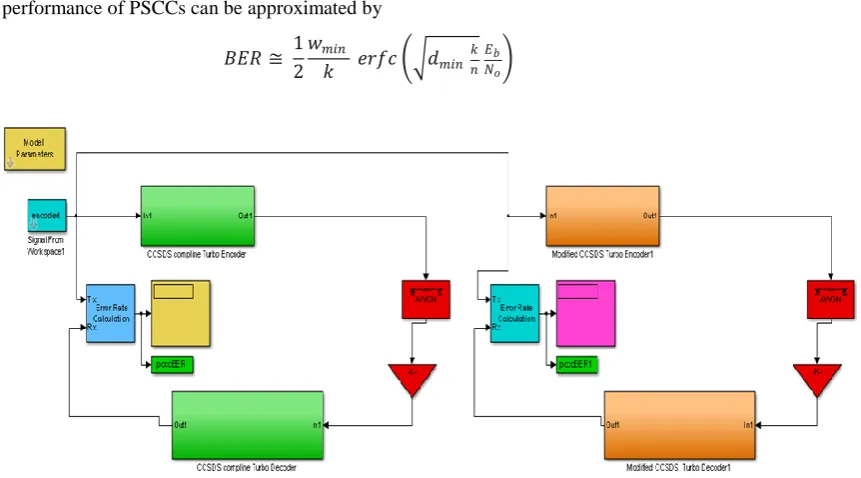
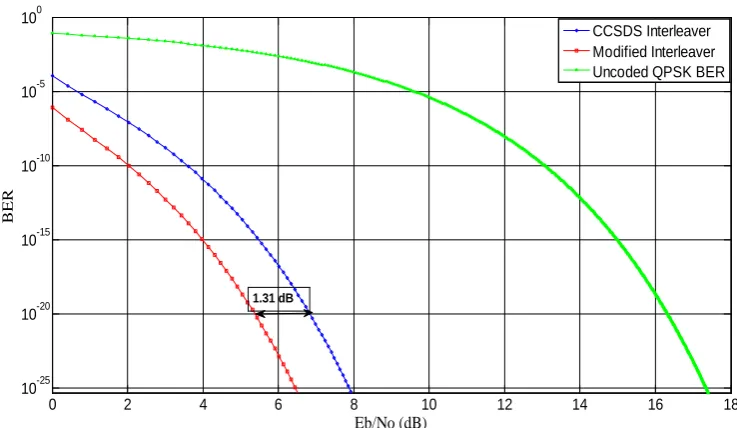
In order to perform comparative analysis, Figure 4 shows comparative performance in Simulink The result of both the interleaver is shown in Figure 5.
0 200 400 600 800 1000 1200 1400 1600 1800
0 200 400 600 800 1000 1200 1400 1600 1800
INPUT
O
U
T
P
U
Table-2 Comparative Performance of Interleaver Frame
length
Code rate Feedback
Polynomial
Feed forward Polynomial
Interleaver Model
dmin Amin Wmin
1784 1/2 10011 11011 CCSDS 17 2 6
1784 1/2 1011 11011 PROPOSED 23 1 1
The improvement factor in terms of error floor using the proposed interleaver compared to CCSDS interleaver in
turbo code performance can be given as
∆dmin = 10 log
𝑑𝑚𝑖𝑛 𝑝𝑟𝑜𝑝𝑜𝑠𝑒𝑑 𝑖𝑛𝑡𝑒𝑟𝑙𝑒𝑎𝑣𝑒𝑟
𝑑𝑚𝑖𝑛 (𝐶𝐶𝑆𝐷𝑆 𝑖𝑛𝑡𝑒𝑟𝑙𝑒𝑎𝑣𝑒𝑟 ) = 10 log 23
17 = 1.31dB
The BER performance of PSCCs can be approximated by
𝐵𝐸𝑅 ≅ 1 2
𝑤𝑚𝑖𝑛
𝑘 𝑒𝑟𝑓𝑐 𝑑𝑚𝑖𝑛
𝑘 𝑛
𝐸𝑏 𝑁𝑜
Figure 5: Comparative Performance Analysis of Proposed Interleaver with respect to CCSDS Interleaver.
4.
RESULT:
In this chapter, modified deterministic interleavers was suggested and their performance was simulated and compared with the one used in the CCSDS standard. Simulation results, shows that the proposed interleaver parameters (dmin=23, Amin=1, Wmin=1), has higher minimum distance which means lower
error floor than the original configuration CCSDS by a factor of 1.31 dB in the region of high Eb/No. This means that we can use it in the new CCSDS earth observation missions, which need BER≤10-10
. Moreover, since the interleaver does not require the storage of the prime integers in the hardware, the hardware complexity of the proposed interleaver is reduced in term of the storage requirement as compared to that of the CCSDS original interleaver. Those achieved results can be applied to the turbo code systems without any encoder/decoder configurations change or any additional system complexity.
5.R
EFERENCES:-
[1]. Berrou, C., Glavieux, A., and Thitimajshima, P., “Near Shannon Limit Error-Correcting Coding and Decoding: Turbo Codes,” IEEE Proceedings of the Int. Conf. on Communications, Geneva, Switzerland, May 1993 (ICC’93), pp. 1064-1070.
[2]. Consultative Committee for Space Data Systems (2003) TM Synchronization and Channel Coding. Blue Book 131.0-B-1.
[3]. Benedetto, S.; Montorsi, G.; Divsalar, D. “Concatenated convolutional codes with interleavers,” IEEE Communications Magazine,Volume: 41 , Issue: 8 , Aug. 2003 Pages:102 - 109 .
[4]. Consultative Committee for Space Data Systems (2007) TM Synchronization and Channel Coding. Blue Book 131.2-O-1.
[5]. Garello R., P .Pierleoni, and S. Benedetto“Computing the Free Distance of Turbo Codes and a Serially Concatenated Codes with Interleavers”, IEEE Journal on Selected Areas in Communications ,vol. 19, no.5, May 2001.
0 2 4 6 8 10 12 14 16 18
10-25 10-20 10-15 10-10 10-5 100
Eb/No (dB)
BE
R
CCSDS Interleaver Modified Interleaver Uncoded QPSK BER
![Figure 1: CCSDS recommended Turbo Encoder [2]](https://thumb-us.123doks.com/thumbv2/123dok_us/464943.2044942/2.595.136.466.208.528/figure-ccsds-recommended-turbo-encoder.webp)