HIV among people who inject drugs
in Central and Eastern Europe and
Central Asia: a systematic review
with implications for policy
Emma Jolley,1Tim Rhodes,1Lucy Platt,1Vivian Hope,1,2Alisher Latypov,3,4 Martin Donoghoe,5David Wilson6
To cite:Jolley E, Rhodes T, Platt L,et al. HIV among people who inject drugs in Central and Eastern Europe and Central Asia: a systematic review with implications for policy.BMJ Open2012;2: e001465. doi:10.1136/ bmjopen-2012-001465
▸ Prepublication history and additional material for this paper are available online. To view these files please visit the journal online (http://dx.doi.org/10.1136/ bmjopen-2012-001465).
Received 10 May 2012 Accepted 6 September 2012
This final article is available for use under the terms of the Creative Commons Attribution Non-Commercial 2.0 Licence; see
http://bmjopen.bmj.com
For numbered affiliations see end of article
Correspondence to
Tim Rhodes;
ABSTRACT
Background and objectives:HIV among people who inject drugs (PWID) is a major public health concern in Eastern and Central Europe and Central Asia. HIV transmission in this group is growing and over 27 000 HIV cases were diagnosed among PWID in 2010 alone. The objective of this systematic review was to examine risk factors associated with HIV prevalence among PWID in Central and Eastern Europe and Central Asia and to describe the response to HIV in this population and the policy environments in which they live.
Design:A systematic review of peer-reviewed and grey literature addressing HIV prevalence and risk factors for HIV prevalence among PWID and a synthesis of key resources describing the response to HIV in this population. We used a comprehensive search strategy across multiple electronic databases to collect original research papers addressing HIV prevalence and risk factors among PWID since 2005. We summarised the extent of key harm reduction interventions, and using a simple index of‘enabling’environment described the policy environments in which they are implemented.
Studies reviewed:Of the 5644 research papers identified from electronic databases and 40 documents collected from our grey literature search, 70
documents provided unique estimates of HIV and 14 provided multivariate risk factors for HIV among PWID.
Results:HIV prevalence varies widely, with generally low or medium (<5%) prevalence in Central Europe and high (>10%) prevalence in Eastern Europe. We found evidence for a number of structural factors associated with HIV including gender, socio-economic position and contact with law enforcement agencies.
Conclusions:The HIV epidemic among PWID in the region is varied, with the greatest burden generally in Eastern Europe. Data suggest that the current response to HIV among PWID is insufficient, and hindered by multiple environmental barriers including restricted access to services and unsupportive policy or social environments.
INTRODUCTION
The HIV epidemics of Europe are diverse but in all European countries HIV dispropor-tionally affects populations that are socially marginalised and people whose behaviour is
ARTICLE SUMMARY
Article focus
▪ A systematic review to identify and synthesise prevalence estimates and risk factors for HIV among people who inject drugs (PWID) in Central and Eastern Europe and Central Asia.
▪ A summary of key data to describe the response to HIV among PWID in Central and Eastern Europe and Central Asia, including a brief char-acterisation of the policy environments.
Key messages
▪ The review highlights that the HIV epidemic among PWID in the region varies from country to country, with Eastern European countries generally the worst affected. Prevalence is extremely high among PWID in many countries with some studies suggesting more than one in two PWID are infected with the virus in parts of Estonia, Russia and Ukraine.
▪ Despite few studies explicitly examining environ-mental factors, our review found that gender, socio-economic position and contact with law enforcement agencies to be associated with HIV prevalence. The complex interplay between the environment and individual behaviour of PWID is not fully understood and further emphasis on understanding the social epidemiology of HIV in this group is needed.
▪ An integrated package of needle exchange pro-grammes, opiate substitution therapy and anti-retroviral therapy is core to an effective response to HIV in this group. The coverage of such interven-tions in the region varies from low to non-existent and must be improved. Further resources coupled with improvement in the policy environments are key to reducing HIV transmission in this group.
Jolley E, Rhodes T, Platt L,et al.BMJ Open2012;2:e001465. doi:10.1136/bmjopen-2012-001465 1
Open Access Research
on September 22, 2020 by guest. Protected by copyright.
http://bmjopen.bmj.com/
socially stigmatised or illegal. The epidemics in Eastern Europe and Central Asia, which are predominantly asso-ciated with injecting drug use, are among the fastest growing in the world.1Over two-thirds of all HIV diagno-ses to date in Europe fall in Eastern Europe and Central Asia, and over 70% of these emanate from Russia.2 3 Over 27 000, or over 30% of new cases of HIV were attributed to injecting drug use in Central and Eastern Europe and Central Asia in 2010.2 3 Almost all of these (99·6%) were made in Eastern Europe and Central Asia. Accounting for differences in absolute population size, between 2006 and 2010, 89 new HIV diagnoses asso-ciated with injecting drug use have been made on average each year in the East per million people. This contrasts with Central Europe where the rate is 100 times less at 0.8 per million.2
Because of low access to and uptake of HIV testing and counselling—especially among the marginalised and stig-matised populations most at risk of HIV infection and transmission—not all HIV cases in Europe are diagnosed and reported.4 Estimates suggest that reported cases probably represent just over half of all people living with HIV in Europe.4It is estimated that just over 2.3 million people were living with HIV in Europe in 2010, 840 000 in Western Europe and 1.5 million in Eastern Europe.4
There are an estimated 3.1 million people who inject drugs (PWID) in Central and Eastern Europe and Central Asia, of whom one million are estimated to be HIV infected.5In Russia alone, there are an estimated 1.8 million PWID, of whom around 700 000 are thought be HIV infected.5Estimates of the prevalence of HIV among PWID in Central and Eastern Europe and Central Asia vary widely, from zero in some Central European coun-tries where injecting drug use is less widespread, to over 20% in some countries in Eastern Europe and Central Asia, including Estonia, Moldova, Russia, and Ukraine.5 6
HIV and other blood-borne infections contribute sig-nificantly to the excess morbidity and mortality experi-enced by PWID in Europe and elsewhere.7 8 HIV has the potential to spread rapidly via the sharing of needles and syringes between PWID as well as via unprotected sex between PWID and their injecting and non-injecting partners.
Social contexts of HIV epidemics
A growing body of work substantiates relationships between health harms related to drug use and social-material factors that shape vulnerability to HIV.9–16 The heuristic of the HIV‘risk environment’envisages HIV risk as the product of reciprocal relationships between micro-level and macromicro-level influences in the physical, social, economic and policy environments which contextualise individual and community actions in relation to risk.9–15 This interaction has been described as a reciprocal process whereby individual actions are constrained as well as enabled by their environments and in turn shape as well as reproduce those contexts.17 Qualitative work among PWID in Russia, for example, has illustrated how reduced capacity for HIV risk reduction in the micro-environment is shaped by street-level policing practices which are in turn contextualised by broader structural policies of criminalisation and cultural practices of mar-ginalisation which taken together produce a collectively internalised fear and sense of constrained agency among PWID.17 18
Recent reviews have thus called for a shift towards social epidemiological approaches.9–15 These investigate how the distribution of HIV in populations is in part shaped by‘social factors’, that is, forces that extend beyond‘ prox-imal’ individual-level factors and their biological media-tors. This simultaneously demands a shift from binary models of‘cause and effect’to‘multilevel’models, which enable HIV risk to be understood as an effect of multiple contributing factors, at once interacting together, includ-ing potentially in ‘non-linear’ and ‘indirect’ ways.19 Delineating causal pathways to inform structural interven-tions is thus a daunting yet critical challenge. Recent evi-dence reviews suggest that currently the epidemiology of HIV among PWID rarely explicitly embraces the study of social determinants.20
The social and economic transitions transforming the Central and Eastern European and Central Asian region in the past 20 years have been abrupt, dramatic and long lasting. In many countries of the region, economic uncer-tainty has combined with weakening social capital, an embryonic and fragile civil society, a poorly resourced and overly vertically structured health system, and public policies tackling drug use that have emphasised law enforcement and security at the expense of public health.16 21 Social and economic transformations follow-ing the dramatic political change in Eastern European and Central Asian countries have played a role in shaping transitions in problematic substance use as well as vulner-ability to HIV.21–26 The opening-up of international and ARTICLE SUMMARY
Strengths and limitations of this study
▪ This review is the most comprehensive synthesis of HIV preva-lence and risk factors among PWID in Central and Eastern Europe and Central Asia to date and is complemented by a clear synopsis of the state of the national policy environments and responses to HIV for people who inject drugs.
▪ The quality of the review relies on quality of the original articles, which are variable. The samples included are often selective as many studies recruited participants from specialist services or via drug user networks. Multivariate analyses are adjusted for a variety of factors, rendering direct comparisons between point-estimates difficult.
▪ The service coverage data are not measured in a standard manner across the region, and is from different years. The quality of data varies greatly by country, thus undermining the compari-sons we can make about coverage.
▪ We use a crude index of‘policy environment’which is developed from binary indicators that cannot account for important nuances influencing intercountry and intracountry environments.
2 Jolley E, Rhodes T, Platt L,et al.BMJ Open2012;2:e001465. doi:10.1136/bmjopen-2012-001465
HIV and people who inject drugs in Central and Eastern Europe and Central Asia
on September 22, 2020 by guest. Protected by copyright.
http://bmjopen.bmj.com/
trade borders, for instance, has facilitated population mixing as well as the development of heroin trafficking routes from Afghanistan to the West, also linked to the diffusion of heroin use.27There was evidence of explosive HIV outbreaks linked to injecting drug use in the former Soviet region by the mid-1990s, especially in Russia, Ukraine and Moldova.21
Enabling policy environments for HIV prevention
Recognising HIV epidemics as features of their social and structural contexts emphasises the potentially pivotal role of social and structural interventions in cre-ating environments which are enabling, rather than con-straining, of evidence-based HIV prevention.28–30 Key dimensions of‘enabling’policy environments conducive to effective HIV prevention for PWID include, but are not restricted to: the meaningful engagement of key sta-keholders (including PWID) in policy formation and programming; a coordinated multisectoral national HIV prevention strategy emphasising an evidence-based public health and rights-oriented approach; the gener-ation of research and surveillance on HIV epidemic spread and response; and the development and scale-up of a package of evidence-based interventions, including the removal of structural obstacles limiting their imple-mentation.31–33 This has led to calls to de-emphasise the criminalisation of PWID by developing policies empha-sising public health above law enforcement-dominated approaches, and for the rapid scaling-up of harm reduc-tion intervenreduc-tions including syringe exchange, opioid substitution treatment (OST), and antiretroviral HIV treatment (ART), as well as community action and social support interventions.31 32 34–36
Review scope
We aim to systematically review epidemiological research investigating the burden of HIV, and associated risk factors, among PWID in Central and Eastern Europe and Central Asia. We seek to identify the extent to which such epidemiological research captures measures of the HIV risk environment by delineating HIV risk factors identi-fied at the levels of the individual and environment. We situate this epidemiological work by synthesising current evidence reviews of the extent and availability of HIV pre-vention targeting PWID in the region and by developing a simple index of ‘enabling’ policy environment at the country level.
METHODS
We reviewed data from the 30 Eastern and Central European and Central Asian countries in WHO-defined Europe, including 15 from Eastern Europe and Central Asia (Armenia, Azerbaijan, Belarus, Estonia, Georgia, Kazakhstan, Kyrgyzstan, Latvia, Lithuania, Republic of Moldova, Russian Federation, Tajikistan, Turkmenistan, Ukraine and Uzbekistan),‘the East’and 15 from Central Europe (Albania, Bosnia and Herzegovina, Bulgaria,
Croatia, Cyprus, Czech Republic, Hungary, Macedonia (FYR), Montenegro, Poland, Romania, Serbia, Slovakia, Slovenia and Turkey),‘the Centre’.
Search strategy and selection criteria
We systematically searched MEDLINE, EMBASE, Global Health, Social Science Citation Index, Popline and CINAHL for studies published from 2005 to 20 October 2011. To identify articles we combine four broad search themes with the Boolean operator ‘AND’. The first theme, HIV, combined the Medical Subject Headings (MESH) terms ‘HIV’ or ‘HIV infections’ with the free word search for ‘HIV’,‘human immunodeficiency virus’ with‘OR’. The second theme, prevalence, incidence and risk factors, included the MESH terms‘prevalence’,‘ inci-dence’,‘risk’,‘factor analysis’,‘statistical’,‘regression ana-lysis’, ‘risk factors’, ‘risk-taking’ and ‘epidemiology’ with the free words‘prevalen*’,‘incidence’,‘risk*’,‘correlat*’, ‘determinant*’, ‘vulnerab*’,‘regression’,‘risk’,‘ (enhan-c*adj3) transmission’,‘multivar*’,‘(route*adj3 transmis-sion)’, ‘ (factor*adj3 transmission)’, ‘social norm*’, ‘network’, ‘socio-demographic’, ‘socio-economic’, ‘ life-style’and‘epidemiol*’with‘OR’. The third theme, geo-graphic coverage, included the names of the countries in the region, as well as the free word terms‘Europe*’and ‘Central Asia*’ combined with ‘OR’. The fourth theme, PWID, combined the MESH terms ‘substance abuse’, ‘intravenous’,‘needle sharing’and‘heroin dependence’ with the free word terms ‘IDU*’,‘inject*’,‘intravenous’, ‘heroin’, ‘addict*’, ‘opiate*’, ‘narco*’, ‘psychotropic*’, ‘psychoactive*’, ‘drug depend#n*’, ‘(recreation*adj3 drug*)’, ‘harm reduction’, ‘syringe*’, ‘methadone’, ‘opioid*’, ‘syringe*’,‘(needle*adj3 shar*)’, and ‘ (illega-l*adj3 drug*)’combined with‘OR’.
Additionally, we systematically searched websites of research institutes, service providers, and donor organisa-tions working with PWID across the region including recent reports from countries reporting to the United Nations General Assembly Special Session on HIV/AIDS (UNGASS). We searched the website of the European Monitoring Centre for Drugs and Drug Addition (EMCDDA) for data and sources reported from member and neighbouring countries. Conference abstracts from the International Conference on the Reduction of Drug Related Harm (2005–2011) and the International AIDS Conference (2006, 2008 and 2010) were also searched. Our review conformed to the PRISMA checklist for sys-tematic reviews.37
Study selection and eligibility criteria
All abstracts were reviewed. Studies were excluded if they were: (1) published before 2005; (2) fell outside the defined geographic region; (3) did not focus on HIV among PWID; (4) did not sample PWID; or (5) did not focus on bio-confirmed HIV prevalence or incidence, or injecting or sexual risk practices. Papers were also excluded if they reported a sample size less than 50, had unclear sampling methods or they contained no
Jolley E, Rhodes T, Platt L,et al.BMJ Open2012;2:e001465. doi:10.1136/bmjopen-2012-001465 3
HIV and people who inject drugs in Central and Eastern Europe and Central Asia
on September 22, 2020 by guest. Protected by copyright.
http://bmjopen.bmj.com/
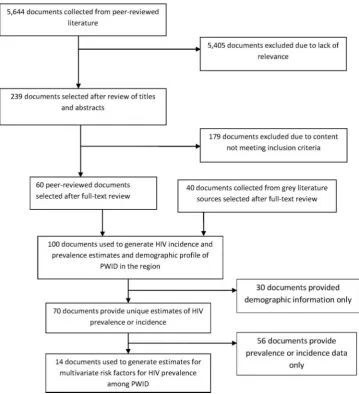
primary data, although the references were searched to gather primary studies not identified by the search. Papers notfitting the inclusion criteria were set aside to aid interpretation of the systematic review findings. Figure 1 summarises the papers searched and retained in the review. Following full-text review 100 peer-reviewed and grey literature documents were identified as meeting our criteria, of which 70 reported an inci-dence or prevalence measure and 30 demographic or risk factor data only. Of the 70 documents reporting prevalence or incidence data, 14 included the results of a multivariate analysis.
Two authors (EJ and LP) independently assessed the quality of the studies reporting HIV prevalence esti-mates using a scoring system that graded the papers on: wide geographic coverage; most recent study; population sampled; and recruitment setting. We allo-cated up to three points each for most recent studies, population sampled, country coverage and for the range of settings sampled, and deducted one point for drug treatment only samples due to the potential for bias.38
Data extraction
The results of the multivariate studies meeting our inclu-sion criteria were extracted as presented, regardless of the strength of association. Comparable factors were collected and examined using forest plots showing the effect estimates and 95% CI. We classified the results of the multivariate studies as ‘individual-level’ factors or ‘environmental-level’ factors based on the proximity of the risk of the factor in terms of HIV transmission. Individual-level risk characteristics or activities included injecting and sexual risks, such as sharing needles or unprotected sex, that shape an individual’s HIV risk through direct biological mechanisms. Environmental-level factors are those which have no direct biological means of influencing HIV risk; however, their presence or absence has been identified as an independent factor in the risk faced by an individual, indicating their role in shaping a‘risk environment’.
Coverage of HIV prevention interventions
In addition to the systematic review, data summarising the coverage of HIV prevention interventions was drawn
Figure 1 Flowchart of study selection.
4 Jolley E, Rhodes T, Platt L,et al.BMJ Open2012;2:e001465. doi:10.1136/bmjopen-2012-001465
HIV and people who inject drugs in Central and Eastern Europe and Central Asia
on September 22, 2020 by guest. Protected by copyright.
http://bmjopen.bmj.com/
primarily from recently published reviews39 and previ-ously published country-level data.40 These data are col-lected from a variety of sources, including UNGASS, WHO and systematic reviews of scientific literature,39 as well as from routine national reports.40
Policy environment index
We generated a simple index of ‘enabling’ policy onment. Our interpretation of an enabling policy envir-onment drew upon guidelines generated by WHO,41 UNAIDS,42 international non-government organisations
(NGOs)43 and peer-reviewed papers in this
field.20 30 32 44 As outlined in box 1, the core items of the index included indicators, at the country level, of: coordinated national strategy to HIV prevention and drug use (indicated by evidence of explicit inclusion of ‘harm reduction’in national-level strategy, and monitor-ing and evaluatmonitor-ing HIV epidemics); meanmonitor-ingful engage-ment of stakeholders in HIV prevention policy formation and programming (indicated by evidence of a national organisation of drug users); and evidence-based HIV prevention intervention approaches (indicated by presence of OST and NSP, presence of OST and NSP in prison settings, and evidence of de-emphasising crimin-alisation through the use of administrative penalties for drug use possession for personal use).
Indicator data were obtained from a combination of sources, including: global reports of harm reduction policy and coverage;45 country profiles collated and updated by the EMCDDA;46 our systematic review of research studies (see above and figure 1); and the International Network of People who Use Drugs (Albers ER, personal communication with EJ, 2011). The index was constructed by allocating equal weight to each of the six items and aggregating a score for each country, with higher scores indicating a more‘enabling’ environ-ment conducive to evidence-based public health approaches.
RESULTS HIV incidence
Only three papers reviewed reported HIV incidence among PWID in this region. Two in Tallinn, Estonia, reported an HIV incidence rate of 31/100 person-years (PY) in 2004, decreasing to 9/100 PY in 2009 among people injecting for less than 3 years.47 48The other from St. Petersburg, Russia, reported a rate of 4.5/100 PY.49
HIV prevalence
Estimates of HIV prevalence among PWID vary widely throughout the region. A total of 79 sources reported HIV prevalence estimates (some multiple), of which 67 reported unique HIV prevalence estimates among PWID in the region; 44 from Eastern Europe and Central Asia6 49–88 and 21 from Central Europe89–109 and two that contained data from both regions.40 110
Multiple estimates exist for many countries (figure 2), and where this was the case we applied the scoring system described above (see Methods section) to select
Box 1 A simple index of enabling policy environment
Meaningful engagement of stakeholders
▸ The meaningful involvement of people who inject drugs (PWID) in policies affecting their health and welfare and in related HIV prevention programming is accepted as an important indicator of ‘health policy’formation.42 157 While assessing ‘meaningful involvement’is complex, we adopt a simple indicator:the pres-ence of a national organisation of drug users.
Coordinated national strategy to HIV prevention and drug use
▸ Explicit and supportive reference to‘harm reduction’in national policy documents can mark a commitment to evidence-based interventions as part of HIV prevention responses targeting PWID. International agencies advocate institutional and national-level endorsement of harm reduction as a feature of national strategy.33 158We adoptevidence of explicit supportive reference
to harm reduction in national strategyas an indicator of enabling policy environment.
▸ Monitoring and evaluating the state of the epidemic and response are important elements of building evidence-based responses.40 159Targeted sero-prevalence and behavioural sur-veillance is recommended in concentrated HIV epidemics.160
We adopt as an indicator of enabling policyevidence of at least one HIV sero-prevalence and one behavioural study among PWID since 2000.
Implementation of Public Health-oriented approaches to redu-cing harm
▸ Drug control policies which seek to distinguish drug users from drug traders and traffickers, and which de-emphasise the criminalisation of drug users, can give priority to public health-oriented approaches to reducing drug-related harm. We adopt the application of administrative rather than criminal penalties for drug use and possession of quantities for per-sonal useas an indicator of an enabling policy environment. ▸ We adoptthe legal availability of opioid substitution treatment
(OST) andneedle and syringe distribution programmes (NSP) in a country as an indicator of enabling policy environment. These are core components of the recommended nine combination HIV prevention interventions for PWID.33 Many countries have adopted at least some recommended mea-sures, but often the components missing are OST and NSPs. The effectiveness of both in improving the health of PWID is well established,32 154 161especially for OST.162–168OST also facilitates access to and augments the effects of other inter-ventions, such antiretroviral HIV treatment.32 151
▸ The availability of OST and NSPs in prisoncan show a country’s willingness to address the needs of even the most marginalised of its citizens, as well as demonstrating noteworthy scale of the programmes. Because of existing laws concerning drug use and possession, PWID in many countries account for disproportion-ately high rates of incarceration.139 Prisons may act as a risk environment for HIV transmission linked to drug injecting. International guidelines169 recommend continuity of services between prison and communities and some countries have developed successful partnerships between penal systems and HIV services, including in the European region.170
Jolley E, Rhodes T, Platt L,et al.BMJ Open2012;2:e001465. doi:10.1136/bmjopen-2012-001465 5
HIV and people who inject drugs in Central and Eastern Europe and Central Asia
on September 22, 2020 by guest. Protected by copyright.
http://bmjopen.bmj.com/
the estimate that appeared to be most representative at the country level. Using these estimates, we have cate-gorised country HIV epidemics among PWID as: ‘low’ (up to 1%); ‘medium’ (2–5%); ‘high’ (5–20%); and ‘very high’(greater than 20%).
No country in the East can be considered to have a ‘low level’ of HIV among PWID, and only Kazakhstan, Georgia and Lithuania have ‘medium level’ epidemics, according to the studies examined here. Of the remain-ing 11 countries with data (no data exist for Turkmenistan), three have prevalence estimates of over 20% (Moldova, Russia and Ukraine) and Estonia has a prevalence of over 50%. In the Centre only Poland and Bulgaria appear to have ‘high level’ epidemics and neither of these exceed 10% prevalence. Several coun-tries (Albania, Croatia, Cyprus, Hungary, Macedonia and Slovenia) report 0% HIV prevalence among PWID. However, there are less data from this region and sample sizes are generally smaller so the estimates may be less robust than those from the East.
Demographic profile
Generally, three times as many men as women inject drugs, although male predominance reached as high as 95% in some studies from the Caucuses.50 54 55 62 64 85 111 The mean age of PWID participating in studies was mid-20s, although many studies restrict recruitment to PWID aged 18 or over. The proportion of PWID reporting having regular income was generally low.
Pattern of injecting drug use
Heroin is the drug of choice among PWID in Europe, although there are sub-regional differences. In Moldova,112 Ukraine73 and Russia,52 the injection of home-produced opioids such as ‘hanka’ or ‘shirka’
(a liquid poppy extract) is reported alongside heroin injec-tion. In Estonia the use of the synthetic opiate, fentanyl (‘China White’,‘White Persian’or‘Afghan’), has become common alongside amphetamine injection.71 113 In Central Europe, heroin is reported as the main drug injected, although studies also report between 30% and 51% injecting amphetamines as their main drug,100 114 115 and the Czech Republic reports the highest prevalence of methamphetamine use in Europe.116–118The frequency of injection varies widely throughout the region.
Contact with criminal justice systems
The data reviewed from Eastern Europe and Central Asia suggest that between half and three-quarters of PWID have experienced arrest. A study among 600 PWID in Odessa, Ukraine found that police beatings were common, with nearly 50% reporting at least one such experience.20 119 Studies in other regions also suggest relatively high rates of police arrest (42–76% ever having been arrested).18 27 107 120 In Estonia and Lithuania, an estimated 58–70% of PWID had been in prison at least once.74 In Georgia and Russia, thisfigure was between 6% and 37%,18 52 64 65 79 121 122In Central Europe, between 18% and 50% of respondents report previously having been in prison.93 107
Individual-level risk factors for HIV
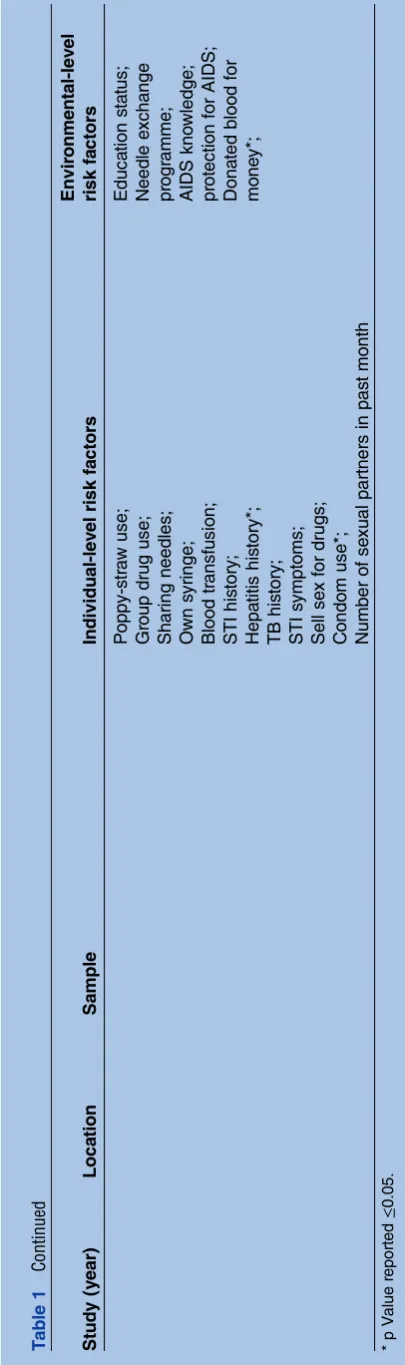
No studies examined risk factors linked to HIV in the Centre, and so we summarise the findings of the multi-variate HIV risk factor analyses from 14 papers identified by our review in the East,49 51–53 57 65 72 73 88 113 121 123–125 although two65 72 present new analyses of data already published in other papers also presented here.123 125 Table 1 summarises the key characteristics of the 14 papers as well as the factors explored in the multivariate Figure 2 The range of HIV
prevalence estimates for countries in the Central and Eastern European region, along with the estimate judged‘best’ highlighted in green.
6 Jolley E, Rhodes T, Platt L,et al.BMJ Open2012;2:e001465. doi:10.1136/bmjopen-2012-001465
HIV and people who inject drugs in Central and Eastern Europe and Central Asia
on September 22, 2020 by guest. Protected by copyright.
http://bmjopen.bmj.com/
Table 1 Summary of studies presenting multivariate analyses of risk factors for HIV among people who inject drugs (PWID) in Central and Eastern Europe and Central Asia
Study (year) Location Sample Individual-level risk factors
Environmental-level risk factors
Plattet al(2006)113 Estonia, Tallinn 350 PWID who injected in past 4 weeks recruited by respondent-driven sampling (RDS)
Primary injection of opioid or amphetamine in past 4 weeks*; Duration of injecting career;
Shared needle in past 4 weeks; Shared equipment in past 4 weeks;
Injected with a used needle of a sex partner in past 4 weeks*;
Number of sexual partners in past year
Age; Gender;
Main source of income in past 4 weeks; Ethnicity;
Ever registered in drug treatment*;
Ever been in prison; Ever attended needle exchange
Abel-Olloet al (2009)71
Estonia, Tallinn and Kohtla-Järve
450 PWID (350 from Tallinn and 100 from Kohtla-Järve) who injected in past 4 weeks recruited by RDS. For analysis the
participants were categorised as HIV-, HIV+ aware of their status and HIV+ unaware of their status, according to self-reported status at the time of testing
The data from Tallinn is also analysed above
Analysis of risk factors for HIV among participants aware of their status (ref HIV participants): Sharing used needles/syringes in past 4 weeks*; Unprotected sex in past 4 weeks;
Sharing water*;
PWID as sex partner in past year*;
Sharing injection equipment with sexual partner in past year*;
Having two or more sex partners in past year; Unprotected intercourse in past year;
Ever sharing needles with HIV+ person*.
Analysis of risk factors for HIV among participants unaware of their status (ref HIV- participants): Sharing used needles/ syringes in past 4 weeks; Unprotected sex in past 4 weeks;
Sharing water;
PWID as sex partner in past year;
Sharing injection equipment with sexual partner in past year;
Having two or more sex partners in past year*; Unprotected intercourse in past year*;
Ever sharing needles with HIV+ person. Uuskülaet al
(2010)88
Estonia, Tallinn 350 PWID, aged 18+, who injected in past 2 months recruited by RDS
Earlier age of initiation to injecting*;
Primary injection of opioid or amphetamine*; Receptive sharing in past 6 months*
Ever attended syringe exchange*;
Main source of income other than work*; Unemployment at habitat level*; Residential change at habitat level*
Continued
Jolle
y
E,
Rhodes
T,
Pla
tt
L,
et
al
.
BMJ
Open
2012;
2
:e001465
.
doi:10.113
6/bmjopen-20
12-001465
7
H
IV
a
nd
people
w
ho
in
ject
drugs
in
C
e
ntr
a
l
a
nd
Eas
tern
E
ur
ope
and
C
entr
al
Asia
Table 1 Continued
Study (year) Location Sample Individual-level risk factors
Environmental-level risk factors
Plattet al(2005)125 Russia, Togliatti 268 Male PWID who injected in past 4 weeks recruited in 2001 by outreach workers
Duration of injection;
Injected with used paraphernalia in past 4 weeks*; Injected with used needle in past 4 weeks; Ever injected homemade drugs;
Injected with used needle from someone known to be HIV+;
Injected with used needle from someone known to be HCV+*;
Unprotected anal or vaginal sex with a regular partner in past 4 weeks;
Unprotected anal or vaginal sex with a casual partner in past 4 weeks*;
Ever had an STI
Ever been in prison; Ever been in drug treatment;
Ever been arrested
Russia, Togliatti 89 Female non-sex worker PWID who injected in past 4 weeks recruited in 2001 by outreach workers
Duration of injection;
Injected with used paraphernalia in past 4 weeks; Injected with used needle in past 4 weeks*; Ever injected homemade drugs;
Injected with used needle from someone known to be HIV+;
Injected with used needle from someone known to be HCV+;
Unprotected anal or vaginal sex with a regular partner in past 4 weeks;
Ever had an STI
Ever been in prison; Ever been in drug treatment;
Ever been arrested
Russia, Togliatti 66 Female sex worker PWID who injected in past 4 weeks recruited in 2001 by outreach workers
Duration of injection;
Injected with used paraphernalia in past 4 weeks; Injected with used needle in past 4 weeks; Ever injected homemade drugs*;
Injected with used needle from someone known to be HIV+;
Injected with used needle from someone known to be hepatitis C virus+;
Unprotected anal or vaginal sex with a regular partner in past 4 weeks;
Ever had an STI
Ever been in prison; Ever been in drug treatment;
Ever been arrested;
Platt et al, 200865 Russia, Togliatti 230 PWID (134 in 2001 from the study above, and 96 from 2004) who reported injecting for 3 years or less and injected in past 4 weeks were recruited by outreach workers in 2001 and through RDS in 2004
Duration of injecting career*; Frequency of injection;
Ever injected homemade drugs;
Injected with used needles in past 4 weeks; Used a previously used filter;
Frontloading in past 4 weeks*;
Year of study*; Gender; Age;
District of residence; Education;
Main source of income Continued
8
Jolle
y
E,
Rhodes
T,
Pla
tt
L,
et
al
.
BMJ
Open
2012;
2
:e001465.
doi:10.1136/
bmjopen-20
12-001465
HIV
a
nd
peopl
e
w
ho
inject
drugs
in
C
e
ntr
a
l
a
nd
Eas
tern
E
ur
ope
an
d
C
entr
al
Asia
Table 1 Continued
Study (year) Location Sample Individual-level risk factors
Environmental-level risk factors
Injected with a prefilled syringe; Frequency of reusing the same needle;
Ever exchanged sex for money, drugs or goods*; History of STIs
in past 4 weeks; History of prison; Police arrest in past year;
Ever in drug treatment*; Main source of needles in past 4 weeks;
Ever been tested for HIV Kozlovet al
(2006)49 *outcome is HIV incidence at 12 month follow up to enrolment
Russia, St. Petersburg
520 Sero-negative PWID enrolled in cohort study who injected at least three times/week in past month or reused another’s injecting equipment at least three times in past 3 months
Frequency of injecting psychostimulants*; Number of sex partners in past 6 months; Selling sex for money or goods in past 6 months
Niccolaiet al (2010)121
Russia, St. Petersburg
387 Ever injectors were enrolled through RDS
Unsafe injection in past 30 days*; Has STI*;
Unemployed*
Rhodeset al (2006)52
Russia, Moscow 455 PWID who injected in past 4 weeks recruited by outreach workers
Duration of injecting career;
Last day injected, number of times injected*; Frequency of injection;
Main drug injected in past 4 weeks; Injected with used needle in past 4 weeks; Shared paraphernalia in past 4 weeks; Ever injected with used needles*; Number of sex partners in past year; History of STI*
Gender; Age; Education;
Main source of income in past 4 weeks; Ever been in prison*; Ever registered as a drug user*
Russia, Volgograd 517 PWID who injected in past 4 weeks recruited by outreach workers
Duration of injecting career; Frequency of injection*; Ever injected homemade drugs;
Injected with used needle in past 4 weeks; Shared paraphernalia in past 3 weeks; Ever injected with used needles;
Injected with needle previously used by sex partner in past 12 months*;
Number of sex partners in past year; History of STI
Gender; Age; Education;
Main source of income in past 4 weeks*; Ever registered as a drug user
Russia, Barnaul 501 PWID who injected in past 4 weeks recruited by outreach workers
Duration of injecting career;
Last day injected, number of times injected*; Frequency of injection;
Main drug injected in past 4 weeks; Ever injected homemade drugs;
Gender; Age; Education;
Main source of income in past 4 weeks;
Continued
Jolle
y
E,
Rhodes
T,
Pla
tt
L,
et
al
.
BMJ
Open
2012;
2
:e001465
.
doi:10.113
6/bmjopen-20
12-001465
9
H
IV
a
nd
people
w
ho
in
ject
drugs
in
C
e
ntr
a
l
a
nd
Eas
tern
E
ur
ope
and
C
entr
al
Asia
Table 1 Continued
Study (year) Location Sample Individual-level risk factors
Environmental-level risk factors
Injected with used needle in past 4 weeks; Shared paraphernalia in past 4 weeks*;
Filled syringe from working syringe in past 4 weeks; Ever injected with used needles;
Number of sex partners in past year; History of STI
Ever been in prison; Ever registered as a drug user
Beyreret al (2009)72
Tajikistan, Dushanbe
419 PWID who injected in past month aged 17 or over recruited through snowball technique
Daily injection in past 6 months* Ethnicity*
Model adjusted for gender
Stachowiaket al (2006)123
Tajikistan, Dushanbe
207 Ethnic Tajik PWID (subsample of above) aged 17 or over recruited through snowball technique
Injecting at least daily for past 6 months*; Less than 3 years since initiation of injection; Injects‘alone’*;
Injected with used needle in past 6 months
Reports narcotics‘very easy’to obtain*; Ever experienced drug treatment*
Boothet al(2006)51 Ukraine, Kiev, Odessa, Makeevka/ Donetsk
778 PWID aged 18+ who injected in past 30 days and were unaware of their HIV status recruited through outreach workers
Injected sedative/ opiate mix in past 30 days*; Daily injection in past 30 days*;
Sex in past 30 days*;
Sex with HIV+ or unknown status partner in past 30 days*
Age*; Gender*; City of origin*
Robbinset al (2010)124
Ukraine, Odessa, Kiev, Donetsk
313 Youth aged 15–24 who live part or full time on the street and reported ever injecting recruited by time–location sampling
Last sex unprotected*; Ever diagnosed with STI*
Model adjusted for gender, age, education, work for pay, orphan status, spending nights outside of residence≥2 nights/week for past few months/ no place to live, city of residence
Dumchevet al (2009)73
Ukraine, Vinnitsya 268 PWID aged 18+ who report at least three injections in past 30 days and have lived in Vinnitsya for past year, recruited through snowball sampling
Shared needles with HIV+ person in past year*; Inject opiates daily*
HIV knowledge score*
Taranet al(2011)57 Ukraine, 16 cities 3487 PWID aged 16+ who injected in past 30 days and were recruited through RDS
Type of drug injected in past month; Duration of injecting career*; Injecting frequency in past month; Used alcohol with drugs in past month*; Shared needle at last injection*;
Frequency of sharing paraphernalia in past month*; Sexual contact in past year
Gender*; Marital status; Occupation*; Education*
Sanchezet al (2006)53
Uzbekistan, Tashkent
701 Self-identified PWID aged 18+ available for 2 weeks after enrolment by outreach workers
Age at first drug use; First illicit drug of use*; Duration of injecting career; Current heroin use; Injecting frequency;
Age; Gender; Nationality; Marital status; Employment status*;
Continued
10
Jolle
y
E,
Rhodes
T,
Pla
tt
L,
et
al
.
BMJ
Open
2012;
2
:e001465.
doi:10.1136/
bmjopen-20
12-001465
HIV
a
nd
peopl
e
w
ho
inject
drugs
in
C
e
ntr
a
l
a
nd
Eas
tern
E
ur
ope
an
d
C
entr
al
Asia
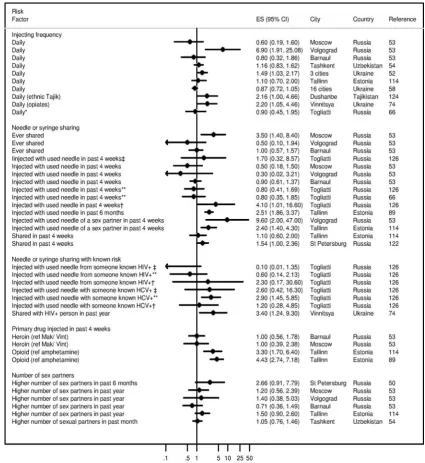
analysis. The forest plots summarised in figures 3and 4 synthesise the effects of particular individual and environ-mental risk factors on HIV. Although studies measure similar associations, it is important to note that each may have carried out analyses in a unique manner, adjusting for different confounding variables.
As shown by the individual risk factor estimates pre-sented in figure 3, many studies investigated the link between HIV and injecting with a used or shared needle. Although the effect sizes tend towards increased HIV risk, most results are inconclusive,‘social-desirability’ bias pos-sibly influencing self-reported responses. Injecting with the used needle of a sex partner was found in Volgograd52 and Tallinn113 to clearly increase an indivi-dual’s odds of HIV. More definitively, injecting with a needle previously used by someone known to have HIV or hepatitis C is shown in most studies to be clearly posi-tively correlated.72 125 Daily injecting is also found to be positively associated. Many reviewed studies also associate longer injecting careers with greater odds of having HIV.125 Although a Russian study found no difference in an indi-vidual’s odds of HIV according to the primary drug they inject,126 studies in Estonia found that primary injectors of an opiate (fentanyl) had between three and four and a half times greater odds of HIV than individuals who pri-marily inject amphetamines.113 127
Regarding exploration of HIV and associatedsexual risk including sex work (SW), most multivariate analyses explored the associations between exchanging sex for drugs or money, the number of sexual partners, and unprotected vaginal or anal sex, as risk factors. Although several strong univariate associations were found, these tended not to hold in the multivariate models (figure 3). This could be because sample sizes were insufficient or because much sexual risk behaviour is determined by other individual or environmental factors such as gender, socio-economic status or injecting behaviour.
Environmental-level risk factors for HIV
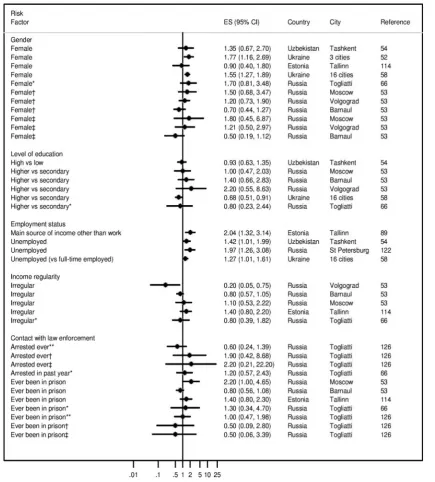
Although most studies presented show adjusted ORs (AOR) identifying female genderas a risk factor for HIV (figure 4), the CIs generally straddle one and are inconclusive.
Multiple studies link HIV to thesocio-economic status of PWID, though economic status is defined through differ-ent measures, including level of education, employmdiffer-ent (regular or not) and income (regular or not, legal or not;
figure 4). Of these measures, only an individual’s employ-ment status showed a consistent association with HIV, with unemployed individuals or those having a main source of income that was not work, showing greater odds of HIV than others.53 57 88 121 An Estonian multilevel study included neighbourhood level data in its analyses and found neighbourhood level effects of unemployment (10% increment in unemployment AOR 5.95, 95% CI 2.47 to 14.31) and habitat change since 1989 (10% change AOR 1.89, 95% CI 1.09 to 3.26) to be both associated with HIV prevalence (results not presented).
T
able
1
C
ontinued
St
udy
(y
ear)
Loca
tion
Sample
Individual-lev
el
risk
fa
ctors
Envir
onme
ntal-lev
el
risk
fa
ctors
P
oppy-s
tr
a
w
use;
Gr
oup
drug
use;
Sharing
needles;
Own
s
yringe;
Blood
tr
ansfu
sion;
STI
his
tory;
Hepa
titis
his
tory*;
TB
his
tory;
STI
s
ymptoms;
Sell
se
x
for
drugs;
C
ondom
use*;
Number
of
se
xual
partners
in
pas
t
month
Educa
tion
s
ta
tus;
Need
le
e
xcha
nge
pr
ogr
amme;
AIDS
kno
wledge;
pr
otection
for
AIDS;
Dona
ted
blood
for
mone
y*;
*
p
V
alue
reported
≤
0.0
5.
Jolley E, Rhodes T, Platt L,et al.BMJ Open2012;2:e001465. doi:10.1136/bmjopen-2012-001465 11
HIV and people who inject drugs in Central and Eastern Europe and Central Asia
on September 22, 2020 by guest. Protected by copyright.
http://bmjopen.bmj.com/
Several studies have examined contact with law enforce-ment agencies as an environmental factor linked with the odds of being HIV infected, although the results pro-duced by the systematic review have large CIs and are largely inconclusive.52 65 113 125 The review reveals that contact between police and PWID in the region is highly commonplace and no studies examined the frequency or duration of contact.
In addition to the universally relevant factors high-lighted above, some studies analysed the relationship between HIV and determinants that are particular to local context (results not shown). For example, a study in Tajikistan found that respondents identifying as Tajik (AOR 7.06, p<0.001) or other ethnicity (AOR 6.05, p<0.001) as opposed to Russian were at higher risk of
testing positive for HIV.72A study in Uzbekistan similarly found respondents of Uzbek ethnicity to have higher odds of HIV than their Russian counterparts (AOR 1.20, 95% CI 0.80 to 1.80).53 However, a study in Estonia found that ethnic Estonians had a reduced odds of HIV compared with those of Russian or other backgrounds (AOR 0.63, 95% CI 0.28 to 1.25).113 In Moscow and Tallinn ever having been registered as a PWID at drug treatment was found to be associated with more than double the odds of HIV (AOR 2.4, 95% CI 1.3 to 4.7; AOR 2.4, 95% CI 1.5 to 3.8).52 113Conversely, a study in Togliatti in Russia conducted among 96 new (<3 years) injectors found having been in drug treatment in the past as negatively associated with risk of HIV (AOR 0.4, 95% CI 0.1 to 1.0).128
Figure 3 Adjusted effect estimates of individual level risk factors present in multivariate studies of PWID. *New people who inject drugs (PWID) (≤3 years); **male PWID;†female (non- sex work (SW)) PWID;‡female (SW) PWID.
12 Jolley E, Rhodes T, Platt L,et al.BMJ Open2012;2:e001465. doi:10.1136/bmjopen-2012-001465
HIV and people who inject drugs in Central and Eastern Europe and Central Asia
on September 22, 2020 by guest. Protected by copyright.
http://bmjopen.bmj.com/
HIV prevention coverage
Coverage—the proportion of the population at risk reached by an intervention, ideally with sufficient inten-sity to have probable impact—emerges as a critical deter-minant of HIV prevention effectiveness.32 129–131 Our review did not focus on collating primary data but sought to synthesise coverage estimates relevant to the Central and Eastern European and Central Asian region from key recently published reviews regarding NSPs, OST and ART.39 40These data are contained infigure 5. They indi-cate that NSPs were available in all countries of the region, except for Turkey, though intervention coverage varies widely. For instance, whereas 50% of PWID in Hungary in 2007 had access to NSPs, with each receiving
around 135 clean needles a year (135 per PWID based on country-level estimates of PWID), in Russia only 7% of PWID had such access to NSPs, with each receiving 56 needles each a year (4 per PWID based on country-level estimates of PWID). These estimates do not include pharmacy-based provision, which is a primary source in some countries in this region, including Russia.132 Figure 5 also shows that 4 of the 30 countries in this region reporting evidence of injecting drug use did not provide OST: Russia, Uzbekistan, Turkmenistan and Turkey. Coverage of OST is generally low, with Slovenia showing the greatest coverage.
Comparing the proportion of HIV cases caused by injecting drug use with the corresponding proportion of Figure 4 Adjusted effect estimates of environmental level risk factors present in multivariate studies of PWID. *New people who inject drugs (PWID) (≤3 years); **male PWID;†female (non- sex work (SW)) PWID;‡female (SW) PWID.
Jolley E, Rhodes T, Platt L,et al.BMJ Open2012;2:e001465. doi:10.1136/bmjopen-2012-001465 13
HIV and people who inject drugs in Central and Eastern Europe and Central Asia
on September 22, 2020 by guest. Protected by copyright.
http://bmjopen.bmj.com/
people receiving antiretroviral therapy who inject drugs, in 2002, 71% of the reported people living with HIV acquired HIV infection through injecting drug use, whereas only 20% of those receiving antiretroviral therapy were people who injected drugs. In 2005 and 2006, among 21 and 23 countries with available data, people who injected drugs represented 77% of reported cases and 26% of antiretroviral therapy recipients, a pro-portion that declined to 22% in 2010 among 19 report-ing countries. Although no trends can be statistically ascertained due to incomparable samples (notably missing data from the Russian Federation in 2002 and 2010), these data suggest that most of the people who acquire infection in reporting countries are people who inject drugs and that, despite this, their treatment needs remain considerably underserved.4
We found no data relating to the impact or coverage of structural level interventions on HIV among PWID, although recent legislative changes in Moldova and the Czech Republic have de-emphasised the criminalisation of small amounts of drugs possession.
Enabling policy environments
Figure 6shows the results of the policy index developed (see Methods section) to describe the distribution of enabling policy environments throughout Central and Eastern Europe and Central Asia. Darker shading repre-sents seemingly more supportive policy environments for HIV prevention and lighter shading seemingly less supportive environments.
Of the 30 countries in the region, 25 explicitly and supportively mentioned harm reduction in their national strategies, and 27 have undertaken at least one sero-prevalence and one behavioural study among PWID in the last 10 years. In 26 countries, OST and NSP are available generally, but available in prison in only three countries. Five countries have national organisations of drug users, and five countries use administrative rather than criminal penalties for people found possessing small quantities of drugs for personal use.
On the basis of the index, the countries with the most supportive policy environments are Moldova and Romania. The countries with the least supportive envir-onments are Turkmenistan and Turkey. Turkmenistan does not show any of the features of a supportive envir-onment according to our index, although Turkey has conducted at least one sero-prevalence and one behav-ioural study among PWID in the last 10 years. In Russia, where the majority share of HIV infections among PWID in the region are located, the national strategy refers to harm reduction as a threat to efforts to reduce the demand for drugs, with NSPs and OST specifically mentioned as problematic for federal level support.133 OST is unavailable in Russia, and NSPs are limited in number, with none available to prisoners, and there is a focus on criminal rather than administrative penalties for drugs possession. However, there is some evidence of drug user activism and organisation (Albers ER, per-sonal communication with EJ, 2011).
Russia and Ukraine both feature among the countries experiencing high HIV prevalence among PWID, and Figure 5 Estimated numbers of syringes distributed per people who inject drugs (PWID) per year and estimated number of opioid substitution treatment clients per 100 PWID in the latest year for which data is available.39 40
14 Jolley E, Rhodes T, Platt L,et al.BMJ Open2012;2:e001465. doi:10.1136/bmjopen-2012-001465
HIV and people who inject drugs in Central and Eastern Europe and Central Asia
on September 22, 2020 by guest. Protected by copyright.
http://bmjopen.bmj.com/
like Russia, criminal punishment rather than administra-tive sanctions for drug use and possession is the norm in Ukraine. While Ukraine has a relatively high number of NSPs alongside increasing availability of OST, it does not provide harm reduction services in prisons. Moldova and Estonia also feature among the high-HIV-prevalent countries but both appear as to present relatively sup-portive environments for PWID. However, to our knowl-edge, neither has an active national drug user organisation and neither NSP or OST in prison settings.
DISCUSSION
HIV epidemic contexts
All but one country (Turkmenistan) in Central and Eastern Europe and Central Asia has generated survey-based estimates of HIV prevalence among PWID. Our review of these studies shows that HIV prevalence among PWID is highest in the Eastern European coun-tries of Estonia, Russia, Moldova and Ukraine (over 20% in each), and lowest in the Central European countries of Albania, Croatia, Cyprus, Hungary, Macedonia (FYR) and Slovenia (0% in each). We identified only three HIV incidence studies among PWID in the region, showing an incidence of 9/100 PY in Estonia in 200948 and 4·5/100 PY in Russia.49 Accepting that country esti-mates of HIV prevalence inevitably only reflect the char-acteristics of the particular samples from which they are drawn, these estimates taken together reiterate that the burden of HIV linked to injecting drug use falls in the East, and especially Russia, where over half of all HIV cases among PWID in the region are located.
Multivariate analyses of HIV risk factors among PWID underscore injecting with a used needle/syringe, fre-quent injecting, and injecting opiates as opposed to amphetamines as proximal factors associated with increased risk of HIV. We acknowledge that thefindings of the multivariate studies we synthesise in the review may not be directly comparable, as they have been derived from studies using different regression
techniques and adjusting for different confounding factors. While most of the epidemiological studies we reviewed did not embrace, by design, the exploration of environmental risk factors—as is the case with HIV epi-demiological studies globally20—a number of important factors in the HIV risk environment can be identified. These included increased HIV risk among women, an association we interpret to have indirect, rather than bio-logical, causative roots through pathways involving mul-tiple linked socio-economic differences related to gender. Although most studies showed women at greater risk of HIV than men, the CIs presented include the null value, preventing us from drawing conclusions on the effect of gender on HIV risk. The lack of conclusive evidence could be due to the small number of women often recruited in to research, as well as genuine vari-ability in the consequences of female gender in different settings. Qualitative data from Ukraine suggest that female PWID are at increased risk of psychological, phys-ical (including sexual) and economic violence from their male partners, constraining capacity to negotiate safer sex, safer injecting practices and access to helping services, thus elevating their HIV risk.134
Additionally,socio-economic status—whether measured by income or employment—emerged as important, although only employment status appeared conclusively associated with HIV risk. The direction and pathways income and employment effects have on HIV risk may vary locally. The ways in which HIV links to wealth and poverty is shaped by social context, and in some settings injecting has diffused among those whose economic status may be comparable to the wider local population.52 135
Lastly, we note contact with criminal justice agencies, including experience of incarceration, as an important risk factor,52 65 113 125although the studies systematically reviewed here were inconclusive in this regard. Studies evidencing the adverse effects of the legal environment on HIV risk among PWID suggest a relationship between street-based policing practices, including extra-judicial ones such as police violence, and increased HIV Figure 6 Map showing the supportiveness of the policy environments for HIV among people who inject drugs in Europe.
Jolley E, Rhodes T, Platt L,et al.BMJ Open2012;2:e001465. doi:10.1136/bmjopen-2012-001465 15
HIV and people who inject drugs in Central and Eastern Europe and Central Asia
on September 22, 2020 by guest. Protected by copyright.
http://bmjopen.bmj.com/
vulnerability, including through reduced capacity for risk avoidance as a consequence of safety short-cuts and rushed injections borne out of a fear of detection or arrest.18 27 119 136–138 While evidence internationally links prison and a history of incarceration to elevated odds of HIV among PWID,139 140only three countries in the region (Moldova, Romania and Kyrgyzstan) provide harm reduction services to prisoners. An association between HIV among PWID and being of a minority eth-nicity that cannot otherwise be explained by needle sharing has been noted elsewhere, and linked to mater-ial as well as other socmater-ial inequalities, including access to support services.141 142 In parts of Eastern Europe and Central Asia where PWID are often required to register as such to obtain drug treatment or are forced to through contact with police, this can lead to increased social marginalisation as well as reducing their ability to gain employment or even to drive a car.143
While the epidemiological studies we reviewed provide some pointers to the role of HIV risk environments, they are self-evidently limited in their capacity to capture how HIV is an effect of social context. This highlights the urgency to develop specifically tailored social epi-demiological approaches, which build into their designs from the outset measures of micro and macro risk environment. It also highlights the importance of mixed-methods approaches, especially those combining qualita-tive with epidemiological data.144For example, by linking HIV epidemiology to data on shifting drug trafficking routes it has been possible to plot the macrophysical dis-tribution of HIV.145In the region of Central and Eastern Europe and Central Asia, the potentially HIV risk pro-ductive role of transit routes for heroin originating from Afghanistan through Central Asian countries along the ‘Northern Route’to Russia and beyond provides a similar example. In 2009, UNODC estimated that 25% of all Afghan heroin (95 metric tons) was transported along this route, with the majority travelling through Tajikistan, to Osh in Kyrgyzstan, and then on to Kazakhstan, before arriving in Russia.146 The effects of this trafficking route appear to have HIV impacts with Kulyab, in Tajikistan, a major hub for Afghan opiate trafficking, reporting the highest HIV prevalence among PWID in Tajikistan at 34.5% in 2009 compared with the national average of 17.3%.147Jalal-Abad reported the highest HIV prevalence among PWID in Kyrgyzstan at 14% in 2007148compared with a national average of 7·7%.83In Kazakhstan, there is substantial overlap between the sites with the largest number of diagnosed HIV infections, largest number of registered drug users and highest number of heroin seizures.149
Future epidemiological studies of HIV among PWID need to better systematically develop measures of HIV risk environment and how these combine to increase or reduce HIV risk.20 Because epidemiological studies of PWID tend to focus on the proximal determinants of risk behaviour and HIV transmission, there is a need to shift towards capturing distal factors and how these interplay
to produce pathways of risk.19 20 28 150Principal among these, according to our review, should be gender, social-economic status, and the effects of criminalisation.
In addition to the limitations discussed above, the study is subject to several potential biases including missing key documents, especially those not published in the English language. Individual studies may tend to publish what are considered‘interesting’results, leading to potential publication bias towards analyses reporting significant results. This can lead a systematic review such as ours to overstate the effect of several factors. As some elements of this review were undertaken by the same authors, this may reduce protection against human error and preservation of independence between the stages of the review.
Towards enabling policy environments
It is well established that HIV prevention targeting PWID requires a‘combination intervention’approach tailored to local setting, including a balance of: needle and syringe distribution programmes (NSPs); opioid substitution treat-ment (OST); antiretroviral HIV treattreat-ment (ART); peer education and outreach; HIV testing and counselling services; and the promotion of public policies and other structural changes conducive to public health approaches.20 32 33 151–153Evidence for the effectiveness of these interventions is well established.32 151 154 155 The extent of HIV prevention intervention coverage, however, varies throughout the region, and is largely inad-equate.39 40Many of the countries with the lowest levels of harm reduction service provision are also those with the highest HIV prevalence and the largest per-capita number of new diagnoses. The unavailability of OST in Russia in particular means that the majority of PWID in the region do not have access to an integral component of evidence-based HIV prevention.
Structural interventions seek to remove environmental barriers to HIV prevention while enabling environmen-tal conditions which protect against vulnerability to HIV. While the relationships between HIV-related policies and their impacts upon micro-level HIV risk practices are clearly not straight forward, the policy environment is a clear object of structural intervention and change. Our review identified no evidence specifically relating to the impact or coverage of structural-level interventions on HIV among PWID, although recent legislative changes in Moldova and the Czech Republic have de-emphasised the criminalisation of small amounts of drug possession, and evidence elsewhere in Europe links such initiatives with reduced HIV risk and increased access to helping services.156
In the absence of social epidemiological data gener-ated from systematic review, we developed a crude index of‘enabling policy environment’based on indicators of: national-level policy endorsing of harm reduction approaches; research of HIV prevalence and risk behav-iour among PWID; drug user community organisation; availability of OST and NSPs; availability of OST and
16 Jolley E, Rhodes T, Platt L,et al.BMJ Open2012;2:e001465. doi:10.1136/bmjopen-2012-001465
HIV and people who inject drugs in Central and Eastern Europe and Central Asia
on September 22, 2020 by guest. Protected by copyright.
http://bmjopen.bmj.com/
NSPs in prison settings; and application of administrative rather than criminal penalties for drug use and posses-sion (see box 1). Such an index seeks to include quanti-fiable indicators of the practical application of ‘healthy policy’, at least as far as such data is comparatively avail-able. We acknowledge the limits of this exercise, but argue for the need for future epidemiological research to better monitor indicators of enabling and risk envir-onment alongside proximal risk factors for HIV, espe-cially those pertaining to community involvement and partnership in policy formation, availability of HIV pre-vention in criminal justice settings, and shifts towards de-emphasising the criminalisation of drug use through providing treatment or care as an alternative to arrest or imprisonment.
Applying our index of enabling policy environment highlighted large discrepancies throughout the region. Of the countries with a seemingly unsupportive environ-ment for HIV prevention among PWID, Turkmenistan may present a particular concern, for it is located between countries of high HIV prevalence, situated on a heroin trafficking route and appears to lack a baseline of epidemiological evidence. Other countries— includ-ing Russia, Uzbekistan and Azerbaijan—appear to present weak policy environments for HIV prevention, compounding potential risk linked to low-level HIV pre-vention coverage. The lack of systematic monitoring of policy environment indicators in the region, and the neglected attention paid to monitoring the effect of structural-level factors on microrisk relationships in epi-demiological research, hampers an understanding of how European HIV epidemic contexts may differ mark-edly regarding HIV prevention need and potential. The development of structural HIV prevention interventions as part of a combination intervention approach clearly requires evidence of how environmental-level factors impact upon HIV risk.
The importance of reducing vulnerability to HIV/ AIDS, by understanding and removing structural bar-riers, is increasingly recognised in European HIV policy, for example as one of the four strategic directions of the European Action Plan for HIV/AIDS 2012–2015, which proposes actions to: address laws and regulations that present obstacles to effective HIV prevention, treatment care and support; strengthen the enforcement of pro-tective laws and regulations; strengthen civil society involvement in the HIV response and ensure gender and age equity in access to HIV and related health services.
Author affiliations
1Centre for Research on Drugs and Health Behaviour, London School of
Hygiene and Tropical Medicine, London, UK
2Centre for Infections, Health Protection Agency, London, UK 3Eurasian Harm Reduction Network, Vilnius, Lithuania
4Global Health Research Center of Central Asia, Columbia University,
New York, New York, USA
5Division of Communicable Diseases, Health Security and Environment, World
Health Organization Regional Office for Europe, Copenhagen, Denmark 6Global HIV/AIDS Programme, World Bank, Washington DC, USA
Contributors TR, LP and VH developed the methodology for the systematic review. TR, LP, VH, AL and EJ reviewed the collected literature. EJ and VH extracted the data. EJ conducted the data analysis. TR and EJ interpreted the data and drafted the manuscript. All authors reviewed the manuscript and commented on the data and interpretation. All authors gave approval for the manuscript to be submitted.
Funding This review was undertaken as part of a larger project funded by the World Bank to review HIV in vulnerable populations in Europe, grant number 7153690.
Competing interests None.
Provenance and peer review Not commissioned; externally peer reviewed.
Data sharing statement No additional data are available.
REFERENCES
1. Joint United Nations Programme on HIV/AIDS (UNAIDS). Global report: UNAIDS report on the global AIDS epidemic 2010, 2010. 2. European Centre for Disease Prevention and Control/WHO
Regional Office for Europe.HIV/AIDS surveillance in Europe 2010. Stockholm: European Centre for Disease Prevention and Control, 2011.
3. Department of Health and Social Development of Russian Federation, Federal Service for supervision of Consumer Protection and Human Welfare, Federal Government Central Science Research Agency Institute of Epidemiology, Federal Research and Methodological Center for Prevention and Control of AIDS. HIV INFECTION Newsletter№35. Moscow, 2011.
4. UNAIDS. Global HIV/AIDS response: epidemic update and health sector progress towards Universal Access. Progress Report 2011. 5. Mathers BM, Degenhardt L, Phillips B,et al. Global epidemiology of
injecting drug use and HIV among people who inject drugs: a systematic review.Lancet2008;372:1733–45.
6. UNGASS. ed. UNGASS Country Progress Report: Republic of Moldova. Chisinau, Moldova, 2010.
7. Bargagli AM, Hickman M, Davoli M,et al. Drug-related mortality and its impact on adult mortality in eight European countries.Eur J
Pub Health2006;16:198–202.
8. Degenhardt L, Hall W, Warner-Smith M. Using cohort studies to estimate mortality among injecting drug users that is not attributable to AIDS.Sex Transm Infect2006;82(suppl 3):iii56–63.
9. Cusick L. Widening the harm reduction agenda: from drug use to sex work.Int J Drug Policy2006;17:3–11.
10. Poundstone KE, Strathdee S, Celentano DD. The social epidemiology of human immunodeficiency virus/acquired immunodeficiency syndrome.Epidemiol Rev2004;26:25–35. 11. Rhodes T. The‘risk environment’: a framework for understanding
and reducing drug-related harm.Int J Drug Policy2002;13:85–94. 12. Rhodes T, Singer M, Bourgois P,et al. The social structural
production of HIV risk among injecting drug users.Soc Sci Med 2005;61:1026–44.
13. Sumartojo E. Structural factors in HIV prevention: concepts, examples, and implications for research.Aids2000;14(suppl 1): S3–10.
14. Latkin CA, Hua W, Forman VL. The relationship between social network characteristics and exchanging sex for drugs or money among drug users in Baltimore, MD, USA.Int J STD AIDS 2003;14:770–75.
15. Latkin C, Mandell W, Vlahov D,et al. Personal network characteristics as antecedents to needle-sharing and shooting gallery attendance.Social Netw1995;17:219–28.
16. Donoghoe MC, Lazarus JV, Matic S. HIV/AIDS in the transitional countries of eastern Europe and central Asia.Clin Med J R College
Physicians2005;5:487–90.
17. Rhodes T, Wagner K, Strathdee SA,et al. Structural violence and structural vulnerability within the risk environment: theoretical and methodological perspectives for a social epidemiology of HIV risk among injection drug users and sex workers. In: O’Campo P, Dunn JR, eds.Rethinking social epidemiology: towards a science of change. Springer: London, 2011.
18. Sarang A, Rhodes T, Sheon N,et al. Policing drug users in Russia: risk, fear, and structural violence.Subst Use Misuse
2010;45:813–64.
19. Galea S, Hall C, Kaplan GA. Social epidemiology and complex system dynamic modelling as applied to health behaviour and drug use research.Int J Drug Policy2009;20:209–16.
Jolley E, Rhodes T, Platt L,et al.BMJ Open2012;2:e001465. doi:10.1136/bmjopen-2012-001465 17
HIV and people who inject drugs in Central and Eastern Europe and Central Asia
on September 22, 2020 by guest. Protected by copyright.
http://bmjopen.bmj.com/