Educational interventions to improve
prescribing competency: a systematic
review
Gritta Kamarudin, Jonathan Penm, Betty Chaar, Rebekah Moles
To cite:Kamarudin G, Penm J, Chaar B,et al. Educational interventions to improve prescribing competency: a systematic review.BMJ Open2013;3: e003291. doi:10.1136/ bmjopen-2013-003291
▸ Prepublication history and additional material for this paper is available online. To view these files please visit the journal online (http://dx.doi.org/10.1136/ bmjopen-2013-003291). GK and JP contributed equally to this paper. Received 23 May 2013 Revised 20 July 2013 Accepted 24 July 2013
Faculty of Pharmacy, World Hospital Pharmacy Research Consortium, The University of Sydney, New South Wales, Australia
Correspondence to Dr Rebekah Moles; [email protected]. au
ABSTRACT
Objective:
To review the literature on educational interventions to improve prescribing and identify educational methods that improve prescribing competency in both medical and non-medical prescribers.Design:
A systematic review was conducted. The databases Medline, International Pharmaceutical Abstracts (IPA), EMBASE and CINAHL were searched for articles in English published between January 1990 and July 2013.Setting:
Primary and secondary care.Participants:
Medical and non-medical prescribers.Intervention:
Education-based interventions to aid improvement in prescribing competency.Primary outcome:
Improvements in prescribing competency (knows how) or performance (showshow) as defined by Miller’s competency model. This
was primarily demonstrated through prescribing examinations, changes in prescribing habits or adherence to guidelines.
Results:
A total of 47 studies met the inclusion criteria and were included in the systematic review. Studies were categorised by their method of assessment, with 20 studies assessing prescribing competence and 27 assessing prescribing performance. A wide variety of educationalinterventions were employed, with different outcome measures and methods of assessments. In particular, six studies demonstrated that specific prescribing
training using the WHOGuide to Good Prescribing
increased prescribing competency in a wide variety of settings. Continuing medical education in the form of academic detailing and personalised prescriber feedback also yielded positive results. Only four studies evaluated educational interventions targeted at non-medical prescribers, highlighting that further research is needed in this area.
Conclusions:
A broad range of educational interventions have been conducted to improveprescribing competency. The WHOGuide to Good
Prescribinghas the largest body of evidence to support
its use and is a promising model for the design of targeted prescribing courses. There is a need for further development and evaluation of educational methods for non-medical prescribers.
INTRODUCTION
Prescribing, a complex process involving the
initiation, monitoring, continuation and
modi-fi
cation of medication therapy,
1demands a
thorough understanding of clinical
pharma-cology as well as the judgement and ability to
prescribe rationally for the bene
fi
t of patients.
2The rational prescribing of medicines as
de
fi
ned by the WHO is
“
the situation in which
patients receive medications appropriate to
their clinical needs, in doses that meet their
own individual requirements for a suf
fi
cient
length of time, with the lowest cost to them
and their community.
”
3Equipping prescribers
with skills for rational prescribing is essential.
ARTICLE SUMMARY
Article focus
▪ Prescribing competencies that cover both
medical and non-medical prescribers have been developed internationally.
▪ A review of the educational interventions
designed to improve prescribing competencies will help to ensure evidence-based interventions are used to develop competent medical and non-medical prescribers.
Key messages
▪ The WHO Guide to Good Prescribing has the
largest body of evidence supporting its use to
improve prescribing competencies
internationally.
▪ Few studies have focused on educational
inter-ventions for non-medical prescribers.
▪ There is a need for further development and
evaluation of educational methods for non-medical prescribers.
Strengths and limitations of this study
▪ Timely systematic review considering
inter-national developments regarding non-medical prescribers.
▪ Difficult to generalise findings considering
differ-ent methods of assessmdiffer-ents used.
▪ Limited to publications in English only. on September 22, 2020 by guest. Protected by copyright.
The diversity of skills required for good prescribing
present a major challenge for the development of
edu-cational programmes. Adding to this complexity is the
extension of prescribing rights to non-medical
health-care professionals such as optometrists, nurses and
phar-macists. Potential bene
fi
ts of non-medical prescribing
have been argued to include improved continuity of
care and access to medicines, better allocation of human
resources, increased patient convenience and less
frag-mentation of care
1; however, the process of prescribing
is considered high-risk and error-prone.
2Hence
compe-tent prescribing is paramount to patient safety. Poor
pre-scribing can be illustrated by prescription errors, under
or overprescribing or inappropriate and irrational
pre-scribing.
2 4Junior prescribers appear most prone to
pre-scribing errors, yet are expected to perform a signi
fi
cant
prescribing role.
5–8Although many prescribing errors
are unintentional, studies have shown that the
prescrib-ing performance of interns and medical students is
poor, partly because of inadequate training.
9 10Little is
known however about non-medical prescribing practices
and rates of prescription errors. Research into
non-medical prescribing has mainly been con
fi
ned to
self-report measures such as questionnaire and interview
surveys.
11Although one UK study indicated that nurses
’
prescribing decisions were generally clinically
appropri-ate, a large proportion did not display some prescribing
competencies, for example, taking patients
’
medicines
history and allergy status.
12Traditionally assessment of education was based on
knowledge tests; however, it is recognised today that
knowledge alone is insuf
fi
cient to predict performance
in practice.
13This has led to the introduction of
competency-based education, focusing on developing
knowledge, judgement and skills.
13 14Miller
13proposed
a four-staged competency assessment model beginning
with assimilation of pure knowledge, progressing to
development of real performance in practice (
fi
gure 1
).
Mucklow
et al
15provides further examples of assessing
prescribing competence based on Miller
’
s model and its
importance
for
the
healthcare
profession.
Such
developments have led the National Prescribing Centre
in the UK and the NPS MedicineWise (Quality Use of
Medicines
service
agency
for
Australia
’
s
National
Medicines Policy) to produce a core competency
frame-work for all prescribing, both medical and
non-medical.
16 17Although a number of recommendations
for prescribing education to ensure competency have
been introduced,
15there is little evidence and detail as
to how these competencies could actually be achieved.
18Three systematic reviews of interventions to improve
prescribing were published since 2009.
19–21One focused
on medical students and junior doctors,
20while another
was an update of two previous reviews investigating the
effectiveness of different types of interventions on
improving prescribing.
19The most recent review focuses
on the hospital setting with an emphasis on new
prescri-bers who were less than 2 years postgraduation.
21Although all new prescribers were included in this review,
little was discussed regarding non-medical prescribers.
The Cochrane collaboration has also comprehensively
evaluated the use of audit and feedback to improve
pre-scribing.
22 23The focus of this review is on prescribing
competencies and its assessment, based on the higher
stages of Miller
’
s model (competency and performance).
This comprises practical aspects of prescription-writing as
well as therapeutic decision-making, ensuring that
rational, evidence-based therapy-selection is made based
on patients
’
requirements and evaluation of their
cap-acity to comply with a prescribed medicine).
This review aimed to examine the literature on
educa-tional interventions designed to develop and improve
patient-focused prescribing competency in both medical
and non-medical prescribers.
METHOD
Search strategy
MEDLINE,
International
Pharmaceutical
Abstracts
(IPA), EMBASE and CINAHL were searched using the
key words: (
‘
prescription$
’
OR
‘
prescriber$
’
OR
‘
pre-scribing
’
) AND (
‘
education
’
OR
‘
curriculum
’
OR
‘
course$
’
OR
‘
training
’
OR
‘
intervention$
’
) AND (
‘
drug
$
’
OR
‘
medication$
’
or
‘
medication therapy
manage-ment
’
) AND (
‘
clinical competence
’
OR
‘
competency
’
OR
‘
competency assessment
’
). The search terms were
mapped onto Medical Subject Headings (MeSH) in
Medline and EMBASE and carried through other
data-base as key search terms. The search was limited to
arti-cles published in English from January 1990 to July 2013
(see online supplementary appendices 1
–
4).
Study selection
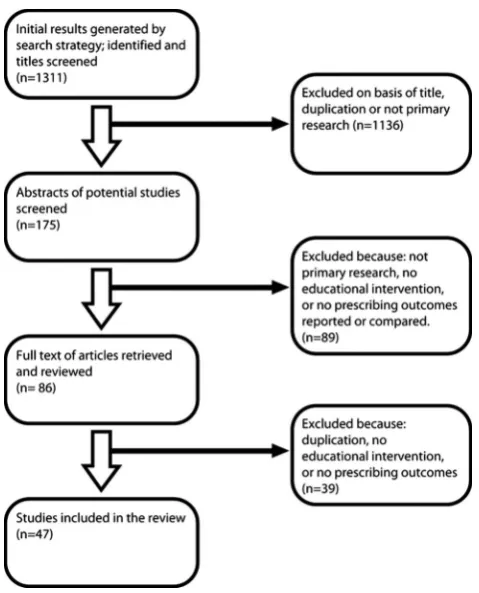
Citations generated by the search strategy were screened
by all authors for relevance and eligibility. The full texts
of potentially relevant articles were reviewed to
deter-mine satisfaction of inclusion criteria. The screening
process was conducted according to PRISMA
guide-lines
24(
fi
gure 2
).
Figure 1 Miller’s framework for clinical assessment.13
Open Access
on September 22, 2020 by guest. Protected by copyright.
http://bmjopen.bmj.com/
The target population was medical or non-medical
prescribers. All study designs were considered for this
review. Studies were included if they were original
research articles, had an educational intervention, and
at least one outcome measure of prescribing
compe-tency demonstrated through prescribing examinations
which evaluated the application of knowledge to patient
cases or scenarios, changes in prescribing habits or
adherence to guidelines. Studies were excluded if they
only measured theoretical knowledge of pharmacology
and therapeutics or studied an intervention involving
drug utilisation evaluation primarily using audit and
feedback without a focus on the educational
interven-tion, as these were often targeted towards
cost-effectiveness and contains a large body of literature that
has been previously reviewed by the Cochrane
collabor-ation.
22 23Systematic reviews, letters, meeting reports
and opinion pieces were also excluded. The review was
not restricted to any country.
Two authors (GK and JP) reviewed the titles and
abstracts of the articles retrieved in the search to assess
relevance. Discussions were conducted between the four
authors to exclude studies which did not meet the
inclu-sion criteria, and this continued until consensus was
achieved regarding study selection.
Data extraction and analysis
Study location, design, characteristics of the study
popu-lation,
description
of
the
education
intervention,
and JP.
RESULTS
Number of studies
The search strategy generated 796 articles in MEDLINE,
300 in EMBASE, 20 in IPA and 195 in CINAHL. Further
re
fi
nement using the exclusion and inclusion criteria
and duplicate exclusion resulted in 47 studies identi
fi
ed
and reviewed (
table 1
).
Study designs
Of the 47 reviewed studies, there were 20 randomised
controlled trials (RCTs),
18 25–4315 non-randomised
com-parative trials
44–58and 12 before-after studies.
59–68Setting and participant characterisation
Ten educational interventions were targeted at general
practitioners (GPs),
25 29 30 32–34 40 44 46 6310 were
conducted in hospitals,
41 45 52 59 61 62 65–67 69six were
implemented at primary healthcare clinics/facilities,
36– 38 43 60 7020 interventions were incorporated within the
curriculum at universities
18 26–28 31 39 42 47–51 53–58 64 68and one intervention was carried out in pharmacies.
35These studies were conducted in numerous countries
around the world (
table 1
).
Types of educational interventions and prescribing
outcomes
A wide variety of educational methods and outcome
measures were used. Interventions were summarised
into two categories using Miller
’
s competency model:
1. Prescribing competence (
‘
knows how
’
)
—
assessing
prescriptions written for theoretical cases;
2. Prescribing performance (
‘
shows how
’
)
—
assessing
prescriptions written for real patients.
Prescribing competence
Twenty studies included interventions targeting
particu-lar tasks involved in prescribing, from taking accurate
medication history, in choosing a rational treatment and
writing the prescription.
18 25–29 31 39 42 47–51 54 56–58 64 68Eight of these studies used a method of rational
pharma-cotherapy education based on the WHO
Guide to Good
Prescribing.
25 27 31 47 54 56 64 68De Vries
et al
27conducted
a multicentre RCT with 583 medical students from eight
countries. The trial reported a signi
fi
cant increase in
mean scores of the intervention group following the
WHO
Guide to Good Prescribing
intervention.
Other studies found evidence of a retention effect,
where improvement in rational prescribing was
main-tained several months after the intervention
25 42and a
transfer effect, where students were able to apply
acquired rational prescribing skills in new situations.
25 54The main limitation of the trials was that assessments
were based primarily on written scenarios with a limited
number of disease topics.
Figure 2 Flow chart of search strategy and study selection based on PRISMA guidelines.24
on September 22, 2020 by guest. Protected by copyright.
Table 1 Summary of educational intervention studies for prescribing
Authors Setting Study design
Number of
participants Intervention
Prescribing outcome
measures Results
Potential for bias
Akiciet al25 Turkey Randomised
controlled trial
12 GPs in intervention group; 13 GPs in control group
Short rational
pharmacotherapy course based on the
‘problem-based
Groningen/WHO model’
Written examination with open and structured questions based on hypertensive cases as well as a question on osteoarthritis (unexposed indication)
Significant improvement in the mean test scores post-training of the intervention group (p<0.05) for both questions, showing a transfer effect. The improvement was maintained for at least 4 months after training
None declared
Butleret al43 UK Randomised
controlled trial
34 medical practices with 139 GPs were in the intervention group; 34 medical practices with 124 GPs in the control group
The intervention contained 7 parts. Six of these were online and included a reflection on their own practice, evidence and guidelines, novel communication skills and sharing experiences. Last, a face-to-face presentation of resistance trends throughout Wales and actual practices
Total numbers of oral antibiotic items
dispensed for all causes per 1000 practice patients adjusted for the
previous year’s
dispensing
A significant reduction of total oral antibiotic dispensing for the intervention group was
observed compared with the control group (664 vs 681.1, p=0.02)
None declared
Celebiet al26 Germany Randomised
controlled trial
36 medical students in early intervention group; 38 medical students in late intervention group
A 1-week prescribing training module which comprised a seminar on common prescription errors, a prescribing exercise with a
standardised paper case patient, drafting of inoperative prescription charts for real patients and discussions with a lecturer
Students were asked to make prescriptions for two virtual cases on a standard patient chart. These prescription charts were subsequently analysed by two independent raters using a checklist for common prescription errors
Prior to training, students committed a mean of 69±12% of the potential prescription errors. This decreased to 29±15% after prescribing training (p<0.001)
None declared
De Vries et al27
Eight countries in Asia and Europe
Randomised controlled trial
194 medical students in personal formulary (PF) group; 198 in existing formulary (EF) group; 191 in control group
The PF and EF groups were given teaching sessions based on the WHO Guide to Good Prescribing model (PF group=whole manual; EF group=manual minus p-drugs), with and without use of PF
Written examination using 16 patient cases based on four topics: hypertension, osteoarthritis, acute bronchitis, gastroenteritis
A significant increase in mean scores of the intervention group compared with the control group (p<0.05). The increase in the PF group was significantly higher than in the EF group. However, this effect was only visible in the universities in Yemen, the Russian Federation, and Indonesia.
Funded by the VU University Medical Center and by the Department of Essential Drugs and Medicines Policy of the WHO
Continued
4
Kamarudin
G,
P
enm
J,
Chaar
B,
et
al
.
BMJ
Open
2013;
3
:e003291.
doi:10.1136/
bmjopen-20
13-003291
Ope
n
Ac
Authors Setting Study design participants Intervention measures Results for bias
No significant differences between PF and EF scores were found in the universities in the Netherlands, Slovakia, Spain, India or South Africa Degnan
et al28
UK Randomised
controlled trial
9 medical students in intervention group; 35 in the control group
An online teaching module consisting of an interactive tutorial of 12 multiple-choice questions and three case studies covering
pharmacokinetics, adverse drug reactions and drug doses calculations
OSCE station requiring administration of lidocaine and adrenaline for a patient with laceration and anaphylaxis
The teaching module significantly improved the
students’ability to calculate the
correct volume of lidocaine (p=0.005) and adrenaline (0=0.0002)
Funded by the Association of Anaesthetists of Great Britain and Ireland
Esmaily et al29
Iran Randomised
controlled trial
58 GPs in intervention group; 54 GPs in control group
Education with an outcome-based approach utilising active-learning principles
Multiple choice and short answer questions, with two case scenarios and
three‘irrational’
prescriptions
There was an overall
improvement of 26 percentage units in the prescribing knowledge and skills of GPs in the intervention group. No such improvements were seen in the control group
Additional funding from the National Public Health Management Centre in Tabriz and the Ministry of Health and Medical Education of Iran
Fenderet al30 UK Randomised
controlled trial
54 GPs in intervention group; 46 GPs in control group
An educational package based on principles of
‘academic detailing’
The appropriate
prescribing of tranexamic acid, nonsteroidal antiinflammatory drugs and norethisterone
A proportionately higher level of appropriate prescribing was found in the intervention group. An increase of 63% in the prescription of tranexamic acid, the most effective first line treatment for menorrhagia, was observed in the intervention group
None declared
Gordonet al42 UK Randomised
controlled trial
76 junior doctors in intervention group; 86 in control group
A 1–2 h e-learning
course on paediatric prescribing
Total correct responses on each prescribing assessment. Drug selection, prescribing calculations for children, discussing therapies and sources of errors were assessed
A significant increase in correct responses by the intervention group compared with the control group at both 4 and 12 weeks after the intervention. At 4 weeks: 79% vs 63% (p<0.0001)
None declared
G,
P
enm
J,
Chaar
B,
et
al
.
BMJ
Open
2013;
3
:e003291.
doi:10.1136/
bmjopen-20
13-003291
5
Open
Acces
Table 1 Continued
Authors Setting Study design
Number of
participants Intervention
Prescribing outcome
measures Results
Potential for bias
At 12 weeks: 79% vs 69% (p<0.0001)
Hassanet al31 Yemen Randomised
controlled trial
56 medical students in intervention group; 44 students in control group
A prescribing course
based on WHO’s Guide
to Good Prescribing, the Yemen Essential Drug List and Yemen Standard Treatment Guidelines
Written examination based on eight patient problems where a complete treatment plan form must be completed
Students from the study group performed significantly better than those from control in all problems presented and also when compared with the results of the pretest (p<0.05)
None declared
Huxet al32 Canada Randomised
controlled trial
135 GPs in intervention group; 116 GPs in control group
Mailed packages of prescribing feedback and guidelines-based educational materials
Median antibiotic cost and proportion of episodes of care in which a prespecified first-line antibiotic was used first
The median prescription cost remained constant in the feedback group but rose in the control group (p<0.002). First-line drug use increased in the feedback group but decreased in the control group (p<0.01)
Author receives salary support from the Institute for Clinical Evaluative Sciences in Ontario
Kahanet al33 Israel Randomised
controlled trial
32 physicians exposed to both interventions; 130 physicians who only received personalised letter; 29 physicians who only attended the lecture; 107 in the control group
Interventions were in the form of a lecture at a conference and a letter with personalised feedback to improve
physicians’rates of
prescribing in the treatment of acute uncomplicated cystitis in adult women
Outcome was the rate of adherence to the guidelines for appropriate treatment using
nitrofurantoin or second-line therapy of ofloxacin for 3 days
The letter intervention significantly influenced
physicians’prescribing patterns.
The lecture intervention was only effective in the short run, indicating that the effect of this technique does not last unless reinforced
Partially funded through a research grant from The Israel National Institute for Health Policy and Health Services Research and through an educational grant from Schering Plough Israel
Midlövet al34 Sweden Randomised
controlled trial
23 GPs in the intervention group; 31 GPs in the control group
Educational outreach visits
Number of prescriptions of benzodiazepines (BDP) and antipsychotics to the elderly
One year after the educational outreach visits there was a significant decrease in prescribing of medium-acting and long-acting BDP and total BDP in the active group compared with the control group (p<0.05). For antipsychotics there were no significant differences between active and control group
Funded by the Department of Primary Care Research and Development in the county of Skåne, Apoteket AB and the Faculty of Medicine, Lund University
Continued
6
Kamarudin
G,
P
enm
J,
Chaar
B,
et
al
.
BMJ
Open
2013;
3
:e003291.
doi:10.1136/
bmjopen-20
13-003291
Ope
n
Ac
Authors Setting Study design participants Intervention measures Results for bias
Nsimba35 Tanzania Randomised
controlled trial
20 pharmacists in intervention facilities; 20 in control facilities
Posters, individual information and one-to-one training sessions
Simulated clients assessed the drug seller/
pharmacist’s knowledge
and prescribing choices. A short examination was also conducted to assess
participants’knowledge
of appropriate treatments for common childhood conditions
85% of simulated clients who went to the intervention facilities were sold the first line drug sulfadoxine/pyrimethamine (SP) compared with 55% at control facilities (p<0.01). The intervention group also performed significantly better on the knowledge examination (p<0.01)
Funded by COSTECH-Tanzania
Ochoaet al36 Cuba Randomised
controlled trial
4 groups of 10 physicians (A, B, C, D) with A receiving community education programme and refresher training, B receiving refresher training, C receiving community education, D was the control group
Refresher training based on teaching sessions and periodic advisory visits. Community education involved group discussions and
distribution of educational materials
Rate of overprescription of antibiotics for mild-acute respiratory infection (ARI) cases
Following the interventions, antibiotic overprescription rates declined by 26% and 63% in groups A and B, while increasing by 2% and 48% in groups C and D
None declared
Odusanya and
Oyediran37
Lagos state, Nigeria
Randomised controlled trial
Number of participants not specified. Primary healthcare workers (no doctors) in Mushin were in the intervention group; health workers in Ikeja were in the control group
4-week training programme on rational drug use
Prescriptions were evaluated according to
compliance to‘standing
orders’, which are a set
of treatment modules. Drug use indicators were also compared
At the 2-week evaluation, the intervention group achieved a significant reduction in the average number of medicines prescribed compared with the control group. There was also a significant increase in the percentage of patients rationally managed from 18% to 30% (p=0.0005) in the intervention group. Improvements were not sustained at the 3-month evaluation
None declared
Rothmann et al38
South Africa Randomised controlled trial
35 primary healthcare nurses in the intervention group; 31 in the control group
A competency-based primary care drug therapy training programme in the treatment of acute minor ailments
Written examination with 8 case studies including scenarios on acute gout, congestive heart failure, acute tonsillitis and infectious arthritis
Post-test results of the intervention group indicated significant improvement towards correct diagnosis and
management of the conditions (p<0.05)
Funded by Boehringer Ingelheim (Pty) Ltd
(Self-Medication Division) Sandilands
et al18
UK Randomised
controlled trial
50 medical students in the intervention group;
Written prescribing examination consisting of
Teaching improved the assessment score of the
None declared
G,
P
enm
J,
Chaar
B,
et
al
.
BMJ
Open
2013;
3
:e003291.
doi:10.1136/
bmjopen-20
13-003291
7
Open
Acces
Table 1 Continued
Authors Setting Study design
Number of
participants Intervention
Prescribing outcome
measures Results
Potential for bias
28 students in control group
Focused doctor-led and pharmacist-led practical prescribing teaching
six scenario-based questions
intervention group: mean assessment 2 vs 1, 70% vs 62%, p=0.007; allergy documentation: 98% vs 74%, p=0.0001 and confidence. However, 30% of prescriptions continued to include prescribing errors
Scobieet al39 UK Randomised
controlled trial
16 medical students in intervention group; 16 students in control group
Practical structured teaching sessions led by a pharmacist
Nine station OSCE examination covering topics such as anticoagulation, intravenous
administration, discharge prescription and medication history
The intervention group achieved higher scores in 8 OSCE stations. Four of these were statistically significant (p<=0.005)
None declared
Smeeleet al40 The
Netherlands
Randomised controlled trial
17 GPs in the intervention group; 17 GPs in control group
Four sessions (lasting 2 h each) of interactive group education and peer-review programme aimed at implementing national guidelines
Data on prescription of inhaled and
anti-inflammatory medications were collected through self-recording by GPs and recording of repeat prescriptions for patients
No significant difference was found in the pharmacological treatment between intervention and control groups (p>0.05)
None declared
Webbeet al41 UK Randomised
controlled trial
13 preregistration house officers
A clinical teaching pharmacist programme to improve prescribing skills
Number of prescribing errors
A 37.5% reduction (p=0.14) in prescribing errors after pharmacist intervention
None declared
Akiciet al47 Turkey Non-randomised
comparative control
50 medical students (interns) in intervention group; 54 interns in control group; 53 GPs
Problem-based rational pharmacotherapy education via the WHO/ Groningen model
A written examination with open and structured questions based on case scenarios of tonsillitis and mild-to-moderate essential hypertension patients
Mean scores of the interns in the intervention group were higher than GPs, which were in turn higher than those of interns in the control group for all cases
Funded by a grant from Marmara University Scientific Research Projects Commission
Akramet al56 Malaysia Non-randomised
comparative control
18 final year dental students in the
intervention group; 19 in the control group
Didactic lecture on how to write a complete prescription
Three case studies including irreversible pulpitis associated with a child, a pregnant woman and periapical pulpitis for an adult man. Assessed
according to WHO’s
Significant improvement in the intervention group occurred compared with the control group in the following areas; date of issue, Rx symbol present, medicine legible, direction to use medicines, refill
instructions, prescriber’s
Funded by the faculty of medicine, Universiti Kebangsaan Malaysia
Continued
8
Kamarudin
G,
P
enm
J,
Chaar
B,
et
al
.
BMJ
Open
2013;
3
:e003291.
doi:10.1136/
bmjopen-20
13-003291
Ope
n
Ac
Authors Setting Study design participants Intervention measures Results for bias
Guide to good prescribing
signature, prescriber’s date and
prescriber’s registration
Al Khaja et al57
Bahrain Non-randomised
comparative control
460 medical students over different stages of the degree were in the intervention group; 450 in the control group
A 2 h interactive session on prescription writing skills is presented
followed by 5–6 case
scenarios given as homework. Formative feedback on these cases was given to the students
A written examination. Physician-related components of the prescription assessed legality of prescription writing while drug-related components relate to the rational and appropriate use of medicines
Significantly higher scores were achieved by those that attended the interactive sessions compared with those that did not. 73.5% vs 59.5% (p<0.0001)
No funding received
Al Khaja et al48
Bahrain Non-randomised
comparative cohort
539 medical students Problem-based learning
curriculum incorporating a prescribing programme
A written examination. Physician-related components of the prescription assessed legality of prescription writing while drug-related components relate to the rational and appropriate use of medicines
Rate of physician-related components by students (years
2–4) was 96.1 (CI 94.1 to 97.5).
However, the rate of various drug-related components was 50.2 (CI 46.0 to 54.4). No significant difference in overall performance of years 4 and 2 students (p=0.237). However appropriateness of drug-related components was significantly higher in year 4 than 2 (p<0.05)
None declared
Celebiet al49 Germany Non-randomised
comparative control
18 medical students who had never completed an internal-medicine clerkship; 38 students who had completed
1–4 weeks of clerkship;
18 students who had completed>5 weeks of clerkship
Internal medicine clerkship based on one general learning objective
of‘students are to be
familiarised with caring for patients in an outpatient and inpatient
setting’
A written test comprising of the completion of prescription charts for two standardised patient paper cases. These were marked using a checklist for common prescription errors
Students committed 69%±12% of all possible prescription mistakes. There was no significant difference between the group without clerkships in internal medicine (G1) (71±9%),
the group with 1–4 weeks (G2)
(67±15%), and the group with more than 5 weeks of clerkships (G3) (71±10%), p=.76
None declared
Coombes et al50
Australia Non-randomised
comparative control
99 medical students in intervention group; 134 in control group
Eight interactive problem-based tutorials covering topics such as antibiotics,
anticoagulants, intravenous fluids, analgesics, oral hypoglycaemics and insulin
A written examination consisting of short answer questions on ADR identification, anticoagulants and analgesics
A significantly higher score was found in intervention students compared with controls; mean score in intervention group 29.46; control group 26.35 (p<0.05)
None declared
G,
P
enm
J,
Chaar
B,
et
al
.
BMJ
Open
2013;
3
:e003291.
doi:10.1136/
bmjopen-20
13-003291
9
Open
Acces
Table 1 Continued
Authors Setting Study design
Number of
participants Intervention
Prescribing outcome
measures Results
Potential for bias
Franson et al51
The Netherlands
Non-randomised comparative cohort
181 medical students in baseline 2003 cohort, 285 students in 2004, 275 students in 2005, 264 students in 2006
Students were taught to use a structured format called the Individualised Therapy Evaluation and Plan (ITEP) to
communicate a
therapeutic plan including the writing of a
prescription
Written examination involving two different therapeutic cases; a simple paediatric case and a complex geriatric case
Students’scores improved
significantly in the 3 years after the introduction of the ITEP in the curriculum. The average score of the 2006 cohort was 6.76 compared with 3.83 for the 2003 group (p<0.0001)
None declared
Kozeret al52 Canada Non-randomised
comparative control
13 trainees in
intervention; 9 trainees in control
30 min tutorial focusing on appropriate methods for prescribing
medications followed by a written test
Main outcome measure was the number of prescribing errors on medication charts completed after the tutorial
No significant difference in errors was found between the intervention group (12.4%) and the control group (12.7%)
Funded by the
Trainee’s
Start-up Fund, The Research Institution, The Hospital for Sick Children, Toronto Canada
McCallet al44 Australia Non-randomised
comparative control
14 GPs in intervention group; 14 in control group
Completion of a Graduate Certificate in General Practice Psychiatry conducted primarily via distance education programme
A clinical audit assessed
GPs’recognition, drug
management, non-drug management of patients with depression and anxiety
No effect on the intervention GPs prescribing habits (p>0.05)
None declared
Pandejpong et al53
Thailand Non-randomised
comparative control
38 continuity of care (CCC) participants; 52 non-CCC participants
CCC curriculum Medical chart audits were
performed and scored with a 12-task checklist of cardiovascular risk management including appropriate prescribing
There was a significant increase in ability to properly adjust antihypertensive medication and in the
prescribing of aspirin as primary prevention for cardiovascular disease in the CCC group (p<0.05)
Funded by a Faculty of Medicines Siriraj Hospital Medical Education Research Grant, Mahidol University
Richiret al54 The
Netherlands
Non-randomised comparative control
197 medical students in the intervention group; 33 students in control
A context-learning pharmacotherapy programme with role-play sessions and OSCE
A written examination involving the formulation of a treatment plan for two patients using the WHO six-step guide of rational prescribing
The mean score on the six steps of the WHO six-step plan for prescribing increased significantly for students who have received the
pharmacotherapy study (p<0.001)
None declared
Shawet al45 Australia Non-randomised
comparative control
The number of junior doctors in intervention
Academic detailing including the provision of a bookmark containing
Prescription error rates of addictive medicines were assessed. Errors were
At the intervention hospital, there was a significant decrease in error rate (from
Partially funded by the
Postgraduate
Continued
10
Kamarudin
G,
P
enm
J,
Chaar
B,
et
al
.
BMJ
Open
2013;
3
:e003291.
doi:10.1136/
bmjopen-20
13-003291
Ope
n
Ac
Authors Setting Study design participants Intervention measures Results for bias
and control hospitals was not specified
the requirements for addictive medicines
defined according to legal requirements for prescription of addictive medicines
41% to 24%, p<0.0001). The control hospital did not show a significant change in error rate over the same study period (p=0.66)
Medical Council of NSW
Tamblyn et al55
Canada Non-randomised
comparative cohort
751 doctors from four graduation cohorts; 600 from before the intervention and 151 after the intervention
A community-oriented problem-based learning curriculum
Annual performance in diagnosis (difference in prescribing rates for specific diseases and relief of symptoms), and management
(prescribing rate for contraindicated medicines) assessed using provincial health databases for the first
4–7 years of practice
After the intervention, graduates showed a significant fourfold increase in disease specific prescribing rates compared with prescribing for symptom relief. No difference in rate of prescribing for contraindicated medicines was observed
Funded by the Canadian Institutes of Health Research and Fonds de Recherche en Sante du Quebec
Volovitz et al46
Israel Non-randomised
comparative control
83 physicians attended the education
programme. Four groups of patients were included. The study group had patients whose physicians attended the education programme and completed two follow-up physician visits. Three control groups of patients were also included
Asthma education programme involving lectures on
pathophysiology, asthma management and prevention. Physicians were also asked to invite patients for three visits to reinforce the principles highlighted in the education programme
Changes in asthma medicine use were analysed before and after the intervention. Data were derived from the central database of Maccabi, Israel
In all four patient groups, a smaller proportion of reliever medicines (SABA) and a greater proportion of controller medicines (ICS and LABA) were used in the follow-up period compared with before the intervention. Patients in the study group were twice more likely to decrease their use of SABA than patients from the control group (p=0.042)
None declared
Wallace et al58
UK Non-randomised
comparative control
20 final year medical students in the intervention group; 11 in the control group
8 tutorials on prescribing in acute clinical
scenarios using peer assisted learning
Accurate completion of a prescription chart
The intervention group significantly improved after the intervention; median score was 47 before; 66 after (p<0.01). No significant change occurred in the control group (p=0.17)
None declared
Aghamirsalim et al69
Iran Before and after
study
72 orthopaedic surgeons Formal 2 h lectures once a week for 4 weeks and a 30 min refresher course was offered at the 4th month. Also, simplified osteoporosis guidelines were distributed
Proportion of patients with fragility factures who received appropriate treatment for osteoporosis
Significantly more patients were appropriately prescribed calcium and vitamin D supplements on discharge. 10% vs 91% (p<0.05).
Significantly more patients were appropriately prescribed a
None declared
G,
P
enm
J,
Chaar
B,
et
al
.
BMJ
Open
2013;
3
:e003291.
doi:10.1136/
bmjopen-20
13-003291
11
Open
Acces
Table 1 Continued
Authors Setting Study design
Number of
participants Intervention
Prescribing outcome
measures Results
Potential for bias
bisphosphonate on discharge. 0.1% vs 73% (p<0.05)
Bojalilet al59 Tlaxcala,
Mexico
Before and after 72 private GPs;
44 public GPs
A training course based on in-service practice. Other materials included the official training manuals for the control of diarrhoea and ARI, training videos and wall charts
Aspects of diarrhoea and ARI treatment which were evaluated and scored using a checklist
Private practitioners showed significant improvements in prescribing practices for children with diarrhoea. For ARI management, decisions on antimicrobial therapy and symptomatic drug use improved for both groups but only reached statistical significance for public physicians
Funded by the Mexican Social Security Institute
Chopraet al60 Cape Town,
South Africa
Before and after 21 nurse prescribers WHO and UNICEF’s
Integrated Management of Childhood Illness implementation. Training used the WHO/UNICEF teaching and assessment modules
A structured observation checklist of the case management of sick children including rational prescribing
There were significant improvements in the appropriate prescribing of antibiotics, with a significant reduction of inappropriate antibiotic use (62% vs 84%). However, there was no change in the treatment of anaemia or the prescribing of vitamin A to sick children
None declared
Daveyet al61 UK Before and after The number of junior
doctors included in the study was not specified
A paediatric junior doctor prescribing tutorial conducted by a pharmacist and a bedside prescribing guideline to encompass the most frequently prescribed medications
utilised on the children’s
unit
Prescribing errors and preventable adverse drug events
The introduction of the prescribing tutorial decreased prescribing errors by 46% (p=0.023). The introduction of a bedside prescribing guideline did not decrease prescribing errors
Author’s
research position was funded by Airedale NHS Trust
Elkharrat et al62
France Before and after 27 doctors Doctors were informed of
the Drug Regulatory Agency prescribing guidelines of NSAIDs. Group sessions were held, posters were displayed and pocket sized, 10-page manuals were distributed
The rate of NSAID prescribing errors was analysed
Prescribing errors declined from 20% to 14% and when
prescriptions were stratified by cause, the quality of prescribing increased significantly
None declared
Guneyet al64 Turkey Before and after
study
101 medical students Rational
pharmacotherapy training
Prescription audit and OSCE examination
A significant improvement in prescription audit scores was
None declared
Continued
12
Kamarudin
G,
P
enm
J,
Chaar
B,
et
al
.
BMJ
Open
2013;
3
:e003291.
doi:10.1136/
bmjopen-20
13-003291
Ope
n
Ac
Authors Setting Study design participants Intervention measures Results for bias
based on the Groningen/ WHO model
based on a simulated patient case with uncomplicated essential hypertension
observed after the training (p: 0.022)
Gallet al63 UK Before and after
study
212 GPs; 139 community nurses
Training on the use of guidelines on prescribing supplements
Changes in prescribing practice of supplements
Education significantly reduced total prescribing by 15% and reduced the levels of inappropriate prescribing from 77% to 59% due to an improvement in monitoring of patients prescribed
supplements
Funded by South Thames Health Authorities Clinical Audit Programme
Leonard et al65
USA Before and after
study
The number of clinical staff (physicians, nurses, pharmacists) included in the study was not specified
Educational patient safety initiatives using multiple interrelated educational and behavioural modification strategies
Assessment of
medication orders which were then used to calculate the absolute risk reduction from prescribing errors
The absolute risk reduction achieved after the interventions was 38/100 orders written (t=25.735; p=0.001).
This yielded an overall relative risk reduction from prescribing errors of 49% (p<0.001)
Funded by the New York State Department of Health 2003 Patient Safety Award and by a donation from Lexi-Comp of Pediatric Lexi-Drugs limited licenses
Minaset al70 Australia Before and after
study
GPs and healthcare prescribers in
Emergency Departments and Sexual Health Clinics. Number included not specified
Treatment guidelines were distributed and informed through professional development sessions, letters and newsletters
Proportion of patients receiving
non-occupational postexposure prophylaxis (nPEP) according to the relevant treatment guidelines
Significantly more patients that received nPEP met the eligibility criteria as stated in the relevant treatment guidelines after the educational intervention. 61.2% vs 90% (p<0.001)
None declared
Otero66 Argentina Before and after
study
Number of participants not specified.
Prescriptions for 95 patients were analysed in 2002 and for 92 patients in 2004
Educational programme developed by the Patient Safety Committee of the Department of Pediatrics including the
implementation of the‘10
steps to reduce
medication errors’
checklist
Prevalence of medication errors detected in written prescription orders during June 2002 (before intervention) and May 2004 (after intervention)
Prevalence of prescription errors was significantly lower in 2004 compared with 2002; 11.4% vs 7.3% (p<0.05)
None declared
Tayloret al67 UK Before and after
study
242 junior doctors 1 h interactive,
case-based educational programme regarding inpatient diabetes care
Number of insulin prescribing errors on medication charts observed after the tutorial
Insulin prescription errors were significantly lower after the intervention; 15.4% vs 7.8% (p<0.05)
None declared
G,
P
enm
J,
Chaar
B,
et
al
.
BMJ
Open
2013;
3
:e003291.
doi:10.1136/
bmjopen-20
13-003291
13
Open
Acces
Four studies examined the effect of structured
pre-scribing tutorials and programmes on prepre-scribing skills
of medical students and GPs.
29 39 42 50Three, speci
fi
cally
covered high-risk medicines and reported signi
fi
cant
improvements in prescribing skills.
29 39 50Prescribing
outcomes were assessed using written case scenarios
29 50and a nine-station OSCE.
39Five studies assessed prescription writing skills of
medical students following a prescribing programme at
university.
48 51 57 58 68Al Khaja
et al
48evaluated a
pre-scribing programme incorporated into a problem-based
learning (PBL) curriculum. Students acquired limited
prescribing competency during the PBL programme.
Only 50.2% correctly selected appropriate medicine(s),
strength and dosage-form in the written examination.
48Al Khaja
et al
57later used a 2 h interactive session on
prescription writing skills with formative feedback. This
programme increased appropriate medicine(s) selection
to 83.9%, appropriate strength to 68% and appropriate
dosage form to 59.6%.
57The other three studies used
peer-assisted learning,
58team-based learning (TBL)
based on WHO
’
s
Guide to Good Prescribing
68and
Individualised Therapy Evaluation and Plan (ITEP) in
the curriculum.
51The TBL and ITEP format allowed
students to provide a rationale-based treatment plan for
an individual patient. Both TBL and ITEP improved
stu-dents
’
ability to solve therapeutic problems and select
appropriate medications.
51 68However, all of these
studies were non-randomised making it dif
fi
cult to
attri-bute their
fi
ndings to the impact of interventions alone.
Three studies measured the incidence of prescribing
errors in written scenario-based examinations.
18 26 49Speci
fi
c prescribing tutorials/teaching modules signi
fi
-cantly reduced prescription errors.
18 26However
obliga-tory medical clerkships, where students are assumed to
acquire prescribing skills by spending up to 16 weeks
with a GP or in a hospital setting, did not have a signi
fi
-cant effect on the rate of prescription errors.
49One study examining an online interactive teaching
module found a signi
fi
cant improvement in students
’
ability to calculate correct volumes of lignocaine and
adrenaline in an OSCE setting.
28Prescribing performance
Twenty-seven studies used educational interventions
which aimed to improve management of particular
con-ditions and increase the appropriateness of
prescrib-ing.
30 32–38 40 41 43–46 52 53 55 59–63 65–67 69 70In 11 of these studies, interventions were implemented
to speci
fi
cally promote prescribing
fi
rst-line therapy or
reduce inappropriate prescribing.
30 32–36 43 62 63 69 70Academic detailing approaches
30and educational
out-reach visits,
34–36 63were found to show positive results in
improving prescribing adherence to guidelines. Mailed
personalised prescribing feedback
32 33was also found to
be effective. An intervention in the form of a lecture was
found to be ineffective unless reinforced with another
intervention, for example, individual feedback.
33An
T able 1 C ontinued Authors Setting Study design Number of participants Interv ention Pr escribing outcome measur es R esults P otential for bias Zgheib et al 68 Lebanon Befor e and a fter s tudy 127 final y ear medical s tudents divided into 18 gr oups of 6 – 7 s tudents 5 team-based learning (TBL) based on WHO ’ s Guide to Good Pr escribing. A lectur e on the role of the pharma cis t, Pharma cy and Ther apeutics committees, formularies and hospital policies w er e also pr esented Gr oup formulary and pr escription writing e xer cises occurr ed a fter ea ch TBL session. Ra tionale for the selection of a drug and the forma t of the pr escription w as included in these assessments Significant impr o v ement in mean gr oup scor es for both formulary and pr escription-writing e xer cises occurr ed o v er the 5 TBL sessions (p=0 .002) None declar ed GP , gener al pr a ctitione r.
Open Access
on September 22, 2020 by guest. Protected by copyright.
http://bmjopen.bmj.com/
inappropriate
prescribing
of
non-steroidal
anti-in
fl
ammatory drugs but results were not statistically
signi
fi
cant.
62Nine
studies
used
educational
interventions
to
improve overall treatment practices of various
condi-tions, with appropriate and rational pharmacological
therapy assessed.
37 38 40 44 46 53 55 59 60The methods
which reported improvements included educational
out-reach visits,
37 38in-service training
59and a multipronged
approach involving training sessions and some
reorgan-isation of management systems.
60Two studies assessed
the effectiveness of curriculum changes at university on
medical graduates
’
patient-care performance.
53 55Both
a PBL curriculum
55and a continuity of care clinic
cur-riculum
53increased prescribing performance indicators.
However, outcome measures differed, with one study
assessing prescribing rates in ambulatory patients aged
>65 years
55and the other focusing speci
fi
cally on
cardio-vascular risk management.
53Mixed results were found in two studies which
evalu-ated asthma management following an educational
intervention.
40 46An intensive small-group education
session and peer-review programme did not show a
sig-ni
fi
cant in
fl
uence on adherence to guidelines for
general pharmacological treatment and management of
exacerbations.
40Another study found a positive change
in medication prescribing following an asthma
educa-tion programme; however, the interveneduca-tion and control
groups showed this change in practice.
46McCall
et al
44examined the impact of a
distance-learning graduate course in general practice psychiatry
on managing mental illness. Although the intervention
had a positive impact on GP
’
s knowledge, there was no
signi
fi
cant effect on overall prescribing habits.
Seven studies evaluated the impact of educational
interventions on the rate of prescribing errors using an
audit of medication charts before and after the
interven-tion.
41 45 52 61 65–67Multidisciplinary interventions using
interrelated educational and behavioural modi
fi
cation
strategies signi
fi
cantly reduced prescribing errors.
65 66Academic detailing reduced the number of incorrect
prescriptions written for addictive medicines,
45however
prescription errors were de
fi
ned only on the basis of
local state laws in Australia and no assessment of the
appropriateness of the choice of medicines was made.
Webbe
et al
41reported a reduction in prescribing errors
following pharmacist accompaniment on prescribing
rounds and a clinical teaching pharmacist programme.
However, the small sample meant that statistical signi
fi
-cance was not reached. Two studies assessed the effect of
a prescribing tutorial on the incidence of paediatric
pre-scribing errors.
52 61Both tutorials focused on
prescrib-ing in the paediatric population; however, the studies
reported mixed results. Kozer
et al
52found no difference
in prescribing errors whereas Davey
et al
61reported
sig-ni
fi
cant differences.
Although a considerable amount of research has been
conducted
in
improving
prescribing
competency
through educational interventions, the range of
hetero-geneous study designs and outcome measures limits the
validity and the ability to generalise their conclusions.
According to Miller
’
s framework of competency
assess-ment, tests of knowledge alone are insuf
fi
cient to
prop-erly
assess
educational
interventions.
Hence,
the
assessment of prescribing skills included in these studies
mainly focused on Miller
’
s pyramid base
‘
knows how
’
and
‘
shows how
’
. The translation of knowledge and skills
into a rational diagnostic or management plan is
de
fi
ned as competency (knowing how), which was
mea-sured using written examinations, patient management
or OSCEs. This in turn predicts performance (showing
how) and action (does) which was evaluated in daily life
circumstances through audits to detect prescription
errors or direct observations of prescribers
’
performance
using standardised checklists. However, prescribing
per-formance is dif
fi
cult to measure as it can be in
fl
uenced
by many factors such as physicians
’
clinical experience,
sociocultural factors, histopathology of disease,
pharma-ceutical industry representatives and the ever-increasing
pressure from patients.
25Although
studies
differed
considerably
in
their
methods and assessment procedures, a number of key
fi
ndings were highlighted. First, speci
fi
c prescribing
teaching can lead to improvements in prescribing
com-petency. This was reported in studies that used tutorials
and educational programmes to guide participants in
the process of rational prescribing.
25 27 29 31 39 47 48 50 51 54 64Of these studies, only the WHO
Guide to Good Prescribing
has been evaluated for both medical students and GPs
across a range of countries.
25 27 31 47 54 64 68The WHO
model provides a six-step guide to choose, prescribe and
monitor a suitable medicine for an individual patient
and presents a good foundation for the development of
therapeutic reasoning in a prescribing curriculum. This
model is in line with the prescribing competency
frame-work developed by the National Prescribing Centre
16and NPS MedicineWise.
17It also provides important
guidance in the development of educational
interven-tions for medical and non-medical prescribers. The
WHO method also encourages prescribers to verify
standard treatment for each patient (recognising issues
such as aging or cognition impairment) and to alter
treatment if necessary,
25which is an essential skill to
acquire, particularly with the aging community.
Incorporating a prescribing component into a
struc-tured, problem-based curriculum also improved
stu-dents
’
ability to prescribe correctly.
26 27 31 39 48 54Although targeted prescribing-teaching is mainly
imple-mented at the undergraduate level, studies have found
that GPs and non-medical prescribers often do not
apply rational prescribing principles in daily practice
and would bene
fi
t from these interventions.
25 35 37 38on September 22, 2020 by guest. Protected by copyright.
Many studies attempted to in
fl
uence prescribing
behav-iour through the promotion of rational medication use
based on published practice guidelines. These guidelines
have been promoted in face-to-face interactions and
training through educational outreach visits, academic
detailing and through institutional audits and feedback.
All of these methods have positively affected health
pro-fessionals
’
behaviour.
30 34 63Although effective, these
methods could be labour intensive and may be
prohibi-tively expensive. Findings suggest that personalised
feed-back letters could be just as effective while blunting
costs.
32 33There is scope to explore why these
interven-tions work and determine which interveninterven-tions are
suit-able for different types of prescribers and settings.
Prescribing practices can also be improved through
enhanced communication between doctors, pharmacists,
nurses, other health professionals as well as patients and
carers. Several studies highlight the interactive role of
medical, pharmacy and nursing staff in ensuring safe
and effective use of medicines.
18 35 39 41 50 59 61This is
not surprising, as many prescribing errors cannot be
attributed to knowledge de
fi
cits alone.
18Hence
improv-ing prescribimprov-ing practices may require interventions
aimed at multiple operant factors, such as developing a
safety-oriented attitude through improving environment
conditions, direct staff supervision and adopting a
zero-tolerance policy for incomplete or incorrect
prescrip-tions.
66Indeed positive results were reported following
multifaceted interventions where education was
incorpo-rated into a system-based approach to in
fl
uence
prescrib-ing behaviour.
65 66Finally, this review has highlighted a lack of
educa-tional interventions targeted at non-medical prescribers.
Four studies assessed the effectiveness of training
pro-grammes: two were for nurses,
38 60one for pharmacists
35and one for primary healthcare workers (community
health of
fi
cers, nurses and community health extension
workers).
37All four studies had relatively small sample
sizes and differed greatly in prescribing outcome
mea-sures. This suggests that further description and
evalu-ation of educevalu-ational methods is needed for non-medical
prescribers.
Overall the conclusions that can be drawn are limited
by the quality of the studies reviewed. The number of
participants included ranged from 13 in an RCT
41to
751 in a cohort study.
55RCTs are considered the gold
standard; however, the smaller studies may have been
underpowered and hence could not produce statistically
signi
fi
cant results. Nevertheless large-sample
randomisa-tion and effective blinding are often not appropriate
or possible in prescribing intervention studies. The
current literature also does not show if the
improve-ments in prescribing persists after the intervention
occurs as many studies only assess up to a few months
after the intervention. Higher quality studies looking at
long-term changes in prescribing habits is required to
assess the effectiveness of educational interventions on
prescribing.
Lastly, the different methods of assessments were often
used with no discussion about their validity and reliability,
and marking schemes were inconsistent across the
differ-ent studies. For example, the de
fi
nitions of
‘
prescription
error
’
differed slightly between studies and one study
de
fi
ned errors based on local state laws instead of on
appropriateness of medication choices.
45The correlation
between the duration of interventions and the impact on
prescribing was also dif
fi
cult to determine as the
inter-ventions ranged from a 30 min tutorial
52to a prescribing
programme implemented for up to 3 years.
51 53 55This
made assessing the quality of the studies dif
fi
cult and no
criteria appeared appropriate for this purpose.
As our search strategy excluded studies that were not
in English, we were unable to report important
educa-tional strategies that may exist in this area. However,
these interventions have already been shown to decrease
costs and may subsequently improve prescribing
appro-priateness.
22 23Furthermore, the comprehensiveness of
our review may have been limited by only including
databases that we perceived would contain the bulk of
the prescribing competency literature, using the key
word
‘
competency
’
and following PRISMA guidelines
24which do not stipulate hand searches. Overall the
studies retrieved provided a broad overview of a range of
prescribing interventions and may be useful in
identify-ing strategies that can be explored further in more
robust, longer term trials in the future.
CONCLUSION
A wide range of educational interventions has been
con-ducted to develop and maintain prescribing
compe-tency. However few studies have sought to evaluate the
educational models used to develop non-medical
pre-scribers
’
prescribing competency and there is a need for
further development in the assessment of teaching for
non-medical prescribers as expansions of prescribing
powers continue to be implemented. The development
of competency frameworks for prescribing has
high-lighted the need to design interventions which target
each prescribing competency domain. In particular, the
WHO
Guide to Good Prescribing
is a promising model for
the design of targeted prescribing programmes and has
been shown to be effective in a wide variety of settings.
The corresponding author has the right to grant on
behalf of all authors and does grant on behalf of all
authors, a worldwide license to the Publishers and its
licensees in perpetuity, in all forms, formats and media
(whether known now or created in the future) to: (1)
publish, reproduce, distribute, display and store the
Contribution; (2) translate the Contribution into other
languages, create adaptations, reprints, include within
collections and create summaries, extracts and/or,
abstracts of the Contribution; (3) create any other
derivative work(s) based on the Contribution; (4) to
exploit all subsidiary rights in the Contribution; (5) the
inclusion of electronic links from the Contribution to
Open Access
on September 22, 2020 by guest. Protected by copyright.
http://bmjopen.bmj.com/
(6) license any third party to do any or all of the above.
Contributors GK, JP, BC and RM jointly developed the search strategy and reviewed the protocol. Data collection and extraction were carried out by GK and JP. All authors contributed to interpretation of the data, drafting the article and revision of the manuscript and approved the final version for submission.
Funding This research received no specific grant from any funding agency in the public, commercial or not-for-profit sectors.
Competing interests None.
Provenance and peer review Not commissioned; externally peer reviewed. Data sharing statement No additional data are available.
Open Access This is an Open Access article distributed in accordance with the Creative Commons Attribution Non Commercial (CC BY-NC 3.0) license, which permits others to distribute, remix, adapt, build upon this work non-commercially, and license their derivative works on different terms, provided the original work is properly cited and the use is non-commercial. See: http:// creativecommons.org/licenses/by-nc/3.0/
REFERENCES
1. Hanes C, Bajorek B. Pharmacist prescribing: is Australia behind the
times?Aust J Pharm2004;85:680–1.
2. Aronson JK. A prescription for better prescribing.Br J Clin
Pharmacol2006;61:487–91.
3. De Vries TP, Henning RH, Hogerzeil HV,et al.Guide to good
prescribing. Geneva: World Health Organisation, 1994.
4. Bryony Dean F, Vincent C, Schachter M,et al. The incidence of
prescribing errors in hospital inpatients: an overview of the research
methods.Drug Saf2005;28:891–900.
5. Coombes ID, Stowasser DA, Coombes JA,et al. Why do interns
make prescribing errors? A qualitative study.Med J Aust
2008;188:89–94.
6. Likic R, Maxwell SRJ. Prevention of medication errors: teaching and
training.Br J Clin Pharmacol2009;67:656–61.
7. Dean B, Schachter M, Vincent C,et al. Prescribing errors in hospital
inpatients: their incidence and clinical significance.Qual Saf Health
Care2002;11:340–4.
8. Ross S, Bond C, Rothnie H,et al. What is the scale of prescribing
errors committed by junior doctors? A systematic review.Br J Clin
Pharmacol2009;67:629–40.
9. Garbutt JM, Highstein G, Jeffe DB,et al. Safe medication
prescribing: training and experience of medical students and
housestaff at a large teaching hospital.Acad Med2005;80:594–9.
10. Hilmer SN, Seale JP, Le Couteur DG,et al. Do medical courses
adequately prepare interns for safe and effective prescribing in New
South Wales public hospitals?Intern Med J2009;39:428–34.
11. Cooper RJ, Anderson C, Avery T,et al. Nurse and pharmacist
supplementary prescribing in the UK—a thematic review of the
literature.Health Policy2008;85:277–92.
12. Latter S, Maben J, Myall M,et al. Evaluating prescribing
competencies and standards used in nurse independent prescribers’
prescribing consultations.J Res Nurs2007;12:7–26.
13. Miller GE. The assessment of clinical skills/competence/
performance.Acad Med1990;65:S63–7.
14. Verma S, Paterson M, Medves J. Core competencies for health care
professionals: what medicine, nursing, occupational therapy, and
physiotherapy share.J Allied Health2006;35:109–15.
15. Mucklow J, Bollington L, Maxwell S. Assessing prescribing
competence.Br J Clin Pharmacol2012;74:632–9.
16. The Natio