Department of Psychology and Cognitive Science University of Trento, Italy
The Syntactic Side of Time:
Processing Adverb-Verb Temporal Agreement
by
Nicoletta Biondo
Dissertation submitted to the Department of Psychology and Cognitive Science in partial fulfilment of the requirements for the degree of
Doctor of Philosophy 2016
Advisor
Prof. Francesco Vespignani
External Referees
III ACKNOWLEDGEMENTS
I have met many people that have supported and inspired me during these three years, and it is definitely time to thank all of them.
First and foremost, I want to thank my advisor, Francesco Vespignani. I started my PhD career as a theoretical linguist with no idea about the cognitive side of language research. Although my inexperience has often led us to inescapable discussions about how and if a psycholinguistic experiment can support specific claims coming from theoretical linguistics (and vice versa), Francesco has patiently guided me and taught me what methodological rigor is. Thanks to him I have learned to think big, to broaden my horizons and to address the right questions, so thanks Francesco.
I want also to thank two valuable researchers that guided me through my research activities when I was abroad, Simona Mancini and Brian Dillon. Simona’s work has been extremely inspiring from the very beginning, since the time of my master’s studies in Siena. My research project would have not been the same without her seminal work on agreement processing. Moreover, I have also found in her a good friend that supported me during some frustrating moments of my PhD, so thanks Simona.
Similarly, Brian’s work on memory access during sentence comprehension has opened a new interesting window in my research path. Moreover, his
encouragement and his countless advice have made my stay at UMass the most creative and productive time of my PhD. Thanks to Brian I have really learned to believe in my ideas.
I want also to thank Brian, as well as Francesca Peressotti, for having kindly accepted to review my dissertation. They both gave me interesting comments and useful suggestions.
IV work with him when I was a master student in Siena and, despite his copious commitments, he has always found the time to give me useful feedback about my experimental findings or to discuss about big (and controversial) theoretical questions, so thanks Luigi.
Many thanks also go to my new friends in Rovereto, in particular to Francesco, Marco, Alessandra, Teresa, Alessio, Andrea, Giuseppe, Luca, Stefano, Tania, Isabel and to my dearest friends and roommates Noemi, Rossella and Chiara that were there for me, both in the “darkest” and in the “brightest” times.
V CONTENTS
Acknowledgments ... III
1. Introduction ... 1
1.1. The challenging status of agreement in current models of parsing ... 1
1.2. The current work: investigating adverb-verb temporal agreement ... 3
1.3. Rationale and structure of the dissertation ... 7
2. Temporal agreement in theoretical linguistics ... 11
2.1. The semantics of Tense and deictic temporal adverbs... 12
2.2. The syntax of Tense and deictic temporal adverbs ... 18
2.2.1. Tense ... 18
2.2.2. Deictic temporal adverbs and their relation with tense ... 20
2.3. Theoretical choices ... 23
2.4. Terminological choice: agreement or concord? ... 27
3. Past experimental literature and new research questions... 29
4. Study 1: A self-paced reading study on adverb-verb temporal agreement ... 37
4.1. Introduction ... 41
4.2. Experiment 1 ... 49
4.2.1. Materials and method ... 58
4.2.1.1. Participants ... 58
4.2.1.2. Design and materials ... 58
4.2.1.3. Procedure ... 60
4.2.1.4. Data analysis ... 62
4.2.2. Results ... 63
VI
4.2.2.2. Number violations ... 65
4.2.2.3. N-words violations ... 66
4.2.2.4. Across experiment interaction ... 67
4.2.3. Discussion ... 67
4.3. Experiment 2 ... 72
4.3.1.Materials and method ... 73
4.3.1.1. Participants ... 73
4.3.1.2. Design and materials ... 74
4.3.1.3. Procedure ... 74
4.3.1.4. Analysis ... 74
4.3.2.Results ... 76
4.3.2.1. Temporal violations ... 77
4.3.2.2. Number violations ... 80
4.3.2.3. N-words violations ... 80
4.3.2.4. Across experiment interaction ... 81
4.3.3.Discussion ... 81
4.4. Experiment 3 ... 85
4.4.1.Materials and method ... 86
4.4.1.1. Participants ... 86
4.4.1.2. Design and materials ... 87
4.4.1.3. Procedure ... 90
4.4.1.4. Data analysis ... 90
4.4.2.Results ... 91
4.4.2.1. Temporal violations ... 91
4.4.2.2. Number violations ... 92
4.4.2.3. N-words violations ... 93
4.4.2.4. Across experiment interaction ... 94
4.4.3.Discussion ... 95
4.5. General discussion ... 97
4.5.1.Late stages of processing ... 97
VII
4.5.3.Distance between the pre-verbal adverb and the verb ... 102
4.5.4.Order of the two constituents ... 103
4.6. Acknowledgements ... 105
5. Bridge between Study 1 and Study 2 ... 107
6. Study 2: Widening agreement processing: a matter of time, distance and features ... 109
6.1. Introduction ... 109
6.1.1.Person, number and tense from a linguistic perspective ... 110
6.1.2.Number, person and tense agreement in current models of parsing ... 113
6.1.3.Feature-based theoretical accounts and some experimental evidence ... 115
6.1.4.Eye-movements and the detection of agreement violations ... 119
6.2. The current study ... 121
6.3. Materials and Method ... 127
6.3.1.Participants ... 127
6.3.2.Design and materials ... 128
6.3.3.Procedure ... 132
6.3.4.Data analysis ... 133
6.3.5.Results ... 136
6.3.5.1. Pre-target region ... 136
6.3.5.1.1. Number and Person... 136
6.3.5.1.2. Tense ... 137
6.3.5.2. Target region ... 137
6.3.5.2.1. Number and Person... 137
6.3.5.2.2. Tense ... 139
6.3.5.3. Post-target region ... 140
6.3.5.3.1. Number and Person... 140
6.3.5.3.2. Tense ... 143
6.3.5.4. Across experiment interaction ... 150
VIII 6.4.1.Optionality and discourse-related properties on adjacent
constituents ... 154
6.4.2.Optionality and discourse-related properties on distal constituents ... 156
6.5. Acknowledgements ... 163
7. Bridge between Study 1-2 and Study 3 ... 165
8. Study 3: Memory retrieval mechanisms in the resolution of the adverb-verb relation, at long distance ... 167
8.1. Introduction ... 167
8.2. The current study: Experiment 1 ... 174
8.2.1.Materials and method ... 179
8.2.1.1. Participants ... 179
8.2.1.2. Design and materials ... 179
8.2.1.3. Procedure ... 182
8.2.2.Data analysis ... 183
8.2.3.Results ... 184
8.2.4.Discussion ... 187
8.3. Follow-up experiment: Experiment 2 ... 189
8.3.1.Design and materials ... 191
8.3.1.1. Adverb-verb manipulation ... 191
8.3.1.2. Context manipulation ... 192
8.3.2.Procedure ... 194
8.3.3.Data analysis ... 195
8.3.3.1. Adverb-verb manipulation ... 195
8.3.3.2. Context manipulation ... 195
8.3.4.Results ... 196
8.3.4.1. Adverb-verb manipulation ... 196
8.3.4.2. Context manipulation ... 199
IX
8.4. Post-hoc analysis on unified data... 203
8.5. General discussion ... 205
8.6. Acknowledgements ... 208
9. Summary of all results (Study 1, 2, 3) ... 209
10. General discussion ... 213
10.1. Temporal agreement in late stages of processing ... 214
10.2. Temporal agreement in early stages of processing ... 216
10.3. Nature of the specificity of temporal agreement ... 218
10.4. Temporal agreement and task sensitivity ... 223
10.5. The sensitivity to an illicit distractor in different types of agreement ... 225
10.6. Agreement is not a unique mechanism as many models of parsing assume ... 227
General References ... 231
1
1. INTRODUCTION
1.1. The challenging status of agreement in current models of parsing
Agreement is a term that has been used in linguistics and psycholinguistics to
encompass all the phenomena that guarantee a consistent covariance of
linguistic information between two or more elements in a sentence (Corbett,
2003).
One of the exemplar and better-studied phenomena of agreement is the one
between the verb and the subject (e.g. “I1st/sg dance1st/sg flamenco”). This special
attention to subject-verb agreement arguably relies on the fact that subjects
and verbs carry important information in the building of the sentence
structure, such as the number (e.g. singular) and the role (e.g. 1st, speaker) of
the agent of the action expressed by the verb (e.g. dancing).
In generative linguistics, the covariance of features between the subject and
verb is guaranteed by a unique operation in which all features are copied from
the subject to the verb (e.g. Chomsky 1995, 2000) and similarly in
psycholinguistics, a unique mechanism for the processing of subject-verb
agreement has been predicted in many of the models of sentence parsing (e.g.
Frazier & Clifton, 1996; Bornkessel & Schlesewsky, 2006; Gibson, 1998;
Hagoort, 2003). Still, recent experimental evidence on online sentence
2 during the processing of different features (e.g. number, person) within the
same relation (e.g. subject-verb), nor during the processing of the same feature
(e.g. number) across two different relations (e.g. subject-verb, noun-reflexive).
Evidence from a differentiation in the mechanisms underlying the processing of
subject-verb number and person features comes both from behavioral studies
and event-related potential (ERP) studies showing respectively larger parsing
costs (Mancini et al., 2014a; Study 2 of this thesis) and qualitatively different
ERP components (Mancini et al., 2011a; Zawiszewski et al., 2015) for the
processing of person violations compared to number violations (see Chapter 6
for further details). Evidence from a differentiation in the processing of
subject-verb agreement and anaphora between a noun and a reflexive (e.g. “John likes
himself” ) comes from other studies investigating the processing of these
relations at long-distance within a sentence (e.g. Dillon et al., 2013; Sturt,
2003; Wagers et al., 2009) showing that the retrieval mechanisms implied in
the resolution of subject-verb agreement and anaphora are qualitatively
different, being the retrieved features equal (see Chapter 8 for further details).
While some studies coming from theoretical linguistics can account for
differences between the interpretation of number and person features (Bianchi,
2003; Sigurdsson 2004, Mancini et al. 2013) or for differences between
subject-verb agreement and anaphora (e.g. Rizzi, 1990), mainstream models of
3
1.2. The current work: investigating adverb-verb temporal agreement
In this challenging framework, I attempt to offer new insights about the
computation of another agreement relation, namely the adverb-verb temporal
agreement which entails the coherence in time between the main verb of a
sentence and a deictic temporal adverb as ‘yesterday, next year’. A sample of
temporal agreement is exemplified in sentence (1) which can be considered
grammatical only if the (past) time of the event expressed by the main verb
‘released’ is coherent with the (past) time interval defined by the adverb
‘yesterday’ (that is the day before the speech time ‘now’).
(1)YesterdayPAST the musician releasedPAST/*releasesPRES his new album.
Differently from well-studied phenomena such as subject-verb agreement or
anaphora, the nature of the adverb-verb relation is still debated in theoretical
linguistics and the experimental evidence on the online comprehension of this
relation is relatively deficient. A detailed description of the theoretical aspects
of the adverb-verb relation is provided in Chapter 2, while an overview of the
past experimental literature investigating the processing of this phenomenon
during online sentence comprehension is provided in Chapter 3.
The debated nature of the adverb-verb temporal agreement probably relies on
the peculiar properties of the constituents involved in the relation. The relation
4 in nature (e.g. Partee, 1973) since verbs can be bound to temporal antecedents,
such as the adverb which allows to set a reference time that the event
expressed by the verb must refer to. However, other accounts have
hypothesized a structural parallelism between the adverb-verb and the
subject-verb relation (e.g. Alexiadou, 1997, 2000). Similarly to subject-subject-verb agreement,
temporal agreement entails the feature consistency between the verb inflection
and an independent constituent, namely a deictic temporal adverb. However,
there are several properties that make temporal adverbs different from subject
noun phrases. First, deictic temporal adverbs play a secondary role with
respect to the core of primary constituents which are fundamental for the
construction of a sentence, across languages. The subject is a primary
constituent in a sentence since it represents one of the verb’s arguments, while
the adverb is an adjunct that is an optional and satellite constituent which can
thus be omitted in a sentence. Second, not all temporal adverbs need to agree
with verb inflection while agreement between the subject and the verb is a
necessary operation to preserve sentence coherence. For example, temporal
adverbs such as “on Monday, at 9 PM” do not need to agree with the verb and
can basically bear any temporal specification encoded by the main verb (e.g. “I
will go/went to the concert at 9 PM”).
To sum up, these specific properties of the temporal adverbs could have made
the adverb-verb temporal agreement “less interesting” for psycholinguistic
research: temporal agreement is a secondary relation within a sentence since
5 present in a sentence, a feature consistency is not always required since only
deictic temporal adverbs, among the others, trigger a temporal coherence
checking.
Two different issues need to be mentioned at this point. First, one of the most
debated topics in the psycholinguistics of sentence comprehension has been
the processing and the preference in the attachment of adjunct chunks of a
sentence, such as prepositional phrases or relative clauses (c.f. Cuetos &
Mitchel, 1988; De Vincenzi & Job, 1993; Carreiras & Clifton, 1993; Carreiras et
al., 2004). Second, recent accounts have raised interesting evidence on the
status of peculiar subject-verb agreement phenomena in which the flow of
feature copying seems to be reversed, from the verb to the subject. For
example, in Spanish sentences as “Los bailarines vamos a bailar toda la noche”
(e.g. “The dancersplur/3rd danceplur/1st all night long”) are considered grammatical
since the subject is interpreted as a function of the person features encoded in
the verb (i.e. (We) the dancers dance all night long). A description and
experimental investigation of the unagreement phenomenon in Spanish is
provided by Mancini and colleagues (2011b, 2013, 2014b).
Moreover, the processing of adverb-verb agreement has played a more
important role in other fields of psycholinguistic research which has provided
some evidence for a dissociation within different instances of agreement such
as adverb-verb and subject-verb agreement. For example, several studies
6 patients show marked difficulties during the production of the inflected verb
when it needed to agree in time with an antecedent temporal adverb, while
subject-verb agreement has been proved to be basically unimpaired (e.g.
Friedmann & Grodzinsky, 1997; Faroqi-Shah & Thompson, 2007 and
references therein). On the other hand, a dissociation between subject-verb
agreement and temporal agreement seems to be present in children language
acquisition. In fact, at the age of 3 children are sufficiently accurate in the use
of subject-verb number agreement (e.g. Belletti & Guasti, 2015), while at the
same age some difficulties in coordinating the temporal specification of adverbs
and verbs seem to be still present (e.g. Weist, 2014).
To my knowledge, there are two current models of sentence parsing which,
being inspired by linguistic theory, seem to open a window on a differentiation
in the processing of different types of agreement and could account for the
processing of adverb-verb temporal agreement, namely the extended Argument
Dependency Model (eADM, Bornkessel & Schlesewsky, 2006) and Construal
(Frazier & Clifton, 1996). However, eADM is basically a model of processing of
thematic relations between the verb and its arguments and “does not seek to
explain processing behavior pertaining nonobligatory constituents” (ibidem,
2006:789), such as temporal adverbs. On the other hand, a differentiation in
the processing of primary relations (e.g. subject-predicate) and non-primary
relations (e.g. adjunct, relative clauses attachment) has been provided by
Construal model. The model explicitly details the mechanism at play when the
7 experimental studies have directly addressed this topic (e.g. Van Gompel et al.
2005; Altmann et al. 1998). However, it is not clear what kind of predictions
the model draws when the features encoded in two different phrases (subject:
primary, adverb: non-primary) need to be checked on the same constituent,
namely the verb (primary phrase).
1.3. Rationale and structure of the dissertation
To better investigate the behavior of adverb-verb temporal agreement during
sentence comprehension, I firstly analyzed past experimental literature.
Experimental evidence on the processing of temporal agreement is sparse and
mainly comes from event-related potentials (ERPs) studies.
Among the ERPs studies investigating the processing and the detection of
adverb-verb temporal anomalies (e.g. Steinhauer & Ullman, 2002; Baggio,
2008; Qiu & Zhou 2012), results showed congruent evidence about the early
detection of temporal violations (around 200 milliseconds after the stimulus
onset) but qualitatively different ERP waveforms were elicited by the target
word in the different experiments (e.g. LAN, P200, N400). These heterogeneous
results can be due to differences in the experimental material (e.g. structural
and linear distance between the adverb and the verb) or cross-linguistic
variation in the expression of tense (e.g. temporal information can be expressed
through verb morphology as in English or Dutch, but also through pre-verbal
8 some authors to opposite conclusions on the nature of temporal agreement
(semantic phenomenon in Baggio 2008, morpho-syntactic phenomenon in
Steinhauer & Ullman 2002), showing how unstable the interpretation of the
ERP components has been in the last years (cf. Kaan, 2007).
For this reason, the experimental evidence about the processing of adverb-verb
temporal agreement I collected basically comes from behavioral techniques
such as self-paced reading (Chapter 4) and eye-tracking (Chapters 6 and 8).
In the first set of self-paced reading studies (Chapter 4) I addressed two main
questions: how different is the processing of adverb-verb temporal agreement
with respect to other better-studied phenomena such as subject-verb number
agreement? Is the different configuration between the verb and the temporal
adverb that has led to heterogeneous results in past experimental literature?
In the second eye-tracking study (Chapter 6) I addressed three other questions
which were inspired by the results previously collected: assuming that there is
a clear difference between the processing of subject-verb number agreement
and adverb-verb tense agreement, how differently the parser deals with the
processing of number, tense and (crucially) person features when encountering
a violation on the inflected verb? Does the distance between the two
constituents of the dependency play any role in the detection of a violation?
Finally, in the third set of eye-tracking studies (Chapter 8) I addressed the
processing of the adverb-verb temporal agreement in a more complex sentential
9 containing a distracting temporal element). This type of sentence structure has
been largely adopted in the experimental literature investigating the retrieval
mechanisms implied in the online resolution of long-distance dependencies. In
this set of studies, the main questions I addressed are: how different can be the
processing of adverb-verb temporal agreement at a conspicuous distance? Is
the temporal adverb-verb relation sensitive to interference effects from an illicit
intervener? How differently this relation behaves with respect to subject-verb
agreement and anaphora during memory retrieval?
The empirical studies here collected try to give a more fine-grained description
of the processing of temporal information conveyed by verbs and temporal
adverbs. Moreover, the experimental findings raise some new questions about
the factors guiding the linguistic system during online sentence
comprehension, with relevant implications for the development of a more
11 2. TEMPORAL AGREEMENT IN THEORETICAL LINGUISTICS
Indo-European languages mainly express time through tense feature in the
verb inflectional morphology (e.g. play-ed) that allows to define if the event
expressed by the verb is located in the past, in the present or in the future with
respect to the time of utterance, ‘now’. However, temporal information in a
sentence can be enriched with other optional linguistic devices such as deictic
temporal adverbs (e.g. last week, next year). Differently from other temporal
adverbs, deictic adverbs are always anchored to the time of utterance, and
need to concord with verb tenses to reach a coherent temporal interpretation of
the sentence (e.g. Last week the concert was/*will be canceled).
The main aim of this theoretical overview is to highlight some of relevant
properties of tense and temporal adverbs, which can inspire research about the
processing of the adverb-verb temporal agreement during online sentence
comprehension.
Two are the main dimensions of time: a grammatical dimension which entails a
system of tenses encoded in the verb morphology, and a semantic dimension
dealing with the temporal location of the event expressed in a sentence.
Particular relevance will be given here to the grammatical side of tense and to
its interaction with (deictic) temporal adverbs. Given that both dimensions are
12 is provided to better understand their role and interaction within the sentence
structure.
2.1. The semantics of Tense and deictic temporal adverbs
All semantic theories of tense agree that in isolated sentences, the
morphological expression of tense (e.g. play-ed) is interpreted with respect to
the time of utterance1 ‘now’ (also called speech time S), but theories differ in
describing how the temporal interpretation of the sentence is effectively
achieved.
In truth-conditional semantics, tenses are considered operators (cf. Prior, 1967)
or quantifiers (cf. Dowty 1979, Montague 1973) and “times” are not introduced
in the structure of a language, but at the semantic level of representation.
However, several arguments have shown that tenses are not operators, but
referential expressions denoting temporal entities. First, tenses show
pronominal properties as shown by Partee (1973) in a famous example reported
in (1.a).
(1)a. I didn’t turn off the stove.
b. Yesterday morning, I didn’t turn off the stove.
1 In some embedded sentences (e.g. complement clauses) or in the presence of an
extra-sentential context (e.g. a narrative context provided before reading the sentence) the temporal interpretation of the sentence is more complex and cab be realized as a function of the
13 In fact, the tense in (1.a) cannot be interpreted with a truth-conditional
semantic approach (i.e. there is no time in the past when I turned off the stove)
but relatively to a contextually salient antecedent time (i.e. there is a time in
the past when I did not turn the stove off). The antecedent time can be also
overtly expressed by a temporal adverb, as in (1.b).
Moreover, two tenses are not always interpreted within their relative scopes as
predicted by the tense logic approach and the syntactic context can play a role
in tense interpretation. In sentences like in (2) the tense of the adjunct relative
clause is independent2 from the tense of the main clause, in fact it is
interpreted with respect to the time of utterance ‘now’, and can be located
either before or after the event expressed by the main clause (Zagona, 2013).
The independency of the tenses of a main and embedded clause is also
provided by Giorgi & Pianesi (1997) in sentences as in (3) in which the tense of
the embedded clause (i.e. who is crying) is not interpreted with respect to the
time of the event of the main clause (i.e. saw) but with respect to the speech
time ‘now’.
(2)a. Yesterday Bill met the woman who got married last summer.
b. Last summer Bill met the woman who got married yesterday.
(3)The teacher saw the child who is crying.
2 Scopal interpretations are instead present in complement relative clauses. In this case,
14 These are just some of the arguments that have led to a referential approach to
tense (Reichenbach 1947, but also Partee 1973) in which “times” are referential
expressions and can be syntactically realized in the sentence structure.
Several studies have been dedicated to the formalization of the grammatical
and semantic features which are needed to represent temporal relations in the
syntactic structure of a sentence (e.g. Enç, 1987; Hornstein, 1990; Zagona
1990, 1995; Giorgi and Pianesi, 1997 but see also Sigurðsson 2016), and all
these theories have been inspired by the system of Reichenbach (1947).
In the reichenbachian approach, tenses are composed of three main times E, R,
S interacting on the basis of two relations, namely precedence (generally
indicated by an underscore sign “_”) and simultaneity (indicated by a comma
“,”). The speech time S refers to the time of utterance ‘now’; the event time E
represents the moment in which the event takes place; the reference time R
represents the perspective from which an event is evaluated. An example of the
derivation of the main tenses in English is given in (4).
(4)a. Present E,R,S e.g. ‘plays’
b. Past E,R_S e.g. ‘played’
c. Future S_E,R e.g. ‘will play’
d. Present perfect E_R,S e.g. ‘has played’
e. Past perfect E_R_S e.g. ‘had played’
15 Although reference time is arguably the less intuitive primitive described in the
ternary system, it is fundamental to understand the temporal information
conveyed in a sentence since it represents the temporal perspective “from
which the speaker invites the audience to consider the event” (Taylor, 1997 in
Smith, 2007). To better understand the role of R, consider the events described
in (5.a) and (5.b).
(5)a. Alexander has eaten the best pizza in town. (E_R,S)
b. Alexander ate the best pizza in town. (E,R_S)
Both events of ‘eating the pizza’ are located in the past with respect to the time
of utterance ‘now’, however in (5.a) R is in a relation of simultaneity with S, and
both are preceded by E while in (5.b) R as well as E are in a precedence relation
compared to the time of utterance S. The difference between the two sentences
is that only in (5.a) the event is interpreted from a perspective (R) located in the
present, in fact when a past deictic temporal adverb is provided, the sentence
becomes ungrammatical as shown in (6.a). On the other hand, the sentence in
(5.b) is grammatical even when a past deictic temporal adverb is provided, as
shown in (6.b).
(6)a. *Yesterday Alexander has eaten the best pizza in town.
b. Yesterday Alexander ate the best pizza in town.
In other words, in sentence (6.a) the adverb ‘yesterday’ sets R in the past
16 of simultaneity between R and S3. This leads to an incoherent temporal
interpretation of the sentence. Conversely, the sentence in (6.b) is grammatical
because both the adverb and the past tense verb predict a relation of
precedence between R and S.
This is one of the reasons why temporal adverbs have been traditionally
considered reference time (R) “setters” in the referential approaches to tense
(Reichenbach, 1947; Smith, 1981; Hornstein, 1990; Partee, 1973,1984).
Moreover, temporal adverbs can be easily treated as referential expressions, as
well as tenses (Enç, 1987). In many languages (e.g. English, Spanish, Italian)
temporal adverbs can be treated as NPs (e.g. yesterday) and they can appear in
argument positions as shown in (7.a,b,c). According to Enç (1987) temporal
adverbs can be considered referential NPs marked [+TEMP] in the lexicon.
(7)a. I love Fridays!
b. Me encantan los Viernes!
c. Amo i venerdì!
There are two considerations that need to be highlighted at this point. First,
temporal adverbs play an important role in the definition of the temporal
location of a sentence since they can lead to ungrammaticality, in some cases.
Second, temporal adverbs cannot be considered as a unique category. As a
3 Cross-linguistic variation needs to be considered for the interpretation of present perfect
17 matter of fact, a classification among different temporal adverbs need to be
done to better understand their properties.
Smith (1978, 1981) provided a classification of different temporal adverbs
depending on their anchoring to the deictic context, namely the time of the
speech. There are, in fact, at least three types of temporal adverbs as shown in
(8).
(8)Deictic: yesterday, today, tomorrow, last year, next week etc.
Clock-calendar: on Monday, at noon, at 3 o’clock etc.
Dependent: Previously, afterwards, beforehand etc.
Deictic temporal adverbs need to be ‘anchored’ to the time of utterance (e.g.
‘yesterday’ is always interpreted as the 24 hours-time interval preceding today).
Clock-calendar adverbs may, but do not need to, be anchored to the time of
utterance. Dependent adverbs never anchor to the time of utterance.
As argued by Alexiadou (1997, 2000), the main difference among these
temporal adverbs is that clock-calendar and dependent adverbs are vague
while deictic adverbs are marked [±PAST], in which [-PAST] denotes present or
future time intervals (e.g. today, tomorrow).
This special property of deictic temporal adverbs would explain why adverbs
such as ‘yesterday’ can lead to ungrammaticality when incongruent with the
tense encoded in the verb morphology (9), while clock-calendar adverbs (10)
18 (9)Yesterday Manuel went/*will go to a jazz concert.
(10) At 10 P.M. Manuel went/will go to a jazz concert.
2.2. The syntax of Tense and deictic temporal adverbs
2.2.1.Tense
Within the temporal information encoded in the verb of a sentence4, tense is
the grammatical category expressed by the verb inflectional morphology whose
main function is to locate (in time) the situation described in a sentence
(Comrie, 1985).
From the syntactic point of view, at least two different approaches can be
mentioned to define the structural position of tense within the sentence
structure. In the minimalist program (e.g. Chomsky 1995, 2000), tense is
encoded in the T node expressed in the inflectional area of the sentence,
together with other features such as phi-features (i.e. number, person and
gender) involved in the agreement between the subject and the verb of a
4 For the sake of clarity, verbs express different temporal information such as grammatical
19 sentence. In other words, one unique projection (TP) encodes all the features
expressed by the verb morphology, both tense and phi-features.
On the other hand, a finer-grained representation of these features in the
inflectional area has been represented within the generative framework.
Different features convey different information, and studies on cross-linguistic
variation have shown that these features are not expressed in all languages as
a bundle. In fact, languages express a different richness of agreement. For
example, there are highly inflected languages (e.g. Italian, Spanish) in which
many of the inflectional features are morphologically expressed (e.g.
mang-er-anno, root – FUT tense – 3rd person, PL number) while other languages are
weakly inflected (e.g. English) and they overtly express only some features (e.g.
will eat, FUT tense(auxiliary), root).
Some previous theoretical accounts (Pollock, 1989; Belletti, 1990; Chomsky,
1992) have thus claimed that phi-features and tense are encoded in two
different structural projections, respectively in the Agreement Phrase (AgrP)
and in the Temporal Phrase (TP). Then, other theories have followed this
seminal work providing a progressive decomposition of the inflectional area, in
which each feature has been represented by separate structural projections
within the sentence structure (e.g. Shlonsky 1989, 2010; Cinque, 1999; Rizzi,
2013; Cinque & Rizzi 2010, 2016). This linguistic approach is called
cartography since it provides a detailed map of the feature syntactic
20 Within this approach, tense is encoded in the tense phrase (TenseP) and it is
separated from the other agreement features of the inflectional area, such as
number (NumberP) or person (PersonP).
Both the minimalist approach and the cartographic approach claim that tense
is expressed in the inflectional area, in a specific functional projection called
(TP, TenseP), but a different representation of features at the inflectional level
are presupposed in two accounts.
2.2.2.Deictic temporal adverbs and their relation with tense
Differently from tense, the nature and the location of temporal adverbs is still
debated in linguistic theory (Alexiadou, 2013).
Traditionally, adverbs have been considered modifiers since they modify the
phrase they refer to (e.g. the verb, in the case of temporal adverbs). However,
different theories have been proposed about the way adverbs are located within
the syntactic structure.
For some theories (e.g. Chomsky, 1986, 1995; Sportiche, 1988 among others),
adverbs are considered adjuncts which are adjoined to the maximal projection
of the phrase they modify. They behave as satellites attached to the maximal
projection of the element they refer to, since they are not obligatory in a
21 addressed within this framework5. However, one of the most accredited
accounts within the referential approach to tense is the one that considers the
relation between temporal adverbs and tenses as anaphoric in nature (Partee,
1973). In fact, in the adverb-tense relation the temporal adverb plays the role of
antecedent which sets the reference time and blocks any reference to previous
extra-sentential context. On the other hand, the tense expressed by the verb
needs to be bound to the temporal adverb (if present) to reach the final
temporal interpretation of the sentence.
For other theories (e.g. Kayne, 1994; Alexiadou, 1997, 2000; Cinque, 1999,
2004; Laenzlinger, 1998 among others), adverbs should be seen as an integral
part of the syntactic structure, and not as mere appendices. In this approach,
adverbs are in fact located in the specifiers of specific functional projections6
which are hierarchically organized within the clause structure. The main
evidence in favor of this approach comes from a cross-linguistic observation of
the adverb ordering within the sentence structure (Cinque, 1999). Within this
approach, deictic temporal adverbs are assumed to be located in the specifier of
the TP phrase. In particular, this specifier-head configuration allows to reach
the consistency in features between the temporal information expressed by the
deictic temporal adverb and the tense encoded in the verb morphology
5In fact, among the “concord” relations which could differ from agreement, only adjectival
modifiers are considered (Chomsky, 2001:34).
6 The X-bar theory (Chomsky 1970, Jackendoff 1977) assumes that each phrase (e.g. VP) is
22 (Alexiadou, 1997, 2000). Note that in Alexiadou’s theoretical analysis (or in
other similar approaches such as Cinque, 1999), no specific formalization is
provided about the operation which guarantees feature consistency between
the deictic adverb and the verb. In other words, no formal feature-checking
operation (à la Chomsky, 1995) is expected between the deictic adverb and the
verb.
The specifier approach has been also criticized (e.g. Ernst 2002, Nilsen 2004)
so, at present, there is not a clear and widely-shared opinion about the adverbs
structural location. In my opinion, this lack of uniformity in the linguistic
description of temporal adverbs has arguably played a role in the lack of
theoretical accounts advanced by psycholinguistics on the processing of the
adverb-verb temporal relation.
In conclusion, although different approaches hypothesize different locations
and resolutions of the adverb-verb relation within the syntactic structure, all
theories assume that the tense expressed by the verb and the temporal adverb
need to be anchored to the time of utterance, or speech time, ‘now’ to reach the
final temporal interpretation of the sentence.A syntactic implementation of the
speech time and its anchoring with the verb and the temporal adverb has been
developed in some cartographic analyses (Bianchi 2003, 2006; Sigurðsson
2004, 2016) proposing a structural realization of speech time in the left
periphery of the structure7, following Rizzi’s approach (1997). The main claim
7 In Rizzi (1997) the left periphery is a structural zone of the clause (delimited by two heads,
23 of this analysis is that every (finite) clause is anchored to the Logophoric
Centre, namely a centre of deixis which specifies the role of the participants
(i.e. speaker, addressee) and the spatial and temporal coordinates of the speech
event (Bianchi, 2003). These syntactically realized deictic coordinates play a
fundamental role in the interpretation of some features such as tense and
person since, despite a feature consistency verification at the inflectional level,
also an anchoring to the structural representation of the deictic context located
in the left periphery (namely SpeechTimeP for tense, SpeechParticipantP for
person) is required to reach the final interpretation of these features. This
anchorage proposed by Bianchi (2003, see also Sigurðsson 2004) has been
developed in terms of processing mechanism by Mancini and colleagues (2013,
for a more detailed description of the anchoring mechanism see Chapter 6).
2.3. Theoretical choices
Past theoretical studies have shown that a pure semantic (and logic) approach
to tense cannot capture some of the tense properties which, conversely, can be
explained within a referential account. Within the referential approach to tense,
I will consider the syntactic side of time, in particular the syntactic interaction
between tense and temporal adverbs which is fundamental to preserve the
grammaticality of the sentence.
24 Clearly, the tense system can be very complex within a language and it is also
subject to cross-linguistic variation. I thus decided to analyze the processing of
adverb-Tense relation in the simplest semantic environment first, considering
only simple tense forms in which the reference time R and the event time E
always coincide. In other words, I will mainly focus on the processing of the
temporal information expressed by the temporal adverb and Tense when they
both match or mismatch (in defining the right temporal location of the event
expressed by the lexical verb), and on the way this mis/match can have an
effect on the anchoring with the speech time S. This might be considered an
oversimplification of the temporal aspects which can be conveyed through
language, but I think this is a necessary step to analyze the grammatical side
of Tense and the cognitive mechanisms underlying the processing of temporal
information within the sentence.
Syntactically speaking, I will consider speech time information to be realized in
the left periphery of the structure and the event time information to be encoded
in the inflectional layer of the sentence (Bianchi 2006, Sigurðsson 2004, 2016).
I will thus adopt a cartographic approach to describe sentence structure.
Basically, three theoretical assumptions of cartography can be relevant in the
present work, namely the structural realization of adverbs in the specifier of
hierarchically organized functional projections (Cinque, 1999; Cinque & Rizzi,
2010), the separate structural representation of the inflectional features
25 discourse-related information (e.g. deictic coordinates) in the left periphery of
the sentence structure (Bianchi, 2003; Rizzi, 1997; Sigurðsson 2004, 2016).
Differently from the rather underspecified description of temporal agreement
provided by the minimalist framework, the cartographic approach offers a very
detailed and cross-linguistically reliable representation of tense, temporal
adverbs and deictic coordinates within the syntactic structure of the sentence,
and this is one of the main reasons for considering cartography a good
framework to describe and investigate the online processing of the adverb-verb
relation.
Besides its descriptive power, cartography can also offer interesting insights for
the development of a more accurate formalization of the mechanisms
underlying sentence parsing. For example, previous accounts (in particular
Mancini et al. 2013) have shown that the fine-grained representation of the
sentence structure offered by cartography can better capture the processing
differences of inflectional features, compared to other syntactic (minimalist)
approaches, in particular during the processing of subject-verb number and
person violations, and during the processing of Spanish unagreement (e.g. “Los
linguistas somos…”, (We) linguists are…). Part of the experimental findings
collected in the present work will provide new evidence in this sense, showing
that reading time differences at the inflectional level (i.e. verb as the target
word) during the processing of different feature violations (e.g. number, person
and crucially tense), would be better described by an account considering the
26 functional projections), instead of a single-cluster representation of these
features, which would predict a unique comprehension mechanisms during the
processing of inflection.
On the other hand, the current work cannot/will not provide experimental
evidence for other theoretical assumptions coming from the cartographic
approach, such as the specifier-approach over the adjunct-approach to
adverbs. As pointed out in section 2.2.2 of this chapter, the topic of the
structural location of the adverbs is still debated. Relatively to the adverb-verb
temporal relation, both (specifier-based, adjunct-based) approaches do not
explicitly describe any specific formal operation which would allow temporal
adverbs and verbs to share a coherent temporal specification, although a
feature specification is assumed to be present in both constituents (e.g.
Alexiadou, 1997; Smith, 1991). In addition, it is not clear whether adjunction,
or the specifier position, could play any role in this feature consistency
verification. As a consequence, the two theoretical approaches would hardly
lead to different predictions about the parsing mechanisms implied during the
processing of adverb-verb temporal agreement. In my opinion, a cognitive
mechanism which allows deictic temporal adverbs and verbs to share a similar
temporal specification would be in line with both assumptions, either in terms
of long-distance relation or in terms of local specifier-head relation8.
8I do not exclude the possibility of investigating these different theoretical claims adopting the
27 Finally, it is worthwhile to clarify that any theoretical speculation on the best
representation of sentence structure9 will be aimed to the investigation of the
cognitive mechanisms underlying the processing of temporal agreement,
towards a better modeling of online sentence comprehension.
2.4. Terminological choice: agreement or concord?
There is no a clear and shared opinion about the use of the terms ‘agreement’
and ‘concord’, which have been adopted interchangeably to identify different
linguistic phenomena (Corbett, 2003). However, the term ‘agreement’ is often
used to refer to the well-known subject-verb agreement in which features are
copied from the subject to the verb, through a formal and asymmetric checking
operation (e.g. Chomsky, 1981). In other words, the term agreement has been
used in two different ways: in a ‘broad’ sense (à la Corbett), agreement should
represent a cover term which identifies the covariance of a semantic or formal
property between two elements in a sentence; in a ‘narrow’ sense (à la
Chomsky), agreement refers to the feature-checking mechanism which has
been specifically formalized to describe the feature sharing between the subject
and the verb.
Past literature on the processing of the adverb-verb temporal relation collected
so far has adopted the broad interpretation of the term agreement, thus using
9In this regard, I would also mention that the detailed description of sentence structure offered
28 terms such as ‘Tense agreement’ (cf. Sybesma, 2007; Sagarra, 2008) or
‘temporal agreement’ (cf. Qiu & Zhou, 2012; Baggio, 2008). To guarantee a sort
of terminological coherence within the experimental literature investigating this
phenomenon, I decided to use the term ‘adverb-verb temporal agreement’
throughout my dissertation.
However, I want to suggest some considerations which would make the use of
the term ‘temporal concord’ more suitable to define the adverb-verb relation.
First, I do not fully agree with the use of a unique term to identify different
linguistic phenomena, although they can share some fundamental linguistic
properties, such as feature consistency. In fact, one of the main claims of this
dissertation is that agreement phenomena may differ in many aspects, and this
differentiation at the theoretical level can also mirror a differentiation at the
cognitive level. It would thus be reasonable to use different labels to identify
different phenomena dealing with different comprehension mechanisms, to
avoid any source of confusion. Given that the term ‘concord’ has been used to
identify the adjective-noun relation (Chomsky, 2001), it would be also
reasonable to use the same term to refer to another modifier-phrase relation,
such as the one between the adverb and the verb. This terminological choice
would also account for another property which makes adverbs (and adjectives)
dissimilar from subject determiner phrases, namely the optionality of the
29 3. PAST LITERATURE AND NEW RESEARCH QUESTIONS
Past experimental literature on the processing of temporal agreement mainly
comes from electrophysiological studies adopting the ERP (Event-related
potential) technique, which provides a record of the brain’s electrical activity
after the presentation of a stimulus (e.g. a word containing a grammatical
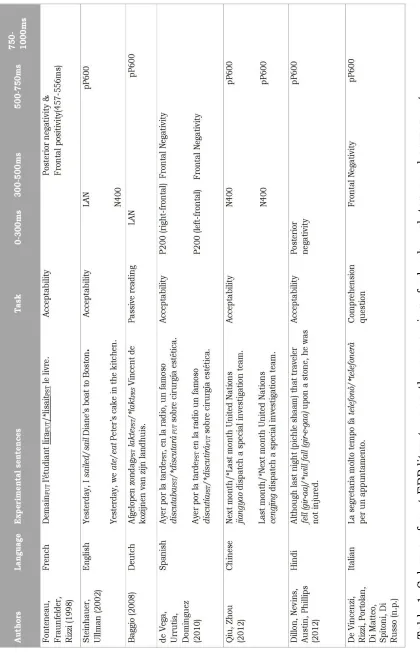
error). A complete list of these studies is presented in Table 1.
As already pointed out in the introduction (Chapter 1), among the ERPs studies
investigating the processing and the detection of adverb-verb temporal
anomalies (e.g. Steinhauer & Ullman, 2002; Baggio, 2008; Qiu & Zhou 2012,
De Vincenzi et al. unpub), results showed congruent evidence about the
presence of a late component, such as P600 which is generally (but not always)
elicited by syntactic violations. On the contrary, in the early time window
(200-500ms after the stimulus onset) all studies report an early detection of the
temporal violation, but the target word (i.e. the verb) in the different
experiments elicited ERP waveforms with different topographies, such as LAN,
N400, right lateralized negativities.
One licit question is thus where the source of heterogeneity resides, and how
this phenomenon can be better investigated. A deeper look at the experimental
material which was adopted in the different studies shows that the
configuration between the adverb and the verb was not kept constant, both
30 a) Afgelopen zondagPST laktePST/laktPRS Vincent de kozijnen van zijn landhuis.
(from Baggio 2008)
(Last Sunday painted/*paints Vincent the window frames of his country
house)
b) DemainFUT l’étudiant liraFUT/*lisaitPST le livre. (from Fonteneau et al. 1998)
(Tomorrow the student will read/*read the book)
c) Ayer por la tardePST en la radio un famoso discutíaPST/*discutiráFUT sobre
cirurgía estética. (from De Vega et al. 2010)
(Yesterday evening on the radio a famous person argued/*will argue about
aesthetic surgery)
One of the main aim of the experimental studies collected in this work will thus
address the role of the reciprocal configuration of the two critical constituents
involved during the processing of temporal agreement, through behavioral
techniques such as self-paced reading and eye-tracking. In fact, several studies
have shown that a rigid correspondence between specific linguistic violations
and respective electrophysiological patterns is not anymore adequate: for
example, the P600 response generally related to reanalysis processes or to
syntactic integration difficulties (e.g. Hagoort et al.1993), has been reported
during the processing of sentences with semantic manipulations (e.g.
Kuperberg et al.2003), while the N400 response commonly associated with
31 has been detected during violations of case marking (e.g. Bornkessel et al.
2004). For this reason, I think that the behavioral investigation of temporal
agreement is a necessary step before adopting more sophisticated (but also
more controversial) techniques such as ERPs.
The core of the thesis, namely six empirical studies investigating the processing
of temporal violations through different designs and techniques, will try to
address the research questions presented in the introductive chapter.
The first set of self-paced reading studies (Study 1), in Italian, will thus address
two main questions.
Q1: how different is the processing of adverb-verb temporal agreement with
respect to other better-studied phenomena such as subject-verb number
agreement?
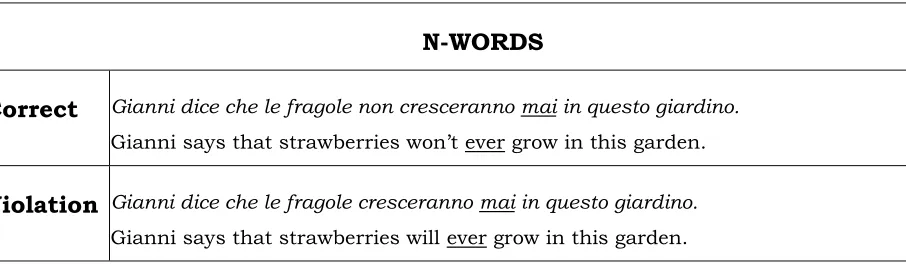
To address the first question, Tense, Number and N-words violations will be
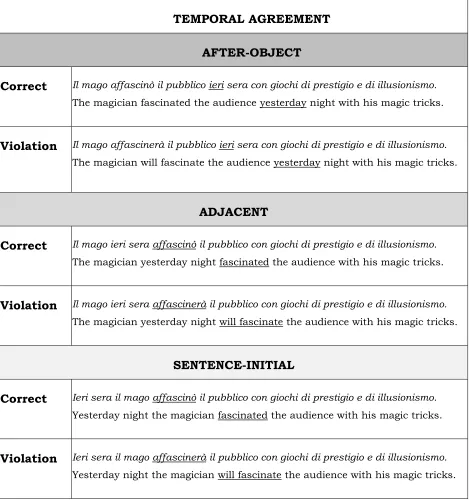
compared as in (1).
(1)
a) Il mago ieri sera affascinò/*affascinerà il pubblico con giochi di prestigio e
illusionismo.
(The magician yesterday night fascinated/*will fascinate the public with his
magic tricks)
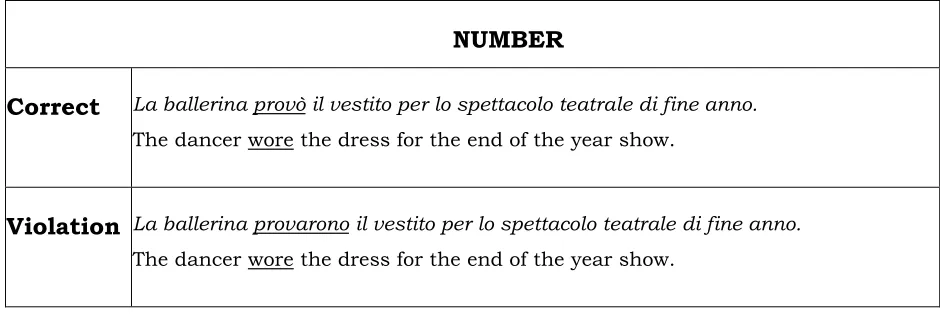
b) La ballerina provò/*provarono il vestito per lo spettacolo di fine anno.
(The dancer woresg/*worepl the dress for the end-of-the-year show)
32 (Gianni says that strawberries won’t/*will ever grow in this garden)
Q2: Is the different configuration between the verb and the temporal adverb
that has led to heterogeneous results in past experimental literature?
To answer the second question, the position of the adverb will be also
manipulated, as shown in (2).
(2)
a) Ieri sera il mago affascinò/*affascinerà il pubblico con giochi di prestigio e
illusionismo.
(Yesterday night the magician fascinated/*will fascinate the public with his
magic tricks)
b) Il mago ieri sera affascinò/*affascinerà il pubblico con giochi di prestigio e
illusionismo.
(The magician yesterday night fascinated/*will fascinate the public with his
magic tricks)
c) Il mago affascinò/*affascinerà il pubblico ieri sera con giochi di prestigio e
illusionismo.
(The magician fascinated/*will fascinate the public yesterday night with his
magic tricks)
In the second (eye-tracking) study (Study 2), in Spanish, two other questions
(which were partially inspired by the self-paced reading studies of this
33 processing on an inflected verb through a strictly controlled paradigm. In this
study, the comparison between number, person and tense features is
specifically interesting since number and person mismatches concern the verb
and a mandatory subject while tense mismatches concern the verb and an
optional deictic adverb. On the other hand, Person and tense entail deictic
information while number does not.
Q1: assuming that there is a clear difference between the processing of
subject-verb number agreement and adsubject-verb-subject-verb tense agreement, how differently the
parser deals with the processing of number, tense and (crucially) person
features when encountering a violation on the inflected verb?
To answer this question, subject-verb and adverb-verb violations will be
compared in the most similar sentential environment, namely keeping the
configuration between the two related constituents constant during the
investigation of the two relations, as in (3).
(3)
Tense: Los viajeros cansados mañana a mediodía volverán/*volvieron a casa en
taxi.
(The tired travelers tomorrow at noonFUT will goFUT/*wentPST home by taxi)
Number: Mañana a mediodía el viajero cansado volverá/*volverán a casa en
taxi.
(Tomorrow at noon the tired travelerSG will goSG/will goPL home by taxi)
Person: Mañana a mediodía el viajero cansado volverá/*volverás a casa en taxi.
34 Q2: Does the distance between the two constituents of the dependency play
any role in the detection of the violation?
To also explore the role of distance in the processing of Number, Person and
Tense features, the three conditions will be compared by changing the position
of the verb-related constituent, as in (4).
(4)
Tense: Mañana a mediodía los viajeros cansados volverán/*volvieron a casa en
taxi.
(Tomorrow at noonFUT the tired travelers will goFUT/*wentPST home by taxi)
Number: El viajero cansado mañana a mediodía volverá/*volverán a casa en
taxi.
(The tired travelerSG tomorrow at noon will goSG/will goPL home by taxi)
Person: El viajero cansado mañana a mediodía volverá/*volverás a casa en taxi.
(The tired traveler3RD tomorrow at noon will go3RD/will go2ND home by taxi)
Finally, in the third set of eye-tracking studies in English (Study 3), the
processing of the adverb-verb temporal relation will be tested in a more
complex sentential environment, namely in sentence where the temporal
adverb and the verb are separated by an embedded relative clause containing a
distracting temporal element.
The questions which will be addressed in this study are:
Q1: how different can be the processing of adverb-verb temporal agreement at a
35 Q2: Is the temporal adverb-verb relation sensitive to interference effects from
an illicit intervener?
Q3: How differently this relation behaves with respect to subject-verb
agreement and anaphora during memory retrieval?
In this case, the processing of verb-adverb violations will be tested in sentences
as in (5).
(5)
a) The agent leased(V1:MATCH) the apartment that was(V2:MATCH) renovated to a
young couple last month after several meetings.
b) The agent leased(V1:MATCH) the apartment that will be(V2:MISMATCH) renovated to
a young couple last month after several meetings.
c) The agent will lease(V1:MISMATCH) the apartment that was(V2:MATCH) renovated to
a young couple last month after several meetings.
d) The agent will lease(V1:MISMATCH) the apartment that will be(V2:MISMATCH)
renovated to a young couple last month after several meetings.
36
T
able
1. Schema of
past ERP literature on the processing of adverb
37
4. STUDY 1: “A self-paced reading study on adverb-verb temporal
agreement”1
Nicoletta Biondoa and Francesco Vespignania
a University of Trento
4.1. INTRODUCTION
Linguistic information can be redundantly expressed in more than a
constituent within a sentence. In languages with rich morphology such as
Italian, the element which mainly shares features with other constituents is the
inflected verb. For example, in a simple clause the verb can share number
feature with the subject or temporal feature with a deictic temporal adverb (e.g.
Ieri il gatto dormì in soffitta ‘YesterdayPST the catSG sleptSG/PST in the loft’). The
phenomenon which guarantees a coherent covariance of features among
constituents has been called agreement or concord (Corbett, 2003) and it is
required to preserve the grammaticality of the sentence (i.e. Number violation:
Ieri il gatto dormirono in soffitta ‘*Yesterday the catSG sleptPL in the loft’, Tense
violation: Ieri il gatto dorme in soffitta ‘*YesterdayPST the cat sleepsPRES in the
loft’).
The main aim of the study is to investigate whether the processes that deal
with these ungrammaticalities during sentence comprehension are similar
38
despite a wide spectrum of different linguistic properties. In other words, one
hypothesis is that any of these relations is dealt within the same agreement
mechanism (uniform parsing mechanism) while the alternative hypothesis is
that mechanisms can differ along dimensions informed by the linguistic theory.
In particular, this study will focus on the processing of the adverb-verb relation
during sentence comprehension and the role of the adverb position in the
detection of Tense anomalies.
Within the agreement phenomena, the most widely-studied and exemplar
morpho-syntactic relation is number agreement between the subject and the
verb. This attention to number subject-verb agreement has been driven by the
fact that it is a relation across constituents (differently from determiner-noun
agreement, for instance) which clearly shows the role of redundancy in
disambiguating or reinforcing distal syntactic relations. Moreover, the
agreement in number between the verb and the subject is a widespread
phenomenon across different languages (Corbett, 2003). Subject-verb number
agreement has been thus widely addressed both in theoretical linguistics (e.g.
Chomsky 1993, 1995, 2000) and from the experimental point of view (e.g.
Pearlmutter et al. 1999, De Vincenzi et al. 2003, Mancini et al. 2014a).
Some theoretical accounts (Cinque, 1999; Alexiadou, 1997) have tried to draw
a parallelism between subject-verb agreement and temporal agreement, at least
in terms of the underlying syntactic structure between the two constituents of
39
However, different are the properties that make temporal agreement different
from number subject-verb agreement. First, temporal agreement entails a link
between the verb morphology and an optional constituent (a temporal adverb)
which is not necessary present in all utterances. On the contrary, the subject
is a mandatory element in a sentence and it can be implicitly (in pro-drop
languages such as Italian) or explicitly expressed through a determiner phrase
(DP). Second, temporal agreement plays a role in the discourse-level
representation of the sentence since it entails deictic information. In particular,
both the event expressed by the verb and the time interval defined by the
adverb need to be interpreted with reference to the time of utterance ‘now’.
Differently, subject-verb number agreement does not entail a
deictic/contextual level of representation since the cardinality of the subject
can be directly interpreted with reference to the subject DP (Bianchi 2003,
Sigurdsson 2004, Mancini et al. 2013), independently from the communicative
context. However, not all temporal adverbs bear deictic information so only
some of them require an explicit feature consistency with verb morphology. For
example, temporal adverbs such as “on Monday” or “at noon”, which are not
necessarily anchored to the time of utterance ‘now’ (Smith, 1981), can be
compatible with past or future verbs (e.g. On Monday/At noon John went/will
go to the hospital) and also with present tense for example in habitual
expressions (e.g. “On Friday evening I go to the pub”). Conversely, deictic
adverbs such as “yesterday, tomorrow” are always interpreted with reference to
40
different temporal information with respect to the inflected verb (e.g.
Yesterday/*Tomorrow John went to the hospital).
Moreover, dissociations between temporal and subject-verb agreement have
been also provided at the psychological level. For example, an experimental
study (Friedmann & Grodzinsky, 1997) on verb form elicitation has shown that
the repetition or production of an inflected verb is markedly impaired when
involving temporal agreement while subject-verb agreement is successfully
produced by aphasic participants. Some other evidence comes from first
language acquisition in children. In fact, children seem to accurately use
subject-verb number agreement at the age of 3 (Belletti & Guasti, 2015) while
failures in coordinating the deictic values of the adverb and the verb are still
present in children between 2 ½ and 3 years of age (Weist, 2014).
In summary, there are at least two properties which make number and tense
agreement different, namely the optionality of the controller and the context
(deictic) relevance of the feature under computation. Moreover, another
dimension that can be manipulated in temporal agreement is the relative
position of the adverb with respect to the inflected verb. In fact, a temporal
adverb can be placed either before (1.a) or after (1.b) the verb, even in
languages with rather fixed word order such as English in which the subject
always precedes the verb.
1.a Yesterday the dancer met the art director in the old theatre.
41
In Italian, namely a language in which the post-verbal subject is allowed, even
more positions are available for this kind of adverbs (2.a,b,c).
2.a Ieri il ballerino incontrò il coreografo nel vecchio teatro.
2.b Il ballerino incontrò il coreografo ieri nel vecchio teatro.
2.c Il ballerino ieri incontrò il coreografo nel vecchio teatro.
There are thus two important positional variables that can have an impact on
the processing of this relation: a) the word at which the agreement computation
happens (adverb vs verb) b) the linear distance between the two elements that
have to agree.
In particular tense agreement processing may be more effective than number
agreement in showing asymmetries on the basis of the order between the target
and the controller of the relation. Consider the case in which the adverb has
been already parsed and agreement is computed on the following inflected verb.
In this case, the word that is being processed is an obligatory element of the
clause (i.e. the verb) and during the processing of verb morphology many
syntactic dependencies are at play, with a possible important role of hierarchic
organization. On the other hand, when verb morphology has already been
processed and agreement is computed on the adverb, the computation applies
on a non-obligatory element and the relation with verb morphology is the only
42
With respect to linear distance between the two elements, at surface level
temporal agreement and subject-verb agreement are very similar: both
phenomena imply a relation across phrases which can be linearly and
structurally distal. In other words, different phrases (or entire relative clauses)
can intervene between the two elements of the relation, such as illusory
licensing elements (see Chapter 8 for a better investigation of intervenience
effects). Aside from illusory intervenients, the simple linear distance (and thus
processing time) between the two elements of the relation may have a larger
role for temporal agreement compared to subject-verb number agreement. The
two relations express two different features, tense and number. When the
parser encounters the subject DP, number information (i.e. the cardinality of
the subject of the sentence) can be easily extracted in the form of a binary
value (±SING). On the other hand, when the parser encounters a deictic
temporal adverb, several are the operations that the parser could do to define a
binary value (±PAST). For example, the deictic temporal adverb can be
expressed by a single word (e.g. yesterday) but also by several words (e.g. long
time ago) that need to be considered all together, as a whole phrase, to define
the temporal value of the adverb. It is thus possible that linear distance can
offer more time to build a syntactic representation of the temporal specification
that the parser can deal with. The processing of temporal agreement can be
thus more sensitive to linear distance with respect to subject-verb number