Implications of Merger Performance in Developing Countries: Drawing
from the Experience of two Cement Companies in Nigeria
1 Onyejiaku, Chinyere. C, 2 Onuselogu, O. C. O, 3 Ezeobele, Ifeoma Blessing
1Department of Management, University of Nigeria, Enugu Campus 2Department of Banking and Finance, University of Nigeria, Enugu Campus 3Accountancy Department, Federal Polytechnic Oko, Anambra State, Nigeria
1. INTRODUCTION:
Merger is an important means through which companies achieve economies of scale, remove inefficient management, or respond to economic, technological, regulatory shocks. Global markets have continuously experienced increased mergers and in some cases, acquisitions over the last decade. Various reasons have driven firms to undertake in mergers. Growing business confidence, consumer demand and improving economic conditions in the region have whetted business executives, appetite for firms in the technology, mining and financial services sectors. Mergers are continuously being adopted for progressive company competitiveness by expanding market share and many firms have
used merger to diversify the company’s portfolio as a risk management strategy.
Mergers are important for developing countries as they are in dire need to provide conducive environment for businesses to compete and thrive, increase production/ provision of goods and services, create jobs, among others. It requires therefore, that a merger in these countries must show evidence of enhanced performance to justify its existence and relevance. With respect to Nigeria, the year 1982 was a landmark in the history of merger and acquisition. Prior to 1982, the concept of mergers and acquisition had minimal significance in Nigeria. One of the very few major mergers that took place before that date was amalgamation of three companies - Re Bendel Co Ltd, Bendel Intra-city Bus Service
Abstract: The developing countries are always in dire need to improve the standard of living of their citizens. These they aim to achieve by, among others, providing the conducive environment for businesses to survive
compete and grow. In today’s globalized economy, merger have become increasingly used for improving competitiveness of companies through gaining greater market share, boarding the portfolio to reduce business, for entering new markets and geographies and capitalizing on economies of scale. Other derivatives include increased production of goods and services, job creation, creation, improved or synergized performance of the merger, among others. The aim of this study was to identify the implications of merger on performance of selected cement manufacturing firms in Nigeria (a developing country). The two companies considered in this study were Dangote Cement Plc and Benue Cement Plc. The study used secondary source of data from published audited annual reports of account for the population of interest and companies supervision annual financial data from balance sheet, profit and loss Accounts, cash flow statements of the two companies for six years in calculating and analyzing accounting ratios (also taken as performance indicators). Accounting ratios were used to analyze the financial performance of the selected firms under study. For the pre-merger period, ratios for the firms were
separately examined in getting an indication of the relative performance of the companies’ pre and post target
merger year. The study reveals that the Return on Asset (ROA) of the new merged firms improved after the merger. An analysis of Return on Equity (ROE) also reveals a similar trend to that of ROA. ROE improved from the year of merger. From the analysis of the selected ratios of the companies that have undergone merger, the study found that profitability of merged firms increased post-merger period; merger had positive impact on
shareholder’s value in the cement manufacturing firms; and that merger in the cement manufacturing firms had
positive effect on managementefficiency. Based on the findings, the study concludes that merger is a survival
strategy as it increases profitability and enhances control in the manufacturing firms in Nigeria. This ultimately leads to the realization of merger objectives such as optimization of resources, removal of duplication of operating cost and well-coordinated management that can be achieved. The study recommends that those firms facing constraints posed by weak capital base should consolidate their energies resorting to merger so as to expand their profitability. Merger is not just for the best interest of the manager but also shareholders as it leads
to an increase in shareholders’ wealth as opposed to each manufacturer operating separately on its own.
Ltd and Trans-Kalife Ltd to form the Bendel Transport Service Ltd. This situation changed significantly after the Securities and Exchange Commission (SEC) began its operations in 1982, marking the beginning of regulated business combinations in Nigeria. The first merger attempt was in 1982 between United Nigeria Insurance Company Limited and United Life Insurance Company Limited which was however, not consummated. Between 1982 and 1988, the SEC supervised thirteen mergers, of which only two of which were unsuccessful. The prospect of mergers has continued to evolve since then. Different legislations have been passed to regulate business combinations including the Companies and Allied Matters Act of 1990 and the Investment and Securities Act of 2007, as well as some Sector specific Acts such as Banking and Other Financial Institutions Act of 1991, Insurance Act of 2003 and the Electric Power Sector Reform of 2005. In 2002, there was a merger of two important petroleum companies, AGIP and Unipetrol Plc to form Oando Plc.
However, the most striking activities in mergers and acquisitions in Nigeria were undoubtedly the 2005 merger that took place in the banking sector. These mergers were driven by the Central Bank of Nigeria 2004 directive to all Nigerian banks to increase their shareholders fund to a maximum of NGN 25 Billions (twenty –five billion naira), from the previous minimum shareholders fund of NGN 2 billion (two billion naira). Few banks had this new minimum capital base, as a result, several mergers and acquisition emerged, with only 25 out of 89 banks surviving the condition and operating after 2005. After then, the banking sector has been successful.
Recent mergers indicate the competitiveness, potentialities and capabilities within industry. Mergers can build unfair market advantage that may be harmful to the industry. The evolution from segmentation to economic integration has led many business organizations to increase the rate of mergers globally and Nigeria is no exception. The reason behind any corporate merger shows that two companies are better than one because of increase in shareholder value than of separate firms. The motives behind mergers are economies of scale, increase in market share and revenues, taxation, synergy, geographical and other diversification.
Corporations are undertaking various strategies in efforts to improve financial performance. Financial performance is vital to the success of any organization as it reflects the financial health of companies in the market and the performance as compared to other players in the industry. Mergers have been undertaken in efforts to improve organization performance due to the benefits they are believed to carry along. Improving financial performance through merger is mainly considered a management strategy. Management considers merger to reduce costs and expenses and maximize shareholder value.
Mergers of the Nigerian manufacturing industries brought about changes in management in the form of rightsizing, re-engineering, re-focusing, business re-investors which makes the firm to be multi-cultural, multi-market, and multi-management and in some cases multi-national. There are challenges in innovativeness, in product market development, mismanagement or economic crisis and information technology driven delivery method that affect the growth of firms of which through effective performance of mergers and acquisition, the firm remains in operation. It is however, why the researcher embarks on this study to investigate the implications of merger in performance of the cement manufacturing firms in Nigeria. The findings will help in analyzing the benefits industries can get from effective performance of mergers in business organization.
Arising from the problem, the study sought to determine the profitability of merged firms’ pre and post merger,
to identify the impact of merger on shareholder’s value, and to assess the effect of merger on management efficiency.
The study proposed to answer the following research questions: What were merged firms profit pre/ post-merger?
What effect does merger has on shareholders’ value? What impact does merger has on management efficiency?
The following hypotheses were proposed;
H1: There is difference in profitability in merged firm’s pre and post-merger.
H2: Merger has impact on shareholder’s value.
H3: Merger has effect on management efficiency.
2. REVIEW OF RELATED LITERATURE:
2.1 NATURE, TYPES, MOTIVES FOR MERGER, FINANCIAL PERFORMANCE AND ITS DETERMINANTS
academics have pointed out a few difference that help determine whether a particular activity is a merger or an acquisition.
An activity is termed a merger when corporations come together to combine as well as share their resources to attain common objectives. In a merger, both firms combine to form a third entity and the owners of both the combining forms remains as joint owners of the new entity (Sudsarsanam, 2003).
Acquiring all the assets of the selling firm will avoid the potential problems of having minority shareholders as opposed to acquisition of stock. However, the cost involved in transferring the assets are generally very high (Ross,
2004). Another term, “take over” which is often used to describe different activities, sometimes refers to as hostile
transactions and sometimes to both friendly and unfriendly merger (Gaughan, 2007). When acquisition is forced in nature and without the will of the target company’s management it is known as a takeover. Takeover normally undergoes the process whereby the acquiring company directly approaches the minority shareholders through an open tender offer
to purchase their shares without the consent of the target company’s management. In merger and acquisition scenario, takeover consolidation and amalgamation are used interchangeably (Charles, 2002).
Mergers are generally classified as horizontal, vertical or conglomerate, market-extension and product-extension. These types differ in their characteristics and their effects on the corporate performance.
Horizontal Merger: Mergers of corporations in similar or related product lines are termed to be horizontal mergers. These mergers involve the removal of a competitor, leading to an increase in the market share of the acquirer and degree of concentration of the industry merger and acquisition (Milford, 1990). However, there are strict laws and rules being put into effect to ensure that there is fair competition in the market and to limit concentration and misuse of power by monopolies and oligopolies.
In addition to increasing the market power, horizontal merger often tends to be used to protect the dominance of an existing firm. It also improves the efficiency and economies of scale of the acquiring firm (Wilson, 2004). Recent examples of horizontal mergers are the Dangote and Benue Cement Plc merger.
Vertical Merger: A vertical merger entails the coming together of two or more firms at different stages or levels of the same product or service. Generally the main objective of such merger is to ensure the sources of supply (Babu, 2005). In vertical mergers, both the manufacturers and distributors come into a partnership. This makes it difficult for competing firms to survive because of the advantages of the merger. The distributor need not pay additional costs to the supplier as they both are not part of the same entity.
Conglomerate Merger: Conglomerate merger occurs between firms that are unrelated by value chain or peer competition. Conglomerates are formed with the belief that one dominant office would have the know-how or knowledge and expertise to allocate capital and run the business better than how they would be run independently (Robert, 2004). Conglomerate mergers can also be described as a merger between companies which are not competitors and do not have a buyer and seller relationship. The general observation has been that such conglomerate mergers are not very successful (Gaughan, 2007).
Market-Extension Merger: Thisoccurs between two or more companies that sell the same products but in different markets. The main purpose is to ensure that the merging companies can get access to a bigger market and a bigger client base.
Product Extension Merger: This takes place between two business entities that deal in products that are related to each other as well as operate in the same market. This form of merger allows the merging firms to group together their products as well as get access to a bigger set of consumers. This ensures that they earn higher profits.
There are many reasons for companies wanting to acquire other companies. The reasons include the pursuit of a growth strategy; the defense of hostile action from another would be acquirer and financial opportunities.
2.2 PROCEDURES, REGULATORY AUTHORITIES, STEPS TO ENSURE LEGALLY CONSUMMATED MERGERS AND ITS FACILITATORS
The formalities of a merger usually include the following steps:
i. The company may execute a memorandum of understanding which spells out the understanding of the parties and
“sets the stage for honest and confident, negotiation and anticipates the future steps to be taken by the parties”. This
ii.The Board of directors of both companies would then adopt a merger agreement. Both companies must notify their respective shareholders of the terms of the proposed merger and the shareholders must approve the transaction by majority vote.
iii. Notification and voting materials usually are provided to shareholders of public companies as part of proxy statements required by statutory instrument. The proxy statements will include the terms of the merger, the
consideration that will be offered to the targets’ shareholders and information about the two companies. These considerations may include stocks and shares or other securities in the acquiring company, debentures or cash. iv. If the merger is approved by the required member of shares, the shareholders of the merging companies will
exchange their stocks for the pre-negotiated consideration.
The regulatory bodies involved in mergers as well as their roles in Nigeria are:
i. The Central Bank of Nigeria (CBN): The CBN gets involved in mergers and acquisitions where banking institutions are involved in such activities. Section 7 of the Banks and other Financial Intuitions Act (BOFIA)
No. 25 of 1991 in referring to mergers and acquisition states that, “except with the prior consent of the Governor
of CBN, no bank shall enter into an agreement; a. Which results in a change in the control in the bank;
b. To employ a management agent or to transfer its business to any such agent.
ii. Securities and Exchange Commission (SEC): SEC is the apex regulatory body of the capital market. Established under the Securities and Exchange Commission Act No. 71 of 1979 or the securities and re-enacted as Decree No. 29 of 1988. The commission is charged with the functions of regulating and developing the Nigerian capital market, a twin responsibility underscored by investor protection and overall growth and
development of the national economy. The commission’s function could be stated as follows:
a. Registering securities.
b. Ensuring transparent and fair trading practice
c. Promoting professionalism, market efficiency and integrity d. Regulating all forms of business combination.
iii. Nigerian Stock Exchange (NSE): Where either or any of combining firms is listed on the stock exchange, the approval of the NSE is required. An application is made to the exchange to admit new shares or detect all or part of old shares.
iv. National Insurance Commission (NAICOM): The insurance decree No. 2 of 1997 empowers the national insurance commission to regulate mergers and acquisition within the insurance commission to regulate mergers and acquisition within the insurance sector.
v. Federal Board of Inland Revenue (FBIR): The role of FBIR is important for tax purpose. FBIR values the transferred assets and calculates the capital gains tax payable where the acquisition is consummated by cash exchange.
vi. Federal Ministry of Finance (FMT): The FMF has to confirm the approval status for shareholding in business especially where foreign shareholders are involved.
vii. Federal High Court: All mergers and acquisitions require the approval of the federal high court before it is binding on shareholders.
Akpan (2007), is of the opinion that the procedure for legally consummating mergers are as follows: i. The search for a suitable company for merger and acquisition
ii. The investigation of business
iii. Packaging the mergers and acquisition iv. Pre-merger/acquisition notice to SEC v. Formal application to SEC
vi. Post approval documentation and filling with SEC.
Garba (2006), enumerated the facilitators in merger as follows;
i. Financial Advisers to Integrating Companies: The financial advisers to the combining companies advise their clients on the financial implication of the exercise.
ii. Reporting Accountants to the Companies: The reporting accountants to the combining firms review the accounts prepared for the purpose of the merger and acquisitions and give their finding or opinions.
iii. Solicitors to the Companies: The solicitors handle all legal issues, on behalf of their clients as it relates to the merger and acquisition.
2.3 BENEFITS AND WHY MERGER FAILS
The most common benefits of mergers are enumerated below:
i. Provision of revenue enhancement through product extension or market dominance as a result of reduced competition.
ii. Risk diversification
iii. Enhanced profitability through cost reduction resulting from economies of scale. iv. It creates opportunities for excess capacity utilization
v. Reduction in tax liabilities resulting from tax loss carry against the profits of another. vi. Mergers often provide the quicker entry into other markets and industries, among others.
vii. Government encourages mergers as a means of rationalizing the structure of industry to create large economic units that makes intervention and planning easier to combat foreign competition.
There could be many causes of failed mergers. It is most likely that a merger would fail as a result of poor management decisions and over confidence. There could be personal reasons considering which managers tend to enter into such activities and hence tend to ignore the primary motive of mergers creating shareholder value. Sometimes however, good decisions may also backfire due to pure business reasons. These factors can be summarized by the following points.
i. Integration Issues: Both merging companies need to be compatible with each other. Business cultures and traditions, work ethics, among others need to be flexible and adaptable. In efficiencies or administrative problems are very occurrence in a merger which often nullifies the advantages of the merger. There must be some urgency between the parties and good communication between them.
ii. Personal Motives of Executives: Managers often enter into mergers to satisfy their own personal motives like empire building fame, higher managerial compensation etc. As a result, they often lose focus on the fact they need to look at the strategic benefit of the merger.
iii. Selecting the Target: Selecting the appropriate target form is an extremely important stage in the merger process. Executives must be able to select the target that suits the organizations strategic and financial motives and needs. Often the incapability or lack of motivation and interest on the part of executives lead to incorrect target selection.
iv. Strategic Issues: Strategic benefits should ideally be the primary motive for any merger activity. However, managers sometimes tend to overlook this aspect. Faculty strategic planning and unskilled execution often leads to problems. These issues which form the care of all merger activities are not addressed adequately leading to failures of mergers.
2.4 THEORETICAL FRAMEWORK
Economists have promoted several competing theories of merger. The theory most relevant to this study is that of inefficient firms are taking over and the efficient ones must survive (Manne, 1965; Mead, 1968 and Jensen, 1988). Theories of mergers are not mutually exclusive. A firm could seek to gain market power and at the same time be building an empire and believe that it can more efficiently manage the business of a firm it has targeted as a possible acquisition. The two leading merger efficiency theories are the disciplinary and synergistic merger motives.
Disciplinary Merger Theory: The theory suggests that merger and acquisition discipline target firm’s mangers that
pursue objectives other than profit maximization.
Synergistic Merger Theory: The theory holds that firm mangers achieve efficiency gains by combining an efficient
target with their business and then improving the target’s performance. Buyers recognize specific complementariness’
between their business and that of the target. Thus, even though the target is already performing well, it should even be better when it is combined with its complementary counterpart, the buyer firm. The synergistic theory implies that a target firm (or plants) performs well both before and after mergers.
2.5 EMPIRICAL REVIEW
Cerasi, Chizzolini and Ivaldi (2009) investigated on the impact of mergers on the degree of competition in the banking industry. The study analyzed the relation between competition and concentration in the banking sector. The empirical answer provided by testing a monopolistic competition models of commercial bank branching behaviour on individual bank data at county level (departments and provinces) in France and Italy. The paper adopted the econometrics modeling approach to determine the effect of horizontal mergers among incumbent banks on competition and discuss when the merger is anti-competitive. The study has implications for competition policy as it suggests an applied tool to evaluate the potential anti-competitive impact of mergers.
Mishra and Jaiswal (2017) conducted a research on the impact of Mergers and Acquisitions on Firms’ Export
Competitiveness Experience of Indian Pharmaceutical industry. The study attempted to examine the impact of mergers and acquisitions (M&A) on export competitiveness of firms in Indian pharmaceutical industry. It found that the wave of mergers and acquisitions had positive impact on both incidence and extent of export competitiveness.
Gwaya and Mungai (2015) conducted a study on the effect of mergers and acquisitions on financial performance of banks (a survey of commercial banks in Kenya). The study examined the banks that merged or had been acquired in Kenya for the period between 2000 and 2014. The aim of the study was to analyze whether the merger had any effect
on the banks’ performance. The study was guided by the following specific objectives; to determine the effect of the
mergers and acquisitions on the shareholders’ value and to examine the implication of mergers and acquisitions on
profitability. Data was collected by use of questionnaires with both open and closed ended questions. The collected data was analyzed using SPSS where the co-efficient of correlation obtained was used to determine the nature of the relationship between the independent and dependent variables. The study found that the mergers and acquisitions raised
the shareholders’ value of the merged/acquiring banks in Kenya. The research questions were significant to the study and useful in arriving data conclusion. The researcher recommended that thorough feasibility studies should be carried out before the merger/acquisition process can be done.
3. METHODOLOGY:
This was an event study methodology used to determine whether there are any changes in post merger performance associated with two sample companies in Nigeria used in the study. The population of interest in this study comprised of two firms out of all the firms that merged or been acquired in Nigeria. The study period of 2007 to 2013 was selected so as to provide insightful information on the performance of merger in the cement manufacturing companies, its effect on the profitability, shareholders value creation and management efficiency. The study used secondary sources of data from published audited annual reports of accounts for the population interest, statement of accounting policies, profit and loss accounts, balance sheets, statement of cash flows of the two companies for 6 years were used in calculating and analyzing the accounting ratios, also known as performance indicators. Data analysis methods employed involves quantitative and qualitative procedures. The study used accounting ratios to analyze the financial performance of the two companies under study. For the pre-merger and acquisition period, ratios for both the acquirers of the relative performance of the acquirer and the target are stated. For the post merger period, the focus of the analysis was on the combined firms. Pre-merger average data was compared with the post merger average data in determining the changes that occurs in performance following the merger and acquisition. Two profitability performance indicators: ROE and ROA was used.
4. DATA ANALYSIS, RESULTS AND DISCUSSION:
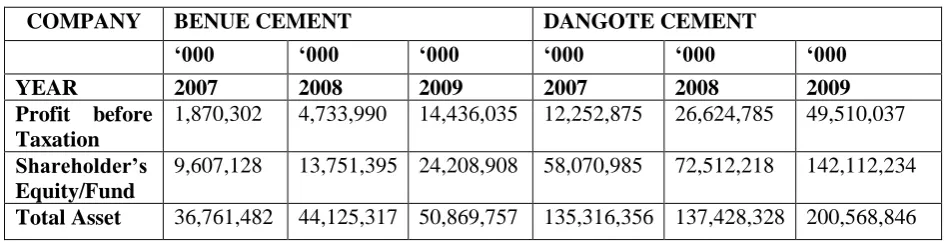
Data extracted from financial statements of the merging organizations are shown in tables I and II respectively for three years before and after the merger year, 2010.
Table I:
Some Financial Statement Variables of Benue Cement Company and Dangote Cement Plc for three years (pre-merger) as at 2007, 2008 and 2009.
COMPANY BENUE CEMENT DANGOTE CEMENT
‘000 ‘000 ‘000 ‘000 ‘000 ‘000
YEAR 2007 2008 2009 2007 2008 2009
Profit before Taxation
1,870,302 4,733,990 14,436,035 12,252,875 26,624,785 49,510,037
Shareholder’s
Equity/Fund
9,607,128 13,751,395 24,208,908 58,070,985 72,512,218 142,112,234
Table II:
Some Financial Statement Variables for Group Company (Post Merger for three years as at 2011, 2012 and 2013.
‘000 ‘000 ‘000
YEAR 2011 2012 2013
Profit before Taxation 113,779,556 135,647,589 190,761,362
Shareholder’s Equity/Fund 281,824,225 404,536,401 550,093,270
Total Asset 526,483,412 658,200,733 843,203,275
Source: Annual Report Dangote and Benue Cement Company 2007-2009
To assess whether profitability of the merged firms increased after adopting merger and also that the merger has impact
on shareholder’s value and effective management efficiency in the study, the following financial ratios were computed
and analyzed:
Return on Investment/Equity = 𝑅𝑒𝑡𝑢𝑟𝑛 𝑝𝑟𝑜𝑓𝑖𝑡 𝑎𝑓𝑡𝑒𝑟 𝑇𝑎𝑥 𝑜𝑟 𝑛𝑒𝑡 𝑖𝑛𝑐𝑜𝑚𝑒
𝑠ℎ𝑎𝑟𝑒ℎ𝑜𝑙𝑑𝑒𝑟′𝑠 𝑒𝑞𝑢𝑖𝑡𝑦
𝑅𝑒𝑡𝑢𝑟𝑛 𝑜𝑛 𝑡𝑜𝑡𝑎𝑙 𝑎𝑠𝑠𝑒𝑡 = 𝑁𝑒𝑡 𝑃𝑟𝑜𝑓𝑖𝑡 𝑎𝑓𝑡𝑒𝑟 𝑇𝑎𝑥
𝑇𝑜𝑡𝑎𝑙 𝐴𝑠𝑠𝑒𝑡
Note that equity = ordinary share capital + reserve and capital employed = equity + long term debt.
Below is the financial statement of the two merged firms;
Benue Cement Company’s calculation for pre- merger years as follows, (That is from 2007 to 2009).
For Year 2007
𝑅𝑂𝐸 = 𝑁𝑒𝑡 𝑝𝑟𝑜𝑓𝑖𝑡 𝑎𝑓𝑡𝑒𝑟 𝑡𝑎𝑥 𝑜𝑟 𝑛𝑒𝑡 𝑖𝑛𝑐𝑜𝑚𝑒 𝑆ℎ𝑎𝑟𝑒ℎ𝑜𝑙𝑑𝑒𝑟′𝑠 𝑒𝑞𝑢𝑖𝑡𝑦 =
1870302
9607128= 0.19468 = 19.5%
𝑅𝑂𝐴 =𝑁𝑒𝑡 𝑝𝑟𝑜𝑓𝑖𝑡 𝑎𝑓𝑡𝑒𝑟 𝑇𝑎𝑥
𝑇𝑜𝑡𝑎𝑙 𝑎𝑠𝑠𝑒𝑡 =
1870302
36761482= 0.05088 = 5.09%
For year 2008;
𝑅𝑂𝐸 =𝑁𝑒𝑡 𝑝𝑟𝑜𝑓𝑖𝑡 𝑎𝑓𝑡𝑒𝑟 𝑇𝑎𝑥 𝑜𝑟 𝑛𝑒𝑡 𝑖𝑛𝑐𝑜𝑚𝑒
𝑆ℎ𝑎𝑟𝑒ℎ𝑜𝑙𝑑𝑒𝑟′𝑠 𝑒𝑞𝑢𝑖𝑡𝑦 =
4735990
13751395 = 0.344401 = 34.4%
𝑅𝑂𝐴 = 𝑁𝑒𝑡 𝑝𝑟𝑜𝑓𝑖𝑡 𝑎𝑓𝑡𝑒𝑟 𝑡𝑎𝑥
𝑇𝑜𝑡𝑎𝑙 𝑎𝑠𝑠𝑒𝑡 =
4735990
44125317= 0.10733 = 10.7%
For year 2009
𝑅𝑂𝐸 = 𝑁𝑒𝑡 𝑝𝑟𝑜𝑓𝑖𝑡 𝑎𝑓𝑡𝑒𝑟 𝑡𝑎𝑥 𝑜𝑟 𝑛𝑒𝑡 𝑖𝑛𝑐𝑜𝑚𝑒 𝑆ℎ𝑎𝑟𝑒ℎ𝑜𝑙𝑑𝑒𝑟′𝑠 𝑒𝑞𝑢𝑖𝑡𝑦 = 1443603524208908= 0.59631 = 59.6%
𝑅𝑂𝐴 = 𝑁𝑒𝑡 𝑝𝑟𝑜𝑓𝑖𝑡 𝑎𝑓𝑡𝑒𝑟 𝑡𝑎𝑥 𝑇𝑜𝑡𝑎𝑙 𝑎𝑠𝑠𝑒𝑡 =1443603550869757= 0.28378 = 28.4%
Dangote Cement Plc calculation for pre-merger year’s areas is as follows (i.e. 2007 to 2009).
For year 2007
𝑅𝑂𝐸 = 𝑁𝑒𝑡 𝑝𝑟𝑜𝑓𝑖𝑡 𝑎𝑓𝑡𝑒𝑟 𝑡𝑎𝑥 𝑜𝑟 𝑛𝑒𝑡 𝑖𝑛𝑐𝑜𝑚𝑒
𝑆ℎ𝑎𝑟𝑒ℎ𝑜𝑙𝑑𝑒𝑟′𝑠 𝑒𝑞𝑢𝑖𝑡𝑦 =
12252875
58070985= 0.21099 = 21.1%
𝑅𝑂𝐴 = 𝑁𝑒𝑡 𝑝𝑟𝑜𝑓𝑖𝑡 𝑎𝑓𝑡𝑒𝑟 𝑡𝑎𝑥
𝑇𝑜𝑡𝑎𝑙 𝑎𝑠𝑠𝑒𝑡 =
12252875
135316356= 0.09055 = 9.05%
For year 2008
𝑅𝑂𝐸 = 𝑁𝑒𝑡 𝑝𝑟𝑜𝑓𝑖𝑡 𝑎𝑓𝑡𝑒𝑟 𝑡𝑎𝑥 𝑜𝑟 𝑛𝑒𝑡 𝑖𝑛𝑐𝑜𝑚𝑒
𝑆ℎ𝑎𝑟𝑒ℎ𝑜𝑙𝑑𝑒𝑟′𝑠 𝑒𝑞𝑢𝑖𝑡𝑦 =
26624785
72512218= 0.36718 = 36.7%
𝑅𝑂𝐴 = 𝑁𝑒𝑡 𝑝𝑟𝑜𝑓𝑖𝑡 𝑎𝑓𝑡𝑒𝑟 𝑡𝑎𝑥
𝑇𝑜𝑡𝑎𝑙 𝑎𝑠𝑠𝑒𝑡 =
26624785
137428328= 0.19373 = 19.4%
For year 2009
𝑅𝑂𝐸 = 𝑁𝑒𝑡 𝑝𝑟𝑜𝑓𝑖𝑡 𝑎𝑓𝑡𝑒𝑟 𝑡𝑎𝑥 𝑜𝑟 𝑛𝑒𝑡 𝑖𝑛𝑐𝑜𝑚𝑒
𝑆ℎ𝑎𝑟𝑒ℎ𝑜𝑙𝑑𝑒𝑟′𝑠 𝑒𝑞𝑢𝑖𝑡𝑦 =
49510037
142112234= 0.34839 = 34.8%
𝑅𝑂𝐴 = 𝑁𝑒𝑡 𝑝𝑟𝑜𝑓𝑖𝑡 𝑎𝑓𝑡𝑒𝑟 𝑡𝑎𝑥
𝑇𝑜𝑡𝑎𝑙 𝑎𝑠𝑠𝑒𝑡 =
49510037
Group Company Calculations for Post Merger Years areas are as follows (i.e. 2011 to 2013). For year 2011
𝑅𝑂𝐸 = 𝑁𝑒𝑡 𝑝𝑟𝑜𝑓𝑖𝑡 𝑎𝑓𝑡𝑒𝑟 𝑡𝑎𝑥 𝑜𝑟 𝑛𝑒𝑡 𝑖𝑛𝑐𝑜𝑚𝑒𝑆ℎ𝑎𝑟𝑒ℎ𝑜𝑙𝑑𝑒𝑟′𝑠 𝑒𝑞𝑢𝑖𝑡𝑦 = 113779556281824225= 0.40373 = 40.4%
𝑅𝑂𝐴 = 𝑁𝑒𝑡 𝑝𝑟𝑜𝑓𝑖𝑡 𝑎𝑓𝑡𝑒𝑟 𝑡𝑎𝑥
𝑇𝑜𝑡𝑎𝑙 𝑎𝑠𝑠𝑒𝑡 =
113779556
526483412= 0.21611 = 21.6%
For year 2012
𝑅𝑂𝐸 = 𝑁𝑒𝑡 𝑝𝑟𝑜𝑓𝑖𝑡 𝑎𝑓𝑡𝑒𝑟 𝑡𝑎𝑥 𝑜𝑟 𝑛𝑒𝑡 𝑖𝑛𝑐𝑜𝑚𝑒
𝑆ℎ𝑎𝑟𝑒ℎ𝑜𝑙𝑑𝑒𝑟′𝑠 𝑒𝑞𝑢𝑖𝑡𝑦 =
135647589
404536401= 0.33532 = 33.5%
𝑅𝑂𝐴 = 𝑁𝑒𝑡 𝑝𝑟𝑜𝑓𝑖𝑡 𝑎𝑓𝑡𝑒𝑟 𝑡𝑎𝑥
𝑇𝑜𝑡𝑎𝑙 𝑎𝑠𝑠𝑒𝑡 =
135647589
658200733= 0.20608 = 20.6%
For year 2013
𝑅𝑂𝐸 = 𝑁𝑒𝑡 𝑝𝑟𝑜𝑓𝑖𝑡 𝑎𝑓𝑡𝑒𝑟 𝑡𝑎𝑥 𝑜𝑟 𝑛𝑒𝑡 𝑖𝑛𝑐𝑜𝑚𝑒
𝑆ℎ𝑎𝑟𝑒ℎ𝑜𝑙𝑑𝑒𝑟′𝑠 𝑒𝑞𝑢𝑖𝑡𝑦 =
190761362
550093270= 0.34678 = 34.7%
𝑅𝑂𝐴 = 𝑁𝑒𝑡 𝑝𝑟𝑜𝑓𝑖𝑡 𝑎𝑓𝑡𝑒𝑟 𝑡𝑎𝑥
𝑇𝑜𝑡𝑎𝑙 𝑎𝑠𝑠𝑒𝑡 =
190761362
843203275= 0.22623 = 22.6%
Table III: Summary of Calculated Ratios
Pre Merger (BCC) (DC) Post Merger
YEAR 2007 2008 2009 2007 2008 2009 2011 2012 2013
Return on investment Equity
19.5% 34.4% 59.6% 21.2% 36.7% 34.8% 40.4% 33.5% 34.7%
Return on total asset
5.09% 10.7% 28.4% 9.05% 19.4% 24.7% 21.6% 20.6% 22.6%
Source: Researchers calculations
From these calculations, it is evident that there is tremendous improvement on the performance of BCC after
merger with DCP except in 2013 where the return on total asset (ROA) of the two firms’ pre merger is higher than in
the post merger period.
Financial Performance
The firms’ performance after merger in 2011-2013 summary of the manufacturing year has established DCP as
the most profitable firm in the country today. Also from the company’s financial statement, it shows that the earnings
per share have increased immensely so both the stakeholders and shareholders have a reason to be impressed. The study has thus revealed that mergers can be encouraged in developing countries and Nigeria in particular.
5. SUMMARY OF FINDINGS, CONCLUSION AND RECOMMENDATIONS.:
Based on the research conducted, the following findings emerged;
Profitability of the merged firms increased post merger.
Merger had positive impact on shareholder’s value in the cement manufacturing firms.
Merger in the cement manufacturing firms had positive effect on management efficiency.
Arising from the findings, it is recommended that
(a)Firms facing constraint on weak capital base should consolidate their energies by restoring to merger so as to expand their profitability and productivity. (b) Employees should be encouraged to participate in job re-design processes. This helps to reduce possible resistance to change and to maintain a positive attitude during the merger transition and help
aspiring to achieve rapid growth and developing they should enunciate policies that promote mergers in order to reap benefits associated with their performance.
REFERENCES:
1. Abdulazeez, D. A,Onotu, S. and Abdulrahaman, Y (2016), Impact of Merger and Acquisitions on the Financial Performance of Deposit Money Banks in Nigeria. Arabian Journal of Business Management Review 6:219.
2. Akpan, J. (2007), Asset Redeployment, Acquisition and Corporate Strategies in Declining Industries Strategies Management. Journal of Administrative Theory, 42 (10):16-24.
3. Babu, F. (2005), The Implication of the Leaning Carves for the Firm Strategy and Public Policy Applied Economics. Journal of Administrative Theory, 15(2)541 -551.
4. Baumol, H. (1967), From Strategic Planning to Strategic Management, New York: Hiley.
5. Cerasi,V, Chizzolini, B and Marc, I (2009). The impact of mergers on the degree of competition in the banking industry.
6. Charles, W. L (2002), International Business Strategy, (3rdedition) New York: McGraw –Hill.
7. Emekekwue, P.E (2008), Corporate Financial Management, (6th edition): Democratic Republic of Congo:
African Bureau of Education Science Kinsha.
8. Garba, A.N (2006). Essential of Strategic Management and Marketing. Enugu: ABIC Books and Equip Ltd. 9. Gaughan, P.A (2007). Mergers, Acquisitions and Corporate Restructuring, (2nd edition) New York: John Wisley
and Sons.
10. Gwaya, O.J. and Mungai, J.N (2015), The Effect of Mergers and Acquisitions on Financial Performance of Banks (A Survey of Commercial Banks in Kenya). International Journal Of Innovative Research &
Development .4(8), 101. ISSN 2278–0211 (Online).
11. Kling, G. (2006). The Long Term Impact of Mergers and the Emergence of a Merger Wave in Pre-World War I Germany, Explorations in Economic History, 43(4), pg 667-688
12. Milford, G. (1990), Merger and Acquisition: The Keys to Success, (4th edition) USA: Englewood-New Jersey.
13. Mishra, P and Jaiswal, N (2017). Impact of Mergers and Acquisitions on Firms’ Export Competitiveness Experience of Indian Pharmaceutical Industry. South Asia Economic Journal, 18(1): 6-10.
14. Nwude, C.E (2003), Basic principles of Financial Management, (1st edition) Enugu: Chuke Nwabude Nigeria Ltd.
15. Okparachi, J. (2007), Comparative Analysis of the Compact of Mergers and Acquisitions on Financial Efficiency of Banks in Nigeria. Journal of Accounting and Taxation, 3 (1): 10-14.
16. Robert, S.A (1993), The Efficiency Effects of Bank Mergers: An Overview of Case Studies of Nine Merger.
Journal of Banking, 22(10):1-5.
17. Ross T.J (2004), Reasons for Frequent Failures in Mergers and Acquisition: A Comparative Analysis. Ibadan: Deustsker University Press.
18. Sudarsanam, W. G (2003), Business Research Methods, (7th edition) New York: Hiley.