Available Online at www.ijpret.com
485
INTERNATIONAL JOURNAL OF PURE AND
APPLIED RESEARCH IN ENGINEERING AND
TECHNOLOGY
A PATH FOR HORIZING YOUR INNOVATIVE WORK
REVIEW PAPER ON IN-MEMORY COMPUTING
GAURI R. JOSHI1, VIJAY B. GADICHA21. M.E. Scholar, Computer Science and Engineering, P. R. Patil College of Engineering and Technology, Amravati (Maharashtra), India.
2. HOD, P. R. Patil College of Engineering and Technology, Amravati (Maharashtra), India.
Accepted Date: 27/02/2014 ; Published Date: 01/05/2014
\
Abstract: In-memory computing technology combines hardware and software technology innovations. Hardware innovations include blade servers and CPUs which having multicore architecture and memory capacities measured in terabytes for massive parallel scaling. Software innovations include an in-memory database with highly compressible row and column storage specifically designed by SAP to maximize in-memory computing technology
[1]. Parallel processing takes place in the database layer rather than in the application layer,
as we know it from the client-server architecture. In-memory computing technology will alter existing IT processes more quickly than ever before. At the same time, business is pursuing disruptive business ideas at an unpredictable rate. In-memory computing will be able to connect the nodes between existing application platforms, new mobile community technologies, and nascent technologies. In memory computing does not deliver appropriate value if it is not implemented mindfully. Telnet is required to manage data volumes and the respective analytical evaluation process effectively and efficiently [11].
Keywords: Nascent, SAP, Telnet
.
Corresponding Author: MS. GAURI R. JOSHI
Access Online On:
www.ijpret.com
How to Cite This Article:
Gauri Joshi, IJPRET, 2014; Volume 2 (9): 485-490
Available Online at www.ijpret.com
486 INTRODUCTION
In-memory computing is the storage of information in the main memory of dedicated servers rather than in complicated relational databases operating on comparatively slow disk drives. In-memory computing helps business customers, including retailers, banks and utilities, to quickly detect patterns, analyze massive data volumes on the fly, and perform their operations as quickly as possible. Today, people expect results not only in minutes, but in seconds, and in some cases, even milliseconds. The task of creating applications that deliver ' instant’ result — though taken for granted by our users — is very challenging as applications are faced with the task of processing increasingly large amount of data over the years, computing has seen performance improvement on two primary fronts, namely CPU speed and hard disk speed. During this time, one more area of computing, namely random Access Memory (RAM) has been undergoing a quiet revolution [14].
The above innovation causes all the vendors to forcefully consider In-Memory Computing (IMC) — where computing is done in RAM. One of the advantages of processing in RAM is lower latency — achieved by bringing data closer to the computation engine — thereby allowing enterprises to address the 'velocity' aspect of Big Data applications [4].
With a lot of RAM available at a low cost it is possible to process large amount of data in RAM itself, thereby allowing enterprises to address the 'volume' aspect of Big Data applications. If data is processed in-memory, instead of following the 'stored-and-process' paradigm as in database, Data Warehouse (DW), and Business Intelligence (BI) solutions, applications can become more responsive. This can enable the creation of a new class of applications, in which users can 'interact' with data and 'discover' new inferences, rather than wait for a long time to get results.
2. METHODS AND MATERIALS:
Available Online at www.ijpret.com
487
in-memory tools, data available for analysis can be as large as data mart or small data warehouse which is entirely in memory. This can be accessed within seconds by multiple concurrent users at a detailed level and gives the potential for excellent analytics. It also decreases the need for performance tuning by IT staff and provides faster service for end users
[15]
.
2.1 ARCHITECTURE OF IN-MEMORY PROCESSING:
Fig: 2.1 Architecture of in memory process
2.1.1 Erp Db:
The data is push in to the HANA DB from this source system from where you are getting data. In ERP DB where there is a Load Controller and Rep Agent which are side by components (along with Rep Server which will sit in In-Memory Computing Engine) which will be used for giving data from Source system to HANA DB. This is a Log based Data Provisioning.
2.1.2 SAP Business Objects BI 4:
This is the place where the Data Services Server and Data Services Designer (Client version) installed. This also will be used for providing data from any source system to HANA DB.
2.1.3 Other Source Systems:
The data can be moved to the HANA database from the any system which can be used as source system
2.1.4 In-Memory Computing Studio:
The user can create an views on top of HANA data by using this eclipse based tool.
Available Online at www.ijpret.com
488 2.1.5 Clients:
By using the reporting tools supported by the client, user can create reports on the top of HANA Data.
2.1.6 In-Memory Computing Engine:
This is the innermost part of in-memory architecture which resides under the Index Server of HANA DB
2.1.7 Session Management: session management will establish the connection to HANA
database and maintain it for each different client when the Client request for the data at runtime or when the user execute the report through reporting layer. As the client is done with his work, the session gets expired.
2.1.8 Request Processing and Execution Control:
The SQL Parser will take a control and call the respective engine accordingly as soon as the session has been established. All the MDX queries will be processed by MDX Engine. There are OLAP Engine, Join Engine and Calc Engine to process different views.
2.1.9 Relational Engine:
This has Row and Column Store which stores the data in memory in table format.
2.1.10 Persistence Layer:
The persistence layer ensures that changes are durable and that the database can be restored to same state after a restart.
2.1.11 Disk Storage:
This is the physical storage of Data and Log Volumes.
3. RESULT AND DISCUSSION:
Available Online at www.ijpret.com
489
Philosophy behind this technology is sound, and the few case studies available have been impressive, in-memory computing is still a fairly new player in the IT field. It can be easy to dismiss the marketing rhetoric around potential performance gains as exaggeration.
4. CONCLUSION:
In-memory computing helps in extreme data retrieval from database. Experiences real time reporting can be achieved. Great end user reappearance can be brought up. In memory computing surprisingly reduces the access time for data.
5. FUTURE SCOPE:
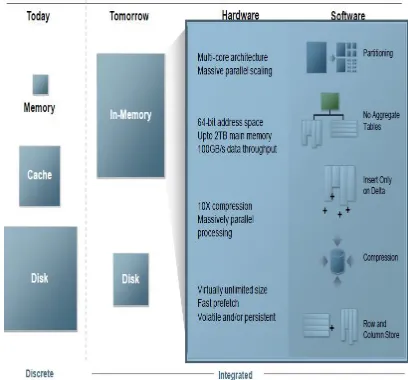
Fig 4.1: Future scope
This might be the future scope of in-memory computing. In future there might be no cache memory and the main memory may be larger than that of disk storage. So, it has wide scope to make development in such way that the computing time will drastically reduced.
5. REFERENCE:
1. Jump up ^ "Definition: in-memory database". WhatIs.com. Retrieved 19 January 2013.
2. Jump up ^ Michael Vizard. "The Rise of In-Memory Databases". Slashdot. Retrieved 19 January 2013.
3. Jump up ^ Polyhedra Lite In-Memory Relational Database System Freeware Available Now from Enea, Press Release, Reuters.
Available Online at www.ijpret.com
490
5. Jump up ^ "Falling RAM Prices Drive In-Memory Database Surge". SAP. Retrieved 19 January 2013.
6. Jump up ^ "Rise of In-Memory Databases Impacts Wide Range of Jobs". Dice.com. May 4, 2012. Retrieved 19 January 2013.
7. Jump up ^ The Bleak Future of NAND
http://research.microsoft.com/apps/pubs/default.aspx?id=162804
8. Jump up ^ Using NVDIMM as Storage, In-Memory Database Gains Durability & Keeps High Performance http://low-latency.com/article/using-nvdimm-storage-memory-database-gains-durability-keeps-high-performance
9. Jump up ^ TPC-H - Homepage. Tpc.org (2010-04-21). Retrieved on 2013-09-18.
10.Jump up ^ Enea Adds Fine-Grain Locking and Cascaded Deletes to the World's Best Relational In-Memory Database Server, Press Release (8.7), Enea AB
11.www.igate.com