Organized by C.O.E.T, Akola, ISTE, New Delhi & IWWA. Available Online at www.ijpret.com621 INTERNATIONAL JOURNAL OF PURE AND
APPLIED RESEARCH IN ENGINEERING AND
TECHNOLOGY
A PATH FOR HORIZING YOUR INNOVATIVE WORK
PERFORMANCE EVALUATION AND STATISTICAL ANALYSIS OF OLD AND
NEW IMPROVED DESIGN OF THE SOLAR AIR PREHEATER.
P. S. CHOPADE
ME- Student, DYPSOEA, Ambi- Pune, Mh – State, India
Accepted Date: 07/09/2016; Published Date: 24/09/2016
Abstract: This paper presents the performance evaluation & statistical analysis of the old design & new improved design of the solar air preheater. Statistical analysis was done using regression analysis on Mini-Tab. Experiment was performed with an existing old model, readings were taken at fixed orientation. The same way experiment was performed with where readings were taken at different orientations based on sun’s position as improved new model at the same time of the day. In the improved model of the solar air preheater orientation of the solar plates were changed as per the direction of the sun rays and readings were taken. This changes in the orientation resulted into performance improvement. The results captured during the test period exhibited that the temperatures inside the solar collector were much higher than the ambient temperature during most hours of the day-light. The maximum temperature rise captured inside the solar air preheater cabinet was up to 26oC. The cost involved in the setup & construction of a solar air preheater is much lower to that of a
mechanical dryer. Also the test was carried out with the simple and inexpensive solar air preheater was designed and constructed using locally sourced materials. The average Tout of the improved model was greater by 14.5% than that of the old model. Also the overall efficiency was improved by 23% for
improved model than that of the conventional solar heater i.e. with fixed orientation. Using Mini-Tab software regression equations for efficiency & solar intensity were prepared from the readings taken for old model & new model. This can be helpful to predict the efficiency & so lar intensity values based on ΔT at any time of the day for improved system.
Keywords: Solar Air Preheater, simple and inexpensive model, Regression Equation, Mini-Tab
Corresponding Author:MR. P. S. CHOPADE
Co Author:
Access Online On:
www.ijpret.com
How to Cite This Article:
P. S. Chopade, IJPRET, 2016; Volume 5 (2): 621-633
PAPER-QR CODE
SPECIAL ISSUE FOR
INTERNATIONAL CONFERENCE ON
“INNOVATIONS IN SCIENCE & TECHNOLOGY:
Organized by C.O.E.T, Akola, ISTE, New Delhi & IWWA. Available Online at www.ijpret.com622
INTRODUCTION
Solar air heating is one of the solar thermal technology which is used to heat an air from the energy of the sun is captured by an absorbing medium.[1] Solar air heating is a renewable
energy heating technology used to heat or condition air for buildings or process heat
applications. It is typically the one of the most cost-effective out of all the solar technologies, especially in industrial and commercial applications, and it addresses the largest usage of building energy in heating climates, which is industrial process heating and space heating.
1.1 Solar Air Collectors are of two different categories:
a. Glazed Solar Collectors (recirculation types that are usually used for space heating)
b. Transpired Solar Collector or Unglazed Air Collectors (used primarily to heat ambient air in industrial, agriculture, commercial and process applications)
1.2 Types of Solar Collector
Solar collectors for air heater are classified by their materials (such as glazed or unglazed) or by their air distribution paths, (such as Front-Pass or Back-Pass). For example:
Unglazed
Glazed
Through-pass collectors
Front-pass
Back pass
Combination front and back pass collectors
Unglazed air collectors and transpired solar collectors:
Background: The term "unglazed air collector" refers to a solar air heating system that consists
Organized by C.O.E.T, Akola, ISTE, New Delhi & IWWA. Available Online at www.ijpret.com623 model the energy savings from transpired solar collectors. Since that time, several thousand transpired solar collector systems have been installed in a variety of industrial, agricultural, commercial, institutional, and process applications in over 35 countries around the world. The technology was originally used primarily in assembly plants where there were high ventilation requirements, and often negative pressure in the building, and industrial applications such as manufacturing and stratified ceiling heat. Ford Motor Company had installed the first unglazed transpired collector in the world on their assembly plant in Oakville, Canada.
The American Society of Mechanical Engineers (ASME) in 2014 honoured the Solar Wall transpired collector technology and inventor John Hollick. They featured the 80s best inventors, inventions and engineering feats of the past two centuries, including Ford, Westinghouse, Edison, Carrier, the steam engine and the Panama Canal in an exhibit entitled “Engineering the Everyday and the Extraordinary”. ASME focused on nine categories of engineering: Energy & Power, Environment, Manufacturing, Food, Safety, Transportation, Health, Communication and Exploration. The Solar Wall technology and John Hollick were featured in the Energy & Power category.
With the increasing drive to install renewable energy systems on buildings, transpired solar collectors are now used across the entire building stock because of high energy production (up to 500-600 peak thermal Watts/square metre), high solar conversion (up to 90%) and lower capital costs when compared against solar photovoltaic and solar water heating.
1.3 Principle of Operation
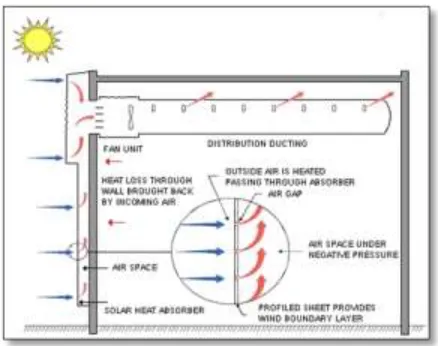
Organized by C.O.E.T, Akola, ISTE, New Delhi & IWWA. Available Online at www.ijpret.com624 Unglazed air collectors very useful to heat the ambient (outside) air instead of recirculation building air. Transpired solar collectors are mostly wall-mounted to capture the lower sun angle in the winter months as well as reflection of sun from the snow and achieve their optimum performance. Return on investment when operating at flow rates of between 4 and 8 CFM per square foot (72 to 144 m3/h.m2) of collector area.
The outer surface of a transpired solar collector consists of thousands of tiny micro-perforations which allow the boundary layer of heat to be captured and uniformly drawn into an air cavity behind the outer panels. This solar heated air is drawn into the building’s ventilation system from air outlets available along the top of the collector and the air is then distributed in the building via using a solar ducting system or conventional means.
Natural Resources Canada and NREL extensive monitoring had shown that transpired solar collector systems reduce between 10-50% of the load of the conventional heating and that RETScreen is an accurate predictor of system performance.
Transpired solar collectors act as a rain resistance screen and they also capture heat loss escaping from the building and drawn back into the ventilation system, it is collected in the collector air cavity. With the expected lifespan of 30 years, there is no maintenance required for solar air heating systems.
1.4 Different types of transpired solar collectors
Unglazed transpired solar collectors can also be roof-mounted for applications in which south facing wall is not a suitable for mounting or for other architectural considerations. Lots of companies now days offered transpired solar collectors suitable for roof mounting either as modules affixed to ducts or mounted directly onto a sloped metal roof and connected to nearby fans and HVAC units.
Higher temperatures can also be achieved with transpired collectors which by configuring to heat the air twice to increase the temperature rise. This makes it suitable for space heating of larger buildings. In a two-stage system, typically unglazed transpired collector is used in the first stage and the glazing covered transpired collector in the second stage. The glazing allows all of that heated air from the first stage to be directed through a second set of transpired collectors for a second stage of solar heating.
Organized by C.O.E.T, Akola, ISTE, New Delhi & IWWA. Available Online at www.ijpret.com625 into the PV system where there is a heating requirement; it decreases the total energy payback period associated with the combined system because the heat energy is captured and used to offset conventional heating and it removes the PV heat and allow the PV systems to operate closer to its actual efficiency (which is 25 C).
1.5 Glazed Air heating Systems
Glazed air systems function in the similar manner as a conventional forced air furnace, it provides heat by recirculation conditioned building air through solar collectors. The use of solar energy collecting surface to absorb sun’s thermal energy, and ducting air to come in connect with it, a simple and effective collector can be made for a variety of air conditioning and process applications.
Fig 2: SPF Solar Air Heat Collector
A simple solar air collector consists of an absorber material, sometimes having a selective
surface, to capture radiation from the sun and transfers this thermal energy to air via
conduction heat transfer. This heated air is then ducted to the process area where the heated air is used for space heating or process heating needs or to the building space.
The pioneer of this type of system was George Lof, who in 1945, built solar heated air system for a house in Boulder, Colorado. He later included a gravel bed for heat storage.
1.5.1 Through-pass Air Collector
Organized by C.O.E.T, Akola, ISTE, New Delhi & IWWA. Available Online at www.ijpret.com626 most surface area which enables relatively high conductive heat transfer rates, but significant pressure drop can require greater fan power, and deterioration of certain absorber material after many years of solar radiation exposure can additionally create problems with air quality and performance.
1.5.2 Back, Front, and Combination passage Air Collector
In back-pass, front-pass, and combination type setup the air is directed on either the back, the front, or on both sides of the absorber to be heated from the return to the supply ducting headers. Although passing the air on both sides of the absorber will provide a greater surface area for conductive heat transfer, issues with dust (fouling) can arise from passing air on the front side of the absorber which reduces absorber efficiency by limiting the amount of sunlight received. In cold climates, air passing next to the glazing will additionally cause greater heat loss, resulting in lower overall performance of the collector.
1.6 Applications of Solar Air Heat
The Solar Air Heat technologies can be utilized at variety of applications to create a sustainable means to produce thermal energy and also to reduce the carbon footprint from use of conventional heat sources (such as fossil fuels). Applications such as greenhouse season extension, pre-heating ventilation makeup air, space heating, or process heat can be addressed by solar air heat devices.[14] In the field of ‘solar co-generation’ solar thermal technologies are
paired with photovoltaics (PV) to increase the efficiency of the system by cooling the PV panels to improve their electrical performance while simultaneously warming air for space heating.
1.6.1 Applications in Space Heating
Space heating for commercial and residential applications can be done through the use of solar air heating panels. This setup of air heat system operates by drawing air from the outdoor environment or from the building envelope and passing it through the collector where the air warms via conduction from the absorber. It is then supplied to the working or living space either with the assistance of a fan or by passive means.
1.6.2 Applications in Process Heat
Organized by C.O.E.T, Akola, ISTE, New Delhi & IWWA. Available Online at www.ijpret.com627
1.6.3 Applications in Night Cooling Systems
On a clear night, a typical sky-facing surface can cool at a rate of about 75 W/m2 (25 BTU/hr/ft2). Principle of heat loss by long-wave radiation from a warm surface (roof) to another body at a lower temperature (sky), this helps to understand radiation cooling to the night sky. This means that a metal roof facing the sky will be colder than the surrounding air temperature. Collectors can take advantage of these cooling phenomena. As warm night air touches the cooler surface of a transpired collector, heat is transferred to the metal, radiated to the sky and the cooled air is then drawn in through the perforated surface. Cool air may then be drawn into HVAC units.
1.6.4 Applications in Ventilation
By drawing air through air heater or a properly designed air collector, solar heated fresh air can reduce the heating load during sunny operation. Applications include transpired collectors preheating fresh air entering a heat recovery ventilator, or suction created by venting heated air out of some other solar chimney.
2.0 Problem Definition:
The solar energy is to be used to maximum extent so there is requirement of system that solar energy should be utilize at maximum extent. Air preheating is one of the widely used applications of Solar energy usage and is to be studied for Solar energy utilization improvement. Hence detail study of solar air preheater and its arrangement with improved performance is to be undertaken.
2.1 Objectives:
The objective of this study is to develop a solar air heater in which the problems of low and medium scale heated air generation could be alleviated, if the solar heater is designed and constructed with the consideration of overcoming the limitations of existing heaters. Also to develop the regression equation for efficiency & solar intensity at any time of the day when temperature difference is known.
Organized by C.O.E.T, Akola, ISTE, New Delhi & IWWA. Available Online at www.ijpret.com628
- To develop air preheating system for testing.
- Improve efficiency of the Solar air preheating system
- Predict efficiency & Solar intensity using regression equation.
3.0 Existing Old Design of Solar Air Preheater Model
Fig 3: Prototype for old solar air preheater system
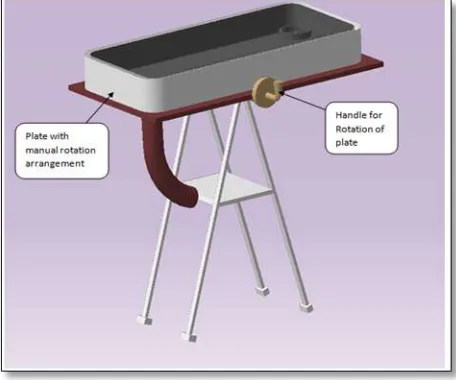
3.1 Modified Improved Solar Air Preheater Model
Organized by C.O.E.T, Akola, ISTE, New Delhi & IWWA. Available Online at www.ijpret.com629
3.3 Calculation formulas for System Efficiency:
A = Surface area of solar collector, m2
Cp= Specific heat of air at constant pressure in KJ/kg0K
ΔT = Temperature Difference between inlet at outlet
q = Heat Transfer Rate in KJ
m = Flow rate of Air, Kg/S
Io = Solar Intensity, W/m2
ΔT = Tout - Tin
q = m* Cp * ΔT
Efficiency η =
By following above calculation method, the efficiency of the solar air preheater was calculated.
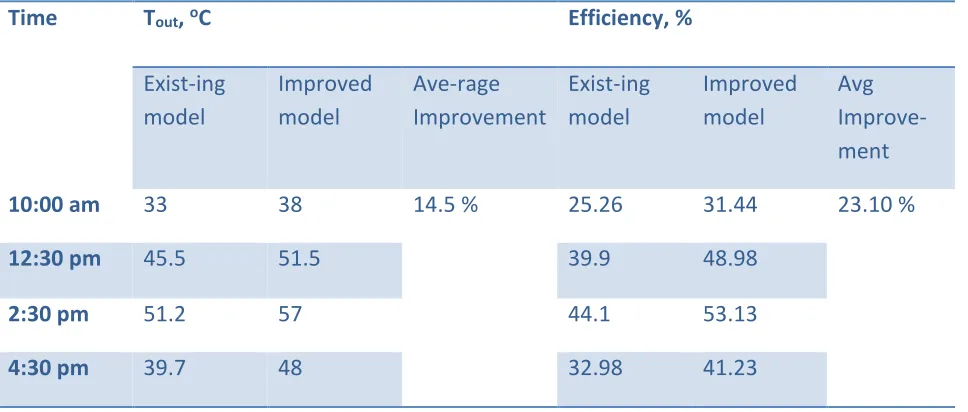
Table 1: Existing and improved model readings for Tout and efficiency
Time Tout, oC Efficiency, %
Exist-ing model
Improved model
Ave-rage Improvement
Exist-ing model
Improved model
Avg Improve-ment
10:00 am 33 38 14.5 % 25.26 31.44 23.10 %
12:30 pm 45.5 51.5 39.9 48.98
2:30 pm 51.2 57 44.1 53.13
Organized by C.O.E.T, Akola, ISTE, New Delhi & IWWA. Available Online at www.ijpret.com630
4.0 Minitab Introduction
Minitab is a statistics package developed at the Pennsylvania State University by researchers Barbara F. Ryan, Thomas A. Ryan, Jr., and Brian L. Joiner in 1972. It began as a light version of OMNITAB, a statistical analysis program by NIST; the documentation for OMNITAB was published 1986, and there has been no significant development since then.
Minitab is distributed by Minitab Inc, a privately owned company headquartered in State
College, Pennsylvania. Minitab Inc. also produces Quality Trainer and Quality Companion, which
can be used in conjunction with Minitab:[3] the first being aneLearning package that teaches statistical tools and concepts in the context of quality improvement, while the second is a tool for managing Six Sigma and Lean Manufacturing.
4.1 Minitab Analysis
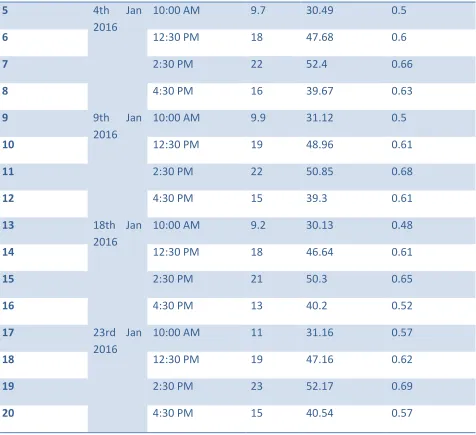
We have taken total 20 different reading on different date on the same time of the day for the improved model of solar air preheater. These readings were then used in Minitab for predicting model for efficiency & solar intensity, this gives regression equation
Efficiency, % = 15.434 + 1.6068 ΔT - (1)
Using Equation (1) we can predict efficiency value based on ΔT, at any time of the day for Improved System.
Solar Intensity,W/m2 = 0.39303 + 0.012531 ΔT - (2)
Using Equation (2) we can predict Solar Intensity values based on ΔT at any time of the day for improved system.
Reading No Date Time ΔT Efficiency, % Solar Intensity,
W/m2
1 24th Dec
2015
10:00 AM 12 31.44 0.6
2 12:30 PM 22 48.98 0.69
3 2:30 PM 26 53.13 0.71
Organized by C.O.E.T, Akola, ISTE, New Delhi & IWWA. Available Online at www.ijpret.com631
5 4th Jan
2016
10:00 AM 9.7 30.49 0.5
6 12:30 PM 18 47.68 0.6
7 2:30 PM 22 52.4 0.66
8 4:30 PM 16 39.67 0.63
9 9th Jan
2016
10:00 AM 9.9 31.12 0.5
10 12:30 PM 19 48.96 0.61
11 2:30 PM 22 50.85 0.68
12 4:30 PM 15 39.3 0.61
13 18th Jan
2016
10:00 AM 9.2 30.13 0.48
14 12:30 PM 18 46.64 0.61
15 2:30 PM 21 50.3 0.65
16 4:30 PM 13 40.2 0.52
17 23rd Jan
2016
10:00 AM 11 31.16 0.57
18 12:30 PM 19 47.16 0.62
19 2:30 PM 23 52.17 0.69
20 4:30 PM 15 40.54 0.57
Table 2: Improved model readings for ΔT, efficiency and solar intensity.
5.0 Results:
- The above results (From Table 1) shows that Tout is improved with improvement in model by around 14.5 %.
Organized by C.O.E.T, Akola, ISTE, New Delhi & IWWA. Available Online at www.ijpret.com632
- Hence, we can conclude that the model we worked on is efficient than conventional solar air preheater which is fix mounted on the same orientation.
- One problem with improved model is that we have to rotate the frame as per Solar rays orientation manually or have to arrange separate mechanism for automatic rotation of the solar collector based on time of the day.
- This can be used at several applications like solar dryer for foods / agriculture goods, air preheater etc.
- Regression Equation for Efficiency of the improved design is
- Efficiency, % = 15.434 + 1.6068 ΔT
- Regression Equation for Solar Intensity of the improved design is
SolarIntensity,W/m2=0.39303+0.012531ΔT
Graph 1: Comparison-Efficiency of Existing and Improved design
REFERENCES:
1. Abhishek Saxena “Design and thermal performance evaluation of a novel solar air heater” at “ElsevierRenewable Energy 77 (2015) 501-511”
2. Chii-Dong Ho “Analytical and experimental studies of wire mesh packed double-pass solar air heaters under recycling operation” at “The 7th International Conference on Applied Energy – ICAE 2015 ”
Organized by C.O.E.T, Akola, ISTE, New Delhi & IWWA. Available Online at www.ijpret.com633 4. Hamdi Kessentini “Numerical and experimental study of an integrated solar collector with CPC reflectors” at “Elsevier Renewable Energy 57 (2013) 577-586”
5. P. Mohamed Shameer, “Designing and Fabrication of Double Pass Solar Air Heater Integrated with Thermal Storage” at “International Journal of Science and Research (IJSR) ISSN (Online): 2319-7064 2013”.
6. Yuechao Deng, “Experimental study of the thermal performance for the novel flat plate solar water heater with micro heat pipe array absorber” at “International Conference on Solar Heating and Cooling for Buildings and Industry, SHC 2014”.
7. Federico Bava, “Simulation of a solar collector array consisting of two types of solar collectors, with and without convection barrier” at “International Conference on Solar Heating and Cooling for Buildings and Industry, SHC 2014”
8. Hiroshi Tanaka, “Theoretical analysis of solar thermal collector and flat plate bottom reflector with a gap between them.” at “Elsevier Energy Reports 1 (2015) 80–88”
9. Amir Hematian, “Experimental analysis of flat plate solar air collector efficiency” at “Indian Journal of Science and Technology Vol. 5 No.8 (August 2012) ISSN: 0974- 6846”
10. Prashant Kumar “Effect of Differential Mass Flow Rate on the Thermal Performance of Double Duct Packed Bed Solar Air Heaters” at “International Conference on Renewable Energies and Power Quality (ICREPQ’12) Santiago de Compostela (Spain), 28th to 30th March, 2012”.
11. Foued Chabane “Thermal Efficiency Analysis of A Single-Flow Solar Air Heater With Different Mass Flow Rates in a Smooth Plate” at “Frontiers in Heat and Mass Transfer (FHMT), 4, 013006 (2013) DOI: 10.5098/hmt.v4.1.3006”.
12. P. T. Saravanakumar, “Numerical Study and Thermal Performance of the Flat Plate Solar Air Heaters with and Without Thermal Storage” at “ARPN Journal of Engineering and Applied Sciences VOL. 7, NO. 4, APRIL 2012 ISSN 1819-6608”