Study the Effect of Surrounding Surface Material Types
on the Multipath of GPS Signal and Its Impact on the
Accuracy of Positioning Determination
Ahmed S. Mohamed1,*, Mohamed I. Doma2, Mostafa M. Rabah3
1
Higher Technological Institute 10th of Ramadan City, 10th of Ramadan City, Egypt
2
Faculty of Engineering, Menoufia University, Egypt
3
Benha Faculty of Engineering, Benha University, Egypt
Abstract
Global Positioning System (GPS) results are suffering from one of the major errors in high precision GPS positioning, the ones caused by reflections, known as Multipath error. Here, we study some of the multipath factors affecting on the accuracy observables obtained from GPS measurements. This will be achieved through monitoring and record the multipath effect according to different types of surface which reflected the signals specific set of generating and monitoring systems for multipath signal is established and a series of controlled experiments are carried out. Experimental results show that Aluminium caused the highest amount of multipath. This is followed by Glass and Wood.Keywords
GPS, Multipath, Material type Effect1. Introduction
With the sophisticated Global Navigation Satellite System (GNSS), the static and kinematic deformations of the largescale structures can be monitored in the real-time mode with three-dimensional positioning precision to several millimetres. The applications include bridge, dam, pipeline and machinery alignment monitoring. In such scenarios, it is advantageous if the coordinates of target points can be provided with high data rates and high accuracy. The global positioning system (GPS) is an attractive system for providing such data since it is weather independent, has high precision positioning and short observation time, is capable of autonomous operation and does not require a line of sight (LOS) between target point (Elsobeiey and El-Rabbany 2010). Although most of the errors affecting short-baseline. GPS are eliminated or minimized by differencing techniques (Leick, 2004), multipath error will remain due to the highly site-specific nature of the reflection of GPS signals from nearby surfaces. (Lau and Mok 1999; Axelrod et al. 1996). The reflections have a random behaviour for the user equipment, making it difficult to impossible to remove completely (Satirapod and Rizos, 2005). Accordingly,
* Corresponding author:
[email protected] (Ahmed S. Mohamed) Published online at http://journal.sapub.org/ajgis
Copyright©2019The Author(s).PublishedbyScientific&AcademicPublishing This work is licensed under the Creative Commons Attribution International License (CC BY). http://creativecommons.org/licenses/by/4.0/
multipath is often considered the most limiting factor in precise GPS positioning (Lau and Mok 1999; Axelrod et al. 1996). Related studies have been carried out for many years and Different methods have been employed to reduce or eliminate the multipath effects. There are four prominent methods of multipath reduction; all these methods have their own advantages and limitation.
2. Methodology
2.1. Selection of Low-Multipath Locations for Antenna Placement is an Effective Method
In the case of volcano monitoring, all the GPS receivers have to be placed on the slope or at the foot of the mountain. The only antenna site which may be free of multipath is the one on the summit, where there is often a great reluctance to install a receiver (Ge et al., 2001).
2.2. Hardware Methods
Among the multipath mitigation techniques, probably the simplest ones are those that apply special antenna designs such as the use of choke rings and dual-polarization antennas to prevent secondary reflections from entering the receiver front-end. However, these techniques are not able to completely eliminate multipath reflections in dense multipath environments since they can only remove reflections arriving from low elevation angles (Asl, 2013).
2.3. Software Methods
The multipath mitigation solutions described in the previous paragraphs are capable of achieving varying degrees of multipath reception reduction. These options, however, require specific conscious efforts on the part of the GPS user. In many situations, especially kinematic, few (if any) of the above solutions may be effective or even possible to incorporate. By far, the best solutions are those which require little or no special efforts in the field on the part of the GPS user. This is what makes internal receiver solutions so desirable and practical (NovatelO, 2000.) Scientists has placed long term concerted efforts into the development of internal receiver solutions and techniques that achieve multipath reduction, all of which are transparent to the receiver user. These achievements have led to technologies such as Narrow Correlator spacing, Multipath Elimination Technique (MET), the Multipath Estimating Delay Lock Loop (MEDLL), Edge Correlator Technique, Strobe Correlator, Enhanced Strobe Correlator and Carrier-Phase Multipath Observable (Mekik, and Can, 2010).
2.4. Hardware and Software (Hybrid) Methods
By combining hardware and software (hybrid) methods to estimate multipath due to the spatial correlation of the measurements received from an array of antennas, but it requires the array to be static (Yedukondalu et al, 2011). Hilla and Cline (2004) Evaluate pseudo range multipath effects at stations in the National CORS Network. The main objectives of this study were to identify the most affected and least affected sites in the network, to closely investigate problematic sites, and to compare various receiver/ antenna combinations. They found that The least affected sites were the state networks installed in Sites used excellent antenna mounts, choke ring antennas, and new receiver technology. Johnson et al. (1995) mentioned in their paper that addresses multipath at the Table Mountain site, where there are no close buildings and multipath is assumed to come from ground reflections. The results and conclusions presented there may be quite different in other environments. Placing the antenna at 1.5 m and/or 24 cm will not always provide the same results, especially when multipath reflections enter
the GPS antenna from elevation angles greater than zero. For these cases, the multipath effects will have different characteristics and suggest antennas should not be mounted near to the ground (< 1.0 m), or other reflecting surfaces such as wide pillars. Kamarudin et al (2004) discuss the detection of the multipath errors from test carried out using two different types and design of GPS antenna such as the ground plane and normal antenna. The study shows that multipath error can be detected in areas with reflected GPS signals, it also shows the ground plane antenna is capable to reduce the multipath errors and, a reliable technique for reducing the multipath errors was successfully being done by differencing observation for two days consecutively. Deep (2013) determine the correlation between the Signal to Noise Ratio (SNR) and multipath errors, so he study the effect of the antenna height to determine the suitable height at which a GPS antenna to be positioned, in this study different heights of antenna were taken at the same place. GPS observations are taken when the urban environment is same. It was observed from the results that in urban environment increasing the antenna height may not always reduce the multipath error as it primarily depends on SNR. Satirapod and Rizos (2005) suggested Multipath Mitigation of Permanent GPS Stations Using Wavelet decomposition. In order to verify the effectiveness of the method, he used a receiver very close to the concrete wall to collect the multipath signals. The results show that the proposed method can be used to significantly mitigate the multipath effects at a permanent GPS station. Dinesh et al (2014) Evaluate of the Effect of Commonly Used Materials on Multipath Propagation of Global Positioning System (GPS) Signals via GPS Simulation. It is observed that aluminium causes the highest amount of the multipath, resulting in the highest probable errors. This is followed by glass, ceramic, PVC and wood. The panels’ dimensions were (1×1 m). They mentioned that the ideal GNSS receiver evaluation methodology would be using a GNSS simulator, which can be used to generate multi-satellite GNSS configurations, transmit GNSS signals that simulate real world scenarios, and adjust the various error parameters. the following assumptions are made for the tests conducted i) No ionospheric or tropospheric delays ii) Zero clock and ephemeris error iii) No unintended obstructions or multipath iv) No interference signals. This would allow for the evaluations of GNSS receiver performance under various repeatable conditions. However, field evaluations using live GPS signals is very important as may be the order of materials is being changed regards to live Data a real multipath environment.
reaching the antenna, while on the dry day the reflectivity of the surface is reduced and so is the multipath signal and the conclusion was that surface materials affect the GPS positional accuracy.
Betaill (2004) introduced assessment and Improvement of the Capabilities of a Window Correlator to Model GPS Multipath Phase Errors. For the purpose of generating multipath in a controlled manner, an experimental set-up has been designed that includes a large metallic reflector (5 m by 2.5 m steel panel).
3. GPS Multipath Error
Multipath error is caused by nearby reflecting surfaces at the receiver location. Just as light reflects off a shiny surface, radio signals can be reflected by solid objects and surfaces. GPS signals cannot penetrate solid objects like buildings, thick tree canopies, cars, ships, and bridges. Instead, these objects deflect them, causing the signals to arrive at the receiver via multiple paths. The reflected signals will interfere with the signals that are received via a direct path. The reflected signal travels for a longer time instead of traveling a direct signal path. As a result, this causes the receiver position to be calculated incorrectly, with the position shifting in the direction of the multipath source. The multipath distorts the C/A-code and P-code modulations, as well as the carrier phase observations. (Ogaja and Clement, 2011). Fortunately the multipath disturbance has a periodic characteristic and is repeated every sidereal day for a static receiver if the antenna environment remains the same (Gulie, 2014). since the GPS satellite ground tracks repeat every sidereal day, the multipath errors experienced today, for example, from 1:00pm – 2:00pm will be very similar to those experienced tomorrow, but will occur from 12:56pm – 1:56pm, provide the antenna environment remains unchanged (Ge et al., 2001).
This repetition can then be useful for verifying the presence of multipath through the analysis of observations made at static receiver on different days. Alber et al. (2000), developed a multipath simulation model and described where in the multipath parameters can be varied and their influences are observed. The parameters included are the reflection coefficient, the antenna to reflector distance, the azimuth and elevation of the reflected signal the existence of multiple reflectors and satellite dynamics. Magnitude of the multipath depends on few factors (Kamarudin et al, 2004):
i) Position of the reflected surface that located near the antenna.
ii) Types of the reflected surface.
iii) The height of antenna from the earth surface. iv) GPS wave distance signals.
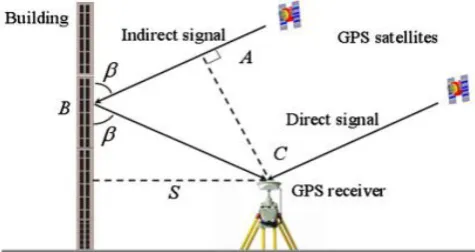
Yi et al, (2012), mentioned that The multipath signals are always delayed compared to the line of sight LOS signals because of the longer travel paths caused by reflections. From the geometrical relations shown in figure 1, the wave
path difference ∆ between indirect and direct signal lengths from the satellite antenna to the receiving antenna can be calculated as follows:
∆ = AB + BC = BC · cos (180° − 2β) + S sin β = 2S·sinβ–S sin β+S sin β = 2S ·sin β (1)
where β indicates the satellite signal incidence angle of the reflected point and S denotes the horizontal distance from the antenna to the reflecting surface. The phase delay between the reflection signal and the direct signal (take radian as unit) can be expressed as follows:
ϕ =∆/λ · 2π =4πS · sin β λ (2) where λ is the carrier wavelength (L1 or L2 for the GPS). The mathematical models of the direct signal and reflected signal are written respectively as
SLOS = A sin(ω0t) (3) And
𝑆𝑚 𝑡 = 𝑚𝑖=1 𝜎𝑖 𝐴 𝑠𝑖𝑛 (𝜔𝑡 + ∅𝑖) (4) Where 𝑆𝐿𝑂𝑆 is the direct signal, SM(t) denotes the reflected signal, A indicates the amplitude of the direct signal, ω0 stands for the angular frequency, and αi and ϕi represent the reflection coefficient (0 ≤ αi ≤ 1) and the phase delay of the reflected signal i, respectively.
Figure 1. Multipath: geometry of a signal, a reflector and a receiver antenna
Thus, the superposed signal (i.e. the true received GPS signal) is (Yi et al, 2012):
𝑆𝑇𝑜𝑡𝑎𝑙 𝑡 = 𝐴𝑠𝑖𝑛 𝜔𝑡 + 𝑚𝑖=1 𝜎𝑖 𝐴 𝑠𝑖𝑛 (𝜔𝑡 + ∅𝑖) (5)
After trigonometric transform, the superposed signal can be given by
STotal(t) = αcA sin(ω0t + ∅𝑖c) (6) where αc and ϕc respectively represent the reflection coefficient of superposed signal and the phase delay of the superposed signal relative to the direct signal, which can be given by the following equations:
Figure 2. The experiment area and the locations of reference (stationary) and the test (rover) receivers
4. Test Field and Materials
The test field chosen for all the multipath geometry experiments is established in Al-Azhar University on the roof of Civil Engineering Faculty Building, Cairo, Egypt.
4.1. Test 1: Types of the Reflected Surface
We choose the roof where there is no multipath from surroundings except from the panels under study cases for the purpose of generating the multipath So the multipath variations that are observed are due to variation in the electrical properties of the surface material. Two receivers are used, both of which are of Trimble System R4 (Model 3). One of them is put on station (a2) as a Base (control point), the other on station (a1) as a Rover. The distance between the two receivers was about 10 m.
Receiver parameters were set as follows: data logging interval 1 seconds, elevation mask 10°, PDOP value of 5 (To ensure high-precision GPS positioning, a PDOP value of 5 or less is usually recommended. In practice, the actual PDOP value is usually much less than 5(DINESH et al, 2010)).
The GPS data observations were made in 4 successive days from 30/01/2016 to 3/02/2016 with gap 1/02/2016. The observations were measured during the same time over the same point every day 1.25 hrs duration. The orbital period of GPS constellation is of 11hours and 56 minutes which implies a satellite will be at the same location in the sky about four minutes earlier each day. This difference was incorporated in extracting the observables. The heights of the
reflector at 1m distance from Rover were obtained according to the receiver’s minimum satellite elevation angle (10)
The material used are (aluminium, glass, wood) - The test includes the following two parts.
- On the first day, the tests were taken over the roof in open environment and no obstructed material for the two antenna. The GPS receivers are set up on the reference and rover (both fixed) stations.
- On the other three successive days, the tests are
conducted for the panels made of different construction materials. The GPS receivers are set up on the reference and rover (both fixed) stations. the panel reflector was placed during consecutive days at 1 m from the rover’s receiver at the same direction. The tests are conducted for the panels (dimensions of 1 × 1 m) made of aluminium, glass, and wood. On the second day, the multipath tests commenced with aluminium panel. On the third day the glass panel was used. On the fourth day, the wood panel was used.
5. Results and Analysis
The software using is Leica Geo Office.
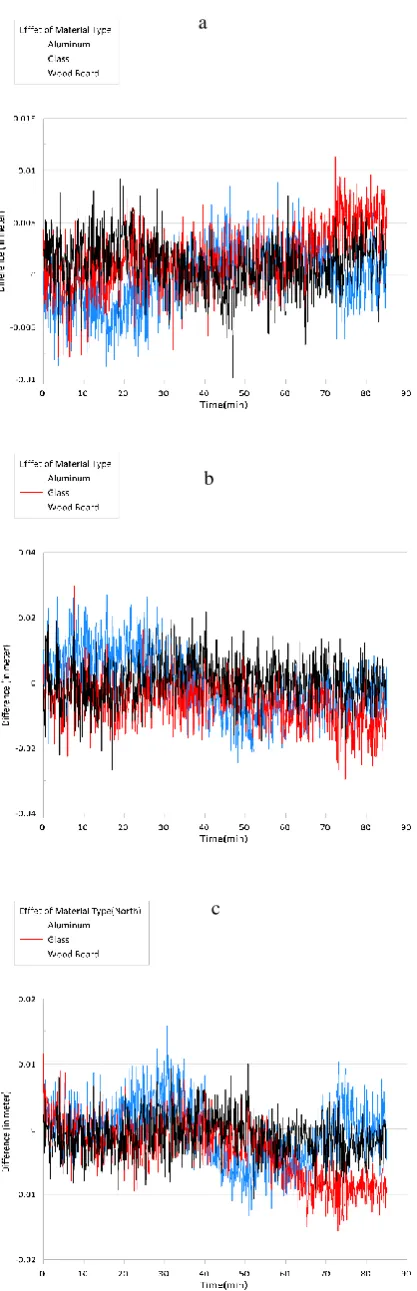
After the dataset collected for four days are superposed to maintain the same satellite configuration, the observations obtained under the multipath geometries are investigated by comparing them against the non-multipath observations (control group). The double differences are utilized in the analyses since the atmospheric (ionospheric and tropospheric) effects, satellite-receiver clock offsets and orbit errors are mostly cancelled out for short baselines (here < 1km) GPS observations (Collins and Langley, 1996). As far as the multipath and non-multipath observations are concerned, since the only difference between them is the presence or absence of reflecting panels.one can deduct that the difference between these data is assumed to emerge from the multipath error plus random error. However, when comparing the results from the multipath geometries to the ones from the control data, the difference still significantly represents the multipath errors since the same random errors occur during the control observations and is presumed to cancels out on differencing. In order to see the differences between the static (true) and multipath coordinates of the test point, the initial changes are charted against three Directions, namely Earth, North and Height.
Figure 3. Vertical reflecting panel (1mX1m). away 1m from the
Figure 4. Changes in Directions, a) Changing in East, b) Changing in North, c) Changing in Height a
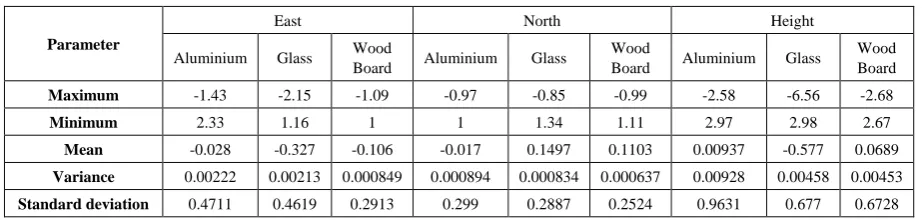
Table 1. Difference results in East, North, Height Directions (unit: cm)
Parameter
East North Height
Aluminium Glass Wood
Board Aluminium Glass
Wood
Board Aluminium Glass
Wood Board
Maximum -1.43 -2.15 -1.09 -0.97 -0.85 -0.99 -2.58 -6.56 -2.68
Minimum 2.33 1.16 1 1 1.34 1.11 2.97 2.98 2.67
Mean -0.028 -0.327 -0.106 -0.017 0.1497 0.1103 0.00937 -0.577 0.0689
Variance 0.00222 0.00213 0.000849 0.000894 0.000834 0.000637 0.00928 0.00458 0.00453
Standard deviation 0.4711 0.4619 0.2913 0.299 0.2887 0.2524 0.9631 0.677 0.6728
From figure 4 and table 1, it is observed from standard deviations comparisons that aluminium causes the highest amount of multipath in the three directions. This is followed by glass, wood. These results are consistent with the findings obtained in (Dinesh et al (2014). The resu1lts indicate that the changes in Height are greater than those in East and North Directions. (The change in the vertical direction is about two times that in the horizontal), as GPS receivers can only track satellites above the horizon, resulting in GPS vertical (height) solution being less precise than the horizontal solution (Dinesh et al., 2010). The metal materials, such as, in the case of this study, aluminium, cause total reflection of GPS signals and hence, higher multipath. For non-metal materials, the multipath effect is dependent on the dielectric constant, which indicates the polarization of the material. Materials with higher dielectric constants cause higher multipath, and vice-versa.
6. Conclusions
Based on the results of this study, it was found that the multipath signals from the panels caused an increase in error coordinates values, it is observed that aluminium caused the highest amount of multipath. This is followed by glass and wood.
REFERENCES
[1] Alber, C., Braun, J., Rocken, C., Ware, R., (2000), Obtaining single path phase delays from GPS double differences. Am. Geophys. Union 27, 2661–266.
[2] Asl, N.S., (2013), GNSS Multipath Mitigation Using Channel Parameter Estimation Techniques. Ph.D. thesis, Department of Geomatics Engineering, University of Calgary, Canada. [3] Axelrad, P., Comp, C.J., MacDoran, P.F., (1996), Applied
GPS for Engineers and Project Managers. American Society of Civil Engineers (ASCE), United States of America. [4] Axelrad, P., Comp, C.J., MacDoran, P.F., (1996), SNR-based
multipath error correction for GPS differential phase. IEEE Trans Aerosp Electron Syst 32(2): 650–660.
[5] Betaille, D., (2014), Assessment and Improvement of the
Capabilities of a Window Correlator to Model GPS Multipath Phase Errors. Ph.D. thesis, Department of Geomatic Engineering, University College London.
[6] Collins, P. and Langley, R (1996), Limiting Factors in Tropospheric Propagation Delay Error Modeling for GPS Airborne Navigation. 52nd Annual Meeting, The Inst. of Navigation, Cambridge, Massachusetts, USA.
[7] Dinesh, S., Wan Mustafa, Wh., Mohd Faudzi., M., Kamarulzaman, M., Hasniza, H., Nor Irza Shakhira, B., Siti Robiah, A., Shalini, S., JAMILAH, J., Aliah, I., Lim, BT., Zainal Fitry, MA., Mohd Rizal, AK., Azlina, B. and Mohd Hasrol, HMY., (2010), Evaluation of the effect of radio frequency interference (RFI) on Global Positioning System (GPS) accuracy. Defense S&T Technical Bulletin, , vol. 3, no. 2, p. 100-118.
[8] Elsobeiey, M., and El-Rabbany, A., (2010), On stochastic modeling of the modernized global positioning system (GPS) L2C signal. Meas. Sci. Technol.
[9] Ge, L., Han, S. and Rizos, C., (2001), GPS Multipath Change Detection in Permanent GPS Stations. School of Geomatic Engineering, University of New South Wales, Sydney, NSW 2052, Australia.
[10] Guile, I., (2014), Mitigation of Multipath-induced Errors in Satellite Navigation. Master of Science thesis, Department of Electronic Systems, Aalborg University, Denmark.
[11] Hilla, S., Cline M., (2004), Evaluating pseudorange multipath effects at stations in the National CORS Network. GPS Solutions 7(4): 253–267.
[12] Johnson, J., J. Braun, J., Rocken, C. and Van Hove T., (1995), The role of multipath in antenna height tests at Table Mountain. UNAVCO.
[13] Kamarudin, M.N. and Amin, Z.M, (2004), Multipath Error Detection Using Different GPS Receiver’s Antenna. 3rd International Federation of Surveyors (FIG) Regional Conference, Jakarta, Indonesia.
[14] Mekik, C., and Can, O., 2010, Multipath Effects in RTK GPS and A Case Study. International Symposium on GPS/GNSS, Taipei, Taiwan, 255-262.
[15] Lau, L., Mok, E., (1999), Improvement of GPS Relative Positioning accuracy by using SNR. Journal of Surveying Engineering-ASCE 125(4): 185-202.
[16] Leick, A., (2004):” GPS satellite surveying. New York, John Wiley & Sons Inc.
Project Managers. American Society of Civil Engineers (ASCE), United States of America.
[18] Satirapod, C., Rizos, C., (2005), Mitigation by Wavelet Analysis for GPS Base Station Applications. Survey Review, vol. 38, 2–10.
[19] Yedukondalu, K., A. D. Sarma and V. Satya Srinivas, (2011),
Estimation and Mitigation of GPS Multipath Interference using Adaptive Filtering. Department of ECE, ACE Engineering College, Ankushapur, Ghatkesar Mandal, Ranga Reddy District, India.