INTEGRATION OF WEED CONTROL METHODS WITH SEED RATES FOR IMPROVING WHEAT YIELD
Fazal Munsif1*, Shahen Shah1, Ayeni Leye Samuel2, Muhammad
Amin3, Ali Shan1, Akhlaq Ahmad1 and Zahid Ali4
ABSTRACT
Efficient weed control is a key factor in maintaining long-term sustainability in crop production and keeping agro-ecosystem free of contaminants. To minimize weed losses and cost of production use of mulch is one of the best options. To evaluate the efficacy of different mulching materials under various seed rates of wheat, an experiment was conducted during 2011-12 at New Developmental Farm of the University of Agriculture Peshawar, Pakistan. The treatments consisted of three seed rates (80, 100 and 120 kg ha-1) and four weeds control treatments (control, Plastic mulch, Newspaper mulch and wheat straw). Weeds control methods and seed rates significantly affected wheat grain yield, biological yield, weeds density and weeds fresh and dry biomass. The results of the experiment revealed that seed rate of 100 kg ha-1 performed better in term of grain yield while biological yield was higher in plots where 120 kg ha-1 seed rate was used. Regarding mulching materials, plastic mulch was found superior over all other mulching materials and had produced higher grain and biological yield. Lower weed density at 40, 80 and 120 DAS and lower weeds fresh and dry biomass was also recorded in plastic mulch. Overall, this field trial demonstrated the potential of mulching materials for induction of short-term benefits in wheat production. From a management perspective, we also highlighted potential conflicts in plastic mulching and its use which may limit its adoption by large and small scale farmers of Khyber Pakhtunkhwa.
Key words: Herbicides, production cost, seed rate, yield, wheat.
Citation: Munsif, F., S. Shah, A.L.Samuel, M. Amin,K. Ali, A. Shan, A.Ahmad and Z.Ali. 2014. Integration of weed control methods with seed rates for improving wheat yield. Pak. J. Weed Sci. Res. 20(2): 155-165.
1Dept. of Agronomy, 3Dept. of Agriculture Mechanization, 4Dept. of
Horticulture, The University Of Agriculture Peshawar, 2Department of
INTRODUCTION
Weeds and plant population play key role in crop production and efficient utilization of resources. Farmers had to make extra expenditure for producing weeds free wheat crop. The magnitude of loses due to high weed infestation ranges from 10 to 30% and may reach to 50% even in severe cases. In several cases, farmers are compelled to apply toxic herbicides for efficient weed control. Resultantly not only production cost is increased but biodiversity of agro-ecological system are also adversely affected. Keeping in view the negative impact of chemical weed control on agro-ecological system and farmers income, researchers have developed interest in the evaluation and identification of such weed control methods which may be environmental and farmers friendly. Plant population and mulching are considered most important weeds control strategies. Several other benefits are also associated with surface mulching such as improving water holding capacity of soil by reducing evaporation,
control soil salinity and suppressing weed growth (Bu et al., 2002).
Plastic film, crop residue, straw, paper pellets, gravel-sand, rock fragment, volcanic ash and city rubbish could be used as mulch
material (Bu et al., 2002; Unger, 2001; Tejedor et al., 2002; Li, 2003;
Berglund et al., 2006). Several investigations suggested that mulching
significantly reduced weeds population in wheat crop (Li and Lan,
1995). According to Li et al. (2004b) and Xie et al. (2006) grain yield
was positively increased in mulched wheat as compared to un-mulched wheat. Mulching improved soil and water conservation, physico-chemical properties and enhanced soil biological activity that
ultimately increased wheat grain yield (Deng et al., 2006;
Ramakrishna et al., 2006).
and maximum attainable yields under various situations. As a result, the effect of density on wheat plant size and crop productivity has
received attention (Harper, 1977). Berglund et al. (2006) are of the
view that a more dense plant stand allows the crop to compete better with weeds. After certain point, however, the benefits of an increased plant population do not outweigh the cost of additional seed, especially when seed cost is high. Increasing seed rate, weed population could be suppressed because increasing seed rate within rows increases intraspecific competition within the crop population more than it
increases competition with the weeds (Weiner et al., 2001) while
environment can also alter the competitive ability of the weed.
Keeping in view the importance of weed control methods and their impact on wheat yield the present study was designed. The ultimate motivation behind this instant study was thus to determine empirically the effectiveness of various mulching practices under different seed rate in wheat crop.
MATERIALS AND METHODS
A field experiment was conducted to study the effect of different seed rate and mulching materials on weeds density and wheat yield during winter 2012. Experiment was designed in randomized complete block design with split plot arrangement with three replications. The seeds of wheat variety ‘Siran’ were sown at
three different seed rate (80, 100 and 120kg ha-1) in a plot size of 3 m
by 4. Field was ploughed twice followed by planking to break the clods. Different mulching materials were used as weeds control agents.
Phosphorus was applied at the rate of 90 kg ha-1 in the form of SSP as
basal dose. Likewise, nitrogen (N) was applied at the rate of 120 kg
ha-1 in two splits (half at sowing and half at tillering stage). Seed rates
were kept in main plots while mulching materials were kept in sub
plots. Wheat seeds were sown on 7th November 2012. Canal water was
used for irrigation when and where needed. Data were recorded on weeds density at 30, 60 and 90 days after sowing, weeds fresh and dry biomass 120 DAS and wheat biological and grain yield. Weed density was recorded at 40, 80 and 120 days after sowing (DAS) from randomly selected three sites one meter long from each experimental unit and was averaged. Fresh and oven dry biomass of the samples were also recorded. For collecting data on growth and yield parameters of the crop, standard procedures were followed. The grain yield was determined by harvesting five central rows in each subplot. The ears from harvested plants were detached, threshed, weighed and
Data analysis
The data collected were statistically analyzed using appropriate procedure for randomized complete block design. The means were
compared using LSD test when F-values were significant (Jan et al.,
2009).
RESULTS AND DISCUSSION
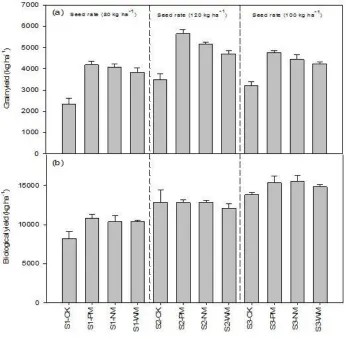
Data regarding grain and biological yield of wheat in response to various seed rates and mulching materials are presented in Figure
1a and 1b. Higher grain yield was produced in plots where 100 kg ha-1
seed rate was used in combination with plastic mulch followed by newspaper mulching (Fig. 1a). Same trend was observed for seed rate
of 80 and 120 kg ha-1 (Fig. 1a). Regarding biological yield, seed rate of
120 kg ha-1 in combination with either plastic mulch or newspaper
mulch resulted in higher biological yield followed by plastic and newspaper mulching with combination of 100 kg ha-1 seed rate (Fig. 1b). Lower biological yield was recorded in check plots (non-mulched)
having lower seed rate (80 kg ha-1) was used (Fig. 1b). Plastic
mulching resulted in higher wheat grain and biological yield and it could be attributed to the ability of surface-applied mulches to improving water use efficiency, heat energy and nutrient status in soil, conserving soil water and nutrients and controlling weed population (Bu et al., 2002). The results of current experiments indicated that as
seed rate increased from 100 to 120 kg ha-1 wheat yield decreased.
Possible reason for it could be that as plant population decreased crop posse’s vigorous growth. Increasing seed rate plant population increased as a result plant compete for light and obtained higher height resultantly lodging occurred which reduced grain yield (Mazurek and Sabat,1984). Wheat grain and biological were increased in weeds control plots as compared to check plots. It could be attributed to less competition for resources such as nutrients, light and space might that provided favorable conditions for wheat growth and development. Our
results are confirmed by the findings of Sinha et al. (2001) and Shinde
et al. (2001) who found that efficient weed control method increased biological yield of cereal crops.
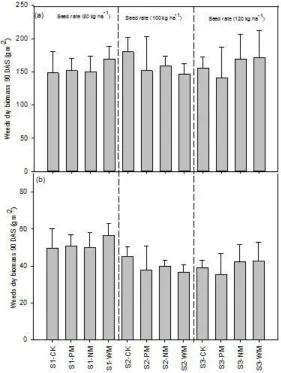
Weeds dry and fresh biomass data 90 days after sowing (DAS) are presented in Fig. 2a and Fig. 2b. Higher weeds fresh biomass was
produced in check plots having seed rate of 100 kg ha-1. Likewise,
seed rate of 120 kg ha-1 in combination with plastic mulch resulted in
lower weeds fresh biomass (Fig. 2a). Seed rate of 100 kg ha-1 under
all weeds control techniques produced lower weeds dry biomass 90
DAS as compared to 120 and 80 kg ha-1 seed rate. Highest weeds dry
biomass was produced in plots where seed rate of 80 kg ha-1 was used
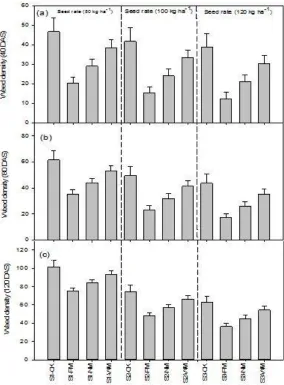
affected by seed rate and mulching materials at 40, 80 and 120 DAS are presented in Fig 2a, 2b and 2c. Overall, weeds density was lower at 40 DAS as compared to 80 and 120 DAS (Fig. 2a). However, different treatments showed variable responses when data were recorded at different DAS. The Fig 2a-c demonstrated that check plots resulted in higher weeds density at 40, 80 and 90 DAS under either
seed rate (80, 100 and 120 kg ha-1). In contrast, plastic mulch under
all seed rate resulted in lower weeds density at 40, 80 and 120 DAS (2a-c). Check plots are bare plots resulted in serious weeds infestation than mulched plots especially plastic mulched plots.The severity of weeds in bare plots might be due to the absence of soil cover/mulch that could have suppressed weed proliferation by reducing photosynthetic ability of weeds as they were unable to receive enough light. Plastic mulching effectively reduced weed infestation as indicated by lower weeds population and biomass in these plots.
Similarly, Grassbaugh et al. (2004) are of the view that
mulched plots resulted in lower weeds density which might be attributed to the ability of mulch material to block the passage of light
to weeds seedlings. Similar results are reported by Fathi et al. (2003),
and Hassan and Ahmad (2005) who found that number of weeds m
-2were higher in weed check plots and lower in plots where weeds
control treatments were applied.Similar results are reported by Gul et
al. (2011) who reported that weed fresh biomass was significantly
lower in hand weeding plots due to the removal of weed density at early stage of the crop. Likewise, our results are in agreements with
the findings of Sharma et al. (1988), Hussein (1997) and Sinha et al.
(2001) who reported lower weeds density in hand weeded plots and plastic mulched plots over weed check plots.
CONCLUSION
The findings of our research suggested that mulching performed better than weed check plots in terms of wheat grain and biological yield. Likewise, weeds density, fresh and dry biomass was positively controlled by plastic mulch as compared to bare plots and
wheat straw mulch. Furthermore, seed rate of 100 kg ha-1 resulted in
higher grain and biological yield of wheat as compared to 80 and 120
kg ha-1. Hence seed rate of 100 kg ha-1 and plastic mulching is
Table-1. Description of treatment combinations used for each
replicated (n = 3) experimental plot
Treatment Seed rate Mulching Material Abbreviation*
T1 80 Check S1-CK
T2 80 Plastic sheet S1-PM
T3 80 Newspaper S1-NM
T4 80 Wheat straw S1-WM
T5 100 Check S2-CK
T6 100 Plastic sheet S2-PM
T7 100 Newspaper S2-NM
T8 100 Wheat straw S2-WM
T9 120 Check S3-CK
T10 120 Plastic sheet S3-PM
T11 120 Newspaper S3-NM
Figure 1. Grain and biological yield of wheat affected by seed rate and
mulching materials. Seed rate 80 kg ha-1 (S1), 100 kg ha-1 (S2)
and 120 kg ha-1 (S3). Mulching materials, Check (CK),
Figure 2. Grain and biological yield of wheat affected by seed rate and
mulching materials. Seed rate 80 kg ha-1 (S1), 100 kg ha-1 (S2)
and 120 kg ha-1 (S3). Mulching materials, Check (CK),
Figure 3. Grain and biological yield of wheat affected by seed rate and
mulching materials. Seed rate 80 kg ha-1 (S1), 100 kg ha-1 (S2)
and 120 kg ha-1 (S3). Mulching materials, Chick (CK),
Newspaper mulch (NM), Plastic mulch (PM) and wheat straw mulch (WM). Data points represent the mean of 3 replicates +SE.
REFERENCES CITED
Brault, D., K.A. Stewart and S. Jenni. 2002. Growth, development and yield of head lettuce cultivated on paper and polyethylene mulch. HortSci. 37:92–94.
Bu, Y.S., H.L. Shao and J.C. Wang. 2002. Effects of different mulch materials on corn seeding growth and soil nutrients’contents and distributions. J. Soil Water Cons.16(3):40-42.
Deng, X.P., L. Shan, H.P. Zhang and N.C. Turner. 2006. Improving agricultural water use efficiency in arid and semiarid areas of China. Agric. Water Manage.80(1-3):23-40.
Fathi, G., F. Ebrahimpoor and S.A. Siadat. 2003. Efficiency of single and integrated methods (chemical-mechanical) for weed control in Corn SC704 in Ahvaz climatic conditions. Iran. J. Agri. Sci. 34 (10): 187-197.
Grassbaugh, E.M., E.E. Regnier and M.A. Bennett. 2004. Comparison of organic and inorganic mulches for heirloom tomato production. Acta Hort. 638:171–177.
Gul, B., K.B. Marwat, M. Saeed and Z. Hussain. 2011. Impact of tillage, plant population and mulches on weed management and grain yield of maize. Pak. J. Bot. 43(3): 1603-1606.
Harper, J.L. 1977. Population biology of plants. Academic Press, London. pp: 41-54.
Hassan, A.A.A and M.K.A. Ahmed. 2005. The influence of some herbicides and additional hoeing in maize growth and yield and yield components. Int. J. Agri. Biol. 7(5): 708-711.
Hussein, H.F. 1997. Studies on dynamic changes in growth, nutrient contents and grain yield of maize plants under weed competitive stress conditions. Mansoura Univ. J. Agric. Sci. 22(3): 643-658.
Jan, M.T., P. Shah, P.A. Hollington, M.J. Khan and Q. Sohail. 2009. Agriculture Research: Design and Analysis, A Monograph. NWFP.Agric. Univ. Pesh. Pak.
Li, F.M., Q.H. Song, P.K. Jemba and Y.C. Shi. 2004b. Dynamics of soil microbial biomass C and soil fertility in cropland mulched with plastic film in a semiarid agro-ecosystem. Soil Biol. Biochem.36(11):1893-1902.
Li, S.Q and N.J. Lan. 1995. Achievements and progresses in the research of wheat mulched by plastic films. Gansu Agri. Sci. Technol. (5): 1-3.
Li, X.Y. 2003. Gravel-sand mulch for soil and water conservation in the semiarid loess region of northwest China. Catena.52(2):105-127.
Munn, D.A. 1992. Comparisons of shredded newspaper and wheat straw as crop mulches. Hort.Technology. 2:361–366.
Ramakrishna, A., H.M. Tam, S.P. Wani and T.D. Long. 2006. Effect of mulch on soil temperature, moisture, weed infestation and yield of groundnut in northern Vietnam. Field Crops Res.95(2-3):115-125.
Sharma, R.K., H.S. Brar, A.S. Khehra and B.S.Dhillon. 1988. Weed control in transplantedmaize in winter. Ind. J. Weed Sci. 20(3):1-3.
Shinde, S.H., A.K. Kolage and R.L. Bhilare. 2001. Effect of weed control on growth and yield of maize. J. Maharashtra Agri. Uni. 26(2): 212-213.
Shogren, R.L. 2000. Biodegradable mulches from renewable resources. J. Sustainable Agr. 16:33–47.
Sinha, S.P., S.M. Prasad and S.J. Singh. 2001. Response of winter maize (Zea mays) to integrated weed management. Ind. J. Agron. 46(3): 485- 488.
Tejedor, M., C.C. Jiménez and F. Díaz. 2002. Soil moisture regime changes in tephra-mulched soils: implications for soil taxonomy. Soil Sci. Soc. Am. J.66:202-206.
Unger, P.W. 2001. Paper pellets as a mulch for dryland grain sorghum production. Agron. J.93:349-357.
Weiner, J., H.W. Griepentrog and L. Kristensen. 2001. Suppression of weeds by spring wheatTriticum aestivum increases with crop density and spatial uniformity. J. Applied Ecol. 38:784-790. Xie, Z.K., Y.I. Wang, W.L. Jiang and X.H. Wei. 2006. Evaporation and