Available Online At www.ijpret.com
INTERNATIONAL JOURNAL OF PURE AND
APPLIED RESEARCH IN ENGINEERING AND
TECHNOLOGY
A PATH FOR HORIZING YOUR INNOVATIVE WORK
AFFECTIVE TECHNIQUES FOR EMOTION RECOGNITION ON MOBILE PLATFORM:
A REVIEW
RAM K. NAWASALKAR1, HEMANT D. GUPTA1, SHRADDHA SHELUKAR1, NILESH M. SHINGNAPURE2
1. Dept. of Computer Science, Arts, Commerce, Science College, Amravati [M. S.]. 2. Dept. of Comp. Sci. and Mgt., New Arts, Comm. and Sci. College, Wardha [M. S.].
Accepted Date:
27/02/2013
Publish Date:
01/04/2013
Keywords
Emotion recognition,
Human Computer Interaction (HCI),
Mobile- Human Computer Interaction (Mobile-HCI), Ubiquitous Computing, Electromyography (EMG), Electrodermal (EDA), Respiration,
Cardiovascular function, Validity,
Triangulation,
Physio-driven approach.
Corresponding Author Mr. Ram K. Nawasalkar
Abstract
Available Online At www.ijpret.com INTRODUCTION
Emotions play a vital role in people’s
everyday life. It is a mental state that does
not arise through free will and often
accompanied by psycho-physiological
changes. Recognition of human emotion
has a part of affective, cognitive system
and increasingly important field of Human
Computer Interaction (HCI) because, it
does play an essential role in human
decision making and memory and
physiological satisfaction, sensing and
providing user’s emotion help application
developers to create useful functionalities
for users in areas of communication and
multimedia thus; becoming an
increasingly important field [1]. Research
carried out in the field of HCI shows that
human have an intrinsic affinity to
communicate with computers in a usual
and social way i.e., the ability to
recognize, understand and express
emotion, just like they interact with other
people in usual and social situations
[2][3][4][5][6].
In mobile scenario too, emotional state
acts as an important context in perception
and decision making where people rapidly
changes places and environments and
hence experience rapid changes of
emotionally stimulating situation.
Simplified emotional computing can aid
the developments of emotionally aware
mobile companion, mobile monitoring
systems, and mobile assistive device. The
increasing sophistication of devices
provides reliable data about human
activity and emotion has made possible to
develop real time human aware mobile
system [7], which is often known as
mobile HCI or mobile technology.
Mobile technology is ubiquitous [8].
Ubiquitous computing applications are
exploratory by nature. In the recent year
“Ubiquitous information and
communication technologies”,
(ubiquitous ICT’s) has now got great
economics insignificance. The industrial
products are becoming smarter because
of their integrated processing capacity,
querying remotely, equipped with sensor,
etc. Today’s mobile phones represents a
rich, powerful and ideal computing
platform, given their sensing, processing
and communication capabilities, that
offers an unobtrusive means of obtaining
information about the behavior of
individuals and their interaction which are
the key characteristics. Over 70% of the
Available Online At www.ijpret.com
phone that mainly used as a
communication portal to the world. The
modern phone have the multitudes of
sensors, microphone, cameras,
accelerometer, GPS and similar provide
the means for application to capture the
users context. These communication and
sensing capabilities makes the mobile
phones an exceptional tool to
continuously collect and analyze the
activity of users as well as their
physiological responses [9].
The current work presents a review for
affective techniques for recognition of
emotion on mobile platform. Thus paper
studies the various measurement
techniques, guidelines and, artifact free
mobile environments for emotion
detection. In the first part of methodology
the work discusses about the traditional
techniques based on self reporting and
recording whereas, the second part
suggested the four folded study of
psycho-physiological data in HCI. In the
first fold, the study undergoes analysis of
electromyography (EMG) that measures
muscles activity, the second fold
measures the electrodermal activity (EDA)
that studies the activity of the eccrine
sweat glands, while the but one fold
measures the respiration and, in the final
fold there are sub fold that study the
cardiovascular function. In the third part
the paper discuss about the model
suggested by Syed Shahbaz Hussain, C.
Peter and G. Bieber, in which biosensors
are used to measures emotion-related
physiological parameters of the user.
In the next step, the work discusses about
the constraint in capturing the
psycho-physiological signal and its related data
i.e., the artifacts. Artifacts are a common
problem encountered when investigating
physiological signals. The physiological
signals may be corrupted by power line
interference, motion or electrode contact
noise [10].Thus the paper also aims to
provide an overview of guidelines in
mobile emotion measurement (MEM)
suggested by J. H. Janssen and E. L. van de
Broek, and some techniques to overcome
the problems of artifact so as to get
effectiveness in recognition of emotion on
mobile platform. Finally the paper
concludes with the study emphasis on
strengths and weaknesses of techniques
and methods.
METHODOLOGY STUDY
Available Online At www.ijpret.com
Traditional Method for emotion
recognition based on self reporting and
recording a user perception, such as
sensual evaluation while self reporting
may include questionnaires, narrative
techniques and contextual enquires [11].
The observations are based on the
observational techniques and video
analysis which a very tedious process.
Thus, the inter-subjectivity and validity of
this approach is hard to guarantee, except
this the described techniques approaches
to automate expression recognition of
facial expression or gesture [12]. The
combination of methods gives the
broader spectrum of emotion that can be
detected [13][14].
2. Psycho-physiological Methods in HCI
The authors [15], suggested the Psycho
Physiological method, which offers
analysis of certain crucial situations of an
experience that are essential for
emotional experience, but also provides
summative analysis over type [16]. To give
more insight into the world of Psycho
Physiology, the following section shall
give a short overview of method applied
for emotional evaluation.
a) Electromyography (EMG)
Access the valance of emotion
[17][16][18][19], the techniques measure
muscle activity by detecting surface
voltage that occur when a muscle is
contracted. The positive emotions are
recorded only by activation of the
zygomaticus major muscle, which is
activated while laughing, whereas,
negative emotions are measured by the
currogators supercilii muscle, which is
activated while frowning.
b) Electro dermal activity (EDA)
Measures
The activity of the eccrine sweat glands
which is linearly co relate to arousal [20].
Well, tonic EDA is a valid researched and
method to arousal and was used for
measuring emotions for interaction with
system [21, 22].
c) Respiration
Respiration can be used for measurement
for negative valence and arousal [23].
Since change in the respiration rate
affects the psycho physiological metrics.
d) Cardiovascular function study
The system offers several studies to
Available Online At www.ijpret.com
• Blood volume pressure (BVP) -
indicates a correlation between
greater dilation in the blood vessels
with less arousal [24].
• Heart Rate (HR) correlated with
arousal.
• Variability of the Heart Rate (HRV) - used as a metric for assessing the
positive or negative valence. It is also
used as a measure for mental
workload.
The methods discuss about providing
emotion based personalized services over
mobile devices. Since the current work is
the restricted to recognition of emotion
only.
3. Model Study
The model [25] discusses about providing
emotion based personalized services over
mobile devices. But, the current work is
restricted to recognition of emotion on
mobile platform. Thus the model does
provide the platform for this purpose
using certain components i.e., modules as
shown in figure below:
Figure 1 Representation of different
modules in the model [27]
The overview of each component is
discussed below.
a) Emotional Data Acquisition
The block make use of any biofeedback
device for collecting physiological data, or
even vision or sound based input devices
collecting auxiliary data such as activity
data of the person or environmental
temperature is beneficial to guage the
sensor readings.
b) Input Processing
During the emotion preprocessing phase
the collected data is synchronized based
on the timestamp which approaches
further to the training module and/or to
the emotion recognition engine.
Available Online At www.ijpret.com The module consists of the different
sensors values along with the auxiliary
and user input data, for a particular
emotional state. The collected training
data is processed by statistical algorithm
to form emotion classifiers, which the
emotion database for later use in the
emotion recognition process.
d) Emotion database
The component stores all data in the table
for emotion classifier in the form of
templates for emotion pattern matching.
e) Emotion Recognition Engine
The component make use of the statistical
approach for analyzing and classifying the
emotion for the purpose, the engine uses
classifiers generated in the training
module to examine input data. Thus,
module is known as heart of the model.
f) Classifiers
Multiple classifiers will be created in the
training module; each classifier would be
classifying the incoming data for
particular emotional states.
g) Mobile Transformation Module
This is the output of the model which is
the result of measured emotional state of
user.
GUIDELINES
The methods discussed above does fall
into certain constraint like lack of general
standard, low accuracy and a doubtful
validity of the results while some related
to mobile measurement are discussed
below:
• Signal capturing delay between the actual change in emotional state and
the recorded change in signal,
• Mobile measurement make
physiological sensor sensitive to
movement artifact and difference in
bodily position,
• Obtrusiveness in some sensor,
preventing bridging with the real
world application,
• Influence in affective signals due to internal (e.g., a thought) or external
factors (e.g., a signal outside) and,
• Time constraint in physiological
changes i.e., the change may be for a
Available Online At www.ijpret.com To overcome these problems Joris H.
Janssen and Egon L. van den Broek [26]
suggested some guidelines concerns with
mobile emotion measurement (MEM): 1)
Validity, 2) Triangulation and, 3)
Physiology- driven approach.
1. Validity
There are various methods to trigger
emotion but which method trigger
participant’s true emotion raises the
question. The validity plays a crucial issue
for MEM. Thus validity is classified into
four types: content, criteria related,
construct, and ecological.
Content validity means the agreement of
experts on the domain of interest or, the
degree of features represents a construct,
or the degree of set of features of a given
sets of signals that represent all facets of
domain. Criteria-related validity handles
the quality of the translation; emotion
preferably measured at the moment they
occur, as is feasible with MEM. However,
measurements before (predictive) or after
(postdictive) the particular events are
more feasible. A construct validation
process aims to develop a nomological, or
ontology or sementic network, build
around the construct of interest but to
build such a network requires theoretical
grounded, observable, operational
definitions of all construct. Such a
network aims to provide a verifiable
theoretical framework. And finally the
ecological validation refers to the
influence of the context on
measurements. Since, emotions are easily
contaminated by contextual factors, using
a similar context as the intended
application for initial learning of vital
importance. Hence emotion
measurements done in controlled
laboratory settings, are poorly generalize
to real world application.
2. Triangulation
Heath [27] defines triangulation as “the
strategy of using multiple
operationalizations of constructs to help
separate the construct under
consideration from irrelevancies in the
operationalization”. Thus this principle of
triangulation can be applied to the human
computer interaction and if thus to
mobile HCI too, that can deal with the
noisy physiological signals inherent to
MEM.
Available Online At www.ijpret.com The final guideline stems from the idea
that physiological emotion measurement
can never be entirely based on
physiological changes, there are many
factors outside one’s affective state that
contaminate affective signals.
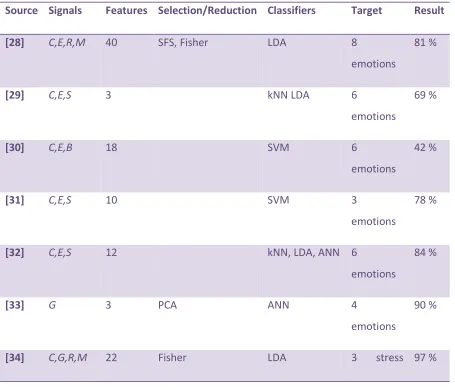
The table with respect to source below
illustrates the summary; infer the mental
state from physiological signals.
Table 1: A summary of 11 studies that have tried to infer a mental state from physiological
signals. They all employed a similar approach: first, a certain mental state (e.g., stress,
certain emotions, mental workload) is induced in participants, while a number of
physiological signals are measured. Subsequently, a variety of features is extracted and
pattern recognition and machine learning techniques are employed to enable the
automatic classification of the emotional states [C].
Source Signals Features Selection/Reduction Classifiers Target Result
[28] C,E,R,M 40 SFS, Fisher LDA 8
emotions
81 %
[29] C,E,S 3 kNN LDA 6
emotions
69 %
[30] C,E,B 18 SVM 6
emotions
42 %
[31] C,E,S 10 SVM 3
emotions
78 %
[32] C,E,S 12 kNN, LDA, ANN 6
emotions
84 %
[33] G 3 PCA ANN 4
emotions
90 %
Available Online At www.ijpret.com
levels
[35] C,G,S,M,P 46 kNN, SVM, RT,
BN
3
emotions
85 %
[36] C,G,S,P 11 SVM 2 stress
levels
90 %
[37] C,E 20 ANOVA SVM, ANN 2 fun
levels
70 %
[38] C,E,M,R 15 SVM, ANFIS 4 affect
states
79 %
[39] E,M 10 ANOVA, PCA kNN, SVM,
ANN
4
emotions
61 %
Notes: C: Cardiovascular activity; E: Electrodermal Activity; R: Respiration; M:
Electromyogram; B: Electroencephalo- gram; S: Skin temperature; P: Pupil Diameter; ANN:
Artificial Neural Network; RT: Regression Tree; BN: Bayesian Network; SVM: Support Vector
Machine; LDA: Linear Discriminant Analysis; kNN: k Nearest Neighbors; ANFIS: Adap
tive neuro-fuzzy inference system; PCA: Principal Component Analysis; SFS: Sequential
Available Online At www.ijpret.com CONCLUSION
The paper described some methods for
emotion recognition. Every method has its
strength and weakness, also strongly
depending on the evaluation context. Firstly
the traditional method which support in
recognition of emotion with respect to face
and gesture on the desktop platform. But,
how this method support accessing
emotions in a mobile context remains
unsolved.
Secondly, about the psycho-physiological
methods in HCI, this is based on firsthand
experience. The method is carried with
respect to motion aspect in mobile situation
and research based on movement and
psycho-physiological measurement
methods. In which, EMG provides more
accurate result than facial expression
recognition with video analysis because low
evocative emotions are difficult to
recognize visually, though it is a viable and
reliable method to measure positive and
negative emotional states even when
participant is moving. Viz., sensors with
cable are attached in the face, which is
obtrusive for participants. In case of EDA, is
a well researched and valid method to
record arousal but , the main constraints of
EDA are the room temperature, humidity,
participant activities and the correct
attachment of the electrodes. Further,
respiration also plays an important role in
measurement of negative valence and
arousal. The method also suggested the
study of cardiovascular function related to
‘HR’, ‘HR’, ‘BVP’ to determine the valence
and arousal, this method should not be
applied unimodal because, a multimodal
approach is more accurate and results in a
broader spectrum of emotion but has the
disadvantages that multiple channels have
to be combined, analyzed and finally
interpret.
In the third model method, also suggest the
useful technique for recognition of
emotion. It consists of set of modules, but
the acquisition of emotional data is
captured through emotion sensing device
thus, the physiological data may comprise
of artifact that encounters the problem in
investigating the emotion. These artifacts
are more problematic in mobile setting. To
overcome the constraints, MEM guidelines
Available Online At www.ijpret.com intelligence vision perfectly. Although
combining wearable and intelligent devices
into smart environments is a great
challenge but, holds a great promise for
future technology and lifestyle.
REFERENCES
1. Hyun-Jun Kim, Young Sang Choi,
“EmoSens: Affective Entity Scoring, A Novel
Service Recommendation Framework for
Mobile Platform”, RecSys’11, October
23-27,2011, Chicago, Illinois, USA., Copyrights
2011 ACM 978-1-4503-0683-6/11/10 ,
2011.
2. Brave, S., Nass, C.,” Emotion in
Human-Computer-Interaction”, In: Jacko, J.A.,
Sears, A. (Eds.). The Human- Computer
Interaction Handbook, Lawrence Erlbaum,
New Jersey, 81-96.
3. Picard R.W., Vyzas E., Healey J., “Toward
Machine Emotional Intelligence - Analysis of
Affective Physiological State”, IEEE
Transactions on Pattern Analysis and
Machine Intelligence, Vol 23 No. 10 October
2001.
4. Peter C., Beale R. (eds.),”Affect and
Emotion in Human-Computer Interaction”,
LNCS, vol. 4868. Springer, Heidelberg
(2008).
5. Peter C., Schultz R., Voskamp J., Urban
B., Nowack N., Janik H., Kraft K., Göcke R.,”
EREC-II in Use –Studies on Usability and
Suitability of a Sensor System for Affect
Detection and Human Performance
Monitoring”, J. Jacko (Ed.):
Human-Computer Interaction, LNCS 4552, pp. 465–
474, 2007. © Springer-Verlag Berlin
Heidelberg.
6. Russell, J. A., “A Circumplex Model of
Affect”, In Journal of Personality and Social
Psychology 39, pp. 1161- 1178. Elsevier
Science Inc, 1980.
7. S. Dornbush K. Fisher K. McKay A.
Prikhodko Z. Segall, ” XPOD – A Human
Activity and Emotion Aware Mobile Music
Player”, University of Maryland Baltimore
County, United States.
8. Raento M.,Oulasvirta A.,Petit R,and
Toivonen H.,”ContextPhone: A Prototyping
platform for Context-aware Mobile
Application”,IEEE Pervasive Computing.
Available Online At www.ijpret.com
9. Yadid Ayzenberg, Javier
Harnandez,Roselind W. Picard, ”FEEL:
Frequent EDA and Event Logging-A Mobile
Social Interaction Stress Monitoring
Systems”, CHI’12, May 5-10,2012, Austin,
TX, USA. ACM 978-1016-1/12/05, 2012.
10. Cornelia Setz, et.al. “Combining
worthless sensor data”, MobileHCI ’09,
September 15 – 18, 2009, Bonn, Germany.
ACM 978-1-60558-281-8.
11. Hassenzahl, M. & Sandweg, N., “From
mental effort to perceived usability:
transforming experiences into summary
assessments”, in 'CHI '04: CHI '04 extended
abstracts on Human factors in computing
systems', ACM, New York, NY, USA, pp.
1283—1286 , 2004.
12. Glowinski, D.; Camurri, A.; Volpe, G.;
Dael, N. & Scherer, K.; “Technique for
automatic emotion recognition by body
gesture analysis”, Computer Vision and
Pattern Recognition Workshops, 2008.
CVPRW '08. IEEE Computer Society
Conference on, 1-6, 2008.
13. De Silva, L., “Audiovisual emotion
recognition, Systems, Man and
Cybernetics”, IEEE International Conference
on 1, 649-654 vol.1, 2004.
14. Gomez, P.; Stahel, W. A. & Danuser, B.,
“Respiratory responses during affective
picture viewing”, Biological Psychology
67(3), 359 - 373.
15. Eva Ganglbauer, Johann Schrammel,
Arjan Geven, Manfred Tscheligi,
“Possibilities of Psychophysiological
Methods for Measuring Emotional Aspects
in Mobile Contexts”, MobileHCI’09,
September 15 - 18, 2009, Bonn,
Germany.ACM 978-1-60558-281-8. , 2009
16. Hazlett, R. L. & Benedek, J., “Measuring
emotional valence to understand the user's
experience of software”, Int. J.
Hum.-Comput. Stud. 65(4), 306--314., 2007
17. Cacioppo, J. T.; Petty, R. E.; Losch, M. E.
& Kim, H. S., “Electromyographic activity
over facial muscle regions can differentiate
the valence and intensity of affective
reactions”, Journal of personality and
sociapl psychology 50(2), 260—268, 1986.
18. Karapanos, E.; Hassenzahl, M. &
Martens, J.-B., “User experience over time”,
Available Online At www.ijpret.com 19. Mandryk, R. L.; Inkpen, K. M. & Calvert,
T. W., “Using psychophysiological
techniques to measure user experience
with entertainment technologies”,
Behaviour & Information Technology 25(2),
141-158, 2006
20. Dawson, M. E., “The Electrodermal
System” in Cacioppo, J. T.; Tassinary, L. G. &
Berntson, G., ed.(2007), Handbook of
Psychophysiology, Cambridge University
Press.2007
21. Mandryk, R. L.; Inkpen, K. M. & Calvert,
T. W.,”Using psychophysiological
techniques to measure user experience
with entertainment technologies”,
Behaviour & Information Technology 25(2),
141-158, 2006
22. Ward, R. D. & Marsden, P. H.,
“Physiological responses to different WEB
page designs”, Int. J. Hum.-Comput. Stud.
59(1-2), 199—212, 2003
23. Glowinski, D.; Camurri, A.; Volpe, G.;
Dael, N. & Scherer, K., “Technique for
automatic emotion recognition by body
gesture analysis”, Computer Vision and
Pattern Recognition Workshops, 2008.
CVPRW '08. IEEE Computer Society
Conference on, 1-6,2008.
24. Ward, R. D. & Marsden, P. H.,
“Physiological responses to different WEB
page designs”, Int. J. Hum.-Comput. Stud.
59(1-2), 199—212,2003.
25. Syed Shahbaz Hussain, Syed Shahbaz
Hussain”, Emotion Recognition on the Go:
Providing Personalized Services Based on
Emotional States”, ACM, 2009.
26. Joris H. Janssen, Egon L. van den Broek,
“Guidelines for mobile emotion
measurement”, MobileHCI ’09, September
15 – 18, 2009, Bonn, Germany. ACM
978-1-60558-281-8.
27. L. Heath, “Triangulation: Methodology”,
pages 15901-15906. Elsevier Science Ltd. :
Oxford, UK, 1 edition, 2001. ISBN:
978-0-08-043076-8.
28. R. W. Picard, E. Vyzas, and J. A. Healey,
“Toward machine emotional intelligence:
Analysis of affective physiological state”,
IEEE Transactions on Pattern Analysis and
Available Online At www.ijpret.com 29. F. Nasoz, K. Alvarez, C. L. Lisetti, and N.
Finkelstein, “Emotion recognition from
physiological signals for presence
technologies”, International Journal of
Cognition, Technology, and Work, 6:4{14,
2003.
30. K. Takahashi, “Remarks on emotion
recognition from bio-potential signals”, In
Proceedings of the IEEE International
Conference on Systems, Man and
Cybernetics, volume 2, pages 1655{1659,
Palmerston North, New Zealand, 5{8
October 2003.
31. K. H. Kim, S. W. Bang, and S. R. Kim,
“Emotion recognition system using
short-term monitoring of physiological signals”,
Medical and Biological Engineering and
Computing, 42:419{427, 2004.
32. C. L. Lisetti and F. Nasoz, “Using
noninvasive wearable computers to
recogniza human emotions from
physiological signals”, Journal of Applied
Signal Processing, 11:1672{1687, 2004.
33. A. Choi and W. Woo., “Physiological
sensing and feature extraction for emotion
recognition by exploiting acupuncture
spots”, Lecture Notes in Computer Science,
3784:590{597, 2005.
34. J. A. Healey and R. W. Picard, “Detecting
stress during real-world driving tasks using
physiological sensors”, IEEE Transactions on
Intelligent Transportantion Systems,
6:156{166, 2005.
35. P. Rani, C. Liu, N. Sarkar, and E. Vanman,
“An empirical study of machine learning
techniques for a_ect recognition in
human-robot interaction”, Pattern Analysis &
Applications, 9(1):58{69, 2006.
36. J. Zhai and A. Barreto, “Stress detection
in computer users based on digital signal
processing of noninvasive physiological
variables”, Biomedical Science
Instrumentation, 42:495{500, 2006.
37. G. N. Yannakakis and J. Hallam,
“Entertainment modeling through
physiology in physical play”, International
Journal of Human-Computer Studies,
66(10):741{755, 2008.
38. C. D. Katsis, N. Katertsidis, G. Ganiatsas,
and D. I. Fotiadis, “Toward emotion
recognition in car-racing drivers: A biosignal
Available Online At www.ijpret.com Systems, Man, and Cybernetics{Part A:
Systems and Humans, 38(3):502{512, 2008.
39. E. L. van den Broek, V. Lis_y, J. H.
Janssen, J. H. D. M. Westerink, M. H. Schut,
and K. Tuinenbreijer.,”Affective
Man-Machine Interface: Unveiling human
emotions through biosignals”, page [in
press]. Berlin/Heidelberg, Germany: