Available Online At www.ijpret.com
INTERNATIONAL JOURNAL OF PURE AND
APPLIED RESEARCH IN ENGINEERING AND
TECHNOLOGY
A PATH FOR HORIZING YOUR INNOVATIVE WORK
THE HUMAN IMMUNE SYSTEM AND NETWORK SECURITY SYSTEM
PROF. DHANASHREE D. UMALE
Department of Computer Science & Engineering, Nova College of Engineering, Nagpur
Accepted Date:
27/02/2013
Publish Date:
01/04/2013
Keywords
Intrusion Detection,
Intrusion Response,
Vulnerability Analysis,
Mobile Agents,
Immune System,
Intrusion Deterrence.
Corresponding Author Prof. Dhanashree D. Umale
Abstract
Most of the current security systems do not provide adequate
level of protection against ever-increasing threats. The main
reason for their failure is the use of point solutions to protect
hosts and reactive approach against intrusions. We studied
human immune system, which survives under dynamic
changing conditions and provides protection against biological
viruses and bacteria. By taking immune system as an analogy,
we propose an end-to-end network security system using
mobile agents. Our solution not only overcomes limitations of
traditional security solutions, but also enhances overall
security by providing protection at each stage of the attack
timeline. It functions in proactive and also reactive manner
and has ability to learn and improve its strategies, equivalent
to what human immune system does against viruses and
Available Online At www.ijpret.com 1. Introduction:
Information systems are required to survive
in different environments in order to
continuously provide their services. They
must be adaptable to different dynamic
environments in order to provide reliable
services. We have studied the systems that
survive in nature in order to understand
how to provide survivability to IT systems.
One example of a natural system that
survives in different dynamic environments
is human immune system [4]. At the lowest
level the human body consists of cells.
These cells form tissues. The tissues
combine to form organs and organs are
combined to form complete systems, like
immune, digestive, and reproductive
system [3]. Cells in the immune system are
produced by special areas in the body, like
the thymus and the bone marrow [3]. There
are different damaging agents (i.e. viruses,
bacteria) that can destroy the body. But the
immune system is able to identify, locate
and remove these damaging agents what
allows the body to survive and maintain
itself for many years [3]. The immune
system enables humans to survive in
different environments. Over the past few
years research community and commercial
product vendors came up with many
solutions to protect network from
intrusions: antivirus, firewall, spyware and
authentication mechanism. These solutions
still face the challenges of inherent system
flaws, OS bugs, and social engineering
attacks. Intrusion Detection Systems (IDS)
fail to provide adequate protection due to
the fact that they cannot detect and
respond to all intrusions in real-time,
because most of them require
customization and human reaction by
system administrators. It is very difficult for
a system administrator to analyze large logs
generated by network traffic, identify the
attack, and respond in real-time. Traditional
IDSs open a window of opportunity for
attacker, because of the delay in attack
identification and response by system
administrators. The major drawback in all
available solutions is their methodology of
protection. First, the methodology is
reactive: reaction starts when there is
already an intrusion in progress. Second,
there is no learning mechanism at a
network level to study and learn about
Available Online At www.ijpret.com
the same intrusion to the rest of the
network. Third, there are no preventive
measures taken against foreseeable threats
that can turn into intrusions based on
existing vulnerabilities in the system, which
become the cause of zero-day attacks. A
number of researchers have applied the
immune system features in securing
information systems ([3], [4], [5]).The
following features of the immune system
are applied in information security systems:
learning to detect new viruses; detecting
viruses locally; identifying viruses;
classifying and eliminating viruses
autonomously; multiple layered protection
system; different cells being able to detect
different viruses and few ‘self’ cells being
able to detect multiple viruses; and
remembering discovered viruses. There is a
need to revisit existing methodologies with
an intension to improve them by applying
the concept of immune system to achieve
comprehensive security for information
systems. In this paper we present the
system that functions in six stages to secure
information systems against intrusions. Our
system is based on the concepts of
prevention, deterrence, detection,
response, and learning as similar as in
human immune system. We used mobile
agents along with different sensors to
achieve the desired results of our
comprehensive security system.
As the first step our system detects and
eliminates vulnerabilities, which are usually
being exploited by intruders. Second, our
system provides access control mechanism
that blocks all illegal accesses based on
predefined security policy. However, it is
possible that attacks overcome the above
two preventive measures. Therefore, as the
third step, we have mechanism to detect
intrusion attempts in real-time based on
Intrusion Detection System (IDS). As the
forth step, an Intrusion Response System
(IRS) is activated in response to alerts
generated by the IDS in order to limit
Available Online At www.ijpret.com 2. Related Work
1.1 Misuse Intrusion Architecture: Prevent, Detect, Monitor and Recover Internal Fraud
The article [1] describes architecture
against misuse intrusion used for
preventing, detecting, monitoring and
recovering frauds that are caused by
employees. The architecture is based on a
holistic approach that considers different
types of factors, both technical and
non-technical. The architecture has managerial,
operational, technical and other controls.
The measures used for prevention of
employee frauds include perimeter defence
technology, recruitment screening,
segregation, training, and supervision [1].
Measures for detecting frauds include
internal auditing, authorization and also
technical measures including both network
and host based intrusion detection systems.
The measures for monitoring are placed at
the network, operating system, and
application levels [2]. At the network level
measures include monitoring access to
sensitive assets, monitoring downloads,
spamming, and network games. At the
operating level monitoring is on system
calls, on CPU usage, audit trails, and file
access. At the application level monitoring
is done on interactions of users with
different applications like requests and
responses, access patterns, user inputs, and
applicationdamages. The fifth step is use of
Post Intrusion Vulnerability Analysis
mechanism, which detects the cause of
intrusion by identifying the vulnerability
that had been exploited by the attacker.
Once that specific vulnerability has been
identified, the system applies preventive
measures against the likely exploitation of
the same vulnerability. Finally, all hosts in
the network must be kept up-to-date with
respect to security technologies, security
configurations, and updates installed.
The following figure shows our approach
using the attack timeline based on the
immune system concept.inputs [2].
Recovery measures include fraud evidence
collection and interpretation measures,
which include evidence identification and
collection, analysis, storage, preservation,
transportation and presentations in courts
Available Online At www.ijpret.com 1.2 Integrated Innate and Adaptive
Artificial Immune Systems applied to Process Anomaly Detection
In the doctoral thesis [3] artificial immune
systems are applied to solve security
problems in software systems.
The biological immune properties were
applied in increasing the performance of
artificial immune systems (AIS). The thesis
presents nine design principles for the
second generation’s artificial immune
systems. The first principle is that artificial
immune systems are represented as
autonomous agents. The second principle
states problems when AIS are represented
as antigens or external (intrusion) signals.
The third principle states that the aim of the
second generation AIS is to maintain
themselves and their environments. The
fourth principle defines the functions of
agents being to capture antigens, to
process, to present, to recognize, to
monitor process and produce signals [3].
The fifth design principle states that agents
have a life cycle. The sixth design principle
states that agents communicate with the
environment at multiple levels. The seventh
design principle states that signals canbe
externally or internally produced. The eight
design principle states that receptors can be
specific, internal or external signals. Te last
principle states that agents can specialize in
specific tasks [3].
1.3 Architecture for Intrusion Detection using Autonomous Agents (AAFID)
AAFID [18], proposed at Purdue in 1998, is
an agent based hierarchal architecture for
IDS. It decomposes the traditional IDS into
lightweight autonomous cooperating
agents, which can easily reconfigure.
Autonomous agents used in AAFID project,
using static and special purpose agent
platform, are used to dynamically
reconfigure IDS components. The other
thing worth noticing is that AAFID is based
on a hierarchal architecture, which is
vulnerable, to direct attacks. If any of the
internal nodes is compromised, the whole
branch is disabled. Secondly, the transfer of
large logs across the hierarchy also
Available Online At www.ijpret.com 1.4 Automated detection of vulnerabilities
in privileged programs by execution monitoring (ADVP)
ADVPP project [8] worked on detection of
vulnerability exploitations in privileged
programs by monitoring operational audit
trails. Their work is based on the
assumption that privilege programs are
more likely to exploit vulnerabilities. They
have introduced the Program Policy
Specification Language based on a simple
predicate logic and regular expressions.
3. Immune System Features for Information Security Systems
Every information system is recommended
to have deterrence measures, prevention
measures, detection measures, response
measures, and recovery [19]. The immune
system has the following features [4] that
can be applied to information security
systems: (i) Distributed – The T-cells and
B-cells can detect infections and viruses
locally without doing any global
coordination. In this work we model this
feature by having mobile agents act as cells
in Vulnerability Analysis System (VAS),
Intrusion Detection System (IDS), Intrusion
Response System (IRS), and Security
Management (SMS). (ii) Multi-layered – The
immune system has multiple defence
layers, defence in depth. This is modeled by
having multiple protections at the boundary
of a system and inside the system and
redundancy protection for all sub-systems
[4] [15]. (iii) Diversity – with diversity,
vulnerabilities in one system are less likely
to be widespread [4] [15]. Diversity could
be provided by having agents doing a
variety of functions; autonomy – the
immune system does not require outside
maintenance or management. It
autonomously classifies and eliminates
foreign cells and it repairs itself by replacing
damaged cells. This behavior is the core of
mobile agent technology, mobile agents act
autonomously based on their task
specifications and achieve the desired
goals.(iv) Adaptability – the immune system
is able to detect and to learn to detect new
foreign cells and retains the ability to
recognize previously detected foreign cells
through immune memory [4] [15]. This
feature is not new in computer systems,
though determining with 100% that a
Available Online At www.ijpret.com
problem. We model this feature by enabling
mobile agents to learn to adapt to the new
intrusions and attacks by using the
conceptual architecture of the artificial
immune model [15].(v) Dynamically
changing coverage – The immune system
has a limited amount of cells for detection
in any moment. There are about 1016
foreign cells in the environment where
humans spend their lives and these foreign
cells must be detect by the limited quantity
of detectors of the immune system [4] [15].
The immune system solves this by
maintaining a random sample of its
detectors that circulates throughout the
body. This is modelled in our system by
having one agent– based system that
detects multiple intrusions, abnormalities
and viruses, analyze multiple vulnerabilities,
and perform multiple functions in the
Vulnerability Analysis System, Intrusion
Detection System, Intrusion Response
System, and Security Management
System.(vi) Identification – The immune
systems marks all the cells that belong to
the body as ‘self’ [4] [15]. We model this
feature in our system by providing ‘self’
identities to all the objects of a system and
by registering them in the database. There
are agents that monitor the system and
when they find objects that are not having
‘self’ identities are handled according to the
system’s policy. We apply the negative
algorithm and cloning algorithms [4] [15] to
generate and train mobile agents for the
four subsystems vulnerability analysis
system, intrusion detection system,
intrusion response system, and the security
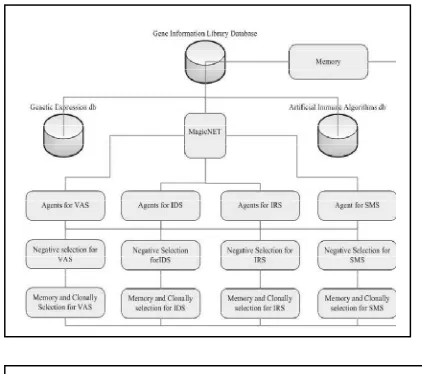
management sub systems.This genetic
information library database, shown in
Figure 2, contains genes that have been
predetermined based on the a priori
knowledge [16]. These genes are combined
to form different solutions like the way you
combine Lego blocks to form some solution
[16]. The gene libraries provide information
for the MagicNET agent creator [17]. as
shown in Figure 2. The MagicNET system
acts like a bone marrow in the human body
in which the B-cells are created [15] [16].
MagicNET combines genetic expressions
from the database of genetic expressions
and artificial immune algorithms from the
database of artificial immune system
Available Online At www.ijpret.com
software agents are given specialized
features for Vulnerability Analysis System
4. System Overview
We have developed the complete system in
our so called MagicNET Environment.
MagicNET is comprehensive Mobile Agents
System that provides features like creation,
appraisal, trust evaluation, privileges
assignment, and secure adoption of mobile
agents and the secure runtime support for
mobile agents’ execution [17]. The
proposed network security system
comprises four subsystems. Figure 3 shows
the layered architecture of the system. The
four subsystems are equivalent to the
human immune system functional concept.
These subsystems are as follows:
a. Vulnerability Analysis System (VAS)
i. Pre-Intrusion Vulnerability
Analysis(VAS), Intrusion Detection System
(IDS), Intrusion Response System (IRS), and
Security Management System (SMS), as
shown in Figure 3. Agents are tested by
using a negative selection algorithm [4] [15]
to make sure that they detect only objects
that do not belong to the system. Those
agents that pass this test are allowed to
perform different tasks in the system. The
agents that perform better according to
specified criteria in the policy are cloned
and stored into memory. Future agents are
created using the features in memory. In
this way the system learns how to adapt to
the environments. The next section
describes the implementation of the
system.
ii. Post-Intrusion Vulnerability Analysis
iii. Vulnerabilities Record Management
b. Intrusion Detection System (IDS)
i. Host based Intrusion Detection
ii. Distributed Intrusion Detection
c. Intrusion Response System (IRS)
Available Online At www.ijpret.com
i. Host based Intrusion Response
ii. Distributed Intrusion Response
d. Security Management (SMS)
i. Vulnerability Rule Updater Moreover, the
following three components work with
these systems to provide comprehensive
network security system.
e. Mobile Agents (MAs)
f. ID\IP Components
g. MagicNET Management Console (MMC)
The presented solution is tightly coupled
with the number of mobile agents which
provide flexibility, scalability, platform
independence and reliability to the system.
Moreover, mobile agents can execute
asynchronously, autonomously and can
adapt dynamically at different stages of
attacks timeline and thus provide a robust
security mechanism. At the abstract level,
these mobile agents are acting as
middleware between ID/IP components and
the overall system’s core functionality.
MMC provides graphical interface to
Security Administration Station, in short
SecAdmin, and to remote servers. At
SecAdmin, MMC helps security
administrator
4.1 Vulnerability Analysis System (VAS)
As the first step, VAS – Vulnerabilities
Record Management provides security
administrator with up-to date and rich
information about vulnerabilities. This has
been achieved by using three vulnerabilities
databases:
NVD, OSVDB and Security Focus [9] [10],
and generating IDP System’s own database
called Vulnerabilities DB. Vulnerabilities DB
is a rich database which contains relevant
information about most of known
vulnerabilities to date. VAS updates DB
daily, weekly, or monthly, depending on a
local security policy. Second, Pre-Intrusion
Vulnerability Analysis provides capability to
Available Online At www.ijpret.com
query remote servers regarding their profile
in terms of different software installed. It is
necessary to acquire host profile for
effective Vulnerability Analysis. to execute
different tasks and observe activities and
results of mobile agent’s processing. At
remote servers, it provides mechanism to
display information about different agents
visiting and performing different actions.
Mobile Agents interact with number of
ID/IP Components on remote host to
accomplish their tasks. These components
are in fact static agents that perform certain
predefined tasks. In our implementation we
have used five IDP components: SNORT,
Osiris, Windows firewall, j Registry, System
logs and Nessus [12][13]. We will not go
into the details of these components due to
space limitation.
Two agents perform this activity:
VAS brings the remote host profile and
queries Vulnerabilities DB for
vulnerabilities. If they exist, it stores
vulnerabilities in the Vulnerabilities DB and
displays the result on the administrative
interface. Most of the IDS and Intrusion
Response Systems (IRS) consider their task
accomplished, after they detect and
respond to intrusion. It can be easily
inferred that intruder will try to exploit the
same vulnerability at a different system in
the network. Post-Intrusion Vulnerability
Analysis provides capability to analyze the
particular vulnerability that was being
exploited by intruder in the most recent
attack. The main purpose of this analysis is
to identify the exploited vulnerability at a
particular host and then apply preventive
measure to the rest of the network against
specific vulnerability. This activity is
performed with the help of
Agent_Post_Intrusion_Vulnerability_Analyz
er.
As soon as IRS finishes it’s task and reports
to the
Administrative Server (the Server from
where agents were launched the first time),
the Administrative Server automatically
launches
Agent_Post_Intrusion_Vulnerability_Analyz
er in order to analyze the particular host
previously under attack by analyzing the
Available Online At www.ijpret.com
SNORT. Administrative Server stores
vulnerability information in the
Vulnerabilities DB in the Exploited
Vulnerabilities table.
4.2 Intrusion Detection System (IDS)
In an IDP system, a team of mobile agents is
dispatched in the network in response to a
suspicious alarm. They analyze the
statistical data related to different intrusion
attempts like DoS attack, DDoS, Doorknob-
Rattling Attack [11] etc, and then request
for reinforcement from the Security
Administrator.
First SIDS, analysis of logs and reporting is
performed on logs generated by system
events and sensors, like SNORT or Osiris on
remote hosts. Analysis of logs notifies
Security Administrator about the intrusion.
Agent_IPS_Logs agent along with the
Agent_Leader agent analyzes these logs,
filter them, extract relevant and useful
information, and display results to the
Security Administrator.
Second, Host–based Intrusion Detection
(HID) subsystem monitors the network
hosts for different types of intrusions and
reports as soon as some intrusion occurs, so
that appropriate response measures by SIRS
can be applied. Host monitoring is being
performed by continuously analyzing
SNORT logs. Agent_Host_Monitoring
initially is not present at remote hosts.
Security administrator launches
Agent_Host_Monitoring agent. It along with
Agent_Leader reaches remote hosts and
stays there permanently. They continuously
investigate log entries generated by SNORT,
OSIRIS and as soon. If they find any
intrusion based on SNORT rules, they ask
for help from the administrative server.
Third, Distributed Intrusion Detection (DID)
subsystem works equivalent as Host–based
Intrusion
Detection, but it is activated by the
detection of suspicious activity below the
intrusion threshold, by ID components.
Agent_Host_Monitoring provides the signal
for the activation of DID. DID creates
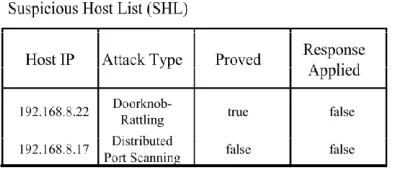
Suspicious Host List (SHL)
[12], specific to each type of attack, and
then logs the addresses of each host
Available Online At www.ijpret.com
Figure 4 shows the structure of the SHL.
Figure # 4 Suspicious Host List (SHL)
Structure
At this instance of time DID, launches
Agent_Distributed_Intrusion_Analyzer
(ADIA) along with Agent_Leader and
Agent_Distributed_Messenger to visit each
host in the SHL, analyze data from system
logs, and then correlate and aggregate
them with system logs of other entries of
SHL to gather traces of the attack. If result is
positive, then
Agent_Distributed_Messenger immediately
returns back to the Administration Server
and marks Proved field as true in the SHL
for hosts under the distributed intrusion
attack, notified by a message to the
administrator. Before launching an ADIA,
DID creates a static agent i.e.
Agent_SHL_Monitoring that constantly
monitors SHL for any change in the Proved
fields of different entries.
In order to understand the described
scenario take an example of a
Doorknob-Rattling Attack in which attacker tries few
common password and username
combinations on many computers that
result in failed login attempts [11].
These failed login attempts, as events are
logged into the system log.
Agent_Host_Monitoring detects these
events, marks them as suspicious, and
reports to the administrator, where DID
creates SHL, fills host IP field and marks
attack type as Doorknob-Rattling. DID then
launches
Agent_Distributed_Intrusion_Analyzer
along with Agent_Leader and
Agent_Distributed_Messenger to visit each
host in the SHL, and analyze data from
system logs for Doorknob-Rattling attack.
4.3 Intrusion Response System (IRS)
IRS is tightly coupled with the IDS and it is
activated as soon as the IDS detect some
intrusion at remote hosts for both cases i.e.
Host–based Intrusion and Distributed
Intrusion. The purpose of the IRS is to
prevent the intrusion in real time. It
Available Online At www.ijpret.com
counter the attack by any mean, like
blocking the address from where the attack
initiated, closing the port, shutting down
service or program, or shutting down of
remote host which is under attack in order
to stop contamination in the network.
Agent_Intrusion_Response along with
Agent_Leader is automatically launched
(event based) from the Administrative
Server to the host that reported an
intrusion. Agent_Intrusion_Response
reaches the desired host, creates the
response, and then reports to the
Administrator. The response is
implemented using decision tables. Decision
table is a mechanism that associates each
attack with a specific response. It is the
basis for static mapping and does not
consider any other factor, except the attack
type. Agent_Intrusion_Response is using
firewall to implement its responses against
intrusions.
As soon as Agent_Distributed_Messenger
mark, Proved field true
Agent_SHL_Monitoring launches
Agent_Intrusion_Response along with
Agent_Leader. Agent_Intrusion_Response
applies appropriate response to all hosts in
the SHL that have confirmed intrusion and
reports back to the Administrator.
4.4 Security Management System (SMS)
SMS also uses mobile agents to perform
management tasks in the network. The
purpose of these tasks is to keep all hosts in
line with respect to number of security
services, solutions, or security
configurations. SMS performs four tasks.
First, test connectivity of remote host,
second query remote host configurations,
and third apply a number of security
management tasks to remote hosts and
exploited vulnerability and SNORT rule
mapping. SMS performs\ these tasks with
the help of a number of MAs as follows:
Test Connectivity: Security administrator
tests the connectivity of remote hosts by
launching Agent_Get_IP along with
Agent_Leader. Agent_Get_IP reaches
remote host if it is running and connected
to network, gets its IP, and reports to the
Available Online At www.ijpret.com
Host Configuration: has acquired with the
help of
Agent_Configuration_Inquiry that moves to
the remote host, checks the configuration
of remote host, and returns results to
SecAdmin. Configuration of remote host
includes OS type, OS version, user logged
on, SNORT running status, number of
SNORT rules and Osiris database generation
date. These configuration items help
security administrator to familiarize
himself/herself with various security
services running on remote host and their
status. Configuration Management: it is
performed by
Agent_Configuration_Management (ACM).
ACM at remote host interacts with firewall
and SNORT sensors in order to implement
security management task. These security
management tasks are to enable/disable
firewall, enable/disable port, enable/disable
services, enable/disable programs running,
run SNORT and add SNORT rule.
Agent_Post_Intrusion_Vulnerability_Analy
zer updates Vulnerabilities DB against
exploited vulnerability, then the SMS
launches
Agent_Vulnerability_Responder in the
network that updates the rest of remote
hosts with a SNORT rule that detect the
exploitation of that specific vulnerability
which was being exploited earlier. The
mapping between SNORT rules and
Vulnerabilities: In ideal situations
vulnerabilities should have available
patches and security administrator should
update network in advance. On the
contrarily, usually there is a time gap
between discovery of vulnerabilities and
availability of their patches. This time gap
can become a window of opportunity for an
attacker. In order to cater this problem, as
soon as intrusion attempt has discovered
and responded to first time, a SNORT rule
will be created for that specific
vulnerability,
Agent_Vulnerability_Responder will use it
later. Currently in the IDP system the
security administrator is performing this
task, but in our future research intelligent
MAs, based on network condition, would
Available Online At www.ijpret.com 5. Conclusion
This paper has presented network security
system that applies features from the
immune system to secure systems. The
system has features that help information
security system learn to adapt to dynamic
environments. This system uses secure
mobile agents to protect systems and
networks. These mobile agents are
generated and tested using the negative
and clonally selection algorithms. The
secure mobile agents that pass these tests
are allowed to perform the vulnerability
analysis, intrusion detection, intrusion
response, and security management
services. We have implemented the system
using secure mobile agents which take
input from sensors like, SNORT, Firewall,
Nessus, and Osiris. Mobile agents process
the inputs from sensors and based on
subsystem functionality perform various
activities and finally output (protective
measure) using sensors again. Our
implementation shows significant
improvements in network security and as
by deploying system, there is significant
reduction in intrusions, as our system
catered them using multifaceted approach,
similar to the human immune system.
6. References
1. N.T. Baloyi. Misuse intrusion
architecture: prevent, detect, monitor and
recover employee fraud, The Proceedings of
the Information Security South Africa 2005
New knowledge today conference.
Sandtorn, South Africa.
2. Furnell, S. Enemies within: the problem
of insider attacks, Computer fraud &
security. Volume 2004, issue 7, July 2004.
3. Twycross, J.P. Integrated innate and
adaptive artificial immune systems applied
to process anomaly detection. University of
Nottingham. 2007.
www.cs.nott.ac.uk/~jpt/papers/phd-thesis.pdf
4. A. Somayaji, S. Hofmeyr and S. Forrest.
Principles of Computer Immune System,
1997 New Security Paradigms Workshop,
ACM p75-82
5. Symantec. The Digital Immune System,
Enterprise-grade Anti-Virus Automation in
Available Online At www.ijpret.com www.symantec.com/avcenter/reference/di
s.tech.brief.pdf
6. Tenable Network Security, NESSUS
http://www.nessus.org/nessus/ last
retrieved 01 December 2008.
7. Xinyou Zhang and Chengzhong Li,
Intrusion Prevention System Design,
Proceedings of the The Fourth International
Conference on Computer and Information
Technology (CIT'04)
8. Ko, C. Fink, G. Levitt, K. Automated
detection of vulnerabilities in privileged
programs by execution monitoring,
Proceedings of Computer Security
Applications Conference, 1994. P 134-144.
9. National Vulnerability Database,
http://nvd.nist.gov/ last retrieved
December 01, 2008.
10. The Open Source Vulnerability
Database, http://www.osvdb.org/ last
retrieved December 01, 2008.
11. S. Ahmed, S. Muftic, Intrusion
Prevention System based on Secure Mobile
Agents, Thesis Report, Department of
Computer and Systems Sciences (DSV-KTH),
March 2006.
12. SNORT www.SNORT.org last retrieved
December 01, 2008.
13. Osiris User Hand Book
http://osiris.shmoo.com/handbook.html#p
art1_chap1 last retrieved December 01,
2008.
14. Jung Won K.; Bentley, P, The Human
Immune System and Network Intrusion
Detection, Department of Computer
Science, University of London, Gower
Street, London, WCIE 6BT, U.K.
15. Jung Won Kim, Integrating artificial
Immune Algorithms for Intrusion Detection,
Ph. D thesis, The Department of Computer
Science, University of London, 2002
16. Kaneshige, J., Krishmakumar K. Artificial
Immune System Approach for air combats
Manoeuvring. NASA Ames Research Centre,
Moffett Field, CA, USA 94035.
17. Shibli, M. A., & Muftic, S. (Feburary
2009). MagicNET: Security Architecture for
Creation, classification and validation of
Available Online At www.ijpret.com
International Conference on Advance
Communication Technology. (Accepted for
publication)
18. P. Kannadiga, M. Zulkernine, DIDMA: A
Distributed Intrusion Detection System
Using Mobile Agents, Proceedings of the
Sixth International Conference on SE. Vol ,
Issue , 23-25 May 2005 Page(s): 238 – 245.
19. Stewart Kowalski, Mariné Boden, Value
Based Risk Analysis: The Key to Successful
Commercial Security Target for the Telecom
Industry, 2nd Annual International Common