Organized by S.V.B.I.T., Gandhinagar. Available Online at www.ijpret.com104
INTERNATIONAL JOURNAL OF PURE AND
APPLIED RESEARCH IN ENGINEERING AND
TECHNOLOGY
A PATH FOR HORIZING YOUR INNOVATIVE WORK
LITERATURE REVIEW ON DESIGN AND CONSTRUCTION OF BITUMINOUS
PAVEMENT USING GLASS WASTE
ROSHAN BHATIA1, ARJUN KOTHARI1, LAVKUSHDATT TRIPATHI1, MITTAL PATEL2
1. UG Student, Department of Civil Engineering, Shankersinh Vaghela Bapu Institute of Technology, Gandhinagar, Gujarat – 382650 2. Assistant Professor, Department of Civil Engineering, Shankersinh Vaghela Bapu Institute of Technology, Gandhinagar, Gujarat - 382650
Accepted Date: 22/12/2018; Published Date: 01/02/2019
Abstract: The bituminous roads are used since years, we know, but nowadays the need to modify the ordinary pavement rises due to high maintenance cost of road system. A large amount of glass materials is generated annually in the world. Which is serious and big issue that we’re facing as most of the amount of waste is not recycled and reused and left in environment. So we aim to the study of the performance of pavement of bitumen in which a crushed glass is used. By that we’ll come to know the properties of glass - bitumen mixture are improved or not in comparison with normal bitumen pavement. Hence, will able to utilize this glass waste properly.
Keywords: Bitumen, Pavement, Waste Glass, Aggregate, Cullet, Recycling, Environment, Utilization.
Corresponding Author: ROSHAN BHATIA
Access Online On:
www.ijpret.com
How to Cite This Article:
Roshan Bhatia, IJPRET, 2019; Volume 7 (6): 104-110
PAPER-QR CODE
SPECIAL ISSUE FOR
2
ndNATIONAL CONFERENCE ON
Organized by S.V.B.I.T., Gandhinagar. Available Online at www.ijpret.com105 INTRODUCTION
Introduction to bituminous pavement:
Bitumen is a black or dark-colored (solid, semi-solid, viscous), amorphous, cementitious material that can be found in different forms, such us rock asphalt, natural bitumen, tar and bitumen derived from oil, which is referred to as petroleum bitumen. Currently most of the roads globally are paved with bitumen. Bitumen (specifically, asphalt concrete), sometimes called flexible pavement due to the nature in which it distributes loads, has been widely used since the 1920s. The viscous nature of the bitumen binder allows asphalt concrete to sustain significant plastic deformation, although fatigue from repeated loading over time is the most common failure mechanism. Most asphalt surfaces are laid on a gravel base, which is generally at least as thick as the asphalt layer although some 'full depth' asphalt surfaces are laid directly on the native subgrade.
Base course layer in a bituminous pavement consists of mineral aggregates such as gravel, stones and sands bonded together with bituminous materials. This layer is used as the foundation on which surface course or binder is placed.
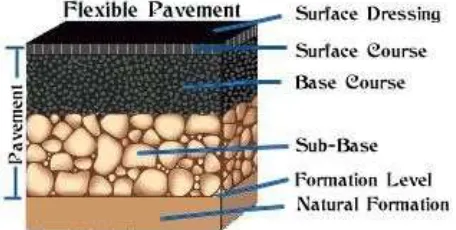
The layers of basic bituminous (flexible) pavement are as followed:
• Subgrade: Subgrades are commonly compacted before the construction of a road
pavement. It is the level at which excavation ceases and construction commences.
• Sub base: It is the layer of aggregate material laid on the subgrade, on which the base
course layer is located.
• Base course: The base course is the layer composed of crushed stone, crushed slag etc.
• Surface course: The layer above the base course where bitumen is laid.
• Surface dressing: Thin film of bituminous binder above surface course.
Fig (a) Flexible (Bituminous) pavement Layers (Source: Google images)
Glass waste:
Organized by S.V.B.I.T., Gandhinagar. Available Online at www.ijpret.com106
with the continuously increased consumption, a large amount of waste glass is generated annually (69 pounds per person per year. 134.2 glass bottles per person per year). In 2017, 7.70 million tonnes of solid waste was generated. [1]
The best way to deal with these wastes is to recycle and reuse them as raw materials or modifiers. Glass can be made by heating ordinary sand (which is mostly made of silicon
dioxide) until it melts and turns into a liquid at extremely high temperature of 1700°C and also
it takes so long… 1 million years to break down naturally. When waste glass is crushed to sand like particle sizes, similar to those of natural sand, it exhibits properties of an aggregate material.
As we can see the amount of waste glass is tremendous and some glass type i.e. hazardous glass, etc. are difficult to recycle or reuse. So we should find the way to perform out the use of waste glass.
II. LITERATURE REVIEW
Vivek Singh, Rakesh Sakale(February 2018)
In this paper, the effect of using waste plastic and waste glass as a modifier in bituminous mix is investigated. HDPE waste plastic is used as modifier in bitumen of VG30 grade and waste glass bottle cullet as fine material in bituminous mix. The initial study was performed on virgin bitumen to investigate the physical characteristic of virgin unmodified binder then HDPE plastics are mixed in virgin bitumen to modify the physical characteristic of bitumen. To mix the HDPE plastic in bitumen 17000C blending temperature and 25mins blending time was adopted
Organized by S.V.B.I.T., Gandhinagar. Available Online at www.ijpret.com107
Merrin Baby, Minu Tresa Jolly, Neenu Baby, Vishnupriya V, Sharon Jacob (July 2017)
In above research paper various laboratory studies are conducted on waste glass as a filler in bituminous mix. In this study, the workability of improving the properties of Bituminous Concrete (BC) mix with waste glass as filler in place of conventional costly fillers like lime and cement was studied. Aggregates, VG-30 bitumen, glass waste, cement and lime were the materials used for preparing BC mixes of Grade 2 as per MORTH. Methods used: Aggregate Proportioning by Rothfutch Method, Marshall Mix Design. They compared Marshall and Volumetric Properties of BC Mixes with Different Fillers and at different glass dosages i.e. 4%, 6%, 8%. Compared properties of normal mix and modified glass mix. Hence, they concluded at the optimum dosage of 6.2%, glass modified bituminous mix showed a higher stability value about 44 than that of normal mixes with quarry dust alone. The addition of glass powder was thus found to make the bituminous mix more stable and resistant to deformations. [3]
Zaydoun T. Abu Salem, Taisir S. Khedawi, Musa Bani Baker and Raed Abendeh (2017)
The above study is about the performance of asphalt concrete mix, where fractional fine aggregate is substituted with different percentages of crushed glass materials of 5%, 10%, 15% and 20 %. They expected that the recycling and use of waste glass in asphalt mixes is feasible. They used various materials in research i.e. Asphalt, Aggregate, Crushed waste glass. The methods used in this research are Conventional fine hot mix aggregate gradations, as specified in AASHTO M29 (ASTM, 1994), Marshall Mix design. The procedure indicated by the standard American Institute MS-2 Manual (2008) and ASTM were used to determine the optimum asphalt content for the mixture. Hence, got the conclusion that max. size of 2.36 mm waste
broken glass can be used in asphalt concrete and the optimum replacement ratio is of 10%.
Also the strength index, high temperature stability and water stability achieved the standards of the asphalt mix design. Hence, using waste glass in hot mixed asphalt will decrease pollution and environmental problems. The most common applications of modified asphalt mix are as surface pavement (surface coarse) for residential streets, secondary roads, parking lots, sidewalks and curbing. [4]
Rabindranath Ghosh, Upvan Kunmar, Shubham Gupta, Vivek Kumar, Azharuddin Malik
(April 2017)
Organized by S.V.B.I.T., Gandhinagar. Available Online at www.ijpret.com108
will not occur. On the other hand, if its percentage increases than overall cost of construction is increased.[5]
Y.1SSA (2016)
Author of this paper studied the performance of pavement asphalt in which a fractional aggregate is replaced with crushed glass. In this paper, some important properties of asphalt mix, including stability, flow, specific gravity and air voids are investigated. The original sample is prepared without adding glass for different percentages of bitumen. Other samples are prepared by adding crushed glass to the mix with 5%, 10%, and 15% by aggregate weight. Various lab tests were conducted on aggregate including sieve analysis, specific gravity, and Los-Angeles tests. Specific gravity test. Nine samples of crushed glass are prepared with 5%, 10%, and 15% by the weight of total aggregates to be (60, 120, and 180 gm) respectively. The main objective of this paper was to study the change in asphalt mixture properties after adding crushed glass from cars windshields. The tests were conducted using the standard Marshall Apparatus. Stability, flow, specific gravity and air voids of the prepared samples were recorded. At last he concluded that crushed glass can be used in asphalt pavement with optimum replacement ratio of 10% by weight of total aggregates. This result can only be used in specific gradation and type of glass to be used. Other type of glass may be producing different results.
[6]
Mehmet Saltan, Betül Oksüz and Volkan Emre Uz(2015)
In this study, the usage of cullet and waste glass bottles dust as mineral filler material in hot mix asphalt as on alternatively to traditional crushed stone dust was investigated. Higher performance and environmentally friendly road pavements can be constructed by the use of by-products instead of traditional materials. The aim of this study is to investigate the stability of waste glass dust as mineral filler in hot mix asphalt (HMA).
Crushed limestone was used as the aggregate. Coarse and fine aggregate are used. Waste glass are categorized in domestic glass waste and scrap glass. To define optimum bitumen content for the mixture with limestone aggregate and limestone mineral filler. Marshall Samples were with 4%, 4.5%, 5%, 5.5%, 6% and 6.5% bitumen contents. Hence, they concluded that cullet glass and domestic glass waste dusts can be used in concrete mixture as mineral filler materials according to the Marshall method. [7]
Dr. Hassan H. Jony, Mays F. Al-Rubaie & Israa Y. Jahad (December 2010)
Organized by S.V.B.I.T., Gandhinagar. Available Online at www.ijpret.com109
Marshal test has been used to determine the optimum binder content. It is indicated where using glass powder filler improve the Marshall Stability values for all mixtures comparing to Portland cement. The percentage of increase ranging from 6% to 36% depending upon percentage of filler.[8]
Yue Huang, Roger N. Bird, Oliver Heidrich(February 2007)
In this paper authors made a study on the use of recycled solid waste materials in asphalt pavements. In this study they used waste glass, waste plastic, steel slag, tiers etc. as well as the performance of asphalt pavements constructed using such recycled materials. Secondary aggregates can be defined as by-products from industrial processes or other human activities. They used wet and dry process for this study to determine properties of wastes. On this they concluded that the use of recycled materials in pavement asphalt represents a valuable outlet for such materials. Yet value applications usually come with additional property requirements and technical restriction. These are liable to drive up the processing cost, often higher than that of purchasing virgin aggregates. [9]
Woodrow J. Halstead (January 1993)
This study attended the study about to find out the extent possible amount of use of waste glass by various transportation agencies in the United States and how they use it. From this information they got, recommendations for a potential strategy to be utilized by the Virginia Department of Transportation were to be developed. The literature search and telephonic survey was conducted to get information about present practice of selected state highway agencies regarding the use of waste glass in highway construction. The aim was to use waste glass which is unsuitable to use ass cullet in glass recycling industry. The research covered cities like New York, New Jersey, Pennsylvania, Maryland, Columbia, Florida, Indiana and Washington DC. The study was conducted by contacting all state/cities highway department. After all the study took over the conclusions they got are that Legislative pressures were increasing at both the national and state levels for use of recycled waste materials in highway construction. Such pressures are generated by the growing concern for landfill space and the increasing costs of placing waste material in such landfills. Also the preferred use of waste glass in highway construction is in embankments and fills. As Glasphalt has smooth surface compared to the aggregate and asphalt mix, Glasphalt will need more treatment for the use in highway construction. Even though Glasphalt can be used in making embankments and fills and curbs.
[10]
CONCLUSION
Organized by S.V.B.I.T., Gandhinagar. Available Online at www.ijpret.com110 REFERENCES
1. https://www.epa.gov/facts-and-figures-about-materials-waste-and-recycling/glass-material-specific-data
2. Vivek Singh, Rakesh Sakale; The effect of using waste plastic and waste glass on Asphalt pavement properties; International Journal of Research in Engineering and Technology, eISSN: 2319-1163 ,pISSN: 2321-7308 Received: 27-12-2017, Accepted: 06-02-2018, Published: 26-02-2018
3. Merrin Baby, Minu Jolly, Neenu Baby, Vishnupriya V, Sharon Jacob, “Lab. Study on using waste glass as filler in bituminous mixes”, e-ISSN: 2395-0056, IRJET, Vol.: 04, Issue: 07, July-2017
4. Zaydoun T. Abu Salem, Taisir S. Khedawi, Musa Bani Baker and Raed Abendeh; Effect of Waste Glass on Properties of Asphalt Concrete Mixtures; 2017.
5. Rabindranath Ghosh, Upvan Kunmar, Shubham Gupta, Vivek Kumar, Azharuddin Malik; Review Paper on Bituminous Concrete Mixed Design For Road Construction; International Research Journal of Engineering and Technology (IRJET); Volume: 04 Issue: 04; Apr -2017
6. Y.ISSA, Assistant Prof. Civil Engineering Department, Fahd Bin Sułtan University, Tabuk 71454, Saudi Arabia ; Effectt of adding crushed glass to asphalt mix ; Archives of civil engineering, Vol. LXII Issue 2 2016.
7. Mehmet Saltan*, Betül Öksüz and Volkan Emre Uz; Use of glass waste as mineral filler in hot mix asphalt: Sci Eng Compos Mater 2015; 22(3): 271 – 277.
8. Dr. Hassan H. Jony, Mays F. Al-Rubaie & Israa Y. Jahad; The effect of using Glass powder filler on Hot Asphalt Concrete Mixture’s properties; Eng. & Tech. Journal, Vol.29, No.1, 2011; Received on: 17/3/2010, Accepted on:2/12/2010.
9. Yue Huang, Roger N. Bird, Oliver Heidrich; A review of the use of recycled solid waste materials in asphalt pavements; Resources, Conservation and Recycling 52 (2007) 58–73; Received 16 December 2006; accepted 20 February 2007