Available Online at www.ijpret.com 131
INTERNATIONAL JOURNAL OF PURE AND
APPLIED RESEARCH IN ENGINEERING AND
TECHNOLOGY
A PATH FOR HORIZING YOUR INNOVATIVE WORK
DETERMINATION OF WELL EFFICIENCY USING ARTIFICIAL NEURAL NETWORK
UMESH KUMAR DAS1, DR. P J ROY2, KH. SATISHCHANDRA3
1. M.tech Scholar, Dept. of Civil Engineering National Institute of Technology, Silchar. 2. Assistant Professor, Dept. of Civil Engineering, National Institute of Technology Silchar. 3. M.tech Scholar, Dept. of Civil Engineering, National Institute of Technology Silchar.
Accepted Date: 05/03/2015; Published Date: 01/05/2015
\
Abstract: This paper demonstrates the application of Artificial Neural Networks (ANNs) in determination of well efficiency. Well efficiency is defined as the ratio of the theoretical drawdown in the formation to the actual drawdown in the well. The difference between the two is caused by frictional energy losses of the water as it moves from within the formation to the pump intake. Thus, well efficiency describes the effectiveness of a well in yielding water. Well efficiency should not be confused with pumping-plant (motor and pump) or "wire-to-water" efficiency used to measure pumping-plant performance. Well efficiency is related to the cost of pumping and the use of energy. If efficiency improves, pumping costs and energy consumption will drop. Present method uses ANN to calculate Aquifer loss coefficient and this value is used to calculate well losses, both of which are required to determine well efficiency. Thus, an approach to determine well efficiency is developed which also allows a proper check on the values obtained i.e. the value obtained using the present approach and the value obtained using the analytical Bierschenk method. The purpose of this method is to avoid the cumbersome curve matching method and to obtain a result that lies within the acceptable range of error.
Keywords: Artificial Neural Network, Well efficiency, Aquifer loss coefficient, Well losses.
Corresponding Author: MR. UMESH KUMAR DAS
Access Online On:
www.ijpret.com
How to Cite This Article:
Umesh Kumar Das, IJPRET, 2015; Volume 3 (9): 131-136
Available Online at www.ijpret.com 132
INTRODUCTION
PREVIOUS METHOD
STEP DRAWDOWN TEST
A step drawdown test is a single well pumping test designed to investigate the performance of a pumping well under controlled variable conditions. In a step drawdown test, the discharge rate in the pumping well is increased from an initially low constant rate through a sequence of pumping intervals (Steps) of progressively higher constant rates. Thus, the data obtained using a step drawdown test is generally time, drawdown and the corresponding discharge rate. Jacob(1947) proposed the following drawdown equation
Sw = BQ+CQ2
Where,
Sw is the drawdown, B is the aquifer loss coefficient, C is the well loss coefficient and Q is the
discharge rate.
Thus, the above equation can also be written as
Sw/Q = B + CQ
Above equation thus becomes the equation of a straight line and can be solved by plotting a
curve in which y-axis is represented by Sw/Q (also known as specific drawdown) and x-axis is
represented by Q (discharge rate). The intercept on y axis is generally known as aquifer loss coefficient and the slope is known as well loss coefficient. Using this two parameters well efficiency is calculated.
Well Efficiency =BQ/ (BQ+CQ²) x100.
PRESENT METHOD
Available Online at www.ijpret.com 133 Thus the obtained value of aquifer loss coefficient was used to calculate the well losses and thus was further used to calculate the well efficiency.
MODEL FOR ESTIMATION OF AQUIFER LOSS COEFFICIENT
CALCULATIONS
USING BIERSCHENK CURVE METHOD
Table-1 Data obtained from ‘EMCHI’ pumping test
Steps Sw
(m)
Q
(m3/day)
Sw/Q
(days/m2)
I 6.47 224.64 0.028802
II 10.84 340.416 0.031843
III 14.11 425.088 0.033193
IV 17.53 490.752 0.035721
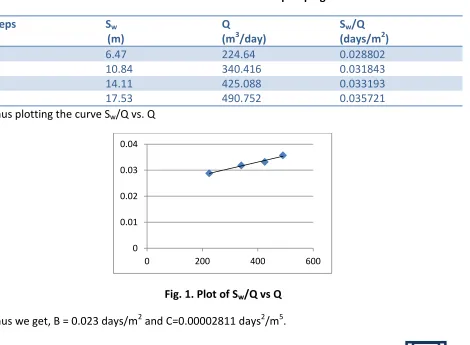
Thus plotting the curve Sw/Q vs. Q
Fig. 1. Plot of Sw/Q vs Q
Thus we get, B = 0.023 days/m2 and C=0.00002811 days2/m5.
0 0.01 0.02 0.03 0.04
Available Online at www.ijpret.com 134 Using the above values we can determine the well efficiency.
Table-2 determination of BQ and CQ2
Q B C BQ CQ2
224.64 0.023 0.00002811 5.16672 1.418519
340.416 0.023 0.00002811 7.829568 3.257473
425.088 0.023 0.00002811 9.777024 5.079472
490.752 0.023 0.00002811 11.2873 6.769943
Table3- determination of average well efficiency.
USING PRESENT APPROACH
Obtained value of B using ANN is 0.021 days/m2.
Using B to calculate C we get
Table-4 determination of C
steps C Average C
I 0.000034729
II 0.000031853 0.00003131
III 0.000028683
IV 0.000029996
BQ+CQ2 Well efficiency(%) Average well efficiency
6.585239 78.46
11.087041 70.62 69.35 %
14.856496 65.81
Available Online at www.ijpret.com 135
Table-5 determination of BQ and CQ2
Table-6 determination of average well efficiency.
BQ+CQ2 Well efficiency
(%)
Average well efficiency
6.2974 74.91
10.7787 66.33 65.055%
14.5768 61.24
17.8457 57.74
RESULTS
The two efficiencies calculated using two different approaches are given below
Method Well efficiency
Bierschenk 69.35%
ANN 65.055%
CONCLUSION
An approach to the determination of well efficiency has been developed that uses the artificial neural network to calculate aquifer loss coefficient and thus is used further to calculate the well efficiency. The present approach is proposed because of its simplicity and because it avoids the curve method.
Q B C BQ CQ2
224.64 0.021 0.00003131 4.7174 1.58
340.416 0.021 0.00003131 7.1487 3.63
425.088 0.021 0.00003131 8.9268 5.65
Available Online at www.ijpret.com 136
REFERENCES
1. Bierschenk, William H., 1963. Determining well efficiency by multiple step-drawdown tests.
International Association of Scientific Hydrology, 64:493-507.
2. Hantush, Mahdi S., 1964. Advances in Hydro science, chapter Hydraulics of wells, pp
281-442. Academic press.
3. Jacob, C.E., 1947. Drawdown test to determine effective radius of artesian well.
Transactions, American Society of Civil Engineers, 112(2312):1047-1070.
4. Rorabaugh, M.I., 1953. Graphical and theoretical analysis of step-drawdown test of Artesian
wells. Transaction, American Society of Civil Engineers, 79(separate 362):1-23.
5. Abd. Rashid Abd. Aziz and Kau-Fui Vincent Wong- A neural network approach to the
determination of aquifer parameters, Vol-30, and no.2 Ground water.
6. Amitabha Mukhopadhyay – Spatial estimation of Transmissivity using artificial neural
network.
7. N. Samani, M. Gohari-Moghadam, A.A. Safavi- A simple neural network model for the