Available Online at www.ijpret.com 1230
INTERNATIONAL JOURNAL OF PURE AND
APPLIED RESEARCH IN ENGINEERING AND
TECHNOLOGY
A PATH FOR HORIZING YOUR INNOVATIVE WORK
DECISION SUPPORT FRAMEWORK FOR DIGITAL (MODEL) COURT
RAJESH G. DEOTE1, DR. NITIN KOLI2
1.District Informatics Officer, National Informatics Center, Yavatmal, Maharashtra. 2.Head, Computer Centre, SGA, Amravati University, Amravati. Maharashtra.
Accepted Date: 05/03/2015; Published Date: 01/05/2015
Abstract: Digital India is an initiative of Government of India to integrate the government
departments and the people of India. It aims at ensuring the government services are made available to citizens electronically by reducing paperwork. As on date, Litigations in Judiciary have risen in large numbers, thereby making it extremely difficult to manage it manually. It has therefore become essential to improve productivity of the judicial staff for efficiently disposing and following up cases registered with various Courts. It was decided to use new technology at marginal cost to achieve the final goal of catalyzing the judicial service to be provided to common man and at the same time concentrate on the internal Judicial Administration to monitor closely the issue of growing Pendency. A decision support framework for Digital (Model) Court, will help system designer to systematically explore design options and select an appropriate design configuration that best meets the location dependent design objectives for Digital (Model) Courts in India and achieve the objectives of Digital India.
Keywords: Digital / Model Court, Digital India, ICT in Judiciary, Decision support framework
Corresponding Author: MR. RAJESH G. DEOTE
Access Online On:
www.ijpret.com
How to Cite This Article:
Rajesh G. Deote, IJPRET, 2015; Volume 3 (9): 1230-1237
Available Online at www.ijpret.com 1231 INTRODUCTION
Indian Judiciary has played a major role for Nation building and also contributed in mobilizing the society to deliver its best to the Nation. As on date, Litigations have risen in large numbers, thereby making it extremely difficult to manage it manually. It has therefore become essential to improve productivity of the judicial staff for efficiently disposing and following up cases registered with various Courts. A thought to provide ICT based Judicial Services to the Judges, Advocates/Lawyers and Citizen had become the need of the hour. It was decided to use new technology at marginal cost to achieve the final goal of catalyzing the judicial service to be provided to common man and at the same time concentrate on the internal Judicial Administration to monitor closely the issue of growing Pendency.
Digital India is an initiative of Government of India to integrate the government departments and the people of India. It aims at ensuring the government services are made available to citizens electronically by reducing paperwork. The initiative also includes plan to connect rural areas with high-speed internet networks. Digital India has three core components. These include creation of digital infrastructure, delivering services digitally and digital literacy.
The main objective of this Decision support framework for Digital(Model) court is to
1. Provide all back-office activities of the Judiciary online.
2. Facilitate Judicial Management to track the critical issue of Pendency.
3. Provide online interface for the Citizens/Advocates to query the system.
4. Ensure the government services are made available to citizens electronically by reducing paperwork.
Materials and Methods
Available Online at www.ijpret.com 1232
Support Framework for Digital (Model) Court. Process section deals with the different types of Services being offered by Court in electronic format to Petitioners, Advocates and citizen. Citizen Section comprises citizen centric services and Employee section consists of various interconnected blocks related to office staff of the court. The sections in detail are as follows
Process Section
eCourt – ICT solution for Court Cases Management System. The e-Courts project was conceptualized on the basis of the “National Policy and Action Plan for Implementation of information and communication technology (ICT) in the Indian Judiciary – 2005” submitted by e-Committee (Supreme Court of India), with a vision to transform the Indian Judiciary by ICT enablement of Courts.
mCourt – Open source mobile application for tracking status of court cases.
eMoney – Electronic transfer of funds from and to the Court. Fund transfers will be implemented through Net-banking, NEFT, RTGS.
Digital evidence- Evidence and trials through VC system. VC will be used.
eDocuments - Digital Documents as evidence for trials. It is Policy matter regarding administrative reforms. Digitally signed electronic documents can be accepted via official email.
eCopy – Digitally signed court Judgments / Orders should be issued through copying section. On the same line electronic documents or copies of court judgments or court proceedings can be made available to public after authenticated by DSC (Digital signature Certificate)
Available Online at www.ijpret.com 1233
Electronic Display System – At Bar Room and corridors electronic displays to be used at various locations which will keep on showing Case no and other relevant details for Case on board of a particular Bench or court.
Public Address System Public Address system may be installed in public areas / corridors for announcement regarding Case. It should be audible enough but should not disturb proceedings going on in other courts.
Citizen Section
Citizen Facility Center - with Cyber Café / Xerox, ATM Facility, various applications regarding court matters will be received and served at Facility Center. Visitor will be provided information regarding court matters through Touch sensitive Information Kioks. Photostate copies (xerox) facility, Internet facility/ ATM facility with Secured cash counter facility / blank formats of various application will be available on payment basis to citizen.
Available Online at www.ijpret.com 1234
Wifi Campus- Court campus should be wifi and should provide access to limited and necessary information related Judiciary.
Employee Section
eStore (for Malkhana) - A dedicated software for tracking the items being stored in the Maalkhana ( Strong Room)
eRecord Room – Scanning & Digitization of old records Digitisation and scanning of data will protect documents from decaying. This will also help in electronic delivery of digital signed documents, court judgement copies.Record room at Court consists of lots of permanent and temporary record. It is very cumbersome job to search exact document from hugh paper data. Computerisation of record room will ensure fast search will ensure fast deliver of copies of records.
eMail for official communication - eMail to be used as official tool in addition to written communication to and from Courts
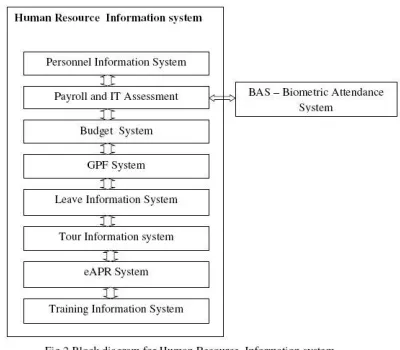
.BAS –Biometric Attendance System for staff – Aadhar based Biometric Attendance System to be implemented for Court staff. This system to be linked with Human Resource Information System.
eOffice – Office Workflow Automation suit NIC developed eOffice Software may be used for day to day office activities by the court staff. This system requires network connected desktop and DSC for every working office staff.
Available Online at www.ijpret.com 1235
Human Resource Information System – All staff related activities are covered in this module. It is comprised of following sections.
Personnel Information System -This component deals with service record details of the staff of the organization.
Payroll and IT Assessment – Deals with salary Income Tax related issues of the staff.
Budget System- This component deals with financial planning of the office and its subsidiaries.
GPF System – deals with Provident Fund for the staff.
Leave Information system – deals with leave and Leave Travel Concession facility for the staff.
Tour Information system – deals with tour allowance settlement details.
APR – electronic filing of Annual Appraisal Reports for Staff is covered under this section.
Training Information System – Training details for Court staff is covered in this module.
Conclusion the designed framework developed for Digital (Model) Court combines the structure of content and service components to design effective replica hosting architectures. A large set of stochastic design parameters with conflicting yet closely coupled design objectives is considered. It can be an effective decision support framework for a system designer to systematically explore design options and select an appropriate design configuration that best meets the location dependent design objectives for Digital (Model) Courts in India and achieve the objectives of Digital India.
ACKNOWLEDGEMENT
I express my gratitude to Miss Savita Barne, Principle and District Judge, Yavatmal for substantial guidance. It is my immense pleasure to offer thanks to Mr. Moiz Hussain, SIO, NIC, Maharashtra for his encouragement and valuable suggestions throughout the work.
REFERENCES
Available Online at www.ijpret.com 1236
2. “Framework for citizen engagement in e-governance”, Department of Electronics and Information Technology, Ministry of Communications and Information Technology, Government of India, April 2012 (URL: http://egovstandards.gov.in/ accessed on 11th July, 2012).
3. “Framework and guidelines for use of social media for government organizations”, Department of Electronics and Information Technology, Ministry of Communications and Information Technology, Government of India, April 2012 (URL: http://egovstandards.gov.in/ accessed on 11th July, 2012).
4. “Saaransh: A compendium of mission mode projects under NeGP”, National e-Governance Division, Department of Information Technology, Ministry of Communications and Information Technology, Government of India, January 2011 (URL: www.mit.gov.in accessed on 11th July, 2012).
5. “Technical standards for interoperability framework for e-governance in India”, Draft version 0.4, Department of Information Technology, Ministry of Communications and
Information Technology, Government of India, December 2011 (URL:
http://egovstandards.gov.in/ accessed on 11th July, 2012).
6. “Technical standards for interoperability framework for e-governance in India”, Document No. IFEG:01, version 1.0, Department of Information Technology, Ministry of Communications
and Information Technology, Government of India, May 2012 (URL:
http://egovstandards.gov.in/ accessed on 11th July, 2012).
7. “An emergency response decision support system framework for application in e-government”, Siqing Shan, Li Wang, Ling Li, Yong Chen, Springer Science+Business Media, LLC 2012, Published online: 15 June 2012. “Dynamic Monitoring and Decision Systems for Enabling Sustainable Energy Services” Ilić, M.D, IEEE JOURNALS & MAGAZINES, Publication Year: 2011, Page(s): 58 – 79.
8. “Decision Support Framework for the Implementation of IT-Governance”, Fink, K., Ploder, C., Proceedings of the 41st Hawaii International Conference on System Sciences – 2008.
Available Online at www.ijpret.com 1237
10.“Method for designing organization decision support system framework”, Jiancong, Fan; Yongquan, Liang; Qingtian, Zeng, BIAI JOURNALS & MAGAZINES, Publication Year: 2006, Page(s): 764 – 768.
11.ICGN. International Corporate Governance Network. 2007 June 2007 [cited; Available from: http://www.icgn.org.
12.“A Visualization Framework for Real Time Decision Making in a Multi-Input Multi-Output System”, Ashok, P.; Tesar, D. Systems Journal, IEEE JOURNALS & MAGAZINES, Publication Year: 2008, Page(s): 129 – 145.
13.“Decision Support System for Managing Educational Capacity Utilization”, Mansmann S.; Scholl, M. H., IEEE JOURNALS & MAGAZINES, Publication Year: 2007, Page(s): 143 – 150.
14.“Transparent decision support using statistical reasoning and fuzzy inference”, Hamilton-Wright, A.; Stashuk, D.W., IEEE JOURNALS & MAGAZINES, Publication Year: 2006, Page(s): 1125 – 1137.