w w w . a a s s j o u r n a l . c o m ISSN (Online): 2322 – 4479 ISSN (Print): 2476–4981
Original Article
www.AESAsport.com Received: 29/08/2017 Accepted: 28/11/2017
The Effect of the Special Cognitive-Behavioral Intervention
on the Commitment to Exercise and Adherence to the Exercise
Routine
1
Ahmad Derakhshanpour
*,
2Mohammad Kazem Vaez Mousavi,
3Hamidreza Taheri
1Exercise Psychology Department, Sport Sciences Faculty, Imam Reza International University, Mashhad, Iran. 2Physical
Education Department, Imam Hossein University, Tehran, Iran. 3Motor Behavior Department, Sport Sciences Faculty,
Ferdowsi University of Mashhad, Mashhad, Iran.
ABSTRACT
Background. Although most people are aware of the advantages of physical exercise, they fail to adhere to a regular routine of exercise, which necessitates this intervention. Objectives. In this study, by controlling the moderating role of the variable of commitment to exercise, the effect of a special cognitive-behavioral intervention on the commitment and adherence to an exercise routine has been investigated in adults. Methods. The statistical population for this study comprises 635 people with over 10 years' professional experience. Of this number, 235 were selected. Then, 80 employees were randomly assigned to two groups, experimental and control, with 40 members each. The experimental group was trained in cognitive-behavioral therapy for four months over 14 sessions. To collect the data on commitment and adherence to the exercise routine, a questionnaire was used. Results. When the effect of the pretest variable on the dependent variable was adjusted, it was observed that there is a significant difference (p<0.01) between the means of the scores for commitment to exercise and adherence to exercise routine. The covariance test revealed that the difference in the adherence to exercise routine in both the experimental and control groups, after controlling the effects of commitment to exercise, was not significant (p<0.05). Conclusion. The findings show that adherence to exercise routine can be improved in people by cognitive-behavioral intervention, using the moderating role of the variable of commitment to exercise and eliminating the gap between the intention to exercise and commitment to exercise. Therefore, counselors and therapists can use the cognitive-behavioral intervention protocol to improve the commitment to exercise and adherence to exercise routine.
KEY WORDS:Cognitive-Behavioral Intervention, Commitment, Adherence, Exercise, Protocol.
INTRODUCTION
Participation in sports and related activities has beneficial effects on the various physical and psychological factors slowing down the aging
process (1). Despite the physical and
psychological advantages of physical exercise,
like the improvement of cardiovascular
performance, the strengthening of muscular
system, improvement of balance (2), the enhancement of self-respect, and the overall improvement of quality of life, there is a decrease in the rate of participation in exercise and physical activities which impacts the general health (3). Weinberg and Gould have defined adherence to exercise as the overcoming of their weakness by
sedentary people to sustain and maintain an exercise program. When sedentary people overcome their weakness and start a sport, their next challenge is to maintain their regular participation in it (4). For this reason, many of the organized sport and physical fitness programs have been developed with an aim to minimize the sedentary adult population (5). However, individuals’ motivation for change and resistance to altering unhealthy habits must be considered when developing an effective approach to counseling (6). People are motivated for different reasons to engage in sport exercises. Yet, the best way to encourage engagement in exercise is to emphasize the various advantages (7).
With the advent of positive psychology and the theory of hope and commitment, numerous
educational, research, and therapeutic
interventions have been used to investigate their impact on the other positive dimensions and traits (8). Weiss, Kimmel, and Smith discussed a model for sport commitment where sport-related enjoyment was introduced as a key and intermediate factor in the commitment to sport. Based on the intermediate model for the commitment to sport, any factor that increases the enjoyment and interest in physical and sport activities can encourage people to continue participating in the activity (9). Further, commitment to sport has been defined as a psychological structure indicating the tendency to continue engaging in sport activities and motivating forces to engage in and insist on continuing the behavior (10). The commitment to sport is the additive effect of the degree to which an individual enjoys participation in sport, invests personal resources (i.e. time, effort, money),
perceives that sport provides valuable
opportunities, and is supported in one’s participation by significant others (11). Although most people are aware of the benefits of exercise for physical and mental health, working very hard to have access to good health procedures, they have so far failed to enjoy the benefits of good health. This will add to the importance and need for the interventionist expansion aimed at enhancing exercise in people (12). The term cognitive-behavioral education emphasizes the point that the thinking process is as important as the environmental effects (13). Educational cognitive-behavioral programs help create and
improve such abilities as decision-making,
motivation, responsibility, positive
communication with others, happiness, esteem, problem-solving, regulation, self-sufficiency, and mental health (14). Briefly, studies have identified such mediating variables as the potential mechanisms by which a variable can be linked to another variable or by some sort of intervention that may be so affected. (15). For instance, in a study aimed at investigating the effects of the mediating variables for commitment and adherence to sport, the findings of the survey by Roche et al., using the acceptance and commitment therapy (ACT), revealed that this therapy helped improve individual values and consequently, increase individual activity (16). In another study, Tobin and Markland, using special distinct interventions, investigated the link between the support for psychological needs and the internalization of regular behavior for sport. Finally, it was revealed that when the need for
support of self-determination and social
assimilation is expanded, people have less need for external stimulation and regulation (17). The results of a study by De Bruijn, on the relation between the sport habit and behavior explored through the concepts of a programmed behavioral model and action control method, indicate a considerable asymmetry between the intention to do and adherence to sport. Moreover, the measurement of controlled perceived behavior is a fixed predictor of controlled action (18). In a study by Scanlan et al., it was also established that perceived eligibility in sport affects the enjoyment of sport and that enjoyment is an important factor in commitment to sport (19).
We are aware that many people do less exercise than they are advised to. Thus, in future studies, there will be need for further research and more solid results on the impact of counseled support on adherence to sport. So far, no experimental study has been conducted on the combined counseling and commencement of sport exercises and in view of the background review, no study has addressed the investigation of cognitive-behavioral therapy. This is an effective method to improve psychological traits in an attempt to improve commitment and its impact on adherence to exercise in adults. This study seeks to fill this research gap. Therefore, the aim of this research is to control the adjusting role
of the variable commitment to exercise and investigate the effect of the special cognitive-behavioral intervention on commitment and adherence to exercise in adults.
MATERIALS AND METHODS
Participants. The statistical population for this study comprises 635 male and female employees, aged 38–56, and working for the personnel department of Zob Aahan Esfahan Factory. All of them have over 10 years' work experience. The statistical sample of this study includes 235 employees selected based on Morgan's Table (20) by using a stratified random
sampling method.Then, 80 of them were selected
and randomly assigned to two groups,
experimental and control, of 40 each, using the scores from a homogeneous questionnaire for commitment and adherence to exercise.
Tools. The control and experimental groups were assessed using the questionnaire for commitment and adherence to exercise. The following instruments were used to measure the independent variable (i.e. cognitive-behavioral intervention) and the dependent variable (i.e. commitment and adherence to exercise).
1. Commitment-to-Exercise Questionnaire:
This researcher-developed
commitment-to-exercise questionnaire comprises a four-factor structure (i.e. enthusiasm for exercise, intensity and frequency of exercise, reinforcing factors, and disrupting factors). The construct validity of the questionnaire was assessed with factor analysis using the principal component analysis (a sampling adequacy index of 0.769) and when the exploratory factor analysis was repeated five times, 10 questions were deleted due to inadequate load factor, and ultimately, the final version of the questionnaire for commitment to exercise had 25 questions on the four dimensions with a specific value larger than one accounts for 58.409% of the questionnaire variance. This instrument was graded on the Likert 5-division scale: 1 for "never" through to 5 for "always". For the reliability of the questionnaire, the Cronbach's alpha obtained using internal consistency was 0.873 (21).
2. Adherence-to-Exercise Questionnaire: The degree of adherence to exercise before and after the operation of the independent variable was assessed by using Corbin and Welk's
adherence-to-physical activity questionnaire (22). This questionnaire has a three-factor structure (i.e. empowered, predisposed, and reinforced) whose construct validity was assessed by the researchers with factor analysis and the principal components method (with a sampling adequacy index of 0.695). The adherence-to-exercise questionnaire comprising 12 questions on three dimensions with a specific value larger than one accounted for a total of 60.5% of the questionnaire variance using the principal components method. To ensure the results of the exploratory factor analysis, a confirmatory factor analysis was performed using LISREL. The Chi-square-to-df ratio was 1. This instrument has been graded with three options, 1 for "correct" through 3 for "incorrect", on the Likert scale. For the reliability of the questionnaire, using internal consistency, the Cronbach's alpha value obtained was 0.872.
Training protocol. For the Special
Cognitive-Behavioral Intervention, the
theoretical infrastructure emphasizes using such components as the enthusiasm for exercise, the intensity and frequency of exercise, reinforcing and disrupting factors. The factors are based on the health belief model (23), the trans-theoretical model (24), the theory of planned behavior (25), and self-determination theory (26). With an emphasis on the theoretical infrastructures, 14 sessions of cognitive-behavioral therapies (of 70 minutes each) were designed. Then, the experimental group was trained with the cognitive-behavioral therapy method and the control group was put on the waiting list. Further, it was recommended to the experimental group to do exercise for four sessions a week, for at least half an hour for each session. The nature of the exercises was specified with respect to the interest of the participants: joining a club, swimming, hiking, or any other activity of their interest.
Data Analysis. The results, from the data obtained and the therapeutic intervention, were described using descriptive statistics. Then, the statistical assumptions were analyzed with the ANCOVA and MANCOVA tests. Further, the effect of the pretest and the concomitant variables was controlled with ANCOVA and MANCOVA. Finally, the research hypotheses were analyzed using statistical covariance and the t-test.
RESULTS
Before the data were analyzed, the assumptions of the multi-variable covariance analysis were tested using the multi-variable covariance analysis. In this respect, the results of the Kolmogorov-Smirnov and Shapiro-Wilk tests were significant for none of the variables. The findings showed that the normality hypothesis was supported. Also, the results of the M Box test and Leven test were not significant. The findings indicate that the assumption of the covariance matrices being equal and the assumption of the equality of the post-test score variances for the dependent variables in both the experimental and control groups were supported. Furthermore, the coefficients between the pre-test and post-test scores were all significant for the dependent variables, which indicated that the relations were linear. More, the correlation of the pre-test and
post-test scores was 0.716 for commitment and 0.686 for adherence to exercise. Therefore, the correlation between the pre-test and post-test was high. Thus in this study, dependent variables were measured in two groups of experiment and control. At first, descriptive statistical methods of center-centered and scattered indicators were calculated and described.
In Table 1, the statistical indices of the means and standard deviation for commitment and adherence to exercise have been presented for the experimental and control groups, in both the pre-test and post-pre-test stages. According to the findings in Table 1, the score of adherence to exercise (M=2.45±0.26) for the cognitive-behavioral intervention group is larger than the mean score of adherence to exercise (M=2.07±0.28) for the control group. Analysis of covariance was used to obtain the results of investigating the effect of the special cognitive-behavioral intervention on commitment and adherence to exercise.
Table 1. Means and Standard Deviation of Pre-test and Post-test Scores in Both Groups
Variables Groups Pretest Posttest
N Mean SD Mean SD
Commitment to Exercise
Experimental 40 2.63 0.54 3.54 0.39
Control 40 2.46 0.54 2.47 0.43
Adherence to Exercise
Experimental 40 2.001 0.32 2.45 0.26
Control 40 2.07 0.31 2.07 0.28
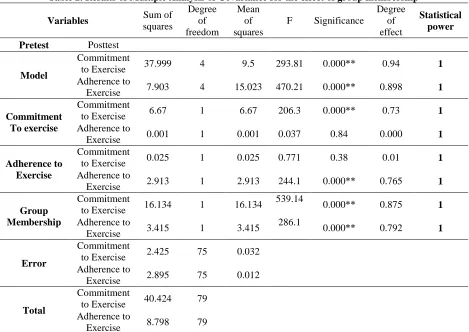
As shown in Table 2, in view of the calculated F coefficient, it can be seen that there is a significant difference between the means of the scores for commitment and adherence to exercise for both groups. Therefore, the special cognitive-behavioral intervention has improved the scores for commitment and adherence to exercise in the experimental group participants on the post-test. In view of the adjusted coefficients of β and the level of significance of 0.01, it can be concluded that the special cognitive-behavioral intervention is capable of predicting 87.5% of the commitment and 79.2% of adherence to exercise.
Ŷ=0.875X1 +0.792X2
Analysis of covariance was used to obtain the results of the effect of the special cognitive-behavioral intervention on adherence to
exercise in view of the controlled scores for commitment to exercise with the results shown in Table 3.
As shown in Table 3, in view of the calculated F value, it can be seen that there is no significant difference between the mean score for adherence to exercise with the controlled concomitant variable of commitment to exercise (P<0.05). Therefore, the adjusting role of the variable for commitment to exercise is supported. With respect to the adjusted coefficients and also β, it is concluded that the special cognitive-behavioral intervention, with the controlled concomitant variable of commitment to exercise can predict only 37.3% of adherence to exercise in the employees. Hence, the equation for predicting the variable of adherence to exercise can be formulated as:
Ŷ=0.373X1
Table 2. Results of Multiple Analysis of Covariance for the effect of group membership
Variables Sum of
squares
Degree of freedom
Mean of squares
F Significance
Degree of effect
Statistical power
Pretest Posttest
Model
Commitment
to Exercise 37.999 4 9.5 293.81 0.000** 0.94 1 Adherence to
Exercise 7.903 4 15.023 470.21 0.000** 0.898 1
Commitment To exercise
Commitment
to Exercise 6.67 1 6.67 206.3 0.000** 0.73 1
Adherence to
Exercise 0.001 1 0.001 0.037 0.84 0.000 1
Adherence to Exercise
Commitment
to Exercise 0.025 1 0.025 0.771 0.38 0.01 1
Adherence to
Exercise 2.913 1 2.913 244.1 0.000** 0.765 1
Group Membership
Commitment
to Exercise 16.134 1 16.134
539.14
0.000** 0.875 1
Adherence to
Exercise 3.415 1 3.415
286.1
0.000** 0.792 1
Error
Commitment
to Exercise 2.425 75 0.032 Adherence to
Exercise 2.895 75 0.012
Total
Commitment
to Exercise 40.424 79 Adherence to
Exercise 8.798 79
R2 =0.94, Adjusted R2 =0.937, Commitment to Exercise β1=0.875 R2 =0.898, Adjusted R2=0.893, Adherence to Exercise β1=0.792
Table 3. Results of covariance analysis for the effect of group membership on the scores for Adherence to Exercise in view of the scores controlled for commitment to exercise
Variables Sum of
squares
Degree of freedom
Mean of
squares F Significance
Degree of Effect
Statistical power
Models 5.142 2 2.571 54.14 **0.000 0.584 1
y-intercept 2.704 1 2.704 56.955 0.000 0.425 1
Concomitant 2.171 1 2.171 45.717 **0.000 0.373 1
Group
Membership 0.001 1 0.001 0.012 0.914 0.001 1
Error 3.656 77 0.047
Total 8.798 79
R2 =0.584, Adjusted, R2=0.574, β1=0.001, β2=0.373
DISCUSSION
The results presented support Hypothesis 1 to the effect that special cognitive-behavioral
intervention improves commitment and
adherence to exercise. The findings of this part of the study are, to some extent, consistent
with those of the studies by Markland and Tobin (17) and Roche et al. (16) in that they cause adherence to exercise interventionally by changing the cognitive mediators. In the study by Roche et al., (16) a limited number of people with chronic fatigue syndrome were
included with the aim of overcoming the impediments to exercise. Further, Markland and Tobin investigated only the effect of special interventions on the satisfaction of psychological needs and internalization of sport behavior (17). By contrast, this study investigates the effect of the cognitive variable commitment to exercise (enthusiasm for exercise, intensity and frequency of exercise, reinforcing factors, disrupting factors) linked to adherence to exercise.
The fact that a considerable proportion of people have not been completely successful at adhering to exercise adds to the importance and need for interventionist expansion based on the behavioral theories and models aimed at raising the level of commitment to exercise in people (12). Typically, to reach these aims, such socio-cognitive-behavioral theories as Health Belief Model, Theoretical Transfer Model, Planned Behavior Theory, and
Self-determination theory can be used.
Accordingly, it seems that the special cognitive-behavioral theory developed by researchers based on the above theories and positive psychology with an aim to improve
commitment to exercise can lead to
improvement of adherence to exercise. Further, based on Weiss et al.'s mediating model for commitment to exercise and the studies conducted by Scanlan (19) which indicated that perceived competence in sport affects enjoyment of sport and is an important factor in commitment to sport, it seems that engagement in physical exercises by the experimental group can have an added effect on commitment and adherence to exercise.
Hypothesis 2 explores whether adherence to exercise continues to improve after the exclusion of commitment to exercise or not. The results indicated that, depending on group
membership, there was no significant
difference between the mean scores for adherence to exercise in the participants in the post-test stage. The findings of this part of the study are consistent with the results of a study by De Bruijin (18), in that they indicate a
considerable asymmetry in the relation between the intention to exercise and adherence to exercise.
The findings of this study add the fact that the gap between the intention for exercise and adherence to exercise can be filled by using a cognitive-behavioral intervention and creating a commitment to exercise. It can be said that intention alone to engage in exercise, informed by the advantages of exercise, will not lead to adherence to an exercise routine regularly. To create adherence to behavior like engagement in exercise, not only the intention but also the commitment to engage in the behavior should be combined with the concept of the intention to behave, so that people become committed and adherent to exercise. Therefore, it seems that, in this protocol, upon excluding the concomitant variable for commitment to exercise and eliminating the effect of commitment to exercise on adherence to exercise, the special cognitive-behavioral intervention alone cannot significantly affect or improve the adherence to exercise.
CONCLUSION
In view of what was presented to explain the hypotheses, it can be concluded that with the implementation of a special cognitive-behavioral intervention based on the socio-cognitive-behavioral theories, the commitment to exercise can be improved in individuals and adherence to exercise can be improved by using the mediating role of commitment to exercise. When people don't exercise despite the risks of having a sedentary lifestyle, it is optimistic to wait and see their commitment to
exercise and therefore, inevitable
interventions are needed. Mere intention of exercising due to knowing its benefits does not necessitate the individual's adherence to an exercise regimen. To enact this intention
practically, the intervening role of
commitment to exercise is needed. Overall, it seems that in view of the fact that a considerable number of individuals informed of the advantages of exercise have so far failed
to adhere to exercise, there is increasing
importance of developing therapy and
intervention with an aim to make people adhere to exercise.
This study attempted to minimize the disturbing variables and possible biases by randomly assigning the participants to the experimental and control groups. However, the most important limitation of this study was the failure to follow up.
ACKNOWLEDGEMENTS
This study is part of my doctoral dissertation, completed with the research support of Zob Aahan Esfahan Factory, for which I wish to sincerely express my gratitude. I am thankful for the cooperation extended to me by the management and employees, which made this research possible.
REFERENCES
1. Gillespie LD. Interventions for preventing falls in older people living in the community. 2012.
2. Buchner DM, Beresford SA, Larson EB, LaCroix AZ, Wagner EH. Effects of physical activity on health status in older adults II: Intervention studies. Annual review of public health. 1992;13(1):469-88.
3. Tiedemann A, Sherrington C, Lord SR. Predictors of exercise adherence in older people living in retirement villages. Preventive medicine. 2011;6(52):480-1.
4. Weinberg RS, Gould D. Foundations of Sport and Exercise Psychology, 6E: Human Kinetics; 2014. 5. Roberts GC, Spink KS, Pemberton CL. Learning experiences in sport psychology: Human Kinetics 1; 1999. 6. Stonerock GL, Blumenthal JA. Role of counseling to promote adherence in healthy lifestyle medicine: strategies to
improve exercise adherence and enhance physical activity. Progress in cardiovascular diseases. 2017;59(5):455-62. 7. Marcus BH, Lewis BA, King TK, Albrecht AE, Hogan J, Bock B, et al. Rationale, design, and baseline data for
commit to quit ii: an evaluation of the efficacy of moderate-intensity physical activity as an aid to smoking cessation in women☆. Preventive Medicine. 2003;36(4):479-92.
8. Snyder C, Cheavens JS, Michael ST. Hope Theory: History and Elaborated Model. 2005.
9. Weiss MR, Kimmel LA, Smith AL. Determinants of sport commitment among junior tennis players: Enjoyment as a mediating variable. Pediatric Exercise Science. 2001;13(2):131-44.
10. Sousa C, Torregrosa M, Viladrich C, Villamarín F, Cruz J. The commitment of young soccer players. Psicothema. 2007;19(2):256-62.
11. Scanlan TK, Russell DG, Scanlan LA, Klunchoo TJ, Chow GM. Project on Elite Athlete Commitment (PEAK): IV. Identification of new candidate commitment sources in the Sport Commitment Model. Journal of Sport and Exercise Psychology. 2013;35(5):525-35.
12. Brug J, Oenema A, Ferreira I. Theory, evidence and Intervention Mapping to improve behavior nutrition and physical activity interventions. International Journal of Behavioral Nutrition and Physical Activity. 2005;2(1):2. 13. Baucom D, Epstein N. Enhanced cognitive-behavioral therapy for couples. American Psychological Association.
2002;1.
14. Sukhodolsky DG, Kassinove H, Gorman BS. Cognitive-behavioral therapy for anger in children and adolescents: A meta-analysis. Aggression and violent behavior. 2004;9(3):247-69.
15. Brassington GS, Atienza AA, Perczek RE, DiLorenzo TM, King AC. Intervention-related cognitive versus social mediators of exercise adherence in the elderly. American journal of preventive medicine. 2002;23(2):80-6.
APPLICABLE REMARKS
Regular physical activity is a major
factor in disease prevention and the improvement of physical and mental health. However, the chief concern is non-adherence to regular exercises. Therefore, physicians and counselors can use cognitive-behavioral therapy as a method to improve commitment and adherence to a regular exercise routine.
The ease of access to training facilities
is potentially beneficial for persuading workers to participate in these programs, but it can be challenging to persuade them to participate regularly. Therefore, it is recommended that if organizations, institutes, and industrial centers want to enhance their staff participation in sports programs, they can apply such a protocol.
16. Roche L, Dawson DL, Moghaddam NG, Abey A, Gresswell DM. An Acceptance and Commitment Therapy (ACT) intervention for Chronic Fatigue Syndrome (CFS): a case series approach. Journal of Contextual Behavioral Science. 2017;6(2):178-86.
17. Markland D, Tobin VJ. Need support and behavioural regulations for exercise among exercise referral scheme clients: The mediating role of psychological need satisfaction. Psychology of Sport and Exercise. 2010;11(2):91-9.
18. De Bruijn G-J. Understanding college students’ fruit consumption. Integrating habit strength in the theory of planned behaviour. Appetite. 2010;54(1):16-22.
19. Scanlan TK, Chow GM, Sousa C, Scanlan LA, Knifsend CA. The development of the sport commitment questionnaire-2 (English version). Psychology of Sport and Exercise. 2016;22:233-46.
20. Krejcie RV, Morgan DW. Determining sample size for research activities. Educational and psychological measurement. 1970;30(3):607-10.
21. Derakhshanpoor A, Mousavi MV, Taheri HR. Introducing the Questionnaire of Commitment to Exercise. Global Journal of Health Science. 2016;9(6):151.
22. Corbin CB, Welk GJ, Corbin WR, Welk KA. Concepts of fitness and wellness: McGraw-Hill; 2001.
23. Becker MH. The health belief model and personal health behavior. Health education monographs. 1974;2:324-473. 24. Richard M, Christina MF, Deborah LS, Rubio N, Kennon MS. Intrinsic motivation and exercise adherence. Int J
Sport Psychol. 1997;28(4):335-54.
25. Ajzen I. The theory of planned behaviour: reactions and reflections. Taylor & Francis; 2011.
26. Deci EL, Ryan RM. Facilitating optimal motivation and psychological well-being across life's domains. Canadian Psychology/Psychologie canadienne. 2008;49(1):14.