Available Online at www.ijpret.com 770
INTERNATIONAL JOURNAL OF PURE AND
APPLIED RESEARCH IN ENGINEERING AND
TECHNOLOGY
A PATH FOR HORIZING YOUR INNOVATIVE WORK
CONNOTATIVE REAL TIME SCHEDULING FOR AUTONOMOUS NAVIGATION OF
ROBOT BASED ON HYBRID CONTROL ARCHITECTURE
N. C. PATIL, PROF. S. P. DHANURE
Dept. of Electronics and Telecommunication Engg, SITS, Narhe, Pune-41, Savitribai Phule Pune University Pune, India.
Accepted Date: 05/03/2015; Published Date: 01/05/2015
\
Abstract: The fundamental and most pressing issue for mobile robot is that of autonomous navigation. For successful navigation, robot should incorporate an intelligent system which sens the surrounding environment and plan autonomously. Such intelligent system includes four vital blocks: localization, perception, cognition and motion which is developed using connotative real-time scheduling. And for implementation of this vital blocks requires a hybrid navigation control architecture which is combination of two well-known control architecture: Deliberative Navigation Control and Reactive Navigation Control. This paper reviews the various control architecture for autonomous navigation of robot and concludes with suggesting the real-time framework called Semantic-aware Real Time (SeART) which deals with complex real time robotics application. SeART find the problem of selecting a subset of tasks to be scheduled depending on the current operating context, task currently executed and targeted objective so based on above study the paper introduce a real life scenario which cope with unknown and dynamic navigation problem.
Keywords: Autonomous navigation robot, RTOS, task scheduling, hybrid control architecture.
Corresponding Author: MR. N. C. PATIL
Access Online On:
www.ijpret.com
How to Cite This Article:
Available Online at www.ijpret.com 771
INTRODUCTION
The advent of new high-speed technology and the growing computer Capacity provided realistic opportunity for new robot controls, architectures and realization of new methods of control theory. This technical improvement together with the need for high performance robots created faster, more accurate and more intelligent robots using new robots control architectures, new drivers and advanced control algorithms. This paper describes a new economical solution of robot control systems. The presented robot real-time scheduling can be used for different sophisticated robotic applications.
Autonomous navigation of mobile robots in an unknown littered environment is quite a difficult task in the recent years. Different applications for mobile robots represent different navigation problem. It is essential for intelligent mobile robots having sensing, planning and actuation capabilities in order to plan its line of action and generate a wide variety of intelligent behaviors.[1-3]. These capability should be integrated to get desired results define by control architecture. Since, various control schemas have been developed to design and develop of robust, flexible, reliable and high performance control systems for autonomous navigation. This control architecture can be classified as: Deliberative (Centralized) navigation, Reactive (Behaviour-based) navigation and hybrid (Deliberative - Reactive) navigation [4][7]. The paper mainly focus on hybrid navigation, but to achieve this all capability the system needs a driver which guaranteed that all functions will be complete within a deadline without blocking of system functionality. For that purpose system needs a Real-Time Operating System (RTOS), where the purpose of a RTOS is to schedule tasks in order to guarantee that inputs are acquired and outputs are produced according to timing constraints [6-7][13-14]. In robotic applications, tasks periodically receive information about the environment through sensors or user interfaces, whereas commands to actuators and other outputs are sent at periodic intervals. The paper flow is given as: Section-I gives detail information about paper, Section-II describes hybrid control architecture where RTOS is used to improve some performance parameter like accuracy which is explain brief in Section-III and for improved task management capability
author introduced an algorithm SeART in Section-IV, proposed by Fulvio
Mastrogiovanni(2013)[5].
II. HYBRID CONTROL ARCHITECTURE
Available Online at www.ijpret.com 772 Hybrid control architecture was developed by Arkin (1989, 1998) and Murphy (2000) which includes the advantages of planning in deliberative architectures and quick response of reactive architectures in dynamic or unknown environment[10]. All these approaches can be classified as either Deliberative Navigation Control or Reactive Navigation Control or a hybrid of the two that came to be known as a Hybrid control architecture (Cognitive Controller).
Available Online at www.ijpret.com 773 By combining this three types it is possible to improve the autonomous navigation of robot, where managerial type helps robot for planning the path and then actuate the system and if any sensor fails to work, robot used the State hierarchical type to predict the future step based on past state and plan accordingly. If robot navigate from indoor to outdoor then it uses the global world model, depends on the position, robot uses GPS or Beacon localization for autonomous navigation[18].
III. AN OVERVIEW OF RTOS
The purpose of a real-time operating system (RTOS) is to scheduled tasks in order to guarantee that inputs are acquired and outputs are produced according to timing constraints. Real time operating systems are the multitasking operating systems, which not only depend upon the logical correctness but also depend upon the application delivery time. These valuable RTOS works on the philosophy of the round robin algorithm and preemptive priority scheduling method. The RTOS requires very less amount of space around 10 KB to 100 KB in memory. There are several advantages of RTOS like simple implementation, low overhead and predictability[5][7-8].
The issues left in hybrid control architecture by using normal operating system that can be overcome by using RTOS and the introduced SeART algorithm, that explain in next section in detail.
IV. AN OVERVIEW ON SEART ALGORITHM
Available Online at www.ijpret.com 774 alternatives requires both deciding what to do and deciding when to do it. One major focus of our SeART work is on taking interactions among sub-problems into account when building solution plans, Another recent focus of our work has been on adding to the problem model the notion of uncertainty in the duration and quality of methods with uncertain information requires additions to the scheduling algorithm and the monitoring of method performance to allow dynamic reaction to unexpected situations [6-7].
As shown in the figure, navigation indicate the user desired job. The Necessity property of this concept is an instance of Motion Data which indicates that user needs this data to be produced as one of its objectives. Tasks Go to Heading and Si (Smoke isnput) can produce Motion Data but under different costs. These tasks also need some input data which are provided by other tasks. For example, following the dependency graph along Go to Heading, we can find a conjunction
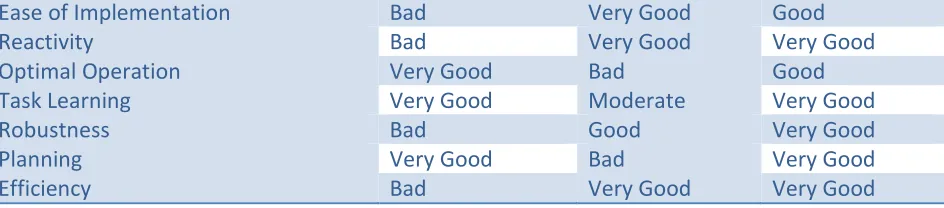
TABLE I: COMPARISION OF SELECTED APPROACHES IN THE LITERATURE SURVEY
Architecture Specification Control Architecture
Deliberative Reactive Hybrid
Goal oriented Very Good Good Very Good
Available Online at www.ijpret.com 775
Ease of Implementation Bad Very Good Good
Reactivity Bad Very Good Very Good
Optimal Operation Very Good Bad Good
Task Learning Very Good Moderate Very Good
Robustness Bad Good Very Good
Planning Very Good Bad Very Good
Efficiency Bad Very Good Very Good
Node indicates Target Data and Posture Heading both are needed as the input of Go to Heading. While edges of each nodes indicates different possible path through KB graph, edges from a conjunction nodes imply that all the subsequent nodes must be considered as conjunctive inputs.
Table 2.1 summarizes results that compare all the aforementioned approaches, and SeART itself, along different axes. It compares each of these three architectures i.e. deliberative control architecture, reactive control architecture, hybrid control architecture with SeART architecture on the basis of how much goal oriented each of them is, flexibility, ease of implementation, reactivity, optimal operation, task learning, robustness, planning and efficiency[13][15][16].
V. CONCLUSION
Various control architecture for autonomous navigation robot has been described. For successful navigation of robot, an improved control architecture is introduced which is based on RTOS with a Semantic-Aware Real Time Scheduling (SeART) in order to achieve the ability of perception and world representation, fast obstacle avoidance, map building ability coupled with inference and decision making ability in order to make reliable decisions based on the known information.
REFERENCES
1. J.E. Laird, P.S. Rosenbloom, Integrating Execution, Planning, and Learning in Soar for External
Environments, AAAI, pp. 1022-1029, 1990.
2. A Comparison of Various Robotic Control Architectures for Autonomous Navigation of
Available Online at www.ijpret.com 776
3. Navigation of an Autonomous Mobile Robot Using Intelligent Hybrid Technique by Prases. K.
Mohanty, Dr. Dayal. R. Parhi in 2012 (ICACCCT).
4. A review of control architectures for autonomous navigation of mobile robots by D.
Nakhaeinia1, S. H. Tang1, S. B. Mohd Noor1 and O. Motlagh1 in International Journal of the Physical Sciences Vol. 6(2), pp. 169-174, 18 January, 2011.
5. Fulvio Mastrogiovanni, Ali Paikan, and Antonio Sgorbissa "Semantic-Aware Real-Time
Scheduling in Roboticst," Proc. IEEE TRANSAC¬TIONS ON ROBOTICS, VOL. 29, NO. 1, FEBRUARY 2013.
6. Y. hsin Kuo and B. MacDonald, A distributed real-time software framework for robotic
applications, in Proc. IEEE Int. Conf. Robot. Autom., 2005, pp. 19641969.
7. Pasi Sarolahti and Karim Yaghmour, "Real-Time Application Interface", 26th February 2001.
8. R. Brooks, A Robust Layered Control System for a Mobile Robot, IEEE Journal of Robotics and
Automation, issue 1, vol. 2, pp. 14-23, March 1986.
9. R. C. Arkin, 1998, Behavior-based Robotics, MIT Press, Cambridge, MA.
10.H. Yavuz, A. Bradshaw, A New Conceptual Approach to the Design of Hybrid Control
Architecture for Autonomous Mobile Robots", J. Intell. Robot. Syst., 34(1): 1-26, 2002.
11.M. Lindstrom, A. Oreback, H.I. Christensen, "BERRA: A Research Architecture for Service
Robots", Proc. IEEE Int. Conf. Robot. Autom., 4: 3278-3283, 2000.
12.M. Piaggio, A. Sgorbissa, and R. Zaccaria, Pre-emptive versus non-preemptive real time
scheduling in intelligentmobile robotics, J. Exp. Theor. Artif. Intell., vol. 12, no. 2, pp. 235245, 2000.
13.H. Xu and P. Jia, RTOC: A Rt-Linux based open robot controller, in Proc. IEEE/RSJ Int. Conf.
Intell. Robot. Syst., 2006, pp. 16441649.
14.F. Qureshi, D. Terzopoulos, R. Gillett, "The Cognitive Controller: A Hybrid,
Deliberative/Reactive Control Architecture for Autonomous Robots", Proc. 17th International Conference on Industrial and Engineering Applications of Artificial Intelligence and Expert Systems, Ottawa, Canada, May 17-20, 2004.
15.N. Vukovi, Z. Miljkovi, "New Hybrid Control Architecture for Intelligent Mobile Robot
Available Online at www.ijpret.com 777
16.Du Z, Qu D, Xu F, Xu D (2007). A hybrid approach for mobile robot path planning in dynamic
environments. IEEE Int. Conf. Robot. Biomimetics, pp. 10581063.
17.Accident Detection and Reporting System using GPS, GPRS and GSM Technology, Md.
Syedul Amin, Jubayer Jalil, M. B. I. Reaz ICIEV on 18-19 May.
18.Averbukh AB (1999). Hybrid intelligent architecture for real time processing. IEEE Int. Joint
Conf. Neural Network, pp. 4107-4110.