The Impact of Spirituality and Ethical Values on Tour
Operator’s Performance:
The Role of Empathy and Commitment
Fatemeh Yavari Gohar,1 Fereshteh Mansourimoayyed,2 MehdiKaroubi3
1 Assistant Prof. Allameh Tabataba'i University, Tehran, Iran (Corresponding Author)
2 Assistant Prof. Tarbiat Modares University, Tehran, Iran
3 Associate Prof. Allameh Tabataba'i University, Tehran, Iran
Received: October 23, 2019 Accepted: December 23, 2019
Abstract
Today, we confront forces bringing spiritual and ethical values into business which have together has a meaningful concept for each business. Nowadays, the growing attention to ethical issues in workplaces has caused the organizations tend to set ethical codes. However, the results of recent studies show that the ethical organizations will obtain more benefits over a long period and will gain better financial and non-financial performance. So this issue has caused the ethical values of organization be an important part of the organization’s culture. Beside this, ethical issues have always been a noteworthy topic in tourism concepts. Therefore, the present research has examined the effect of ethical values and empathy on non-financial performance of tour operators in Tehran through the organizational commitment. The statistical population is composed of employees of tour operators and data were collected by the standard questionnaires. Results show that ethical values and empathy in workplace have a positive and significant effect on organizational commitment and following that non-financial performance of organization.
Introduction
Tourism is now one of the most important components of economic development and welfare in most countries and it is expected that this industry will soon become the world's largest industry and economic activity (Liu & Pratt, 2017). As a perfectionist creature, human always seeks to acquire knowledge and travel provides a platform for realizing its semantic orientation (Shirmohammadi & Abyaran, 2019). According to World Tourism Organization, in 2017, tourism is ranked as the world’s third highest-paid industry after oil and automobiles manufacturing. Tourism has a special place in contributing to sustainable development. In other words, in many countries, tourism is an important way of development. Therefore, it must be assured that tourism is developed in a way which helps to sustainable development is the optimal destination (Zargham Boroujeni & Sedaghat, 2018).
The evolution or collapse of organizations is closely related to ethical values. Because it is not possible to pursue perfection without ethical values. Spirituality and ethics are essential at workplace and leaders who can promote and encourage spiritual and ethical values in their organization, they improve quality of life for their employees and quality of service for customers.
time, ethical organizations perform better than non-ethical organizations in terms of financial and non-financial performance (Hartman, 1996). Many of the disadvantages associated with the performance of organizations and firms stem from the ethical incompetence of economic agents (Hartman, 1996). Ethics provide the essential foundation for the business to improve its working status (Jondle et al., 2014). The importance of the concept of ethical value can be understood from the attention to the fact that ethical theories actually are seeking to provide criteria and patterns for valuating human behaviors, and various ethical schools have emerged from this. Religion and ethical values of any society have a significant impact on health, education and social policies of that society (Shahriari et al., 2014). Due to the growing interest in ethical issues in business communities, many organizations have organized and institutionalized ethics in the form of codes and executive guidelines (Jung, et.al, 2010) that shows the importance of ethical issues in today's modern economy.
Investigating ethical issues among tourism industry activists and brokers is one of the favorite issues for researchers (Ingram et al., 2007). According to researchers, despite the rich literature on ethical behavior (Ferrell et al., 2007), the point of this study is that most ethical decision-making frameworks are introducing a logical process in which emotional issues are forgotten (Girard, 2007). Interestingly, the marketing literature is also more focused on business relationships based on similar literature. That is, logical issues and frameworks are more addressed than emotional issues (Bagozzi, 2006). Among the marketing literature, empathy is a social emotion that has been considered as an important variable for understanding business communication (ibid).
(Agnihotri & Krush, 2015). According to the above, it can be stated that empathy among tour providers shows a level of interest in tourists (Ahearne et al., 2007).
On the other hand, organizational commitment is a new concept that differs from dependency and job satisfaction. There are many reasons why an organization should increase the level of organizational commitment of its members (Sreers & Porter, 1992). Researches have shown that the organizational commitment has a positive relationship with consequences such as job satisfaction (Bateman & Strasser, 1984), presence (Mathieu & Zajac, 1990), trans-social organizational behavior (O'Reilly & Chatman, 1986) and organizational performance and have a negative relationship with job abandonment (Mowdey et al., 1982). On the other hand, Kumari and Jafar (2013) showed that there is a positive and significant relationship between ethical values and organizational commitment. In another research conducted by Salahudin et al., in 2016, they specifically examined the impact of Islamic work ethics on organizational commitment and concluded that Islamic work ethics significantly influenced organizational commitment (Yousef, 2000).
Thus, it seems that given the above contents and the importance of emotional issues in activities such as marketing on the one hand, and lack of attention of researchers to these issues on the other hand, the present study aimed to examine the impact of emotional issues such as empathy in formation of ethical behavior and organizational commitment.
Theoretical Foundations and Research Background
Ethical Values
Ethics and ethical principles are among the topics that have been emphasized in society by Islam so that the Prophet (Peace be upon him) has introduced the purpose of his mission as fulfillment of an ethical dignities. Therefore, ethics as a set of values, goods and evils, can play an important role in the effective management of organizations. Work discipline, empathy, justice, productive companionship, consultation, humility, loyalty, service, and tolerance are among the most favored ethical practices emphasized by Islam in the management of organizations and for them to be realized, it is necessary to regulating and executing an ethical charter (Rajabipoor & Dehghani, 2013).
The importance of the concept of ethical value can be understood from the attention to the fact that ethical theories actually are seeking to provide criteria and patterns for valuating human behaviors, and various ethical schools have emerged from this. Hunt et al. developed the concept of organization’s ethical values, and these ethical values describe the cultural characteristics of an ethical environment. Research shows that people's perceptions of these values are positively related to specific ethical beliefs and ethical management. Employees prefer the organizational environment with an ethical space. The ethical values of the organization increase the general responsiveness of employees to their job and on the other hand, committed employees are often associated with the values of the organization (Boenink, 2010).
such as rewarding ethical behavior and punishing unethical behavior (Elias, 2005).
Important researches have been done to investigate the consequences of positive ethical values of the organization. Deal and Kennedy have noted that values impart a sense of identity to members of the organization, enhance the stability of its social system, and guide managers' decisions. Many studies have also shown that there is a positive relationship between ethical values and organizational commitment and behavioral intentions (ibid).
Creating and maintaining ethical standards in the sales process means meeting the needs of different stakeholders (Chonko et al., 1996). In addition, sales forces often face many ethical challenges to meet stakeholder expectations (Schwepker & Good, 2011; Ingram et al., 2007). The complexity in the sales ethical environment has led many researchers to become interested in this field of study (Evans et al., 2012; Ferrell et al., 2007).
Relationship between Spirituality and Ethics
spirituality, in comparison to those not, accept ethics in their life (Rodriguez-Rad & Ramos Hidalgo, 2017). Spirituality and religion are complex multidimensional phenomena, and every single definition may probably reflect only a few limited views and preferences (Shalbafian & Zarandian, 2019). Similarly, Ayoun et al. (2015) found no powerful relationship between spirituality and ethics, but some studies which clarify the impact of spirituality on morality. All in all, the relationship between spirituality and ethics might not be observe in an explicit way, but we can conclude them as the interrelation concept and both of them are the key part of personal development (Abram, 2009).
Empathy
Empathy is a powerful force for realizing the goals and plans of the organization and it is the most effective reason for the advancement of personal growth and human relationships and communication with others. In an organization, with the power of empathy, many complex nodes can be opened, many impossible things can be possible and difficult ways of working and accomplishing goals and programs can be navigated (Rameson, et.al. 2012). Empathy means the ability to understand the opposite side, as subtly as he understands himself. Therefore, it seems that if we want to create empathy within an organization, we need to create a place where employees can put themselves in managers’ place and understand them. Besides, managers can become intimate with employees and see issues from their perspective, listen to them carefully, without prejudice, and pay attention to the issues that matter to employees as much as they care (Mencl
& May, 2009).
et al., 2007) that strongly influence customer satisfaction (Agarwal et al., 2012) and on the other hand, it increases sales performance (McBane, 1995).
Organizational Commitment
There are many definitions of commitment. Allen and Meyer (1990) believe that organizational commitment is a sense of belonging that each employee feels to the organization in which he/she works. Organizational commitment can be measured by the degree to which individuals in an organization are ready to internalize the values of the organization. In addition, organizational commitment can be assessed in terms of the degree of fulfillment of staff responsibilities and duties. It is also possible to measure organizational commitment by observing the behavior of people in the workplace. In the 1980s, Allen and Meyer developed an analytical theory for organizational commitment and divided it into three definable sections: emotional organizational commitment, continuous organizational commitment, and normative organizational commitment. Emotional commitment is the emotional belonging of employees to the organization’s values in which they work, meaning how much the individual is interested in the organization. Continuous commitment is the individual's willingness to continue working with the same organization, and the normative commitment deals with the commitment and responsibility the individual feels to the organization. Each of these types of organizational commitment may affect the other (Jaros, 2007).
Non-financial performance
person's overall attitude toward his or her job, which is a situation in which individuals are satisfied with their job and other dependent conditions (Farrahi et al., 2010). Human resources development is a tool to improve people's productivity in the workplace (Taban et al., 2013). Spirituality at work is an inspiring and motivating force for the continuous search for purpose and meaning in work life, a deep understanding of the value of work, life, the universality of the universe, the natural beings and the personal belief system (Rafiee et al., 2013). Motivation is one of the important tools in inducing employees to produce effective and efficient results and create a positive workplace and successful implementation of anticipated programs (Shafie Nikabadi & Salimi, 2016). The results of a study showed that ethical management affect the success of the organization following work ethics and social responsibility through increasing the legitimacy of the organization's actions, utilizing the benefits of increasing multiplicity and income, profitability and improving competitive advantage (Provis & Gramberg, 2004).
Ethical values, organizational commitment, and non-financial
performance
commitment and concluded that Islamic work ethics significantly influenced organizational commitment (Yousef, 2000). Therefore, according to the above, the first and second hypotheses of this study can be mentioned as follows:
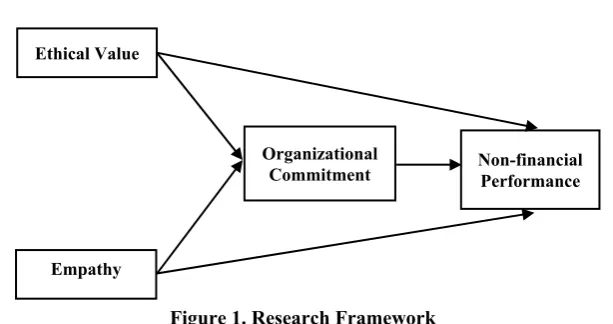
H1: Non-financial performance of the organization is influenced by ethical values.
H2: Ethical values affect non-financial performance through organizational commitment
.
Empathy, organizational commitment, and non-financial
performance
As noted earlier, today not only does human social needs depend on communicating with others, but according to the complex social structures, providing individual demands such as physical and mental needs are also less likely to be met without communication. Empathy is an emotional need that, as mentioned before, has been less favored by marketing professionals. In a study conducted by Agnihotri and Krush in 2015, they examined empathy along with ethical behavior and trust in measuring sales staff performance (Agnihotri, & Krush, 2015). Also in another study conducted in 2005, the effect of sales force empathy on relational results was examined. According to the above, the third and fourth hypothesis of this research can be described as follows:
H3: The non-financial performance of the organization is affected by empathy.
H4: Empathy affects non-financial performance through organizational commitment.
Figure 1. Research Framework
Research methodology
In terms of purpose, the present study is practical and in terms of data collection methodology, it is quantitative. This study is a descriptive survey and the data were collected using questionnaires so that the results of the analysis can be generalized to the statistical population.
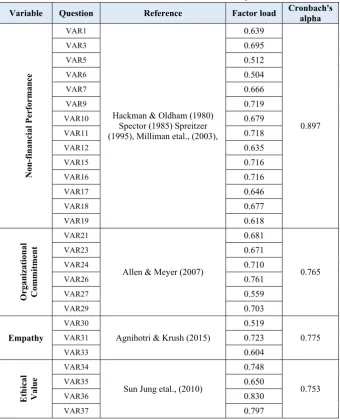
The statistical population of the study is all of the tour providers companies in Tehran, using a random sampling method. The sample size was 384 according to Morgan table and according to researchers’ opinion, 390 questionnaires were distributed. Due to the nature of the statistical population and respondents’ non-cooperation and non-return of some questionnaires, finally 273 reliable questionnaires were collected. As mentioned above, standard questionnaire was used for data collection. After translation and localization of the questionnaires, the validity and reliability of the questionnaire were evaluated, as the suitability criterion of the measures is examined in terms of its validity and reliability. The original questionnaire consisted of 34 questions that were distributed as a pilot test in form of 30 questionnaires. After the initial evaluation of validity and reliability of the questionnaire, finally, seven questions with low validity were removed and the number of final questions of the questionnaire was 27 questions. It is noteworthy that content validity and construct validity were used to assess the validity of the questionnaire. According to the structure of the previous questionnaire that has been used in domestic and international research as well as the approval of marketing and tourism experts and professors, the questionnaire used in this study has face and content validity. In addition, the results of confirmatory factor analysis showed that the
Ethical Value
Non-financial Performance
Empathy
construct validity of the final questionnaire used in the present study was 95% significant. The results are shown in Table 1. Cronbach's alpha coefficient was used to measure the reliability of the questionnaire and with alpha ≥0.70, reliability considered as satisfactory. The results are shown in Table 1.
Tbale 1. Factor load and Cronbach's alpha
Variable Question Reference Factor load Cronbach's alpha
Non-financ ial Pe rf or mance VAR1
Hackman & Oldham (1980) Spector (1985) Spreitzer (1995), Milliman etal., (2003),
0.639
0.897
VAR3 0.695
VAR5 0.512
VAR6 0.504
VAR7 0.666
VAR9 0.719
VAR10 0.679
VAR11 0.718
VAR12 0.635
VAR15 0.716
VAR16 0.716
VAR17 0.646
VAR18 0.677
VAR19 0.618
Organizational Commitment
VAR21
Allen & Meyer (2007)
0.681
0.765
VAR23 0.671
VAR24 0.710
VAR26 0.761
VAR27 0.559
VAR29 0.703
Empathy
VAR30
Agnihotri & Krush (2015)
0.519
0.775
VAR31 0.723
VAR33 0.604
Ethical Value
VAR34
Sun Jung etal., (2010)
0.748
0.753
VAR35 0.650
VAR36 0.830
Research Findings
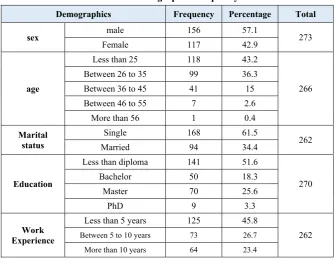
In this study, structural equation modeling technique with partial least squares (PLS) method was used for data analysis. In PLS analysis, a block of variables is used instead of working with the current variables. The main reason for using this approach can be no needing of distributive assumptions and measurement scales, predictive and theoretical objectives, appropriateness to hybrid models, appropriateness to small samples, lack of suitable solutions, and factors uncertainties (Azar et al., 2012: 18). The data obtained from the distribution of questionnaires in the sample were analyzed using Smart PLS and SPSS software. The results of the descriptive statistics for the demographic variables in the sample are presented in Table 2.
Table 2. Demographics frequency
Demographics Frequency Percentage Total
sex male 156 57.1 273
Female 117 42.9
age
Less than 25 118 43.2
266
Between 26 to 35 99 36.3
Between 36 to 45 41 15
Between 46 to 55 7 2.6
More than 56 1 0.4
Marital status
Single 168 61.5
262
Married 94 34.4
Education
Less than diploma 141 51.6
270
Bachelor 50 18.3
Master 70 25.6
PhD 9 3.3
Work Experience
Less than 5 years 125 45.8
262
Between 5 to 10 years 73 26.7
More than 10 years 64 23.4
status and level of education, the unmarried with 61.5% and those with diploma or lower with 51.6% had the highest frequency. In terms of sales experience, those with less than five years of experience with 45.8% had the highest frequency in the sample. It is noteworthy that the structural equation modeling technique consists of two stages: the first stage examining the general fitness of the model and the second stage examining the research hypotheses.
For overall model fitness in the partial least squares method from index reliability, convergent validity and divergent validity are used in the software outputs. The reliability of the index is in the form of Cronbach's alpha and hybrid reliability, convergent validity is measured by average variance extracted and factor loadings and finally divergent validity is measured by root mean square average variance extracted criterion from current variables. The Cronbach's alpha values and hybrid reliability, which are index reliability criteria, are shown in Table 2. Since the values above 0.7 are considered as acceptable values for these two criteria, according to the results that show these values are above 0.7 for the research variables, it can be stated that the fitness of the measurement model for this research has been confirmed. Since the Cronbach's alpha is a traditional criterion for determining the structure reliability, the partial least squares method uses a more modern criterion called hybrid reliability. Wertz et al. (2018) introduced this criterion. If the value for each structure is above 0.7, it indicates good internal consistency for the measurement models. It is noteworthy that the hybrid reliability criterion in structural equation modeling is a better criterion than Cronbach's alpha (Mansouri & Yavari Gohar, 2017).
Convergent validity is another criterion for measuring the fitness of measurement models to the partial least squares method.
Table 3. AVE, Cronbach's alpha, CR
AVE Cronbach's alpha CR
Ethical Value 0.575 0.753 0.843579
Empathy 0.614 0.775 0.826472
Organizational
Commitment 0.467 0.765 0.839151
Non-Financial
Performance 0.431 0.897 0.912873
The results of the divergent validity for the measurement model using cross-factor loadings also show that the divergent validity of the measurement model is acceptable and generally, it can be stated that, according to the above, the appropriate fitness of the model is confirmed.
The next step in this study is to test the hypotheses using the collected data, which is the second step of the structural equation modeling method.
The first hypothesis of the study suggests the impact of ethical values on the non-financial performance of the organization, while the second hypothesis states that the impact of ethical values on the non-financial performance of the organization is through organizational commitment.
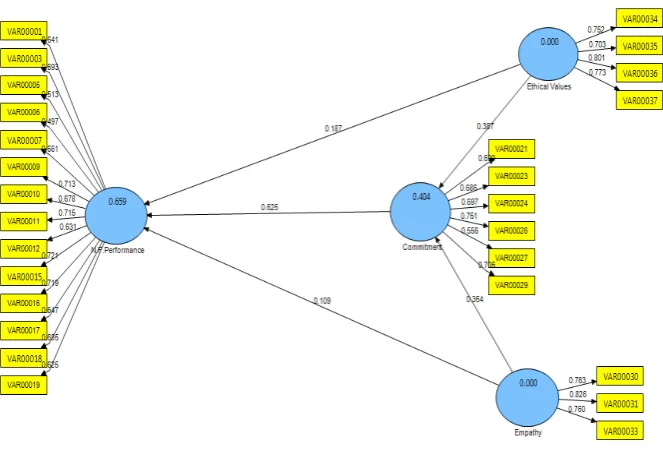
Figure 3. Structured Model of Research
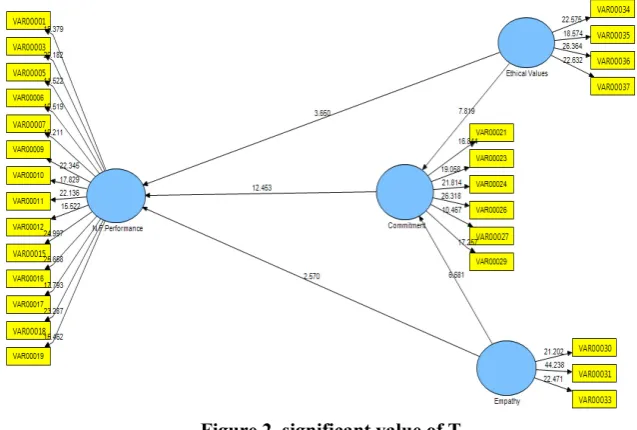
The software outputs in figures 2 and 3 show that in relation to the first hypothesis, the significant value of t and path coefficient are 3.65 and 0.187, respectively. Given that the statistical significance of t is greater than 1.96 at 95% confidence level, this hypothesis is confirmed at 95% confidence level, meaning that ethical values governing the organization affect the non-financial performance of the organization. But considering the significant values of t and path coefficient for the second hypothesis, since these path coefficients and significance of t for this path are greater than the values obtained for the path of the first hypothesis, it can be stated that organizational commitment plays a mediating role on the non-financial performance of the organization in relation to organizational ethical values.
organization through organizational commitment. The results show that the significant values of t and path coefficient for the third hypothesis are 2.57 and 0.109 respectively, which confirms the hypothesis at 95% confidence level and the effect of empathy on the non-financial performance of the organization. While the significant values of t and path coefficients related to the fourth hypothesis, indicate that empathy has an impact on non-financial performance of the organization through the mediating role of organizational commitment and the fourth hypothesis is confirmed at 95% confidence level. Because in relation to the fourth hypothesis, the above values show more intensity and significance than the outputs for the third hypothesis.
Table 4. The final result of hypothesis
Hypothesis result
H1 Non-financial performance of the organization is influenced by ethical values. confirmed
H2 Ethical values affect non-financial performance through organizational commitment. confirmed
H3 The non-financial performance of the organization is affected by empathy. confirmed
H4 Empathy affects non-financial performance through organizational commitment. confirmed
Conclusions and Suggestions
reducing trade balances and downward slope of employment, timely and appropriate planning can be put to the utmost.
On the other hand, in today's societies, ethical values are a criterion for evaluating human behavior and relationships, and since organizations are also an integral part of today's societies, the ethical values of the organization have been formed so as to more easily explain the characteristics and criteria of an ethical environment. It can be said that ethical values are a subset of the general culture dominant in the organization that can affect the relationships of individuals in the organization as well as the quality of these relationships. In human relationships formed in organizations, empathy can also be seen as a factor for personal growth and development, as well as relationships with others in the pursuit of more and better goals and programs. Empathy is defined as the amount of attention and understanding one has to others' perceptions and moods.
there is a positive and significant relationship between ethical values and organizational commitment. In another research conducted by Salahudin et al., in 2016, they specifically examined the impact of Islamic work ethics on organizational commitment and concluded that Islamic work ethics significantly influenced organizational commitment. The results of this study regarding the impact of ethical values on organizational commitment and non-financial performance of the organization are in line with the results of other researches and indicate that the ethical values governing the workplace significantly affects the non-financial performance of the organization through organizational commitment.
Researchers point to employee empathy as a competitive advantage, especially in service marketing disciplines (Ahearne et al., 2007), which strongly influence customer satisfaction (Agarwal et al., 2012) and on the other hand, it increases sales performance (McBane, 1995). In a study conducted by Agnihotri and Krush in 2015, they examined empathy along with ethical behavior and trust in measuring sales staff performance (Agnihotri, & Krush, 2015). Also in another study conducted in 2005, the effect of sales force empathy on relational results was examined. The results of this study also indicate that empathy among employees through organizational commitment has a significant effect on non-financial performance of the organization, which is in line with the findings of other researches in this area.
Therefore, it can be said that ethical values are an important element in organizations, especially in tour providers’ offices and it affects the employees and their relationships and ultimately the overall performance of the organization consisting of financial and non-financial aspects. Besides, the empathy formed in the workplace and between employees not only affects their moods and quality of work life, but also their relationship with the organization in such a way that they are committed to the organization and their duties. Ultimately, their satisfaction with the organization and their job, affects staying in the job, motivation and objectives of the organization. Managers can make the necessary use of this opportunity created in the organization by their timely and appropriate investigation and attention.
substantially effect on nonfinancial performance. So it is on behalf of CEO and other decision makers or influencers to create an ethical climate in their organization for encouraging spirituality in order to achieve more out comes. In this research we encountered some restrictions. Accessing statistical samples made us several problems and limits our results. Moreover we had to control some variables regarding our project time and costs. So all of these has affect the project outcomes and limited the real results.
References
Abram, A. (2009). Ethics and spirituality: Self-sufficiency or symbiosis?. Studia
Bobolanum, 4, 69-81.
Agrawal, R., Gaur, S. S., & Narayanan, A. (2012). Determining customer loyalty: Review and model. The Marketing Review, 12(3), 275-289.
Agnihotri, R., & Krush, M. T. (2015). Salesperson empathy, ethical behaviors, and sales performance: the moderating role of trust in one’s manager. Journal of
Personal Selling & Sales Management, 35(2), 164–174.
Ahearne, M., Jelinek, R., & Jones, E. (2007). Examining the Effect of Salesperson Service Behavior in a Competitive Context. Journal of the Academy of
Marketing Science, 35(4), 603–616.
Allen, N., & Meyer, J. (1990). The measurement and antecedents of affective, continuance and normative commitment to the organization. Journal of
Occupational Psychology, 63, 1-18.
Ayoun, B., Rowe, L., & Yassine, F. (2015). Is workplace spirituality associated with business ethics?. International Journal of Contemporary Hospitality
Management, 27(5), 938- 957.
Azar, A., Gholamzadeh, R., Ghanvati, M. (2012). Structural Model in Management. 1st ed. Tehran. Negahe Danesh. (In Persian)
Bagozzi, R. P. (2006). The Role of Social and Self-conscious Emotions in the Regulation of Business-to-Business Relationships in Salesperson-Customer Interactions. Journal of Business & Industrial Marketing, 21(7), 453–457. Bahrifar, A., & Javaheri kamel, M. (2010). The consequences of Ethical Values in
Organization. Journal of Management System, 7(28), 95-118. (In Persian) Barclay, D., Higgins, C., & Thompson, R. (1995). The partial least squares approach
to causal modeling: personal computer adoption and use as an illustration”.
Technological Studies, 2(2), 285-309.
Boenink, M. (2010). Tensions and opportunities in convergence: Shifting concepts of disease in emerging molecular medicine. NanoEthics, 3(3): 243-255.
Chen, G., Mathieu, J. E., & Bliese, P. D. (2015). A framework for conducting multi-level construct validation. In F. J. Dansereau & F. Yammarino (Eds.), Research
in multi-level issues: The many faces of multi-level issues .Oxford, UK: Elsevier
Science. 273-303.
Chonko, L. B., Tanner Jr., J. F., & Weeks, W. A. (1996). Ethics in Salesperson Decision Making: A synthesis of Research Approaches and an Extension of the Scenario Method. Journal of Personal Selling and Sales Management, 16(1), 35–52.
Corner, P. D. (2009). Workplace spirituality and business ethics: Insights from an eastern spiritual tradition. Journal of Business Ethics, 85(3), 377-389.
Ebrahimi, J., Kanani, Y. G., Tabari, M., & Seydanlou, O. (2017). Investigating the relationship between professional ethics and spirituality at work with social responsibility (Case Study: Gas company of Mazandaran province). JIMS8M:
The Journal of Indian Management & Strategy, 22(1), 25-31.
Elias, R. Z. (2005). The Effect of Corporate Ethical Values On Accountants’ Perceptions of Social Responsibility. Journal of Applied Business Research, 21(4), 1-10.
Evans, A. M., Levitt, D. H., & Henning, S., (2012). The Application of Ethical Decision-Making and Self-Awareness in the Counselor Education Classroom.
Journal of Counselor Preparation and Supervision, 4(2), 41-52.
Farahibourzanjani, B., Mahdavi, M., & Abbasi, M. (2010). Factors Affecting on Employee Satisfaction in Fava. Journal of Resources Management, 2(3), 101-120. (In Persian)
Ferrell, O. C., Johnston, M. W., & Ferrell, L. (2007). A Framework for Personal Selling and Sales Management Ethical Decision Making. Journal of Personal
Selling & Sales Management, 27(4), 291–299.
Girard, R. (2007). Achever Clausewitz, Entretiens avec Benoît Chantre. Paris: Carnets Nord.
Haj karimi, A., Tabarsa, Gh., Rahimi, F. (2008). The Impact of HRM on OBC by the Role of Commitment. Journal of Strategic Management Thinking, 2(1), 103-123. (In Persian)
Hartman, E. (1996). Organizational Ethics and the Good Life. Oxford University Press.
Huang, L., & Paterson, T. A. (2017). Group ethical voice: Influence of ethical leadership and impact on ethical performance. Journal of Management, 43, 1157-1184.
Ingram, T. N., LaForge, R. W., & Schwepker Jr., C. H. (2007). Salesperson Ethical Decision Making: The Impact of Sales Leadership and Sales Management Control Strategy. Journal of Personal Selling & Sales Management, 27(4), 301– 315.
Issa, T. & Pick, D. (2010). Ethical Mindsets in the Australian Services Sector. Asia
Pacific Journal of Business and Management. 1(1), 29-42.
Jaros, S. (2007). Meyer and Allen Model of Organizational Commitment: Measurement Issues. The Icfai Journal of Organizational Behavior, 6(4), 7-25. Jondle, D., Ardichvili, A., Mitchell, J. (2014). Modeling Ethical Business Culture:
Development of the Ethical Business Culture Survey and Its Use to Validate the CEBC Model of Ethical Business Culture. Journal of Business Ethics, 119(1), 29-43.
Jung Sun, Hyo & Namkung, Young & Hyun Yoon Hye (2010). The effects of employees’ business ethical value on person–organization fit and turnover intent in the foodservice industry. International Journal of Hospitality Management, 29, 538–546.
Komari, N., & DJafar, F. (2013). Work Ethics, Work Satisfaction and Organizational Commitment at the Sharia bank, Indonesia. International
Business Research, 6(12), 107-125.
Lau, C. M., & Moser, A. (2008). Behavioral effects of nonfinancial performance measures: the role of procedural fairness. Behavioral Research in Accounting.
Forthcoming. 20(2), 55-71.
Liu, A., & Pratt, S. (2017). Tourism's vulnerability and resilience to terrorism.
Tourism Management, 6, 404-417.
Lowery, C. M., Duesing, R. J., & Beadles, N. A. (2014). A research note on the relationships among spirituality, contextual variables, and perceptions of ethics in the workplace. Journal of Managerial, 3(86), 408-423.
Mansouri Moayyed, F., & Yavari gohar, F. (2017). The Impact of Role Stress on Employed Women Satisfactions: The Role of Self-Efficacy. Management
Studies in Development and Evolution, 26(86), 125-144. (In Persian)
Mathieu, J. E., & Zajac, D. M. (1990). A Review and Meta-Analysis of the Antecedents Correlates and Consequences of Organizational Commitment.
Psychological Bulletin, 108(2), 194-171.
McBane, D. A. (1995). Empathy and the salesperson: A multidimensional perspective. Psychology & Marketing, 12(4), 349-370.
McLaughlin, C., (2005). Spirituality and ethics in business. European Business
Review, 17(1), 76-98.
Mencl, J., & May, D. R. (2009). The Effects of Proximity and Empathy on Ethical Decision- making: An Exploratory Investigation. Journal of Business Ethics, 85(2), 201–226.
Meyer, J., & Allen, N. (1997). Commitment in the Workplace: Theory, Research,
and Application. Sage Publications.
Meyer, J. P., Allen, N. J., & Smith, C. A. (1993). Commitment to organizations and occupations: Extension and test of a three-component conceptualization. Journal
of Applied Psychology, 78(4), 538-551.
Mohajeran, B. (2014). Structural modeling of relationship between professional ethics and spirituality at work with social responsibility among nurses in the public hospitals in Kermanshah city. Quarterly Journal of Nursing Management, 3(2), 20-29.
Montazeri, M. Borhani, F. & Tavakkoli, S. N. (2017). Spirituality in treatment and medical ethics. Journal of research in medical and dental science, 5(6), 131-136. Motlagh, M., Jamali, A., & Ghoorchian, N. (2016). The role of spirituality and ethics in higher education quality improvement. Management Science Letters, 6(5), 341-350.
Mowdey R. T., Porter L. W., & Steers R. M. (1982). Employee- Organization
Linkage of Commitment, Absenteeism and Turnover. New York: Academic
Press.
Mukherjee, S., Bhattacharjee, S., & Singha, S. (2016). Workplace Spirituality: A Paradigm Shift to Ethics from Business. Iosr Journal of Business and Management. Special Issue - AETM', 16, 11-15.
O'Reilly, C. A., & Chatman, J. (1986). Organizational commitment and psychological attachment: The effects of compliance, identification, and internalization on prosocial behavior. Journal of Applied Psychology, 71(3), 492-499.
Provis, C., & Gramberg, B. V. (2004). Ethics, Conflict and Human Resource
Managers in New Economy. Victoria University of Technology Press.
Rajabipoor, A., & Dehghani, M. (2013). The Relation between Organizational Commitment and Job Satisfaction. Bioethics Journal, 6, 49-91. (In Persian) Rameson, L. T., Morelli, S. A., & Lieberman, M. D. (2012). The neural correlates of
empathy: Experience, automaticity, and prosaically behavior. Journal of
Cognitive Neuroscience, 24(1), 235-245.
Rodriguez-Rad, C. J. & Ramos Hidalgo, E., (2017). Spirituality, consumer ethics, and sustainability: The mediating role of moral identity. Journal of consumer
marketing, (just-accepted)
Salahudin, S. N., Baharuddin, S. S.,Safizal, M., & Osman, A. (2016). The Effect of Islamic Work Ethics on Organizational, Commitment. Procardia Economics and
Finance, 35, 582-590.
Schwepker Jr., C. H., & Good, D. J. (2011). Moral Judgment and Its Impact on Business-to-Business Sales Performance and Customer Relationships. Journal of
Business Ethics, 98(4), 609–625.
Shafiei Nikabadi, M., & Salimi, A., (2016). DEA of Organizational Culture and Non-Financial Performance and Knowledge Management. Productivity
Management Journal, 9(34), 7-45. (In Persian)
Shahriary, M., Abaszadeh, A., Mohammadi, E., & Bahrami, M., (2014). Nursing Ethical Value from Quran Perspective. Bioethics Journal, 4(14), 39-65. (In Persian)
Shalbafian, A. A., & Zarandian, N. (2019). Volunteer Tourism; an Approach to Realize Spirituality. International Journal of Tourism and Spirituality, 4(1), 9-31.
Sheikhi , H. (2010). The Impact of Armies productivity, the Factors Loading in Naja, Master Thesis in Farabi University. (In Persian)
Shirmohammadi, Y. & Abyaran, P., (2019). The influence of spiritual experience on the brand of religious place. International Journal of Tourism and Spirituality, 4(1), 33-55.
Spiro, R. L., & Weitz, B. A. (1990). Adaptive selling: conceptualization, measurement, and nomological validity. Journal of Marketing Research, 27(1), 61–69.
Sreers R. M., Porter, L. W. (1992). Motivation and Work Behavior. McGraw Hill, Book Co.
Taban, M., Javanmard, B., Mohammadi, A., & viseh, M., (2013). “The Study of Relationship between Spritual Leadership and Employee Attitude”. Journal of
Culture in Islamic University, 2(2), 229-238. (In Persian)
Yousef, D. A., (2000). “Organizational commitment and job satisfaction as predictors’ attitudes toward organizational change in a non – western setting”.
Personnel Review, 5(29), 56-70.
Wertz, J., Caspi, A., Belsky, D. W., Beckley, A. L., Arseneault, L., Barnes, J. C., ... & Odgers, C. L. (2018). Genetics and Crime: Integrating New Genomic Discoveries Into Psychological Research About Antisocial Behavior,
Psychological Science, 29(5), 791-803
Weinsten, Neil, D. (1980). Unrealistic Optimism about Future Life Events, Journal
of Personality and Social Psychology, 39, 112-122.