Experimental Study of Using Organic Waste Ash (OWA)
Instead of Cement in Concrete
Abdollah Mortezaei1, Seyyed Vahid Razavi Tosee 2*
1 M.Sc. of Structural Engineering, Jundi-Shapur University of Technology, Dezful, Iran.
*2 Assistant Profesor, Department of Civil Engineering, Jundi-Shapur University of Technology, Dezful, Iran.
*Corresponding author’s Email: [email protected]
(Date of received: 12/07/2018, Date of accepted: 10/03/2019)
ABSTRACT:
In this experimental study, the mechanical strength properties of concrete using 5, 8 and 12% of organic waste ash (OWA) instead of cement are investigated. The results showed that the 28 days compressive and tensile strength and slump of the concrete made by OWA in compared with ordinary concrete were 0.99, 0.99, and 0.8, respectively, for 5% OWA instead of cement, 0.96, 0.9, and 0.69, respectively, for 8% OWA instead of cement, and 0.9, 0.9, and 0.09, respectively, for 12% OWA instead of cement.
Key words:Concrete, OWA, Mechanical strength, Cement.
1- Introduction
OWA as a construction material, in cement-based materials especially.
Several studies around the performance of concrete using fly ash, wood ash, and waste wood ash (WWA) have been done [2 to 15] but none of them investigated the effects of adding animal waste ash to WA on the mechanical properties of manufactured concrete. Naik et al. investigated on the economic benefits of using WA as a part of the total cementitious materials in concrete and concluded that only in Wisconsin city, approximately 120,000 to 500,000 US dollars annually could be saved by using only 5 to 12% wood ash [10]. Sashidhar investigated the influence of adding different percentages of wood ash (0 to 30%) to concrete on its
resistance in acid attack with concentrated acids such as H2SO4 and HCL and concluded that 10% of wood ash
is the optimum rate to confront acid threats [15]. Oye reported that wood bottom ashes have no components which would be harmful to cement [4]. Olokode et al. reported that the best ratio of WA to get the desired mechanical properties from concrete is about 5 to 10% [14].
2- Methods and materials
The cement used in this experiment is Portland type 2 with a specific gravity of 3500 kg/m3. Saturation density
of sand used as fine aggregate in this study is 2440 kg/m3. Sand compliance with ASTM standards is shown
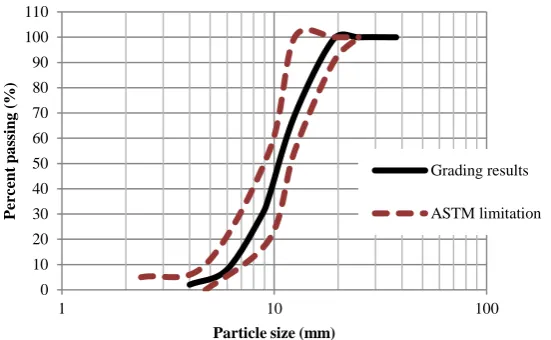
in Figure 1. In this study scoria with the saturated density of 2550 kg/m3 is used as coarse aggregate in accordance with ASTM standards. This compliance is shown in Figure 2. OWA used in this study is a mixture of milk vetch ash, oak and almond wood ash, and animal waste ash. The amount of OWA used in this study passing sieve #100 (150 μm) and sieve #200 (75 μm) was found to be 34.5% and 21.67% respectively. Based
on the obtained results, the unit weight value of OWA determined to be 890 kg/m3. To determine the chemical
composition of the OWA used in this study a XRF test based on (ASTM E 1621, 2005) regulation has been used which the obtained results are shown in Table 1. Based on the obtained results 29.8 % of OWA is based on the oxides of aluminum, silicon, and calcium. Also, chemical analysis results (Table 1) showed that the
major oxides in the OWA are silicon dioxide (SiO2), lime (CaO), aluminum oxide (Al2O3), potassium oxide
Fig.2. Coarse aggregates compliance with ASTM standards.
Table 1: Chemical analysis results on the OWA
Analysis Parameters OWA
SiO2 (%) 37.5
CaO (%) 16.7
Al2O3 (%) 7.8
K2O (%) 6.7
Fe2O3 (%) 5.3
MgO (%) 4.1
Cl (%) 1.3
P2O5 (%) 1.2
SO3 (%) 1.0
TiO2 (%) 0.42
SrO (%) 0.13
Na2O, Available alkali (%) 1.1
L.O.I (at 1000 C) (%) 16.79
La&Lu (%) <1.0
2.1. Properties of concrete including OWA
Slump test results of concrete containing different percentages (0, 5, 8, and 12% by weight of cement) of WOA are shown in Table 2, which indicates the inverse relationship between the workability and the percentage of used OWA.
Table 2: Slump of concrete with OWA as replacement for cement
OWA instead of cement (%) 0 5 8 12
Slump (mm) 42 35 29 4
0 10 20 30 40 50 60 70 80 90 100 110
1 10 100
Pe
rc
en
t
p
a
ssi
n
g
(
%
)
Particle size (mm)
Grading results
and all of the concrete samples manufactured by this rate of ash suffered from severe bleeding.
2.2. Compressive strength
In this experimental study the effect of using 5, 8 and 12% of OWA instead of cement on the compressive strength of produced concrete mixtures have been determined. Naik et al. evaluated the effect of using 5, 8 and 12% of the total cementitious materials of WA as a replacement on the compressive strength of concrete mixtures [13]. Figures 3, 4 and 5 indicate the attained compressive strength results using OWA and WA in concrete at the age of 7, 28 and 91 days, respectively.
Fig.3. Compressive strength of concrete with OWA and WA at age of 7 days. 0 5 10 15 20 25 30 35
0 5 8 12
C o m p re ssi v e st re n g th ( M Pa ) Ash (%) OWA Naik et al. 2002
0 5 10 15 20 25 30 35
0 5 8 12
Fig.5. Compressive strength of concrete with OWA and WA at age of 91 days.
Compressive strength of concrete using 5, 8 and 12% of OWA to the normal mixture were respectively 0.97, 0.85, and 0.93 for the age of 7 days and 0.99, 0.96, and 0.92 for the age of 28 days. Based on the results of both experiments, the highest compressive strength at the age of 28.
2.3. Tensile splitting strength
In this experimental study the effect of using 5, 8 and 12% of OWA instead of cement on the tensile splitting strength of produced concrete mixtures have been determined. Naik et al. evaluated the effect of using 5, 8 and 12% of the total cementitious materials of WA as a replacement on the tensile splitting strength of concrete mixtures [13]. Figure 6 indicates the attained tensile splitting strength results using OWA and WA instead of cement at the age of 28 days.
respectively 0.99, 0.9, and 0.94. Based on the results, by using 8% of OWA compressive strength and tensile splitting strength in 28 days would increase respectively 17 and 11%, which makes it the optimum among the rest.
2.4. Relationship between compressive strength and tensile splitting strength
To determine the relationship between compressive and tensile splitting strength of concrete, results of following mixtures have been used:
Water/Cement ratio = 0.35: mixtures with 5 and 8% of OWA by weight of cement
Water/Cement ratio = 0.45: mixtures with 5, 8 and 12% of OWA by weight of cement
Fig.8. Relationship between tensile and compressive strength with OWA.
3- Conclusion
Results of this study can be explained in follow:
1-The optimum ratio of OWA to be used in concrete mixtures as a replacement for cement is 5 to 8
percent by weight of cement which is in compliance with results on the WA from other experimental
studies.
2-Slump test results decreased by increasing the ratio of OWA in concrete mixtures.
Concrete mixtures containing 20 percent of OWA by weight (with constant water to cement ratio)
suffered from severe bleeding and lack of workability.
3-Compressive strength results at 91 days proved that organic waste would cause no severe hazard or
threat on the mechanical properties of concrete.
4- By increasing the OWA ratio from 0 to 8 percent instead of cement by weight, the ductility of
y = 0.0616x + 0.4907 R² = 0.3563
1.9 2 2.1 2.2 2.3 2.4 2.5
25 26 27 28 29 30 31
A
v
er
a
g
e
te
n
si
le
st
re
n
g
th
(
M
Pa
)
4- References
1. Lee, M., Legg, R., Maxwell, S., Rees, W., (2013). Closing the Loop: Reducing greenhouse gas emissions and creating green jobs through zero waste in BC. Wilderness committee.
2. Siddique, R., (2012). Utilization of wood ash in concrete manufacturing. Resources, Conservation and Recycling 67, 27-33.
3. Naik, T. R., (1999). Tests of wood ash as a potential source for construction materials. Report no. CBU-1999-09. UWM Centre for By-Products Utilization. Department of Civil Engineering and Mechanics, university of Wisconsin-Milwaukee, Milwaukee, p. 61.
4. Bjarte O., (2012). Ash Utilisation, Wood ash as raw material for Portland cement. SINTEF. 5. Campbell, A., (1990). Recycling and disposing of wood ash. TAPPI Journal, 73(9), 141–143.
6. Etiegni, L., (1990). Wood ash recycling and land disposal. Ph.D. thesis. Department of Forest Products, University of Idaho at Moscow, Idaho, USA. 7. Etiegni, L., Campbell, A. G. (1991). Physical and chemical characteristics of wood ash. Bio-resource Technology, 37(2), 173–184.
8. National Council for Air and Stream Improvement, Inc. (NCASI), (1993). Alternative management of pulp and paper industry solid wastes. New York, NY: Technical Bulletin No. 655, NCASI.
9. Tarun, R., Naik, R., Kraus, N., Siddique, R., (2003). Use of wood ash in cement-based materials, CBU-2003-19.
10. Tarun, R., Naik, R., Kraus, N., Siddique, R., (2003). Demonstration of manufacturing technology for concrete and CLSM utilizing wood ash from Wisconsin, Report No. CBU-2003-20, Interim Report for Year 2 Activities Submitted to the Wisconsin Department of Natural Resources, Madison, WI, for Project # 01-06, Department of Civil Engineering and Mechanics, University of Wisconsin-Milwaukee, Milwaukee
11. Udoeyo, F. F., Inyang, H., Young, D. T., Oparadu, E. E., (2006). Potential of wood waste ash as an additive in concrete. Journal of Materials in Civil Engineering, 18(4), 605–611.
12. Abdullahi, M., (006). Characteristics of wood ash/OPC concrete. Leonardo Electronic Journal of Practices and Technologies, 8, 9–16.
13. Tarun, R., Naik, R., Kraus, N., Siddique, R., (2002). Demonstration of manufacturing technology for concrete and CLSM utilizing wood ash from Wisconsin, Report No. CBU-2002-30, Report for year 1 activities submitted to the Wisconsin Department of Natural Resources, Madison, WI, for Project # 01-06 UWM Center for By-Products Utilization, Department of Civil Engineering and Mechanics, University of Wisconsin-Milwaukee, Milwaukee