in the population sciences published by the Max Planck Institute for Demographic Research Konrad-Zuse Str. 1, D-18057 Rostock · GERMANY www.demographic-research.org
DEMOGRAPHIC RESEARCH
VOLUME 15, ARTICLE 5, PAGES 105-146
PUBLISHED 14 SEPTEMBER 2006
http://www.demographic-research.org/Volumes/Vol15/5/ DOI: 10.4054/DemRes.2006.15.5
Research Article
Similarities and differences between two
cohorts of young adults in Italy:
Results of a CATI survey on transition to
adulthood
Stefano Mazzuco
Letizia Mencarini
Rosella Rettaroli
1 New clues in the debate on convergence or persistent divergence of transition to adulthood in Europe?
106
2 The Italian context of latest-late transition to adulthood and lowest-low fertility
108
3 Structure, rationale and potential of the I.D.E.A. survey 110 4 Timing and sequence of events in the transition to adulthood 111 4.1 A further delay for the 1966-1970 cohort 111
4.2 Reasons for leaving home 114
4.3 Persistence of a rigid sequence of events for 1966-70 young adults 114 5 Determinants of path out of parental home 118
6 Behaviour of new cohorts 122
7 Late parenthood 128
7.1 Does late transition mean late and low fertility? 128 7.2 Determinants of transition to first child linked to other markers
of “delay syndrome”
129
8 Conclusions 133
9 Acknowledgements 134
References 135
http://www.demographic-research.org 105
Similarities and differences between two cohorts
of young adults in Italy:
Results of a CATI survey on transition to adulthood
Stefano Mazzuco 1
Letizia Mencarini2
Rosella Rettaroli3
Abstract
This paper analyses the results of a CATI survey, consisting of a representative national sample of 3083 young Italian people of two different generations: those aged 23-27 and 33-37 in the first half of 2004. The analysis is targeted particularly at the older cohort and examines the late transition to adulthood and its effect on fertility. Is the situation in Italy converging towards the European one? We also analyse transition processes to all “life course” events as interrelating mechanisms, in which each process is the premise for the next step, but in which they are all probably considered indispensable in choosing to have a child. The results suggest the spread of new family forms among youth, but a persistent delay in family formation.
1 Corresponding author, Post-doctoral graduate at Department of Statistics, University of Padova, Italy.
Address: Department of Statistics, Via Cesare Battisti, 241 35121 Padova. Phone ++390498274192, fax ++390498274170. E-mail: [email protected]
2 Researcher at Faculty of Political Science, University of Florence, Italy. Address: Department of Statistics,
viale Morgagni 59 50134 Florence,. Phone ++390554237368, fax ++390554223265. E-mail: [email protected]
3
Full Professor at Faculty of Statistics, University of Bologna, Italy. Address: Department of Statistics, via delle Belle Arti 47, 40126 Bologna. Phone ++390512098243, fax ++39051232153.
1. New clues in the debate on convergence or persistent divergence of
transition to adulthood in Europe?
Since the seminal work by Model et al. (1976), much has been said and debated on the transition to adulthood in Europe. The wide diversity among industrialised countries has inspired researchers to examine the reasons for the high heterogeneity in timing and sequencing of pathways to adulthood observed both inside and outside Europe.
As Shanahan (2001) observes, the modernisation of societies is often invoked as the main force driving recent transformations in the life-courses of individuals. More specific demographic literature calls this underlying process the “second demographic transition” (SDT). It is related to increased emphasis on individual autonomy in ethical, moral and political spheres, greater rejection of any form of institutional control, and a rise in values connected with higher-order needs, “lower-order” needs being more concerned with subsistence (Surkyn and Lesthaeghe, 2004). This revolution in values has given rise to many transformations in demographic behaviour – basically, a postponement of marriage and fertility, and a rise in the frequency of informal cohabitation and non-marital fertility.
Nevertheless, this change has not spread uniformly through Europe: although well-established in northern and western Europe, in Mediterranean countries cohabitation and out-of-wedlock fertility remain at low levels. After 1990, Eastern Europe started to converge towards the behaviours of northern countries and commentators maintain that this will also happen in southern Europe, although the process is taking more time than expected.
Other scholars are more sceptical of this, believing that this tardiness will remain a southern peculiarity, especially in timing and sequencing of transition to adulthood. Reher (1998), who is among them, emphasises that the differences we observe today between northern and southern Europe are rooted far in the past: for instance, leaving home early by young people in northern Europe reflects the habit (in the late Middle Ages) of young adults leaving home to work in agriculture or as servants in urban households– a practice far less common in southern Europe, where permanent departure from home came only with marriage and, for the chosen heir, marriage led to continued co-residence with parents.
In addition, in Mediterranean traditional society, much of the aid given to vulnerable members (children, and the old and sick) came from their families. Still today the family is the most important institution of solidarity, and is essential for the wellbeing of its members.
http://www.demographic-research.org 107 continue to occupy clearly differentiated vital spheres”. In weak family systems
individuals take precedence over the family group; in strong family systems they develop their personalities and freedom within the family group.
The importance of educational and occupational career in determining the pathways to adulthood must also be considered. Generally, it is acknowledged that one reason behind the general postponement of leaving home and union formation is the prolongation of education (Corijn and Klijzing, 2001). It has also been stated that increased uncertainty, especially as regards employment, poses a further obstacle to young people in the route out of their parental homes (Blossfeld et al., 2003). Nevertheless, for Mediterranean young adults, the definitive departure from the parental home continues to coincide more or less closely with the end of their education, marriage and finding a permanent job. If young adults get jobs during the period preceding their marriage, they normally continue to live with their parents. This choice enables young people to save money in order to set up their future families.
The issue of convergence to SDT standards is thus crucial when considering a southern European country such as Italy. Will Italy and the other Mediterranean countries move in the direction predicted by SDT, or will they remain far from the northern European pattern? Will this convergence undermine the deep disparities that have always characterised the family in the northern and southern regions of Europe?
If, as stated, strong family ties in Italy continue to drive the most important phases in the transition to adulthood we would expect delayed times in the spread of modernisation in this country. Modernisation of individual behaviour may imply that one of the entire family group.
In this paper, we present results from a sub-sample of a nationally representative survey of young Italian adults, recently conducted with the specific aim of studying these crucial transitions in the life-course and their interconnections. There are three main aims of the study:
(1) have there been changes in the entry to adulthood for recent Italian cohorts? Patterns of timing and sequencing of crucial marker events are analysed separately for the 1966-70 and 1976-80 cohorts;
(2) what reasons do young adults have for leaving home, compared with the well-known ones of previous generations, and do some specific sub-groups of young individuals make different choices in terms of their transition to adulthood?
(3) what are the determinants of transition to parenthood, taking into account the sequence of previous “marker” events of transition to adulthood?
adulthood and lowest-low fertility (section 2) and given details of the source of data (section 3), we first make a descriptive analysis of timing and sequences of marker events at transition to adulthood, and reasons why young adults of the 1966-70 cohorts leave home, then we analyse more in depth the determinants of the transition out of parental home, again for 1966-70 cohort. Empirical methods used here are based on event history analysis, which are particularly suitable for uncovering structures of dependency between life-course histories (Blossfeld and Rowher, 2002). In addition, we also study the new cohorts' behaviour (1976-80) and the determinants of late parenthood (only for the older cohort), and its possible links with the other markers of the “delay syndrome”. Our main findings and a discussion are presented in section 8. Model results are listed in an appendix.
2. The Italian context of latest-late transition to adulthood and
lowest-low fertility
A “latest-late transition” to adulthood and a “lowest-low fertility” (Kohler et al., 2002) defines the socio-demographic Italian context of family formation. One of the most important features of southern Europe is its very low fertility (period total fertility rate below 1.3 children per woman at the beginning of the new century). Italy, together with other Mediterranean countries such as Spain may be considered the precursor of the lowest-low fertility (Livi Bacci and Delgado Peréz, 1992). But, as previously stated, also in terms of leaving the parental home, a Mediterranean or southern European pattern can be recognised. This specific feature, which is logically embedded in the whole process of family formation, is therefore closely related to the timing of marriage and the onset of childbearing (Billari et al., 2001, 2002; Billari 2004).
http://www.demographic-research.org 109 The causes of the peculiar and highly conspicuous Italian "delay syndrome" (Livi
Bacci, 2001) are not easy to understand. According to the classical definition (Model et al., 1976), the transition to adulthood is marked by certain events, in which both timing and sequence of these events are considered to be particularly important. At the individual level, family formation and fertility behaviour is a consequence of a series of choices during the life-course, and especially during the period defined as transition to adulthood.
The economic, cultural and psychological factors that underlie the transition to adulthood are, unsurprisingly, interrelated and complex. Several factors have been quoted as being crucial in understanding its postponement in Italy: (1) the centrality of marriage for family formation and the prerequisite of a stable job position (De Sandre et al., 1997; Barbagli et al., 2003); (2) the prolonged period devoted to education (Ongaro, 2005); (3) the strength of inter-generational ties which typifies the south-western European family compared with north-western countries (Reher, 1998; Micheli, 2000; Barbagli et al., 2003; Dalla Zuanna 2002), characterised by considerable psychological and material solidarity and also high residential proximity between generations; (4) the lack of specific policies directed towards young people – typical of the “Mediterranean” welfare regime – (Mayer, 2001) generating a strong dependency of young people on their parents. Furthermore, and more recently, the difficulty of finding a job, the amount of time required to find a stable position (Rettaroli, 2005), and the problem of scarce housing (Mencarini and Tanturri, 2005) have also become significant factors.
In the resulting institutional framework, in Italy the traditional expectation is that young people should not leave the parental home until they are fully ‘prepared’ to establish their own family households, minimising the risk of returning to their parents. However, it should be noted that, cohabitation – as an alternative or precursor to legal marriage – has recently been gaining ground in Italy and, as such, should not be ignored as a new marker of adulthood transition.
3. Structure, rationale and potential of the I.D.E.A. survey
The I.D.E.A. ("Inizio Dell'Età Adulta" - Beginning of Adulthood) survey was carried out on a nationally representative sample of more than 3,000 young people aged 23-27 and 33-37 between December 2003 and March 20044. These two groups were chosen with the aim of considering two precise and sufficiently distant cohorts of both sexes. The sample was stratified5 by sex, marital status, and residential macro-areas (North, Centre and South of Italy).
The survey offers the good possibility of exploring the recent evolution of transition to adulthood dynamics in Italy. Individuals are asked on aspects such as leaving home, marriage, cohabitation, job career, first sexual intercourse, and fertility. A “relational” perspective is introduced by acknowledging the importance of certain key actors, such as the parents of the person interviewed, the partner (even if not cohabiting) and also siblings and peer groups. The role of parents in determining young adults' behaviour was studied in depth; information on both moral and practical issues was collected, together with data on material and psychological support provided by parents throughout the life-cycle6. The rationale behind this strategy is that, in the Italian context, characterised as it is by “strong family ties” and very weak provision for welfare, parents have a strong “propulsive” or “braking” power on their children’s timing of autonomy, with consequences on the timing of all successive phases (union formation and fertility behaviour).
Here, we analyse first data from the older group interviewed, aged 33-37 (born between 1966 and 1970) and consisting of 1533 interviewees. In this older group, we captured retrospectively the various phases of transition to adulthood such as leaving the parental home, union formation and fertility choices. The aim was to gain knowledge of various social processes, such as education and work, and their interaction with the parallel courses of first love relationships, union formation and fertility biographies. Particular attention was paid to job characteristics, emphasising the
4
The survey was organized by a consortium of Italian Universities, in the framework of a project on “Life cycle, family building and childbearing between choices and constraints”. Interviews were conducted with CATI (Computer Aided Telephone Interviewing) technique.
5 Given the low response rate which usually characterizes telephone interviews (in our case it should range
between 30% and 40%, but it is not possible to have a point estimate of it), the final sample was post-stratified with weightings, in order to take into account also education level, which is a critical variable in determining the probability of being interviewed. Weights for post-stratification are derived from the National Labor Force Survey (Billari and Dalla Zuanna, 2004).
6 In addition to the young people, 592 mothers from the younger cohort (young people still living with
http://www.demographic-research.org 111 role of job stability. The hypothesis we wished to test was whether increased flexibility
in the labour market led to precarious job positions which may have influenced and further slowed down the path towards residential autonomy and adulthood.
The younger group interviewed was aged 23-27 (born between 1976 and 1980) and was composed of 1550 interviewees. Information from this younger group enabled us to study the beginning of the individual pathways and decision-making process that leads to the eventual exit from the parental home, entering into a union, and forming one’s own fertility intentions. Most young people in this age group still live with their parents (approximately 70% according to a recent survey, Buzzi et al., 2002). This means that, for this group ex-ante interactions between various family actors, leading to residential autonomy or – for those who have already experienced it – the first phases of life outside the family, could be studied. In addition to individual information on life-course (such as leaving and returning to the parental home, union formation and fertility), the survey also collected detailed information on education, work, and love relationships.
4. Timing and sequence of events in the transition to adulthood
4.1 A further delay for the 1966-1970 cohort
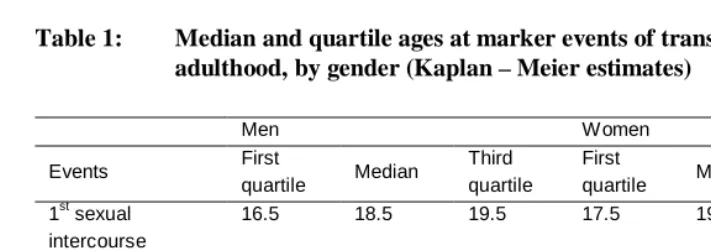
For the older cohort “event history analysis” methods were applied to ascertain whether the determinants of the path out of the parental home have changed or not, with regard to literature evidence. Most of these young people, aged 33–37, have completed the process of residential autonomy: 86% of men and 90.3% of women had left home at least once at the time of the interview. Table 1 lists median ages at marker events of transition to adulthood.
The proportion of those who had never left home at the age of 30 is directly comparable with other Italian data: in particular, the 1996 Fertility and Family Survey data (De Sandre et al., 1997) and the 1998 Multi-Purpose Survey (ISTAT). According to FFS data, in the 1961-65 cohort, 84.9% of men and 89.6% of women had left home at the age of 30. Thus, a further general slight delay in leaving home can be revealed for our 1966-1970 cohort, even stronger in the North of Italy for men and in the Centre for women (data not shown here). Comparisons of age at leaving the parental home for the two cohorts clearly highlight gender differences. For both cohorts the median age for men is 27, and for women there has been a postponement from 24 to 25 years.
generations, compared with previous cohorts, also with regard to age at first job, first marriage, and first child. Concerning first sexual relations, the median age of males is consistent with ages from other data source (Ongaro, 2005) and is slightly lower for females. Both Table 1 and Figure 1 show a very high median age at cohabitation, a symptom of the scarce prevalence on a national level of cohabitation as a form of first union7.
The latest data from Istat (2005) confirm the increasing propensity of Italian young adults to leave the parental home to form an informal union: unions with both partners who had never married totalled 47.6% in 2003, against 29.5% 10 years previously.
Table 1: Median and quartile ages at marker events of transition to adulthood, by gender (Kaplan – Meier estimates)
Men Women
Events First
quartile Median
Third quartile
First
quartile Median
Third quartile 1st sexual
intercourse
16.5 18.5 19.5 17.5 19.5 21.5
1stjob 17.6 21.4 27.5 19.5 24.0 35.8
1st exit from parental home
23.0 27.2 30.6 21.7 25.1 28.6
1stmarriage 26.6 30.1 — 23.4 26.6 32.7
1stchild 29.2 33.4 — 25.3 29.3 35.4
1st cohabitation 31.2 — — 29.3 37.5 —
7 The phenomenon of cohabitation has a strong regional gradient in Italy and is widespread only in the areas
http://www.demographic-research.org 113
4.2 Reasons for leaving home
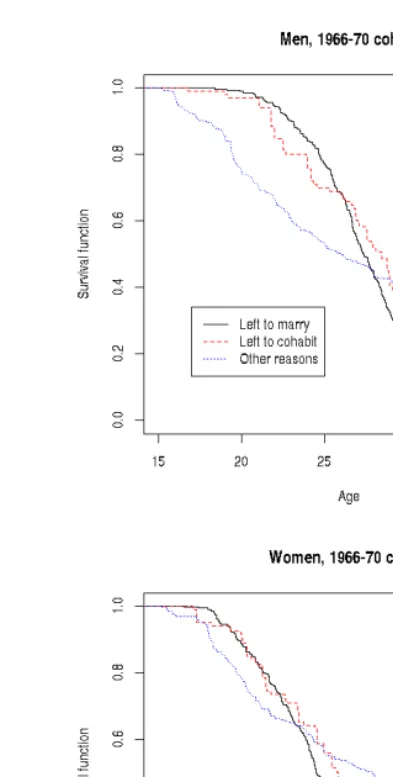
The most recent studies show that something is changing in the reasons why young Italian people leave home. Figure 2 highlights new motivations for the young adults born between 1966-70. Marriage is still the prevalent reason but, among men having left the parental house before the age of 30, the second most important reason is their job. Cohabitation as a motivation for leaving the family of origin is also increasing: 9% of women and 8% of men have left home before the age of 30 to cohabit with a partner.
Figure 2 shows a different pattern of timing for home-leaving according to the reason for doing so. Home-leaving curves for marriage and cohabitation are quite similar, confirming that cohabitors in this cohort leave home as late as those who leave home to marry. However, it is also seen that those who leave home for reasons other than union formation show a different pattern and a definite acceleration of the event due to students who leave home for educational reasons and those who leave to work.
Regional patterns (Figure 3b) also highlight reasons, the main features being: (1) the proportion of North-Centre Italian men who leave home to marry is particularly low compared with previous cohorts (Ongaro, 2001); (2) leaving the parental home in order to cohabit is increasing in the North-Centre of Italy but is still a marginal category8 in the South; (3) the proportion of young men leaving home for work reasons is higher in the South, where the unemployment rate is higher, confirming interregional migration movements with a South-North gradient; (4) the number of young women leaving the parental home to study far from their family of origin is higher in the South than in the North-Centre. This aspect is a clear sign of innovation in the behaviour of the most traditional part of Italy - particularly important, especially for Southern women.
4.3 Persistence of a rigid sequence of events for 1966-70 young adults
A general observation on transition from youth to adulthood among post-war cohorts across Europe is de-standardisation and de-synchronisation of the life-course. The very segments and events in the process of transition to adulthood have become less strictly defined and their sequence more diverse. In the passage from a “standard” transition to a “choice” transition, there is no longer a strict normative model with appropriate ages for certain steps in the life course (Giddens 1990; Corijn and Klijzing, 2001).
Nevertheless, the Italian context has been described as far more normative and rigid. Two distinctive aspects of the sequence of events have been shown, at least for cohorts born up to the early 1960s: (1) a high degree of synchronisation between
8 From the I.D.E.A. survey, the proportion of cohabiting people among 1966-1970 cohorts is 19.2% for Italy,
http://www.demographic-research.org 115 leaving the family of origin and first marriage; (2) the beginning of working life in a
non-autonomous residential situation, i.e., still living at home. Our data – on 1966-1970 cohorts – confirm these characteristics, although some signs of change are evident.
Figure 3 suggests that the sequences of events experienced by young adults are still very traditional: very rarely do young people marry while they are still studying or in job training. This rigid pathway is more flexible for the later cohorts.
Figure 4 shows the prevalence of simultaneity between leaving home and marrying, although more than one-third of men and one-fifth of women have left home before marrying (the spread of cohabitation does not suffice to explain this high percentage – see next sections for details on reasons for leaving home). As regards the link between first job and leaving home, Figure 4 clearly shows that most young people leave home only after beginning to work. For this sequence too, exceptions are more frequent among men than women.
http://www.demographic-research.org 117
Figure 3: Proportion of young people who left home before age of 30, with reasons for leaving and gender (full sample)
3a) Italy (full national representative sample)
Figure 4: Prevalence of certain sequences between leaving home and 1st marriage and 1st job by gender
36.2% 2.2% 25.0% 62.1% 76.9% 61.6% 12.9% 20.6% 2.5% 28.0% 8.3% 63.7% Left home and then 1st marriage Left home at same time of 1st marriage 1st marriage and then left
home
Left home and then 1st job
Left home at same
time of 1st job
1st job and then left
home
SEQUENCE LEAVING HOME-1ST MARRIAGE SEQUENCE LEAVING HOME-1ST JOB
Men Women
5. Determinants of path out of parental home
As stated previously, the two main features in Italy for the transition to adulthood are: 1) the synchronisation between leaving home and entering a union; 2) the entry into the labour market while still remaining with parents. Nevertheless there is increasing heterogeneity in the main reasons as indicated by responses regarding leaving the family of origin, and some routes taken out of the parental home which are rarely chosen by young adult are gaining in social relevance.
http://www.demographic-research.org 119 the process of leaving home, taking into account the various destinations of young
people.
Debate on the independence of young adults and such characteristics is well known in the literature (see, among others, Ongaro, 2001). Education and employment have a significant influence on the timing of creation of one's own household and family. Investment in education makes the transition to first residential autonomy more difficult and may even lead to postponement of the acquisition of independence. Occupation plays a similar role: employed women are older when they begin to create a family of their own and at the birth of their first child.
Moreover, gender differences have not disappeared in the transition to adulthood: the greater involvement of women in personal fulfilment in areas outside the family makes it difficult to reconcile the career of wife and/or mother with other domains such as work or study. Thus, women are only able to start a family once they have reached a sufficiently secure position. The postponement of entry into adulthood in Italy has been found to have further social determinants. Having many siblings accelerates leaving home and the birth of the first child. The characteristics of the family of origin in terms of educational and professional background of parents have also proved to influence tendencies concerning transitional events. The more stable the social career of the family, the longer the delay in the passage to adult responsibilities.
Religion and devoutness also play an important role in individuals' family behaviour. Being highly religious, or having parents who are so, makes for a slower exit from the parental home and a higher age at first union, but it accelerates first parenthood. A reverse effect has been found for the experience of the initial sexual activity and the first couple relationship: experiencing these events at a young age makes for earlier leaving from home, but later onset of a reproductive career.
When we look at the links between the decision to leave home and the covariates which the literature has identified as influencing the process (Table 2), we see that the positive determinants associated with an earlier leaving from home – apart from residence in a main city and having completed one’s education – differ markedly by gender. Among men, an earlier leaving is associated more frequently with low attendance to religious functions at the age of 16 and with having siblings and a father in an medium status working position; precocious women tend to live in the South, to have had couple and sexual relationships at an early age and, more frequently, to be working.
risk (see Blossfeld & Rowher, 2002), in which the transitions to different states are considered as competing events.
Taking into account leaving home with the entry into a union, we classify individuals into five groups: (1) those who have never left home or experienced a first union – which in the model is the original state; (2) those who have entered into a union while remaining at home; (3) those who have left home and, at the same time, experienced first marriage; (4) those who have left home to enter into a first cohabitation; (5) those who have left home for some reason other than a union (e.g., education, job career, search for personal independence, etc.)9. Detailed results of the models are listed in the appendix.
Numerous empirical studies have emphasised the strong ties between social features and family formation. In this section, we focus on how the characteristics of the parental household and the educational and work careers of young adults influence the onset of an independent life, distinguishing the various reasons for leaving home. From the model with covariates (Table 3) we find evidence consistent with the existing literature, but only sometimes do we find clear evidence of gender differences. Here, we are more interested in highlighting in the characteristics of emerging groups of young people leaving home to cohabit or for other reasons, such as education or a job, than in the well-known characteristics of those leaving home to marry (more often residing in the South of Italy and precocious on sex and couple relationships). Both these groups are characterised by the fact that they are more frequently composed of people with scarce attendance to religious functions. Although the effect of religion is reinforced by the low attendance of the father during adolescence in young cohabiting men, the similarities between the two emerging groups end here. Those who left for an informal union more commonly live in the Centre and North of Italy and are those who have had early sexual initiation. Those who left for work or education are more often from the South (particularly men, confirming the well-known South-North internal migration tendency for education or work reasons), are single children, have highly educated mothers, and reside in a main city.
9 Some of the covariates used in the models are defined as time-dependent, so that their values may change
http://www.demographic-research.org 121
Table 2: Determinants of leaving home earlier: 1966-1970 cohorts. Main significant results of leaving home hazard regression. (See table 1, appendix, for complete results)
Covariates Men Women
Resident in a main city X X
Resident in the South X
Low religious attendance at the age of 16 X
First sexual intercourse <18 X
First couple relationship <16 X
Completed education X X
Having a job X
Having siblings X
Father with medium-status job position X
Table 3: Determinants of leaving home for different destinations: 1966-1970 cohorts. Main significant results of leaving home hazard regression with multiple destinations.
(See table 2, appendix, for complete results)
Marriage Cohabitation “Other reasons”
Covariates Men Women Men Women Men Women
Resident in a main city X X
Resident in the South South South Centre/North Centre/North South Low religious attendance
at age of 16
X X X X X X
First sexual intercourse <18
X X
First couple relationship <16
Completed education
Having a job X
Siblings 1 + none none
Father's job High
Low religious attendance of father when subject was 16
X
Mother with high education level
6. Behaviour of new cohorts
Thus far, we have analysed the behaviour of cohorts born between 1966-70 in terms of transition to adulthood. However, one of the main points in this research was to ascertain whether the new cohorts (born ten years later) show further changes in the path to adulthood with respect to the older ones. This comparison cannot be complete, as the younger cohorts are at the very beginning of the transition process. Some events in particular (e.g., first child) have only been experienced by a quite small proportion, so that we can only compare the beginning of the process of transition to adulthood of the two cohorts.
As regards marriage, for instance, Figure 5 shows that there is a delay, particularly for women, whereas for men there is only a slight (and not significant) acceleration at the very beginning, at approximately the age of 20. But after that age postponement of marriage seems clearer although we are dealing with a sample in which the proportion of those who married before the age of 23 is extremely low (less than 10%).
Apart from marriage, there is a clear acceleration in leaving home. It is slight for women, but clear-cut for young men (see Figure 6). A similar result was shown by Ongaro (2005) with a different dataset. Thus, younger cohorts leave home before older ones and as there is no acceleration of marriage, there should be an increase in those leaving home for a destination other than marriage. One route that is increasing in prevalence is cohabitation. This comes as no surprise, since even among the older cohorts we noted an increasing preference for cohabiting unions. Table 4 illustrates that leaving home for education is also increasing in prevalence, particularly for those who left home before the age of 23. 43% of males from the younger cohort who left home before this age left for education, while the same figure is 21% for men in the older cohort. Similarly, 37% of young women from the 1976-80 cohort who left home before the age of 23 left for education, compared with 19% in the older cohort. Table 4 also confirms the increasing prevalence of cohabitation, although the proportion of those who leave to cohabit remains considerably lower than in Northern and Central Europe. Conversely, there is a lower prevalence of leaving home to marry, particularly for women, although marriage is still the main route taken out of the parental home10. Among males there is also a decreasing tendency to leave home for work: 44% of men who left home before the age of 23 left for work reasons in the older cohort, but only 16% in the younger cohort. This fact suggests a possible delay in the onset of the
10 This is true for young women but not for young men, as the proportion of those who left home to marry is
http://www.demographic-research.org 123 working career between the two cohorts. Indeed, the survival functions of first job in
Figure 7 confirm this, at least before the age of 23. This postponement of first job is an indirect effect of the extended period of education which is taking place in Italy: the proportion of people who end their education before the age of 23 is 79% among men from the 1966-70 cohort and 62% among those from the younger cohort. Women show a similar trend (76% vs. 55%).
Thus comparisons between the two cohorts give us an interesting picture of the current process of transition to adulthood in Italy: the extended duration of education is often stated to be one of the factors responsible for increasing age at other marker events of transition to adulthood. In fact, despite this prolonged period, we observe a slightly early onset of transition to adulthood, at least where leaving home is concerned. On one hand this has caused postponement of the beginning of a job, on the other hand, young adults leave home for education at an increasing rate.
Another point of interest is the diffusion of cohabitation. The prevalence of cohabiting unions in Italy is far below the European average. Results from multiple destination hazard models and survival curves show that young people leave home to cohabit with greater frequency. The behaviour of the younger cohort is in line with this trend, and the prevalence of cohabitation is higher when compared with the 1966-70 cohort (Figure 8). Both men and women enter into non-marital unions earlier: 7% of women from the 1976-80 cohort started a cohabitation before the age of 23, compared with 4% of the older cohort. For men the same figures are 9% and 5%. These percentages are still quite low when compared with most European countries, although there is clearly a slow change occurring in union formation in Italy.
Undeniably, interpretations drawn from comparisons between cohorts must be made with caution. The younger cohort is at the very beginning of its transition to adulthood, so that the initial trend given by the survival curves does not provide us with enough information to make certain statements regarding the true evolution of the process. For instance, is the acceleration of cohabitation a quantum or a tempo effect? In other words, is it a sign of the spread of cohabiting unions or is there only an upward trend at lower ages than these? We have no elements with which to furnish an accurate answer to this question.
http://www.demographic-research.org 125
http://www.demographic-research.org 127
Table 4: Young adults who had left home by the age of 23 by cohort, gender and reason for leaving, weighted data
Men Women
1976-80 1966-70 1976-80 1966-70
Marriage 14.1 15.1 43.5 58.2
Cohabitation 5.4 4.1 9.1 7.2
Job 15.5 43.7 5.1 7.4
Education 43.9 21.4 36.8 19.0
Other reasons 21.1 15.8 5.5 8.2
Total (=100) 227.5 178.9 264.1 215.4
7. Late parenthood
7.1 Does late transition mean late and low fertility?
The link between delayed union formation and parenthood is a central issue of analysis in Italian fertility patterns (Salvini, 2004; Billari and Rosina, 2004).
Figure 1 (section 3) shows survival curves for first child, by gender, together with those of leaving home and first job. The median age at first child is 29.3 for women and 33.4 for men. There is a noticeable difference by residential region: for both men and women, the median age is one year higher in the North-Centre than in the South and major islands (Sicily and Sardinia).
http://www.demographic-research.org 129 survival functions by gender and reason for leaving home, as expected, we find that
those leaving home for the “traditional” reason of marriage are those having a first child earlier and more frequently. However those who left home for reasons other than a union are a select group, having a child later and less frequently. In particular, the survival curves for women leaving home for reasons other than a union are striking. This picture is of course pertinent to only a small proportion of young Italians who, nevertheless, are increasing in numbers and seem to be quite different from the majority.
In addition, increased numbers of out-of-wedlock births, prevalent in Central-Northern European countries, remains low in Italy, although we again see regional differences. From our data, 12% of women and 10% of men in the North-Centre areas of Italy have experienced an out-of-wedlock birth, whereas these percentages are halved for Southern regions11. Naturally, among these young cohorts the increase of out-of-wedlock births is linked to the spread of cohabitation as a union prior to or in place of marriage (for the role and spread of cohabitation in Italy, see Billari and Rosina, 2005). It is evident that, for the time being, we cannot see any pronounced diffusion of out-of-wedlock fertility, even in the North-Centre of Italy. There is not much evidence to support any convergence to Central-Northern European patterns. From this simple descriptive analysis, with respect to the research questions posed, we may therefore state that:
(1) the delay of childbearing continues for recent cohorts, with the well-known gender and South-North gradients current in Italy;
(2) the proportion of out-of-wedlock births has increased in the Centre-North and is consistent with the spread of cohabiting unions in these regions but, at aggregate level, these regions are still those with relatively lower and belated fertility.
7.2 Determinants of transition to first child linked to other markers of “delay syndrome”
In this last part of our empirical analysis, we study the relationship between leaving home, union formation, and timing of the first birth. We therefore model the hazard of having a first child for young adults who are in a union, and use the various pathways out of the parental home as covariates. A single destination hazard risk regression is applied, but we allow for period-specific effects in order to relax the proportionality assumption that is implicit in the piecewise exponential model12. The results are shown
11
This is consistent with 11.1% of prevalence for all cohorts at national level (Istat data, 2001).
12
in table A3 in the appendix. Covariates were divided into groups, corresponding to the respondents' individual and family characteristics, their education and first job, and steps towards adulthood, with particular attention to union formation.
When we focus on the effects of transition to adulthood events, some salient findings came to the fore, e.g., early onset of an active sexual life delays the transition to motherhood. There is also a positive effect of marriage and cohabitation, but a negative effect of their interaction. This means that the combination of premarital cohabitation and marriage makes the transition to parenthood less likely, compared with marriage without cohabitation or cohabitation without marriage. This link is explained by the fact that, in Italy, most children are born within a marriage, and cohabitation is confined to a premarital phase.
Having controlled for variables related to union formation, we still find a positive effect in women from leaving home, for both union formation and other reasons, which is limited to the second age period (between ages 26-30). For men a negative effect is revealed by leaving home for union formation, again limited to the second age period (29-32). This may mean that the most important fact – affecting sub-sequence fertility – is leaving the family of origin, regardless of reasons indicated for doing so.
http://www.demographic-research.org 131
http://www.demographic-research.org 133
8. Conclusions
The availability of new recent data collected for the I.D.E.A. survey offered us a unique possibility of analysing the timing and paths of transition from youth to adulthood of young Italians. In particular, we observed the behaviour of cohorts born between 1966-1970 and 1976-1980. These recent data allow us to state that there has been a progressive increase in non-traditional post-modern behaviour among cohorts born in the latter part of the 1960s: for instance, the proportion of young people cohabiting has increased, prior to or in place of marriage, as well as the proportion of young adults who have left home for this reason. Nevertheless, it is still difficult to foresee to what extent these young people, experiencing cohabitation, should be considered forerunners or whether there will be a successive further spread of such behaviour. In fact, although these signs may be interpreted as factors of Italian characteristics converging towards those of the rest of Europe – within the framework of the Second Demographic Transition – most young Italians will probably continue to leave home directly to marry.
Concerning the timing of transition to adulthood, survey results confirm a further delay in leaving the family of origin, which increased cohabitation does not seem to contrast. Marriage is still the main reason why young adults leave home before the age of 30 but, among men, the second most important reason is work. Leaving to cohabit is also increasing, although with a strong Centre-North of Italy trend. As regards fertility, postponement of childbearing has continued: the median age at first birth is 29 years for women and 33 for men. In the demographic literature, this late timing is linked to lowest-low fertility levels in Italy.
a positive effect on the probability of getting married, therefore indirectly increasing the likelihood of having a first child.
Summarising, it is clear that all possible determinants of fertility are dominated by the effect of union formation and, in particular, marriage. This fits the Mediterranean family pattern in which fertility occurs prevalently within marriage and cohabitation is still limited, although on the increase.
Data on the younger cohort reveals some signs of a changing trend. There is indeed a slight acceleration in leaving home among this cohort, in contrast with the older group. The main driving force of this new pathway is education: the younger cohort delays the end of education, which, in principle, should negatively affect the propensity to leave home at early ages, although there is a significant rise in the proportion of those who leave home for educational reasons (mainly to attend university). In this case, these anticipated exits from the parental home are more likely to be of a provisional nature, and we expect the rate of returning home will also increase. Alternatively, other marker events of transition to adulthood, such as marriage and starting a first job continue along a postponement trend.
9. Acknowledgements
http://www.demographic-research.org 135
References
Barbagli, M., Castiglioni, M. and Dalla Zuanna, G. (2003): Fare famiglia in Itala. Un secolo di cambiamenti. Il Mulino, Bologna.
Billari F., Dalla Zuanna G. (2004) “Presentazione dell’Indagine dal punto di vista metodologico: campionamento e qualità”, contributo presentato al workshop di Verona del 19-20 ottobre 2004.
Billari F.C. (2004) “Becoming an Adult in Europe: A Macro (/Micro) Demographic Perspective” Demographic Research, Special Collection 3, article 2.
Billari F.C., Castiglioni M., Castro Martìn T., Michielin F. and Ongaro F., (2002): “Household and Union Formation in a Mediterranean Fashion: Italy and Spain”. In E. Klijzing and M. Corijn (Eds.): Dynamics of fertility and partnership in Europe. Insights and lessons from comparative research. Volume II, United Nations, New York and Geneva: 17-41.
Billari F.C., Rosina A. (2004) “Italian “latest-late” transition to adulthood: an exploration of its consequences on fertility, Genus, LX, n.1.
Billari F.C., Rosina A. (2005) “Mamma” and the diffusion of cohabitation: the Italian case, paper delivered at 2005 PAA annual meeting.
Billari, F.C., Philipov, D. and Baizan, P. (2001): “Leaving Home in Europe. The Experience of Cohorts Born Around 1960”. International Journal of Population Geography, 7, 339-356.
Billari, F.C.; Ongaro, F. (1999): “Lasciare la famiglia di origine: quando e perché?” In: De Sandre, P.; Pinnelli, A.; Santini, A. (Eds.): Nuzialità e fecondità in trasformazione: Percorsi e fattori del cambiamento. Bologna: Il Mulino, 327-346.
Blossfeld H.P., Rohwer G. (2002). Techniques of Event History Modeling. Mahwah, NJ: Lawrence Erlbaum Associates.
Blossfeld H.P., Huinink J. (1991). “Human Capital Investments or Norms of Role Transition? How Women's Schooling and Career Affect the Process of Family Formation?”, American Journal of Sociology, 97(1):143-68
Blossfeld, H. P., Klijzing E., Mills M., Kurz K.. 2003. The Losers of Globalisation: Becoming an Adult in Uncertain Times. Bamberg: Bamberg University.
Corijn M., Klijzing E. (eds.) (2001), Transitions to Adulthood in Europe, Kluwer Academic Publishers, Dordrecht.
Dalla Zuanna, G. (2002) "The banquet of Aeolus." Demographic research 4-5.
De Sandre P., Ongaro F., Rettaroli R., Salvini S., (1997), Matrimonio e figli: tra rinvio e rinuncia, il Mulino, Bologna.
Giddens, A. (1990), The Consequences of Modernity, Cambridge, Stanford University Press, California.
Iacovou M. (2004) “Patterns of Family Living”, in Berthoud R, Iacovou M. (eds.) Social Europe. Living Standard and Welfare States, E.Elgar, Chetenham, UK, pp.21-45.
Istat (2005), Rapporto Annuale 2004, Roma.
Kohler, H-P, Billari, F.C. e Ortega, J.A. (2002): “The emergence of lowest-low fertility in Europe during the 1990s”. Population and Development Review 28, 4:641-680.
Livi Bacci M. (2004): “The narrow path of policies”, Genus, vol.LX, N.1.
Livi Bacci, M. (2001): “Too Few Children and Too Much Families”. Dedalus 130, 3: 139-155.
Livi Bacci, M. and Delgado Perez, M. (1992), "Fertility in Italy and Spain: the Lowest in the World", Family Planning 24, 4.
Mayer, K. U. (2001), ‘The Paradox of Global Social Change and National Path Dependencies: Life Course Patterns in Advanced Societies’, in A. E. Woodward and M. Kohli (eds) Inclusions – Exclusions, pp. 89 – 110. London: Routledge.
Mencarini L., Rettaroli R, Rosina A. (2005) Alcuni primi risultati dell’indagine I.D.E.A ("Inizio Dell' Età Adulta"), Temi e materiali di discussione, Università Cattolica, Milano, 2005.
Mencarini L., Tanturri M.L. (2005) “Vincoli economici per la transizione allo stato adulto”, in Atti del Convegno “Famiglie, nascite e politiche sociali” (Roma, 28-29 aprile 2005), Accademia Nazionale dei Lincei, Roma.
Micheli, G.A. (2000): “Kinship, family and social network”. Demographic Research 3.
http://www.demographic-research.org 137 Ongaro F., (2001), “Transition to adulthood in Italy”. In Corijn M. and Klijzing E.
(eds.), Transitions to Adulthood in Europe, Kluwer Academic Publishers, Dordrecht.
Ongaro F., (2005) “Analisi del ritardo”, in Atti del Convegno “Famiglie, nascite e politiche sociali” (Roma, 28-29 aprile 2005), Accademia Nazionale dei Lincei, Roma.
Reher, D.S. (1998): “Family Ties in Western Europe: Persistent Contrasts. Population and Development Review 24, 2:203-234.
Rettaroli R. (2005) “Flessibilità come vincolo e come opportunità per le scelte di autonomia dei giovani”, in Atti del Convegno “Famiglie, nascite e politiche sociali” (Roma, 28-29 aprile 2005), Accademia Nazionale dei Lincei, Roma.
Rosina A., Fraboni R., Sabbadini L.L. (2003) “Diventare donne e uomini in Italia”, in Genere e demografia, (eds. A. Pinnelli, F. Racioppi and R. Rettaroli), Il Mulino, Bologna.
Salvini S. (2004) Low Italian fertility: the Bonaccia of the Antilles?, Genus, LX, n.1.
Schoenmaeckers, R.C. and E. Lodewijckx (1999) “Demographic Behaviour in Europe: Some Results from FFS Country Reports and Suggestions for Further Research.” European Journal of Population 15: 207-240.
Shanahan (2001) “Pathways to Adulthood in Changing Societies: Variability and Mechanisms in Life Course Perspective”, Annual Review of Sociology 26, 667-692.
Appendix: Detailed results of models
Table A1: Determinants of leaving home
MEN WOMEN
Variables Coeff. Signif. Coeff. Signif.
Period 1: Women <26, Men <23 -3.482 1.000 -3.286 1.000
Period 2: Women age 23-27, Men <26-30 -2.329 1.000 -2.071 1.000
Period 3: Women >27, Men >30 -2.158 1.000 -2.002 1.000
Birth cohort >1968 -0.012 0.107 0.272 0.999
Resident in main city 0.272 0.998 0.250 0.997
Frequent religious attendance at age 16 -0.157 0.902 -0.086 0.668 Steps towards adulthood and union
First sexual intercourse before 18 0.195 0.966 0.414 1.000
First couple relationship before 16 0.571 0.998 0.736 1.000
Education and job
Student (time-varying) -0.742 1.000 -0.578 1.000
Graduate 0.067 0.374 0.099 0.585
Permanent job (time-varying) -0.007 0.054 0.284 0.991
Fixed-term contract job (time-varying) 0.056 0.339 0.298 0.984 Family of origin
Sibling 1 (ref. none) 0.250 0.935 -0.172 0.795
Sibling 2 + (ref. none) 0.254 0.930 -0.003 0.020
Father professional or manager when respondent was 16 (ref. no work
or other) 0.274 0.864 -0.115 0.506
Father white or blue-collar worker when respondent was 16 (ref. no
work or other) 0.257 0.924 -0.075 0.425
http://www.demographic-research.org 139
The main results, shown in table A2, are the following:
– the birth cohort shows a positive coefficient only for women leaving home for union formation, with the strong significance of cohabitation;
– at a geographical level, men and women living in the South are more likely to leave home to marry than to cohabit, and especially for men the coefficient is particularly high. Young people residing in main towns also have higher risk of leaving home, especially for reasons other than entering a union.
Among the determinants of autonomy choices, some characteristics of the family of origin may be considered as proxies of a personal value structure.
– The number of siblings generally has a positive effect on the risk of leaving home and entering into a union for women, with a preference for traditional models of family formation, and a negative one in cases of leaving home for reasons not connected with a union. For men, a higher number of siblings fosters less traditional choices, such as cohabitation or residential autonomy without a union.
– The frequent religious attendance of the fathers of young men and women has a negative effect on leaving home for cohabitation. Moreover, men and women with frequent church attendance when they were 16 are less likely to leave home for reasons other than a union. The strong effect of this variable testifies to the persistence of cultural elements which may slow down the spread of new forms of family formation and new ways of independent living.
– The education level and employment status of parents are also considered in the analysis. Mother’s education and employment have a positive but not significant effect for women on the likelihood of leaving home for reasons other than a union.
– To better understand the role of educational career, the effect of school enrolment is separated from the influence of educational level attained (Blossfeld and Huinik, 1991). The first dimension controls the status of still being or not being within the educational system, whereas the second is a proxy of individual cultural and economic resources. Following the same approach, to evaluate the effects of work career on various destinations, we distinguish the first entry into the labour market according to type of contract (permanent job vs. fixed-term contract). The hypothesis that we wish to verify here is that in a situation in which the transition to adulthood is defined by a rigid sequence of events – as in the Italian case – economic autonomy can accelerate or slow down entry into the various destinations.
http://www.demographic-research.org 141 – Leaving home for reasons other than a union shows a clear gender difference,
being positively and significantly associated with educational level for women but not for men. This result confirms the hypothesis that higher qualifications also allow greater residential autonomy and employment mobility.
– Regarding the role played by first job on the propensity for residential autonomy, the models emphasise that for women a permanent job has a positive influence on all destinations, with a strong statistical significance for leaving home to marry, whereas fixed-term contracts encourage males to leave home to cohabit.
– Having a partner poses a very interesting difference between men and women: men leave home earlier and whereas women delay leaving home.
Table A3: First birth hazard regression with period specific effects, cohort 1966-70
ALL ONLY THOSE IN UNION
MEN WOMEN MEN WOMEN
Variable Period Coeff. Signif. Coeff. Signif. Coeff. Signif. Coeff. Signif. Women: >30; Men >32 (period 3) -6.211 1.000 -5.668 1.000 -3.654 1.000 -2.660 1.000
Birth cohort >1968 (period 1) 0.254 0.865 -0.116 0.703 0.289 0.909 -0.089 0.421 (period 2) 0.124 0.482 -0.116 0.703 0.025 0.100 -0.136 0.614 (period 3) 0.091 0.333 0.315 0.927 0.123 0.433 0.331 0.926 Resident in Centre of Italy (period 1) 0.327 0.781 0.067 0.207 0.290 0.709 -0.134 0.391 (period 2) -0.061 0.174 -0.208 0.637 -0.266 0.635 -0.334 0.850 (period 3) 0.172 0.519 0.105 0.383 0.272 0.695 0.141 0.483 Resident in South of Italy (period 1) 0.862 1.000 0.491 1.000 0.830 1.000 0.394 0.995 (period 2) 0.233 0.850 0.491 1.000 0.021 0.075 0.394 0.995 (period 3) 0.233 0.850 0.491 1.000 0.375 0.886 0.546 0.979 Resident in main city (period 1) 0.163 0.787 -0.322 0.947 0.109 0.670 -0.314 0.932 (period 2) 0.163 0.787 -0.232 0.957 0.109 0.670 -0.172 0.863 Frequent religious attendance
at age 16 (period 1) -0.529 0.995 0.022 0.106 -0.468 0.986 -0.041 0.191 (period 2) 0.055 0.215 0.094 0.420 0.121 0.447 0.056 0.257 (period 3) 0.129 0.446 -0.206 0.733 0.072 0.256 -0.266 0.837 Steps towards adulthood
and union
First sexual intercourse
before 18 (period 1) 0.069 0.301 -0.276 0.879 0.034 0.149 -0.295 0.891 (period 2) 0.260 0.813 -0.439 0.977 0.198 0.833 -0.473 0.984 (period 3) 0.203 0.687 0.076 0.279 0.198 0.833 0.105 0.374 Left home before union
(time-varying) (period 1) 0.326 0.673 0.488 0.623 -0.004 0.014 0.795 1.000 (period 2) -0.085 0.135 1.309 0.966 0.414 0.946 0.285 0.801 (period 3) -0.085 0.135 -0.955 0.901 -0.158 0.518 -0.089 0.321 Married (time-varying) (period 1) 4.386 1.000 4.906 1.000 4.428 1.000 4.959 1.000 (period 2) 4.386 1.000 3.066 1.000 2.313 1.000 2.537 1.000 (period 3) 4.386 1.000 5.759 1.000 1.938 1.000 1.615 1.000
http://www.demographic-research.org 143
Table A3: (continued)
ALL ONLY THOSE IN UNION
MEN WOMEN MEN WOMEN
Variable Period Coeff. Signif. Coeff. Signif. Coeff. Signif. Coeff. Signif. First cohabitation (time-varying) (period 1) 2.508 1.000 2.609 1.000 0.492 0.913 0.976 0.998 (period 2) 2.508 1.000 2.017 1.000 0.714 0.983 0.668 0.991 (period 3) 2.508 1.000 4.587 1.000 0.023 0.061 0.203 0.639 Marriage * cohabitation (period 1) -2.353 1.000 -1.913 1.000
(period 2) -2.353 1.000 -1.913 1.000 (period 3) -2.353 1.000 -4.761 1.000 Education and job
Student (time varying) (period 1) -0.759 0.979 -0.526 0.911 -0.601 0.928 -0.467 0.870
(period 2) -0.005 0.012 -0.472 0.917 -0.121 0.275 -0.590 0.970 (period 3) -0.101 0.239 -0.605 0.947 -0.044 0.104 -0.681 0.969 Graduate (period 1) -0.339 0.524 -0.979 0.938 -0.224 0.323 -1.395 0.991 (period 2) -0.210 0.466 -0.573 0.977 -0.099 0.207 -0.719 0.993 (period 3) 0.285 0.680 0.190 0.579 0.258 0.580 0.203 0.561 Secondary school (period 1) -0.536 0.989 -0.472 0.978 -0.523 0.983 -0.541 1.000
(period 2) -0.181 0.603 -0.497 0.994 -0.209 0.666 -0.541 1.000 (period 3) 0.043 0.151 0.227 0.692 0.021 0.072 0.240 0.698 Permanent job (time-varying) (period 1) 0.065 0.276 -0.414 0.956 0.049 0.205 -0.443 0.965
(period 2) -0.056 0.267 -0.155 0.612 -0.055 0.260 -0.281 0.878 (period 3) -0.056 0.267 -0.025 0.093 -0.055 0.260 0.006 0.021 Fixed-term contract job (time-varying) (period 1) -0.248 0.646 -0.141 0.447 -0.482 0.898 -0.163 0.502 (period 2) -0.083 0.253 -0.211 0.672 -0.014 0.043 -0.274 0.789 (period 3) 0.130 0.391 0.247 0.696 0.099 0.295 0.289 0.761 Family of origin
Table A3: (continued)
ALL ONLY THOSE IN UNION
MEN WOMEN MEN WOMEN
Variable Period Coeff. Signif. Coeff. Signif. Coeff. Signif. Coeff. Signif. Sibling 2 + (ref. none) (period 1) 0.628 0.970 0.251 0.613 0.580 0.952 0.431 0.976
(period 2) -0.057 0.150 0.349 0.846 0.043 0.158 0.431 0.976
(period 3) 0.039 0.105 -0.589 0.981 0.043 0.158 -0.578 0.974
Father professional or manager when respondent was 16 (ref. no work or
other) (period 1) 0.566 0.957 0.029 0.103 -0.124 0.242 -0.083 0.205 (period 2) -0.184 0.488 -0.778 0.999 0.009 0.018 -0.831 0.988
(period 3) 0.226 0.493 -0.175 0.393 0.205 0.376 -0.199 0.379 Father white or blue-collar worker when
respondent was 16 (ref. no work or
other) (period 1) -0.072 0.144 0.103 0.257 0.426 0.866 -0.032 0.114 (period 2) -0.060 0.124 -0.733 0.980 -0.087 0.234 -0.805 0.999 (period 3) 0.293 0.520 -0.276 0.527 0.170 0.384 -0.106 0.242 Mother employed when respondent was
16 (period 1) -0.518 0.980 0.306 0.991 -0.583 0.990 0.368 0.998
(period 2) 0.257 0.913 0.306 0.991 0.263 0.913 0.368 0.998
(period 3) 0.257 0.913 -0.001 0.004 0.263 0.913 0.047 0.186 Mother’s education: >=secondary
school diploma (period 1) -0.196 0.289 0.359 0.723 -0.127 0.187 0.250 0.548 (period 2) -0.276 0.773 -0.180 0.649 -0.585 0.861 -0.036 0.100 Father's frequent religious attendance
when respondent was 16 (period 1) 0.249 0.931 -0.244 0.948 0.164 0.757 -0.196 0.877 (period 2) 0.249 0.931 -0.244 0.948 0.164 0.757 -0.196 0.877 (period 3) -0.038 0.136 0.324 0.928 -0.028 0.102 0.310 0.915
Partner
Partner graduated (period 1) -0.439 0.645 0.449 0.799
(period 2) -0.138 0.362 -0.085 0.247
(period 3) -0.310 0.787 -0.095 0.345
He older than she (ref. peers) (period 1) -0.346 0.728 0.831 0.939
(period 2) 0.508 0.818 -0.006 0.015
(period 3) -0.365 0.647 0.455 0.864
She older than he (ref. peers) (period 1) -0.464 0.966 0.505 0.933
(period 2) 0.495 0.861 -0.030 0.124
http://www.demographic-research.org 145 The results shown in table A3 and not commented on in the text, concern important
characteristics for transition for adulthood, such as:
1) Educational and job career of young people:
– In all periods, being a student delays, the first birth, with a higher significance for women.
– Generally, a higher education level has a negative effect on the risk of having a first child, for both women and men – even when controlling for partner's educational level.
– Having a first job which is permanent has a negative effect for females and therefore delays the first birth. The effect is high and significant, especially when women are under 26 years old (decreasing in later periods). However, the beginning of the first job does not have a significant effect for men. This may be explained by the fact that, below the age of 26, the proportion of women having a child is very low, and non-working women are more likely to have a child.
2) Respondents' individual characteristics:
– As expected, young people living in southern Italy are more likely to have their first child compared with those from the north. Among men, this effect goes against delayed parenthood, because it is significant only in the first period (below the age of 29). Only for women, living in main towns affects delayed parenthood. The religiosity of both respondents and of their fathers (when respondents were 16) has mixed effects which are not easy to explain.
3) Characteristics of family of origin:
– The number of siblings generally has a positive effect, except for women over 30 (an effect difficult to explain).