in the population sciences published by the Max Planck Institute for Demographic Research Konrad-Zuse Str. 1, D-18057 Rostock · GERMANY www.demographic-research.org
DEMOGRAPHIC RESEARCH
VOLUME 18, ARTICLE 4, PAGES 117-144
PUBLISHED 18 MARCH 2008
http://www.demographic-research.org/Volumes/Vol18/4/ DOI: 10.4054/DemRes.2008.18.4
Research Article
How fertility and union stability interact in
shaping new family patterns in Italy and Spain
Lucia Coppola
Mariachiara Di Cesare
© 2008 Coppola & Di Cesare.
This open-access work is published under the terms of the Creative Commons Attribution NonCommercial License 2.0 Germany, which permits use, reproduction & distribution in any medium for non-commercial purposes, provided the original author(s) and source are given credit.
1 Introduction 118
2 Union dissolution and fertility decision: common determinants and direct influence
119
3 Union dissolution as a relatively new phenomenon in Italy and Spain
121
4 Fertility and the lowest-low levels reached in Italy and Spain 123
5 Data and methods 126
6 Results 127
6.1 Unobserved determinants of fertility and union dissolution 128
6.2 Union dissolution 133
6.3 Fertility 134
7 Conclusions 136
8 Acknowledgements 137
How fertility and union stability interact in shaping new family
patterns in Italy and Spain
Lucia Coppola1;2 Mariachiara Di Cesare3
Abstract
In this paper we investigate the relationship between fertility decisions and union dissolution in Italy and Spain. We ask whether these processes affect each other directly and whether they are simultaneously influenced by the same unobserved characteristics. The analysis is based on the 1996 Fertility and Family Survey for Italy and Spain. Results show that the direct effect between processes is significant in both countries: as expected, childbearing decreases the risk of union dissolution, and union dissolution decreases the risk of further childbearing. Individual unobserved characteristics simultaneously shape both processes in Italy, where individuals who have a higher risk of having children also have a lower risk of dissolving their union (and vice versa). In contrast, this result does not hold in Spain.
1The authors agree on the entire paper and they both worked equally on the formulation and elaboration of this paper, for this reason the names of the authors are in alphabetical order.
2 ISTAT, Istituto Nazionale di Statistica, Via Adolfo Rava’, 150, 00142 Rome, Italy.
E-mail: [email protected]
3 Centro EULA, Universidad de Concepción, Chile, Barrio Universitario s/n, Concepción, Chile.
1. Introduction
In the framework of the Second Demographic Transition, Italy and Spain represent the so called “Mediterranean Model”. These two countries show peculiar demographic trends (Van de Kaa 1987) that differentiate them from their counterparts in Central and Northern Europe. In the Southern European countries, timing to first union formation and parenthood has dramatically increased, while marriage and fertility rates have decreased, at even lower levels than in other countries. In many Western countries cohabitation compensates the decline of marriages, and non-marital fertility and late age childbearing partly balance the decline in fertility. Yet, this is not the case in Italy and Spain (Lesthaeghe and Moors 2000). On the one hand, these two countries are well-known in Europe as champions for having achieved the “lowest-low” levels of fertility (Kohler, Billari and Ortega 2002). On the other hand, union instability although increasing, is still at very low levels if compared with other European countries (De Rose and Di Cesare 2003; Solsona, Houle and Simo 1999). Italy and Spain are also similar in being characterized by very strong family ties, which often provide individuals with the social support not guaranteed by their weakened welfare states (Reher 1998).
In this paper we focus on fertility decision and union instability. We argue that investigating these life trajectories together is worthwhile, because we expect that decisions about fertility and union instability are made according to same individual characteristics, possibly unobserved, belonging to one’s beliefs and values (Thornton 1977; Lillard and Waite 1993). For instance, individuals who are more likely to have children may also be less likely to experience union dissolution, because they may be particularly willing to invest resources in the family (Jansen and Kalmijn 2002).
Futhermore, fertility and union stability shape one’s family life-course through affecting each other directly. Childbearing may induce a lower risk of union dissolution (Willcox 1891; White 1990) by providing the couple with shared goals and interest (Thornton 1977), and by increasing the costs associated with an eventual union dissolution (Burges and Wallin 1953; Becker 1991). Similarly, union dissolution may decrease the chance of further childbearing, not only because non-marital fertility is very low (particularly in the case of Italy and Spain) (Council of Europe 2003; 2004), but also by reducing the confidence in the chances of future unions to last (Lillard and Waite 1993).
simultaneous modeling improves the comprehension of union dissolution and fertility decisions. The empirical analyses use data from the Family and Fertility Survey (FFS) for Italy and Spain.
2. Union dissolution and fertility decision: common determinants
and direct influence
When two individuals enter a formal union, either a marriage or cohabitation, they share a decision-making process which influences the survival of the relationship itself, and the procreation during the relationship. Keeping a stable and satisfactory relationship, and having children, may represent two important goals for a union. The importance of each of these goals (or of both them) may be strongly determined by the individuals’ value orientation, attitudes and preferences (Lesthaeghe and Moors 2000; Becker 1996).
Values, attitudes, and preferences influence individuals’ selection of one specific life path, among many possible alternatives (Barber, Axinn and Thornton 2002; Jansen and Kalmijn 2002; Bumpass 2002). Individuals decide among several possible life trajectories coherently, according to their own values, to achieve their own specific goals (Lesthaeghe and Moors 2000). For instance, individuals oriented towards family values are likely to decide about their employment, union, childbearing, and other careers consistently aiming to realize their family preferences: they may likely experience an early union formation (Baizan, Aassve and Billari 2003), and invest many resources to achieve a stable and satisfactory relationship, trying to avoid or postponing union breakdown as long as there is a chance to improve the relationship (Bumpass 2002). They may also be likely to experience an early childbearing (Baizan, Aassve and Billari. 2003), evaluating childbearing as a primary outcome of a union (Myers 1997; Jansen and Kalmijn 2002).
Thus, we expect that union dissolution and fertility will be simultaneously determined by the same individual characteristics that generally influence one’s whole life-course. In this paper, we handle these characteristics as unobserved, and we interpret them in terms of value orientation. Our first research hypothesis then follows:
H1: Individuals who are more likely to have children are also less likely to experience union dissolution (and vice versa).
chance of experiencing an event characterizing another trajectory (Lesthaeghe and Moors 2000). Thus, we expect not only fertility and union dissolution decisions to have common determinants, but also that the outcomes of these two processes may affect each other directly.
On the one hand, having children may affect union stability. Children have been shown to have an impact upon stability in several ways. By increasing marital satisfaction, childbearing may promote union stability: children may provide the partners with shared goals and interests which are in turn translated into satisfaction and stability (Thornton 1977). The presence of children delays or prevents the break up of couples who are unhappily married (Thornton 1977). In this sense, the cost of children represents an obstacle to union dissolution (Becker 1991). Similarly, few children in the marriage may represent weak attractions within the marriage, low barrier forces, and strong attractions outside the marriage (Wineberg 1988; White 1987; Levinger 1965, 1976). The birth order of children may also affect the couple relationship (Levinger 1965, 1976; Thornton 1977; Becker 1991). Some authors show that a first child reduces divorce probability in the year following the birth (Waite and Lillard 1991; Waite, Haggstrom and Kanouse 1985; White and Booth 1985), while this effect is not visible for subsequent births. Thus, our second hypothesis follows:
H2: Having children reduces the risk of union dissolution, and a stronger effect is associated with the first childbirth.
On the other hand, union dissolution may affect the chance of having a further childbearing for each partner of the couple. Lillard and Waite (1993) have shown that the risk of union dissolution delays the transition into parenthood: since children represent a commitment for the marriage, couples that are more likely to split up, tend to avoid or postpone the decision of having a further child. Such an effect is expected to be even stronger once the union dissolution actually takes place. We assume that once a union ends, former partners are much less likely to have a child for two reasons. Firstly, singleness may reduce individual willingness to have a child (Lillard and Waite 1993). Secondly, having experienced a union disruption may reduce the chance and/or the desire to form a new commitment and the confidence in its stability, which in turn reduce the likelihood of childbearing (Lillard and Waite 1993). Thus, our third hypothesis follows:
H3: Experiencing union dissolution decreases the risk of further childbearing.
are decisions that do not belong to a single individual, but to both partners. Thus, considering the life-course of both partners would be necessary to achieve a full understanding of the life trajectories of interest. However, because of lack of information, we have to focus on one partner only. Furthermore, the Family and Fertility Survey does not provide information about former partners of individuals who have experienced a union dissolution. Ideally, we would like to investigate the process of interest separately for men and women, since this would provide an insight into potential gender differences. However, we choose to analyze women’s behavior only, because the Family and Fertility Survey provides an extremely restricted sample size for men, limiting the statistical power of our estimates and hampering our ability to reliably compare men and women.
3. Union dissolution as a relatively new phenomenon in Italy and
Spain
In modern societies, marriage is a voluntary association between persons at which belong different costs of formation (Weiss and Willis 1993). From an economic point of view, the end of marriage has two different causes. Firstly, the relationship with a partner could be upset when one of the members meets a new potential partner who increases his or her utility. Secondly, many events may modify a marriage, leading both partners to break the union. The importance of these events depends on linked social problems. Union dissolution may produce change in economic conditions such that the needs of some family members may be insufficiently covered. The solidarity and internal redistribution that are typical of the traditional family may no longer function and new economic differences may arise among family members (Sgritta 1993). The negative consequences of a dissolution often affect women disproportionately, as in general their economic standing is more precarious than that of men (Giddens 1991).
Rising divorce rates seem to be strongly related to changing gender systems and gender relations in society, such as the gradual elimination of gendered items in legal provisions and the growing tendency of women to take up paid employment (Lee 1982).
Figure 1: Total divorce rate in some European countries – Years 1960-2003
0.0 0.1 0.2 0.3 0.4 0.5 0.6
1960 1965 1970 1975 1980 1985 1990 1995 2000
T
D
R
Years Italy Sweden France Spain Netherlands Finland
Source: Council of Europe – Demographic Yearbook 2003 and 2004
characteristics associated with a higher risk of union dissolution. We expect cohabitation to affect union instability in Italy in Spain, because this type of union still has a limited spread in these countries (Liefbroer and Dourleijn, 2006), and it was even less spread at the time when the FFS was carried out. We also consider parents union stability: parental separation is likely to lead the offspring to leave home earlier, to enter a union more quickly, to prefer cohabitation to marriage, and eventually to experience more unstable unions (Pope and Mueller 1976; Greenberg and Nay 1982; McLanahan and Bumpass 1988; Bumpass, Martin and Sweet 1991; Amato 1996). Among individual characteristics, we consider age at union formation: we expect that the younger the person is at the time of union formation, the higher the union instability, possibly because the decision to form a union in not thought enough (Morgan and Rindfuss 1985; South and Spitze 1986; Thornton and Rodgers 1987; Martin and Bumpass 1989). We also consider the role of educationon the couple’s stability: usually the likelihood of union disruption increases as individuals’ level of education increases (Blossfeld et al. 1995). However, recent studies (Raley and Bumpass, 2003) increasingly suggest that high educated women show lower levels of divorce compared to low educated women. According to Martin (2006) this pattern could be explained by a shift, in recent decades, in demographic trends regarding marriage and education, specifically marriage postponement among highly educated women (which decreases the risk of divorce) and high incidence of premarital births between low educated women (which increases the risk of divorce). Lastly, paid employment plays a relevant role in family dynamics (Bracher et al. 1993). We examine whether women’s involvement in the labor market is associated with a higher risk of marital instability (Booth et al. 1986; Rank 1987; Spitze and South 1985) paying a particular attention to the amount of hours worked weekly, a factor found to be positively correlated to union dissolution (Hill 1988; Spitze and South 1985).
4. Fertility and the lowest-low levels reached in Italy and Spain
participation of women in the labor force (Becker 1991), have contributed to delay the transition into parenthood.
Italy and Spain have experienced an evident postponement of parenthood as well as a progressive reduction of total fertility. As a result, these countries have become champions in lowest-low fertility (Kohler, Billari and Ortega 2002). In these two countries fertility has declined across the years (Figure 2) and also between generations. These trends are partly explained by an extremely evident postponement of the transition to adulthood, and by the difficulties for new family habits to spread, as shown by the limited diffusion of cohabitation, and out of wedlock childbirths (Lesthaeghe and Moors 2000; Council of Europe 2003; 2004). As a consequence, young individuals enter marital unions later and less, and childbearing takes place later and less.
Figure 2: Total fertility rate in some European countries – Years 1960-2003
0.0 0.5 1.0 1.5 2.0 2.5 3.0 3.5
1960 1965 1970 1975 1980 1985 1990 1995 2000
T
F
R
Years
Italy Sweden
France Spain
Netherlands Finland
Source: Council of Europe – Demographic Yearbook 2003 and 2004
attainment of a medium or high level of education is associated with a lower and later fertility. In particular, a medium level of education is more likely to have an impact on the quantum of fertility, leading more often to the decision of not having children at all. A high level of education is more likely to have an impact on timing of fertility, but it is less often an impediment to eventual childbearing (Pinnelli, Hoffmann-Nowotny and Fux 2001). Also women’s participation to labor market has an impact on fertility decisions, inducing women to have less children and later (Butz and Ward 1979; Lesthaeghe and Moors 1995; Kohler, Billari and Ortega. 2002). This is especially true in Italy and Spain, where the labor market is characterized by very similar patterns of employment for women and men which do not permit women to conciliate family and work (Angeli, De Rose and Di Cesare 2004). Conform to McDonald’s research (2000), fertility falls to very low levels when gender equity rises in individual oriented institution, like the labor market, but not in family oriented institutions. On the one hand, in Italy and Spain, employed women do not have many means to reconcile work with family commitments. On the other hand, family roles are taking longer than in other countries to adapt to women’s participation to labor market (Chesnais 1996). A highly asymmetric labor division within households is evident, and it becomes even more asymmetric after the first childbirth (Palomba and Sabbadini, 1993). In addition, the very low level of institutional and social support to family (Reher 1998) means that more often women have to choose between employment and maternity.
Union characteristics are also likely to play a relevant role in determining the fertility process: marriages are expected to be associated with a higher fertility, compared to cohabitations. Particularly, the transformation of cohabitation into marriage has been found to have a positive effect on fertility (Pinnelli, Hoffmann-Nowotny and Fux 2001).
5. Data and methods
The analysis is based on the 1996 Fertility and Family Survey (FFS) data for Italy and Spain. This survey was conducted in the 1990s in many member states of the United Nations Economic Commission for Europe and was coordinated by the Population Activities Unit (PAU). The survey provides a (bigger) sample of women, a (smaller) sample of men, as well as a third sub-sample of the current partners of women. As we mentioned above, these data do not allow investigating timing to union dissolution and to childbearing as dynamics of the couple, and even the gender comparison is hampered by the sizable difference in the sample size of men and women4. Thus, we focus on women’s behavior. In particular, we select a sub-sample of women who have experienced the formation of a first union, so that we can analyze individuals simultaneously at risk of childbearing and union dissolution. The exclusion of women who have never experienced a marriage or a cohabitation is not expected to affect significantly the analysis of fertility, since out of wedlock childbearing is extremely rare in Italy and Spain. According to EUROSTAT, in 1996 the proportion of births outside marriage was 12% in Spain and 8% in Italy (as a contrast, for the same year, the proportion was 54% in Sweden). We consider first unions, either cohabitations or marriages, controlling for the effect of the union type on both processes under study. Time to union dissolution is defined as the month when partners stop living together.
We have argued that union dissolution and fertility decisions may be simultaneously influenced by some common determinants, and may also influence each other directly. To test our hypotheses in the context of Italy and Spain, we use simultaneous hazard modeling (Lillard and Waite 1993). Each process is represented by a continuous hazard equation. To control explicitly for their mutual effect, the outcome of each process is used as an explanatory variable of the other process. The effect of unobserved characteristics on each process is represented by a heterogeneity term. By allowing for correlation between the two heterogeneity terms we control for the effect of potentially common unobserved determinants of both processes (Baizan, Aassve and Billari 2003; Coppola 2004). Formally the models can be presented as follows:
f f f f f
t
Diss
t
X
t
A
t
D
t
h
(
)
=
α
+
(
)
+
(
)
+
α
(
)
+
α
(
)
+
ε
ln
0 1 2d d d
t
Fer
t
Y
t
D
t
h
(
)
=
β
+
(
)
+
β
(
)
+
β
(
)
+
ε
ln
0 1 2 (1)
4 Italy shows the smallest men’s sample size (642 individuals), and only 59 union dissolutions. In the case of
where hf(t)
is the hazard rate of experiencing a further childbearing; Df(t) is the spline
(with knots at 12, 24 and 36 months) representing the duration of exposure to the risk of having a child since the union formation (for the first parity) or since the previous childbirth (for the following parities); Af(t)is the spline (with knots at 23 and 28 years)
representing the woman’s age at the event; X(t)is the set of time constant or time
varying explanatory variables we include in the model: cohort, educational level, employment, birth order and marriage; Dissf(t)is the time varying variable indicating
whether the union dissolution occurs (through this variable we control for the direct effect of the other process); εf is the heterogeneity term representing the effect of the unobserved characteristics on the process. Similarly,hd(t)is the hazard rate of
experiencing union dissolution; Dd(t)is the spline (with knots at 38, 84, and 180
months) representing the duration of exposure to the risk of union dissolution since the first union formation; Y(t) is the set of explanatory variables we include in the model: age at first union, educational level, employment, marriage, historical period, parents’ separation; Fer(t)is the time varying variable indicating whether and how many
children the woman has at each month; εd is the heterogeneity term.
Allowing for correlation between the heterogeneity terms (ρ) is crucial to control for the (potentially) simultaneous effect of the unobserved characteristics on both processes. The error terms are assumed to be time constant and distributed according to a bivariate normal distribution as follows:
≅ 2 2 , 0 0 d d f d f f d f Nσ
σ
σ
σ
σ
σ
ε
ε
ρ ρ (2)The models are estimated with maximum likelihood, using the aML software package (Lillard and Panis 2000).
6. Results
terms.5 We show estimates of the three models to better examine if and how much using simultaneous modeling improves our understanding of the interrelationship between fertility and union dissolution in Italy and Spain.
6.1 Unobserved determinants of fertility and union dissolution
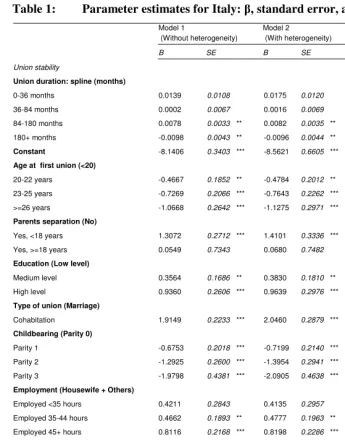
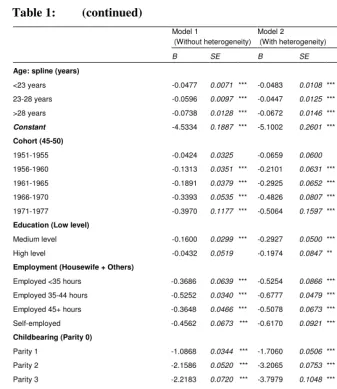
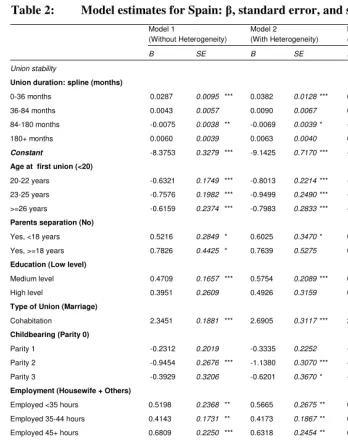
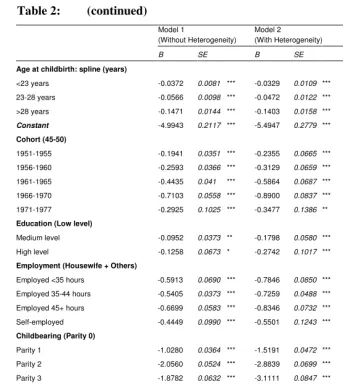
The estimates obtained through the simultaneous approach are shown in the column named Model 3, in Table 1 for Italy and Table 2 for Spain. We discuss the estimates of the simultaneous modeling and compare them to the estimates of the model that excludes the heterogeneity terms (Model 1), and to the model that includes the heterogeneity terms but excludes the correlation between them (Model 2). Whether there exists common unobserved characteristics affecting union dissolution and fertility is indicated by the estimate of the correlation between the heterogeneity terms (ρ). In the case of Italy, results show there is a negative and statistically significant correlation between unobserved factors affecting union dissolution and those affecting fertility. In Spain, instead, this correlation is still negative but much smaller and not statistically significant. Thus, our first hypothesis (H1) finds empirical support in Italy but not in Spain. In Italy, individuals who are more likely to experience union dissolution are less likely to have a further child, and vice versa. In Spain, the risk of having a further child and that of experiencing a union dissolution do not depend on common unobserved determinants, once the effect of observed and unobserved explanatory variables is taken into account. Thus, in the case of Italy the use of simultaneous modeling improves the description of fertility and union dissolution and of their interrelationship. In the case of Spain, instead, this modeling approach does not provide any further information compared to the model that excludes the correlation between the error terms (Model 2). As a consequence, the estimates of the direct effect of each process on the other are also different when using simultaneous modeling in Italy, but similar when using different approaches in Spain.
Table 1: Parameter estimates for Italy: β, standard error, and significance
Model 1
(Without heterogeneity)
Model 2
(With heterogeneity)
Model 3 (With correlation)
B SE B SE B SE
Union stability
Union duration: spline (months)
0-36 months 0.0139 0.0108 0.0175 0.0120 0.0118 0.0113
36-84 months 0.0002 0.0067 0.0016 0.0069 -0.0021 0.0071
84-180 months 0.0078 0.0033 ** 0.0082 0.0035 ** 0.0069 0.0034 ** 180+ months -0.0098 0.0043 ** -0.0096 0.0044 ** -0.0099 0.0044 **
Constant -8.1406 0.3403 *** -8.5621 0.6605 *** -8.6902 0.3555 ***
Age at first union (<20)
20-22 years -0.4667 0.1852 ** -0.4784 0.2012 ** -0.4896 0.1966 ** 23-25 years -0.7269 0.2066 *** -0.7643 0.2262 *** -0.7420 0.2218 *** >=26 years -1.0668 0.2642 *** -1.1275 0.2971 *** -1.1051 0.2850 ***
Parents separation (No)
Yes, <18 years 1.3072 0.2712 *** 1.4101 0.3336 *** 1.3876 0.2998 *** Yes, >=18 years 0.0549 0.7343 0.0680 0.7482 0.0387 0.7492 Education (Low level)
Medium level 0.3564 0.1686 ** 0.3830 0.1810 ** 0.4255 0.1817 ** High level 0.9360 0.2606 *** 0.9639 0.2976 *** 0.9942 0.2863 ***
Type of union (Marriage)
Cohabitation 1.9149 0.2233 *** 2.0460 0.2879 *** 2.1500 0.2553 ***
Childbearing (Parity 0)
Parity 1 -0.6753 0.2018 *** -0.7199 0.2140 *** -0.3845 0.2663
Parity 2 -1.2925 0.2600 *** -1.3954 0.2941 *** -0.7863 0.4368 * Parity 3 -1.9798 0.4381 *** -2.0905 0.4638 *** -1.2557 0.6220 **
Employment (Housewife + Others)
Employed <35 hours 0.4211 0.2843 0.4135 0.2957 0.4629 0.2952
Employed 35-44 hours 0.4662 0.1893 ** 0.4777 0.1963 ** 0.5401 0.1962 *** Employed 45+ hours 0.8116 0.2168 *** 0.8198 0.2286 *** 0.8712 0.2298 *** Self-employed -0.0399 0.3375 0.0098 0.3536 0.0757 0.3532 Period (until 1987)
After 1988 0.4366 0.1640 *** 0.4567 0.1714 *** 0.4814 0.1705 ***
Fertility
Time since last birth: spline (months)
<12 months 0.1878 0.0091 *** 0.2184 0.0091 *** 0.2184 0.0092 *** 12-24 months -0.0324 0.0052 *** -0.0073 0.0055 -0.0071 0.0055
Table 1: (continued)
Model 1
(Without heterogeneity) Model 2
(With heterogeneity)
Model 3 (With correlation)
B SE B SE B SE
Age: spline (years)
<23 years -0.0477 0.0071 *** -0.0483 0.0108 *** -0.0464 0.0107 *** 23-28 years -0.0596 0.0097 *** -0.0447 0.0125 *** -0.0458 0.0124 *** >28 years -0.0738 0.0128 *** -0.0672 0.0146 *** -0.0670 0.0146 *** Constant -4.5334 0.1887 *** -5.1002 0.2601 *** -5.1628 0.2593 ***
Cohort (45-50)
1951-1955 -0.0424 0.0325 -0.0659 0.0600 -0.0560 0.0599
1956-1960 -0.1313 0.0351 *** -0.2101 0.0631 *** -0.2051 0.0630 *** 1961-1965 -0.1891 0.0379 *** -0.2925 0.0652 *** -0.2882 0.0650 *** 1966-1970 -0.3393 0.0535 *** -0.4826 0.0807 *** -0.4804 0.0804 *** 1971-1977 -0.3970 0.1177 *** -0.5064 0.1597 *** -0.4954 0.1596 ***
Education (Low level)
Medium level -0.1600 0.0299 *** -0.2927 0.0500 *** -0.2949 0.0500 *** High level -0.0432 0.0519 -0.1974 0.0847 ** -0.1990 0.0847 **
Employment (Housewife + Others)
Employed <35 hours -0.3686 0.0639 *** -0.5254 0.0866 *** -0.5206 0.0865 *** Employed 35-44 hours -0.5252 0.0340 *** -0.6777 0.0479 *** -0.6784 0.0478 *** Employed 45+ hours -0.3648 0.0466 *** -0.5078 0.0673 *** -0.5063 0.0671 *** Self-employed -0.4562 0.0673 *** -0.6170 0.0921 *** -0.6199 0.0923 ***
Childbearing (Parity 0)
Parity 1 -1.0868 0.0344 *** -1.7060 0.0506 *** -1.7088 0.0507 *** Parity 2 -2.1586 0.0520 *** -3.2065 0.0753 *** -3.2084 0.0753 *** Parity 3 -2.2183 0.0720 *** -3.7979 0.1048 *** -3.7997 0.1046 ***
Union dissolution (No)
Yes -0.7598 0.1359 *** -0.8495 0.1581 *** -0.6375 0.1845 ***
Type of union (Cohabitation)
Marriage 0.9085 0.1009 *** 1.3101 0.1192 *** 1.3252 0.1193 ***
Heterogeneity term for fertility εf 0.8281 0.0312 *** 0.8296 0.0312 ***
Heterogeneity term for union dissolution εd 0.8077 0.5573 0.8077
Correlation σ -0.4564 0.2416 *
Table 2: Model estimates for Spain: β, standard error, and significance
Model 1
(Without Heterogeneity)
Model 2 (With Heterogeneity)
Model 3 (With Correlation)
B SE B SE B SE
Union stability
Union duration: spline (months)
0-36 months 0.0287 0.0095 *** 0.0382 0.0128 *** 0.0370 0.0102 *** 36-84 months 0.0043 0.0057 0.0090 0.0067 0.0080 0.0062
84-180 months -0.0075 0.0038 ** -0.0069 0.0039 * -0.0073 0.0039 * 180+ months 0.0060 0.0039 0.0063 0.0040 0.0062 0.0040
Constant -8.3753 0.3279 *** -9.1425 0.7170 *** -9.1809 0.3611 ***
Age at first union (<20)
20-22 years -0.6321 0.1749 *** -0.8013 0.2214 *** -0.8071 0.2051 *** 23-25 years -0.7576 0.1982 *** -0.9499 0.2490 *** -0.9503 0.2287 *** >=26 years -0.6159 0.2374 *** -0.7983 0.2833 *** -0.7973 0.2786 ***
Parents separation (No)
Yes, <18 years 0.5216 0.2849 * 0.6025 0.3470 * 0.6035 0.3408 * Yes, >=18 years 0.7826 0.4425 * 0.7639 0.5275 0.7643 0.5332 Education (Low level)
Medium level 0.4709 0.1657 *** 0.5754 0.2089 *** 0.5794 0.198 *** High level 0.3951 0.2609 0.4926 0.3159 0.5058 0.3135 Type of Union (Marriage)
Cohabitation 2.3451 0.1881 *** 2.6905 0.3117 *** 2.7249 0.2321 ***
Childbearing (Parity 0)
Parity 1 -0.2312 0.2019 -0.3335 0.2252 -0.2541 0.2606
Parity 2 -0.9454 0.2676 *** -1.1380 0.3070 *** -0.9976 0.3574 ** Parity 3 -0.3929 0.3206 -0.6201 0.3670 * -0.4245 0.4993 Employment (Housewife + Others)
Employed <35 hours 0.5198 0.2368 ** 0.5665 0.2675 ** 0.5840 0.2667 ** Employed 35-44 hours 0.4143 0.1731 ** 0.4173 0.1867 ** 0.4383 0.1884 ** Employed 45+ hours 0.6809 0.2250 *** 0.6318 0.2454 ** 0.6488 0.2471 *** Self-Employed 0.5824 0.4304 0.4745 0.4655 0.4783 0.4664 Period (until 1987)
After 1988 0.2570 0.1561 * 0.2691 0.1717 0.2805 0.1707 Fertility
Time since last birth: spline (months)
<12 months 0.1948 0.0099 *** 0.2174 0.0100 *** 0.2174 0.0100 *** 12-24 months -0.0272 0.0054 *** -0.0074 0.0056 -0.0074 0.0056
Table 2: (continued)
Model 1
(Without Heterogeneity)
Model 2 (With Heterogeneity)
Model 3 (With Correlation)
B SE B SE B SE
Age at childbirth: spline (years)
<23 years -0.0372 0.0081 *** -0.0329 0.0109 *** -0.0331 0.0109 *** 23-28 years -0.0566 0.0098 *** -0.0472 0.0122 *** -0.0472 0.0122 *** >28 years -0.1471 0.0144 *** -0.1403 0.0158 *** -0.1405 0.0158 *** Constant -4.9943 0.2117 *** -5.4947 0.2779 *** -5.4965 0.2776 ***
Cohort (45-50)
1951-1955 -0.1941 0.0351 *** -0.2355 0.0665 *** -0.2337 0.0665 *** 1956-1960 -0.2593 0.0366 *** -0.3129 0.0659 *** -0.3113 0.0658 *** 1961-1965 -0.4435 0.041 *** -0.5864 0.0687 *** -0.5858 0.0687 *** 1966-1970 -0.7103 0.0558 *** -0.8900 0.0837 *** -0.8895 0.0838 *** 1971-1977 -0.2925 0.1025 *** -0.3477 0.1386 ** -0.3465 0.1385 **
Education (Low level)
Medium level -0.0952 0.0373 ** -0.1798 0.0580 *** -0.1813 0.0581 *** High level -0.1258 0.0673 * -0.2742 0.1017 *** -0.2749 0.1017 ***
Employment (Housewife + Others)
Employed <35 hours -0.5913 0.0690 *** -0.7846 0.0850 *** -0.7851 0.0850 *** Employed 35-44 hours -0.5405 0.0373 *** -0.7259 0.0488 *** -0.7255 0.0488 *** Employed 45+ hours -0.6699 0.0583 *** -0.8346 0.0732 *** -0.8346 0.0731 *** Self-employed -0.4449 0.0990 *** -0.5501 0.1243 *** -0.5490 0.1243 ***
Childbearing (Parity 0)
Parity 1 -1.0280 0.0364 *** -1.5191 0.0472 *** -1.5188 0.0472 *** Parity 2 -2.0560 0.0524 *** -2.8839 0.0699 *** -2.8836 0.0699 *** Parity 3 -1.8782 0.0632 *** -3.1111 0.0847 *** -3.1105 0.0849 ***
Union dissolution (No)
Yes -0.4001 0.1122 *** -0.4204 0.1280 *** -0.3706 0.1477 **
Type of union (Cohabitation)
Marriage 1.2469 0.0912 *** 1.5793 0.1099 *** 1.5853 0.1104 ***
Heterogeneity term for fertility εf 0.7143 0.0281 *** 0.7143 0.0282 ***
Heterogeneity term for union dissolution εd 1.0927 0.3921 *** 1.0927
Correlation σ -0.0989 0.1629
Regarding the effect of fertility on union dissolution in Italy, we notice that having a further child significantly decreases the risk of union dissolution when the effect of unobserved characteristics is disregarded (see Model 1 and 2), but the same effect is much smaller and less significant when simultaneous modeling is used (see Model 3). Indeed, when using the simultaneous approach, only the second or higher parities are associated with a statistically significant lower risk of union disruption. Thus, not only having a child induces a lower risk of union dissolution: union dissolution is also influenced by unobserved characteristics that simultaneously induce women to have a higher fertility and a higher union stability. In Spain, fertility induces a significantly lower risk of union dissolution only in the case of the second birth order, independently on the modeling approach used. In sum, our second hypothesis (H2) is partially confirmed: fertility induces a lower risk of union dissolution, but this effect is lower than expected. Moreover, while union dissolution decreases with parity in Italy, this is not the case in Spain. The stronger effect on union dissolution does not stem from the first parity as we expected.
With regard to the effect of union dissolution on fertility, in both countries a union breakdown induces a significantly lower risk of having a further child. Thus, our third hypothesis (H3) is confirmed in both countries. As we hypothesized when the simultaneous approach is used the direct effect of union dissolution on fertility is slightly lower in the case of Italy.
The next two sections examine timing to union dissolution and to childbearing.
6.2 Union dissolution
Duration of the union: results show the risk of union dissolution does not have a well-defined shape. In Spain, a higher risk is visible in the first years of the union and the risk of dissolution decreases after the 7th year of the union. In Italy the risk increases significantly between the 7th and the 15th year of union and decreases after the 15th year. However, in both countries the effect of duration is very small.
Age at union formation: in both countries, this variable plays an important role in determining union stability. Women who were 19 or less when forming a union have a higher risk of ending their union than women aged 20 or more at union formation. The general trend in both countries is that as the age at union formation increases, the risk of union dissolution decreases. However, the decrease in risk is more pronounced for relatively young ages.
affects the value and the meaning individuals attribute to partnership. Children’s age at their parents’ separation also has an impact on their union stability. Experiencing parental union disruption during childhood strongly and significantly increases the risk of union disruption. Such an effect becomes non significant if parents’ separation occurs when the individual has already become an adult (more than 18 years old).
Education: in both countries, there is a significant effect of education on the risk of union dissolution. In Italy, a higher level of education among women is associated with a higher risk of union dissolution. In Spain a medium level of education is associated with a higher risk of union dissolution. It seems that at least in Italy the traditional relation between women’s education and risk of divorce still holds.
Type of union: to pick up the effect of cohabitation, we considered marriage as a reference category. We find that cohabiting couples have a much higher risk of experiencing union dissolution than married couples, and this effect is statistically significant in both countries. It is worth mentioning that cohabitation is not legally recognized in Italy or Spain. Cohabiters do not have mutual rights and duties and either party may consider ending the relationship at any time. Possibly partners prefer a cohabitation when they do not feel a strong commitment or when they desire to test their relationship before getting married.
Employment: employed women have a higher risk of union disruption compared to unemployed women and housewives. Among employed women, those who work more than 45 hours a week experience a much higher risk of union dissolution. This result holds in both countries, and in Italy the difference between working 45 hours or more and other categories of work hours is even wider. Possibly women who invest much of their time in a job face more difficulties in integrating family and work activities and in carrying on a stable relationship.
Period: the process of secularization is associated with an increase in union instability, but such an effect appears to be stronger in Italy. This is probably due to the fact that in Italy divorce was legalized earlier than in Spain.
6.3 Fertility
second year loses statistical significance, and, as result, the overall pattern shows a reverse U shape with a knot at the end of the third year.
Age at childbirth: the higher the age at childbirth, the lower the risk of having a further child. Such a trend is statistically significant and strong in both countries, indicating that late childbearing is consequential for women’s total fertility.
Cohort: as expected, the younger the cohort, the lower the risk of a further childbearing in both countries. The youngest Spanish cohort represents an exception to this trend. In fact, the negative effect of this youngest cohort is weaker than that of the previous cohorts and it is quite similar to that of the 1956-60 cohort. This is probably due to a change in attitudes among the youngest generations. When controlling for the effect of unobserved characteristics (model 2 and 3), the decrease in the risk of having a further childbirth by cohort is even more evident. Possibly, once we control for unobserved characteristcs, the effect of reducing fertility as a result of inter-cohort changes in culture, values, and socioeconomic context appears more clearly.
Education: as expected, education affects the risk of a further childbirth. In Italy, having a medium level of education is associated with a lower fertility more strongly than having a high level of education. Higher educational levels may be associated with other individual characteristics and resources that ease women’s integration of family and non family-related roles (i.e. higher economic resources, more flexible position in the labor market). This is not the case in Spain, where the higher the educational level, the lower the chance of a having a further child.
Employment: when the number of working hours per week increases, the probability of having a further child decreases. Only in Italy, a slight recovery for women who work for more than 45 hours is visible. It is possible that these women have access to additional financial resources to afford the services they need to conciliate employment and fertility. The main difference between the two countries is represented by the category of self-employed workers: while in Italy these workers have the lowest probability of having a subsequent child, in Spain self-employed women have the second highest probability of having a further child, immediately following housewives. This could be due to country differences in the composition of the category of self-employment. Self-employment in Spain may allow for a higher flexibility and in turn for an easier conciliation of employment and fertility.
Parity: in both countries, the higher the parity, the lower the risk to have a further child. Women in union seem to aim at having at least one child, but not necessarily more than one.
7. Conclusions
We have argued that fertility and union dissolution are two deeply interrelated trajectories (Lillard and Waite 1993). Both decisions are relevant in defining individuals’ family related life course. Having one or more children and having a stable and satisfying relationship are indeed two of the main goals an individual has once entering a union, either a cohabitation or a marriage. We have also argued that there may be some unobserved characteristics that simultaneously affect the decision to have a further child and the decision to end a relationship (Lillard and Waite 1993; Thornton 1977). We proposed an interpretation of these unobserved characteristics in terms of individuals’ value orientation. This interpretation states that the values of individuals influence, at least partially, the decisions they make about their life trajectories (Jansen and Kalmijn 2002). Individuals who are oriented towards family values are likely to invest more resources in the family (Jansen and Kalmijn 2002), and we expect that they may be more willing to attain higher fertility and to stay in longer lasting unions.
Our arguments hold in Italy where, once we account for unobserved characteristics that simultaneously affect fertility and union dissolution, women who are more likely to have a further child are also less likely to experience union dissolution. In the case of Spain, instead, considering the correlation between unobserved factors for each event does not alter the results, once we control for the direct effect between union dissolution and fertility, and for other individual characteristics. We think this result implies that value orientation does not influence fertility and union dissolution in Spain, but rather that once the effect of individual characteristics and life trajectories are explicitly considered, the unobserved factors affecting one event are different from those affecting the other event. Previous research on union dissolution in Italy and Spain (De Rose and Di Cesare 2007) suggests not only that this event is less spread in Italy than in Spain, but also that it is more frequently experienced by individuals of better socio-economic conditions in Italy, while it is less dependent on social status in Spain. We may also argue that unobserved factors that affect union dissolution are different in the two countries, such that these unobserved characteristics are correlated with fertility in Italy, but not in Spain. Possibly, a lower acceptance of union dissolution in Italy induces individuals to more strictly interrelate their decisions regarding fertility and union dissolution. Thus, in the case of Italy, considering the direct effect between fertility and union dissolution does not provide a sufficient explanation of these events.
On the other hand, union dissolution strongly decreases the risk of further childbearing. A union breakdown represents an obstacle to further fertility, either by removing for some time the natural environment to having children, or by potentially reducing individuals’ confidence in the stability of the subsequent relationship, which in turn decreases the chance of having further children (Lillard and Waite 1993).
Italy and Spain are usually considered very similar countries not only because of the demographic patterns they have experienced (Van de Kaa 1987), but also for the welfare states they rely on, and for the roles played by different institutions (Esping-Andersen 1999). Among these institutions, for instance, the family is fundamental in both countries: through solid ties, the family provides strong support to individuals when facing transitions and important life decisions (Reher 1998). For these reasons, when investigating demographic processes in these countries, researchers have usually expected similar findings. In our case, the similarity between Italy and Spain is partially confirmed, because union dissolution and fertility are affected by individual characteristics and by each other in the same manner. However, unobserved characteristics play a different role in the two countries. This difference may refer to a distinction that, even if it is smaller when compared to other Western countries, it still holds in these two countries comparison. It would be useful to carry out further research that focuses on the differences between these countries rather than on their similarities. Understanding what generates this difference in contexts that are similar may provide a better insight into fertility and union dissolution decisions. Moreover, considering household and couple characteristics would allow a better comprehension on these dynamics, where certainly the couple more than the individual provide the appropriate unit of analysis (Olah, 2001).
8. Acknowledgments
References
Angeli, A., A. De Rose, and M. Di Cesare. 2004. “Prima e Dopo lo Scioglimento dell’Unione: Istruzione, Lavoro e Differenze di Genere.” Pp. 171-198 in
Nuovi
Comportamenti Familiari e Nuovi Modelli. Italia ed Europa a Confronto, by A. Angeli, L. Pasquini, and R. Rettaroli. CLUEB, Bologna.
Amato, P.R. 1996. “Explaining the intergenerational transmission of divorce”, Journal of Marriage and Family, 58:628-640.
Baizan, P., A. Aassve, and F.C. Billari. 2003. “Cohabitation, Marriage and First Birth: the interrelationship of Family Formation Events in Spain.” European Journal of Population 19:147-169.
Barber, J.S., W.G. Axinn, and A. Thornton. 2002. “The Influence of Attitudes on Family Formation Processes.” Pp. 45-95 in Meaning and Choice: Value Orientations and Life Course Decisions, edited by Lesthaeghe R.. The Hague/Brussels: NIDI/CBGS Publications.
Becker, G.S. 1991. A Treatise on the Family. Enlarged Edition. Cambridge: Harvard University Press.
Becker, G.S. 1996. Accounting for Tastes. Cambridge: Harvard University Press.
Beets, G. 1996. “Does the Increasing Age at First Birth Lead to Increases in Involuntary Childlessness?.” Pp. 15-29 in Evolution or Revolution in European Population. European Population Conference 1995. Volume II edited by Aeep, Eaps, Iussp, and Vieps. Milan: FrancoAngeli.
Bennett, N.G., A.K. Blanc, and D.E. Bloom. 1988. “Commitment and the Modern Union: Assessing the Link Between Premarital Cohabitation and Subsequent Marital Stability.” American Sociological Review 53:127-138.
Blossfeld, H.P., A. De Rose, J.M. Hoem, and G. Rowher. 1995.
“Education, Modernization and the Risk of Marriage Disruption in Sweden, West Germany and Italy.” P.p 200-222 in Gender and Family Change in Industrialized Countries, edited by Mason K.O. and A.M. Jensen. Oxford: Clarendon Press.
Booth, A. and D. Johnson. 1988. “Premarital Cohabitation and Marital Success.” Journal of Family Issues 9(2):255-272.
Booth A., D.R. Johnson, L.K. White, and J.N. Edwards. 1986. “Divorce and Marital Instability over the Life Course.” Journal of Family Issues 7(4):421-442.
Bracher, M., G. Santow, S.P. Morgan, and J. Trussell. 1993. “Marital Dissolution in Australia: Models and Explanations.” Population Studies 47:403-425.
Bumpass, L. 2002. “Family-related Attitudes, Couple Relationships and Union Stability.” Pp. 161-184 in Meaning and Choice: Value Orientations and Life Course Decisions, edited by Lesthaeghe R.. The Hague/Brussels: NIDI/CBGS Publications.
Bumpass, L.L., T.C. Martin and J.A. Sweet. 1991. “The impact of family background and early marital factors on marital disruption”. Journal of Family Issues 12(1):22-42.
Bumpass, L. and E.K. Mburugu. 1977. “Age at Marriage and Completed Family Size.” Social Biology 24(1):31–37.
Burgess, E.W. and P. Wallin. 1953. Engagment and Marriage. Philadelphia: J.B. Lippincott Company.
Butz, W.P. and M.P. Ward. 1979. “Baby Boom and Baby Bust: a New View.” American Demographics 1(8):11-17.
Chesnais, J.C. 1996. “Fertility, Family, and Social Policy in Contemporary Western Europe.” Population and Development Review 22(4):729–739.
Coppola, L. 2004. “Education and Union Formation as Simultaneous in Italy and Spain”. European Journal of Population 20: 219-250.
Council of Europe. 2003. Demographic YearBook 2003.
Council of Europe. 2004. Demographic YearBook 2004.
De Rose, A. and M. Di Cesare. 2007. “Gender patterns in the dissolution of first union” Pp: 167-184 in Gender in the life course edited by Pinnelli A., F. Racioppi and R. Rettaroli. The Springer, Series on Demographic methods and Population Analysis, Vol.19.
Di Giulio, P., R. Lesthaeghe, G. Moors, and A. Pinnelli. 1999. “Fertility Tempo and Quantum: an Empirical Test of Major Theories with Data from Four FFS-Countries.” in Démographie, Analyse et Synthèse, Actes du Séminaire de Roma-Napoli-Pozzuoli, 2, DSD-INED, Roma-Paris.
Esping-Andersen G. 1999. Social Foundations of Postindustrial Economies. Oxford: Oxford University Press.
Giddens A. 1991. Sociologia. Bologna: Il Mulino.
Greenberg, E.F. and W.R. Nay. 1982. “The Intergenerational Transmission of Marital Instability Reconsidered.” Journal of Marriage and Family 44:335-347.
Hill M.S. 1988. “Marital Stability and Spouses’ Shared Time: A Multidisciplinary Hypothesis” Journal of Family Issues 9(4):427-451
Inglehart R. 1997. Modernization and Postmodernization. Cultural, economic, and political change in 43 societies. Princeton University press. Princeton
Jansen, M. and M. Kalmijn. 2002. “Investments in Family Life: the Impact of Value Orientations on Patterns of Consumption, Production and Reproduction in Married and Cohabiting Couples.” Pp: 129-159 in Meaning and Choice: Value Orientations and Life Course Decisions edited by Lesthaeghe R.. The Hague/Brussels: NIDI/CBGS Publications.
Kiernan, K. 2002. “Cohabitation in Western Europe: Trends, issues, and implications” Pp. 3-31 in Just living together: Implications of cohabitation on families, children, and social policy edited by Booth A. and A.C. Crouter, Mahwah, NJ: Lawrence Erlbaum Associates.
Knudsen, L.B. 1996. “Do gender-specific differences in fertility pattern in Denmark reflect different expectations to men and women?.” Pp. 85-96 in Evolution or Revolution in European Population. European Population Conference 1995. Volume II edited by Aeep, Eaps, Iussp, and Vieps. Milan: FrancoAngeli
Kohler, H.P., F.C. Billari, and J.A. Ortega. 2002. “The Emergence of Lowest-Low Fertility in Europe During the 1990s.”, Population and Development Review 28(4):641-680.
Lee, G.R. 1982. Family structure and Interaction: A Comparative Analysis. Minneapolis: University of Minnesota Press.
Evolution or Revolution in European Populations, European Population Conference, Milan: Franco Angeli.
Lesthaeghe, R. and G. Moors. 2000. “Recent Trends in Fertility and Household Formation in the Industrialised World.”. Review of Population and Social Policy, 9:121-170
Levinger, G. 1965. “Marital Cohesiveness and Dissolution: an Integrative Review.“ Journal of Marriage and Family 27:19-28.
Levinger, G. 1976. “A Social Psychological Perspective on Marital Dissolution.” Journal of Social Issues 32:21-42.
Liefbroer, A.C. and E. Dourleijn. 2006. “Unmarried Cohabitation and Union Stability: Testing the Role of Diffusion Using Data From 16 European Countries.” Demography 43(2): 203-221
Lillard, L.A. and C.W.A. Panis. 2000. aML Multilevel Multiprocess Statistical Software, Release 1.0. Los Angeles, California, EconWare.
Lillard, L.A. and L.J. Waite. 1993. “A Joint Model of Marital Childbearing and Marital Disruption.” Demography 30(4):653-681.
Marini, M.M. and P.J. Hodsdon. 1981. “Effects of the Timing of Marriage and First Birth on the Spacing of Subsequent Births.” Demography 18(4):529–548.
Martin, S.P. 2006. “Trends in Marital Dissolution by Women’s Education in the United States.” Demographic Research 15(20):537-560.
Martin, T.C. and L. Bumpass. 1989. “Recent Trends in Marital Disruption.” Demography 26:37-51.
McDonald, P. 2000. “Gender Equity in Theories of Fertility Transition.” Population and Development Review 26(3):427–439.
McLanahan, S. and L. Bumpass. 1988. “Intergenerational Consequences of Family Disruption”. American Journal of Sociology 94:130-152.
Menken, J. and U. Larsen. 1994. “Estimating the Incidence and Prevalence and Analysing the Correlates of Infertility and Sterility.” Annals of the New York Academy of Sciences 709:249-265.
Myers, S.M. 1997. “Marital uncertainty and childbearing.” Social Forces 75:1271-1289.
Oláh L.S. 2001. “Gender and family stability: dissolution of first parental union in Sweden and Hungary.” Demographic research 4(2):29–96.
Oppenheimer, V.K. 1988. “A Theory of Marriage Timing.” American Journal of Sociology 94(3): 563-591.
Oppenheimer, V.K. and F. Lew. 1995. “Marriage Formation in the Eighties: How Important Was Women’s Economic Independence?.” Pp. 105-138 in Gender and Family Change in Industrialized Countries, edited by Mason K.O. and A. Jensen.Oxford: Clarendon Press.
Palomba, R. and L.L. Sabbadini. 1993. “Female Life Strategies: the Way of Compromise.” Pp. 219–231 in Proceedings of the XXIII IUSSP General Conference, Montreal 1993, 24 August - 1st September. Volume 2, edited by IUSSP Liege, Belgium.
Pinnelli, A., H.J. Hoffmann-Nowotny, and B. Fux. 2001. Fertility and New Types of Households and Family Formation in Europe, Population Studies 35, Council of Europe Publishing.
Pope, H. and C.W. Mueller. 1976. “The Intergenerational Transmission of Marital Instability: Comparisons by Race and Sex.” Journal of Social Issues 32:49-66.
Raley, R.K. and L. Bumpass. 2003. “The topography of the divorce Plateau: levels and trends in union stability in the United States after 1980.” Demographic Research 8(8):245-260.
Rank, M. 1987. “The Formation and Dissolution of Marriages in the Welfare Population.” Journal of Marriage and Family 49:15-20.
Reher, D.S. 1998. “Family Ties in Western Europe: Persistent Contrasts.” Population and Development Review 24(2): 203-234.
Sabbadini, L.L. 1997. “Le Convivenze “More Uxorio””. Pp. 86-94 in Lo Stato delle Famiglie in Italia edited by Barbagli M. and C. Saraceno. Il Mulino: Bologna.
Sgritta G.B. 1993. “Divorzio.” Pp. 231-242 in Enciclopedia delle Scienze Sociali, Roma, IEI.
South, S. and G. Spitze. 1986. “Determinants of Divorce over the Marital Life Course.” American Sociological Review 51:583-590.
Spitze, G. and S.J. South. 1985. “Women’s Employment, Time Expenditure, and Divorce.” Journal of Family Issues 6(3):307-329.
Teachman, J. 2003. “Premarital sex, premarital cohabitation, and the risk of subsequent marital dissolution among women”. Journal of Marriage and Family, 65(2): 444–455.
Thornton, A. 1977. “Children and Marital Stability.” Journal of Marriage and Family 39(3):531-540.
Thornton, A. and W. Rodgers. 1987. “The Influence of Individual and Historical Time on Marital Dissolution.” Demography 24:1-22.
Tobio, C. 2001. “Marriage, Cohabitation and the Residential Independence of Young People in Spain”. International Journal of Law, Policy and the Family, 15:68-87.
Van de Kaa, D.J. 1987. “Europe’s Second Demographic Transition” Population Bulletin 42:1-57.
Waite, L.J. and L.A. Lillard. 1991. “Children and Marital Disruption.” American Journal of Sociology 96(4):930-953.
Waite, L.J., G.W. Haggstrom, and D.E. Kanouse. 1985. “The Consequences of Parenthood for the Marital Stability of Young Adults.” American Sociological Review 50(6):850-857.
Weiss, Y. and R.J. Willis. 1993. “Transfers among divorced couples: evidence and interpretation.” Journal of Labor Economics 11(4):629-79.
White, J. 1987. “Premarital Cohabitation and Marital Stability in Canada.” Journal of Marriage and Family 49:641-647.
White, L.K. 1990. “Determinants of Divorce: a Review of Research in the Eighties.” Journal of Marriage and Family 52:904-912.
White, L.K. and A. Booth. 1985. “The Quality and Stability of Remarriages: the Role of Stepchildren.” American Sociological Review 50(5):689-98.
Wineberg, H. 1988. “Duration between marriage and first birth and marital stability.” Social Biology 35:91-102