Distortion Control via Optimization of the Cooling Process
and Improvement of Quench Oils
Kiyoshi Funatani*
IMST Inst., Mizuho-ku, Nagoya, Japan
Various trials and challenges are underway to increase the cooling power of High Pressure Gas quenching. However, the most important issue is distortion control via the optimization of the cooling process fit for products and should be discussed. Whichever quench media such as molten salt, cold or hot oils and gases, which have quite different cooling characteristics, is selected, the design of the cooling process should be optimized to minimize distortion.
Simultaneously, with optimum jig and tray design, various efforts are taken to improve the quench oils based on the world’s oldest JIS Quench Oil Evaluation standards. Various quench oils have been developed to reduce distortion problems with joint efforts of suppliers and users. Periodical analysis and control of quench oil characteristics and accumulated improvement of quench oil characteristics (H-value, L.P., viscosity and etc.) enabled the production of quality works. Not only the selection of quench oil types, temperature, agitation and dipping time, but also typical characteristics of cooling processes should be optimized to reduce distortion.
In this paper, ideas for a cooling process design will be introduced and several successful examples of distortion control measures are given also for the HPGQ processes.
© 2009 Journal of Mechanical Engineering. All rights reserved.
Keywords: cooling, cooling process, quenching oils, heat treatment, distorion
0 INTRODUCTION
The cooling speed of Gas is very slow compared to liquid quenchants. However, the clean finish of Gas quenched part is favoured because it is eliminated after quench cleaning process, so many companies are attempting to increase High Pressure Gas Quench methods. Usually, the higher the cooling speed, the larger the heat treatment distortion, similar to the influence of steel hardenability. Because of such influences, in some cases such as thin wall parts, gas quenching contributes to decreased distortion. However, for thick or massive parts, the cooling power of gas quenching cannot satisfy hardening ability. If high hardenability steels are applied, distortion will be directly increased.
Various methods are being studied to increase the cooling speed by high pressure or high speed nozzles and in most, the performance is the same as the speed by oil quench However, even in Liquid quenching their cooling speed is not always as quick as molten salt because of the vapour blanket stage. The Vapour blanket stage is not favoured because it is directly associated with the rewetting phenomena that causes scatter of cooling speed by portion. However, observing from various successful distortion control
measures, it is a very useful way to control cooling speed at the very early stage.
As it will be explained later, the adjustment of the length of vapour blanket stage is reduced over cooling just after quenching is started. Through several examples of distortion control methods, the mechanism of how this influence can reduce distortion will be explained.
1 FACTORS INFLUENCING DISTORTION
The state and properties of quenching media are the most important factors that affect the distortion. There are many quenchants, such as hot and cold oils, cold, hot and sprayed water and aqueous solution, molten salts, metallic dies and pressurized gasses, which should be selected to minimize distortion. Also, the cooling condition such as flow rate and volume, uniformity, temperature and pressure of quenchant and tank, quench table flow guide of quench tank, design and mass of used trays and positioning jigs have a large effect on distortion.
On the other hand, the properties and the distortion of heat treated materials vary not only due to the difference of the metal grade but also because of the changes brought about by the variation of chemical composition directly and in-directly related with hardenability and physical, mechanical and thermal properties. Also, the mass and design of components and residual stresses result from the previous processing, design and operation of quenching and cooling mechanisms, which have a considerable influence on distortion. However, those factors are difficult to place under a simulation condition and cause the misfit of calculated value and measured distortion. [9]
2 DISTORTION CONTROL MEASURES
Starting from the selection of steel grade and specification through process balance, it is quite important to introduce quality and allowable distortion products via the precise parts and process design, pre-heat treatment, machining and quenching. Case hardening operation should be designed to enable fabrication of quality products in an economical, efficient and environmentally friendly manner.
However, one of the most important parts of heat treatment is fabrication of low distortion components. Besides the optimum design of trays and jigs, the cooling power of quench media is very important as it is widely known. An
improvement of cooling methods and media such as quench oils, water and water base aqueous solution and salts, and press or plug quench and die quenching should be optimized to reduce distortion.
Oil quenching, especially is one of the most popular methods and various types of quench oils are produced. The oil properties change with use over long periods and deteriorate performance of quench operation. The world’s oldest National standard JIS K-2242, 2526 & 2527 for quench oils was approved in 1965 based on more than ten years of investigation and development performed by Prof. I. Tamura[4]. It was reviewed several times and the new improvement [4] was finished and standardized in JIS K-2242 last year with the addition of the new Silver probe developed for measurement of cooling curve of aqueous solution.
The main part of distortion control generally concerns the cooling speed control. The measurement of cooling power by cooling curve analysis is important because the heat transfer coefficient calculated from cooling curve is necessary for computer simulation.
Martemper hot oil, Salt bath quench (single or double baths), QSQ (quick slow and quick) quenches, reduced pressure quench and press or die quenching is actually used in industry [6].
a) Module 3 transmission gears (SCr420H) [16] b) Distortion of Hypoid ring gears (SCM420H) [Funatani, 1967[8]]
Fig. 2. Direct dump quenching of mounted 8 Ring Gears [16] (Upper surface of bottom set Jig needs reground every two month)
Hot martemper quench oil can reduce distortion to some extent via the reduction of temperature scatter just before the final martensite transformation. Pressure control of quench chamber can control vapour blanket zone during the first step of cooling and reduce temperature differences occurring at the very early stage of quenching. Sometimes agitation during boiling stage can reduce distortion of components. Some examples of distortion control measures used in mass production processes are explained.
2.1 Influence of Steel Hardenability [8]
Hardenability of steel is influenced by its chemical composition and grain size. Even within a grade of steel, the chemical composition differs depending on melt lot. The higher hardenability steel lot is more easily hardened than the lower hardenability lot, therefore core hardness and effective case depth increase if the hardenability is higher. Simultaneously, distortion increases as core hardness increases even if the heat treatment is exactly the same.
Jigs were designed and finally, the direct mounting Jig design proved the effective distortion control as shown in the Figure 2. This type of setting Jigs enabled reduction of
preparation, processing and total production cost nearly down to half. The bottom Jig design played a very important role in maintaining the flatness of the mounted Gears on hand and simultaneously reduced the early stage cooling speed via the generation of vapour bubbles by massive thermal capacity.
2.2 Development of Oil with Long Vapour Blanket Stage to Reduce Distortion [7]
2.3 Comparison of Jig Design to Reduce Pin Bore Distortion [4]
Jigs design directly influence distortion. A typical example was observed in a small pin bore diameter of latchet case that is quenched in Oil after gas carburizing. The pin bore diameter was distorted by hardening and becomes oval if it is directly free quenched into oil. The ellipticity of a pin bore diameter was improved by an increased jigs mass just under the pin bore portion of the latchet that reduced the cooling speed of the area.
2.4 Length of Vapour Blanket Stage Influence Distortion. [3], [14] and [15]
The characteristics of cooling curves are different in different quench media. Quench oil has a rather long vapour blanket stage and has a considerable influence on heat treatment distortion. The vapour blanket stage has low cooling speed and causes different wetting condition by portion. However, the vapour blanket stage can reduce distortion in case the parts differ largly in mass in one component.
Fig. 3. Comparisons of Cooling curves(a) and heat transfer coefficient of several oils (b) [7]
Fig. 4. Core hardness, case depth and distortion of various quench oils [7]
The length of a vapour blanket stage and peak cooling power is adjustable by oil additive and chemical composition. On the other hand vapour length of blanket stage changes by oil surface pressure and enable reduce distortion. This technology is quite effective in controlling cooling power even by using one grade oil in vacuum or reduced pressure heat treatment, which is almost impossible with other quenching methods. [Kanamori, 1996[4]] This type ofdistortion control measure is comparable with the control of characteristic temperature of quench oils with a special additive.
As shown in Fig. 5, the cooling curve, especially the vapour blanket stage changes with pressure and affects distortion as shown in Fig. 6. There is also an optimum pressure just fit for the parts.
This means that the length of vapour blanket stage has a direct influence on distortion via reducing scatter of cooling speed by portion.
This influence is understandable as shown in Fig. 7, where the first transformation starts just inside of the carburized case of gear teeth, about several seconds after quenching. The higher cooling speed directly increases the temperature gap within the part and the high cooling speed accelerates the start of the first transformation. This condition simultaneously suggests large a temperature difference between the teeth tip and
the gear root and the body, which results in a larger size and dimensional distortion.
Fig. 5. Relation between Oil surface pressure and cooling curve.[10]
As proved in the above examples, the vapour blanket stage has a considerably important influence on distortion. The general phenomena and tendency of heat treatment distortion are nearly explained through the observation of the cooling process and a step by step explanation becomes possible. Dr. Arimoto and our colleagues have been trying to explain the origins and processes that cause distortion and residual stress via the step wise analysis following the cooling process. In case of Carburized and hardened parts as Gears, the transformation starts just inside of the carburized layer in just a few seconds after the quench.
Fig. 7. Time step change of the Helical angle of Gear teeth during quenching [17]
This means that while the temperature of the gear body is still very high, the transforming portion is affected by transformation plasticity and temperature difference results in expansion. That is the cause of edge extrusion type distortion.
The temperature difference cannot be reduced if the cooling speed is very high and cannot be compensated afterwards. Therefore, the early stage cooling speed should be carefully controlled to reduce dimensional distortion. This directly relates to the cooling speed in vapour blanket stage.
However, there are still many problems in making the computer calculated data fit the measured results perfectly. Not only the state of materials database but also the database of heat transfer coefficient are not enough to get precise results.
The vapour blanket stage is one of the key characters of quench oil and measurement of Leiden frost point is very important.
In Japanese JIS (China and Korea) and French standard use Silver probe of high thermal conductivity and precise LP measurement is possible. However, ISO prove with INCONEL has very poor thermal conductivity and it is difficult to detect LP accurately.
We would like to propose a new Silver probe with center-set Thermo couple for a wide variety of applications. The results from extensive
experiences and improvement of the HTC (Heat Transfer Coefficient) database of quench oil will be prepared for world wide use in the near future, as explained by Narazaki.
3 MATERIALS AND HTC DATABASE AND SIMULATION
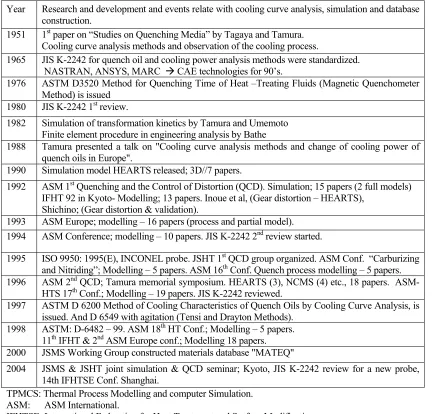
Table 1 shows the history timeline of the oil property measurement standards. JIS 2242 was issued in 1965 and accumulated tremendous data, while the other standard even such as GM Quenchometer came ten years later, while other quench power studies were done after Tamura gave his presentation in 1988. In spite of differences in opinion, JIS has the most extensive and incomparable experiences. We would hope JIS based Database can contribute to the advancement of cooling and quenching technologies in the near future.
Table 1. Timeline in cooling curve test methods JIS standard, ASTM and ISO.
Year Research and development and events relate with cooling curve analysis, simulation and database construction.
1951 1st paper on “Studies on Quenching Media” by Tagaya and Tamura. Cooling curve analysis methods and observation of the cooling process.
1965 JIS K-2242 for quench oil and cooling power analysis methods were standardized. NASTRAN, ANSYS, MARC Æ CAE technologies for 90’s.
1976 ASTM D3520 Method for Quenching Time of Heat –Treating Fluids (Magnetic Quenchometer Method) is issued
1980 JIS K-2242 1st review.
1982 Simulation of transformation kinetics by Tamura and Umemoto Finite element procedure in engineering analysis by Bathe
1988 Tamura presented a talk on "Cooling curve analysis methods and change of cooling power of quench oils in Europe".
1990 Simulation model HEARTS released; 3D//7 papers.
1992 ASM 1st Quenching and the Control of Distortion (QCD). Simulation; 15 papers (2 full models) IFHT 92 in Kyoto- Modelling; 13 papers. Inoue et al, (Gear distortion – HEARTS),
Shichino; (Gear distortion & validation).
1993 ASM Europe; modelling – 16 papers (process and partial model). 1994 ASM Conference; modelling – 10 papers. JIS K-2242 2nd review started.
1995 ISO 9950: 1995(E), INCONEL probe. JSHT 1st QCD group organized. ASM Conf. “Carburizing and Nitriding”; Modelling – 5 papers. ASM 16th Conf. Quench process modelling – 5 papers. 1996 ASM 2nd QCD; Tamura memorial symposium. HEARTS (3), NCMS (4) etc., 18 papers.
ASM-HTS 17th Conf.; Modelling – 19 papers. JIS K-2242 reviewed.
1997 ASTM D 6200 Method of Cooling Characteristics of Quench Oils by Cooling Curve Analysis, is issued. And D 6549 with agitation (Tensi and Drayton Methods).
1998 ASTM: D-6482 – 99. ASM 18th HT Conf.; Modelling – 5 papers. 11th IFHT & 2nd ASM Europe conf.; Modelling 18 papers. 2000 JSMS Working Group constructed materials database "MATEQ"
2004 JSMS & JSHT joint simulation & QCD seminar; Kyoto, JIS K-2242 review for a new probe, 14th IFHTSE Conf. Shanghai.
TPMCS: Thermal Process Modelling and computer Simulation. ASM: ASM International.
IFHTSE: International Federation for Heat Treatment and Surface Modification. Iron or steels, aluminium alloy or any
materials used today vary from country to country and from a producer to producer. As a result it is difficult to construct a universal database.
Furthermore, the composition and manufacturing process of cooling and quenching media vary by product and the change of their properties during use is quite difficult to know.
3.1 Materials Database
Materials database is necessary for an input of the simulation model in order to estimate heat treatment results. Partly, mechanical,
physical and thermal properties of materials are investigated and used for simulation work.
They are: Elastic modulus, Poisson ratio, Flow stress, Density, Specific heat, Latent heat, Thermal conductivity, Thermal expansion coefficient, and Carbon and Nitrogen diffusion rate. Transformation Kinetics with TTT and CCT diagram are important also.
3.1.1 Stress-Strain Diagram of Materials.
The strength of materials varies depending on temperature, which is necessary for estimation of distortion. However, the stress - strain diagram data covering all of the heat treatment temperature range are quite scarce. Quite a lot of time, money and effort to construct such a database would be needed.
Therefore, there are strict needs and merits to construct such a chemical composition based material database over the internationally collaborative system.
3.2 Materials Database “MATEQ” of Japan Society for Materials Science [12]
In 2002, Japan Society for Materials Science and Constructed Materials Database for Compute simulation and considerable advancement was completed. [12] However, those data represent only some parts of the steel grade and are not perfect to get precisely fit data.
There is a need to construct materials database via the estimation of each necessary property according to the chemical composition of the material itself.
Another quite important issue, is the relation between the chemical composition of materials and their properties. Even if we have typical materials database for considerable types of standardized steels, it does not qualify accuratelly when those data are used for computer simulation of a different chemical composition.
As explained in the latter section, the case and surface hardenability changes depend on their chemical composition, and also influence distortion greatly.
It suggests the needs to construct thermo dynamic models to estimate properties of the chemical composition of materials.
3.3 Database of Heat Transfer Coefficient
Database of heat transfer coefficient is also necessary, but it is directly related with the measuring method of cooling curve and calculation model of HTC (heat transfer coefficient). Up to date each country or institute have been trying to construct a database, but international collaboration seems to be necessary for data accumulation and the development of a
calculation model to advance and increase the reliability of estimated results.
The heat transfer coefficient data are usually calculated by a cooling curve. Several issues are to be solved to increase accuracy of computer simulation technology such as the following:
The difference of cooling curve measuring methods has a considerable influence on the calculated heat transfer coefficient.
The test probes are made of Silver (JIS and old AFNOR), INCONEL (ISO), Iron and Steel influence the cooling curve itself. Probe size and shape, test methods also influence the accuracy and HTC value [5].
3.3.1 Fact Database on LBE and Application Tools
Apart from the above explained data, there is another serious gap between data input to computer simulation and heat treatment condition in actual heat treatment operation.
The accumulated technology for distortion control should be studied by computer simulation model to explain how such distortion changes occurr. In order to realize such an estimation, it is necessary to expand the model capacity and to develop tools for calculating the effect of distortion control measures.
4 SUMMARY
THE FUTURE OF DISTORTION CONTROL TECHNOLOGY
1. Vapour blanket stage (LP) is important to reduce distortion via the control of early stage cooling speed.
2. The measuring method of LP is also important and an appropriate method to improve cooling performance should be chosen.
3. The early stage over cooling is adjustable by many methods, such as selection of oil characteristics, control of an additive and chemical composition, Oil surface pressure and optimum jig design.
5. Stepwise analysis of the cooling process on the state of stress, strain, transformation and temperature is very important for understanding the distortion mechanism and the design of optimum cooling condition.
Computer simulation technology enables the advancement in understanding the process causing deformation and distortion, and stepwise analysis is important to detect key periods to improve heat treatment process. [18] and [17] The LBE knows how it must be explained by the proven phenomena during cooling and the improvement of process can be designed basing on the estimated results.
Modelling and simulation technology is effective to minimize duration and investment is necessary for the development of ecological and efficient heat treatment processes and equipment.
However, the variation of quenching and cooling condition of each part differ from each other and the misfit between calculated and validate results seems to be natural. For the improvement of fitness between simulation and validation it is necessary to accumulate heat transfer data, which enables filling the gap between actual heat treatment i.e. quenching and the condition of computer estimation.
Materials and heat transfer coefficient database should be constructed with international collaboration; because of the complexity of the problem in accumulating fact data and because a considerable investment is needed to acquire sufficient data. Also, a model to calculate heat transfer coefficient needs to be investigated and standardized.
One of the new approaches in heat treatment is the development of a more simple process to heat treat piece by piece or small lot parts so that their heat treating condition is more controllable and reduces scatter of cooling condition like induction heat treatment. [9].
5 REFERENCES
[1] Arimoto K., Yamanaka S., Funatani K. Proc. no. 5, ICQCD Berlin (2007), p. 157.
[2] Asada S. J. JSHT V. 43(2003), no. 4, p. 269. [3] Fukuhara K., Asada S. JSHT Quenching WG
Report (1997), p.123.
[4] Funatani K., Totten G.E. Proc. no. 2 ICQCD (1996) ASM, p. 3.
[5] Funatani K., Narazaki M., Tanaka M. Proc. 19th Conf. ASM-HTS, Nov. 1999, Cincinnati, p. 255.
[6] Funatani K., Inoue T., Totten G. E. Proc. no. 1 TPMCS (2000) Shanghai IFHTSE.
[7] Funatani K. JSHT Quenching WG Report (1997), p. 21. [Research Report, Toyota Motor(1979)].
[8] Funatani K. Toyota Technical Review vol. 18 (1967), no. 1, p. 11.
[9] Funatani K. Proceedings of 1st International Conference on Thermal Process Modelling and Compute Simulation, Shanghai (2000), p. 35-41.
[10] Ichitani K. 29th Idemitsu Heat Treatment Seminar (2007.3 I-1) .
[11] Inoue T., Arimoto K., Ju D.Y. Proceedings of the 1st International Conference on Quenchin and Control of distortion, ASM (1992), p. 205-212.
[12] Inoue T., Okamura K. Proceedings of the 5th International Symposium on "Quenching and Distortion Control" 2000, p. 51.
[13] Narazaki M., Shichino H., Sugimoto T., Watanabe Y. Proc. no. 5ICQCD(2007), p. 111.
[14] Ogino M. Automobile and Heat Treatment, JSIF Feb. (1995), p. 20.
[15] Sugiyama M. Kinzoku, May (1985), p. 65-71. [16] Takahashi A., Morishima T., Yamada H.
Journal of Japan Society for Heat Treatment vol. 30 (1990), no. 6, p. 301.
[17] Takasaki N., Fujiwara Y., Aoyama Y. 20th Conf. ASM-HTS (2000) p.680 .

![Fig. 2. Direct dump quenching of mounted 8 Ring Gears [16]](https://thumb-us.123doks.com/thumbv2/123dok_us/8953380.1862748/3.539.56.456.71.312/fig-direct-dump-quenching-mounted-ring-gears.webp)
![Fig. 3. Comparisons of Cooling curves(a) and heat transfer coefficient of several oils (b) [7]](https://thumb-us.123doks.com/thumbv2/123dok_us/8953380.1862748/4.539.124.444.381.634/fig-comparisons-cooling-curves-heat-transfer-coefficient-oils.webp)
![Fig. 5. Relation between Oil surface pressure and cooling curve.[10]](https://thumb-us.123doks.com/thumbv2/123dok_us/8953380.1862748/5.539.89.432.429.637/fig-relation-oil-surface-pressure-cooling-curve.webp)
![Fig. 7. Time step change of the Helical angle of Gear teeth during quenching [17]](https://thumb-us.123doks.com/thumbv2/123dok_us/8953380.1862748/6.539.68.494.71.291/fig-time-change-helical-angle-gear-teeth-quenching.webp)