SYSTEMATIC MAP PROTOCOL
Effectiveness of animal conditioning
interventions in reducing human–wildlife
conflict: a systematic map protocol
Lysanne Snijders
1,2*, Alison L. Greggor
3, Femke Hilderink
4and Carolina Doran
1Abstract
Background: Human–wildlife conflict (HWC), is currently one of the most pressing conservation challenges. We restrict ourselves here to wildlife behaviour that is perceived to negatively impact social, economic or cultural aspects of human life or to negatively impact species of conservation concern. HWC often involves wild animals consuming anthropogenic resources, such as crops or livestock, either out of necessity (loss of habitat and natural prey) or as consequence of opportunistic behaviour. A variety of interventions are undertaken to reduce HWC, differing in prac-ticability, costs and social acceptance. One such non-lethal intervention is animal conditioning, a technique to reduce conflict by modifying the behaviour of ‘problem’ animals long-term. Conditioning changes associations animals have with resources or behaviours. Both via ‘punishment’ of unwanted behaviour and ‘rewarding’ of alternative behaviour, researchers aim to make expression of unwanted behaviour relatively less desirable to animals. Despite the potential, however, studies testing conditioning interventions have reported seemingly contradictory outcomes. To facilitate reduction of HWC via conditioning, we thus need to better understand if and when conditioning interventions are indeed effective. With this systematic map we intend to make the global evidence base for conditioning of free-ranging vertebrates more accessible to practitioners, to identify potential evidence clusters and effect modifiers for a subsequent systematic review and to highlight evidence gaps for future research.
Methods: We will compile evidence, including grey literature, from bibliographic databases, online search engines, specialist sites and expert contacts. Where possible, a Boolean-style full search string will be used, including Interven-tion and Outcome search terms. Searches will be conducted in English. Search comprehensiveness will be evaluated with an a priori list of benchmark articles. We will base inclusion of articles on presence of quantitative data, subject identity, comparator and outcome. Inclusion consistency checks will be performed with 10% of the titles, abstracts and full texts. We will assess validity of the literature base on basis of study design and sample size. Finally, we will develop a searchable literature database and an interactive evidence atlas along with a narrative synthesis of the evidence.
Keywords: Aversive conditioning, Conservation, Evidence synthesis, Learning, Positive reinforcement, Predator control, Problem animals, Problem behaviour, Training, Human–wildlife impact
© The Author(s) 2019. This article is distributed under the terms of the Creative Commons Attribution 4.0 International License (http://creat iveco mmons .org/licen ses/by/4.0/), which permits unrestricted use, distribution, and reproduction in any medium, provided you give appropriate credit to the original author(s) and the source, provide a link to the Creative Commons license, and indicate if changes were made. The Creative Commons Public Domain Dedication waiver (http://creat iveco mmons .org/ publi cdoma in/zero/1.0/) applies to the data made available in this article, unless otherwise stated.
Open Access
*Correspondence: [email protected]
Background
“Everyone knew there were wolves in the moun-tains, . . . , but they seldom came near the village - the modern wolves were the offspring of ancestors that had survived because they had learned that human meat had sharp edges.”
Terry Pratchett, Equal Rites
Human–wildlife conflict (HWC) is increasing. The human population and the numbers of associated live-stock are growing and expanding, while natural habitat is declining [1]. At the same time, some wildlife popu-lations, following conservation actions, are also (re) growing. As a consequence of one or both of these developments, the intensity and frequency of HWC has increased to the point of being recognized as one of the most critical conservation challenges [2–5]. Conflict with wildlife can range from Canadian geese (Branta canaden-sis) eating and defecating on golf courses, to wolves (Canis lupus) killing sheep, to polar bears (Ursus mar-itimus) and tigers (Panthera tigris) attacking and killing people. Conflicts thus cover a variety of ‘problem’ behav-iours, ranging from a nuisance to threatening lives and livelihoods. Not only do these conflicts result in short-term costs for humans and, often as a consequence of retaliation, for animals, in the long-term it also decreases local support for wildlife conservation [3, 5, 6]. We restrict our definition of HWC here to wildlife behaviour that is perceived to negatively impact social, economic or cultural aspects of human life, or species of conservation concern, i.e. ‘human–wildlife impacts’ [7], but for simplic-ity we use the term ‘human–wildlife conflict’ (HWC).
Although there has been a recent surge in urgency, especially concerning conflicts with large carnivores [2, 4, 8, 9], HWC has long been an issue, as illustrated by a quote from 254 to 184 BC: “Where there are sheep, the wolves are never very far away.” (Titus Plautus). As such, many lethal and non-lethal interventions, with the aim to reduce conflicts, have been proposed and tested, but not one type of intervention has proven to be the silver bullet [4, 5, 10–16]. Besides effectiveness, an intervention needs to fulfil a number of additional criteria, such as those based on cost-effectiveness, feasibility, sustainabil-ity and social, legal and ethical acceptance. Lethal inter-ventions might be socially or legally undesirable even if they appear effective in some cases [15, 17–19], translo-cation might be too costly and risky for the animals, next to being generally ineffective for large carnivores [11, 20–22] and use of simple deterrents may be effective dur-ing the actual intervention but not in the long-term [10, 12, 14, 23–26]. Large-scale traditional fencing might be undesirable from a social/ethical perspective and unfea-sible when it strongly restricts movements of non-target
species [11, 27–30] and while virtual fences could prevent problems for non-target species, their usefulness may be mostly restricted to highly social species [31]. Finally, although guardian animals appear to be a promising tool, specifically for reducing livestock predation, they may not be effective against all kinds of problem species and behaviours [10–12, 32]. In summary, appropriateness and effectiveness of specific HWC intervention techniques is very much dependent on the local context. Therefore, a combination of several techniques is likely to always be necessary to effectively reduce HWC. Ideally these inter-ventions are conducted in combination with preventive measures. For example, those that reduce the problem animal’s need for anthropogenic resources, such as habi-tat restoration and natural prey management, those that directly disrupt the problem animal’s learning process before a conflict can form, such as olfactory pre-exposure [33] and those that target the human side of the conflict (or impact), such as knowledge exchange and compensa-tion schemes [16, 34].
A promising HWC intervention that could be part of an effective ‘HWC mitigation toolbox’ and which does not involve extremely invasive procedures, such as killing or trans-locating animals, is ‘animal conditioning’ [35]. The key component of conditioning is associative learn-ing. Associative learning involves memory, making it in essence effective after, not just during, the intervention. Learned associations also have the potential to be general-ized over locations, possibly making the intervention effec-tive over larger areas or from ex situ (captivity) to in situ (wild) [36]. Conditioning has therefore been flagged as a potentially useful tool for reducing HWC [37–39]. Condi-tioning interventions in HWC specifically aim to change the behaviour of an animal in the long-term.
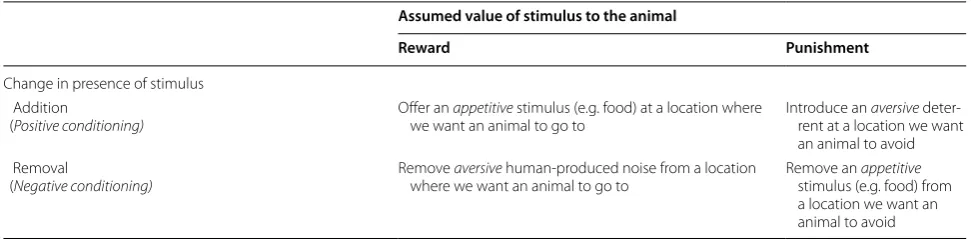
Generally, two main arms of conditioning are rec-ognised: classical and operant. Classical conditioning
appetitive stimulus, when that behaviour occurs (Table 1, based on [40]). In HWC situations, the use of condi-tioning by introducing aversive stimuli is much more common practice than conditioning by adding appeti-tive stimuli. Even though the latter may be ethically pre-ferred, finding an effective appetitive stimulus is usually more challenging. For example, pain is aversive at any time while food might only be appetitive when an animal is hungry. Additionally, an appetitive stimulus (e.g. sup-plemental food) might artificially bolster the population, which may in turn lead to more conflict.
It should be noted, however, that when a behav-iour is performed by an animal to acquire a resource that is essential to its health and survival (a biological imperative), for example because no alternative natu-ral resources are sufficiently available, trying to make the unwanted behaviour less desirable to the animal will require considerable effort and it may be unlikely to extinguish the behaviour completely. In turn, when accessing a resource is not (or no longer) a biologi-cal imperative, and the conflict thus involves somewhat opportunistic behaviour [5], conditioning has the poten-tial to be a more effective and less laborious intervention. There are, however, some practical challenges associ-ated with applying conditioning as a HWC interven-tion. The first challenge is that conditioning is generally expected to be most effective when it is applied as a pre-ventive measure rather than a remedial one [41]. Second, to be successfully paired, the stimulus should be behav-iourally contingent (i.e. follow the behaviour quickly). With certain sporadic and elusive unwanted behaviours, such as livestock predation, it may be very difficult to catch the animal in the act and immediately apply pun-ishment. In this scenario, the behaviour to be punished is ‘attacking sheep’. Because of the logistical (and ethi-cal) challenges involved with trying to punish attack behaviour directly, proxies, such as sheep carcasses, are regularly used [42, 43]. This can lead to counterproduc-tive outcomes whereby the ‘eating of sheep carcasses or
baits’ is punished, but not the actual unwanted attack-ing and killattack-ing behaviour [44–46]. That is, the wrong lesson is learned. This limited effectiveness might also be explained by a third challenge in animal condition-ing, namely that not all types of stimuli can be effectively paired with each type of resource or behaviour. For exam-ple, wild rats were observed to avoid eating a food that made them sick, but not to avoid coming to a place that made them sick [47, 48]. In cases where illness-inducing substances are used, limited effectiveness might also be the result of the animals having associated the smell of the substance (and not the resource) with the illness [45, 49, 50]. Generally, stimuli that are perceptually sali-ent and generate experiences that are more biologically relevant are learned faster [40]. Mammalian predators are especially quick to learn associations between (unin-tended) olfactory cues and following rewards or punish-ments, although pre-exposure to the smell might provide a solution in some cases [33]. Fourth, animals could learn to overcome the aversive stimulus (i.e. habituate/ desensitize) and even start to use it as a cue for resource availability, otherwise known as the “dinner bell” effect [51]. Five, the social system of animals may influence the effectiveness of conditioning interventions, as social interactions can facilitate or modify learned associations [52–54]. Lastly, and maybe most importantly, to deter-mine if conditioning has actually taken place, animals should be monitored before/during and after the inter-vention on an individual-level, and some variation at this level should be expected.
Unsurprisingly, there is no clear agreement on the over-all effectiveness of conditioning interventions in reduc-ing HWC. Moreover, based on field trials with livestock predating carnivores, certain conditioning interventions are often deemed unsuccessful [10, 11, 14]. Differences in outcomes are potentially explained by differences in methodology, context, behaviour being targeted, species traits and individual traits. But studies have also been criticised for lacking internal validity, by using too small
Table 1 Four methods of operant conditioning in the context of human–wildlife conflict
Assumed value of stimulus to the animal
Reward Punishment
Change in presence of stimulus Addition
(Positive conditioning) Offer an we want an animal to go toappetitive stimulus (e.g. food) at a location where Introduce an rent at a location we want aversive deter-an deter-animal to avoid Removal
a sample size and not using an (appropriate) control [10, 55], and for lacking external validity, by using captive instead of wild animals or by focussing too much on one (type of) species [10, 12, 44]. To help facilitate a mini-mally invasive, yet long-term effective reduction in HWC via conditioning of free-ranging vertebrates, it is neces-sary to better understand if and when conditioning inter-ventions in HWC contexts are indeed successful.
We will first assess whether there is enough high-qual-ity evidence available to evaluate overall effectiveness of conditioning in free-ranging vertebrates, by synthesising existing conditioning intervention studies in a system-atic map [56]. If there is sufficient high-quality evidence, a systematic map can provide a global evidence base for the premise of animal conditioning as a wildlife inter-vention technique. However, if not enough high-quality evidence can be found, our map will highlight an impor-tant knowledge gap. For example, in a recent large-scale evaluation of human–carnivore conflict interventions, it was concluded that such interventions are rarely quan-titatively compared against experimental controls and that therefore an appropriate and much needed evidence base for carnivores is still missing [57]. Yet, if our map highlights potential evidence clusters, these clusters of evidence may serve subsequent systematic reviews in assessing if animal conditioning is an intervention tech-nique worth pursuing overall, if it should be restricted for use in certain species or behaviours, or if resources might be better invested elsewhere.
Stakeholder engagement
The topic of HWC reduction using animal conditioning techniques was first identified during discussions with an international group of fellow behavioural/conserva-tion ecologists in a joined Collaborabehavioural/conserva-tion for Environmen-tal Evidence (CEE) training workshop (Oct 2017) [58]. Subsequently, an Advisory Team was established (i.e. the co-authors) and later expanded (Prof. Colleen Cas-sady St. Clair and Rob Appleby B.Sc), comprising experts in behavioural ecology, animal cognition, wildlife con-servation, wildlife management and specifically HWC. St. Clair and Appleby have also been directly involved in the design and application of animal conditioning to reduce HWC [59, 60]. The Advisory Team includes, but is not restricted to, staff of the Leibniz Institute for Zoo and Wildlife Research, the Institute for Conservation Research of San Diego Zoo, WWF-Netherlands and the company Wild Spy (Banyo, Australia). It also includes participants of the CEE workshop, who contributed to the search strategy and will be part of the consistency checking process. All Advisory Team members con-tributed to the lists of search terms, inclusion/exclusion criteria, literature, specialist websites and/or contact
persons. Moreover, the Advisory Team aspired to make the primary question as relevant (for practitioners) and comprehensive (for a systematic map) as practically feasible.
Objectives of the review
With the proposed map we mean to provide an extensive evidence base of existing studies on the effectiveness of animal conditioning interventions in reducing HWC with free-ranging vertebrates. The map is the first step towards a systematic review on this topic and we will use it to identify evidence clusters (appropriate subtop-ics/subcategories for systematic review) and potential effect modifiers. Additionally, we aim to identify evidence gaps as a basis for recommendations for relevant future research directions. In this map we thus aim to provide and assess the evidence base necessary to address the pri-mary and secondary questions, but not to answer them. This systematic map protocol has been structured follow-ing the ROSES reportfollow-ing standards [61, 62] (see Addi-tional file 1).
Primary question
Are animal conditioning techniques effective in reducing human–wildlife conflict (i.e. impact) with free-ranging vertebrates?
Secondary questions
1. Over what period of time are animal conditioning techniques generally effective in reducing human– wildlife conflict?
2. Are animal conditioning techniques more or less effective in reducing specific categories of human– wildlife conflict, such as crop raiding versus egg pre-dation versus livestock predation?
Components of the primary question
The primary question can be broken down to the follow-ing PICO components:
Population (P) All free-ranging vertebrate species involved in human–wildlife conflict (i.e. human–wildlife impact) as indi-cated by the respective study. Sub-jects should be free-ranging during the quantification of the outcome, but not necessarily the intervention.
Intervention (I) Non-lethal or lethal techniques
conditioning) or have conditioning of (non-target) animals as a poten-tial consequence (e.g. disruptive stimuli, such as deterrents and repel-lents or hunting of conspecifics). Overall, deterrents serve to ‘hinder’, while repellents serve to ‘avert’ at the moment of intervention. However, disruptive stimuli lie on a continuum and all these stimuli may (uninten-tionally) lead to learned aversions. Therefore, we will include all appli-cations of above-mentioned stimuli under the condition that the authors quantified a potential change of behaviour after the intervention. Comparator (C) No intervention (as described above)
in time, space or both. Alternative interventions (e.g. killing, transloca-tion and fencing) in time, space or both.
Outcome (O) Human–wildlife incidents (e.g.
unde-sired close encounters, attacks and kills), livestock or fisheries predation, depredation of eggs or species (plants or animals) with a high conserva-tion value, damage to anthropogenic goods or food resources (e.g. crop raiding, beehive destruction, tree destruction and car break-ins) and visitations to specific (human-popu-lated) areas.
Methods
Searching for articles
Search string
A list of relevant search terms and initial HWC research and review articles was compiled by the Advisory Team. Subsequently, we used these and ‘snowballed’ articles to generate word frequency lists and complement the initial search term list with frequently used HWC terms. Next, we refined the search string via test searches in Web of Science, removing search terms that appeared to be too general. We formatted the search string for Web of Sci-ence following Boolean-style and structured it using derivatives of two of the four PICO elements: Interven-tion (e.g. CondiInterven-tion* = conditioned, conditioning etc.) and Outcome (e.g. Depredat* = depredation, depredated etc.). Because we are interested in a very broad group of species (i.e. all vertebrates), we did not include a popu-lation term. The search terms are combined using the
Boolean operators “OR” and “AND” (Table 2). The asterix (*) is used to represent any number of additional char-acters, including no character, and the dollar sign ($) to only include a maximum of one more character. Quota-tion marks (“”) are used to allow for the search of exact phrases (including hyphenated variations). Terms com-bined using ‘NEAR/5’, allows the search of terms that occur within five words apart from each other.
We will develop simplified search strings for data-bases and search engines that do not accept the elabo-rate search string proposed in Table 2. All adjustments and variations of the search string, together with the corresponding database and/or search engine name will be recorded. For databases, search engines and web-site searches, we will only use English search strings. If articles include publications from other languages, but include a relevant abstract in English, they will be recorded separately. We will compile a database includ-ing the references of all the returned publications. We will evaluate search comprehensiveness with an a priori list of 23 benchmark articles of which 20 are available in Web of Science (Additional file 2). The list was compiled via stakeholder suggestions, pilot searches on Google
Table 2 Composition of the initial Boolean-style full search string for Web of Science (WoS)
This search string led to 14,016 initial hits (January 2019), including 20/20 of the “benchmark” articles available in WoS
TI: title; TS: topic; SU: research area Search string
(I) TI = (“Aversive conditioning” OR “Fear condition-ing” OR “Appetitive conditioncondition-ing”)
OR
TS = ((“Associative learning” OR “Avoidance learning” OR Banger$ OR (Bear NEAR/3 spray) OR “Capsicum spray” OR Clicker OR Collar* OR Conditioning OR Conditioned OR CTA OR Diversionary OR Flare$ OR Hazing OR “Illness inducing” OR “Negative punishment” OR “Nega-tive reward” OR “Non-lethal management” OR “Non-lethal control” OR Pinger$ OR “Positive punishment” OR “Positive reward” OR Reinforce-ment OR “Response learning” OR “Rubber bul-lets” OR Slingshot$ OR “Taste aversion” OR Train* OR Vexing) AND
(O) (Collision$ OR Crop-raid* OR Depredati* OR Deterr* OR Food-condition* OR Habituat* OR (Human NEAR/5 Coexistence) OR (Human NEAR/5 Conflict) OR HWC OR Human–Animal OR Human–Wildlife OR Human/Wildlife OR (Predat* NEAR/5 Cattle) OR (Predat* NEAR/5 Egg) OR (Predat* NEAR/5 Fish) OR (Predat* NEAR/5 Livestock) OR (Predat* NEAR/5 Nest) OR Nuisance OR (Problem NEAR/5 Animal) OR Repell* OR Retalliat* OR (“Tree Brows*”) OR (Wildlife NEAR/5 Damage) OR (Wildlife NEAR/5 Impact)))
AND
Scholar and snowballing HWC review paper reference lists. The final percentage of benchmark articles retrieved via our search strategy will be reported.
With our search strategy we aim to retrieve studies published as primary literature in scientific journals, as well as those published as grey literature (e.g. Ph.D. the-ses, NGO reports). We do this to be as inclusive as pos-sible and to reduce the influence of a publication bias that is often associated with journal publications, i.e. an over-representation of articles reporting significant effects of conflict interventions [11]. The quality of the studies will be evaluated during the validity assessment phase and will not be based on the venue of publication (e.g. high-impact journals). If the time-span between the ini-tial search and the target date for final submission of the systematic map were to exceed 2 years, we will conduct literature-update searches to check for new published studies. After the final publication, we intend to update the map approximately every 5 to 10 years.
Bibliographic databases
We will search the following online bibliographic data-bases, using the institutional access provided by the host-institutes of the Advisory Team. We will search “All Databases”, however, where possible, searches will exclude articles from clearly irrelevant research fields, such as Physical Sciences and Arts, for example by add-ing SU = “Life Sciences Biomedicine” and “Zoology” in Web of Science (see Table 2). Such specifications will be documented.
1. ISI Web of Science Core Collection—Database for Scientific Literature and Data—[https ://webof knowl edge.com].
2. Scopus—Database for Peer-Reviewed Literature— [https ://www.scopu s.com].
3. BioRxiv—The Preprint Server for Biology—[https :// www.biorx iv.org/].
4. ProQuest—Dissertation and Theses Dissemination and Ordering—[http://www.proqu est.com/].
5. Open Access Theses and Dissertations—[https :// oatd.org/].
6. AGRICOLA—Agriculture Research Database—
[https ://www.ebsco .com/produ cts/resea rch-datab ases/agric ola].
Search engines
We will use Google Scholar to search the internet for relevant articles. Google Scholar Search is limited to one ‘phrase’ (enclosed in double quotation marks), one ‘OR substring’ and 256 characters. Our search string will therefore be adjusted accordingly, creating multiple
search strings. All these strings and the number of hits will be recorded. We will examine the first 50 hits per search string, sorted by relevance. We will list additional relevant specialist websites identified by this method. We will make searches with cookies and browser history cleared and using private ‘incognito’ settings in Google Chrome.
Specialist websites and databases
The Advisory Team compiled a list of specialist websites and databases (Additional file 3). We will screen these websites intensively and specialists will be contacted if there is evidence for (unpublished) HWC studies that might involve conditioning techniques or outcomes. This list is not final as we might encounter additional relevant websites throughout the search process.
Other literature sources
We will consult stakeholders within the network of our Advisory Team for relevant published and unpublished material. An open request will be made on Research-Gate, LinkedIn and Twitter for additional highly relevant material, including publications in other languages. If relevant non-English papers are identified an additional (open) request will be made for a researcher speaking this language to enter the associated metadata in English. We will scan (i.e. ‘snowball’) reference lists of literature included at the final full text stage for relevant missed articles and, if possible, we will retrieve such articles.
Search record log
We will document any adjustments of the proposed search string in Table 2 and for each search we will record the total number of hits per unique platform/literature source, together with the date of the search. The percent-age of benchmark articles returned will be recorded for Web of Science and for all platforms combined. We will report additional relevant (unpublished) material put forward by stakeholders and specialists and additional publications identified by scanning the reference lists of included articles.
Reference management and literature reference archive
reference archive) for this systematic map and any sub-sequent systematic reviews following this map. Next, we will use CADIMA to screen for relevant titles and abstracts. Any missing full texts of articles included after abstract screening will be actively searched for and, if possible, retrieved using institutional access of the Advi-sory Team and expert stakeholders or by contacting the first and final author (for publications < 10 years).
Article screening and study eligibility criteria
Screening process
We will first screen the retrieved literature on basis of title then abstract and finally full text. Consistency of screening will be checked within CADIMA before the official screening. Two reviewers will evaluate a random subset of 10% of the articles at (1) title, (2) abstract and (3) full-text stage (max 100 articles at title and abstract stage and 50 at full text stage). We will analyse consist-ency of article inclusion using the Kappa score and will be deemed acceptable with a Kappa score of 0.6 or higher. We will discuss discrepancies, irrespective of the score, but we will repeat the check with adjusted criteria definitions if the score falls below 0.6. When the score is 0.6 or higher the primary reviewer will continue screen-ing. We will perform this process for title, abstract and full-text stage. Inclusion will be conservative, meaning that when we are in doubt, we will include an article to be reviewed in the next stage. Articles with relevant titles but no abstract will automatically transfer to the full text screening stage. We will restrict inclusion decisions to reviewers who have not (co)authored any articles to be considered within the review.
Eligibility criteria
Eligible subjects: All vertebrate species (excluding humans) involved in HWC (see “Background” for work-ing definition). Animals should be free-rangwork-ing at the time of the outcome measure (but not necessarily during the intervention). This includes trans-located or reintro-duced animals that are known to have a high probability of becoming involved in HWC.
Eligible intervention: All methods that can conse-quently result in conditioning of the animal. This does not have to be a method that was intentionally designed for the purpose of conditioning. For example, a repellent, such as bear spray, is designed for immediate aversion of conflict, but could have as a consequence that the bear reduces its overall tendency to approach humans.
Eligible comparator(s): The study should include a con-trol, comprising before versus after treatment, treatment versus no intervention or treatment versus a different intervention. Effectiveness of the conditioning interven-tion should be evaluated using behavioural data collected
after the intervention (in absence of the unconditioned stimuli). Otherwise, changes in behaviour cannot con-clusively be assigned to the animal conditioning or learn-ing (i.e. formlearn-ing a new association between the existlearn-ing resource or behaviour and a reward or punishment.
Eligible outcomes: The animals should be free-ranging at the time of the outcome measurement. We will include precursor behaviours, i.e. those behaviours that are essential for the unwanted behaviour to arise (approach before attack and attack before kill). Both individual-based and population-individual-based outcome measures will be eligible for inclusion, but limitations of the latter meas-ure will be part of the descriptive validity assessment (see “Study validity assessment” for details).
Eligible types of study design: When an article includes quantitative data on effectiveness it will be eligible for inclusion, with the exception of meta-analyses. We will exclude meta-analyses, but also review, opinion, com-ment and discussion papers and save and list them separately. We will scan their reference lists and supple-mental materials for potentially missed primary studies. A study should at the very least include a before–after (BA) design or control-impact (CI) design. We will include articles independent of study sample size and unit of analysis (i.e. individual or population), but we will document this information, together with the pres-ence/absence of randomization, the length of study and the study design, in the metadata file and use it for the descriptive validity assessment. We will not apply inclu-sion restrictions based on geography.
Eligible language and dates: We will only evaluate studies in English, unless highly relevant publications in other languages are proposed by experts/stakeholders. When such publications can be reliably translated we will include them as well. No date restrictions will be applied.
All inclusion/exclusion decisions in the full-text stage will be documented and made publicly available together with the literature reference archive and search records. When the same study is published twice, for example via a thesis and via a publication, we will include the most recent publication.
Study validity assessment
level, meaning that we will quantitatively describe the presence/absence of study components known to affect validity, but that we will not use this information in map-related eligibility decisions. For example, we will create bar graphs to visualize the number of studies per unique research design (e.g. BA, CI, BACI) and we will create frequency histograms to visualize variation in sample size among studies. If the data permit, we will subdivide these data per species family, type of unwanted ‘problem’ behaviour, conditioning technique and/or stimulus type. Additionally, we will pay special attention to the corre-spondence between the reported unwanted behaviour and the outcome measurement. For example, when the primary problem is an animal killing livestock, the quan-tified outcome should ideally be closely related to attack or kill behaviour, and not merely be eating behaviour. When an animal can be conditioned to stop consuming a dead sheep, it does not necessarily mean that the animal will not attack and kill a live sheep. We will therefore dis-cuss and graphically represent how many of the included studies show a potential mismatch between the previ-ously described unwanted behaviour and the quantified outcome behaviour.
Data coding strategy
We will collect metadata on a variety of aspects of the study, including bibliographical information, study year and location characteristics, population characteristics, ‘unwanted behaviour’ characteristics, intervention and outcome characteristics, study design and comparator information and any additional remarks. For example, in the category ‘intervention and outcome characteris-tics’ we will collect available data on intensity, modality and frequency of exposure of the unconditioned stimu-lus, which are predicted to influence the effectiveness of conditioning interventions [41, 64]. See Additional file 4 for a complete overview. To evaluate consistency of data extraction a second reviewer will additionally fill in the datasheet for ten publications. Any discrepancies will be discussed before further extraction and if neces-sary, definitions of variables will be refined and/or codes adjusted. When relevant metadata information in an arti-cle appears missing or unarti-clear, not retrievable from other sources (e.g. IUCN Red List) and the reported study was conducted less than 10 years ago, we will try to con-tact the authors of the respective article to retrieve the information. For articles reporting on studies older than 10 years we will leave sections with missing metadata blank. Also, if certain types of metadata are missing or unclear for more than 50% of the included articles (irre-spective of study year) authors will not be contacted.
Study mapping and presentation
We will make a narrative synthesis of the included stud-ies. In this synthesis the availability of the evidence in respect to the main research question and the two sub-questions, as well as specific metadata variables (e.g. species, social system, intervention type, study-design) will be discussed. Where useful, descriptive statistics will be provided and one or more study-frequency heat-maps will be created to visualise the potential presence of evidence clusters and gaps in the evidence base. In the narrative synthesis we aim to discuss whether the iden-tified evidence clusters might be suitable for systematic review. Based on the included studies, we will also dis-cuss potentially important effect modifiers to be included in a subsequent systematic review. We will pay special attention to factors that were mentioned by previous studies to potentially affect effectiveness of conditioning (see “Background”), such as the social system of the sub-ject species, the specific combination of types of uncon-ditioned stimulus and conuncon-ditioned stimulus or behaviour, frequency and duration of stimulus pairing and order and time between occurrence of conditioned stimu-lus or behaviour and unconditioned stimustimu-lus presenta-tion. Finally, we will discuss any identified evidence gaps and will suggest potentially relevant avenues for future research on this topic. Special attention will be paid to avoid vote-counting and discussions on the overall effec-tiveness of conditioning interventions. Together with the narrative synthesis, we will create an interactive geo-graphic map of the results (i.e. evidence atlas), which will show the geographical spread of the evidence within the literature. We will also make a MS-Excel database avail-able that includes all the extracted metadata (see Addi-tional file 4). Finally, we will present a flow diagram of the mapping process and we will publish all the data related to search strategy, consistency checking and other inter-mediate steps in the mapping process (as made available by CADIMA) together with the narrative.
Additional files
Additional file 1. ROSES for Systematic Map Protocols. File contains the completed ROSES document for this protocol.
Additional file 2. Benchmark studies. File contains the list of benchmark studies, including their publication characteristics, used in this protocol.
Additional file 3. Specialist websites. File contains the list of specialist websites that will be searched for evidence.
Authors’ contributions
LS specified the systematic map topic with input from FH. LS wrote the main body of the protocol. All authors contributed to the list of search terms, literature sources and inclusion criteria. All authors commented on a draft of the protocol and all agreed to its final version. All authors read and approved the final manuscript.
Author details
1 Department of Biology and Ecology of Fishes, Leibniz-Institute of Freshwater Ecology and Inland Fisheries, Berlin, Germany. 2 Department of Evolution-ary Ecology, Leibniz-Institute for Zoo and Wildlife Research, Berlin, Germany. 3 Institute for Conservation Research, San Diego Zoo Global, Escondido, CA, USA. 4 WWF-Netherlands, Zeist, The Netherlands.
Acknowledgements
We thank Biljana Macura (MISTRA-EviEM and Stockholm Environment Institute, Sweden) for training LS, ALG and CD in environmental evidence synthesis. This training was made possible by the Ben-Gurion University and Monash University and by generous support from the Jacob Blaustein Center for Scientific Cooperation, The Swiss Institute for Dryland Environmental & Energy Research, Mitrani Department of Desert Ecology, and Ben-Gurion University of the Negev. We are grateful to Christian Kohl for introducing us to CADIMA.
Competing interests
The authors declare that they have no competing interests.
Availability of data and materials
All relevant data generated in preparation of this protocol are included in this published article and its additional files. Any additional information is available from the corresponding author on reasonable request.
Consent for publication Not applicable.
Ethics approval and consent to participate Not applicable.
Funding
LS and CD were both funded by a Leibniz-IGB postdoc fellowship and an Alexander von Humboldt Stiftung postdoc fellowship. The funding bodies had no role in the design of this protocol and will not have a role in the collection, analysis, and interpretation of data.
About this supplement
This article has been published as part of Environmental Evidence Volume 8 Supplement 1, 2019: Using animal behavior in conservation management. The full contents of the supplement are available online at https ://envir onmen talev idenc ejour nal.biome dcent ral.com/artic les/suppl ement s/volum e-8-suppl ement -1.
Publisher’s Note
Springer Nature remains neutral with regard to jurisdictional claims in pub-lished maps and institutional affiliations.
Published: 13 June 2019
References
1. Ripple WJ, Wolf C, Newsome TM, Galetti M, Alamgir M, Crist E, et al. World scientists’ warning to humanity: a second notice. Bioscience. 2017;67:1026–8.
2. Inskip C, Zimmermann A. Human-felid conflict: a review of patterns and priorities worldwide. Oryx. 2009;43:18–34.
3. Madden F. Creating coexistence between humans and wildlife: global perspectives on local efforts to address human–wildlife conflict. Hum Dimens Wildl. 2004;9:247–57.
4. Messmer TA. Human–wildlife conflicts: emerging challenges and oppor-tunities. Hum Wildl Confl. 2009;3:10–7.
5. Sillero-Zubiri C, Sukumar R, Treves A. Living with wildlife: the roots of con-flict and the solutions. In: MacDonald D, Service K, editors. Key topics in conservation biology. Oxford: Blackwell Publishing Ltd; 2007. p. 266–72. 6. Goodrich JM. Human–tiger conflict: a review and call for comprehensive
plans. Integr Zool. 2010;5:300–12.
7. Redpath SM, Young J, Evely A, Adams WM, Sutherland WJ, Whitehouse A, et al. Understanding and managing conservation conflicts. Trends Ecol Evol. 2013;28:100–9.
8. Darimont CT, Paquet PC, Treves A, Artelle KA, Chapron G. Political populations of large carnivores. Conserv Biol. 2018;32:747–9. 9. Ripple WJ, Estes JA, Beschta RL, Wilmers CC, Ritchie EG, Hebblewhite
M, et al. Status and ecological effects of the world’s largest carnivores. Science. 2014;343:1241484.
10. Eklund A, López-Bao JV, Tourani M, Chapron G, Frank J. Limited evidence on the effectiveness of interventions to reduce livestock predation by large carnivores. Sci Rep. 2017;7:2097.
11. Linnell JDC, Odden J, Mertens A. Mitigation methods for conflicts asso-ciated with carnivore depredation on livestock. In: Boitani L, Powell RA, editors. Carnivore ecology and conservation. Oxford: Oxford University Press; 2012. p. 314–32.
12. Miller JRB, Stoner KJ, Cejtin MR, Meyer TK, Middleton AD, Schmitz OJ. Effectiveness of contemporary techniques for reducing livestock depredations by large carnivores: human–carnivore coexistence. Wildl Soc Bull. 2016;40:806–15.
13. Shivik JA. Tools for the edge: what’s new for conserving carnivores. AIBS Bull. 2006;56:253–9.
14. Smith ME, Linnell JDC, Odden J, Swenson JE. Review of methods to reduce livestock depredation II. Aversive conditioning, deterrents and repellents. Acta Agric Scand Sect Anim Sci. 2000;50:304–15.
15. Treves A, Krofel M, McManus J. Predator control should not be a shot in the dark. Front Ecol Environ. 2016;14:380–8.
16. Treves A, Wallace RB, White S. Participatory planning of interventions to mitigate human–wildlife conflicts. Conserv Biol. 2009;23:1577–87. 17. Cromsigt JPGM, Kuijper DPJ, Adam M, Beschta RL, Churski M, Eycott
A, et al. Hunting for fear: innovating management of human–wildlife conflicts. J Appl Ecol. 2013;50:544–9.
18. Treves A. Hunting for large carnivore conservation. J Appl Ecol. 2009;46:1350–6.
19. Treves A, Naughton-Treves L. Evaluating lethal control in the manage-ment of human–wildlife conflict. In: Woodroffe R, Thirgood S, Rabinow-itz A, editors. People and wildlife. Cambridge: Cambridge University Press; 2005. p. 86–106.
20. Bradley EH, Pletscher DH, Bangs EE, Kunkel KE, Smith DW, Mack CM, et al. Evaluating wolf translocation as a nonlethal method to reduce livestock conflicts in the Northwestern United States. Conserv Biol. 2005;19:1498–508.
21. Isasi-Catala E. Is translocation of problematic jaguars (Panthera onca) an effective strategy to resolve human–predator conflicts? Collab Environ Evid. 2010;08–018:1–57.
22. Miller B, Ralls K, Reading RP, Scott JM, Estes J. Biological and techni-cal considerations of carnivore translocation: a review. Anim Conserv Forum. 1999;2:59–68.
23. Chelliah K, Kannan G, Kundu S, Abilash N, Madhusudan A, Baskaran N, et al. Testing the efficacy of a chilli-tobacco rope fence as a deterrent against crop-raiding elephants. Curr Sci. 2010;99:1239–43.
24. Shivik JA, Treves A, Callahan P. Nonlethal techniques for manag-ing predation: primary and secondary repellents. Conserv Biol. 2003;17:1531–7.
25. Shivik JA, Martin DJ. Aversive and disruptive stimulus applications for managing predation. In: Proceedings of the 9th wildlife management conference. 2000. p. 111–9.
26. Stevens GR, Rogue J, Weber R, Clark L. Evaluation of a radar-activated, demand-performance bird hazing system. Int Biodeterior Biodegrad. 2000;45:129–37.
27. Hayward MW, Kerley GIH. Fencing for conservation: restriction of evo-lutionary potential or a riposte to threatening processes? Biol Conserv. 2009;142:1–13.
•fast, convenient online submission
•
thorough peer review by experienced researchers in your field
• rapid publication on acceptance
• support for research data, including large and complex data types
•
gold Open Access which fosters wider collaboration and increased citations maximum visibility for your research: over 100M website views per year
•
At BMC, research is always in progress.
Learn more biomedcentral.com/submissions
Ready to submit your research? Choose BMC and benefit from:
29. Packer C, Loveridge A, Canney S, Caro T, Garnett ST, Pfeifer M, et al. Conserving large carnivores: dollars and fence. Ecol Lett. 2013;16:635–41.
30. Vanak AT, Thaker M, Slotow R. Do fences create an edge-effect on the movement patterns of a highly mobile mega-herbivore? Biol Conserv. 2010;143:2631–7.
31. Jachowski DS, Slotow R, Millspaugh JJ. Good virtual fences make good neighbors: opportunities for conservation. Anim Conserv. 2014;17:187–96.
32. Smith ME, Linnell JDC, Odden J, Swenson JE. Review of methods to reduce livestock depredation: I. Guardian animals. Acta Agric Scand Sect Anim Sci. 2000;50:279–90.
33. Price CJ, Banks PB. Exploiting olfactory learning in alien rats to protect birds’ eggs. Proc Natl Acad Sci. 2012;109:19304–9.
34. Engel MT, Vaske JJ, Marchini S, Bath AJ. Knowledge about big cats matters: insights for conservationists and managers. Wildl Soc Bull. 2017;41:398–404.
35. Pavlov IP. Conditional reflexes: an investigation of the physiological activ-ity of the cerebral cortex. Oxford: Oxford Universactiv-ity Press; 1927. 36. O’Donnell S, Webb JK, Shine R. Conditioned taste aversion enhances the
survival of an endangered predator imperilled by a toxic invader. J Appl Ecol. 2010;47:558–65.
37. Greggor AL, Berger-Tal O, Blumstein DT, Angeloni L, Bessa-Gomes C, Blackwell BF, et al. Research priorities from animal behaviour for maximis-ing conservation progress. Trends Ecol Evol. 2016;31:953–64.
38. Greggor AL, Clayton NS, Phalan B, Thornton A. Comparative cognition for conservationists. Trends Ecol Evol. 2014;29:489–95.
39. Appleby R, Smith B, Bernede L, Jones D. Utilising aversive conditioning to manage the behaviour of K’gari (Fraser Island) dingoes (Canis dingo). Pac Conserv Biol. 2017;23:335.
40. Shettleworth SJ. Cognition, evolution and behavior. 2nd ed. Oxford: Oxford University Press; 2010.
41. Schakner ZA, Blumstein DT. Learning and conservation behavior: an introduction and overview. In: Berger-Tal O, Saltz D, editors. Conserva-tion behavior: applying behavioral ecology to wildlife conservaConserva-tion and management. Cambridge: Cambridge University Press; 2016. p. 66–92. 42. Ellins SR, Catalano SM, Schechinger SA. Conditioned taste aversion: a field
application to coyote predation on sheep. Behav Biol. 1977;20:91–5. 43. Gustavson CR, Garcia J, Hankins WG, Rusiniak KW. Coyote predation
control by aversive conditioning. Science. 1974;184:581–3. 44. Bekoff M. Predation and aversive conditioning in coyotes. Science.
1974;187:1096.
45. Conover MR, Francik JG, Miller DE. An experimental evaluation of aversive conditioning for controlling coyote predation. J Wildl Manag. 1977;41:775.
46. Conover MR, Francik JG, Miller DE. Aversive conditioning in coyotes: a reply. J Wildl Manag. 1979;43:209.
47. Barnett SA. The rat: a study in behavior. Chicago: Aldine Press; 1963. 48. Garcia J, Koelling RA. Relation of cue to consequence in avoidance
learn-ing. Psychon Sci. 1966;4:123–4.
49. Nicolaus LK, Nellis DW. The first evaluation of the use of conditioned taste aversion to control predation by mongooses upon eggs. Appl Anim Behav Sci. 1987;17:329–46.
50. Nielsen S, Travaini A, Vassallo AI, Procopio D, Zapata SC. Conditioned taste aversion in the grey fox (Pseudalopex griseus), in Southern Argentine Patagonia. Appl Anim Behav Sci. 2015;163:167–74.
51. Carretta JV, Barlow J. Long-term effectiveness, failure rates, and “dinner bell” properties of acoustic pingers in a gillnet fishery. Mar Technol Soc J. 2011;45:7–19.
52. Galef BG. Social interaction modifies learned aversions, sodium appetite, and both palatability and handling-time induced dietary preference in rats (Rattus norvegicus). J Comp Psychol. 1986;100:432–9.
53. Rossler ST, Gehring TM, Schultz RN, Rossler MT, Wydeven AP, Hawley JE. Shock collars as a site-aversive conditioning tool for wolves. Wildl Soc Bull. 2012;36:176–84.
54. Aplin LM, Farine DR, Morand-Ferron J, Cockburn A, Thornton A, Sheldon BC. Experimentally induced innovations lead to persistent culture via conformity in wild birds. Nature. 2015;518:538–41.
55. Griffiths Jr RE, Connolly GE, Burns RJ, Sterner RT. Coyotes, sheep and lithium chloride. In: Proceedings of the 8th vertebrate pest conference (1978). 1978. p. 190–6.
56. Haddaway NR, Bernes C, Jonsson B-G, Hedlund K. The benefits of system-atic mapping to evidence-based environmental management. Ambio. 2016;45:613–20.
57. van Eeden LM, Eklund A, Miller JRB, López-Bao JV, Chapron G, Cejtin MR, et al. Carnivore conservation needs evidence-based livestock protection. PLoS Biol. 2018;16:e2005577.
58. Berger-Tal O, Greggor AL, Macura B, Adams CA, Blumenthal A, Bouskila A, et al. Systematic reviews and maps as tools for applying behavioral ecology to management and policy. Behav Ecol. 2019. https ://doi. org/10.1093/behec o/ary13 0.
59. Found R, Kloppers EL, Hurd TE, St. Clair CC. Intermediate frequency of aversive conditioning best restores wariness in habituated elk (Cervus canadensis). PLoS ONE. 2018;13:e0199216.
60. Appleby R, Smith B, Mackie J, Bernede L, Jones D. Preliminary observa-tions of dingo responses to assumed aversive stimuli. Pac Conserv Biol. 2017;23:295.
61. Haddaway N, Macura B, Whaley P, Pullin A. ROSES for systematic map protocols. Version 1.0. 2018. https ://doi.org/10.6084/m9.figsh are.58972 84.v4.
62. Haddaway NR, Macura B, Whaley P, Pullin AS. ROSES RepOrting standards for Systematic Evidence Syntheses: pro forma, flow-diagram and descrip-tive summary of the plan and conduct of environmental systematic reviews and systematic maps. Environ Evid. 2018;7:7.
63. Kohl C, McIntosh EJ, Unger S, Haddaway NR, Kecke S, Schiemann J, et al. Online tools supporting the conduct and reporting of systematic reviews and systematic maps: a case study on CADIMA and review of existing tools. Environ Evid. 2018;7:8.