Open Access
Research article
The assessment of recalled parental rearing behavior and its
relationship to life satisfaction and interpersonal problems: a
general population study
Katja Petrowski*
1, Hendrik Berth
2, Silke Schmidt
3, Jörg Schumacher
4,
Andreas Hinz
5and Elmar Brähler
5Address: 1Dresden University of Technology, Department of Psychotherapy and Psychosomatic Medicine, Fetscherstr. 74, D-01307 Dresden,
Germany, 2Dresden University of Technology, Department of Medical Psychology and Medical Sociology, Fetscherstr. 74, D-01307 Dresden,
Germany, 3Universitätsklinikum Hamburg-Eppendorf, Department of Medical Psychology and Medical Sociology, Martinistr. 52, D-20246
Hamburg, Germany, 4University of Jena, Department of Medical Psychology, Stoystr. 3, D-07740 Jena, Germany and 5University of Leipzig,
Department of Medical Psychology and Medical Sociology, Phillip-Rosenthal-Str.55, D-04103 Leipzig, Germany
Email: Katja Petrowski* - [email protected]; Hendrik Berth - [email protected]; Silke Schmidt - [email protected]; Jörg Schumacher - [email protected]; Andreas Hinz - [email protected];
Elmar Brähler - [email protected] * Corresponding author
Abstract
Background: Parental rearing behavior is a significant etiological factor for the vulnerability of psychopathology and has been an issue of clinical research for a long time. For this scope instruments are important who asses economically recalled parental rearing behavior in a clinical practice. Therefore, a short German instrument for the assessment of the recalled parental rearing behavior Fragebogen zum erinnerten elterlichen Erziehungsverhalten (FEE) was psychometrically evaluated [Recalled Parental Rearing Behavior].
Methods: This questionnaire was evaluated in a representative population sample (N = 2.948) in Germany which included 44.2% male and 55.8% female persons with a mean age of M = 47.35 (SD = 17.10, range = 18–92). For the content evaluation of the FEE the Life Satisfaction Questionnaire (FLZ) and the Inventory of Interpersonal Problems (IIP) was filled out by the participants.
Results: The FEE scales yielded a good to satisfactory internal consistency and split-half reliability. Its three factors (rejection/punishment, emotional warmth, control/overprotection) correlated positively with most of the areas of life satisfaction. Furthermore, positive associations between interpersonal problems and parental rejection and control could be identified.
Conclusion: The FEE is a short, reliable and valid instrument that can be applied in the clinical practice. In addition, the data proved an association between recalled parental rearing behavior, life satisfaction and interpersonal problems conform to the literature. Finally, specific problems with the retrospective assessment of parental rearing behavior were addressed as well.
Published: 6 March 2009
BMC Medical Research Methodology 2009, 9:17 doi:10.1186/1471-2288-9-17
Received: 30 October 2007 Accepted: 6 March 2009
This article is available from: http://www.biomedcentral.com/1471-2288/9/17
© 2009 Petrowski et al; licensee BioMed Central Ltd.
Background
The impact of parental rearing behavior on child develop-ment has been an issue of clinical research for a long time. Perceived parental rearing practices were emphasized as a significant etiological factor in a vulnerability model of psychopathology [1] and connected to a child's general psycho-social development as well as to the social prob-lems of children [2]. Subjects who reported having had supportive, non-rejecting and non-overinvolved parents showed higher psychological adjustment, less social alien-ation and more life satisfaction [3,2]. However, age and gender moderated these effects as older individuals ideal-ized their parents' child rearing behavior more than younger ones did [4]. On the whole, male subjects reported a more rejecting parental rearing behavior than their female counterparts did [5].
In clinical research and in retrospective studies most of the empirical results were obtained with the help of two ques-tionnaires: The first one is the Parental Bonding Instru-ment (PBI [6]) and its clinical version, the Measure of Parenting Style (MOPS [7]). The PBI was comprised of the two dimensions "care" and "control", and the MOPS con-sisted of an additional third dimension of "parental abuse" (retest-reliability = .63 to .76 [6]). The second one was the Egna Minnen Beträffande Uppfostran (EMBU [8] [Own Memories of Child Rearing Experiences] and yielded separately a three-factorial structure with the dimensions "rejection/punishment", "emotional warmth", and "control/overprotection" for the mother as well as the father [9]. The long version of the EMBU dis-played an internal reliability of < .70 [9] and the short ver-sion an internal reliability of > .72 [10].
Both questionnaires (EMBU, PBI) exist as long versions in German and show good psychometric properties. Eco-nomical short versions for clinical application do exist in English and German exclusively for the EMBU. The Ger-man short version of the EMBU, the Fragebogen zum erin-nerten elterlichen Erziehungsverhalten (FEE [11]) [Recalled Parental Rearing Behavior], was already imple-mented in different studies examining the perceived parental rearing behavior in siblings, in clinical samples in respect to attachment and relationship characteristics [12-16]. However, the psychometric properties of this German FEE short version had not yet been specified in a representative sample. Therefore, the purpose of this study was to evaluate the psychometric properties of this short version based on a representative sample.
The first objective of this study was the specification of internal reliability of this German FEE short version based on a representative German sample. This questionnaire might show a similar range of internal reliability indices as published for the different English EMBU versions.
The second objective of this study was the evaluation of the construct validity of this German FEE short version. Starting from the assumption that similar psychometric properties and results as based on the English version are replicable, the male subjects may state more rejection in parental rearing behavior than female ones. Whereby, the older subjects might idealize the parental rearing behavior more than the younger subjects did. Furthermore, non-supportive and rejecting parental rearing behavior may be associated with more interpersonal problems and less life satisfaction.
Methods
SubjectsThe sample consisted of 2,948 subjects constituting a rep-resentative sample of the German population interviewed by a demographic consulting company (USUMA, Berlin) in 1994. The selection of the households by the random-route-procedure was based on the register of the political elections of 1994. The randomly selected household member had to be over 18 and a native speaker. The sub-jects were asked to fill out an extensive questionnaire. The response rate of this examination was 68%. This sample was representative for the main socio-demographic data of the German population (age, gender, city, county and education). The mean age of this sample was M = 47.35 (SD = 17.10, range = 18–92) with 44.2% male subjects and 55.8% female subjects.
The study followed the ethical guidelines of the "German professional institutions of social researcher" [Arbeitskreis Deutscher Markt- und Sozialforschungsinstitute e.V. (ADM), Arbeitsgemeinschaft Sozialwissenschaftlicher Institute e.V. (ASI), Berufsverband Deutscher Markt- und Sozialforscher e.V. (BVM)] which were implemented to improve the German federal law to protect the ethical rights of individuals. These guidelines specify amongst others how the person has to be approached and treated in the interview and how the personal as well as the col-lected data has to be handled and stored. The application of the guidelines secures that the studies follow the valid ethical standards. Therefore, additional ethical approval is not necessary. The study presented here was approved according to the guidelines of the German professional institution of social researchers.
Instruments
the EMBU for measuring recalled parental rearing behav-ior which is not identical to any existing English EMBU short versions. Since the factor loadings of the English and the German long versions of the EMBU differ considera-bly, the item selection for this German short version (FEE) was based on the eight highest factor loadings on the scales of the German long version [12]. For the scale "emotional warmth" the items 2, 7, 9, 12, 14, 15, 17, 24, for the scale "rejection/punishment" the items 1, 3, 6, 8, 16, 18, 20, 22 and for the scale "control/overprotection" the items 4, 5, 10, 11, 13, 21, 23 were selected. Even though the two English versions and the German short version of the EMBU [3,10] care based on different item selections, the same theoretical constructs (emotional warmth, rejection/punishment, control/overprotection) could be identified for the English and the German ver-sions.
The FEE includes 24 items to be answered separately for both, mother and father, on a Likert-type scale with the categories 1 (no, never), 2 (yes, sometimes), 3 (yes, often) and 4 (yes, always) (range = 8–32, for an example of the items see [8]). This separate answering style had been evaluated successfully for the original version of the EMBU by a principal component factor analysis [8]. The scales of the FEE were factor analytically derived as in the English versions [9]: emotional warmth, rejection/pun-ishment, control/overprotection. A high score on the scale "rejection" means highly rejecting and punishing recalled parental rearing behavior. Similarly, for emotional warmth and overprotection high scores indicate great emotional warmth and overprotective recalled parental rearing behavior.
General and specific life satisfaction was assessed by the Fragebogen zur Lebenszufriedenheit (FLZ) [Life Satisfac-tion QuesSatisfac-tionnaire] by Fahrenberg, Myrtek, Schumacher and Brähler [18]. This instrument measures the following areas of life satisfaction: health, job and profession, finances, leisure, spouse/partner, relationship to own chil-dren, self, sexuality, friends and relatives, and home. All of the ten subscales of the FLZ (with seven items each) were rated from 1 (very dissatisfied) to 7 (very satisfied). High scores indicate high satisfaction with the areas of life. The reliability ranged from .82 to .95.
The Inventory of Interpersonal Problems (IIP) [19] assesses self-reported difficulties in social interaction. The German version of the instrument (IIP-D) [20] includes 64 items subdivided into eight subscales (overly domi-neering; overly vindictive; overly cold; overly socially avoidant; overly non-assertive; overly exploitable; overly nurturant; overly intrusive). The items were rated on a five-point Likert scale from 0 (not at all) to 4 (very much). High scores on the scales of the IIP stand for great
difficul-ties in social interactions. The reliability of the scales ranges from .36 to .64.
Statistical analysis
The statistical data analysis was performed by means of SPSS for Windows version 10.0.
Concerning the psychometric properties of the FEE scales the internal consistency of the scales was specified by Cronbach's alpha. In addition, a split-half reliability was calculated for each scale by a Spearman-Brown correla-tion. Since the extraction of the items is based on the fac-tor loadings of the German long version, the internal reliability of the original and the new German short ver-sion may be similar.
In order to test the three-dimensional structure and the factorial validity of the FEE a principal component analy-sis (PCA) was calculated separately for the mother and the father. Hereby, an orthogonal varimax rotation was applied ahead of time. The factorial structure for the Eng-lish and the German long version had already been repli-cated in several studies [9]. Therefore, the original factorial structure can be expected to be replicable also for the new German short version.
Differences between the mother- and father-scale ratings were calculated by t-tests for paired samples. Since paren-tal rearing behavior proved to be specific to the parent's gender [8], significant differences between the mother-and father-scales were to be expected. However, the simi-lar constructs between the mother and the father might be associated with higher than opposing constructs between the mother and the father rating. Furthermore, the scales were correlated with each other by using a Pearson corre-lation coefficient (two-tailed).
To specify the influence of age (three categories: 18–30, 31–60 and 61–92 yrs.) and gender on parental rearing behavior, two-factorial univariate analyses of variance were calculated. T-tests were calculated to evaluate the effect of the child's gender (child gender) on the rated par-ent. Furthermore, the interaction effects between the gen-der of the evaluated parent (father/mother) and the gender of the child were calculated by a two-factorial mul-tivariate analysis of variance. It can be postulated that older subjects may recall more rejection and stricter parental rearing behavior than younger ones [4], whereby the male subjects may perceive more rejecting parental rearing behavior than the female ones.
Pear-son correlation coefficients (two-tailed) were calculated to examine associations between the FEE and other con-structs. Hereby, non-supportive, rejecting and overprotec-tive parental rearing behavior may be connected to more interpersonal problems and less life satisfaction than in the case of supportive, non-rejecting and non-overprotec-tive parental rearing behavior.
Results
Reliability of the FEE
The means and standard deviations of the FEE scales and some additional characteristics are depicted in Tables 1 and 2. Each of the three FEE scales yielded a good to satis-factory internal consistency and split-half reliability for both paternal and maternal rearing behavior. For all three scales, significant mean differences between the experi-ence of recalled maternal vs. paternal rearing behavior emerged in terms of less rejecting and less punitive, emo-tionally warmer and more overprotective mothers. The highest score on emotional warmth had 0.1 percent of the sample whereas rejection had 0.2 percent and overprotec-tion reported 0.02 percent of the participants. The lowest score on emotional warmth had 0.6 percent, rejection described 7.4 percent and overprotection experienced 1.4 percent of the participants.
Factorial validity of the FEE
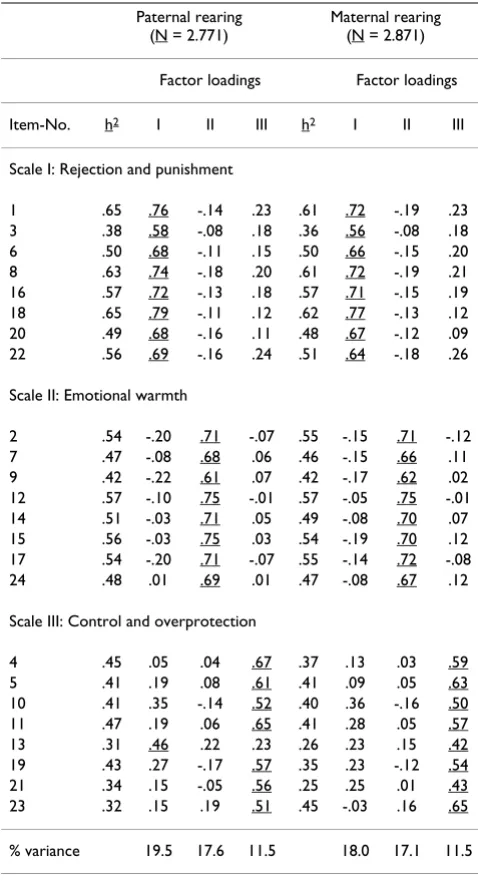
Furthermore, the factorial structure as well as the inde-pendence of the three dimensions were tested. In Table 3 the factor loadings for the recalled parental rearing items are depicted. The original factor structure could be satis-factorily replicated (with the exception of item 13 – "Did your parents use the expression: If you don't do this, then I'll be sad"). The largest proportion of variance was expli-cable by the factor "rejection and punishment" (19.5% for
the paternal items and 18.0% for the maternal items) was followed by "emotional warmth" (17.6% and 17.10%, respectively) and "control and overprotection" (11.5% for both factors). The cumulative explained variance was 48.6% for recalled paternal rearing and 46.6% for recalled maternal rearing behavior.
Intercorrelations of the FEE subscales
Table 4 shows that some of the scales are highly corre-lated. The highest intercorrelations could be found between the identical (regarding content) scales for fathers and mothers (r = .70 to .77). Positive but moderate correlations were also found when investigating one par-ent or both parpar-ents concerning the scales "rejection and punishment" as well as "control and overprotection". Fur-thermore, the scale "emotional warmth" correlated nega-tively with the scale "rejection and punishment" whereas "emotional warmth" and "control and overprotection" were unrelated.
Influence of socio-demographic factors
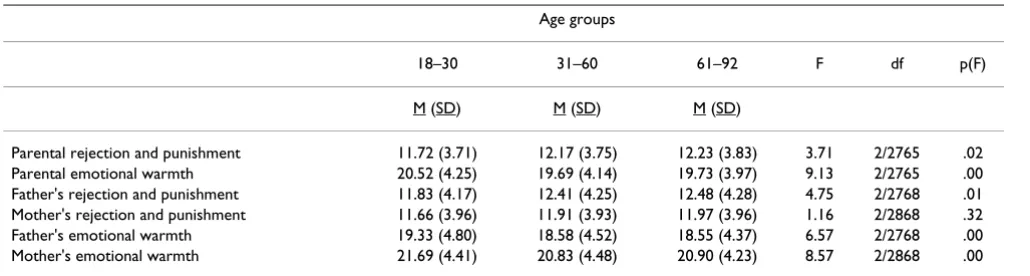
In addition, the influence of age and gender on recalled parental rearing behavior was calculated. Age (three cate-gories: 18–30, 31–60 and 61–92 yrs.) exerted a significant influence on the perception of recalled paternal rejection and punishment as well as on emotional warmth. Fur-thermore, the age also influenced the father's recalled rejection and punishment as well as the mother's emo-tional warmth (see Tables 5 and 6). According to their memories, the older the subjects, the stronger they experi-enced their parents' rejection and the less their parents' emotional warmth. In addition, they reported much stricter and less emotionally warm parental rearing behav-ior in reference to their father as well as a lack of emo-tional warmth from their mother.
Table 1: Psychometric properties of the FEE scales
Scales M SD α rtt Skewness Excess
Rejection and punishment paternal N = 2771
12.30 4.25 .89 .88 1.45 2.30
maternal N = 2871
11.88 3.94 .87 .86 1.57 2.69
Emotional Warmth paternal N = 2771
18.73 4.55 .86 .86 0.04 0.02
maternal N = 2871
21.03 4.41 .86 .86 -0.20 -0.05
Control and overprotection paternal N = 2771
14.59 3.87 .74 .73 0.62 0.32
maternal N = 2871
15.04 3.82 .72 .70 0.50 0.11
M ... mean
SD ... standard deviation
The data also revealed significant main gender effects on recalled parental rearing behavior, i.e. the male subjects recalled more rejecting and stricter parental rearing behav-ior than the female subjects. In addition, the parents' emotional warmth was less remembered by the male sub-jects than by the female subsub-jects. To be specific, the female subjects reported their fathers as emotionally warmer and less punishing than did the male subjects (see Tables 5 and 6).
Furthermore, there was a significant interaction effect between the gender of the evaluated parent (father/ mother) and the gender of the child concerning "rejection and punishment" (Mmales = 12.81 (SD = 4.33) vs. Mfemales = 11.91 (SD = 4.12); F = 30.32; df = 1/2769; p(F) < .01) and "emotional warmth" (Mmales = 18.32 (SD = 4.34) vs.
Mfemales = 19.05 (SD = 4.71); F = 16.65; df = 1/2766; p(F)
< .01). Significant interactive effects between age and gen-der could not be observed.
Correlations between the FEE and other scales
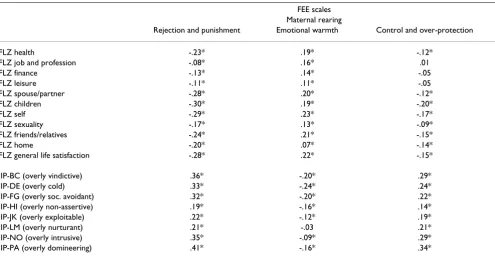
As a first step for evaluating the external validity of the FEE its relationships to other scales were tested (see Tables 7 and 8 for p < .001). Concerning life satisfaction (FLZ), low to satisfactory relationships were established to most of the examined areas from .07 to .39: Subjects who had recalled more rejecting, punitive and controlling parental rearing behavior and a lack of emotional warmth reported a lower level of life satisfaction than subjects with a more positive rearing experience.
Low to satisfactory relationships to recalled parental rear-ing, behavior, in particular on the scales "rejection and punishment" and "control and overprotection", also appeared for interpersonal problems (IIP factors) with a
range of .09 to .39: Subjects who recalled rejective and strict rearing behavior spoke of difficulties in trusting other people, supporting others and caring for others' needs. Furthermore, they had problems cooperating, and they attempted to dominate and control others. They also described themselves as resentful and quarrelsome. Table 2: Comparison of the paternal and maternal FEE scales
Scales t p(t) d
Rejection and punishment paternal N = 2771
7.02 .001 0.107
maternal N = 2871
Emotional Warmth paternal N = 2771
-35.58 .001 0.513
maternal N = 2871
Control and overprotection paternal N = 2771
-9.63 .001 0.117
maternal N = 2871
Notes: significance of mean differences between perceived paternal p(t)... and maternal rearing (t-test for paired samples)
d ... effect sizes
Table 3: Factor structure of perceived parental rearing according to FEE (principal component analysis with varimax rotation and extraction of predefined three factors)
Paternal rearing (N = 2.771)
Maternal rearing (N = 2.871)
Factor loadings Factor loadings
Item-No. h2 I II III h2 I II III
Scale I: Rejection and punishment
1 .65 .76 -.14 .23 .61 .72 -.19 .23 3 .38 .58 -.08 .18 .36 .56 -.08 .18 6 .50 .68 -.11 .15 .50 .66 -.15 .20 8 .63 .74 -.18 .20 .61 .72 -.19 .21 16 .57 .72 -.13 .18 .57 .71 -.15 .19 18 .65 .79 -.11 .12 .62 .77 -.13 .12 20 .49 .68 -.16 .11 .48 .67 -.12 .09 22 .56 .69 -.16 .24 .51 .64 -.18 .26
Scale II: Emotional warmth
2 .54 -.20 .71 -.07 .55 -.15 .71 -.12 7 .47 -.08 .68 .06 .46 -.15 .66 .11 9 .42 -.22 .61 .07 .42 -.17 .62 .02 12 .57 -.10 .75 -.01 .57 -.05 .75 -.01 14 .51 -.03 .71 .05 .49 -.08 .70 .07 15 .56 -.03 .75 .03 .54 -.19 .70 .12 17 .54 -.20 .71 -.07 .55 -.14 .72 -.08 24 .48 .01 .69 .01 .47 -.08 .67 .12
Scale III: Control and overprotection
4 .45 .05 .04 .67 .37 .13 .03 .59 5 .41 .19 .08 .61 .41 .09 .05 .63 10 .41 .35 -.14 .52 .40 .36 -.16 .50 11 .47 .19 .06 .65 .41 .28 .05 .57 13 .31 .46 .22 .23 .26 .23 .15 .42 19 .43 .27 -.17 .57 .35 .23 -.12 .54 21 .34 .15 -.05 .56 .25 .25 .01 .43 23 .32 .15 .19 .51 .45 -.03 .16 .65
% variance 19.5 17.6 11.5 18.0 17.1 11.5
Notes:h2 = communality;
factor loadings > .40 are underlined Eigen values of the unrotated solutions:
paternal rearing: Faktor I 6.44/Faktor II 3.77/Faktor III 1.46 maternal rearing: Faktor I 6.29/Faktor II 3.61/Faktor III 1.29 Factor I = Rejection and punishment
Factor II = Emotional warmth
Discussion
Based on the data presented in this paper the FEE repre-sented a reliable and valid instrument for the assessment of adults' memories of their parents' rearing behavior for the German-speaking areas. Its relatively low number of items allowed for an economical application in research and clinical work. Both, the items and the three scales showed satisfactory to good psychometric properties. The reliability figures highly corresponded to the values obtained for the original long version of the EMBU from 14 countries (N = 3.500) [21].
In the present data, the results from the principal compo-nent analysis successfully replicated the previously obtained factorial structure of the EMBU [21]. The cumu-lative variance explained by the three factors is higher than the corresponding figures for the EMBU [21] and confirmed the factorial validity of the FEE. Also, the inter-correlational pattern of the FEE factors was consistent with previous results using the original long version of the EMBU [21].
When comparing recalled paternal and maternal rearing behavior, a number of significant differences were found, whose relevance deserves a closer look due to the small numerical mean differences. However, the findings
moth-ers compared to fathmoth-ers tended to be emotionally warmer and less rejecting on the one hand and more controlling and overprotective on the other, were in agreement with the results of the study by Gerlsma and Emmelkamp [22].
Whereas based on the EMBU only a few studies reported age and gender effects, the presented data indicated some influence of these factors on recalled parental rearing behavior. Based on their memories, older subjects recalled their parents as more rejecting and less emotionally warm than did their younger counterparts. This age effect might be explained by the historical changes in parenting atti-tudes and behavior in child rearing practices. In addition, the historical German background may also have to be considered. Furthermore, based on their memories, the female subjects reported having received more emotional warmth from their fathers than the male subjects did, whereby the latter recalled their fathers as stricter and more rejecting.
In the literature a few studies have focused on the connec-tion between life satisfacconnec-tion and parental rearing behav-ior [2,3,23,24]. In line with the literature, the presented data have shown that recalled parental rearing behavior was connected to life satisfaction and self-reported inter-personal problems.
Table 4: Intercorrelations of the FEE scales
Scales 1 2 3 4 5 6
1 Paternal rejection and punishment -.31* .54* .70* -.27* .43*
2 Paternal emotional warmth -.01 -.19* .71* .01
3 Paternal control and overprotection .45* .02 .77*
4 Maternal rejection and punishment -.36* .53*
5 Maternal emotional warmth .02
6 Maternal control and overprotection
Notes: Pearson correlations (two-tailed), *p < .001 2.768 ≤ N ≤ 2.871
Table 5: The influence age on the recalled parental rearing
Age groups
18–30 31–60 61–92 F df p(F)
M (SD) M (SD) M (SD)
Parental rejection and punishment 11.72 (3.71) 12.17 (3.75) 12.23 (3.83) 3.71 2/2765 .02 Parental emotional warmth 20.52 (4.25) 19.69 (4.14) 19.73 (3.97) 9.13 2/2765 .00 Father's rejection and punishment 11.83 (4.17) 12.41 (4.25) 12.48 (4.28) 4.75 2/2768 .01 Mother's rejection and punishment 11.66 (3.96) 11.91 (3.93) 11.97 (3.96) 1.16 2/2868 .32 Father's emotional warmth 19.33 (4.80) 18.58 (4.52) 18.55 (4.37) 6.57 2/2768 .00 Mother's emotional warmth 21.69 (4.41) 20.83 (4.48) 20.90 (4.23) 8.57 2/2868 .00
M ... mean
SD ... standard deviation
The retrospective assessment of recalled parental rearing behavior represents a specific problem in assessing the actual parental rearing experienced during childhood or its subjective representation [25,26]. The subjective repre-sentation may reflect the present mood, errors in autobio-graphical memory (un-/conscious distortions), false memories or idiosyncratic reconstructions of the subjects' personal history. However, the existing literature did not provide consistent and conclusive data on the mood-con-gruent recall of relevant personal stimuli [25,27-30] as well as on the validity of retrospective data on parental rearing behavior [31]. Therefore, longitudinal studies
with independent raters should be considered for the validity of parental rearing practices (see [32]). Unfortu-nately, in clinical practice, the child rearing experienced by patients can only be assessed retrospectively after the onset of the disorder. Nevertheless, the then obtained information can be of help in the therapeutic process.
Based on the data from a representative sample, general conclusions cannot be drawn, since the large sample size could easily lead to significant results, e.g. a correlation coefficient of r = .07 (p < .001). In the context of validating the instrument, this study did not focus on any connection Table 6: The influence child's gender on the recalled parental rearing
Child's gender
female male d t df p(t)
M (SD) M (SD)
Parental rejection and punishment 11.85 (3.73) 12.39 (3.79) -.14 3.79 1/2766 .00 Parental emotional warmth 20.07 (4.28) 19.63 (3.93) -.11 -2.81 2703.97 .00 Father's rejection and punishment 11.91 (4.14) 12.81 (4.33) -.21 5.59 1/2769 .00 Mother's rejection and punishment 11.79 (3.97) 11.98 (3.92) -.05 1.27 2869 .21 Father's emotional warmth 19.05 (4.70) 18.32 (4.34) -.16 4.22 2702.71 .00 Mother's emotional warmth 21.08 (4.53) 20.96 (4.26) -.04 -.74 2869 .46
M ... mean
SD ... standard deviation d ... effect sizes
p(t)... significance of mean differences between perceived paternal and maternal rearing (t-test for paired samples)
Table 7: Correlations between perceived paternal rearing and both life satisfaction (FLZ) and interpersonal problems (IIP)
FEE scales Paternal rearing
Rejection and punishment Emotional warmth Control and over-protection
FLZ health -.21* .16* -.11*
FLZ job and profession -.11* .17* .01
FLZ finance -.13* .13* -.03
FLZ leisure -.09* .08* -.03
FLZ spouse/partner -.23* .16* -.12*
FLZ children -.34* .22* -.20*
FLZ self -.27* .21* -.15*
FLZ sexuality -.17* .14* -.08*
FLZ friends/relatives -.26* .24* -.12*
FLZ home -.19* .07* -.11*
FLZ general life satisfaction -.26* .21* -.13*
IIP-BC (overly vindictive) .37* -.18* .26*
IIP-DE (overly cold) .33* -.20* .22*
IIP-FG (overly soc. avoidant) .31* -.17* .22*
IIP-HI (overly non-assertive) .19* -.13* .12*
IIP-JK (overly exploitable) .19* -.09* .16*
IIP-LM (overly nurturant) .19* -.03 .19*
IIP-NO (overly intrusive) .32* -.06 .28*
IIP-PA (overly domineering) .39* -.12* .32*
to psychological symptoms. Therefore, additional studies that include assessments of psychological symptoms as well as a formal comparison of the German long and short version of the EMBU as well as the original version would still be essential. Furthermore, retest-reliability testing and connections to other parental child rearing questionnaires or external ratings would be helpful to further specify the validity and reliability of this short version.
Conclusion
In summary, the afore-discussed data show that the FEE is a reliable and valid instrument for the retrospective assess-ment of subjective representations of parental rearing behavior. Moreover, this information will be relevant not only to the research concerning psychological disorders but also to the field of non-clinical applications.
Competing interests
The authors declare that they have no competing interests.
Authors' contributions
KP did the final draft of the manuscript and critically revised it for the intellectual content. HB and SS have given final the approval of the version to be published. JS substantially contributed to the analysis and the interpre-tation of the data. He wrote the first draft of the manu-script. AH substantially contributed to the analysis and the interpretation of data. EB was responsible for the col-lection of the data and the general supervision of the research group. He substantially contributed to the
con-ception and the design of the study as well as the acquisi-tion of the data. All authors read and approved the final manuscript.
Acknowledgements
The authors would like to thank all of the participants of the study as well as the University of Leipzig, which made it possible for us to collect the pre-sented data.
References
1. Perris C, Arrindell WA, Eisemann M: Parenting and psychopathology
New York, Wiley; 1994.
2. Lamborn SD, Monnts NS, Steinberg L, Dornbusch SM: Patterns of competence and adjustment among adolescents from authoritative, authoritarian, indulgent, and neglectful fami-lies. Child Dev 1991, 62:1049-1065.
3. Winefield HR, Goldney RD, Tiggemann M, Winefield AH: Reported parental rearing patterns and psychological adjustment: A short form of the EMBU. Pers Individ Dif 1989, 10:459-465. 4. Someya T, Uehara T, Kadowaki M: Effects of gender difference
and birth order on perceived parenting styles, measured by the EMBU scale, in Japanese two-sibling subjects. Psychiatry Clin Neurosci 2000, 54:77-81.
5. Richter J, Eisemann M, Richter G: Determinants of recall of parental rearing behavior: The influence of age or loss of par-ents by separation or death. Psychopathology 1992, 25:120-127. 6. Parker G, Tupling H, Brown LB: A parental bonding instrument.
Br J Med Psychol 1979, 52:1-10.
7. Parker G, Roussos J, Hadzi-Pavlovic D, Mitchell P, Wilhelm K, Austin MP: The development of a refined measure of dysfunctional parenting and assessment of its relevance in patients with affective disorders. Psychol Med 1997, 27:1193-1203.
8. Perris C, Jacobsson L, Lindström H, von Knorring L, Perris H: Devel-opment of a new inventory for assessing memories of paren-tal rearing behaviour. Acta Psychiatr Scand 1980, 61:265-274. 9. Arrindell WA, Ende J van der: Replicability and invariance of
dimensions of parental rearing behaviour: Further Dutch experiences with the EMBU. Pers Individ Dif 1984, 5:671-682. Table 8: Correlations between perceived maternal rearing and both life satisfaction (FLZ) and interpersonal problems (IIP)
FEE scales Maternal rearing
Rejection and punishment Emotional warmth Control and over-protection
FLZ health -.23* .19* -.12*
FLZ job and profession -.08* .16* .01
FLZ finance -.13* .14* -.05
FLZ leisure -.11* .11* -.05
FLZ spouse/partner -.28* .20* -.12*
FLZ children -.30* .19* -.20*
FLZ self -.29* .23* -.17*
FLZ sexuality -.17* .13* -.09*
FLZ friends/relatives -.24* .21* -.15*
FLZ home -.20* .07* -.14*
FLZ general life satisfaction -.28* .22* -.15*
IIP-BC (overly vindictive) .36* -.20* .29*
IIP-DE (overly cold) .33* -.24* .24*
IIP-FG (overly soc. avoidant) .32* -.20* .22*
IIP-HI (overly non-assertive) .19* -.16* .14*
IIP-JK (overly exploitable) .22* -.12* .19*
IIP-LM (overly nurturant) .21* -.03 .21*
IIP-NO (overly intrusive) .35* -.09* .29*
IIP-PA (overly domineering) .41* -.16* .34*
Publish with BioMed Central and every scientist can read your work free of charge "BioMed Central will be the most significant development for disseminating the results of biomedical researc h in our lifetime."
Sir Paul Nurse, Cancer Research UK
Your research papers will be:
available free of charge to the entire biomedical community
peer reviewed and published immediately upon acceptance
cited in PubMed and archived on PubMed Central
yours — you keep the copyright
Submit your manuscript here:
http://www.biomedcentral.com/info/publishing_adv.asp
BioMedcentral
10. Arrindell WA, Sanavio E, Aguilar G, Sica C, Hatzichristou C, Eisemann M, Recinos LA, Gaszner P, Peter M, Battagliese G, Kállai J, Ende J van der: The development of a short version of the EMBU: its appraisal with students in Greece, Guatemala, Hungary and Italy. Pers Individ Dif 1999, 27:613-628.
11. Schumacher J, Eisemann M, Braehler E: FEE, Fragebogen zum erinnerten elterlichen Erziehungsverhalten Bern, Huber; 2000.
12. Schumacher J, Eisemann M, Braehler E: Rueckblick auf die Eltern: Der Fragebogen zum erinnerten elterlichen Erziehungsver-halten (FEE). Diagnostica 1999, 45:194-204.
13. Kitze K, Hinz A, Braehler E: Das elterliche Erziehungsverhalten in der Erinnerung erwachsener Geschwister. Adult siblings' memories of parental behavior. Psychol Erz Unterr 2007, 54:59-70.
14. Albani C, Reulecke M, Koerner A, Villmann T, Villmann B, Blaser G, Geyer M: Erinnertes elterliches Erziehungsverhalten und das Ausmass psychischer Beeintraechtigung bei Psychothera-piepatientinnen. Z Med Psychol 2000, 9:69-75.
15. Albani C, Reulecke M, Koerner A, Villmann T, Blaser G, Geyer M, Pokorny D, Kaechele H: Erinnertes elterliches Erziehungsverh-alten und Zentrale Beziehungsmuster bei Psychotherapie-patientinnen. Psychother Forum 2002, 9:162-171.
16. Dick A, Vanderbilt S, Jacot C, Hurni F, Jaeggi C, Leiggener E: Erin-nertes elterliches Erziehungsverhalten und aktuelle Bind-ungsorganisation im Erwachsenenalter – Unterschiede zwischen Personen mit und ohne Angststoerungen. Z Klin Psychol Psychother 2005, 34:35-38.
17. Arrindell WA, Perris C, Eisemann M, Granell de Aldaz E, Ende J van der, Kong Sim Guan D, Richter J, Gaszner P, Iwawaki S, Baron P, Jou-bert N, Prud'homme L: Cross-national transferability of the two-factor model of parental rearing behaviour: A contrast of data from Canada, the Fed. Rep. Germany, Hungary, Japan, Singapore and Venezuela with Dutch target ratings on the EMBU. Pers Individ Dif 1992, 13:343-353.
18. Fahrenberg J, Myrtek M, Schumacher J, Brähler E: Fragebogen zur Lebenszufriedenheit (FLZ). In Handanweisung Göttingen, Hogrefe; 2000.
19. Horowitz LM, Rosenberg SE, Bauer BA, Ureno G, Villasenor VS: Inventory of Interpersonal Problems. Psychometric proper-ties and clinical applications. J Consult Clin Psychol 1988, 56:885-892.
20. Horowitz LM, Strauß B, Kordy H: Inventar zur Erfassung Interpersonaler Probleme – Deutsche Version (IIP-D) Weinheim, Beltz Test; 1994. 21. Arrindell WA, Perris C, Eisemann M, Ende J van der, Gaszner P,
Iwawaki S, Maj M, Zhang J: Parental rearing behaviour from a cross-cultural perspective: A summary of data obtained in 14 nations. In Parenting and psychopathology Edited by: Perris C, Arrin-dell WA, Eisemann M. New York, Wiley; 1994:145-171.
22. Gerlsma C, Emmelkamp PMG: How large are gender differences in perceived parental rearing styles?: A meta-analytic view. In Parenting and psychopathology Edited by: Perris C, Arrindell WA, Eisemann M. New York, Wiley; 1994:55-74.
23. Daggett J, O'Brien M, Zanolli K, Peyton V: Parents' attitudes about children: Associations with parental life histories and child-rearing quality. J Fam Psychol 2000, 14:187-199.
24. Holloway S, Suzuki S, Yamamoto Y, Mindnich J: Relation of Mater-nal Role Concepts to Parenting, Employment Choices, and Life Satisfaction Among Japanese Women. Sex Roles 2006, 54:235-249.
25. Brewin C, Andrews B, Gotlib IH: Psychopathology and early experience: A reappraisal of retrospective reports. Psychol Bull 1993, 113:82-98.
26. Gerlsma C: Parental rearing styles and psychopathology: Notes on the validity of questionnaires for recalled parental behavior. In Parenting and psychopathology Edited by: Perris C, Arrin-dell WA, Eisemann M. New York, Wiley; 1994:75-105.
27. Matt GE, Vasquez C, Campbell WK: Mood congruent recall of affectively toned stimuli: A meta-analytic review. Clin Psychol Rev 1992, 12:227-255.
28. Parrott WG, Sabini J: Mood and memory under natural condi-tions: Evidence for mood incongruent recall. J Pers Soc Psychol
1990, 59:321-336.
29. Gerlsma C, Kramer JJAM, Scholing A, Emmelkamp PMG: The influ-ence of mood on memories of parental rearing practices. Br J Clin Psychol 1994, 33:159-172.
30. Richter J, Eisemann M: Stability of memories of parental rearing among psychiatric inpatients: A replication based on EMBU subscales. Psychopathology 2001, 34:318-325.
31. Halverson CF: Remembering your parents: Reflections on the retrospective method. J Pers 1988, 56:435-443.
32. Schneewind KA, Ruppert S, Schmid U, Splete R, Wendel C: Kontrol-lüberzeugung im Kontext von Autonomie und Verbunden-heit – Befunde einer 16-jährigen Längsschnittstudie. Zwischen Autonomie und Verbundenheit und Formen der Behauptung von Subjektiv-ität 1999:357-391.
Pre-publication history
The pre-publication history for this paper can be accessed here: