71
Providing a flexible learning environment:
Are on-line lectures the answer?
Barbara C. Panther, Wendy Wright, Jennifer A. Mosse
Corresponding author:
School of Applied Sciences and Engineering, Monash University, Churchill VIC 3842, Australia
Keywords: online learning; recorded lectures; online discussion; learning resources; off-campus students
International Journal of Innovation in Science and Mathematics Education, 20(1), 71-82, 2012.
Abstract
As universities embrace new technologies to increase flexibility and enhance students’ learning experiences, tertiary students are increasingly presented with a wider range of learning resources to support their studies. In this study, a diverse group of undergraduate science students self-report their behaviour, experiences and perceptions relating to the resources that are provided to them. A total of 109 students were invited to participate in the study. Sixty students completed a survey and 29 students took part in focus groups. The majority of these students favoured face-to-face lectures due to the ability to interact with lecturers and other students and the ability to ask questions in real time. Recorded lectures were seen to be useful for clarification and revision, largely because they can be paused and rewound, facilitating review of difficult material. Text-based resources such as study guides are still considered important and are often used, especially by students working in off-campus mode. On-line discussion forums are not seen as a substitute for face to face interaction; a need for active facilitation of such forums is highlighted.
Background
In the current social and political climate, universities are attempting to increase their engagement with groups traditionally under-represented in tertiary education. Targeted populations include individuals from low SES backgrounds and from regional and remote communities; individuals with disabilities; and those seeking to upgrade qualifications to increase career prospects. Many within these groups have difficulty finding time to meet on-campus attendance requirements due to a combination of geographic, economic and personal factors, highlighting the need for flexible teaching strategies.
72
attend face-to-face lectures when online lectures are available (Davis, Connolly, & Linfield, 2009).
A number of studies have examined the effects of provision of face-to-face lectures, recorded lectures (both audio and video) and detailed written materials including lecture notes, study guides and texts, on student performance (Vandehey, Marsh, & Diekhoff, 2005), student satisfaction (Grabe & Christopherson, 2007; Palmer & Holt, 2008) and attendance (Vandehey et al., 2005). However, few studies have asked students how they use these resources, and what relative importance they place on the different materials. Our studies have shown that recorded lectures alone do not meet the needs of off campus students, who make use of a
wide range of learning resources, including recorded lectures, on-line discussion forums, study guides and texts (Mosse, Panther, & Wright, 2011).
This study was designed to document the students’ own experiences and behaviour in order to understand questions such as: Why students continue to attend face-to-face lectures when it is often difficult for them to do so, and when an alternative (in the form of a recorded lecture) is available. Students were also asked to report how they used the range of learning resources available and how they selected combinations of materials to meet their needs. Given that we teach students in a range of study modes, across the on- and off-campus spectrum, we were also able to explore whether different groups of students have different requirements and preferences.
Context of the Study
This study was carried out at Monash University’s regional campus in Victoria, Australia. Monash University is a large, research-intensive, multi-campus university with six local campuses throughout the state of Victoria, as well as international campuses in Malaysia and South Africa, and international centres in Italy and India. Located in the town of Churchill, approximately two hours by car from Melbourne, the Gippsland campus is Monash University’s only non-metropolitan campus. It offers programs in Art and Design, Business, Education, Engineering, Information Technology, Media and Social Sciences, Nursing and Midwifery and Science. Many of these programs, including Science, are taught in both on and off-campus (distance education) modes. On-campus students may also choose to study some units in off-campus mode, to minimise travel and accommodate work schedules and other commitments. Monash University Lectures Online (MULO) offers teaching staff the opportunity to record lectures given in on-campus classes, providing either audio-only recordings of lectures (with copies of the slides also made available), or full audio-visual recordings (via EchoSystem) in which students see the slides and any annotations made by the lecturer while hearing their voice. Recordings are available for download via the University’s Library website soon after the lecture has occurred.
Methods
Students enrolled in at least one of three subjects offered at the School of Applied Sciences and Engineering, Monash University Gippsland in semester 2, 2010, were selected for this study. The subjects were first level biology, second level biochemistry and third level environmental science. Resources available in these units included:
• Written materials: comprising detailed study guides, copies of lecture slides and texts available as hard copy and/or online.
• Online discussion forums
73
• Recorded lectures (in two of the three units)
• Face-to-face laboratory classes (in two of the three units)
Online copies of lecture slides and study guides and the online discussion forums were available within the online learning environment (Blackboard) which was standard across Monash Unviersity at the time of the study. On- and off-campus students had equivalent access to all resources provided in any particular subject except for face-to-face lectures and laboratory classes. Although off-campus students are not prohibited from attending lectures, they are typically enrolled in off-campus mode because of their inability to attend classes at the prescribed times. Recorded lectures were available in two of the three subjects, where lectures were presented using tablets and software which allows the lecturer to annotate and make explanatory sketches on slides during the lecture. These lectures were captured using EchoSystem technology.
Second year off-campus biochemistry students have face to face contact with academic staff and their peers during a residential laboratory school. This opportunity is not available to off-campus students undertaking first year biology and third year environmental science, who complete their practical work off-campus (Mosse & Wright, 1999) and undertake independent field work, respectively.
In total, 47 on-campus and 62 off-campus students were invited to take part in the questionnaire. Twenty-three on-campus students (8 males and 15 females) and 38 off-campus students (16 males and 22 females) responded (56% percent response rate). Twelve off-campus students and 17 on-off-campus students attended focus groups. The study was approved by Monash University’s Human Research Ethics Committee.
Questionnaire
Students were invited via email to complete an anonymous questionnaire using
SurveyMonkey
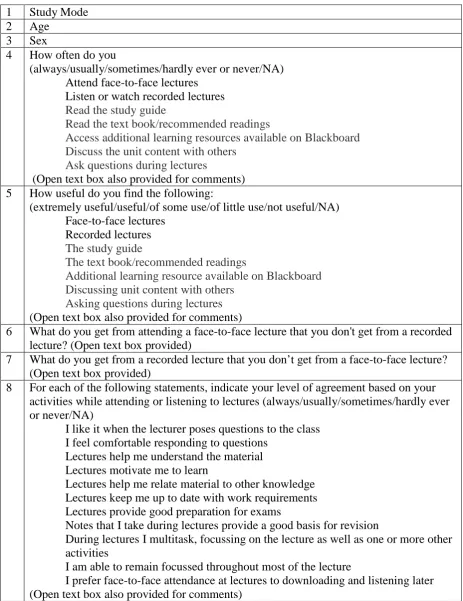
2010. They were asked to comment on how often they used face-to-face and recorded lectures, the perceived usefulness of each activity, and their use of additional learning materials. The questionnaire focussed on student behaviour (how often do you ...) and students’ perceptions of the usefulness of different resources (how useful do you find ...). A Likert scale was used for the questions, shown in Table 1, and additional comments were invited from students.
Focus groups
74 Table 1: Questionnaire Content
1 Study Mode
2 Age
3 Sex
4 How often do you
(always/usually/sometimes/hardly ever or never/NA) Attend face-to-face lectures
Listen or watch recorded lectures
Read the study guide
Read the text book/recommended readings
Access additional learning resources available on Blackboard Discuss the unit content with others
Ask questions during lectures
(Open text box also provided for comments) 5 How useful do you find the following:
(extremely useful/useful/of some use/of little use/not useful/NA) Face-to-face lectures
Recorded lectures
The study guide
The text book/recommended readings
Additional learning resource available on Blackboard Discussing unit content with others
Asking questions during lectures
(Open text box also provided for comments)
6 What do you get from attending a face-to-face lecture that you don't get from a recorded lecture? (Open text box provided)
7 What do you get from a recorded lecture that you don’t get from a face-to-face lecture? (Open text box provided)
8 For each of the following statements, indicate your level of agreement based on your activities while attending or listening to lectures (always/usually/sometimes/hardly ever or never/NA)
I like it when the lecturer poses questions to the class I feel comfortable responding to questions
Lectures help me understand the material Lectures motivate me to learn
Lectures help me relate material to other knowledge Lectures keep me up to date with work requirements Lectures provide good preparation for exams
Notes that I take during lectures provide a good basis for revision
During lectures I multitask, focussing on the lecture as well as one or more other activities
I am able to remain focussed throughout most of the lecture
75
Results and Discussion
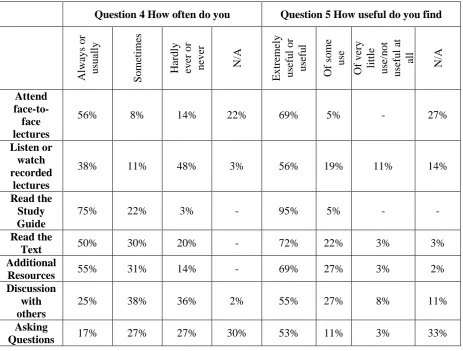
Student responses to the questionnaire were examined to determine their behaviours and indicate the usefulness of the materials provided. The proportion of students who reported using the various resources provided for each unit is shown in Table 2.
56% of students who responded to the questionnaire regularly attended face-to-face lectures (reflecting the 61% of students who were enrolled on campus) and 38% regularly used recorded lectures (this group comprises both on- and off-campus students). There was a clear preference amongst our students for face-to-face lectures compared with recorded lectures. 11% of students saw little or no use in recorded lectures.
Table 2: Attendance and Usefulness of face-to-face and recorded lectures
Question 4 How often do you Question 5 How useful do you find
Al wa y s o r us ua ll y S o me ti me s H ar d ly eve r or ne ve r N/ A E x tr eme ly u se ful or u sef u l O f so m e us e O f v ery li tt le us e/ n ot u sef u l a t al l N/ A Attend face-to-face lectures
56% 8% 14% 22% 69% 5% - 27%
Listen or watch recorded
lectures
38% 11% 48% 3% 56% 19% 11% 14%
Read the Study Guide
75% 22% 3% - 95% 5% - -
Read the
Text 50% 30% 20% - 72% 22% 3% 3%
Additional
Resources 55% 31% 14% - 69% 27% 3% 2%
Discussion with others
25% 38% 36% 2% 55% 27% 8% 11%
Asking
Questions 17% 27% 27% 30% 53% 11% 3% 33%
76
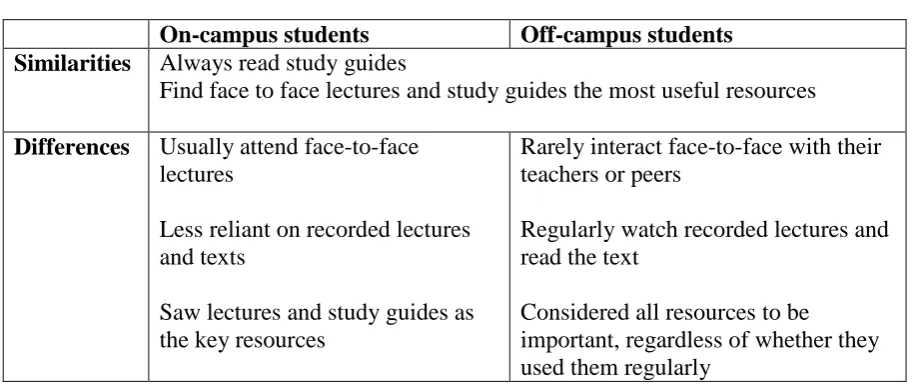
The focus group discussions revealed that on and off campus students use the resources differently. The key differences between on and off-campus students’ self-reported use of the resources provided are summarised in Table 3.
Table 3: Broad qualitative similarities and differences in use and usefulness of materials, as reported by on-campus and off-campus students
On-campus students Off-campus students Similarities Always read study guides
Find face to face lectures and study guides the most useful resources
Differences Usually attend face-to-face lectures
Less reliant on recorded lectures and texts
Saw lectures and study guides as the key resources
Rarely interact face-to-face with their teachers or peers
Regularly watch recorded lectures and read the text
Considered all resources to be
important, regardless of whether they used them regularly
On-campus students use study guides regularly, but not as their primary source of information. Instead, they use them as supplementary resources to support their learning.
I don’t use the study guide that much during the term, I just use it when I am trying to remember things, like questions for exams. So I don’t actually use the study guide stuff, but the objectives I use.
It’s good that if you miss a class, or you don’t understand something, (I) use the study guide as a back up to go over it. If I didn’t get that I’d have a read through it.
I think the study guide is sometimes better because there is so much in the lectures. The study guide is a condensed version of the main bits you need to know.
Off-campus students can be divided into two approximately equal groups according to whether they use written materials or lectures as their primary source of information. Students who prefer reading study guides and text books typically use lecture slides and recordings to fine tune and revise. They seem to be highly organised, with a linear approach to their study.
I don’t listen to lectures at all, I start with study guides and the textbook and I will go through and make notes from the study guide ... then I will look at the slides and see if there is anything that the lecturers have put in which isn’t in the study guide.
I’ll make notes or rewrite the study guide my way ... three weeks or four weeks before (the exam) I start to listen to the lectures just to go over it.
77
the Powerpoint in front of me and I try to follow it and make notes as you talk about it.
Interestingly, off-campus students who begin with lecture slides and recordings also read study guides, but are less likely to read the textbook. This group of students recognise a lack of organisation or motivation in their own approaches to study, and use the lectures to provide a framework for their learning:
I couldn’t sit and read the study guide and make notes from it ‘cos I would just be daydreaming and thinking about other things. I basically only use the lecture notes and the visual just because it keeps me stimulated. I tend not to use the textbook very much unless I’m looking for a definition ...
I listen to the lectures and jot down bits and pieces but then I go back over the study guide and look at the set reading and try to read through and write as many notes as I can ... With the textbook: I’ve been a little bit slacker with that.
I listen to lectures. I find them really interesting and I kind of wrap my head around it all so then, when I read the study guide, I feel like it just kind of sets in.
In particular, when considering the recorded lectures, off-campus students appreciate the interactive nature of CP3 technology, which gives them the ability to ‘watch’ diagrams being created as they hear the accompanying audio:
.. when you say ‘here’ and ‘there’ I have a pretty good idea of where you are pointing to. I can see what you’re drawing and what you are actually talking about.
I think the fact that you are able to do it [draw and annotate] and talk about it at the same time means it doesn’t have to be a great picture. Even if it looks like ‘mush’ I know what you’re talking about”.
On-line lectures do not meet the needs of students who do not have regular study time available and may be working ahead of the on-campus class schedule. One student claimed not to use the audio recordings at all for currently enrolled units, but planned to access recorded lectures over the summer break to prepare for a unit s/he intended to study the following year.
78
I find face-to-face lectures, where it is interactive and I am able to discuss with others and ask questions, the easiest way of learning.
Assignments are the main reason I don’t come to lectures ... every day I’m working on assignments and stuff.
Table 4: Student perceptions about lectures
Strongly Agree/
Agree
Neutral
Disagree/ Strongly Disagree
N/A
I like it when the lecturer poses questions to the
class 69% 14% 8% 9%
I feel comfortable responding to questions 48% 19% 9% 23%
Lectures help me understand the material 88% 9% - 3%
Lectures motivate me to learn 70% 25% - 5%
Lectures help me relate material to other
knowledge 88% 9% - 3%
Lectures keep me up to date with work
requirements 78% 16% 3% 3%
Lectures provide good preparation for exams 80% 13% 3% 5%
Notes that I take during lectures provide a good
basis for revision 61% 23% 6% 9%
During lectures I multitask, focussing on the
lecture as well as one or more other activities 36% 17% 38% 9%
I am able to remain focussed throughout most of
the lecture 56% 25% 14% 5%
I prefer face-to-face attendance at lectures to
downloading and listening later 52% 13% 8% 28%
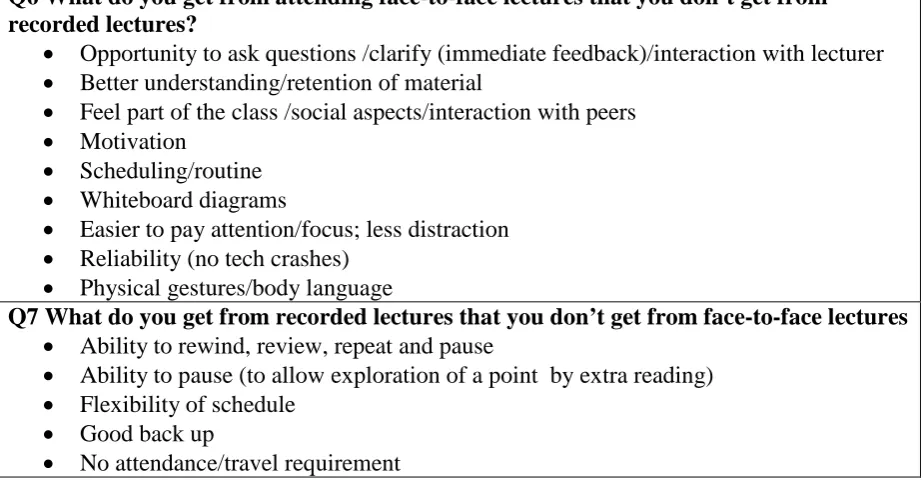
79 Table 5: Themes Drawn From Student Responses
Q6 What do you get from attending face-to-face lectures that you don’t get from recorded lectures?
• Opportunity to ask questions /clarify (immediate feedback)/interaction with lecturer
• Better understanding/retention of material
• Feel part of the class /social aspects/interaction with peers
• Motivation
• Scheduling/routine
• Whiteboard diagrams
• Easier to pay attention/focus; less distraction
• Reliability (no tech crashes)
• Physical gestures/body language
Q7 What do you get from recorded lectures that you don’t get from face-to-face lectures
• Ability to rewind, review, repeat and pause
• Ability to pause (to allow exploration of a point by extra reading)
• Flexibility of schedule
• Good back up
• No attendance/travel requirement
Many students commented that they were better able to retain information from an interactive face-to-face lecture experience than from watching a recorded lecture. The ability of the lecturer to engage the students is an important aspect of this interactivity.
I find face-to-face lectures very useful ... but only if the lecturer is able to clearly deliver the material, using diagrams and examples. When the lecturer simply reads
off the slides or speaks in a monotone it’s very difficult to stay focused.
The face-to-face lecture was also described as an opportunity to gain an overview:
Once you get all the stuff from the lecture in your head, then you can go back and get more detail from the textbook.
On-campus students used recorded lectures in a number of different ways, for clarification or revision of the content, as preparation for class, and as a replacement for a lecture missed due to scheduling or travel difficulties. Recorded lectures seem to be most valuable when a lecture has been missed although most students indicated that the recording was not as good as the ‘real thing’. One of the most important aspects of recorded lectures, as reported by our students, is the possibility to move around within the material; to pause and rewind or review aspects of the lecture at the student’s own pace. Many students also used recorded lectures for content revision, particularly when they had problems understanding the material and wished to hear an explanation again. Interestingly, prior attendance at the face-to-face lecture improves the students’ ability to sample the recorded material in this way. Some students even accessed recordings from lecturers who delivered parallel lectures in the same subject, thus receiving an alternative explanation of the content:
80
Last semester when I had a lecturer I didn’t particularly get a lot from, I went online and listened to [another staff member’s] lectures”
I listen to it while driving on the way to uni - give it just one quick run through and then have a better listen later on and actually take notes
I am able to attend face-to-face lectures however I still use the recorded video for more detailed note-taking as I can pause [and] rewind.
The use of recorded lectures for revision and for checking understanding is also reported by Davis et al. (2009) and, for students following complex mathematical proofs, by Le, Joordens, Chrysostomou, & Grinnell, (2010).
It became apparent during the discussion that off-campus students do not see recorded lectures as equivalent to face-face lectures and felt disadvantaged by the lack of opportunity to talk with lecturers and fellow students:
If I attended face-face lectures, the benefit of being able to pose questions to the lecturer would be great.
I would like to discuss the unit content with others which is why I find the [residential] schools very useful.
I miss not being able to ask questions of the lecturer as I think of them while I am listening to the lecture. Anything not covered though I can usually find via Blackboard discussions.
This is consistent with the observation that a high proportion of students identified ‘asking questions’ as ‘not applicable’ to them (see Table 2) when this opportunity was in fact available to all students via the virtual learning environment (Blackboard). The majority of students who selected ‘not applicable’ were off-campus students, implying that they do not think of the online discussion environment in the same way that they think about questions/answers and discussion in the classroom and that the online forums clearly are not meeting the students’ desire for interactions with their lecturers and/ or peers. While students indicated that they logged on ‘daily’ or ‘a few times a week’, the few students who were prepared to initiate conversation online were often disappointed by the lack of response:
At the start I was, like, the only biochemistry person. Is there anyone out there? [It’s] very quiet -[a student] keeps trying but no one wants to talk to him.
Nobody wants to talk to me.
81
& Ludviniak, 2010; Larkin, 2010, Gysbers et al., 2011) and is of particular interest, since one of the most common concerns raised by staff in relation to the provision of recorded lectures is the potential adverse impact that the production of this resource may have on lecture attendance (Davis et al., 2009).
This is good news for teaching staff; although ‘student attendance is not a learning outcome’ (Larkin, 2010, p. 47), it is important for teaching staff to have an audience in order to generate the interactivity and engagement that are so important to our students. The quality of the lecture is arguably improved by the presence of the students and a higher quality lecture is better in both face-to-face and recorded modes. This idea is further explored by Jones (2007) who considers the lecture as a performance art. Jones (2007) compares the face-to-face lecture to a live music performance, suggesting that a skilled teacher will interact verbally and non-verbally with students in the classroom and adjust the pace, delivery, emphasis and even content in response to the audience. He argues that participation in this live experience is sought after by students and is not easily replicated either by texts or recorded media. We agree, and would add that such experiences are also important to teaching staff who know that their performances are enhanced by a good audience.
Our students were smart about their use of recorded lectures, which they accessed for different purposes compared to face-to-face lectures. The recordings were largely used as a supplementary resource from which students could sample. Lecture attendance enabled the students to be strategic in their use of the recordings for review and repetition of key or difficult concepts. Students who used recorded lectures as their sole or main source of content acknowledge that their experience is inferior when compared to the experience of the live lecture, recognising the value and motivation incorporated in a learning experience that is shared with their peers and their lecturer. Our students wanted the freedom to choose resources appropriate to their own learning style:
Everything was there. It didn’t matter if you were an on-campus student or an off-campus student: you had access to all the same materials. So I think the spread of material you got enabled you to do exactly what you need to do: which is, those who learn doing the lectures can do the lectures (and obviously they’ve been improved with Echo), and those who study the way I do, can do, because they’ve got well written study guides and the textbook is reasonably good. You cover the lot.
Conclusion
On- and off-campus students participating in this study make extensive use of the range of resources available to them. They select combinations of resources that suit their learning styles and lifestyles, with some drawing on recorded lectures to provide an external source of motivation and/or a learning framework as well as content, and others relying more heavily on printed materials and a more self-directed approach. Students use recorded lectures strategically, most often sampling these along with other supplementary learning materials for clarification and revision. The preferred instructional delivery mode is one in which the “whole package” of face-to-face lectures and video recordings of the lectures along with uploaded course documents is made available, giving the students the choice to use these resources as they prefer.
82
Those who cannot attend classes feel that they miss out on this type of experience, despite the attempts of staff to create online environments which foster interactions. As teachers, it is our responsibility to ensure that students’ participation in the lecture experience is rich and rewarding. Our students identified interactivity and questioning as key components of a good lecture and these elements should be encouraged within on and off-campus learning environments.
On-line discussion forums are not currently meeting our students’ desire for interaction with academics and their peers. The facilitation of on-line discussion forums is an art, rather than a science, yet skilful intervention has been shown to promote active participation and to facilitate learning. This emphasises an important role for the lecturer in actively nurturing the development of on-line communication between students, particularly those studying in off-campus mode, to provide a more vibrant learning experience.
References
Bassili, J. (2008). Media richness and social norms in the choice to attend lectures or to watch them online. Journal of Educational Multimedia and Hypermedia, 17(4), 453-475.
Buchanan, W. J., Macfarlane, R., & Ludviniak, R. (2010, September 2) Student perception of online lectures with a blended learning environment. Paper presented at the 4th International Conference on Cybercrime Forensics Education & Training, Canterbury Christ Church University, United Kingdom.
Buxton, K., Jackson, K., deZwart, M., Webster, L., & Lindsay, D. (2006). Recorded Lectures: Looking to the Future, Proceedings of the 23rd Annual Conference of the Australasian Society for Computers in Learning in Tertiary Education: Who’s Learning? Whose Technology? Sydney: Sydney University Press, 101-104. Davis, S., Connolly, A., & Linfield, E. (2009). Lecture capture: making the most of face-to-face learning
Engineering Education, 4(2), 4-13.
Grabe, M., & Christopherson, K. (2008). Optional student use of online lecture resources: resource preferences, performance and lecture attendance. Journal of Computer Assisted Learning, 24, 1–10.
Gysbers, V., Johnston, J., Hancock, D., & Denyer, G. (2011). Why do students still bother coming to lectures, when everything is available online? International Journal of Innovation in Science and Mathematics Education, 19(2), 20-36.
Jones, S.E. (2007). Reflections on the lecture: outmoded medium or instrument of inspiration? Journal of Further and Higher Education, 31(4), 397-406.
Larkin, H.E. (2010). “But they won’t come to lectures ” The impact of audio recorded lectures on student experience and attendance. Australasian Journal of Educational Technology, 26(2), 239-249.
Le, A., Joordens, S., Chrysostomou, S., & Grinnell, R. (2010). Online lecture accessibility and its influence on performance in skills-based courses. Computers and Education, 55, 313-319.
Mosse, J.A., Panther, B.C., & Wright, W. (2011, September 28-30). Want? In M. Sharma, A. Yeung, T. Jenkins, E. Johnson, G. Rayner, & J. West (Eds), Proceedings of The Australian Conference on Science and Mathematics Education. Sydney, NSW: UniServe Science.
Mosse, J.A., & Wright, W. (1999, April) Mum can't come to the phone right now – she's in the laundry doing a rat dissection. Uniserve Science Flexible Learning Tools Workshop Proceedings, Sydney, Australia. Palmer, S. R., & Holt, D. M. (2008). Examining student satisfaction with wholly online learning, Journal of
Computer Assisted Learning, 25, 101-113.
Panther, B.C., Mosse, J.A., & Wright, W. (2011, September 28-30). Proceedings of The Australian Conference on Science and Mathematics Education. Sydney, NSW:
UniServe Science.
Phillips, R., Gosper, M., McNeill, M., Woo, K., Preston, G., & Green, D. (2007, December 2-5). Staff and student perspectives on web based lecture technologies: insights into the great divide. Ascilite 2007, Australasian Society for Computers in Learning in Tertiary Education, Nanyang Technological University, Singapore.