Conquest and Consequences
Canadians are proud of their ability to find peaceful solutions to problems. It is part of who we are: we work together to settle disputes without using violence. Occasionally, though, talking and negotiating fail. Sometimes, people get into fights.
Countries that cannot agree sometimes get into fights too—they go to war. War involves the use of organized force on a large scale to attain a goal.
Peace
Key
CONCEPT
▲
Superpowers
You may have heard the term superpower. It refers to a country that is more powerful than almost all other countries. Superpowers dominate world affairs. Today, for example, the United States is the world’s largest superpower.
In the 1700s, France and England were rival superpowers. Both countries had huge, well-equipped armies and strong navies. Both were wealthy. Both controlled vast empires. These empires included colonies in North America.
How did military events and their consequences contribute
to the foundations of Canada?
Chapter
France and England were often in conflict with one another. This happened because they both wanted the same thing. They wanted more territories, including those in North America. They wanted the resources in these territories. They were
rivals for power in Europe and on the high seas. Between 1690 and 1763, France and England were almost always at war with each other.
In this chapter, you will learn about the Seven Years’ War. France and England fought for control of New France. You will look at the causes of the war and the effect war had on different groups living in North America at the time. Finally, you will discover the long-term effects of the war, which helped to shape the country we live in today.
Perspectives on War
As you read this chapter, think about the war through the eyes of those affected by it. Here’s what some of those people might have thought about the looming war.
1. Have you or a relative of yours lived through war? Do you think that all people involved in an armed conflict have similar opinions about it? How and why would people’s opinions be different?
2. Think about the perspectives you have read above. Then create a chart to record information about how war affected each of these people. Fill in the category “Effects of War” as you read the rest of the chapter.
Think
AHEAD
▲
Affected Group Perspectives about War Effects of War Halifax merchants need to expand business
Canadien habitant:
If the English come here, will we be forced to give up our livelihoods, homes, rights, language, and religion?
Do you trust everything you read? The Skill Check feature in this chapter shows you
how to Identify Facts, Opinions, and
Bias. This skill is important to your studies because it will help you think critically about your research findings.
The project at the end of the chapter
will ask you to use this skill as you identify a turning point in Canadian history.
Honing
Your Skills
Acadian farmer: Why can’t both sides just leave us in peace? Why do we have to choose to support one side or the other?
Mohawk trapper:We have a strong alliance with the French. Will we have to defend them in this war? What is this war going to mean for the fur trade?
Mi’kmaq woman:We have lived peacefully with the Acadians. The British have been our enemy since they raided us to enslave us. If the British come, will they take our land?
T
he British won the Battle on the Plains of Abraham. This is a fact. What did the battle contribute to the foundations of Canada? That is a matter of opinion. When people give an opinion without facts to back it up, they are showing bias.To study history, you need to know the difference between facts and opinions. You need to spot bias. Then you can judge historical accounts for yourself.
S
KILL
C
HECK
:
Identify Facts,
Opinions, and Bias
Facts]
Information that is accepted as correct and true is a fact. It is important to get the facts right so that we can be sure of what happened and when.
Can a fact be wrong? People may believe something to be true. They think it is a fact. Then, new information comes along that proves it is nottrue. For example, long ago people believed the sun revolved around the earth. Then, new technology revealed that the earth revolves around the sun. So sometimes a “fact” can be wrong.
Opinions ]
When people give their point of view or judge something, they are expressing their personal opinion. For example, let’s assume you said, “Harry Potter books are dull!” You would be expressing an opinion. Others might disagree with you.
Some people try to present
opinions as facts. As a student of history, you must be on the
lookout for that.
In history, if you decide that one fact is more
important than another fact, you are expressing an opinion. You could be right. If you want others to respect your opinion, use facts to support your point of view.
Bias []
Chances are that if you live in Calgary, you are a Flames hockey fan. If you live in Edmonton, you are likely an Oilers hockey fan. Favouring one hockey team because we live in the same city is a type of bias. We all have biases. They make us more accepting of some things than of others. We can be biased about something and not even be aware of it.
When studying history, you need to ask yourself if a source favours one perspective over another. Bias is harmful if it leaves out important information. This would present an inaccurate picture of the past.
When you study history, ask yourself what bias the person who created the source may have had.
Here are some questions to ask when looking for bias:
• What is the source? Who is the author? Who is the intended audience?
• When was the source created? How might this colour the point of view? • Are strongly positive or negative
words or phrases used?
• Are opinions supported by facts? • Is important information left out?
Is the information one-sided? Can I confirm the information in other sources?
In a small group, decide which is the “best” computer game. Identify
W
hen the Seven Years’ War broke out in 1756, it was close to being a world war. As well as in Europe, France and England fought in India, the Caribbean, andAfrica. In all these places, the two countries had colonies—and resources—they were determined to protect or expand.
What were the specific causes of tensions in North America? What was each side’s perspective? Were they prepared for war? In this section, you’ll discover the answers to these questions.
The French Perspective]
By 1750, the French were very well established in North America. The area
France claimed was huge. French colonists lived on Île Saint-Jean (Prince Edward Island), Cape Breton, and in Louisiana in the south. Acadia belonged to the British, but it was populated by French-speaking people.
The heart of New France was the colony along the St. Lawrence River. About 50 000 French colonists lived there. By 1750, most of the population had been born in New France. These colonists were no longer Europeans. They had begun to see themselves as a new people—the Canadiens.
New France felt secure—perhaps too secure. It felt protected by the home country, which supplied soldiers, and by the mighty fortresses at Québec and Louisbourg. Surely the English armies could never get past these barriers!
Why were France and England drawn
into conflict in North America?
Focus
Figure 5.1 Eastern North America, about 1750. The grey areas are those territories that were in dispute. Why do you think the French and English both felt hemmed in? How would the Haudenosaunee [hah-duh-nuh-SAH-nee] feel about the tensions between the French and English?
The Canadiens were the Francophone citizens of Québec. A Francophoneis a person whose first language is French. After the First World War, English-speaking Canadians no longer wished to be known as British subjects. They called themselves “Canadians”. That is when the term
The English Perspective
English colonists from the Thirteen Colonies far outnumbered the French colonists of New France. They wanted to move into the interior of North America. They needed more farmland for their growing population. They also wanted to trade with the First Nations in the interior. Yet they could not cross the Allegheny Mountains to settle in the Ohio River Valley. France had claimed the area for itself and had built forts to protect it. The Thirteen Colonies felt blocked on the north and west.
In the Atlantic region, control of the fisheries was at stake. The Atlantic fisheries produced tonnes of cod and other fish for dinner tables back in Europe. The English wanted to control this profitable resource. England also wanted to gain control of the major gateway to the continent: the St. Lawrence River.
The English felt hemmed in. Yet they had the most powerful navy in the world. The temptation to use it against the French must have been great.
Strengths and
Weaknesses ]
As war approached, each side in the conflict assessed its strengths and weaknesses. Read the chart below. Which side do you think was in the stronger position? Why do you think so?
“England” versus “Britain”
In this book, you have been reading about England and Britain, or Great Britain. The terms do not mean quite the same thing. Great Britain (“Britain” for short) is an island in Western Europe. Together, England, Scotland, and Wales share the island. With Northern Ireland, they form the country called the United Kingdom of Great Britain and Northern Ireland. Historically, Great Britain is often called England because England was the largest member of the partnership.
British Strengths
• the most powerful navy in Europe
• prosperous colonies in New England, which could provide military supplies
• Haudenosaunee allies (later in the war)
British Weaknesses
• an army that was not used to waging forest warfare • major challenges: that is, the need to capture the
well-defended French fortresses
• constant bickering among the Thirteen Colonies
French Strengths
• the most powerful army in Europe
• strong fortresses at Louisbourg and Québec • many First Nations allies, including the Mi’kmaq
[MIG-mah], Maliseet [MAL-ih-seet], Canadian Mohawks, Innu [IN-noo], Algonquin [al-GONG-kwin], Wendat [WAH-n-dot], Ojibwa [oh-JIB-way], Odawa [oh-DAH-wuh], and Abenaki [a-buh-NA-kee]
French Weaknesses
• dependence on France for supplies • a vast territory that was hard to defend • a single entry route to the colony: the
St. Lawrence River (In time of war, an enemy could block it.)
CASE
STUDY
Fortress Québec
By 1750, Québec had grown to be the largest town in New France, with a population of about 8000. It was the centre of French power in North America.
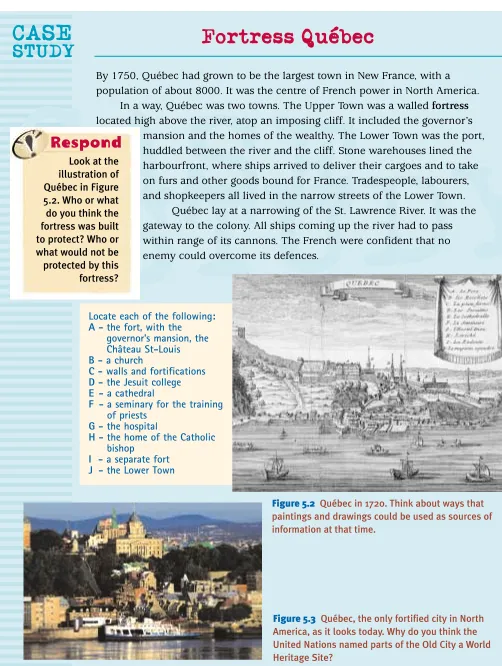
In a way, Québec was two towns. The Upper Town was a walled fortress located high above the river, atop an imposing cliff. It included the governor’s
mansion and the homes of the wealthy. The Lower Town was the port, huddled between the river and the cliff. Stone warehouses lined the harbourfront, where ships arrived to deliver their cargoes and to take on furs and other goods bound for France. Tradespeople, labourers, and shopkeepers all lived in the narrow streets of the Lower Town.
Québec lay at a narrowing of the St. Lawrence River. It was the gateway to the colony. All ships coming up the river had to pass within range of its cannons. The French were confident that no enemy could overcome its defences.
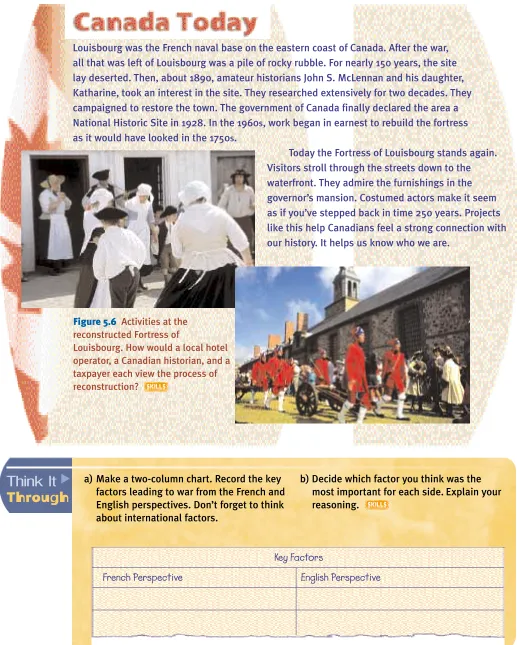
Look at the illustration of Québec in Figure 5.2. Who or what do you think the fortress was built to protect? Who or what would not be protected by this fortress?
Respond
Locate each of the following:
A- the fort, with the governor’s mansion, the Château St-Louis
B- a church
C- walls and fortifications
D- the Jesuit college
E - a cathedral
F - a seminary for the training of priests
G- the hospital
H- the home of the Catholic bishop
I - a separate fort
J - the Lower Town
Figure 5.3 Québec, the only fortified city in North America, as it looks today. Why do you think the United Nations named parts of the Old City a World Heritage Site?
War Rumblings in
the West []
The war for North America began in the Ohio River Valley. In 1754, a British force led by General George Washington marched into the valley. In time, Washington would become the first president of the United States. On this occasion, however, he suffered defeat. The next year, the British tried again with a much bigger force. The result was the same. The French had successfully adopted the battle tactics of their First Nations allies.
For the moment, New France was secure. Even so, the British were determined to drive the French out of North America. The British prime minister, William Pitt, promised to send more soldiers, more ships, and more money.
Figure 5.4 A drummer and a soldier of New France, about 1690, drawn by historical artist Michel Pétard. At any one time, up to a third of the population of Québec were soldiers sent from France to defend the colony. Some were teenagers. How would this affect the character of the
community?
a) Make a two-column chart. Record the key factors leading to war from the French and English perspectives. Don’t forget to think about international factors.
b) Decide which factor you think was the most important for each side. Explain your reasoning.
Think It
Through
▲
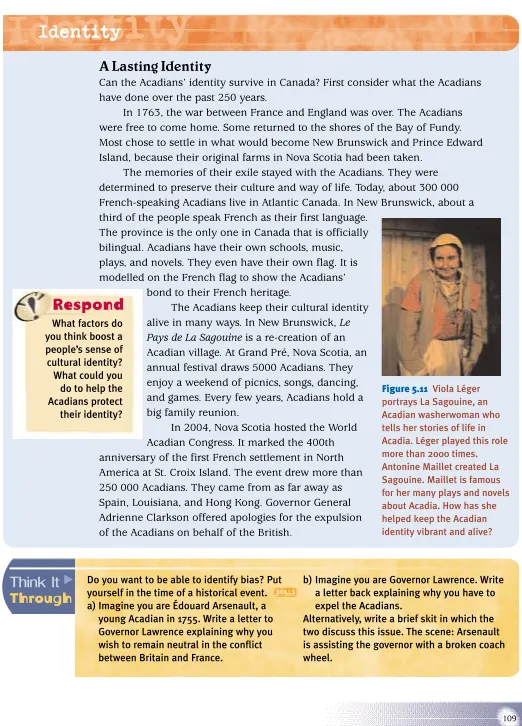
Louisbourg was the French naval base on the eastern coast of Canada. After the war, all that was left of Louisbourg was a pile of rocky rubble. For nearly 150 years, the site lay deserted. Then, about 1890, amateur historians John S. McLennan and his daughter, Katharine, took an interest in the site. They researched extensively for two decades. They campaigned to restore the town. The government of Canada finally declared the area a National Historic Site in 1928. In the 1960s, work began in earnest to rebuild the fortress as it would have looked in the 1750s.
Today the Fortress of Louisbourg stands again. Visitors stroll through the streets down to the waterfront. They admire the furnishings in the governor’s mansion. Costumed actors make it seem as if you’ve stepped back in time 250 years. Projects like this help Canadians feel a strong connection with our history. It helps us know who we are.
Figure 5.6 Activities at the reconstructed Fortress of
Louisbourg. How would a local hotel operator, a Canadian historian, and a taxpayer each view the process of reconstruction?
Key Factors
T
he Acadians were the descendants of the French colonists who had firstfarmed the shores of the Bay of Fundy in the 1600s. Acadia had changed hands many times in the seventeenth century. First the English captured it. Then the French did. Back and forth it went.
By 1710, most of Acadia was firmly under British control. Acadians had developed a unique identity because they had been cut off from the rest of New France for so long. Britain changed the colony’s name to Nova Scotia. It allowed the Acadians to live their lives in
peace. It seemed that the Acadians’ troubles were over. As you will see in this section, however, the Acadians became victims of a war they did not want.
The Acadian Way of Life
By 1750, more than 10 000 Acadians lived on small farms and in villages nestled along the shores of the Bay of Fundy. Many had intermarried with their Mi’kmaq trading partners. They were mainly French-speaking Catholics. Over the years, they created their own way of life. It was based on fishing and their unique methods of farming.
Caught in the Middle
Britain had always wanted to populate Nova Scotia with people who spoke English. As tensions between England and France grew, the governor of Nova Scotia, Charles
Lawrence, began to wonder if the Acadians might side with the French. The Mi’kmaq and Maliseet had trade and family ties with the Acadians. Over the years, they had captured hundreds of English ships. The Acadians had always refused to swear loyalty to the British Crown.
In 1755, Lawrence gave the Acadians an ultimatum (a threat of serious penalties): swear your loyalty or lose your land. The Acadians did not want to fight. They wanted to remain neutral. They promised not to take up arms against the English, but they refused to take the oath. That set the stage for le Grand Dérangement—the Great Upheaval.
Prelude to War: Acadia
Why did the English expel the Acadians from their land in Nova Scotia?
Focus
Figure 5.7 The main Acadian settlements around 1750. Think about Acadia’s location. Why did both Britain and France want to control the colony?
An Acadian is a Francophone citizen of Acadia.
To better remember what you’re reading, try identifying the main idea in every paragraph as you read.
To see a re-enactment of Acadians preserving fish, open Chapter 5 on your Voices and Visions CD-ROM.
CASE
STUDY
In modern Canada, we believe that people have certain human rights. For example, Canadian citizens have a right to live in Canada. We have the right not to be torn from our families and shipped off to foreign lands. Our government has the responsibility to protect those rights.
It has not always been this way. Just consider what happened to the Acadians in 1755.
The Great Deportation—Le Grand Dérangement
Governor Lawrence was convinced that the British newcomers in Nova Scotia would not be safe with the Acadians living among them. He thought he found proof of this when British troops captured Fort Beauséjour from the French in 1755. Inside, they found 300 armed Acadians defending the fort. To Lawrence, this meant that all Acadians were disloyal.
The governor gave the order: “The French inhabitants of the province shall be removed out of the country as soon as possible.” British soldiers fell upon the Acadian villages. They rounded up the people at gunpoint. They broke up families and forced them to board ships bound for distant lands. They burned homes and churches. They destroyed farms and drove off animals.
How It Ended
Most of the Acadians were deported by ship to the New England colonies. Some were sent to the Caribbean, France, or England. A few escaped and went into hiding in the woods. Others made their way to New Orleans, Louisiana, still part of New France. Their descendants formed the Cajun community, which still thrives.
Many Acadians didn’t survive the deportation, though. They died of disease, drowning, or starvation. In all, about 10 000 Acadians were driven from their homes. Seeing what happened to the Acadians, the Mi’kmaq and Maliseet abided by the wishes of the British.
Figure 5.8 British soldiers forcing Acadians from their homes. The exiles could take only what they could carry. How has Lewis Parker, who created this painting, used facts and emotions to re-create the scene?
CASE
STUDY
The whole of the French people were drawntogether in a group. I then ordered Captain Adams to lead away the young men to the ships. I ordered the prisoners to march. They all answered they would not go without their fathers. I told them that “no” was a word I did not understand.
The King’s command had to be obeyed. I told them that I did not want to use harsh means, but there was no time for talking and delay. I ordered the troops to fix their
bayonets and march towards the French. The men started off, praying, singing, and crying. Along the way they were met by the women and children who were on their knees crying and praying.
Source: Colonel John Winslow,
The Journal of Colonel John Winslow
(Nova Scotia Historical Society Collections, Vol. III).
continued
John Winslow was a British army officer who took part in the removal of the Acadians from Grand Pré. Here he tells about what he did:
Figure 5.10 Destinations of the Acadian deportees in 1755. Le Grand Dérangementcan also be translated as “the Great Bother.” What comment do you think the Acadians were making when they labelled such a tragedy with that phrase?
Think about this question: Did Governor Lawrence have to abuse people’s human rights?
a) With two partners, analyze the facts about the Great Upheaval.
b) Here are three roles:
• Col. Greenhouse, a British army officer • M. Arsenault, an Acadian who refused to take
the oath
• Mme LeBlanc, an Acadian who took the oath and stayed
Think about how these characters would have viewed the facts.
c) What evidence supports your position? Record the evidence supporting each point of view in a graphic organizer.
d) Now develop an argument to support or oppose your response to the question from your
own point of view.
Respond
A Lasting Identity
Can the Acadians’ identity survive in Canada? First consider what the Acadians have done over the past 250 years.
In 1763, the war between France and England was over. The Acadians were free to come home. Some returned to the shores of the Bay of Fundy. Most chose to settle in what would become New Brunswick and Prince Edward Island, because their original farms in Nova Scotia had been taken.
The memories of their exile stayed with the Acadians. They were determined to preserve their culture and way of life. Today, about 300 000 French-speaking Acadians live in Atlantic Canada. In New Brunswick, about a third of the people speak French as their first language.
The province is the only one in Canada that is officially bilingual. Acadians have their own schools, music, plays, and novels. They even have their own flag. It is modelled on the French flag to show the Acadians’
bond to their French heritage.
The Acadians keep their cultural identity alive in many ways. In New Brunswick, Le Pays de La Sagouineis a re-creation of an Acadian village. At Grand Pré, Nova Scotia, an annual festival draws 5000 Acadians. They enjoy a weekend of picnics, songs, dancing, and games. Every few years, Acadians hold a big family reunion.
In 2004, Nova Scotia hosted the World Acadian Congress. It marked the 400th anniversary of the first French settlement in North America at St. Croix Island. The event drew more than 250 000 Acadians. They came from as far away as Spain, Louisiana, and Hong Kong. Governor General Adrienne Clarkson offered apologies for the expulsion of the Acadians on behalf of the British.
What factors do you think boost a people’s sense of cultural identity? What could you
do to help the Acadians protect
their identity?
Respond
Do you want to be able to identify bias? Put yourself in the time of a historical event. a) Imagine you are Édouard Arsenault, a young Acadian in 1755. Write a letter to Governor Lawrence explaining why you wish to remain neutral in the conflict between Britain and France.
b) Imagine you are Governor Lawrence. Write a letter back explaining why you have to expel the Acadians.
Alternatively, write a brief skit in which the two discuss this issue. The scene: Arsenault is assisting the governor with a broken coach wheel.
Think It
Through
▲
Figure 5.11 Viola Léger portrays La Sagouine, an Acadian washerwoman who tells her stories of life in Acadia. Léger played this role more than 2000 times. Antonine Maillet created La Sagouine. Maillet is famous for her many plays and novels about Acadia. How has she helped keep the Acadian identity vibrant and alive?
F
or a few years, the French, Canadian Mohawks, Ojibwa, and other First Nations successfully fought the English. They kept the enemy at bay in the Ohio River Valley and the Great Lakes region. There was only one way to win New France. England would have to gain control of France’s two centres of power in NorthAmerica: Louisbourg and Québec. In this section, you will see how they accomplished this daunting task.
Capturing Louisbourg
Louisbourg had to be captured first. It guarded the St. Lawrence River, which led to the Québec colony.
In the spring of 1758, the British collected a huge force of warships and troops at Halifax. Arriving off Louisbourg that June, the British fleet blockaded the harbour. The British soldiers scrambled onshore with their cannons. They cut off the town from the landward side and settled in for a long siege(a blockade of a city).
Inside the fortress, the people were cut off from supplies and reinforcements. Their food supplies ran low. They watched as the British sank their ships, one by one. The people weakened as the British launched a steady rain of cannonballs onto the fort. After seven weeks of bombardment, the French at Louisbourg surrendered.
Onward to Canada
With the route to Canada now open, the British lost little time. The next spring, in 1759, Major-General James Wolfe led a fleet up the St. Lawrence River. He had about 200 ships carrying 9000 soldiers and 18 000 sailors. The line of ships stretched for 150 kilometres.
The battle for Québec unfolded over three months. Victory for the British was never a sure thing. The French commander was the Marquis de Montcalm. He had 16 000 troops and a stone fortress that would not be captured easily. If Montcalm could hold out until winter, Wolfe and his ships would have to retreat before the river froze.
How was the Battle on the Plains of Abraham a turning point in Canadian history?
Focus
Figure 5.12 Louisbourg as the siege began, 1758. Captain Charles Ince, a British soldier who took part in the attack, painted this scene. It shows the British moving their cannons into place. To the right, French ships are anchored in the harbour. In the distance, the British fleet waits offshore. In what ways might the soldier’s bias have affected his interpretation of the scene?
V
V
“
”
The short-term effects of war in New France were dreadful. Mother Marie-Marguerite d’Youville ran a charitable home in Montréal during the war. Here she expresses her despair:
We had flattered ourselves that France would not abandon us. This country is more and more forsaken. My tears are blinding me.
Source: L’Hôpital Général des Soeurs Grises de la Charité. Montréal (nd), Vol. 1, pp. 238–240 (Trans.). Quoted in K.A. MacKirdy et al., Changing Perspectives in Canadian History
(Don Mills, ON: J.M. Dent, 1967), p. 65.
Points of View before
the Battle
Wolfe and Montcalm faced different
challenges. Wolfe was on the attack. He and his troops faced a well-defended fortress perched atop a high cliff. It appeared impossible to climb. Unlike Louisbourg, Québec could not be surrounded from the countryside behind the fort. Therefore, Wolfe could not cut off supplies. Time was short. There would be only a few weeks until the cold weather set in. Wolfe’s only hope was to draw the enemy out onto the open battlefield.
Montcalm, on the other hand, was on the defence. He and his French forces faced a huge fleet of British ships and a well-trained army. He believed they were safe inside the stone fortress. They could fire their cannons at will on the enemy below. They believed help was on the way. The best thing to do was to wait.
A Standoff [
The French and the British bombarded each other for almost nine weeks. The fortress of Québec was in ruins, but it still had not been captured. “We do not doubt that you will destroy the town [with
cannon fire],” declared one French officer, “but we are determined that you shall never set foot within its walls.” Despite major damage to the city, Montcalm would not release his army to fight.
General Wolfe wrote to his mother: “My antagonist [Montcalm] has wisely shut himself up so that I can’t get at him.” Wolfe unleashed a savage attack on the countryside. Troops destroyed villages and set fire to hundreds of farmhouses and barns. Frightened habitantfamilies fled to the protection of the walled fortress. It was a terrifying tactic, but it did no good. The French forces would not leave the fortress.
Winter was setting in. It was time for the British to leave. For Wolfe, this was the time for one last gamble.
The Battle on the Plains
of Abraham []
Wolfe came up with a plan. On the high clifftop behind the fortress was a farmer’s field known as the Plains of Abraham. If British soldiers could secretly make their way there, they could attack the French where their defences were weak.
Just before midnight on 12 September 1759, the first British soldiers stepped ashore. Throughout the night, they crept up a steep path leading to the field. In a few hours, the British army was in place on the
To see a re-enactment of the life of a French soldier at Québec before the siege, open Chapter 5 on your
Voices and Visions
CD-ROM.
Plains of Abraham. When dawn broke, the French were astonished to see thousands of red-coated soldiers in battle position just outside the city gates.
At the fort, Montcalm had 6000 soldiers, including 300 upper Great Lakes Odawa allies. About 4400 professional British
soldiers waited on the Plains. Reinforcements had not arrived. What should Montcalm do? Should he march out and fight the British head-on? Should he stay safely behind the
fortress walls? Montcalm decided he couldn’t wait. It was a fateful decision.
Montcalm emerged from the city leading 4000 troops. The British launched a massive volley of musket fire. The French fired back. A fierce battle raged, and both Wolfe and Montcalm were killed. After 15 minutes of slaughter, the French turned and fled. In all, 1300 soldiers died on the Plains of Abraham. It was the bloodiest battle ever fought on Canadian soil.
Figure 5.13 The events of the Battle on the Plains of Abraham, shown as if they were all happening at the same time. It is based on a sketch by Hervey Smyth. He was a British soldier who was wounded during the battle. Locate the following: the British fleet, the landing boats, the Plains of Abraham, and the town of Québec. What distortions in the painting might be a result of Smyth’s bias?
Figure 5.14 A portrait of the Marquis de Montcalm. Most historians blame Montcalm for the loss of Québec. They argue that if he had waited for reinforcements to arrive, he might have won the battle and the French may have won the war. What do you think? Did Montcalm make the best decision he could?
Following the battle, the English troops entered the city. “Québec is nothing but a shapeless mass of ruins,” reported one eyewitness. “Confusion, disorder, pillage reign even among the inhabitants.” French colonists and British soldiers alike
scrambled to find food during the winter. More British soldiers died from disease than had died in the battle.
The remaining French soldiers fell back to Montréal. Here they held out for a few months. Many of their First Nations
8 September 1760, the French surrendered at Montréal. New France passed into British hands.
The Legacy of the Colony
With their First Nations friends and allies, the Canadiens accomplished a great deal during the over 150 years that they controlled the St. Lawrence River Valley. They were the first newcomers in the territory that would one day be Canada. French traders pioneered the fur trade. They travelled all the way to the Western Plains. In spite of the harsh climate, the Canadiens created successful farms. They cleared the land, dug wells, and built roads. They started up shops and businesses. Through the Catholic Church, they began a tradition of public responsibility for education, health, and the disadvantaged. These are roots of values central to the contemporary Canadian identity.
The Canadiens proved that a colony could survive in this difficult land. By the time the English arrived in the St. Lawrence, the Canadiens had already laid the
foundations of a successful country.
Figure 5.15 The Plains of Abraham as it looks today. In the nineteenth century, the British built the Citadel, which you can see in the foreground. In 1908, the National Battlefields Commission was created to preserve the site. Why would we want to preserve a battle site?
1. Review the section titled “The Struggle for Canada.”
a) Make a list of the key events that took place, with their locations and dates. b) Put them in order and create a timeline.
Alternatively, create an illustrated map showing these events. Label each event, including the date.
2. Do an Internet or library search for information about the Battle on the Plains of Abraham. Find what looks like a useful source. Then answer the following questions:
• What are the facts? What are opinions? • Are the opinions supported by facts,
reasoned arguments, or respected sources?
• What is the bias? How do you know?
3. What might have happened if French ships had arrived in Québec before the British ships did in 1759? Write a front-page newspaper story or narrative poem. In it, describe how events might have unfolded.
4. How did the citizens of New France lay the foundations of the Canada you know today?
Think It
Through
A
s you will discover in this section, the First Nations were deeply involved in the wars between the French and the English. Most First Nations supported the French, with whom they had a long historyof trading. Some Haudenosaunee sided with the English.
The First Nations fought independently against the enemy. They also fought and died
alongside their allies on the
battlefield. At Québec, for example, 300 Odawa sharpshooters helped defend the city. They could not have known that the winner of this war would take control of all the lands, including the First Nations territories.
The First Nations did not stop fighting after the French surrendered. The First Nations and the English first had to negotiate neutrality. Only then could the English declare victory.
Reasons for Anxiety
Following the war, France and England made peace. They signed a treatyin 1763. It gave England possession of most of North America. The treaty disappointed the First Nations. The future of their land was at stake, yet no one had invited them to take part in the peace process. The French governor made the English promise not to take revenge against the First Nations peoples who had sided with the French.
As you learned in Chapter 4, British traders took over the French fur trade. They did not follow the same trading practices as the French. They were not as generous in giving gifts such as tobacco, ammunition, and wampum. The British did not
understand that exchanging gifts was how First Nations people built trust.
The First Nations were worried about the newcomers. English farmers began to move into the Ohio River Valley. Gradually, the First Nations were losing their lands. They began to consider war.
What role did the First Nations
play in the war between France and England?
Focus
Figure 5.16 The Great Lakes area, about 1750. How would the Haudenosaunee territory act like a buffer between the French and English?
The First Nations and the War
V
OICES
V
OICES
“
”
Minweweh was a chief of the Ojibwa people. He told the British,
Although you have conquered the French, you have not conquered us. We are not your slaves. These lakes, these woods and mountains, were left to us by our ancestors. They are our inheritance, and we will part with them to none.
the British
The person who inspired a war against the English was a man named Pontiac. This leader of the Odawa convinced several First Nations to join together to drive the British out of the Ohio River Valley. In May 1763, Pontiac and the Odawa laid siege to the British fort at Detroit. Around the same time, Pontiac’s allies captured forts along
Erie. They were remarkably successful, capturing seven of ten English forts.
Pontiac hoped that the French would come to help him. After all, he and his allies had aided the French in theirwar with the English. The French, however, had already surrendered at Montréal. The British sent in troops to fight the First Nations. The
alliance that Pontiac had formed fell apart.
CASE
STUDY
Tactics versus Physical Strength
When you play hockey or soccer, good tactics can help you beat a stronger opponent. The same is true in war.
Fort Michilimackinac [mish-il-ih-MAK-ih-nak] was held by the British. It was located where Lake Huron and Lake Michigan meet. The Chippewa [CHIP-uh-wah] who lived in the area joined Pontiac’s fighting force. Their first target was the fort, but the fort was too strong to attack outright. Instead, they devised a clever plan.
The men gathered outside the walls of the fort and began a game of lacrosse. British soldiers idly watched as the players chased the ball back and forth. Suddenly, one of the players tossed the ball
through the fort’s open gate. It seemed to be an accident. As the other players chased it into the fort, though, the women who had been watching handed the men weapons they had hidden under their clothing. Taking the British by complete surprise, the Chippewa captured the fort in just a few minutes.
Have you ever won a physical sport because of your strong tactics? With your classmates, discuss what is more important in playing team sports: tactics or physical strength.
Respond
Figure 5.17 Gates of the reconstructed Fort Michilimackinac. Without the element of surprise, do you think the Chippewa would have had much hope of taking over the fort?
1. The First Nations felt betrayed after the Seven Years’ War. Were they betrayed? How did the English and French view the situation? Explain your reasoning. What might be your bias in this question?
2. As Britain expanded its control in North America, the First Nations were concerned that their interests would not be respected. Why did First Nations have good reason to be concerned about their future?
Think It
Through
A
fter the war, the Canadiens, English newcomers, and First Nations and Métis peoples were faced with a new challenge. How could these new citizens ofa single colony live together in peace? In this section, you will see how they struggled to find ways to meet this challenge.
New Challenges
Each group had its own concerns as it looked to the future. The First Nations were tired of war. They just wanted a return to normal life, but they feared that land-hungry newcomers would flood into their territories.
The Canadiens feared the worst. Those who stayed in Canada faced the challenge
of rebuilding the colony. They wondered if they would be allowed to speak French and worship in the Catholic faith. After all, the British had forced the Acadians to abandon their homes. Would the same thing happen to the Canadiens?
The new British rulers faced
challenges, too. They now had a colony of 70 000 people who spoke a different language and practised a different religion. The Canadiens had a different form of government, followed different laws, and had different ways of doing things. The English were worried about the First Nations, too. Many of them had been allies of the French during the war. How were the English going to make the Canadiens and First Nations peoples loyal subjects of the British Crown?
After the War
How did the British treatment of
their new colonies and the people who lived there
influence the future of Canada?
Focus
The surrender of Montréal in 1760 ended the fighting over New France. As you
learned earlier, though, the conflict between England and France was fought elsewhere, too. It continued for three more years in Europe and other parts of the world.
Finally, in 1763, France and Britain signed the Treaty of Paris, ending the conflict. Under the treaty, France gave up any claim to Québec or any other part of North America. In return, France received Guadeloupe, a sugar-producing island in the Caribbean. The only parts of New France still in the hands of the French were the tiny islands of Saint-Pierre and Miquelon near the coast of Newfoundland. (Find them on the map on page 118.)
Choices for the Future]
The British had gained control over what had been New France. Now they had to
options did they have?
• Eviction.Should they evict the Canadiens from their homes and deport them from British North America?
• Assimilation.Should they pressure the Canadiens to give up their language and religion and become loyal British
subjects?
• Accomodation.Should they leave the Canadiens alone to live as they always had, with their own religion, language, and customs?
At the same time, the British had to decide two more things. Should they make land agreements with First Nations peoples? And how could they reward the American colonists of New England? Many of these colonists had fought for Britain in the war. New England farmers wanted land in the Ohio River Valley. British traders hoped to be able to set up businesses in Canada.
Figure 5.19 The fate of the five regions of New France. Which country controls the islands of Saint-Pierre and Miquelon today?
Québec
Nova Scotia (or Acadia)
Cape Breton
Prince Edward Island ( Île Saint-Jean) Newfoundland
• most heavily settled part of New France
• all but Cape Breton became British in 1713
• Acadians expelled in 1755 • controlled by France • called Île Royale • controlled by France
• the British won possession of the island in 1713 • the French kept a small
portion of the shoreline for fishing
• became a British colony
• Cape Breton was added
• controlled by the British as part of Nova Scotia
• came under British control
• the island came under total British control except the offshore islands of Saint-Pierre and Miquelon
The Royal Proclamation
of 1763
The British did not want to evict the Canadiens from their homes. However, they did want to assimilatethem. This
means the Canadiens would become more like the British and would lose their language and culture. The British chose the second of the three options listed on page 117.
In October 1763, King George III of England signed the Royal Proclamation
of 1763, which laid out the British
government’s plans for the colony. To attract Anglophones to Québec, the Proclamation brought in British institutions and laws.
It also prevented settlement west of the Appalachians. This forced American colonists who wanted land to move to Québec.
Recognition for First
Nations
Pontiac’s acts of war were not in vain. They made the British realize that they had to pay attention to the demands of the First
Nations. In the Royal Proclamation of 1763, Britain set aside a huge area of land for the First Nations. It included all lands west of the Appalachian Mountains and east of the Mississippi River. Europeans could not live there. It seemed that some First Nations had achieved what they wanted—to continue their way of life without interference.
Figure 5.20 The Proclamation reduced the size of the colony to a small area along the St. Lawrence and Ottawa Rivers. Overall, do you think the British were fair? Explain.
Terms of the Royal Proclamation
• La Nouvelle-France(New France) became the Province of Québec. • Québec became much smaller. • The interior was set aside for First
Nations peoples.
• A system of British laws and courts replaced the French system.
• Civil government replaced the military government.
• The government would consist of a governor, appointed by Britain, and an appointed council of advisors.
• The Catholic Church lost its ability to tithe. Catholics were not allowed to sit on the council of advisors or to hold senior jobs in government.
To see a descriptive map related to the Royal Proclamation, open Chapter 5 on your Voices and VisionsCD-ROM.
Royal Proclamation of 1763
And whereas great Frauds and Abuses have been
committed in purchasing Lands of the Indians,
to the great Prejudice of our Interests, and to the
great Dissatisfaction of the said Indians: In
order, therefore, to prevent such Irregularities
for the future, and to the end that the Indians
may be convinced of our Justice and determined
Resolution to remove all reasonable Cause of
Discontent, We do, with the Advice of our Privy
Council strictly enjoin and require, that no
private Person do presume to make any purchase
from the said Indians of any Lands reserved to
the said Indians.
The duties of citizenship include recognizing the rights of others. How is the king engaged in active citizenship? What reasons does the king give for protecting First Nations lands?
Formal documents like this can be hard to understand. Try “translating” each phrase into everyday, modern English.
Are modern Aboriginal land claims legitimate? According to the Proclamation of 1763, the answer is yes. In it, the British king promises to protect First Nations lands. This document laid the legal grounds for all the land
treaties that followed. Today, treaties between First Nations and Canada still rely on the Proclamation as the basic guarantee of
Aboriginal rights. For this reason, it is sometimes called the Aboriginal Bill of Rights. These rights are now guaranteed in the Constitution under the Charter of Rights and Freedoms.
Figure 5.22 Almira Augustine, a Mi’kmaq from the Burnt Church Reserve in New Brunswick. Augustine is taking part in a protest about the fishery in August 2000. First Nations across Canada have a legal right to a share of the fishery. Why are documents such as the Proclamation of 1763 so important to First Nations?
The Québec Act of 1774 ]
The attempt to turn Québec into a colony with a British identity failed. The Canadiens had developed such a strong sense of
identity that they could not be “made” British. They were determined to survive as a people. Only a few hundred English-speaking newcomers were attracted to Québec.
Meanwhile, in the Thirteen Colonies, the colonists were becoming restless under British rule. The British did not want trouble in Québec as well. They needed to keep the colony loyal. They decided the best way to do that was to recognize the Canadiens’ rights that had been taken away by the Proclamation. Therefore, in 1774, Britain passed a law with new plans for the colony.
The Beginnings of a
Bilingual Canada
Bilingualismrecognizes two of the peoples that forged the foundations of Canada. Bilingualism means that Canada has two official languages: French and English. It means that Canadian citizens have the right to government services in either language. It means they have the right to do business in either language. Bilingualism is central to the Canadian identity.
You will learn more about bilingualism later in this book. For now, it is important to understand that the origin of bilingualism was the Québec Act. The British recognized the Canadiens’ right to maintain their language and traditions. This was a foundation for peace. Québec, and later Canada, became a partnership between French- and English-speaking citizens.
The Québec Act resulted in the survival of the French language in North America. Consequently, it is known by some as the Magna Carta of Francophones.
Terms of the Québec Act
• Québec was expanded to the size it had been when it was a colony of France.
• Much of the land that had been set aside for First Nations became part of Québec. Remaining Aboriginal lands were still protected.
• French language rights were recognized. • The French seigneurial system remained in
place.
• Catholics were given freedom of religion. They were allowed to hold government jobs. • French civil law would be used in matters of
property, inheritance, and to settle disputes. • The Roman Catholic Church got back the
power to hold property and to tithe.
1. What was the impact of Britain’s takeover of New France? Did the Canadiens get a bad deal or a good deal?
a) Think about the facts.
b) Present arguments for both sides. c) Did your opinion change after
considering the facts? Explain.
2. Working with a partner or in a small group, create any type of multimedia display on the concept of “conquest and
consequences.” Help your viewers understand the following:
• the causes of the Seven Years’ War • the effect of the war on the Acadians,
the First Nations, and the Canadiens • the long- and short-term consequences Assess your findings for bias.
3. How did military events and their consequences contribute to the foundations of Canada?
Think It
Through
Turning Points
S
ome events seem to change everything. After the event, life is different. A turning pointcan take place without people being aware of it. The creation of the Internet was a turning point, yet few people knew about it.Turning Points in
Your Life
Your life has taken certain twists and turns that have affected who you are.
1. Make a list of the turning points in your life. 2. Use these to create a timeline titled “The
Timeline of My Life.”
3. Choose one event that had major consequences for you. How did it affect who you are today?
Turning Points in Canadian
History
Ask yourself what happened in North America between 1740 and 1774. Was there a turning point that changed everything?
Make a list of events that took place during this time. For ideas, review this chapter. Remember that even small events can have big consequences. For each event, note what you know about its short- and long-term effects.
Gather Evidence
For the events on your list, find out whether or not they had important long-term consequences. Conduct research on the Internet, in books, or on databases. Ask the questions listed in the Skill Check feature on page 100 to help you judge the bias in the information you gather.
Back Up Your Choice
What event is the most important turning point? What biases do you have that might affect your choice? What facts and arguments can you use to support your choice?
Present Your Turning Point
With a partner, create a visual display, write a news article, videotape a news feature, or write lyrics for a ballad. Your presentation should show how the event you chose is a turning point that affected the foundations of Canada.
Looking Back
After giving your presentation and viewing other presentations, think about how you might do things differently. How could you improve how you screened for bias? How could you back up your opinions more effectively?