Journal of Applied Linguistics and Language Research Volume 5, Issue 4, 2018, pp. 118-129
Available online at www.jallr.com ISSN: 2376-760X
* Correspondence: Fateme Saeidi, Email: fatemeh.m.saeidi gmail.com © 2018 Journal of Applied Linguistics and Language Research
The Effectiveness of Telegram for Improving Students'
Reading Ability
Salva Shirinbakhsh
Assistant Professor, Amin Institute of Higher Education, Fooladshahr, Isfahan
Fateme Saeidi *
MA Graduate, Amin Institute of Higher Education, Fooladshahr, Isfahan
Abstract
The present study sought to investigate the effectiveness of social media, more specifically Telegram, as a presentation technique for teaching reading strategies in IELTS preparatory courses. The population of the study from which sample was selected were ILETS students studying ILETS preparatory course located in Isfahan, Iran. The sample was randomly assigned to a control and an experimental groups, each having 8 participants. The former group received strategies through the traditional method while the latter received them through Telegram social network. Statistical analysis of the data revealed that the experimental group had better performance on the posttest. Also, the frequently employed strategies when answering comprehension questions were identified. The top three strategies turned out to be ‘reading instructions carefully’, ‘skim the question and answer choices carefully’ and ‘look at the illustrations or diagrams’. Finally, the learners all agreed that they liked learning via Telegram. The findings of this study can be used by IELTS practitioners and teacher of other general proficiency test, textbook designers and materials developers. So, teaching reading comprehension ability through social network can similarly improve EFL learners’ motivation and render more useful results.
Keywords: IELTS, Telegram, Test-taking strategies, Reading preparatory courses
INTRODUCTION
IELTS assesses the four language skills of listening, speaking, reading and writing, which candidates need to study or practice in the medium of English (IELTS Handbook, 1999, p. 2). The IELTS test consists of two modules: the Academic and General training modules. The Academic Module is designed for those seeking admission to undergraduate and postgraduate courses, which is the focus of this study.
A large number of research works have supported the teaching of reading strategies (Carrell, 1988b; Koda, 2004). However, the research which investigates the effectiveness of mobile-learning, in general, and social networks, in particular, for reading strategy instruction is still limited.
When it comes to teaching strategies, there are several problems that teachers and students encounter. One is that teaching strategies can be boring on the part of learners and also by its nature demands the presentation to be accompanied by illustration. This can make the task of the teacher much more difficult. In this regard, technology especially social networks and education apps can be conducive to solve this problem. Mobile-learning in general and social networks together with educational apps in particular can provide two options for presenting reading strategies more efficiently. Firstly, they can enhance the cooperative and therefore collaborative learning context necessary for learning strategies. In the second place, they provide required illustration and sample of successful implementation of strategies.
Therefore the present study is an attempt to investigate the effectiveness of educational apps developed for improving students’ reading ability. It seeks to investigate into the issue through comparing students’ performance when taught through the in-class traditional presentations and through learning via professional apps developed for improving one’s reading skills.
This study has three objectives to pursue. In the first place, it attempted to investigate the effectiveness of the social networks as a blended presentation technique for teaching reading strategies in IELTS preparation courses. In the second place, it attempted to examine the frequency of employing reading strategies when taught by blended presentation technique by Iranian EFL learners. Thirdly, it sought to find about the attitude of students towards the use of social networks for teaching reading strategies in IELTS preparation courses.
The International English Language Testing System (IELTS) is a test of English for academic and vocational purposes managed jointly by three partners: University of Cambridge Local Examinations Syndicate (UCLES), British Council and IDP: IELTS Australia. It is recognized widely as a language requirement for entry to courses in further and higher education, and is accepted by more than 6000 organizations worldwide including universities, immigration departments, government agencies, professional bodies and multinational companies (http://www.ielts.org).
undergraduate or postgraduate courses or seeking professional registration. The passages may be written in a variety of styles, for example narrative, descriptive or discursive/argumentative. At least one text contains detailed logical argument. Texts may contain non-verbal materials such as diagrams, graphs or illustrations. If texts contain technical terms, a simple glossary is provided.
Test-taking strategies are conceptually defined as the plans and problem solving steps taken by examinees when attending tasks of a given test or assessment. Test-taking strategies are classified into two categories. First category is called test-management which deals with the use of construct-relevant response behaviors and the second category deals with textual and technical aspects of the test that are not construct relevant. Test-taking strategies are commonly divided into three broad categories: language learner strategies, test management strategies and test-wiseness strategies (Rumelhart, 1980).
Preparatory courses are usually held by IELTS centers and different institutes with the purpose of making candidates ready to take part in IELTS examination. The courses mostly deal with skills separately. In reading preparatory courses candidates get familiar with the format of the test and how to take the test more efficiently and score higher. Teachers normally try to give candidates a general overview of the strategies they can employ to successfully complete different tasks and items of the test and intensive practice on employing strategies is encouraged during the course (http://www.ielts.org). RESEARCH QUESTIONS AND HYPOTHESE
The following research questions were addressed in this study:
RQ 1: Is there any significant difference in the reading performance of the participants learning reading strategies through traditional in-class presentations as opposed to those learning via the social network Telegram?
RQ 2: What reading strategies are frequently employed by the participants in the two environments?
RQ 3: What is Iranian EFL learners’ attitude towards learning reading strategies via the social network Telegram?
Accordingly, the following hypotheses were formulated:
H01: There is no significant difference in the reading performance of the participants learning reading strategies through traditional in-class presentations as opposed to those learning via the social network Telegram.
H02: There is no difference in the reading strategies employed by the participants in the two environments (i.e., traditional print vs. social network Telegram) H03: Iranian EFL learners hold a positive attitude towards learning reading
REVIEW OF LITERATURE
Models of Reading Comprehension
In the realm of teaching language, reading has always been a controversial issue among teachers and researchers. Hence, a lot of attempt has been put in this area to define reading as a communicative process. Three models have been proposed to explain the processing in the mind of the learners: (1) bottom-up processing model, which takes its name from the fact that it looks at comprehension as a process of matching sounds and letters on a page; (2) top-down processing model, which deals with the background information a reader brings to the text in order to comprehend the text; and (3) he third model called "interactive" model which combines both models and explains reading as a mixture of both bottom-up and top-down processing. Current reading research suggests that both L1 and L2 readers draw on the same processing when they are reading (Johnston, 1983).
Language Testing and Research on Reading Skills
The notion of reading skills has been researched quite extensively in the literature (see, for example, Urquhart and Weir 1998:89 for a graphical representation of the number of research on reading skills between 1966 and 1996). In language testing research, reading skills are viewed as a very powerful framework for test construction and development and are believed to continue to be so in the years to come (Alderson 2000).
In language testing, one aspect of research on reading skills centers on the componential view of the construct of reading (i.e. the reading ability comprises separable skills). This has been viewed differently by researchers. Goodman (1969), for example, believes that unless componential reading leads to important insights into the reading process, it cannot be considered an important research direction. On the other hand, Glaser (1990) suggest:
While material writers may disagree on the emphasis to be devoted to any particular skill, there seems to be substantial agreement on the importance of such skills as guessing the meaning of unknown words, identifying anaphoric references, identifying the main idea, and inference.
Moreover, other researchers believe that the componential view of reading would assist in diagnosing reader’s problem/s and result in identifying remediation. For instance, Farrell (2001)believes tests developed on this basis would help establish the areas of reading comprehension on which the individual pupils need help. This, he maintains, would inform the corresponding types of exercises which are implemented to remedy the diagnosed weaknesses. In support of diagnostic reading tests, Farrell (2001) maintains:
Tests that promise a quick and reliable diagnosis of sub-skills of reading comprehension are met with lively interest from teachers and school psychologists, especially when a paralleled offer of training material tailored to this diagnosis is made.
In this light, teachers are expected to have a clearer perspective of what individual students are doing while engaging in reading activities. For some Japanese University students, it is highly likely that reading English is still a process of "laborious deciphering” Birch (2002), as a result of repeated grammar-translation practice in high school. It is also probable that other students transfer comprehension strategies from reading in the native language to reading in a foreign language.
In concert with the ideas mentioned above, Alderson (2000), when discussing the integrated and discrete approaches to the assessment of reading, refers to the diagnostic role of tests of reading skills and maintains that such tests are made to diagnose the state of the development of learners’ skills. He also suggests that, “students should be tested on a range of relevant skills and strategies with the results possibly being provided in a diagnostic profile-based format” (p. 29).
As it was discussed earlier, the idea that reading skills are identifiable and, therefore, can be taught and tested in isolation from each other, has initiated a great deal of debate around issues such as identifiability, hierarchy of difficulty, and the existence or otherwise of an implicational scale in reading skills ( Alderson, 2000).
Computer Assisted Language Learning
Aydin (2012) characterized CALL as “the search for and study of applications of the computer in language teaching and learning (p.1).” the main aim of CALL is facilitating teaching and learning, which is in form of using computer technology to escalate learning by utilizing computer programs such as word processing, presentation packages, guided drills and practice, tutorials, games and simulations, multimedia CD-ROMs, and internet applications including e-mail, chat, and websites for the purposes of language learning. Large number of research works have support the teaching of text structure reading strategy. However, the research which investigates the effectiveness of a CALL program developed for reading strategy instruction is still limited.
Motaghian et al (2013) investigated if second year law students at a university in North Cyprus performed better reading comprehension when the reading instruction is assisted by the web. The participants, evaluated for their reading comprehension before and after the experiment, were divided into an experimental group, practicing reading skills activities on the Web, and a control group, practicing the same activities using the traditional methods guided by the teacher in class. Online activities provided to the students in the experimental group included such features as chatting, searching, and online dictionary. The researcher interviewed some selected students about their attitudes towards using Web-based and paper-based reading activities. The results showed that the Web-assisted English reading skills instruction was more effective and successful than the traditional one.
METHOD
prospective participants of the study took the reading section of a retired IELTS test and those scoring 4-5.5 were selected as the target participants of the study. 16 candidates met the criterion in this study and were assigned to two groups each including 8 participants. All participants were informed of the purpose of the study and signed a written consent to guarantee the ethical issue of this study.
Materials
Materials in the present study included IELTS reading strategies which were presented to members of both the experimental and the control groups. The strategies were adapted from IELTS preparation books by the researcher. Each question type and the relevant test-taking strategies are explained to them.
Instruments
In this section, the instruments employed for collecting data are discussed with details. IELTS Practice Test
The reading section of a Practice IELTS test, adopted from Cambridge IELTS series, was employed to both homogenize the participants and make sure that they all had the same level of language proficiency and also to measure the efficacy of presenting strategies through Telegram and traditional teaching. The test included three passages and the total number of 40 questions. The test was adopted from the past paper collections published by Cambridge University Press to obviate the need for estimating the reliability and validity of the test by the researcher. Since the test was already valid and reliable, there was no need for piloting the test.
Telegram
To present the IELTS strategies through a social network, Telegram was chosen by the researcher due to two main reasons. Firstly, it is widely used by Iranian users hence, it could not pose any problem of accessibility. Secondly, Telegram can provide the users with a wide range of options like sending and receiving multimedia messages along with texts, hence it could serve the purpose of the research. Since strategy-based teaching involves exemplification of the use of strategies, Telegram was compatible with the requirements of strategy-based instruction.
Interview
To evaluate the perception of the candidates from employing social networks, in this case Telegram, a structured interview was designed. The interview included 15 questions asking about the candidates’ attitude towards the use of technology in IELTS preparatory classes, in general, and reading classes in particular. All the candidates’ responses were digitally recorded and transcribed for further analysis.
Procedure
their centers. Then, all the participants were invited to take part in the study and those intended to participate signed a written consent.
In the next step, candidates took part in reading section of IELTS which aimed at homogenizing the participants of the study. Those who scored 4-5.5 were supposed to be the participants of the study. 16 participants met the standard and could serve as the target participants of the study. They were assigned into two groups each including 8 participants.
Courses were on the odd days and each session last for 120 minutes. In each session, one reading question type was covered; therefore, each course was 10 sessions, each devoted to teaching and practicing strategies of one question type. One of the groups received the strategies in the classroom by the teacher and practiced exam-like materials in the class. On the other hand, another class, experimental group, received the strategies through Telegram before the class and were asked to carry out 2 tasks related to the question type covered and bring a report to the class. The time of the class was allocated to solving students regarding employing the strategies. Besides, some extra exercises were done to help the candidates master the strategies.
At the end of the course both groups were asked to take the reading section of the IELTS test and 4 candidates from each group participated in a introspection study to help the researcher elicit type and frequency of the strategies they employed while attending different item types. Those who were selected to go through think-aloud (introspection) procedure had to be trained to how to behave during the test session to provide the researcher with appropriate and reliable data. In so doing, each of them was instructed how to think aloud by asking them to carry out a simple mathematical problem. The whole think-aloud sessions were digitally recorded and then was analyzed by coding the data and the frequency of use of each strategy regarding each item type was estimated. Finally, four other candidates from the control group were interviewed by the researcher. They were asked to express their opinions about the course and use of Telegram as a tool for presenting strategies and practicing the strategies. The interview sessions were also digitally recorded and transcribed for analysis.
Data Analysis
Data analysis was divided into two parts as follow:
The data obtained from the pre-test and post-test were put in descriptive statistics. Furthermore, the performance of the experimental group and the control group were compared by running the independent t-test on their scores.
The strategies extracted through think aloud were coded and the frequency of employed strategies by participants were estimated and then compared. Also, the interview results were interpreted qualitatively.
RESULTS
to the Telegram Group (TG) and 8 learners to the traditional Classroom Group (CG). Both groups of learners were exposed to the instruction of reading strategies, though through different modes of input delivery. Then, some of the EG learners were asked to take part in an interview and both CG and EG learners in think-aloud data collection sessions. The data collected from these observations as well as the pretest/posttest of reading comprehension enabled the researcher to come up with the results of the study, which are presented in detail in the following.
Reading Performances of Traditional-Method and Telegram Groups
The first research question of the study was concerned with whether presenting reading strategies through Telegram had any significant effect on Iranian EFL learners’ reading comprehension. To find an answer to this research question, first the pretest scores of the EG and CG learners were compared via an independent-samples t test to assure that there were not any pre-existing differences between the two groups. Then, another independent-samples t test was employed to compare the posttest scores of the two groups. Table 1 displays the descriptive statistics for these analyses.
Table 1. Comparing Pretest and Posttest Scores of EG and CG Learners
N Mean Std. Deviation Std. Error Mean
EG Pretest
CG Pretest 8 8 24.62 24.50 1.92 2.87 1.01 .67
EG Posttest CG Posttest
8 8
32.62 29.12
3.15 2.85
1.11 1.00
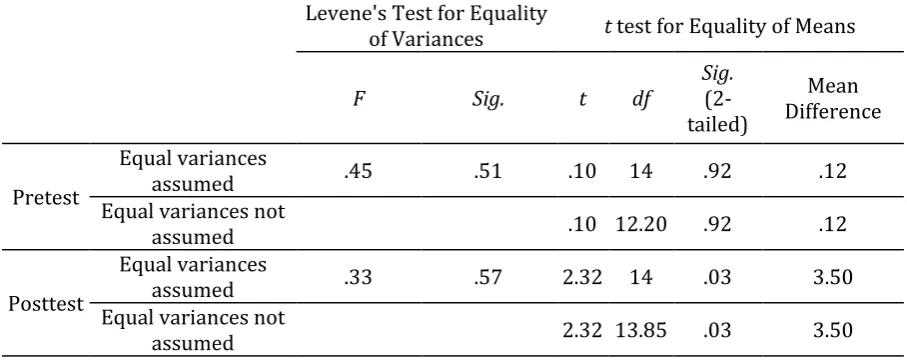
As it can be seen in Table 1, the difference between the pretest scores of the EG (M = 24.62) and the CG (M = 24.50) was very infinitesimal and negligible. Nonetheless, the posttest scores of the EG (M = 32.62) and those of the CG (M = 29.12) were comparatively more distinct. To unveil whether the differences in the pretest and posttest scores of the two groups were statistically significant, the following t test table (Table 2) had to be examined:
Table 2. Results of the Independent-Samples t Test Comparing Pretest and Posttest Scores of EG and CG Learners
Levene's Test for Equality
of Variances t test for Equality of Means
F Sig. t df
Sig. (2-tailed)
Mean Difference
Pretest
Equal variances
assumed .45 .51 .10 14 .92 .12
Equal variances not
assumed .10 12.20 .92 .12
Posttest
Equal variances
assumed .33 .57 2.32 14 .03 3.50
Equal variances not
Table 2 shows that there was not a statistically significant difference in pretest scores for EG (M = 24.62, SD = 1.92) and CG (M = 24.50, SD = 2.87), t(14) = .10, p = .92 (two-tailed). In fact, this result was obtained since the p value exceeded the significance level (.92 > .05). Hence, it could be inferred that the two groups were not significantly different at the beginning of the study with regard to their reading comprehension abilities.
On the other hand, the difference between EG (M = 32.62, SD = 3.15) and CG (M = 29.12, SD = 2.85) posttest scores was of statistical significance due to the fact that the p value under the Sig, (2-tailed) column was less than the significance level (i.e., .03 < .05). This indicates that teaching reading strategies through Telegram was more effective than the traditional instruction of those strategies, and it had a more influential role in helping EFL learners improve their reading comprehension.
Reading Strategies Used by the Participants
The second research question of the study was posed to find about what reading strategies were more frequently employed by Iranian EFL learners when taught through Telegram in comparison to traditional teaching. The results obtained from the think-aloud session are summarized in the table which follows (Table 3). The table shows the question types and the employed strategies of each question type by Telegram group and traditional group participants, respectively.
Table 3. Most Frequently Used Strategies by Both Groups of Participants
Strategy Frequency Telegram Percentage Telegram Traditional Frequency Traditional Percentage
Read instructions carefully 35 17.94% 28 19.17%
Skim the Questions and answer choices
carefully 21 10.76% 12 8.21%
Look at the illustrations or diagrams 17 8.71% 10 6.84%
Underline the key words. 7 3.58% 16 10.95%
Go back to the 1st question and decide what
parts of the text you need to read. 17 8.71% 11 7.53%
Think about the grammatical form as well as the vocabulary that should follow from the
stem. 15 7.69% 10 6.84%
Make sure sentences make sense both
logically and grammatically. 18 9.23% 12 8.21%
Decide what section of the passage the
exercise covers. 13 6.66% 12 8.21%
If the question is in the form of summary, read through it first and see if you can guess
any of the missing words. 7 3.58% 5 3.42%
Search the section of the text which deals
with the idea/fact under question 15 7.69% 13 8.90%
Look for synonyms and parallel expressions 23 11.79% 15 10.27%
Be aware that sources may be referred to in
more than one place in the text. 5 2.56% 2 1.36%
Read a paragraph and sum it up in your own words and then look at the bank of headings
to find the most similar one. 2 1.02% 0 0%
Looking through Table 3, it could be understood that the most frequently used strategy by learners in both the Telegram group and the Traditional group was “reading instructions carefully.” The percentage of use of this strategy by the Telegram group and the traditional group was 17.94% and 19.17%, respectively, which shows that the learners in both groups were careful to pay attention to the directions before embarking on answering the questions.
Participants’ Attitude towards Telegram
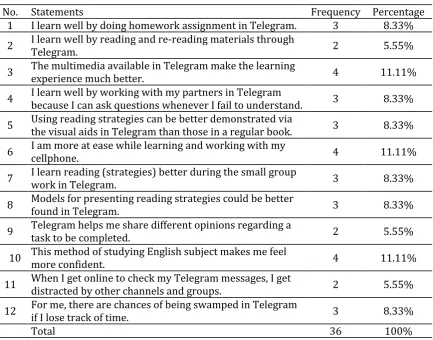
The third research question of the study was “What is Iranian EFL learners’ attitude towards implementing Telegram as a presentation technique?” The data obtained through the interview were documented, categorized, tallied, and summarized in Table 4 below:
Table 4. Learners’ Attitudes toward Using Telegram for IELTS Reading Classes
No. Statements Frequency Percentage
1 I learn well by doing homework assignment in Telegram. 3 8.33%
2 I learn well by reading and re-reading materials through Telegram. 2 5.55%
3 The multimedia available in Telegram make the learning experience much better. 4 11.11%
4 I learn well by working with my partners in Telegram because I can ask questions whenever I fail to understand. 3 8.33%
5 Using reading strategies can be better demonstrated via the visual aids in Telegram than those in a regular book. 3 8.33%
6 I am more at ease while learning and working with my cellphone. 4 11.11%
7 I learn reading (strategies) better during the small group work in Telegram. 3 8.33%
8 Models for presenting reading strategies could be better found in Telegram. 3 8.33%
9 Telegram helps me share different opinions regarding a task to be completed. 2 5.55%
10 This method of studying English subject makes me feel more confident. 4 11.11%
11 When I get online to check my Telegram messages, I get distracted by other channels and groups. 2 5.55%
12 For me, there are chances of being swamped in Telegram if I lose track of time. 3 8.33%
Total 36 100%
Of the 4 learners in Telegram group who participated in the interview, all contended that (a) the multimedia available in Telegram make the learning experience much better, (b) they were more at ease learning and working with their cell phones at the same time, and (c) they felt more confident while learning English this way.
DISCUSSION
Testing First Null Hypothesis
The first null hypothesis drawn in the present study was ‘There is no significant difference in the reading performance of the participants learning reading strategies through traditional in-class presentations as opposed to those learning via the social network Telegram’. Results obtained from the analyses carried out scores for the control and treatment groups revealed the opposite of this hypothesis. It was shown that there was a significant difference between the experimental group members’ reading ability and reading of ability of those in the traditional group. So the first null hypothesis was rejected and the opposite proved true.
Testing Second Null Hypothesis
The second null hypothesis stated that there was no difference between frequencies of reading strategies used by Iranian EFL learners when social network Telegram was employed. The second null hypothesis was also rejected and the opposite was significant difference was seen between the strategies offered to the present students. As explained before, it was revealed that there was only strategy for which higher frequencies were recorded in favor of the traditional group was “underline the key words” (10.95) in comparison with the use of this strategy by Telegram group learners (3.58%). To the present author’s knowledge, no previous studies have taken frequencies of reading strategies into account.
Testing Third Null Hypothesis
The third research null hypothesis expressed that ‘Iranian EFL learners hold a positive attitude towards learning reading strategies via social network Telegram as a presentation technique’. the multimedia available in Telegram make the learning experience much better, (b) they were more at ease learning and working with their cell phones at the same time, and (c) they felt more confident while learning English this way. All in all, it was seen that the positive points outweighed the negative ones and that most participants had positive ideas about using Telegram into learning contexts since it provided a good account of facilities as compared to available applications. Next, it was concluded that MLL (mobile language learning) was positively conceived by the IELTS learners. Finally, this notion was approved that reading comprehension practice was facilitated for the present participants through Telegram.
CONCLUSION
traditional group. As it was evidenced learners showed a positive attitude towards Telegram as a venue for learning, which could be cater to their individual needs and give them a feeling of security.
In what follows, some of the issues that need more investigation on the use of social networks in reading skill by Iranian EFL learners will be briefly suggested. It is hoped that L2 practitioners of different fields keep these suggestions in their mind and apply them for their forthcoming research studies.
This study has focused on Iranian intermediate IELTS learners. The same research can be done on TOEFL learners of in similar educational settings or participants of other English proficiency tests. Further studies can examine other social networks on reading skill, speaking skill, listening skill, writing skill, vocabulary acquisition, vocabulary retention, etc. Moreover, it would also be helpful to investigate the effects of Telegram social network on teaching grammar, vocabulary, and other aspects of language.
REFERENCES
Alderson, J. C. (2000). Assessing reading. Ernst Klett Sprachen.
Brown, A. L., Palincsar, A. S., & Armbruster, B. B. (1984). Instructing comprehension-fostering activities in interactive learning situations. Learning and comprehension of text, 255-286.
Carrell, P. L., Devine, J., & Eskey, D. E. (1988). Interactive approaches to second language reading. Cambridge University Press.
Koda, K. (2004). Insights into second language reading: A cross-linguistic approach. Cambridge University Press.
Rumelhart, D. E. (1980). Schemata: The building blocks of cognition. In. R. Spiro, B. Bruce and W. Brewer (eds.) Theoretical issues in reading comprehension.
Johnston, P. H. (1983). Reading comprehension assessment: A cognitive basis. International Reading Association, 800 Barksdale Rd., PO Box 8139, Newark, DE 19711 (Order No. 951, $4.50 member, $6.50 non-member)..
Goodman, K. S. (1969). Analysis of oral reading miscues: Applied psycholinguistics. Reading Research Quarterly, 9-30.
Glaser, R. (1990). The reemergence of learning theory within instructional research. American Psychologist, 45(1), 29.
Farrell, T. S. (2001). Teaching Reading Strategies. Reading in a Foreign Language, 13(2), 631-46.
Birch, J. H. (2002). The effects of the Delaware Challenge Grant Program on the standardized reading and mathematics test scores of second and third grade students in the Caesar Rodney School District (Doctoral dissertation, Wilmington College). Aydin, S. (2012). Teachers’ perceptions about the use of computers in EFL teaching and
learning: the case of Turkey. Computer Assisted Language learning. doi: 10.1080/09588221. 2012/654495