Issues
ISSN: 2146-4138
available at http: www.econjournals.com
International Journal of Economics and Financial Issues, 2016, 6(S5) 65-71.
Development of Cluster Integration in Agricultural Sector of the
Republic of Kazakhstan
Elmira Omirserikovna Kydyrbayeva
1*, Balhiya Kulmesovna Shomshekova
2,
Saule Shaudirbaevna Bisenova
3, Bibigul Hamitovna Kylyshbayeva
41Zhetysu State University Named after I. Zhansugurov, I. Zhansugurov Street 187a, 040009 Taldykorgan, Almaty Region, The
Republic of Kazakhstan, 2Zhetysu State University Named after I. Zhansugurov, I. Zhansugurov Street 187a, 040009 Taldykorgan,
Almaty Region, The Republic of Kazakhstan, 3Kazakh National Research Technical University Named after K. Satbayev, Satbayev
22a, Almaty City, 050013, The Republic of Kazakhstan, 4Zhetysu State University Named after I. Zhansugurov, I. Zhansugurov
Street 187a, 040009 Taldykorgan, Almaty Region, The Republic of Kazakhstan. *Email: [email protected]
ABSTRACT
This article contains an overview of the cluster approach methods, the author analyzes the existing forms of cooperation between agricultural enterprises, distinctive features of territorially-industrial clusters from other forms of organization of production in the agro-industrial complex of the Republic of Kazakhstan. We studied the experience of developed countries on the formation of the cluster system, government regulation, which allowed substantiating the necessity of formation and suggesting a mechanism of interaction between participants of geographical industrial cluster in agriculture. The main factors that justify the need for the development of cluster integration and formation of territorial and sectoral clusters in the agro-industrial complex of the Republic of Kazakhstan are studied.
Keywords: Intersectorial Integration, Agricultural Sector, Economic Relations, Development, Economic Growth, Industrial Clusters
JEL Classifications: O21, Q13, Q18
1. INTRODUCTION
The theoretical concepts of international economic integration are thought to be recognized as the most developed ones which from the last mid-century reflected the processes in the global economy. The most popular were the theory of neo-liberalism, neo-Keynesianism and its branches – dirigisme, structuralism and corporationalizm. Their main differences are various combinations of market origins and measures of state influence on the processes of economic and political consolidation of countries, international labor division, establishment of other economic relations up to the formation of large regional systems, first of all, the European Union. In connection with the expansion of the European Union membership, new theoretical concepts and models of “stepped integration,” “differentiated integration” as well as the concept of “Europe of concentric circles” appeared. Their core idea is formation of a “nucleus” of the most developed countries and
“circles” of the states with relatively lower levels of economic development and the paces of integration into the European Union.
Many scientists and scientific schools promoted the development of theories of international economic integration. They include Repke (Switzerland) (1944), Allais (France) (1969), Myurdal (Sweden) (1990), Shmelev (1987), Kudrow (2009) and others (Russia).
Unfortunately, theoretical and methodological bases of integration of production and markets in major sectors of economy such as agricultural sector (ACS) were the least developed.
national subsystems. At the stage of post-crisis development of the global economy the processes are considered in terms of cluster development and acquire a new impulse, get a different scale and geopolitical course. The scientists are coming to the conclusion that contradictions and crises are not only the brakes of integration, but also the stimulus for its development. This fact increases the topicality of the scientific research on cluster integration into global and national scales, as well as in the major social and economic spheres, for example, ACS.
2. METHODOLOGY
The cluster approach is interpreted in two ways. In the first case, as a method of multivariate statistical analysis with the purpose to select objects according to the aggregation of similar features and joining them into groups (clusters) to justify a differentiated approach in resolving economic, social and other goals. This method is quite well developed and widely used in various fields of knowledge and practice.
In the second case, the cluster approach can be considered as a method for comprehension of the fundamental changes in the territorial organization and searching for possible ways of structural transformation of production in order to promote the development and growth of its competitiveness in the processes of exchange and distribution in the free market. The second method supposes the use of the first one bearing in mind the need to group the objects together by aggregates of their similar features.
As a result of this comprehension one of the new organizational forms was suggested to call a cluster (also refers to new groups, complexes, industrial parks, business incubators, logistics centers, holdings, cooperatives, etc., which distinguish by their industrial, technological, economic relations, VAT, rental fee, participants, owners and the purposes of their creation):
• As an aggregation of technology-related companies in space (Gorkin and Lidmark, 1978);
• As national and regional innovation systems, groups; • As a territorial organization that focuses on competitiveness
and increase of the labor productivity (Porter, 1990);
In Kazakhstan the most popular book is “Competition” by Porter. His rhomb of competitive advantages is known with determinants: The conditions for production factors; the state of demand, related and supporting industries; sustainable strategy with two independent variables – a government and occasion. Also in this work there is no classification as well as a clear definition of the term “cluster,” the structure and identity of its boundaries in space. Although this fact does not confuse many researchers, on the contrary, they increasingly encourage the use of this term without trying to formulate a precise mathematical model of cluster. This thing leads to the fact that in many cases something is accepted as a cluster or called a cluster which is actually not a cluster at all in the original significance. Objects absolutely different at their genesis which had their own designations (for example, industrial districts, industrial parks, cooperatives) were called clusters just under the trends.
3. RESULTS
One of the priority directions of Kazakhstan’s economy development is the development of cluster integration which implies the process of mutual adaptation of geographically isolated
economic agents, deepen their interaction and the development the relations between them. The urgency of this problem is confirmed by the implementation of the National Action Plan for realization the Message of the President of Kazakhstan 2012 “Strategy” “Kazakhstan – 2050,” where the goal was set to develop “roadmaps” to form national promising clusters (Decree of the President of the Republic of Kazakhstan No. 449 2012, December 18), in the Message of the President to the people of Kazakhstan in 2014, the Head of the state Nazarbayev noted the necessity “to create experimental agro-innovation clusters” (2014, January 17). Nowadays in the Republic of Kazakhstan the course is taken for diversification the agricultural production, modernization and industrial-innovative development of the ACS of the Republic of Kazakhstan, which rationalizes the requirement to use methods of cluster development in the process of agricultural enterprises integration (Program on development ACS in the Republic of Kazakhstan for 2013-2020 “Agrobusiness – 2020;” State Program on forced industrial and innovation development of the Republic of Kazakhstan 2010-2015).
The necessity to create industrial clusters was noted in 2005 by the Head of the state Nazarbayev in his Message “To the competitive Kazakhstan, competitive economy and a competitive nation” in the Project of diversification of the economy of Kazakhstan by cluster development of non-mining industries economy (2005).
Since the declaration of requirement to create territorial and sectoral clusters in the Republic of Kazakhstan, including the ACS, 7 years have passed, during this period the attempts to form them in cotton and textile, dairy, fruit and vegetables and other sectors
have been demonstrated, but the process has not appropriately developed or spread.
The attitude to the clusters in Kazakhstan is not ambiguous, and sometimes even diametrically opposite. Some people consider them as the most promising form of economic development, the others are skeptical about their creation, believing that the wide clustering of the economy of Kazakhstan is just another myth. However, most people who are even directly related to the real economy, have not sufficient clarity about a cluster itself, its advantages over traditional forms of management.
spread of innovation, information and other important factors that are fundamental in the competition.
Despite the advantages of the cluster approach proven by practice in many developed countries, Kazakhstan in this course, especially in the ACS, is making only the first steps. Therefore, the necessity of theoretical, methodological and methodic study of the issues related to the formation and functioning of territorial and sectoral clusters in ACS is grounded. Absence of such scientific and theoretical basis causes the fact that a cluster is often perceived as any form of territorial concentration of production, any organizational form which operates a closed-circuit of production of any final product. Such situation impedes the realization of benefits of the cluster approach in the ACS.
The objectives of this study are an attempt of theoretical, methodological and methodic grounding of the issues related to possible use in the economy of Kazakhstan and, above all, in the economy of regional agriculture production, of the cluster approach. For this point it is necessary to systematize and develop as applied to the specifics of Kazakhstan some theoretical aspects, to find out the presence of preconditions and deterrents, to disclose the differences of clusters from other organizational forms of production organization, to develop fundamental models of competitive food and agro-industrial clusters at the regional level, etc.
The necessity of socio-economic, institutional and technological transformations emerged long ago in the 1970-80s. The bulky socialist planning and distribution system did not allow business entities to adapt quickly to the needs of consumers, so it did not encourage competitive production output, caused mental inertness of most leaders of all levels, hampered the processes of
stable development of the society. One of most important ideas of reconstruction of ACS economy was creation of integrated systems. They were the regional agricultural associations, scientific production associations, agricultural firms, agricultural factories, territorial and production complexes (TPC) other formations focused on manufacturing finished products and sale via own distribution network.
The most wide-ranging debate among the analysts is about the concepts of a “TPC” and a “cluster” (Liang et al., 2013). Some authors believe that in Soviet times TPC in the industry and adequate systems in agricultural production were to a great extent shaped like clusters, they were to a certain degree like their prototypes in the foreign practice. In a pre-reform period under TPC an aggregate of interrelated and interdependent components of the economy formed within a compact area (region) was understood. One of the goals of TPC establishment was an attempt to overcome departmental disconnection of ministries due to the formation of centralized state system of management. Precisely proceeding from this goal, the ACS was formed, its basic structure including the system of the public management has preserved till the present time.
The phenomenon of the Kazakh economy that replaced the planned one meant the fact that the state did not interfere in those processes
where its presence was objectively necessary (development of economic policy, regulation of inter-sectoral relations, creating a favorable business climate, adoption of the necessary regulations, etc.), but on the contrary, was actively engaged in reorganization of enterprises, notably those issues where the government’s intervention should be minimal.
The model of the agrarian reform implemented in the first stage had the result of disintegration of large-scale production. The attempt to form the class of owners in ACS caused a gap of technological cooperation relations, fracture and isolation of the stages of production, preparation, transportation, storage and processing of agricultural products, disparity in relations of former ACS partners and was one of the reasons of dramatic decrease of foodstuff production. The leading role in production of many kinds of agricultural products was played by not peasant (farm) economies or agricultural enterprises, but private farms of the population. At their expense, as well as thanks to garden plots the self-supply of rural and the significant part of urban population was ensured by many important foodstuffs – potatoes, vegetables, meat, milk, etc. So, it was a return to primitive technology and forms of management.
Thus, the crisis of ACS, in particular, was predetermined by hasty and unreasonable changes in the economic mechanism, the main at the macroeconomic level being:
• Disturbance of established interregional and inter-sectoral relations;
• Liberalization of prices, especially for energy carriers at conducting erroneous policy of removal of the government from execution of objectively necessary regulatory functions of its economic and social processes;
• A dramatic decline of investment activity of the government and loss of control over the money circulation;
• Accelerated massive privatization of state property without accounting the territorial and sectoral specificity of agro-industrial production;
• Absence of a specific concept of social orientation of the reform.
However, in the conditions of transition to the market when a lot of agricultural enterprises were at the edge of bankruptcy, the most viable were integrated structures. In comparison with cooperative organizations they are distinguished by a more aggressive feature of their activity aimed at obtaining quick return on investment. They arise and develop at the first place where there are great opportunities for commodity production and entrepreneurial initiative (Mendes et al., 2013).
4. DISCUSSION
the sense of the new direction of reforming the economy of ACS, and namely the reasons, motives, forms and sizes of created territorial-industrial clusters, mechanism of their formation and functioning, management organization, participation in solving social problems of the village, etc. is thought to be an extremely urgent task of the science.
Thus, the practice of participation in the agro-industrial integration of companies which have no direct relation to agricultural production is usually temporary. Undoubtedly, at some stage they perform an important role in the recovery of the economy of agriculture, although the purpose of investing their capital in it is ultimately the hope of making a profit.
More effective and sustainable agriculture means the integration of agriculture with related and supportive sectors which include sectors producing and processing food (related sectors); sectors creating conditions for related industries operation (supporting sectors) – feed mill, agricultural engineering, production of mineral fertilizers, etc. (Higgins and Laredo, 2006).
The economy of ACS at the present time still keeps many unsolved problems: Low level of material and technical basis, lack of investment, mismatch of organizational forms of agricultural production with the conditions of creating competitive advantages, weakness of scientific, information and personnel reserves, etc. At the same time, a positive trend is being established in overcoming the consequences of the agrarian crisis and developed in regions programs and strategies of socio-economic development of the ACS allowing forecasting a phased transition to innovative technologies and effective systems of management.
In the conditions of stabilization of the economy of Kazakhstan and the prospects for its development the first significant goal was not just a survival specific to the crisis situation of the 90s of the XX century, but the goals of increase the efficiency, competitiveness
of manufactured production, development of rural areas and a significant improvement of the standard of people’s living. The effective tool for solving these problems is changing to cluster innovation technologies of economic development.
Nowadays some sectors were identified, the implementation of the cluster policy was defined as strategic goals, including the agro-industrial production. Use of the term “cluster” became trendy, although this concept has a different meaning. Sometimes, organizational structures are perceived as clusters which in fact are not clusters at all. The confusion between clusters and other forms of integrated and cooperative formations occurs as a rule due to insufficiency of scientific researches concerning this issue, absence of the state conception of cluster technologies development as well as the experience of creating proper and valuable clusters with a good adjusted system of interaction of the enterprises and organizations, which successfully operate in many developed countries.
It is important to notice the opinion of the majority of scientists that a cluster is not a special business form, it means that it does not act as a legal entity (Bosona and Gebresenbet, 2011). Unfortunately, in Kazakhstan under the concept “cluster” sometimes former TPC are understood, vertical integrated formations which carry out closed circle of the production of separate final products, including agro-holdings, modern techno parks, special economic zones, social and entrepreneurial corporations.
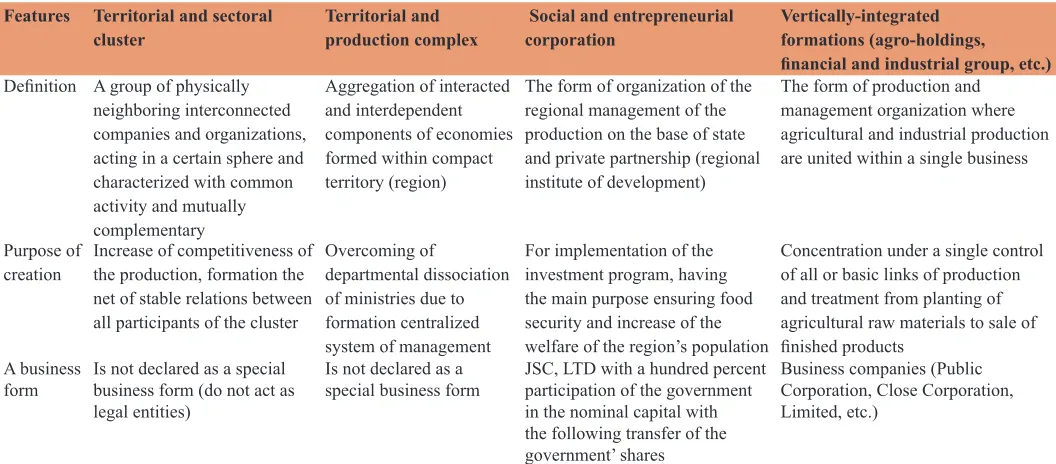
Proceeding from the conducted analysis of the established forms of interaction the ACS enterprises, we revealed the distinctive
features of territorial and sectoral clusters from other forms of
production organization in ACS of the Republic of Kazakhstan (Table 1).
Similarities of territorial and sectoral clusters and vertically integrated structures:
Table 1: The distinctive features of territorial and sectoral clusters from other forms of production organization
Features Territorial and sectoral
cluster Territorial and production complex Social and entrepreneurial corporation Vertically-integrated formations (agro-holdings,
financial and industrial group, etc.)
Definition A group of physically neighboring interconnected companies and organizations, acting in a certain sphere and characterized with common activity and mutually complementary
Aggregation of interacted and interdependent components of economies formed within compact territory (region)
The form of organization of the regional management of the production on the base of state and private partnership (regional institute of development)
The form of production and management organization where agricultural and industrial production are united within a single business
Purpose of
creation Increase of competitiveness of the production, formation the net of stable relations between all participants of the cluster
Overcoming of
departmental dissociation of ministries due to formation centralized system of management
For implementation of the investment program, having the main purpose ensuring food security and increase of the welfare of the region’s population
Concentration under a single control of all or basic links of production and treatment from planting of agricultural raw materials to sale of finished products
A business
form Is not declared as a special business form (do not act as legal entities)
Is not declared as a
special business form JSC, LTD with a hundred percent participation of the government in the nominal capital with the following transfer of the government’ shares
• Availability of the synergetic effect which is provided by mutually beneficial, intercoordinated communications between the participants;
• Joining (integration) of the ACS enterprises with a united technological cycle from production agricultural raw materials to the final product;
• Factors encouraging integration development, including restoring of destroyed industrial and economic relations between agricultural and processing industries;
• Realization of the principle of beneficial exchange of products passed from the producer to the consumer;
• Increase of the standard of life of the population and growth of their welfare;
• Growth of state and private investments into the economy of the country;
• Focusing to the innovation modifications, raise of competitiveness;
• In the process of formation of the cluster and vertically integrated structures attention is highly paid not to certain sectors, but to the relations between them, enterprises and sectors which encourage development of the production, decrease of transaction expenses, etc.
• Geographical closeness of the participants encourages tight interaction of enterprises, stimulates growth of labor productivity, development of innovation technologies; • The concept of social orientation is the powerful tool of
social reformations which are focused to increase people’s employment, raise of salary, improvement of the social infrastructure and the level of population’s welfare.
Porter is the founder of this theory, he defines the cluster as a group of physically neighboring interconnected companies and organizations, acting in a certain sphere and characterized by common activity being mutually complementary. The competitive priority is more identified with the ability of the firm to organize the whole system of relations. As Porter notices “The better the firm organizes these relations, the more competitive advantage it can reach” (Porter, 1993). At cluster creation all productions comprising it start to support each other and the benefit spreads over all directions of relations. New producers joining the cluster from other sectors speeds its development encouraging different approaches to research and development and supplying all necessary means for new strategies implementation. There is free exchange of information and quick spread of innovations through the channels of suppliers or consumers which have contacts with numerous business rivals.
Based on studies of Porter’s theory and other concepts of cluster development the author formulated the following definition of the territorial and industrial cluster in ACS: This is the most complicated form of agro-industrial interaction united by a single technological cycle, the result of which is a final product created by the efforts of all participants of the process – from the producer to the consumer with application of scientific achievements, high technologies, where the interests of private enterprises, agricultural producers, government, financial, public and other organizations are intertwined.
The researches of the experience of the developed countries on formation of the cluster system, government regulation allowed
proving the need to create and propose the model of interaction the participants of the territorial-sectoral cluster in ACS. The mechanism of interaction between the participants of territorial-sectoral cluster includes economic relations between agricultural commodity producers and processing enterprises, land lessees and owners, seeds and fertilizers producers; direct (equipment, electricity, fuel, water and human resources) and indirect (financial, construction, transport and warehousing services) suppliers;
economic relations of the basic constituents of the cluster
with supporting, in particular, the associated and maintaining enterprises (high educational institutions, public associations, state bodies, the Committee of standardization and metrology, etc.), infrastructure (road and railway, telecommunications), wholesalers, exporters, etc.
The main factors justifying the necessity of development of the cluster formation and integration of territorial-sectoral clusters in the ACS of the Republic of Kazakhstan:
• Low competitiveness of domestic products of ACS of the Republic of Kazakhstan;
• Imperfection of economic relations, absence of mutual coordination, interest of the ACS related sectors;
• Lack of infrastructure development, especially in the process of passing the product from the producer to the consumer under the technological chain “producing- processing-storage-transportation-marketing;”
• Small-scale commodity nature of production, high proportion of farms and households that does not allow improving the quality of agricultural raw materials and finished products;
• Low level of technique and technological support of ACS enterprises, use of highly efficient equipment;
• Non-efficient use of resources and production potential of ACS enterprises, absence of optimal schemes to locate the production facilities of processing enterprises in an optimal their raw materials;
• Orientation of ACS enterprises on production of agricultural raw material (intermediate product) rather than the final ready product.
Today in the Republic of Kazakhstan there are organizational and economic preconditions to create grain, dairy, cotton-textile and other types of clusters. Thus, the competitive advantages of grain cluster include: Dynamically developed sector with great export potential; highly enough volumes of wheat production; availability of innovation infrastructure and the possibility of productivity increase; availability of production facilities of enterprises on grain processing – a significant entrepreneurial interest in the production of wheat and grain products.
a foreign market (Perez-Mesa and Galdeano-Gomez, 2010). The action of the distribution mechanism should provide the parity of the interests of all participants of the cluster: Work not only “for yourself,” but also for the other participants. The analysis of publications on the problems of cluster development shows that
the least studied are the issues of formation the mechanism of the
cluster functioning, building up distribution relations throughout the whole chain of participants of the production of final products. Formation of grain cluster is recommended to be implemented in four stages:
• Formation and development of the internal relations between the participants of the cluster;
• Development of production and introduction of industrial technologies of wheat growing;
• Improvement of the production and deep processing of grain; • Formation and development of the brand of domestic products
from grain.
5. SUMMARY
Expected results at the conditions of formation the grain cluster in the Republic of Kazakhstan:
• Increase the production of grain, flour, pasta and other bread products;
• Expand the product line;
• Increase the export of finished grain product from (flour, pasta, breakfast cereals and others);
• Increase the loading of production facilities, reduced processing costs;
• Improve the competitiveness of products of each participant of the cluster and their profitability;
• Increase the share of businesses working in agriculture at intensive and industrial technologies.
Formation of dairy and meat clusters in the country is proven by objective necessity to improve economic interrelations between the agricultural producers, processing, servicing enterprises, state, financial, public and other supporting organizations.
The expected results under the conditions of formation of dairy and meat clusters of the Republic of Kazakhstan:
• Increase the production of meat of all kinds of livestock and poultry;
• Meeting the demand of the population in meat product; • Access to foreign markets with tinned meat product; • Increase the proportion of industrial processing of meat in
production;
• Increase the loading of producing facilities, processing costs reduction;
• Increase in the herd structure of highly productive breeding livestock;
• Growth of the share of farms operating in livestock farming with intensive and industrial technologies;
• No epizootic troubles, unobstructed access to products markets;
• Increase the share of highly productive pedigree stock in the herd structure.
6. CONCLUSION
Recommended models of interaction of the participants of territorial-sectoral clusters will allow joining together enterprises connected with a united technological cycle from production the raw material to finished products, to encourage close cooperation of agricultural, processing and servicing enterprises, engineering personnel, scientists, government, etc.; to protect economic interests of each participant, finally, increase the production of output products and to improve its competitiveness.
In order to form agro-industrial clusters in the country the necessity of active participation of the state in this process is justified, its main role is in the following measures:
• Supporting and initiating the processes of the clusters activation;
• Development and implementation of targeted programs within the areas (regional programs);
• Organization of international cooperation;
• Establishment of the working group with representatives from various local organizations interested in formation the territorial-sectoral clusters and able to provide real help; • Cooperation of authorities and existing research organizations,
a consulting firm, a high educational institution on the basis of contract conclusion about services;
• Assistance of the government in solving problems at the local level (regional and republican) management, such as development of the resource base, creation of the favorable investment climate, market research, marketing, buyers search, branding, improving the management, certification, and cooperation assistance, etc.;
• Use of indirect methods on influence the development of the cluster.
REFERENCES
Allais, M. (1969), Growth and inflation. Journal of Money, Credit and Banking, 1, 355-426.
Bosona, T.G., Gebresenbet, G. (2011), Cluster building and logistics network integration of local food supply Chain original research article. Biosystems Engineering, 108(4), 293-302.
Decree of the President of the Republic of Kazakhstan No. 449. (2012), About the Measures on Implementation, the Message of the Head of the Government to the People of Kazakhstan of December 14, 2012. “Strategy Kazakhstan-2050”.
Duchemin, C., Joe, E.N. (2015), Urban Agriculture. Hamburg: Springer. Gorkin, M., Lindmark, L. (1978), From firms to systems of firms, A study
of interregional dependence in a dynamic society. In: Hamilton, F.E.I., Linge, G.J.R. editors. Spatial Analysis, Industry and the Industrial Environment. Vol. 1. Industrial Systems. London: John Wiley & Sons. Higgins, A.J., Laredo, L.A. (2006), Improving harvesting and transport
planning within a sugar value chain. Journal of the Operational Research Society, APR, 57(4), 367-376.
Kudrow, V.P. (2009), Useful experience of system transformation. Modern Europe, 4, 35-50.
Liang, S., Zhang, T., Jia, X. (2013), Clustering economic sectors in China on a life cycle basis to achieve environmental sustainability. Frontiers of Environmental Science & Engineering, 7(1), 97-108.
Message of the President of the Republic of Kazakhstan N. Nazarbayev to the People of Kazakhstan. (2014), Kazakhstani Way-2050: Common Objective, Common Interests, Common Future.
Message of the President of the Republic of Kazakhstan N. Nazarbayev to the People of Kazakhstan. To Competitive Kazakhstan, Competitive Economy, Competitive Nation. (2005).
Myurdal, G. (1990), World Economy. Problems and Prospects. Moscow: Nauka.
Perez-Mesa, J.C., Galdeano-Gomez, E. (2010), Agrifood cluster and transfer of technology in the Spanish vegetables exporting sector: The role of multinational enterprises. Agricultural Economics-CZECH, 56(10), 478-488.
Porter, M. (1993), International Competitiveness: Translation from English. Under Reduction of Shchetinin, V.D. Moscow: International Relations. p90-92.
Porter, M.E. (1990-1998), Competitive Advantage of Nations. 2nd ed.
New York: Free Press. p896.
Program on Development Agricultural Sector in the Republic of Kazakhstan for 2013-2020 (“Agrobusiness – 2020”).
Repke, B. (1944), Civitas Humana. Erienbach: Eugen Rentsch. Shmelev, N.P. (1987), World Economy: Trends, Changes and
Contradictions. Moscow: Nauka.