JIEM, 2013 – 6(3): 723-731 – Online ISSN: 2013-0953 – Print ISSN: 2013-8423 http://dx.doi.org/10.3926/jiem.552
Relevant problems in collaborative processes of non-hierarchical
manufacturing networks
Beatriz Andrés, Raul Poler
Research Centre in Production Management and Engenieering (CIGIP) (Spain)
[email protected], [email protected]
Received: September 2012 Accepted: March 2013
Abstract:
Purpose:
The purpose of this paper is to identify some of existing problems associated with
collaboration among SMEs of the same network. Concretely, the problems are focused. The
research objective is to identify the most relevant problems existing when SMEs have to deal
with decentralized decisions (DDM).
Design/methodology/approach:
Through the literature review there have been collected
collaborative problems caused by inter-organizational barriers. The approach taken is a
qualitative study and analysis that classifies collaborative problems from less important to very
important. In light of this, we are able to identify what are the most relevant problems to study
in the NHN collaborative context.
Findings:
The developed methodology allows researchers to indentify amongst the collaborative
problems those that are most relevant to solve in the NHN context, with the main aim of
providing solutions in the future. The research aim is to provide the expert in the collaborative
field a starting point to address the collaborative problems SMEs can find when belonging to
collaborative networks.
networked partners. Identified problems are also considered because there are relevant to
achieve collaboration among SMEs.
Originality/value:
The degree of coverage and the degree of significance is the taxonomy criteria
used to identify the importance of solution degree of the encountered collaborative problems,
in NHN context, in order to provide a future research of solutions to overcome them.
Keywords:
collaborative problems, non-hierarchical networks, decentralised decisions
1. Introduction
In today’s global market, small and medium enterprises (SMEs) competitiveness and growth rely largely on the movement towards highly innovative industrial systems and agile networked enterprises through the creation and consolidation of non-hierarchical manufacturing networks (NHN) of multinational SMEs.
Traditional hierarchical manufacturing networks (HN) are based on centralized decision models (CDM), where the majority of the involved companies have to adapt themselves to the constraints defined by a minority of dominant firms. CDM generates significant inefficiencies for the entire network due to the underestimation of the constraints of each company. The HN performance can be improved through considering decentralized decision-making models (DDM), thus create NHN. The main contribution offered by DDM in NHN is that all the networked partners are involved in the business processes management in a collaborative way. DDM improves each network node commitment as regards to the overall goal of the network while improving communication, collaboration and flows among nodes (Poler, 2010). In short, NHN equally considers all network partners.
An increasing number of organization forms in collaborative networks are emerging as a result of the in information and communication technologies advances, the market and society needs and the international projects progress. Andrés and Poler (2011) identify and analyze problems that arise in collaborative networks and propose a classification matrix for the most relevant ones.
2. Identified Problems in Collaborative Networks
In collaborative networks context there is a wealth of knowledge available, but there is a need to consolidate this knowledge through developing a framework that provides models, guidelines and tools for supporting collaborative processes. Despite the interest in the topic under research, there is no framework that relates problems and solutions associated with collaborative processes in NHN. Andrés and Poler (2011) review some of the existing problems affecting the network collaborative processes and propose a collection of solutions that address the most relevant problems that affect collaborative processes caused by the inter-organizational barriers (Poler, Ortiz, Tormo, & Gutierrez, 2002). Furthermore, the degree of coverage analysis is proposed for identifying the extent to which the literature provided solutions, of the identified problems, can be adopted to address the problems in NHN context. In this way, if the solution is specifically provided for NHN it has an excellent degree of coverage for NHN ( ). Otherwise, if the solution is focused for HN it must be determined in which extent the provided solution can be implemented in NHN. For that, the solution is classified in a poor, unsatisfactory, acceptable or satisfactory degree of coverage (Andrés and Poler, 2011).
The poor coverage level (¡) is associated with those solutions that cannot be applied to NHN. The problem is listed as an unsatisfactory coverage level ( ) when the solution concept or idea can be implemented in NHN but the solution itself cannot be applied due to the solution is subject to a HN features. The degree of acceptable coverage ( ) is associated with problems whose solutions are outlined for the HN scenarios but there can be applied to NHN. The satisfactory coverage level ( ) is allocated to those problems for which the majority solution lines are adaptable or defined for NHN.
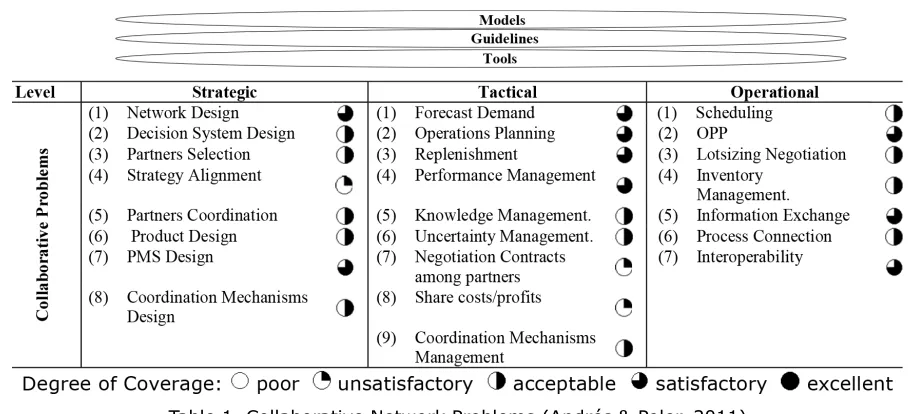
The identified problems are conceptually arranged according to (i) the decision-making level: strategic, tactical and operational (S/T/O) and (ii) to the used criteria for the solutions classification: models, guidelines and tools (M/G/T).
The classification scheme of the identified problems affecting collaboration in manufacturing networks is showed in Table 1, from both HN and NHN perspective.
Table 1. Collaborative Network Problems (Andrés & Poler, 2011)
3. Selection of relevant problems for NHN context
According to the proposed matrix and the degree of coverage (Table 1), problems with unsatisfactory solutions in NHN context have been identified. The aim of this section is to identify amongst all the identified problems, those that have less satisfactory solutions and are considered more important for providing solutions in NHN context. The methodology for selecting the most relevant problems in NHN context is proposed next (Figure 1).
Figure 1. Methodology for selecting relevant problems in NHN
Following the methodology the first step is the justification of the solution failure that will prove why the problem is considered totally or partially unresolved taking into account the degree of coverage results.
Degree of Coverage
Problem with non satisfactory degree of coverage. Is necessary to cover it. The solutions do not cover the problem in NHN context
Problem with an acceptable degree of coverage. Is necessary to cover it. The provided solutions have a half degree of coverage in NHN context
Problem with a satisfactory degree of coverage. The problem is completely covered in NHN context by the solutions proposed in the literature
Table 2. Degree of Coverage of the problem
Once identified the degree of coverage of the problem, the third phase is to determine which are the most important problems when decentralized decision making and collaborative non-hierarchical relationships are established in a network (Table 3).
Degree of significance to establish collaborative relations
Problem with a high significant degree to establish collaborative relationships in a NHN ↑↑↑
Problem with significant degree to establish
collaborative relationships in a NHN ↑↑ Problem with a lower degree of importance to
establish collaborative relationships in a NHN ↑
Table 3. Degree of significance for establishing collaborative relationships among NHN collaborative members
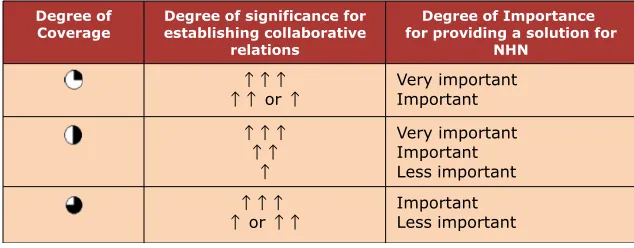
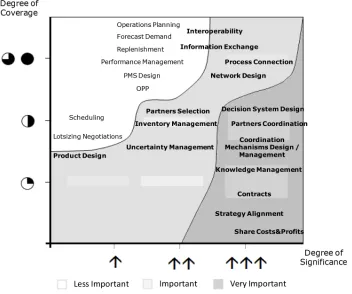
The classification of the problems regarding (i) the degree of coverage of the solution and (ii) the degree of significance to establish decentralized and collaborative relationships enables the definition of the degree of importance for providing a solution (Table 4), from highest to lowest importance areas (Figure 2).
Degree of
Coverage Degree of significance forestablishing collaborative relations
Degree of Importance for providing a solution for
NHN ↑↑↑
↑↑ or ↑ Very importantImportant
↑↑↑ ↑↑ ↑ Very important Important Less important ↑↑↑
↑ or ↑↑ ImportantLess important
Table 4. Allocation rule for determining the degree of importance in the problem resolution
Figure 2. Areas of importance solution degree
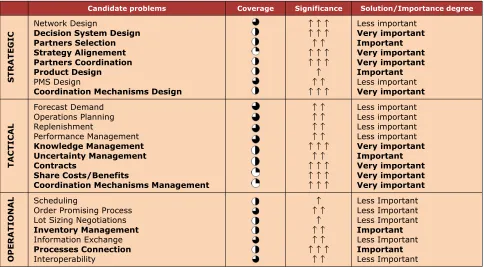
Candidate problems Coverage Significance Solution/Importance degree
S T R A T E G IC Network Design
Decision System Design Partners Selection Strategy Alignement Partners Coordination Product Design
PMS Design
Coordination Mechanisms Design
↑↑↑ ↑↑↑ ↑↑ ↑↑↑ ↑↑↑ ↑ ↑↑ ↑↑↑ Less important Very important Important Very important Very important Important Less important Very important T A C T IC A L Forecast Demand Operations Planning Replenishment Performance Management Knowledge Management Uncertainty Management Contracts Share Costs/Benefits
Coordination Mechanisms Management
↑↑ ↑↑ ↑↑ ↑↑ ↑↑↑ ↑↑ ↑↑↑ ↑↑↑ ↑↑↑ Less important Less important Less important Less important Very important Important Very important Very important Very important O P E R A T IO N A L Scheduling
Order Promising Process Lot Sizing Negotiations
Inventory Management Information Exchange Processes Connection Interoperability ↑ ↑↑ ↑ ↑↑ ↑↑ ↑↑↑ ↑↑ Less Important Less Important Less Important Important Less Important Important Less Important
Table 5. Problems classification according the degree of coverage and the degree of significance
Before selecting the problem to provide a solution we have to ensure that the selected problem has not been previously addressed from the NHN perspective. Therefore, a literature review must be specifically carried out for papers dealing with the selected problem. Updating the literature review for a particular problem will allow us to decide if the selected problem does really need future research to propose a solution.
Figure 3. Relevant Problems to provide solutions
4. Further Research
Once the problems that need further research are detected, the building blocks of the collaborative framework for non-hierarchical manufacturing networks are identified. Figure 4 shows the building blocks that need further research. Less shaded blocks correspond with the problems that have been already solved in the literature, in a particular solution area (models, guidelines and tools), with a satisfactory or excellent degree of coverage. Blocks with intense shading correspond to the problems whose provided solutions, in the literature, have an unsatisfactory degree of coverage. Problems with intense shading have greater need to provide a solution in the NHN context. Finally, blocks with intermediate shading correspond to those solutions that solve the problem in an acceptable degree of coverage or in a centralized context; thus the problem requires being adapted to the decentralized context. Whether the problem is not covered but is not required to be covered in a determinate area due to there are other solution areas that address it satisfactorily, is also classified with intermediate shading.
Figure 4. Building blocks for NHN Collaborative Framework. Problems with less satisfactory solutions in NHN context
5. Conclusions
There exist many types of problems affecting inter-enterprise collaboration. This paper has proposed a methodology that allows us to identify the most relevant problems, in collaborative networks context, to be solved in the future.
partners selection, strategy alignment, partners coordination, product design, and coordination mechanisms design (ii) at the tactical level: knowledge management, uncertainty management, contracts, share costs and benefits and coordination mechanisms management and (iii) at the operational level: inventory management, and process connection, interoperability and information exchange problems. The listed problems are identified as important to provide solutions in the NHN context.
The expected contribution of the future dissertation research is to develop a framework (mentioned in section 3) for providing models, guidelines and tools for supporting collaborative processes, specifically in the non-hierarchical context. The framework is aimed to achieve a better understanding how SMEs deal with collaborative problems in NHN.
References
Andrés, B., & Poler, R. (2011). Análisis de los Procesos Colaborativos en Redes de Empresas No-Jerárquicas. XV Congreso de Ingeniería de Organización. Cartagena.
Poler, R., Ortiz, A., Tormo, G., & Gutierrez, D. (2002). Practices in Knowledge Management in Small and Medium Firms in Enterprise Inter. And Intra Organizacional Integration Building International Consensus. En L. Camarinha-Matos & H. Afsarmanesh, Processes and Foundations for Virtual Organizations, 217-224. Kluwer Academic Publishers.
Poler, R. (2010). Intelligent Non-Hierarchical Manufacturing Networks (iNet-IMS). Intelligent Manufacturing Systems. http://www.ims.org/sites/default/files/iNet-IMS%20MTP%20Initiative %202009%20v1.3.doc
Journal of Industrial Engineering and Management, 2013 (www.jiem.org)
Article's contents are provided on a Attribution-Non Commercial 3.0 Creative commons license. Readers are allowed to copy, distribute and communicate article's contents, provided the author's and Journal of Industrial Engineering and Management's names are included.