Volume 3, Issue 3, 2016, pp. 146-153 Available online at www.jallr.com ISSN: 2376-760X
* Correspondence: Rahim Ahmadi Nargese, Email: [email protected] © 2016 Journal of Applied Linguistics and Language Research
Structuralization of the Concept of Time in Persian
Language According to Cognitive Linguistics
Mahmood Naghizadeh
Assistant Professor, Department of Foreign Languages and Linguistics, Payame Noor University, IR. Iran
Rahim Ahmadi Nargese *
PhD Student in General Linguistics, Ahvaz Branch, Islamic Azad University, Iran
Abstract
The aim of this paper is to study and analyze the temporal concepts in Persian structure. This study has been done on the basis of cognitive linguistics. In this analytic-descriptive study, some dynamic verbs, temporal words, adverbs of time and temporal prepositions were chosen and also examples of personifications, simile, and metaphor were provided. Deductions were made that human is the central point in studying the temporal concepts because human is sometimes the source and sometimes the target for the movement of temporal concepts.
Keywords: cognitive linguistics, conceptualization, temporal concepts
INTRODUCTION
Cognitive linguistics has become one of the most prominent approaches in linguistics. This theory is not an individual approach, because although it has similar features with other theories, it also has important differences with them. This approach considers three main hypotheses (Croft & Cruse 2004. p. 1).
1. Language is not an autonomous cognitive faculty. As we know this principle is opposed to generative grammar introduced by Chomsky and his followers. They believed that language is an autonomous (innate) faculty separated from non-linguistic cognitive abilities.
2. Grammar is conceptualization. This principle is opposed to truth-conditional semantics in which a semantic met language evaluated of truth and falsity in relation to the world.
The cognitive linguistics' approach has been evolved in the following of linguistic discussion and cognitive sciences in the decades of 1960 and 1970 especially by studying and analyzing Gestalt psychology and the subject of conceptualization in human's mind (Ivan's & Green, 2006). Cognitive linguistics like other linguistics tries to describe the system and function of the language. One of the most important reasons (aims) for these linguists in studying language was that by using human experiences from outside world and utilizing approaches for perceptions and the ways for conceptualization, can study and survey the language very well. George Lake off and Lanker were two famous linguists who play an important role in developing this approach. They believe that language studies should be based on meaning and cognitive abilities. In this approach-despite of the formalists – the meaning is more important than from.
CONCEPTUALIZATION
In cognitive linguistics Saussure's points of view about considering language as a set of indefinite systems of signs have been accepted. As it was said before, one of the main ways (methods) in this approach is conceptualization. It can be used in different fields such as space, time, etc. In conceptualization, the human's mind by using concrete and embodied experiences can make abstract and mental concepts. Consider the following examples:
1. (a) Nowruz (new year) is approaching
(b) Akbar and Hassan have a far (distant) friendship.
In sentence (a) “Nowruz” (new year) which has a temporal and abstract concept has been shown by using a concrete field of movement. In this sentence movement "which is one of animates characteristics has been given to Nowruz(new year). This is one type of conceptualization of the time concept which Persian speaker can construct it in his/her mind, but in sentence (b) the word "far" (distant) has a situational (place) concept , showing the distance between things and human beings. This word in this sentence is used in the conceptual field of "kindness" which is an abstract concept. The conceptual field is a set of knowledge from inside our conceptual system which includes our experiences and related concepts and then regularizes them.
Talmy (2006), has studied the system of conceptual structure. He applied two fields of space and time to distinguish between lexical categories. In his view, the distinction among these two fields is represented by grammatical structure. He refers to space field as “matter” and time field as "verb or work". He also gave examples to show that these two fields (space and time) are not completely distinctive. He said that in some cases these concepts are used substitutive:
2. (a):How far is to Tehran? [tǎ Tehran čeqadre?] (b): 8 hours [hašt sǎ?at]
The answer (b) is according to time field and the answer(c) is according to place field. Tamly called this case as conceptual substitution of place and time. Mahmood Naghizade and his colleagues (1390) studied the concept place in Persian language on the basis cognitive linguistics. Now we are trying to survey the time concept in this essay.
3-1 In studying time and place concepts the human being is always considered as the main and central point. The time concepts such as adjectives (near, far(,verbs (approaching , disappearing , come , go), adverbs (sooner, before, after) , ... are considered in relation to human beings is considered as the point (source) of movement and sometimes as target of it.
If we are the source of movement so the human beings will approach to temporal concept such as new year, summer, spring, Ramazan, ... as target and if we are as the target of the movement. Then temporal concept will have human characteristics and they’ll act as animate (as human beings) and approach to us (as target) consider examples in these cases:
(a) We are approaching to new year. [mǎ dǎrim be ?eid nаzdik mišavi:m] میوش یم کیدزن دیع هب میراد ام
(b) We finally reached to winter.[?axareš residim be zemestan] ناتسمز هب میدیسر شرخآ
(c) Holidays are closing.[Tatilǎt dǎre nazdik miše] هشیم کیدزن هراد تلایطعت
(d) Ramazan came. [Ramazǎn ?ǎmad] دمآ ناضمر
In example (a) and (b) , the human is the source of movement and the temporal concept as "new year" and “winter” are the target of movement but in (c) and (d) are vice versa- the human is target and the temporal concept such as “new year” and “Ramazan” are the source of movement towards human beings.
3.2. Temporal concepts are divided in different ways: sometimes the point of the beginning in this approach (cognitive linguistics) in the time approach is as metaphor in cognitive theory. As we know the cognitive theory of metaphor was represented by Lake off and Janson(1999,1980). They stated that time in human’s sensor and perceptual experiences are in the surrounding environment and in the movement of things. Lake off and Janson presented linguistic evidences for their claims. They proved that a little of our understanding of “time” has (showed) completely temporal concept. Look at the following examples:
فلا ) تسا هدیسر ارف لمع نامز .
(b) The deadline is approaching. [?ultimǎtum dǎre Nazdik mišavad] ب
) دوش یم کیدزن هراد مویتامیتلوا .
(c) We are approaching the summer sales.[mǎ dǎri:m be foroš sǎlǎne nazdi:k mišavim] ج
) میوش یم کیدزن هنلااس شورف هب میراد ام .
(d) We are moving towards decision- time.[mǎ dǎrim be zamǎne tasmi:mgi:ri nazdi:k mi:šavi:m]
د ) میوش یم کیدزن یریگ میمصت نامز هب میراد .
In example (a) and (b) , the temporal concepts are transitive and moves from one point of time to another, but in (c) and (d) “we” (as human beings) are transitive and are getting close to temporal points(concepts). Getting close to something is equal with getting far from other things in our environment. In fact we can say that there are relative not absolute, because sometimes we are approaching to a place, time, thing or human, and sometimes we are getting far (away) from them.
3.3 Time is directly experienced: Zakay and Block (1997) found that temporal perception is influenced by how interesting a particular activity is judged to be. They found that direct experience of “time” based on the amount of attractiveness of an activity so the perception of “time” as approaching or getting far from something is the result of the amount of interest (love or hate) to a thing.
Examples:
(a) Chance has “faced” to him (her)”(approaching)” [šǎns be ?ū rū ăvard/nazdik šod] دروآ يور وا هب سناش
( دش کیدزن )
(b) Chance has faced to us (getting far)[sans be mă post kard/dūr sod] درک تشپ ام هب سناش
( دش رود
)
(c) His/hers youth has gone (went, getting far)[javǎniyaš separi šod/gozašt] وج
دش يرپس شینا (
تشذگ )
(d) His/hers Aging has come to her/him(approached, reached)[pi:ri ?aš farǎ resi:d/ǎmad]
دیسر ارف شا يریپ
3.4. Time is not a monolithic experience type Time, as, experienced, appears to relate a complex and multifaceted set of experiences (Evan, 2013)
The word "Time" covers arrange of quite different lexical concepts (Evans, 2004) Consider the following examples:
4.(a) The time for action has arrived.[?alǎn vaghte ?amal ast/zamǎne ?amal ǎmad] نلاا تسا لمع تقو
.
4.(b) The time to start thinking about environment is here[zamǎneš resi:de ke be fekre mohi:te zi:st bud/zamǎneš amade]
دوب تسیز طیحم رکف هب هک هدیسر شنامز
4.(c) Time flies when you having fun.[vaqti sargarmi zaman zūd mi:gzare] مرگرس يتقو درذگیم دوز نامز يتسه
4.(d) Time drags when you have nothing to do [vaqti bi:kǎri čeqadr zaman di:r migzare] اکیب يتقو
درذگ يم رید نامز ردقچ ير
4.(e) The young woman's time[labour,Ezdevǎj, child birth] approached.[zamǎne (kar,ezdevaj,bačedari) zane javan fara reside]
نامز ( جاودزا،يراد هچب،راک )
دیسر ارف ناوج نز .
4.(f) His time [=death] has come.[ajalaš (zamane margeš) resi:de] شلجا
( شگرم نامز )
هدیسر
In 4(a) the time (particular time) for doing an action(by someone) has come.
In 4(b): the beginning of an action or a measurement to save our environment has come (arrived) Examples 4(c) and 4(d) refer to the experimental feeling of transition of time: Happy times are faster than hard (sad) times. Examples 4(e) and 4(f) show the particular time or period.
We understand from the above examples that "Time" is understood as quietly different kinds of experiences, so the single from of the word "time" introduces multiple meanings (polysemy) of it.
3.5. "Time" as an intellectual achievement: Another type of temporal representation which mentioned above involves our personification of "time" Linguistic evidences of such notions come from the following:
5.(a) [Benjamin Pisraeli] 'Time is the greatest physician'[ Zamǎn bozorgtari:n Pezešk ?ast].تسا کشزپ نیرتگرزب نامز
5.(c) [Lord Byron]:'Time is the avenger'[zamǎn bozorgtari:n enteqǎmju ?ast] نیرتگرزب نامز تسا وجماقتنا
5.(d) [ Milton] :'Time is the subtle theif of youth'[ zamǎn dozed zi:rak va mǎheri: ?ast].تسا يرهام و کریز دزد نامز
5.(e) [Ovid]:"Time is the devourer"[zamǎn balande (xorande) ?omr ?ast] هدنروخ(هدنعلب نامز و رمع
)... تسا
In above examples time has been introduced as “physician, innovator, avenger, thief, and devourer” which in terms of figurative literary are called personification. These characteristics are individual features for human beings.
3-7. The seventh feature of "time" is that (time) can be conceptualized according to contentedness. It means that "the time" can be condensed to be shorter or be extended to become longer.
Examples:
6.(a) The new year came sooner this year.[emsal ?eid zood ?amad] دمآ دوز دیع لاسما
6.(b) Last year, the summer went later.[parsal tabestan di:r raft] تفر رید ناتسبات لاسراپ
.
In the example 6(a) contentedness and shortness of the time of the new year caused new year comes sooner and in example 6(b) extendedness of the "time" caused the time of the summer goes later.
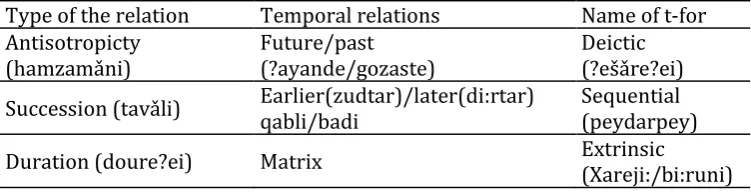
3.8: what should be mentioned in the discussion and conclusion of relationship of temporal concepts is that temporal relations can be classified in the following table (Ivans, 2006): temporal relations (ravabete zamǎni)=ینامز طباور
Table 1.Type of relations
Type of the relation Temporal relations Name of t-for
Antisotropicty
(hamzamǎni) Future/past (?ayande/gozaste) Deictic (?ešǎre?ei)
Succession (tavǎli) Earlier(zudtar)/later(di:rtar) qabli/badi Sequential (peydarpey)
Duration (doure?ei) Matrix Extrinsic (Xareji:/bi:runi)
As you observe in the above table, there are three relations as: 1) Antisotropicity(hamzamǎni)
3) Duration(doureei)
In the following we mention only several samples for each kind:
7.(a) [new year came] ?eid ?ǎmad(the movement of time towards the speaker(stable) 7.(b) [Ramazan went] Ramzan raft(In this example, the speaker is stable)
7.(c) The New year is getting close:[?eide Nowruz dǎre nazdi:k mišhe]( The new year moves towards the stable speaker)
7.(d) We are approaching to Now ruz(New year)[mǎ dǎri:m be ?eid nazdi:k mišavi:m][our movement towards the stable New year]
The example 7(a) & 7(b) express the occurrence of an event or a temporal event. All of them express the movement toward human being as a central (main) point. The semantic relations between concepts sometimes refer to past or future.
The following examples express a kind of succession (tavǎli)
8.(a) Holidays came sooner this year.(Tati:lǎt ?emsal zudtar resi:d(?amǎd) 8.(b) The hot season spent(went) later last year.(fasle garmǎ ?emsǎl di:rtar raft).
8.(c) The last wends day of the year (comes) before(sooner than) New year.[ čaršanbe suri: qabl az (zudtar) ?az ?eid ?ast. (succession) (tavǎli)
8.(d) The New year is after (later than) the last wendsday of year.[sǎle nou ba:d ?az (di:rtar ?az čar šanbe suri ?ast](succession)
Examples 8(a)-8(b) show the second kind of temporal succession. It means that New year or last wends day occurs after or before each other.
The following examples show the temporal relation which refer to duration of time (third kinds of T-relations):
9.(a) Ali slept two hours( Ali du sa ǎt xǎbi:d) دیباوخ تعاس ود یلع
9.(b) I rang Ahmad about 20 minutes.[man bi:st daqi:qe be Ahmad zang zadam] تدم هب نم
20 مدز گنز دمحا هب هقیقد
9.(c) He studied one hour [zu yek sazat montale kard] درک هعلاطم تعاس کی وا
9.(d) He swam from one o'clock to two o'clock (؟u az sǎat yek tǎ du šenǎ kard]
As you observe "two hours" (du saat) "20 minutes" ( bi:st daqiqe), "one hour" (yek saǎt) and "one to two" (saǎt yek ta du) refer to a duration of time.
At the end of this essay I noted researchers and readers to a reality which is very important to cognitive linguistics. That reality is that the encyclopedic meaning is used instead of dictionary meaning. Finally it should be noted that the concept such as temporal ones have never individual meaning. It should be kept in mind that there are often overlapping between space, time.
CONCLUSION
The present essay titled “structuralization of the time concept in Persian on the basis of cognitive linguistics”. Has been accomplished by using Tamly’s pattern (2000, 2006, Evans, 2013) in the field of time.
In this survey sometimes the temporal concepts moves towards human (speaker) and vice versa. The essay has studied the temporal words (verbs) and non-temporal words (noun) and it also studied three different cases of Antisotropicty (hamzamǎni), Succession (tavǎli), and Duration (doure?ei). Moreover I represented examples of conceptualization of Antisotropicty (hamzamǎni), Succession (tavǎli), and Duration (doure?ei). As it was said these conceptualization have been achieved in the different fields as space and time. These conceptualizations have been achieved on the basis of the Lake off and Janson's theory (1997). The Personification of adverbs of time and conceptualization of them is also the subject of this essay which has been studied and analyzed.
REFERENCES
Craft, W. & Cruse, D. (2004). Cognitive linguistics. Cambridge University Press.
Evans, V. (2013). Language and time: A cognitive linguistics approach. Cambridge University Press.
Frawley W. (1992). linguistic semantics. Hills: NJ.
Hill, C. A. (1978). Linguistic representation of spatial and temporal orientation. In
Annual Meeting of the Berkeley Linguistics Society (Vol. 4, pp. 524-538). -Lake off
George (1993). The contemporary theory of metaphor. Cambridge University Press.
Lyons, J. (1997). Linguistic semantics. Cambridge University Press.
Naghizade, M. (1390). The process of structuralization of space in Persian on the basis of cognitive linguistics. Journal of Linguistics and Khorasan dialects, 4, 1-28.