Journal of Applied Linguistics and Language Research Volume 3, Issue 3, 2016, pp. 185-198
Available online at www.jallr.com ISSN: 2376-760X
* Correspondence: Laila Samavarchi, Email: [email protected] © 2016 Journal of Applied Linguistics and Language Research
Schema-based Analysis of English Textbooks Designed within
a Foreign Language Context
Ebrahim Khodadady
Ferdowsi University of Mashhad
Laila Samavarchi *
Ferdowsi University of Mashhad&Iran Language Institute
Abstract
The present study aims to linguistically and cognitively analyze all the words comprising three English textbooks taught at advanced levels in a foreign language context. The textual analysis of the books was conducted on the basis of the microstructural approach to schema theory. To this end, eighteen reading passages comprising the textbooks were chosen to be schematically analyzed. The schemata were parsed, codified and assigned to the semantic, syntactic and parasyntactic domains, which were further subsumed under the genus and species categories. The study was limited to analyzing the semantic, syntactic and parasyntactic domain and genus tokens and types. Descriptive statistics and Chi-square tests were carried out to analyze the data. Results indicated that there were significant differences between semantic domain tokens and types and also syntactic and parasyntactic domain and genus types and tokens. The findings also demonstrated that the semantic schemata were comparatively higher than the syntactic and parasyntactic ones, especially the genus nouns. Additionally, the findings confirmed the empirical and psychological validity of applying schema theory to reading comprehension texts. The implications of the findings are discussed.
Keywords: schema theory, reading comprehension, textbooks, semantic, syntactic, parasyntactic
INTRODUCTION
work and role plays can substitute the textbooks since textbooks are unified instructional materials which play a very important role in the classroom.
Even though textbooks are considered by some to be inflexible or biased (Allwright, 1982), one cannot deny the advantages that using textbooks in the classrooms can provide. Considering the view that textbooks are a core part of the teaching/learning process and due to growing need of many Iranians to learn a foreign language especially English, textbooks used in the classrooms should be put to scrutiny to help teachers select suitable textbooks, which could facilitate the teaching/learning process.
Considering the fact that reading and listening activities form major parts of the textbooks, and that reading and listening comprehension depends on the readers' background knowledge or schema (Khodadady, 1997, 2008), and that the acquisition of new information depends on the previously stored schemata (Carell, 1983, 1984; Khodadady & Elahi, 2012; Khodadady & Hesarzadeh, 2014), this study has attempted to evaluate and textually analyze the reading texts by employing schema theory. It can be applied to reading comprehension ability either macro-structurally or micro-structurally (Khodadady, 1997, 1999; Khodadady & Herriman, 2000).
The macrostructural approach adopts texts as units of reference and considers schema to be as scripted or rhetorical knowledge (McNeil, 1987; Poplin, 1988; Yekovich and Walker, 1988) which requires "special knowledge" (Klein-Braley, 1997, p.65) or in Yule's words (2006, p. 132) a "conventional knowledge structure that exists in memory." In this approach, when the readers encounter the title of the text, they invoke whatever background knowledge they have and subsequently process and integrate the information presented in the entire text relying on their background knowledge. However, this approach has been questioned as to its validity for considering schema as being fixed and its subjective nature (Khodadady & Hesarzadeh, 2014). Khodadady and Gholamian (2014), for example, argued that a schema is not just conventional but also personal and it, therefore, shouldn't be considered as a fixed entity as Yule (2006) or as a fixed map as Carrell (1983) did.
schemata make the text comprehensible to the reader. Following this approach, Khodadady (2008) classified schemata into three domains: semantic, syntactic and parasyntactic.
Semantic schemata are traditionally referred to as "open-class items" (Quirk, Greenbaum, Leech & Svartvik, 1985, p. 73) which represent the main concepts the authors have stored in their minds as their background knowledge (Khodadady & Hesarzadeh, 2014). They are many in type but few in tokens because they express actions, attitudes, emotions and states their possessors wish to convey (Khodadady, 2008). As a cognitive domain, semantic schemata consist of genera which, in turn, are comprised of a number of species. For instance, the semantic domain of schemata includes four genera: adjectives, adverbs, nouns and verbs, each of which consist of a number of species. The adjective genus, for example, is subcategorized into agentive, complex, comparative, dative, derivational, nominal, simple, and superlative species. In contrast to semantic schemata, syntactic ones which are traditionally referred to as "closed-class items" (Quirk et al, 1985, p. 71) are few in type but many in tokens or frequency. They are few in type because of their dependence on and attachment to the semantic schemata in order to confine them within the variables of time and place (Khodadady, 2008). The third domain of schemata known as parasyntactic is similar to semantic one in that its constituting schemata can be open in type. A large number of names do, for example, exist and are created or borrowed from other languages continuously. They are, however, dependent on semantic schemata, hence parasyntactic, in order to represent a specific and independent concept, e.g., a specific person. This domain comprises abbreviations, names, numerals, interjections, particles, para-adverbs and symbols (Khodadady, 1999; Khodadady, 2008; Khodadady & JavadiMehr, 2012).
The schemata comprising the three semantic, syntactic and parasyntactic domains of a specific text need to be activated in isolation and in combination with each other by listeners or readers so that they can fully comprehend the text (Khodadady & Elahi, 2012). In order to determine and evaluate their comprehension a thorough analysis of these schemata is, therefore, necessary. This holds equally true for researchers who embark on any type of textual analysis.
Schematic analysis can also be extended to the genre of films as done by Hale (2009). The research showed 'that schema theory was powerful in identifying research based insights into film of value to film researchers and professionals (p. 2).' A textual analysis of letters written by male and female participants was conducted by Khodadady and JavadiMehr (2012). Schema theory was used to determine the possible gendered differences between male and female self-disclosure letters. Schema theory was also applied in the comparative analysis of two English translations of a religious text (Khodadady & Eslami, 2013).
Some studies on schema theory have focused on the reading skill. Xaio-hui, Jun and Wei-hua (2007) analyzed schema theory and its influence on reading by considering schema to be the basis for cognition and information processing. In a similar vein, Shen (2008) explored the use of schema theory in intensive reading classroom and claimed that familiarity with the subject matter in terms of schema theory can affect L2 understanding of a text. It was concluded that texts become easier to understand when the students' prior knowledge is enhanced. Another study attempted to investigate the effect of cultural background or cultural schema on the performance of Iranian EFL learners' reading performance (Dehghan & Sadighi, 2011). Aloqalili (2012) applied schema theory as a rational premise for analyzing the interdependent relationship between reading comprehension, critical thinking and prior knowledge. Schema theory was considered to be one of the most effective theories having a considerable influence on reading instruction and reading comprehension. More recently, schema theory was used for the comparative analysis of micro-reading and traditional reading (Wang, 2014) and also to explore the reading strategies in micro-era based on the effects which schema theory have on micro-reading.
Based on the microstructural approach to schema theory, Khodadady and Lagzian (2013) textually and statistically analyzed the schemata of an English dentistry textbook and its Persian equivalent, with the focus of the analysis being the semantic domain schemata. The results showed that the two texts differed significantly from each other on the level of domain, genus and species, confirming the schema theory as an objective tool of evaluation of the empirical validity of translated texts.
Taking into consideration the microstructural approach of schema theory, the present study intends to analyze textually and statistically the reading passages in the textbooks used as the main source of information in English classrooms at advanced levels. Considering the fact that the topics of the reading passages vary to a large extent in different levels, the study aims to explore where, if any, any significant difference between three textbooks used in three advanced levels lie with regards to the semantic, syntactic and parasyntactic schemata comprising the texts.
The following questions were raised and answered in this study:
2. To what extent do distinct and common semantic domain types used in the three advanced level books differ from each other?
3. To what extent do distinct and common semantic genera tokens used in the three advanced level books differ from each other?
4. To what extent do distinct and common semantic genera types used in the three advanced level books differ from each other?
METHOD
Materials
The English textbooks entitled "The ILI English Series, Advanced 1: Student's Book," "The ILI English Series, Advanced 2: Student's Book" and "The ILI English Series, Advanced 3: Student's Book" used at the Iran Language Institute for the advanced levels were chosen to be analyzed schematically. The three ILI advanced level books each contain six reading passages of varying lengths. The titles of the passages in Advanced 1 are as follows: Hurry Sickness, The Education Gender Gap, The Global Product: The World as a Single Market, He Survived His Own Funeral, When is a Room not a Room and The Other Population Crisis. The titles in Advanced 2 are: The Stages of Adjustment, The Great Work Myth, Stolen Friendship, Fingerprints, Intuition, and Reading the Screen. The passages in Advanced 3 are entitled: Maintaining Their Identity, The Invisible Thread, Three Days to See, The Riddle of Intelligence, The Power of Nothing and Beyond Rivalry.
The reason for choosing these books is that ILI is the only language institute that is affiliated with the Institute for the Intellectual Development of Children and Young Adults, which makes the ILI a reliable institute which, in turn, provides face validity to the learners. The ILI was first established in Tehran in 1956 and has expanded considerably into 200 branches in 73 cities in 27 provinces, making the ILI not only the oldest but also the biggest and probably the most popular language institute in Iran. Almost 240000 students are currently taking classes at the ILI and the number is steadily increasing.
Procedure
Data Analysis
To find out whether the semantic, syntactic and parasyntactic domains of the three textbooks differed significantly from each other or not, Chi-Square test was used and the analysis was limited to domain and genus tokens and types. Since the genera and species of domains consisted of more than two categories, Crosstabulation statistics was employed and Khodadady and Khosravany (2014) was followed to find out whether the three textbooks differed in the number of common and different domain and genera tokens and types. To this end, IBM SPSS Statistics was used to carry out the statistical analyses.
RESULTS
Table 1 below presents the semantic, syntactic and parasyntactic schemata comprising the three advanced level books. It can be seen that from the total of 18317 schema tokens, 8413 schemata (45.93%) belong to the semantic domain, 8243 (45%) to the syntactic domain and 1661 (9.07%) to the parasyntactic domain. As can also be seen, 5891 schema types comprise the three textbooks, of which 4723 schemata belong to the semantic domain, 601 to the syntactic domain and 567 to the parasyntactic domain. As the figures in the table below indicate, the majority of the schema types belong to the semantic domain comprising almost 80% of the total schema types.
Table 1. Descriptive statistics for domain tokens and types of three textbooks
Tokens Types
Domain/Books One Two Three Total One Two Three Total
Semantic 2242 2931 3240 8413 1317 1657 1749 4723
Syntactic 2129 2991 3123 8243 196 211 193 601
Parasyntactic 463 629 569 1661 162 180 225 567
Total 4834 6551 6932 18317 1676 2048 2167 5891
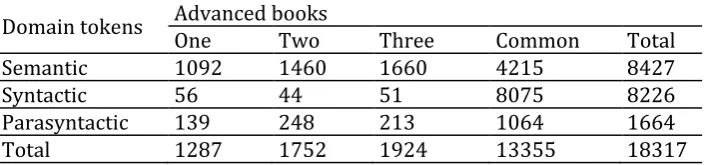
To be able to determine the schemata distinct and common to all the three advanced books, another variable called common was added to the data analysis, the results of which are presented in Tables 2 and 3 below. Table 2 below presents schemata distinct and common to the three advanced textbooks. As can be seen from Table 2, the semantic schemata common to three books were 4215(50%), the common syntactic schemata comprised 98% and the common parasyntactic schemata comprised almost 64% of the respective domains. Furthermore, when the distinct schemata of each book are considered, the distinct semantic schemata of Advanced 1 comprised 84.85%, of Advanced 2 83.33% and of Advanced 3 86.3% of total schemata distinct to each book, indicating the importance of semantic schemata at all levels.
Table 2. Domain tokens for distinct and common schemata
Domain tokens Advanced books
One Two Three Common Total
Semantic 1092 1460 1660 4215 8427
Syntactic 56 44 51 8075 8226
Parasyntactic 139 248 213 1064 1664
Table 3 below presents the schema domain types distinct and common to the three textbooks. As can be seen from Table 3 below, the semantic schemata common to three books comprised 32.65%, the common syntactic schemata comprised 59% and the common parasyntactic schemata comprised almost 32.8% of the respective domains. Moreover, when considering the distinct semantic schemata types in each book, it can be seen that the distinct semantic schemata of Advanced 1 comprised 81.6%, of Advanced 2 85.65% and of Advanced 3 84.56% of total schemata distinct to each book, again indicating the importance of semantic schemata, whether distinct or common, in the three textbooks.
Table 3. Domain types for distinct and common schemata
Domain types Advanced books
One Two Three Common Total
Semantic 870 1176 1282 1395 4273
Syntactic 87 84 75 355 601
Parasyntactic 109 113 159 186 567
Total 1066 1373 1516 1936 5891
As the results in Tables 1, 2 and 3 above indicate, the semantic schemata comprised majority of the schemata in the three books, whether distinct or common. Hence, further analyses focuses on the semantic schemata and the results and implications are discussed below. A Chi-Square test was carried out on semantic domain tokens and the results showed that the distinct and common tokens of three books, differed significantly from each other (X2 = 2888.487, df = 3, p < .001). Furthermore, the results
indicated that the semantic schemata specific to the Advanced 1 book was 12.96%, to the Advanced 2 book was 17.33%, to the Advanced 3 book was 19.70% and the semantic schemata common to the 3 books represented 50% of the total semantic schemata. Based on these results, the first question can be answered that there is a significant difference between semantic domain tokens in the 3 advanced level books. The Chi-square test also showed that the semantic domain types of three books, whether different schemata or common, differed significantly from each other (X2 =
129.397, df = 3, p < .001), answering the second question.
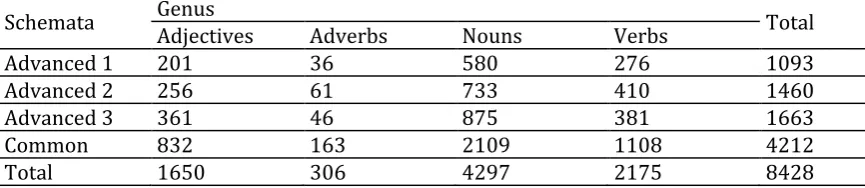
To answer the third and fourth questions, crosstabulations were run and the results are shown in Tables4and 5below for the semantic genus tokens and types, respectively. As can be seen in Table 4, the majority of schemata comprising the texts in the 3 books were nouns followed by verbs. However, the results also show that nouns were more commonly used than verbs in the books. The Chi-square test showed that the difference between different semantic genera tokens of the books is not significant (X2 = 33.229, df
= 3, p=.099).
Table 4. Language by semantic genus tokens crosstabulation
Schemata Genus Total
Adjectives Adverbs Nouns Verbs
Advanced 1 201 36 580 276 1093
Advanced 2 256 61 733 410 1460
Advanced 3 361 46 875 381 1663
Common 832 163 2109 1108 4212
Table 5 presents the semantic genus types in the 3 advanced books. Similar to semantic genera tokens, the semantic genera types comprised mostly of nouns followed by verbs. However, the Chi-square test showed the difference between semantic genera types of the books is highly significant (X2 = 24.167, df = 3, p>.001).
Table 5. Language by semantic genus type crosstabulation
Schemata Genus Total
Adjectives Adverbs Nouns Verbs
Advanced 1 176 38 392 264 870
Advanced 2 234 61 508 373 1176
Advanced 3 303 46 585 347 1281
Common 321 69 603 402 1395
Total 1034 214 2088 1386 4722
Based on the results in Tables 4 and 5, what can be confirmed is that as far as the semantic genus tokens are concerned, there is a significant difference between the common and different schemata used in the books but as the numbers indicate there isn't much difference between the different schemata in the books. With regards to the semantic genus types, there was also a significant difference between the common and different schemata used.
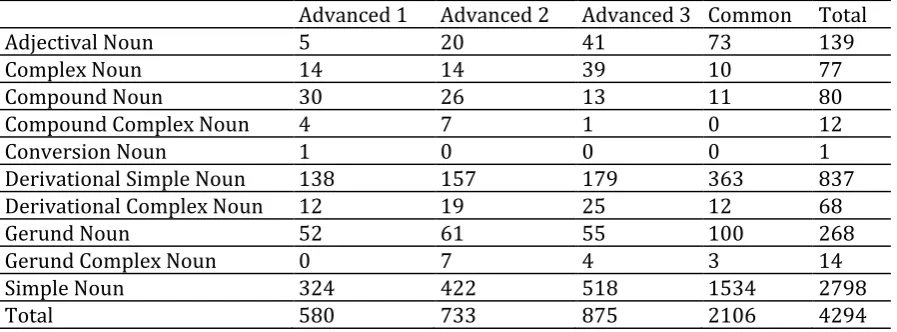
As can be seen from Tables 4 and 5 above, all the three textbooks comprised mostly nouns in both semantic genera tokens and types. Hence, further descriptive statistics were run and the results are presented in Tables 6 and 7 below. Table 6 below presents the descriptive statistics for noun tokens. The table clearly shows that the number of simple nouns were comparatively much higher than others nouns, both with regards to distinct and common schemata in the 3 textbooks. Next highest number of nouns belonged to derivational simple nouns, both distinct and common.
Table 6. Descriptive statistics for noun tokens
Advanced 1 Advanced 2 Advanced 3 Common Total
Adjectival Noun 5 20 41 73 139
Complex Noun 14 14 39 10 77
Compound Noun 30 26 13 11 80
Compound Complex Noun 4 7 1 0 12
Conversion Noun 1 0 0 0 1
Derivational Simple Noun 138 157 179 363 837
Derivational Complex Noun 12 19 25 12 68
Gerund Noun 52 61 55 100 268
Gerund Complex Noun 0 7 4 3 14
Simple Noun 324 422 518 1534 2798
Total 580 733 875 2106 4294
was the most frequent in Advanced 1, work in Advanced 2, sister in Advanced 3 and the noun people was the most frequent in the three textbooks with a frequency of 55. With regards to derivational simple nouns, the nouns installation in Advanced 1, traveler in Advanced 2, children in Advanced 3 and the noun product were used commonly in all textbooks.
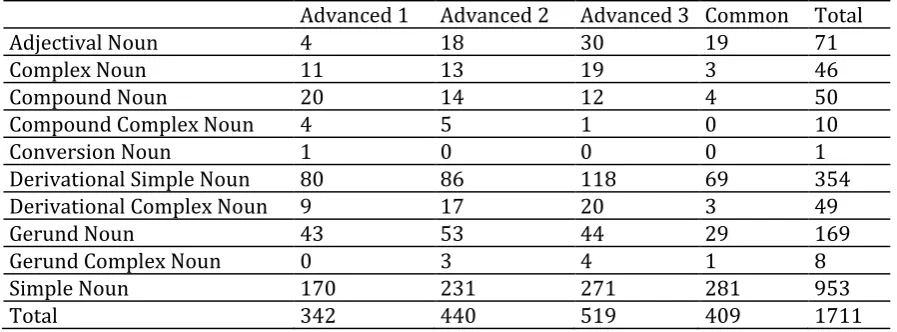
Table 7. Descriptive statistics for noun types
Advanced 1 Advanced 2 Advanced 3 Common Total
Adjectival Noun 4 18 30 19 71
Complex Noun 11 13 19 3 46
Compound Noun 20 14 12 4 50
Compound Complex Noun 4 5 1 0 10
Conversion Noun 1 0 0 0 1
Derivational Simple Noun 80 86 118 69 354
Derivational Complex Noun 9 17 20 3 49
Gerund Noun 43 53 44 29 169
Gerund Complex Noun 0 3 4 1 8
Simple Noun 170 231 271 281 953
Total 342 440 519 409 1711
DISCUSSION
The semantic schemata belonging to open set items (Quirk, et al. 1985) are joined to each other by syntactic and parasyntactic schemata in order to express the conveyor's message (Khodadady, Alavi & Khaghaninezhad, 2012). On the other hand, syntactic schemata are said to be closed set items by being limited in type. The results found in this study confirm the fact that syntactic schemata are closed as it was found that 98% of the syntactic domain tokens and 59 % of the syntactic domain types were common to the 3 books. Focusing on the semantic schemata, as was mentioned above, there were a number of semantic schemata that were distinctly as well commonly used in the three textbooks. It was also found that nouns formed the majority of schemata in all the three books, especially simple nouns and derivational simple nouns. Frequency analysis of the simple nouns and derivational simple nouns were, therefore, carried out. The simple nouns boys, girls and gender were the most frequent in Advanced 1, the nouns stage, country and house in Advanced 2, the nouns sister, brother and siblings in Advanced 3 and the most frequent common nouns were people, life, time, work and friend. Among the derivational simple nouns, the words installation and technology were the most frequent in Advanced 1, traveler and setter in Advanced 2, friendship and population in Advanced 3 and children, women, product, psychologist and student were the most frequent in the three books. The use of words such as boys, girls, sister, brother, siblings, people, friend, friendship, children and women were not only specific but also common in the three books indicating the importance given to people and their kinship relationships.
highlighting and focusing on this very natural process, schema theory accounts for the ever-evolving and dynamic nature of schemata they are encountered in various contexts in real life (p.38).” Extending Khodadady and Bagheri’s idea to this study, let’s consider the kinship terminology used in sentences in the analyzed texts. For instance, in Advanced 1, the sentence Most young Chinese adults have no brothers or sisters and face the prospect of having to care for two parents and four grandparents on their own has 4 kinship terminology. When these schemata are analyzed on a sentential level, they indicate social, emotional and psychological relationships when used in interaction with other schemata on a cognitive level. The young adults are tied emotionally to their parents and grandparents, whereas taking care of parents and grandparents on their own can affect them socially and psychologically.
Similarly, when analyzing the sentence in an Advanced 2 text Work is a community, the place where we meet friends and form relationships, a provider of our social as well as our work life, it can be seen that the use of schemata like community, friends, relationships, social and work life indicate intricate emotional and social connections among the participants. Considering the sentences in Advanced 3 such as Friendship is as old as humanity and as important as love or justice; During childhood, sisters and brothers are a major part of each other’s lives, for better or for worse; … parents and sometimes spouses gone, brothers and sisters often turn to each other for a special affinity and link to the past, it can be further seen that the schemata such as friendship, humanity, important sisters, brothers, affinity among others indicate the underlying emotional, social and psychological relationships among these schemata on a sentential level.
According to Miller (2007), popular media such as television inculcates moral and idealized models of relationship indicating the intervention between the academic literature and the everyday life. Miller focuses here on television programs, mentioning that in many countries the classic sitcoms are part of the daily fare of television over the last few decades. The sitcoms such ascorbic Show, Rosanne, Malcolm in the Middle or cartoons such as the Simpsons are set in family situations. This situation is not specific to a particular country like the US but also in other countries like India and Iran, where family relationships form the major theme of programs. This concept can also be applied to academic literature such as textbooks, in which family relationships and friendship form the core ideology. All of them share a basic message around a shared ideology based on the idealized normative roles expected of family relationships.
life including academic life in Iran as brought up by the three textbooks taught at advanced levels in the ILI.
CONCLUSION
According to Khodadady (2008), schema theory provides a coherent basis to categorize all concepts expressed in texts into three categories: semantic, syntactic and parasyntactic. The findings of this study provide further empirical evidence to Khodadady's claim that the categorization of schemata into semantic, syntactic and parasyntactic domains is psychologically valid and real. The findings further support the rationale that the domains and their constituting genera and species can be used to study possible or hypothetical differences among texts written in different fields. Furthermore, the schema theory provides empirical rationale for determining the range of schema knowledge that is needed to acquire proficiency or at least accuracy in a given language. The present study indicates that, for instance, even though a learner of a new language needs to acquire all 3 kinds of schemata (semantic, syntactic and parasyntactic), one can never fully acquire the semantic schemata due to its openness, being wide in scope and range, and also its additive capacity i.e., new semantic words are added to languages to keep up with the current trends. Moreover, this study supports Khodadady and Bagheri’s (2014) claim that once a word is looked up in a dictionary or even any text, it becomes a schema.
Hence, a teacher of language has to present semantic schemata such as “understanding” and “realizing” in such a way as to enable learners to differentiate them on the basis of their linguistic contexts, i.e., sentences, and what they represent conceptually in combination of other words comprising the sentences, i.e., species. In other words, while the schemata “realize” and “understand” might invoke the same concept in a reader’s mind in isolation, only “understand” can combine with the schema “Arabic” to express “I understand Arabic” as a species. Furthermore, it is the teachers' responsibility to make sure that students comprehend a text by creating a cognitive structure or framework in which they can develop the broader cognitive concepts of genera and domains represented by paragraphs and passages, respectively. In other words, these are the writers’ words and their specific combinations with each other within sentences and paragraphs which generate a passage. The readers which grasp what the writers have said if they acquire the schemata, species, genera and domain represented by the words, sentences, paragraphs and passage, respectively.
The linguistic and cognitive structures explained by the microstructural approach of schema theory will help teachers present schemata such as those dealing with kinship relationships within an authentic context in which they convey certain concepts not only by themselves but also in combination with other schemata constituting the sentences, paragraphs and passage of which they form a part (Khodadady & Hesarzadeh, 2014). In other words, semantic, syntactic and parasyntactic schemata must be understood in terms of the broader cognitive concepts they produce when they form species, genera and a specific domain represented by the sentences and paragraph of a given text, respectively. Since the number of syntactic and parasyntactic schema types are far fewer than the semantic ones, the main focus of teaching must be semantic schemata and their combination with each other within species, genera and domain.
REFERENCES
Allwright, R. (1982). What Do We Want Teaching Materials For? ELT Journal, 36(1), 5-18.
Aloqaili, A. S., (2012). The relationship between reading comprehension and critical thinking: A theoretical study. Journal of King Saud University – Languages and Translation, 24, 35–41
Brown, H.D. (2001). Teaching by principles: An interactive approach to language pedagogy (2nded.). White Plains, NY: Pearson Education.
Carrell, P. L. (1983). Some issues in studying the role of schemata, or background knowledge, in second language comprehension. TESOL Convention (pp. 81-92). Toronto: Canada.
Carrell, P. L. (1984). Schema theory and ESL reading: classroom implications and applications. The Modern Language Journal, 68(4), 332-343
Eggan, F. (1968). Kinship. International Encyclopedia of the Social Sciences. Retrieved from http://www.encyclopedia.com/topic/kinship.aspx
Ghani, A. (2012). Coherence and Schematic Correlation in William Blake and Gerard M. Hopkins‘s Selected Poems. Unpublished MA dissertation, College of Languages. Hale, G. G. (2009). A cognitive schematic analysis of film. Unpublished PhD Dissertation,
University of York.
Iran Language Institute, (2008). The ILI English Series, Advanced 1: Student's Book (1st
ed.). Offset Printed House.
Iran Language Institute, (2008). The ILI English Series, Advanced 2: Student's Book (1st
ed.). Kanoonchap.
Iran Language Institute, (2009). The ILI English Series, Advanced 3: Student's Book (1st
ed.). Kanoonchap.
Khodadady, E. (1997). Schemata theory and multiple choice item tests measuring reading comprehension. Unpublished PhD Thesis, the University of Western Australia.
Khodadady, E. (1999). Multiple-choice items in testing: Practice and theory. Tehran: Rahnama.
Khodadady, E. (2008). Schema based textual analysis of domain controlled authentic texts. Iranian Journal of Language Studies, 2(4), 431-448.
Khodadady, E., Alavi, S.M., &Khaghaninezhad, M. S. (2012). Schema-based instruction and general English courses at Iranian universities. Iranian EFL Journal, 8 (2), 44-68.
Khodadady, E. &Bagheri, N. (2014). Development and validation of Islamic religious orientation scale with pilgrims of Imam Reza Shrine. Journal of Arts and Humanities, 3(8), 37-50.
Khodadady, E. &Elahi, M. (2012). The Effect of Schema-Vs-Translation-Based Instruction on Persian Medical Students’ Learning of General English. English Language Teaching, 5(1), 146-165.
Khodadady, E. &Eslami, S. (2013). A Comparative Analysis of Two English Translations of Ya Seen (Q.36): A Schema-Based Approach. International Journal of Business and Social Science, 4(13), 168-178.
Khodadady, E. & Gholamian, M. (2014). Motivations Underlying Blind Students’ English Language Learning: A Theoretical and Factorial Analysis. International Journal of Applied Psychology, 4(5), 169-180.
Khodadady, E., & Herriman, M. (2000). Schemata Theory and Selected Response Item Tests: From Theory to Practice. In A. J. Kunnan (Ed.), Fairness and validation on language assessment. Cambridge: CUP, pp. 201-222.
Khodadady, E. & Hesarzadeh, R. (2014). The Effect of Schema-vs-translation-based Teaching on Learning English in High Schools. Theory and Practice in Language Studies, 4(1), 143-154.
Khodadady, E. & JavadiMehr, S. (2012). Schema-Based Analysis of Gendered Self-Disclosure in Persian: Writing for Dating Context. English Language Teaching, 5(1), 20-31.
Khodadady, E. & Lagzian, M. (2013). Textual Analysis of an English Dentistry Textbook and Its Persian Translation: A Schema-Based Approach. Journal of Studies in Social Sciences, 2(1), 81-104.
Khodadady, E. & Moosavi, E. (2015). Spiritual Intelligence and English Language Learning at a Specific Grade in Secondary Education. Theory and Practice in Language Studies, 5(9), 1801-1808.
Klein-Braley, C. (1997). C-Tests in the context of reduced redundancy testing: an appraisal. Language Testing, 14(1), 47-84.
McNeil, J. D. (1987). Reading comprehension: New directions for classroom practice. Glenview, IL: Scott, IL, Foresman, and Company.
Miller, D. (2007). What is a relationship? Kinship as negotiated experience. Ethnos, 72(4), 535-554.
Poplin, M. S. (1988). Holistic/ constructivist principles of the teaching/ learning process: Implications for the field of learning disabilities. Journal of Learning Disabilities, 21, 401-416.
Quirk, R., Greenbaum, S., Leech, G. & Svartvik, J. (1985). A comprehensive grammar of the English language. London: Longman.
Richards, J. C (2001). Curriculum Development in Language Teaching. Cambridge: Cambridge University Press.
Semino, E. (1995). Schema theory and the analysis of text worlds in poetry. Language and Literature, 4(2), 79-108.
Shen, Y. (2008). An Exploration of Schema Theory in Intensive Reading. English Language Teaching, 1(2), 104-107.
Wang, H. (2014). The Comparative Analysis of Micro-reading and Traditional Reading Based on Schema Theory. International Journal of Social, Behavioral, Educational, Economic and Management Engineering, 8(6), 1937-1939.
Xiao-hui, L., Jun, W., & Wei-hua, W. (2007). An analysis of schema theory and its influence on reading. US-China Foreign Language, 5(11), 18-21.
Yekovich, F. R., & Walker, C. H. (1988). The activation and user of scripted knowledge in reading about routine activities. In B. Britton, & S. M. Glynn (Eds.), Executive control processes in reading. Hillsdale, NJ: Lawrence Erlbaum Associate.