with a Domain-Specific Thesaurus
Automatische Schlagwort-Indexierung mit einem dom¨anen-spezifischen Thesaurus
Magisterarbeit zur
Erlangung der W¨urde des Magister Artium
der Philologischen, Philosophischen und Wirtschafts- und Verhaltenswissenschaftlichen Fakult¨at der
Albert-Ludwigs-Universit¨at Freiburg i. Br.
vorgelegt von
Olena Medelyan aus Kertsch, Ukraine
WS 2004/2005
Contents
Abstract (in German) 2
Acknowledgements 4
1 Introduction 5
1.1 Keywords, keyphrases and keyphrase sets . . . 5
1.2 Motivation of the research . . . 7
1.3 Thesis statement . . . 8
1.3.1 Controlled keyphrase indexing . . . 9
1.3.2 Semantic relations . . . 9
1.3.3 Towards improved indexing consistency . . . 10
1.4 Basic concepts . . . 10
1.5 Outline . . . 12
2 Related work 15 2.1 Keyphrase extraction . . . 15
2.1.1 Machine learning methods . . . 16
2.1.2 Symbolic methods . . . 18
2.1.3 Terminology extraction . . . 19
2.2 Keyphrase assignment . . . 21
2.3 Extraction vs. assignment . . . 23
2.4 Indexing theory and cognitive processes . . . 25
3 Experimental data and evaluation strategy 29 3.1 Document collection . . . 30
3.2 The Agrovoc thesaurus . . . 31
3.3.1 Indexing performance of algorithms . . . 34
3.3.2 Inter-indexer consistency . . . 35
3.3.3 Limitation of evaluation methods . . . 36
3.4 Semantic based similarity measures . . . 38
3.4.1 Level-based similarity . . . 39
3.4.2 Vector based similarity . . . 40
3.5 Human experts’ keyphrases . . . 42
3.5.1 Statistics on indexers’ keyphrase sets . . . 42
3.5.2 Relations among assigned keyphrases . . . 45
3.5.3 Estimating similarity coefficients . . . 46
4 KEA++: Keyphrase Extraction Algorithm for controlled indexing 51 4.1 Identifying candidates and term conflation . . . 52
4.2 Extending candidate selection . . . 55
4.3 Feature definition . . . 56
4.4 Building the model . . . 58
4.5 Computing feature values . . . 60
5 Evaluation and analysis 61 5.1 Automatic evaluation . . . 62
5.1.1 Evaluation of candidate identification . . . 62
5.1.2 Evaluation of the filtering technique . . . 63
5.2 Indexing consistency . . . 67
5.3 Manual analysis of results . . . 70
5.3.1 PDF to text conversion errors . . . 70
5.3.2 Conflation mistakes . . . 72
5.3.3 Proper nouns . . . 74
5.3.4 Partial matching . . . 75
5.3.5 Low or zero occurrence frequency . . . 76
5.4 Final results . . . 76
6 Conclusions 81 6.1 Proof of the hypotheses . . . 81
6.1.1 Free vs. controlled indexing . . . 82
CONTENTS iii
6.1.3 Towards improved indexing consistency . . . 83
6.2 Possible extensions . . . 84
6.2.1 Other languages . . . 84
6.2.2 Domain-independence . . . 84
6.2.3 Other applications . . . 85
Zusammenfassung
Schlagwortindexierung ist die g¨angige Form der inhaltlichen Beschreibung von Dokumenten in physikalischen und digitalen Bibliotheken. Schlagw¨orter und -phrasen dienen zur Orga-nisierung der Dokumente entsprechend ihrer Themengebiete, erm¨oglichen inhalt-basierte Suche in einem Katalog und sind n¨utzlich zur Darstellung und Navigation in den Suchergebnis-sen. Zur manuellen Verschlagwortung m¨ussen professionelle Indexierer die Dokumente lesen und verstehen, um danach anhand von Katalogregeln passende Schlagw¨orter aussuchen. Dies ist eine zeit- und kostspielige Aufgabe.
Zwei Ans¨atze zur Automatisierung dieses Prozesses wurden bislang entwickelt. Bei der Schlagwortextraktion werden die intrinsische Eigenschaften von Wortketten in einem Doku-ment, wie z.B. deren H¨aufigkeit und L¨ange, analysiert, um relevante Schlagw¨orter zu identi-fizieren. Bei der Schagwortzuweisung werden die Phrasen aus einem kontrollierten Vokabular als Kategorien gesehen, in die Dokumente aufgrund ihres Inhalts automatisch klassifiziert wer-den. Ein entscheidender Nachteil im ersten Verfahren ist die schlechte Qualit¨at der extrahierten Phrasen: sie sind oft grammatikalisch falsch oder unpassend. Die zweite Methode umgeht dieses Problem, ben¨otigt jedoch ein großes Korpus mit manuell klassifizierten Dokumenten zum Trainieren entsprechender Lernalgorithmen.
vorkommen, anhand dieses Modells analysiert, um relevante Terme festzustellen. Die resul-tierenden Schlagw¨orter sind wohlgeformt und haben eine direkte Beziehung zum Inhalt des Dokuments.
Acknowledgements
During the course of my studies though especially in the main phase, this past year, I received immense support from many people, and I am grateful to have the opportunity to thank all of them in this part of my thesis.
First of all I would like to thank Prof. Ian H. Witten, my supervisor at the University of Waikato. His invitation to write my master thesis at his research group in New Zealand was the beginning of the very valuable and fruitful time. From the day one, Ian made me feel comfortable and welcome in a foreign country and gave me tremendous support throughout writing this thesis. He has been an encouraging and motivating supervisor, who has taught me the essentials of doing research and academic writing. He gave me directions on how to organize and plan a project and how to communicate with other people so that everyone can reap the most benefits from it. Thank you, Ian, for the priceless experience of working with you and the enjoyable after hours with you and your family.
This thesis wouldn’t have been written without the support of Prof. Dr. G¨unter Kochend¨orfer. His willingness to supervise me while I was on the other hemisphere and to allow me to write on an interdisciplinary topic deserves my deep respect and appreciation. Thank you very much for your flexibility.
Prof. Dr. Udo Hahn, who supported me in my studies from the very beginning, deserves a special mentioning. The majority of the theoretical knowledge I applied in this thesis I learned in his inspiring courses. Prof. Hahn also supported me financially by offering student assistance work at his research group at the University of Freiburg. I am very grateful for your help in facilitating my studies in Germany and all the valuable knowledge in Computational Linguistics I received from you.
discus-sions and the prompt support in applying for this exchange program.
Thanks to the Department for Computer Science at the University of Waikato for offering me a study award and conference funding. I learned to love the excellent research environment and the friendliness of my colleagues here.
An important part of my studies in Freiburg and Hamilton was the student life beside the university. I was lucky to meet the most exciting people in both towns and to share unforget-table experiences with all of them. Thanks for the great time, your friendship and backing in all the difficult moments.
A special thank you deserves Michael Poprat, who accompanied my studies as a great friend and partner. He was always there for me, when I needed help, and made me feel safe and happy. His support through the last years is beyond all words. I am glad that I met you and very thankful for everything you have done for me.
Finally, I would like to thank my parents, who instilled in me a thirst for knowledge and foreign languages from the young age, which all turned out to be of a great benefit for my studies. Thank you for the permanent encouragement to do great things, teaching me to be confident and stay optimistic and for making my education in Germany possible.
Chapter 1
Introduction
Searching for information has become a common activity for everyone who uses computers in everyday life. While the Internet offers an unfathomable source for satisfying most inquiries, finding the documents that contain necessary information is still a challenging task, often com-pared figuratively to the problem of finding a needle in a haystack. Formulating correct and accurate search terms is the key problem in an electronic search. In online library catalogues users are supported by controlled vocabularies that set forth potential search phrases. The aim of these vocabularies is to organize documents into groups labeled by keywords or keyphrases that correspond to their salient concepts. These keywords are selected manually by professional human indexers and provide quick content-based access to library holdings.
Because of the importance of keyphrase indexing and the impossibility of manually index-ing the constantly growindex-ing panoply of electronic documents, methods for assignindex-ing keyphrases automatically are in great demand. Existing approaches for automatic keyphrase extraction and assignment do not achieve sufficiently high indexing performance to be of practical use. This is obviously caused by their restriction to syntactic and statistical properties of extracted phrases. I propose a new method that enhances keyphrase extraction by semantic information on terms and phrases, contained in a domain-specific thesaurus. Comparing the results with manually-assigned keyphrase sets reveals the utility of the approach.
1.1
Keywords, keyphrases and keyphrase sets
terms or phrases that describe the content of a document and, additionally, group and organize library holdings. Documents that deal with the same subject are grouped together and can be accessed quickly by selecting a particular subject heading. Like subject headings keywords and keyphrases can be selected from a standardized set of descriptors called acontrolled vo-cabulary. Another way of assigning keywords is to extract them from the document’s body or, as frequently done by librarians, solely from its title.1 Compared to full-text indexing, where all terms that appear in the document are stored in a database, keyword or keyphrase indexing require notably less storage and provide a concise overview of thematic areas covered by the document collection as a whole and each document in particular.
Akeyphrase implies a multi-word lexeme (e.g. computer science), whereas a keyword is a single word term (e.g. computer). Humans seem to prefer keyphrases to keywords. In the training collection used in this project about 68% of humanly assigned keyphrases contain more than one word (see Section 3.1 for further details). Hulth (2004) reports that over 86% of the keyphrases in her collection are multi-word lexemes. The number varies depending on the purpose for which keyphrases are intended: Shorter phrases can organize small collections of documents into larger thematic groups, whereas longer ones describe the document’s content more precisely. Phrases longer than one word are potentially more useful for keyphrase search. Search engine query logs show that people tend to use longer phrases in order to describe the subject they are looking for (e.g. Silverstein et al. (1998) estimate the average query length in an Altavista query log as 2.4 terms). Therefore this thesis focuses on determining keyphrases rather than keywords, but refers to both terms by the wordkeyphrase.
In this work the main emphasis is to identify keyphrases as descriptors of the document’s content. The purpose of the thesis is to detect keyphrases that are terms or phrases from a controlled vocabulary that may or may not appear in the document verbatim. The intention is to determine akeyphrase set consisting of several keyphrases. Each keyphrase should represent one of the main topics in a given document, and the keyphrase set should cover the thematic scope of the entire document. In other words, the keyphrase set should summarize what the document is about.
1
1.2 Motivation of the research 7
1.2
Motivation of the research
Keyphrases are useful metadata in physical and digital libraries and help to organize the hold-ings based on their content. Their most important advantage over other metadata such as title, author name, or date of publication, is that they support thematic access to the documents.2 As search engines became everyday tools for all who work with the Internet (or corporate intranets), people learn to express their information needs in terms of search queries. Conse-quently, they prefer to use this kind of search in conventional catalogs as well. User surveys on online catalog systems (e.g. Engl et al. (1997)) show that about 30% of search queries are keyphrases, and users consider keyphrase search as important as title and author search.
Another advantage of keyphrases is their multi-functionality. A series of recent publica-tions explored how keyphrases and keyphrase sets can be used for various natural language processing applications such as text clustering and classification (Jones and Mahoui 2000), content-based retrieval and topic search (Arampatzis et al. 1998), automatic text summariza-tion (Barker and Cornacchia 2000), thesaurus construcsummariza-tion (Paynter et al. 2000), representing search results (Hulth 2004), and navigation (Gutwin et al. 1998). The effectiveness and utility of these approaches depend on the quality of the keyphrases that have been assigned. There-fore, it is important to have accurately selected descriptors, ideally provided by human experts.
Depending on the situation, keyphrases are sometimes assigned by the document’s authors, e.g. for articles in conference proceedings. In cataloguing, documents are usually indexed by professional indexers, partly because most documents lack author-defined keyphrases, and most importantly because this is the only way to achieve indexing consistency over the entire library holdings. Assigning high-quality keyphrases by humans is an expensive and time-consuming task. Professional human indexers must scan each document and select appropriate keyphrases from the library’s own vocabulary according to defined cataloguing rules. Nowa-days libraries spend more money on employees than for new books or journal subscriptions (Hilberer 2003). Given the constant growth of the Internet and the popularity of digital lib-raries, manual keyphrase indexing is completely impractical. Therefore accurate and effective methods for automatic keyphrase indexing are in great demand.
Existing approaches to keyphrase extraction and assignment are based on simple statistical algorithms that analyze the frequencies of character strings extracted from a document collec-tion. Some authors report that they could improve performance by enhancing their system with
2
linguistic knowledge (Hulth (2004); Paice and Black (2003)). At the same time, automatic in-dexing methods rarely make use of any semantic information. The meaning of the terms in the documents, and the relations between them, are generally ignored. In this thesis, an automatic keyphrase indexing method is designed that analyzes both the statistical behavior of phrases and their semantic characteristics encoded in a thesaurus.
1.3
Thesis statement
Existing approaches to automatic keyphrase indexing are realized either as an extraction process or as an assignment process. In keyphraseextraction terms and phrases that appear in the document verbatim are analyzed to select the most representative ones. Inassignment documents are instead classified into a pre-defined number of categories corresponding to keyphrases (cf. Chapter 2). In this thesis I extend the state-of-the-art keyphrase extraction algorithm KEA3into a new version KEA++ that combines these two approaches into a single process, where terms and phrases are extracted from documents but need to be present in a controlled vocabulary in the first place. The indexing process is extended by analyzing seman-tic information about the document’s terms, i.e. their relations among each other and to other terms in the thesaurus.
Another important issue studied in this thesis is measuring the performance of keyphrase indexing. Previous studies in this area evaluated results based on exact matching of phrases assigned from two sources, one human and the other automatic. Semantic similarity of keyphrases was basically ignored. This thesis explores semantic relations between keyphrases as essential constituents in measuring indexing quality between human assessors and the algo-rithm.
The striking deficiencies in the current manual and automatic keyphrase indexing, as well as the possibilities for improvement mentioned above, suggest the following hypotheses:
1. Keyphrase extraction can be improved by using controlled vocabulary. 2. Using semantic relations between terms enhances indexing performance.
3. Automatic keyphrase indexing can achieve the same degree of indexing consistency as professional indexers.
Although it is apparent that computer systems will never be able to compete with human performance in tasks that require understanding of the meaning of words, the possibility of
3
1.3 Thesis statement 9
enhancing automatic keyphrase indexing by semantic information suggests that it may finally become utilizable in real-world scenarios. The goal of this thesis is to prove this empirically. Through the implementation and evaluation of KEA++, we determine whether or not the above three hypotheses are valid. The following subsections discuss them in detail.
1.3.1 Controlled keyphrase indexing
Keyphrase extraction implies that all keyphrases appear in the document verbatim. Of course, human authors or indexers are not subject to this constraint. The use of free text rather than a pre-defined set of index terms has the potential disadvantage that keyphrases are neither normalized nor restricted to a particular vocabulary. This reduces consistency compared to keyphrase assignment, even among professional indexers (Leininger 2000). The probability of achieving higher levels of consistency grows as the size of the controlled vocabulary used for indexing decreases. Therefore, automatic controlled keyphrase indexing has a greater chance of being solved in a way that competes with human performance.
Beside the restrictive function of controlled vocabularies they also usually provide a hie-rarchical structure that can be explored for keyphrase indexing in different ways. The domain specific thesaurus Agrovoc,4utilized for indexing of the document repository of the Food and Agriculture Organization of the United Nation (FAO), is probably the best example for this. KEA++ is not restricted to assigning only extracted phrases, but they must appear in Agrovoc. Additionally, KEA++ explores the semantic relations integrated in Agrovoc’s structure, which is the basis for the next hypothesis.
1.3.2 Semantic relations
When humans assign keyphrases, they need in the first place to understand what the document is about. Understanding the document’s content requires understanding the main concepts in it, and how they relate to each other. Both the text and the knowledge available to the reader can be expressed as a semantic network, in which terms are connected to each other by semantic relations based on the similarity of their meaning and usage.
Agrovoc has such a network similar structure, where terms and phrases are connected by semantic relations such as hierarchicalIS-A links (between a broader and a narrower term) and by associative links, if terms are related in any other way to each other. KEA++ extends the number of concepts that are associated with a document due to their verbatim appearance
4
by terms that are connected to them by these semantic relations. This increases the statistical probability of finding correct keyphrases for indexing. Another enhancement for indexing is to consider the characteristics of semantic relations between terms, i.e. the number of other terms in the document that are connected by different relations to a candidate keyphrase.
1.3.3 Towards improved indexing consistency
Inter-indexer consistency is computed as the average overlap between keyphrase sets assigned by two or more professional indexers to a set of documents, and reflects the potential quality of index terms in a library catalog. Experiments on indexing consistency reveal that humans seldom assign exactly the same keyphrase sets, because their understanding of the documents and their background knowledge differ. Therefore, evaluating the performance of automatic keyphrase indexing algorithms against keyphrases assigned by a single person may be mislead-ing. Moreover, it is important to know how the consistency of automatic indexing compares to that of human indexing. In this project, a document set was indexed by six professional index-ers and by KEA++. A comparison of the average consistency between humans and between KEA++ and all indexers will show whether the algorithm can achieve an applicable level of indexing quality. Missing phrases, or phrases that do not match exactly, are unavoidable even in keyphrase sets assigned by professional indexers. Thus, the similarity of keyphrases, esti-mated through semantic links in the Agrovoc thesaurus, is an important issue investigated in this thesis and will be included in measurements of consistency.
1.4
Basic concepts
This thesis addresses an interdisciplinary topic and requires understanding of basic concepts in both linguistics and computer science. This section presents briefly the main terms that will be mentioned in following chapters.
1.4 Basic concepts 11
usually by stripping each word of its derivational and inflectional suffixes”. Algorithms that iterate from left to right and remove affixes till the word root can be separated use lists with possible inflectional endings. More sophisticated approaches are required for languages with agglutinative features, where words are formed by joining morphemes together (e.g. decom-pounding algorithms for Germanic languages).
Two different words can be also conflated due to their semantic similarity, for example if they are synonyms. Lexical databases and thesauri are usually required for establishing semantic relations between terms.
Vector Space Modeling To represent and process documents in a vector space three stages are required. In the first stage single terms in a document are identified, e.g. by dividing it into tokens separated by space symbols. It is common to ignore all tokens that are stopwords – very frequent and not content bearing words, e.g. articles, propositions, adverbs, etc. Each document in the collection can be represented then as a vector, where each element indicates presence or absence of a word in a document. This is the so called “bag of words” representa-tion.
The second stage is the weighting of the terms according to their appearance frequency in the entire collection and in the given document. Salton and McGill (1983) showed different weighting schemes, and in particular the popularT F ×IDF technique. TF stands forterm frequency and is computed relatively to the total number of words in the document. IDF is the inverse document frequency, computed as the number of documents that contain a given term divided by the total number of documents in the collection. It is common to takelog2 of the document frequency to normalize the overall term weight.
The last stage includes computing similarity between vectors in the resulting space to build clusters of similar documents or to rank documents according to their similarity to the user’s query, also represented as vector. The most common similarity measure is the cosine coeffi-cient, which measures the angle between two vectorsDa andDb according to the following
formula:
Sim(Da, Db) =
Pn
i=1wai∗wbi
qPT
i=1(wai)2∗
PT
i=1(wbi)2 ,
wherewai andwbiare the weights of the term ti in the documentsDa andDb respectively.
This measure returns a value between 0 (no similarity) and 1 (identical documents).
scheme used to interpret them. In the first place, the characteristics of the input data are ana-lyzed statistically. Then, this information is used to create a learning model that describes the solution of the problem according to a pre-defined function called learning scheme. Depending on the problem type different learning schemes can be applied. For the task described in this thesis theNa¨ıve Bayes scheme is suitable. It is based on conditional probability rule defined as following: Given a hypothesisHand an eventE, the probability that H holds given this event is:
P r[H|E] = (P r[E|H]P r[H])
P r[E] ,
whereP r[A]is the probability of eventAandP r[A|B]is the probability ofAgiven another eventB. This is a simple method, called na¨ıve because all events are assumed to be independent of one another. However, in practice it was proven to be very effective (Witten and Frank 1999).
Evaluation of training performance To evaluate the performance of the learning scheme the experimental data (e.g. a document collection) needs to be split into two sets, where the first one serves for training and the second for testing purposes. The training set is analyzed to adjust the computational model to the characteristics of the data. The test set remains untouched and serves solely for testing purposes. Splitting is usually made randomly, but especially when the collection is small, the results depend on what document turn to appear in each set. To keep the evaluation unbiased towards data’s properties, an extension of this strategy called10-fold cross-validation is useful (Witten and Frank 1999). Here, the document collection is divided randomly into ten sets. Ten separate evaluational runs are performed with training on nine sets and testing on the remaining one sets, so that every set is used nine times for training and once for testing. The results are taken as an average over all runs. Further improvement is possible, where the 10-fold cross-validation is repeated ten times on ten random split-ups, with 100 experimental runs in total. Due to practical reasons, only a single 10-fold cross-validation is applied for the automatic evaluation in this thesis.
1.5
Outline
1.5 Outline 13
chapter discusses the indexing task as performed by humans. Because understanding the doc-ument’s content is the main phase in human indexing, we also introduce some approaches to the study of human text comprehension.
Chapter 3 gives an overview of experimental data used in this project and describes the evaluation strategy. A deep analysis of the Agrovoc thesaurus (Section 3.2) and keyphrase sets assigned by professional indexers (Section 3.5) provides valuable insights into semantic relations between terms that are integrated in the experiments described here. The problem of estimating semantic similarity between keyphrase sets, based on the individual relatedness of phrases in one set to phrases in another, takes up an important part of the chapter.
The detailed explanation of the keyphrase extraction algorithm KEA++ in Chapter 4 starts with the description of term extraction and conflation. It demonstrates the main idea behind merging keyphrase extraction and assignment into a single keyphrase indexing procedure, by mapping extracted terms to entries in a controlled vocabulary. Sections 4.2 and 4.3 describe further extensions of the state-of-the-art approach such as candidate selection with respect to semantic relations in the thesaurus and new features implemented in KEA++. The chapter also explains the learning scheme used to build the model from the training collection and its application to new documents, where keyphrases need to be extracted automatically.
Chapter 5 presents the evaluation of the automatic keyphrase indexing method according to the metrics elaborated in Chapter 3. The candidate extraction technique and filtering method are evaluated automatically on the main document collection. These results demonstrate the improvements achieved by controlled indexing strategy and the new developed features. To compute the inter-indexer consistency KEA++ is also tested against data provided by six pro-fessional indexers. These results are considered as the main indicator of KEA++’s perfor-mance. Manual analysis of the results reveals sources for errors produced by the algorithm, some of which can be avoided with small modifications. The last section repeats the evaluation after these final changes and demonstrates some typical keyphrases extracted with KEA++.
Chapter 2
Related work
Due to the increasing popularity of electronically available documents (company databases, digital libraries, and webpages) efficient access methods became necessary. To provide content-based search text processing tools for automatic indexing, terminology extraction, document classification, keyphrase assignment and extraction are required. There is a large variety of methods developed for these tasks. While some of these problems are well solved (e.g. Jacquemin and Tzoukermann (1999) report that their system archives recall and precision near 100% for indexing on terms and their variants within a restricted domain), keyphrase index-ing is still a challengindex-ing problem: Maximal reported F-measure value for automatic evaluation against author’s phrases1 is 45% (Hulth 2004). This can be explained by the difficulty of the task and the problematic evaluation of indexing algorithms, since even professional human in-dexers often disagree on what phrases are significant for a given document (See Sections 3.3.2 and 3.5 for further discussion).
This chapter begins with an overview of current achievements in keyphrase extraction, assignment and related areas. The comparison of these two strategies for keyphrase indexing reveals the reasons for sparse efforts in both approaches. The chapter ends with background on human indexing and related work in the area of cognitive linguistics, which sheds some light on the indexing specific cognitive processes and motivates the keyphrase indexing method proposed in this work.
2.1
Keyphrase extraction
Keyphrase extraction is usually realized in two stages:
1
1. Selecting candidates. All content words (non-stopwords) and phrases (concatenation of content words or combined with stopwords) are extracted from the document. Alter-natively, a part of speech (PoS) tagger and a shallow parser are used to identify noun phrases (NPs).
2. Filtering. Analysis of selected candidates and filtering heuristics are applied to deter-mine keyphrases among them.
Filtering methods can be classified into machine learning and symbolic approaches ac-cording to the techniques they use. While machine learning methods build a statistical model from the training data (cf. Section 1.4), in symbolic methods researcher deduce best possible filtering heuristics based on manual analysis of documents and their keyphrases.
2.1.1 Machine learning methods
Keyphrase extraction can be seen as supervised learning from examples. The main problem is to define informativefeatures that can be determined for each phrase and used to distinguish keyphrases and non-keyphrases among the candidate terms. A learning algorithm needs two sets of documents with manually assigned keyphrase sets, where the first is used for training, i.e. to createclassification model, and the second one for evaluation of this model. All phrases in the documents of the training set can be seen as positive and negative examples. The training scheme learns the model by analyzing feature values for each example. The performance of this model is then evaluated on unseen documents from the test set.
KEA The research group for machine learning at the University of Waikato developed the Keyphrase Extraction Algorithm KEA,2 based on robust and simple methods (Frank et al. (1999), Witten et al. (1999)). In the first stage of keyphrase extraction KEA determines textual sequences defined by orthographical boundaries such as punctuation marks, numbers, new lines and splits these sequences into tokens. All n-grams, i.e. single words or concatenations of two and more tokens, that do not begin or end with a stopword are candidate keyphrases. KEA stems each candidate with the iterated Lovins (1968) stemmer, but keeps the most frequent full version of a phrase for the output. In the filtering stage KEA computes two features for each candidate: theT F ×IDF measure (a phrase’s frequency in a document compared to its frequency in the document collection, (Salton and McGill 1983)) and the distance of the phrase’s first occurrence in the document from its beginning. ANa¨ıve Bayes (Domingos and
2
2.1 Keyphrase extraction 17
Pazzani 1997) learning scheme creates training data consisting of two sets of weights: for author’s keyphrases and all other phrases appearing in the document. In the filtering stage the overall probability for each candidate being a keyphrase is calculated based on this data. The candidate phrases are ranked according to the computed probability, and thertop ranked phrases are included into the resulting keyphrase set, whereris the number of phrases the user requested.
GenEx P. Turney from the National Research Council Canada developed a hybrid genetic algorithm for keyphrase extraction GenEx, consisting of two components: Genitor and Ex-tractor (Turney 1999). ExEx-tractor combines a set of symbolic heuristics to create a ranked list of keyphrases. Turney’s candidates are phrases consisting of up to three content words. The candidates are stemmed by truncation: cutting off all terms to the length of 5.3 To filter out keyphrases among the candidates, each of them is scored as its frequency multiplied by its po-sition in text. The scores of the candidates with more than one word are additionally boosted, because they have usually lower scores than single word terms. After removing duplicates and selecting the most frequent full form for each stemmed phrase, Extractor presents top-ranked phrases as output. Extractor has 12 numeric parameters and flags (e.g. boosting factor for phrases with two stems or parameter for number of resulting keyphrases). The steady-state genetic algorithm Genitor4is applied to determine the best parameter settings from the training
data.
A. Hulth presented in her PhD thesis (Hulth 2004) another machine learning technique with additional use of NLP tools. She compared different methods to extract candidate words and phrases: NP chunking, PoS pattern matching and, finally, the trivial n-gram extraction. Match-ing of candidates against the manually assigned keyphrases proved that both lMatch-inguistic oriented approaches produce more correct phrases than n-grams. NP-approach outperformed other can-didate extraction methods additionally by having a smaller amount of incorrect terms. For filtering Hulth uses four features: term frequency, inverse document frequency (unlike KEA, not combined asT F×IDF measure), position of the first occurrence and the PoS-tag (Hulth’s analysis of her experimental data has shown that certain PoS-patterns are more likely to denote
3
Turney (1999) argues that stemming by truncation is much faster than Porter or Lovins stemmer. But such an aggressive stemming has lots of disadvantages: words with different meaning are stemmed to the same string (e.g. contact and container), allomorphs are disregarded (moderate and modest are truncated to different stems) and all words shorter than 5 characters are not stemmed at all (e.g. terms and term).
4
keyphrases). A combination of several prediction models, applied on NP candidates (after removing the determiners at the initial position) yielded best results.
KEA is the simplest keyphrase extraction approach among these systems. GenEx is based on more complex filtering heuristics, but it does not outperform KEA (Frank et al. 1999). Al-though no comparison of all three systems on same document collection exists, Hulth’s evalua-tion results are significantly higher than those reported for KEA and GenEx. She demonstrates that the performance of her algorithm was improved after using linguistic based techniques for candidate selection and classification. Hulth’s observations are a good motivation to explore further NLP techniques for keyphrase extraction and assignment.
2.1.2 Symbolic methods
Barker and Cornacchia (2000) developed a tool they callB&C that does not incorporate any machine learning techniques. To extract candidates they use a simple dictionary lookup to assign basic PoS-tags and a shallow parser to identify all nouns with zero or more pre-modifying adjectives and nouns. In the filtering step, Barker and Cornacchia compute the frequency of the head noun for each candidate phrase and keep all phrases withN top ranked heads. For each phrase they compute its frequency times its length. The topK highest scoring phrases are keyphrases for the given document. N andK are thresholds that are set by the user. Evaluation experiments involving human judges have shown that this simple approach performs as well as Turney’s Extractor (cf. Subsection 2.1.1).
Paice and Black (2003) extract terms from documents that are specific for a particular do-main and can be seen as keyphrases. To archive a higher conflation rate of candidate phrases they transform each extracted n-gram to apseudo-phrase in three basic steps: removing all stopwords from the n-gram, stemming the content terms and sorting them into alphabetical order. This matches similar phrases such as algorithm efficiency, efficiency of algorithms, the algorithm’s efficiency, an efficient algorithm and even the algorithm is very efficient to the
2.1 Keyphrase extraction 19
In a final step, they apply a pattern-based technique to establish semantic roles and relations among remaining phrases. They concentrate their attention on three main roles (INFLUENCE, OBJECT, andPROPERTY) covered by domain-independent patterns such aseffect of IN-FLUENCE on PROPERTY of OBJECT. Phrases which are not covered by any of the
pat-terns are removed. The remaining phrases are presented with information on the roles that have been detected between them. This approach is an interesting symbiosis between keyphrase and information extraction. The authors do not provide any evaluation of their methods, but they present some striking examples.
Keyphrase extraction methods and especially the last presented one are highly related to the area of automatic terminology extraction. Such approaches are advantageous if a database with all terms in a specific field is required. This data is important for various tasks (e.g. content-based indexing, text classification) and is normally collected manually by human experts in a given field. The main difference to keyphrase extraction is that terms are not extracted from individual documents, but from the entire collection.
2.1.3 Terminology extraction
Terminology extraction and keyphrase extraction share the initial problem of term normaliza-tion, which means conflation of morphologically, syntactically or even semantically related terms into the same group (cf. Section 1.4.
FASTR is one of the most prominent examples in this field (Bourigault and Jacquemin (1999), Jacquemin and Tzoukermann (1999), Jacquemin and Bourigault (2003)). FASTR uses a generator of morphologically related terms and a shallow transformational parser with a number of sophisticated conflation rules for terminological indexing of French and English texts. Term extraction starts with statistical PoS tagging. After that FASTR applies derivational analysis on each term in the document collection. This analysis is based on inflectional mor-phological rules and generates as many lexical forms for a given term as possible. For example, for the French stem mortel the following related terms are derived:
[mortel]→[im-[mortel]A]A (immortal)
→[[im-[mortel]A]A-iser]V (immortalize)
→d´es- [[im-[mortel]A]A-iser]V]V(unimmortalize)
→. . .
cor-pus. The remaining forms, grouped into derivational classes, support the morpho-syntactical conflation of terms and phrases. While syntactical variants are identified by coordination or substitution rules (e.g. high tension is a variant of high or medium tension), morpho-syntactic variants imply additional derivational changes of their components. The derivational equiv-alence is estimated by using prior determined classes. The following meta-rule5 identifies
variants of the same conceptN1andN5:
M etarule AtoN(N1 →N2A3)≡N5 →N2(A?P D?A?)N4
< N4 deriv ref erence >=< A3 ref erence >
For example, it conflates phrases such as production industrielle (industrial production) and production actuelle de l’industrie (current production of the industry), where the first phrase
corresponds to the patternN2 A3 and the second toN2 A P D N4. The logical constraint in the second line of the rule above says that it can be applied only ifA3 andN4 are in the same derivational class, which is the case for industrielle and industrie.
Conflating semantic variants is an additional constraint for every type of phrase in the document collection. Two phrases can be conflated if their components are located in the same synset of the lexical database WordNet.6 E.g., the following rule matches phrases such as rigid lens and hard lens as semantic variants:
M etarule SemArg(N1 →A2N3)≡N1 →A4N3
< A2syn >=< A4syn >
FASTR involves a variety of NLP-tools from a finite-state morphological processor over a parser for extraction of terminological transformations to a lexical database. The high amount of manual work makes this approach quite complex and also expensive. But the results show that the efforts are worthwhile. The authors report that their indexing method has a very high precision (97.7%) and increases the recall rate from 72.4% (for simple indexing) to 93,4%, after term conflation (Jacquemin and Tzoukermann 1999).
MOGA is a simple machine learning based system that was proposed by Wu and Agogino (2004) for the same task. They focused attention not on term conflation but on distinguishing terms specific for a given field from generic ones. For this purpose they use a measure called dispersion computed for each candidate noun phrase asM = NE, whereNthe exact number of units that contain the phrase andEis their expected number.Eis computed with a formula that
5The word class abbreviations are the following: Afor adjective,N for noun,P for preposition andDfor
article. The sign?in the meta-rule denotes an optional element.
6
2.2 Keyphrase assignment 21
takes into account the total number of all textual units and the total occurrence of the phrase in the entire document collection. The lower is the dispersionM, the higher is the probability that this term is content-bearing.
The authors use a generic algorithm to determine the best cutoff value of dispersion. The resulting terminology set was evaluated by six human experts in the given specific field (en-gineering design), who considered over 90% of extracted phrases as related to the domain in question. They also cover 80% of the author’s phrases assigned to this document collection manually. Although the purpose of this approach differs from the present project, it would be interesting to consider the dispersion as a feature. Unfortunately the definition ofE is un-clear and the authors also do not clarify their definition of textual units: these could be either paragraphs or sentences in the documents.
2.2
Keyphrase assignment
Keyphrase assignment utilizes keyphrase indexing in an entirely different way. In contrast to keyphrase extraction, it uses a predefined set of keyphrases, a so-called controlled vocabulary. The characteristics of the documents themselves, rather than the individual phrases in them, are analyzed to find appropriate keyphrases from this vocabulary. A keyphrase may or may not appear in the document verbatim. The task of keyphrase assignment is better known as text classification or text categorization, defined as “labelling natural language texts with thematic categories from a predefined set” (Sebastiani 2002, 1). Keyphrase indexing with a controlled vocabulary is referred to askeyphrase assignment or text classification, depending on the con-text.
Scientists have been developing methods for automatic text classification for around fifty years. Until the late ’80s knowledge-engineering experts manually created logical classification rules that were then automatically applied to electronic texts. Since the early ’90s, this task has been explored mainly in the context of machine learning. Different inductive learning schemes have been used to analyze the characteristics of manually classified documents and build the classifier automatically.
A classifier is a function that maps adocument vector to a confidence value that a document belongs to a given class. This value is a number between 0 and 1. A threshold is used to decide whether a particular document can be assigned to a given category or not. A classifier for the class interest could be thus
The process of building classifiers starts with representation of the document in a vector space (cf. Section 1.4). Because of the high number of index terms in a document collection, the resulting vector space is high dimensional and requires a lot of computational resources. The number of dimensions can be reduced by keeping only those terms that are especially useful for the classification process. The usefulness value can be determined computationally with a specified formula (see Sebastiani (2002) for details).
Dumais et al. (1998) compared the effectiveness of classification when using more sophis-ticated techniques such as considering multi-word phrases as single index terms (e.g. new york) or using shallow or deep parsing. None of these linguistically driven methods could improve the accuracy of classifying functions. Lewis (1992), who had similar experience, explained this by low statistical quality of the linguistic indexing methods.
Different learning methods have been applied for text classification. Dumais et al. (1998) compared all main types of classifiers such as Find Similar (vector similarity with relevance feedback), Decision Trees, Na¨ıve Bayes, Bayes Nets and Support Vector Machines (SVMs). The SVM method achieved the highest average precision of 0.87 for classifying around 3,300 documents into 90 categories. This technique has the advantage that it can handle more di-mensions than other methods, and no parameters need to be set. Another technique is to use the so-calledclassifier committees, where the majority vote among different classifier makes the decision. According to Sebastiani (2002), who summarized the performance of different techniques, SVM and classifier committees outperform all other methods.
These experiments were made on a widely-used collection of Reuter’s news articles clas-sified under categories related to economics. The number classification labels is 135. This scenario is far removed from a real-world keyphrase assignment problem, where vocabular-ies comprise thousands of descriptors. Some of the authors use for their experiments the OHSUMED collection, which is a part of a MEDLINE document repository (Joachims (1998), Ruiz and Srinivasan (1999), Mark´o et al. (2003)). Every document in this collection has one or more manually assigned descriptors from the MeSH (Medical Subject Headings) vocabulary, that has in total over 20,500 main headings (descriptors) and over 120,000 synonymic non-descriptors. Joachims (1998) and Ruiz and Srinivasan (1999) use only a small fraction of this vocabulary of around 23 and 120 descriptors respectively.
2.3 Extraction vs. assignment 23
and in the indexing vocabulary onto one or severalsubwords encoded in the lexicon constitu-ing the most important part of the MorphoSaurus system.7 The mapping includes an orthogra-phical normalization of equivalent spellings,8morphological segmentation (leukemia becomes
{leuk, em, ia}) and semantic mapping (equivalent forms are grouped in MorphoSaurus under the same ID). Second, they retrieve normalized MeSH headings that appear in every normal-ized document and score them according to predefined rules. These scores are enhanced by probabilities acquired statistically from a training corpus. The probabilities are computed for every unordered trigram sequence of subwords that co-occur with MeSH headings of the par-ticular document. MeSH descriptors assigned to a given document are ranked according to their total scores. A threshold value defines the resulting set of top ranked keyphrases. The evaluation on 309 abstracts yielded precision of 55% and recall of 26% for the top 5 assigned keyphrases.
The particular advantage of this approach is its language independence. MeSH headings can be assigned to any language that is present in the MorphoSaurus lexicon. Unfortunately, creating such lexical knowledge base requires diligent efforts by people who have to be experts in linguistics and the particular domain (e.g. medicine).
2.3
Extraction vs. assignment
The previous section demonstrates that text classification works well as long as the documents belong to relatively few classes. For example, the text classification software TextCat9has been
successfully used in applications ranging from language identification (trained for 70 classes) to spam filtering (only 2 classes necessary). Keyphrase assignment is a more problematic ver-sion of text classification and cannot be solved with the same strategies, because the amount of training data required increases rapidly with the number of categories grows. Controlled vocab-ularies, even if used in restricted domains, usually consist of several thousands of keyphrases. For example, the United States National Library of Medicine uses more than 22,500 MeSH descriptors for indexing medical articles.
7
MorphoSaurus (http://www.morphosaurus.de/) is developed by the Department of Medical Informatics at Freiburg University, Germany, in cooperation with the Language and Information Engineering Lab at Jena Uni-versity, Germany. It is maintained manually and comprises over 20,000 equivalent classes for English, German, Spanish and Portuguese subwords.
8
For example, changing of “c” before{a, o, u}to “k” and before{e,i}to “z” helps to conflate different German versions of “cancer”: Karzinom, Carzinom, Karcinom etc. There are a lot of similar examples in medical language, since Latin terms are here very frequently.
9
Keyphrase extraction is closely related to keyphrase assignment, but it is resolved with a completely different strategy. It is based on analysis of the properties of keyphrases that can be computed relatively simply and quickly. It is notable that both sophisticated machine learning approaches and simple scoring of candidate phrases or their head nouns yield similar levels of accuracy (Barker and Cornacchia 2000). Their performance is still insufficient to replace the expensive manual work of human indexers. Although a rather large percentage of keyphrases assigned by authors have been reportedly extracted automatically (e.g. Hulth (2004)), these numbers should be taken with a pinch of salt, because they do not contain any information about non-matching keyphrases. When two professional indexers assign keyphrase sets to the same document, these sets usually also match only partially, but all keyphrases are highly related to the document and are definitely grammatical phrases. There is no guarantee for this in automatic keyphrase extraction. In fact, extracted keyphrases are often too general or malformed. Even approaches enhanced by some rudimentary linguistic techniques such as PoS patterns matching or NP chunking tend to extract useless or non-grammatical phrases, because they can not avoid errors generated by the linguistic tools.10
While these technical errors could be improved by using more accurate NLP-tools, keyphrase extraction still has several disadvantages. For example, there is no homogeneity among selected keyphrases, because the extraction process is restricted to the vocabulary of the document’s author. Documents that describe the same subject in different but synonymous words (e.g. seaweed culture and sea weed farming) receive different keyphrases and cannot be grouped together according to their content. Keyphrase assignment avoids this shortcoming by having a controlled vocabulary of indexing terms. Another problem in automatic keyphrase extraction is that it is restricted to syntactic properties of phrases without considering their meaning. These algorithms also ignore the content of the document as a whole and therefore fail to cover all its topics in the keyphrase set. Keyphrase assignment is more advanced in this sense, because it analyzes the content of the document by taking into account the co-occurrence statistics between terms.
These observations show that both keyphrase assignment and extraction have their advan-tages, but also their limitations. Combining the approaches into a single keyphrase indexing system would allow one to benefit from both of them and at the same time avoid their short-comings. The following section starts with a short insight into indexing strategy performed by
10
2.4 Indexing theory and cognitive processes 25
librarian experts. On the one hand, they need to understand the content of the document first, on the other hand, their choice of keyphrases are restricted by cataloguing rules. The processes of understanding the content of the indexed document has not been explored in the context of automatic indexing yet. The indexing theory and the text comprehension issues in cognitive lin-guistics might provide some information for improving current automatic keyphrase indexing strategies.
2.4
Indexing theory and cognitive processes
The goal of keyphrase indexing in library science is to organize library holdings based on their content and to provide fast and unified access to them. Given a document, the task of the indexer is to assign a keyphrase set that reflects its main topics in an exact and precise way and to keep the indexing consistent among all of the documents in the collection.
David et al. (1995) define following key stages in performing this task:
1. Scanning of document: In this stage the indexer recognizes the document’s nature (e.g. research report) and its main parts by using his professional knowledge.
2. Content analysis: In this stage the indexer uses his domain knowledge to determine what the document is about.
3. Concept selection: Among all concepts appearing in the document the indexer chooses those that are representative for the given document.
4. Translation into descriptors: This stage is only important for controlled indexing where central concepts need to be translated into descriptors.
5. Revision: The indexer adjusts his selection to his work environment by comparing his index terms to similar documents in the database.
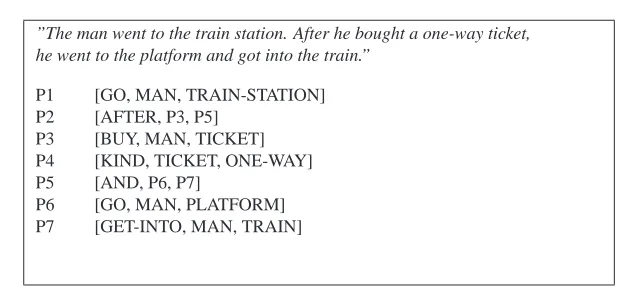
”The man went to the train station. After he bought a one-way ticket, he went to the platform and got into the train.”
P1 [GO, MAN, TRAIN-STATION] P2 [AFTER, P3, P5]
P3 [BUY, MAN, TICKET] P4 [KIND, TICKET, ONE-WAY] P5 [AND, P6, P7]
P6 [GO, MAN, PLATFORM] P7 [GET-INTO, MAN, TRAIN]
Figure 2.1: Example for representation of a text in form of propositions
and text memory are involved in a modified way into current solutions for automatic keyphrase extraction and assignment, the long-term memory is not presented in any of known approaches. To support systems involving automatic text understanding with this kind of external knowl-edge, an automatically accessible knowledge base, represented in a flexible and usable form, is required. A popular type of such knowledge bases issemantic networks, where concepts are connected to each other according to semantic relations between them. Beside the relatively simple and intuitive representation of conceptional knowledge, semantic networks also support another activity involved into text understanding –spreading activation (Collins and Loftus 1975). When a particular concept (node) in the network is activated (e.g. the indexer reads a particular term in the text), other nodes that are related to it are activated as well. Activating nodes allows the avoidance of ambiguities and provides a framework, which represents the scope of the text’s content and its relatedness to the entire knowledge base.
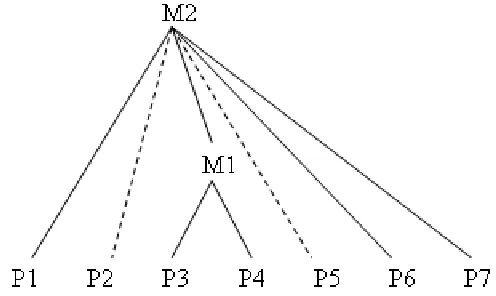
This process is crucial for determining concepts in the document. Concepts, in turn, build uppropositions that denote the meaning of sentences and represent the text base (e.g. P1 to P7 in Figure 2.1). According to Kintsch’s and van Djik’s theory of text understanding (Kintsch and van Dijk 1978), propositions are then transformed mentally into amacro-structure representing the gist of the text. This transformation includes a recursive applying of the so-called macro-rules, such as deletion (elimination of irrelevant propositions), generalization (converting a series of specific proposition to a more general one) and construction (constructing a new proposition from a series of proposition given in text by activating world knowledge). The macro-rules can be represented as edges that connect the propositional nodes into a network representing the macro-structure (cf. Figure 2.2).
2.4 Indexing theory and cognitive processes 27
Figure 2.2: Example macro-structure for the text in Figure 2.2
it is constructed. Figure 2.2 shows a macro-structure that could be created from the text in Figure 2.1. The form of the macro-structure depends on the particular content of the text and the long-term knowledge of a given person. For example, Figure 2.2 represents the construction rule that transforms propositions P1, P6 and P7 and the macro-proposition M1 into a new macro-proposition M2. This macro-proposition is the theme of the given text snippet and could be expressed by a phrase taking the train. Although this information is not explicitly available in text, the reader is able to deduce it from his world knowledge. David et al. (1995) claim that these operations take place when professional indexers perform the second indexing stage, the content analysis.
The third point, selecting the main concepts in a document, can be also observed from the perspective of text comprehension process. Given a longer text, with more than one global macro-proposition, the question is, which are the most important. (Kintsch and van Dijk 1978, p. 78) proposed different strategies of how humans identify the key subjects in texts. For example, those propositions that are more frequent are obviously more important. Frequency is also a common feature in keyphrase extraction algorithms (cf. Section 2.1.1). Another interesting notice made by Kintsch and van Djik is that macro-propositions with the higher amount of ingoing edges are more significant. When one considers the semantic content of the text not as a macro-structure but as semantic network, this observation would mean that nodes with the highest amount of relational links to other nodes in the document are most relevant for its content.
The backgrounds of indexing theory and cognitive linguistics presented briefly in this section provide new ideas of how keyphrase indexing task can be solved automatically. The ideal keyphrase indexing system needs, first of all, to detect the main concepts within a text. Second of all, semantic relations between the document’s concepts and other information (e.g. general world knowledge or domain specific statistics) available to the system should be determined. Thirdly, this information on concepts and relations between them need to be analyzed to create the final set of most significant terms in a particular document.
The most difficult task in designing such a system is to extend it with a large but flexi-ble database containing background knowledge. In computer science, thesauri and ontologies are typically used to encode world-knowledge into computer. A thesaurus is a database with entries representing concepts connected by semantic relations such as synonymy, antonymy, hyper-/hyponymy, mero-/holonymy and others. One of the most popular thesauri,WordNet,11
developed in the Cognitive Science Laboratory at Princeton University, contains more than 150,000 words that are organized into over 110,000 groups representing concepts. WordNet became primarily a practical tool for knowledge-based natural language application and was explored successfully for different tasks, such as information retrieval, word sense disambigua-tion and knowledge engineering (Fellbaum 1998). Using domain-restricted thesauri allows one to limit the number of meanings per term and to reduce the size of the required knowledge database. In this project Agrovoc, a domain-restricted thesaurus for the field of agriculture (Section 3.2), was explored as semantic knowledge base. Chapter 4 describes in detail, how theoretical backdrops of this section were included in the design of the keyphrase indexing system KEA++.
11
Chapter 3
Experimental data and evaluation
strategy
All textual resources employed in this project were obtained from the Food and Agriculture Organization (FAO) of the United Nations.1 The main document collection consists of 200 fulltexts that were downloaded randomly from the document repository of the FAO.2 Both training and automatic evaluation of KEA++ are accomplished on these documents. The actual indexing is based on another electronic resource from the FAO, the domain-specific thesaurus Agrovoc, which is incorporated in two ways in KEA++: as a controlled vocabulary and as a knowledge base. Agrovoc’s semantic links between terms are not only explored in the context of the indexing process, but also extend the evaluation strategy in this thesis. A detailed analysis of Agrovoc’s structure is necessary to see how it can be applied for these tasks in the best way. The description of both resources is presented in the first part of this chapter.
The remainder of the chapter investigates the problem of measuring the indexing perfor-mance. Matching the automatically extracted index phrases against manually assigned ones is a common way of evaluating indexing algorithms. Given a test set that is large enough, it is a fast way to see if experimental modifications are effective. However, the final testing of the indexing algorithm requires a more accurate and objective evaluation based on judgments of several assessors. In this thesis a small evaluation set with keyphrase sets assigned by several professional indexers is analyzed to find the best way of measuring the indexing quality of KEA++. A special issue of semantic relatedness between keyphrases (vs. exact matching) is studied in a separate section. The resulting evaluation strategy is applied to evaluate KEA++’s
1
http://www.fao.org/
2
indexing performance in Chapter 5.
3.1
Document collection
The mandate of the FAO is to increase agricultural productivity and to improve the conditions of rural population all over the world. One of its important activities is to collect, analyze and disseminate data that aid this development. FAO maintains a large and well used (1 Million hits per month) online document repository with technical documents, reports, books in the domain of agriculture, forestry and fishery. To access the documents users can either fill out the search form or select one or more descriptors from the FAO’s thesaurus Agrovoc.
In this thesis a part of the document repository, consisting of 200 fulltext documents and their abstracts, serves as a document collection in the experiments. The collection was down-loaded randomly with two restrictions. First of all, each document should contain two or more keyphrases from the Agrovoc thesaurus. This restriction is of a practical nature, since many documents in the repository are not indexed. Furthermore, each document should be available in two forms: as fulltext (PDF file with several pages) and as abstract. This restriction was made for experimental reasons. Using both abstracts and fulltexts in experiments allows us to determine how the indexing quality depends on the length of documents in both training and testing stages. This aspect was not investigated in previous experiments despite its im-portance. Most electronic document collections provide only abstracts. If the indexing quality does not depend on the document’s length, the automatic indexing would be even more useful and applicable in real-world cataloguing systems.
Some statistical data about the document collection is presented in the Table 3.1. Lines 1 and 2 correspond to number of words per document and per abstract, whereas line 3 describes how many keyphrases were assigned to each document. The length of fulltexts varies from 95 to about 145,150 words per document and sums up to the total size of the fulltext collection of approximately 3.45 million words. Although abstracts are on average significantly shorter than fulltexts (the total size of the abstract collection is circa 25,650 words), some of them are longer than particular fulltexts, since the maximum size of an abstract is higher than the minimum size of a document. Each document was indexed with 5.4 phrases on average, with a median value of 4 keyphrases. The total number of assigned keyphrases is 1080. However, only 495 keyphrases in this set are unique. The median and mean3 values demonstrate the
3
Themean was computed asx¯=
Pn i=1xi
n . Themedian is the n+1
3.2 The Agrovoc thesaurus 31
min max median mean total (1) Documents 95 145,150 12,220 17,250 3,450,500 (2) Abstracts 20 501 116 128.3 25,650 (3) Keyphrase Sets 2 15 4 5.4 1080 Table 3.1: Size of text files in words (1,2) and keyphrases (3).
average size of each file in words or keyphrases. Differences in these values (particularly in lines 1 and 3) are caused by a small number of extremely long documents and few documents with high number of keyphrases respectively.
3.2
The Agrovoc thesaurus
The Agrovoc thesaurus has been developed by the FAO and the AGRIS/CARIS centers4since the 1980s and is used for both indexing and retrieval. Agrovoc is a multilingual controlled vocabulary designed to cover the terminology of all subject fields of agriculture, forestry, fish-eries, food and related domains (e.g. environment). Using Agrovoc as a controlled vocabulary allows the maintainer of the FAO’s document repository to organize the collection by grouping documents that deal with similar subject under the same index keyphrase. The most important advantage of having univocal descriptors is that they can reduce searching time. Various ways to express the same topic (e.g. convenience foods, ready meals, ready to cook foods etc.) are covered by a single keyphrase (prepared foods). Instead of trying all possible fulltext searches, with the help of Agrovoc users can retrieve all related documents in one instance. Another way to utilize Agrovoc for accessing documents in the online catalog of the FAO is to browse them by topic. Each descriptor in Agrovoc has a number of related phrases, so that users can refine their search by clicking through linked concepts (e.g. selecting instant foods from the page on prepared foods).
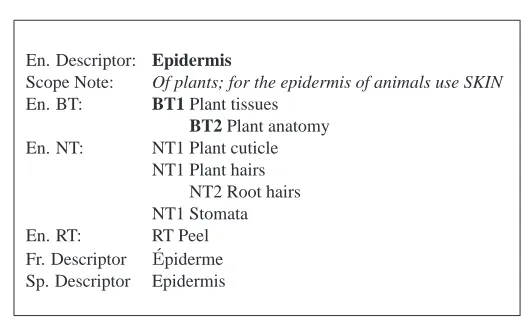
Agrovoc is available in print (AGROVOC 1995) and in a digital form. The current digital version (IMARK 2005) comprises nearly 35,000 entries in English, Spanish, French, Arabic and Chinese languages. Most entries are available in at least English, Spanish and French (E.g. a typical entry from AGROVOC (1995) in Figure 3.1). FAO supports the completion of the the-saurus and the extension of Agrovoc to other languages (e.g. currently Czech and Portuguese) are planned. Each entry consists either of a descriptor and terms that are related to it, or of
4
En. Descriptor: Epidermis
Scope Note: Of plants; for the epidermis of animals use SKIN En. BT: BT1 Plant tissues
BT2 Plant anatomy
En. NT: NT1 Plant cuticle NT1 Plant hairs
NT2 Root hairs NT1 Stomata En. RT: RT Peel Fr. Descriptor E´piderme Sp. Descriptor Epidermis
Figure 3.1: Example entry in Agrovoc (1998).
a non-descriptor and the pointer to the corresponding descriptor. Only descriptors are used by human indexers as keyphrases for documents in the repository. The USE relation between non-descriptors and descriptors prevents having different entries of the same semantic concept and supports subject based indexing. Ambiguities are handled by scope notes, if required.
Beside the USE (or the symmetric USED-FOR) relation, which in most cases denotes the synonymy (e.g. overweight is the descriptor for obesity5), three other semantic relations are present in Agrovoc. Hierarchical relations between terms in Agrovoc are expressed bybroader term (BT) and the symmetric narrower term (NT) relations (e.g. sense organs is a BT for eyes). Usually there is only one broader term for one or more narrower terms (in circa 96% of cases). Rarely, some terms have two and three generic terms: e.g. Brazil is NT for both South America and for Latin America. The last relation RT,related term, is vaguer and expresses any kind of relatedness (e.g. vision disorders is related to vision, or marine fisheries is related to coastal fisheries).
In this thesis only the English entries in the Agrovoc were considered: in total over 27,500 terms. This number adds up from approximately 16,800 descriptors and 10,600 non-descriptors. Table 3.2 shows how many descriptors are linked to other terms by each relation. It is remarkable that all non-descriptors are mapped to less than 6,000 descriptors. This means that for at least every third descriptor in Agrovoc there are two alternative expressions. This example shows that using a controlled vocabulary for content-based organization of documents is essential. Other relations in Table 3.2 represent links between descriptors. Approximately one half of controlled terms in Agrovoc have RTs, building over 13,700 semantically related
5
3.2 The Agrovoc thesaurus 33
Relation terms with given relation pairs connected by given relation
BT 15,000
15,700
NT 4,200
RT 8,800 13,700
USED-FOR 5,900 6,300
Table 3.2: Number of terms connected by each relation in Agrovoc.
Relation max avg stdev
BT 3 1.0 0.2
NT 242 3.7 7.6 RT 152 3.1 5.0
Table 3.3: Number of terms related to a descriptor by each relation in Agrovoc.
pairs. NT and BT relations connect most of the terms (95%) into a hierarchical structure and build around 15,700 symmetric pairs of generic and specific terms.
Each descriptor in Agrovoc is connected by different relations to other terms in the the-saurus. Table 3.3 presents details on the number of terms that are connected by each relation. While a term usually has only one broader term, NT and RT connect between up to 242 or 152 terms respectively. The number of NTs per descriptor varies a lot due to the specificity of the domain. Keyphrases from biological areas in particular have many classificational branches (e.g. the descriptor saltwater fishes has 82 narrow terms, which link to further fish species in their turn).
The analysis of the vertical distribution of terms reveals that Agrovoc does not have a tree-like structure tree-like other thesauri (WordNet or Roget’s thesaurus). Its relational organization is rather flat: A vertical path from a generic concept on the top to a specific one has an average length of 2.3, and maximum 7 links (c.f. to WordNet, where terms are organized on up to 16 levels).
Another observation is that more than 11,600 descriptors (70% of the total) have no further BTs and build the top level of the Agrovoc tree. Compared to other thesauri, where concepts are organized up to several basic concepts (e.g. 9 unique beginner in WordNet such as entity, abstraction, act etc.), Agrovoc is obviously missing several top levels that would represent
relations between generic concepts.
words per keyphrase 1 2 3 4 to 7 % of all Agrovoc terms 45.0 47.7 5.90 1.4 % of assigned terms 34.1 62.4 3.2 0.3 Table 3.4: Distribution of term length in Agrovoc.
is a difference between both distributions. It seems that when indexers select keyphrases from the thesaurus, they prefer to use two-word phrases.
Developed by the same organization, Agrovoc is a very suitable thesaurus for the given document collection. Its structure differs from other popular genera