
Patron: Her Majesty The Queen Rothamsted Research Harpenden, Herts, AL5 2JQ
Telephone: +44 (0)1582 763133 Web: http://www.rothamsted.ac.uk/
Rothamsted Research is a Company Limited by Guarantee Registered Office: as above. Registered in England No. 2393175. Registered Charity No. 802038. VAT No. 197 4201 51. Founded in 1843 by John Bennet Lawes.
Rothamsted Repository Download
A - Papers appearing in refereed journals
Bass, C. G., Zimmer, C. T., Riveron, J. M., Wilding, C. S., Wondji, C. S.,
Kaussmann, M., Field, L. M., Williamson, M. S. and Nauen, R. 2013.
Gene amplification and microsatellite polymorphism underlie a recent
insect host shift. Proceedings of the National Academy of Sciences of the
United States of America. 110 (48), pp. 19460-19465.
The publisher's version can be accessed at:
•
https://dx.doi.org/10.1073/pnas.1314122110
The output can be accessed at:
https://repository.rothamsted.ac.uk/item/8qy9q
.
© 11 November 2013, National Academy of Sciences of the United States of America.
Gene ampli
fi
cation and microsatellite polymorphism
underlie a recent insect host shift
Chris Bassa,1, Christoph T. Zimmera,b, Jacob M. Riveronc, Craig S. Wildingc, Charles S. Wondjic, Martin Kaussmannb, Linda M. Fielda, Martin S. Williamsona, and Ralf Nauenb
aDepartment of Biological Chemistry and Crop Protection, Rothamsted Research, Harpenden AL5 2JQ, United Kingdom;bPest Control Biology, Bayer CropScience AG, D40789 Monheim, Germany; andcVector Biology Department, Liverpool School of Tropical Medicine, Liverpool L3 5QA, United Kingdom
Edited by May R. Berenbaum, University of Illinois at Urbana–Champaign, Urbana, IL, and approved October 8, 2013 (received for review July 25, 2013)
Host plant shifts of herbivorous insects may be afirst step toward
sympatric speciation and can create new pests of agriculturally important crops; however, the molecular mechanisms that medi-ate this process are poorly understood. Certain races of the
polyphagous aphidMyzus persicaehave recently adapted to feed
on tobacco (Myzus persicae nicotianae) and show a reduced
sen-sitivity to the plant alkaloid nicotine and cross-resistance to neon-icotinoids a class of synthetic insecticides widely used for con-trol. Here we show constitutive overexpression of a cytochrome
P450 (CYP6CY3) allows tobacco-adapted races of M. persicaeto
efficiently detoxify nicotine and has preadapted them to resist
neonicotinoid insecticides. CYP6CY3, is highly overexpressed in M. persicae nicotianae clones from three continents compared withM. persicaes.s. and expression level is significantly correlated
with tolerance to nicotine. CYP6CY3 is highly efficient
(com-pared with the primary human nicotine-metabolizing P450) at me-tabolizing nicotine and neonicotinoids to less toxic metabolites
in vitro and generation of transgenicDrosophilaexpressing CYP6CY3
demonstrate that it confers resistance to both compounds in vivo. Overexpression of CYP6CY3 results from the expansion of a dinu-cleotide microsatellite in the promoter region and a recent gene
amplification, with some aphid clones carrying up to 100 copies.
We conclude that the mutations leading to overexpression of
CYP6CY3 were a prerequisite for the host shift ofM. persicaeto
tobacco and that gene amplification and microsatellite
polymor-phism are evolutionary drivers in insect host adaptation.
T
oxic secondary metabolites produced by many plant species present barriers to host range expansion by phytophagous insects, and the evolution of mechanisms to circumvent or de-toxify these antiherbivore defenses is often a prerequisite for a successful host shift (1–3). Several studies have elucidated the molecular basis of insect adaptation to plant allelochemicals (4– 7); however, most of these studies have examined adaptation that has occurred over a long evolutionary time scale and so have been unable to make direct comparisons with nonadapted con-specific races. As a result, identifying the initial genetic changes that enable a host shift has proved elusive. The recent host shift to tobacco (Nicotiana tabacum) by the peach–potato aphid,Myzus persicae, represents one of the few opportunities to study this evolutionary process in action (8). M. persicaeis a globally distributed highly polyphagous aphid with a host range of>400 species, including many economically important crop plants (9). Tobacco-adapted races, Myzus persicae nicotianae, are morpho-logically and genetically differentiated from M. persicae sensu stricto (s.s.), although there are clear examples of recent gene
flow between the two taxa (10). M. persicae nicotianae have evolved enhanced tolerance to the pyridine alkaloid nicotine (11), a potent natural insecticide produced by tobacco and other members of the Solanaceae family (12); however, the underlying mechanisms are unknown. Interestingly, tobacco-adapted forms also show reduced sensitivity to neonicotinoids, an important class of synthetic insecticides widely used for control that are chemically related to nicotine (11, 13).
One of the most important superfamilies of enzymes used by insect herbivores to detoxify xenobiotics, including the secondary metabolites of plants, is the cytochrome P450s (P450s) (14). Among the most well characterized examples of P450-mediated detoxification of plant allelochemicals is that of furanocoumarin metabolism within the genusPapilio(swallowtail butterflies) (15). Members of the P450 CYP6B gene subfamily are induced in severalPapiliospecies by dietary furanocoumarin as a result of xanothotoxin-responsive elements in their promoters (4, 16, 17). The inducibility of individual P450s isolated from different spe-cies and their activity (substrate specificity for, and turn-over of, different furanocoumarins) display a strong correlation with the ecology of the different species (i.e., frequency of exposure to furanocoumarins) (18, 19). In the case of other insect species that have adapted to nicotine-producing plants, P450s have also been implicated in detoxification in the case of the tobacco hornworm,Manduca sexta(20). This tobacco specialist employs a putative alkaloid pump at the blood–brain barrier coupled with detoxifying enzymes to provide a metabolic blood–brain barrier to nicotine. Although there is evidence that the detoxification enzymes involved in this process are P450s, the specific enzyme(s) involved has never been identified.
In the present study, we used a range of molecular, biochem-ical, and transgenic approaches to (i) identify the metabolic process which M. persicae nicotianae has evolved to detoxify nicotine and so allow colonization of tobacco, (ii) determine the genetic changes (mutations) underpinning this adaptation, and (iii) determine whether the development of the mecha-nism to detoxify nicotine has preadapted these races to resist neonicotinoid insecticides.
Significance
Insect host shifts may lead to sympatric speciation and can create new crop pests, however identifying the genetic changes involved has proved elusive. We studied a subspecies of the
aphidMyzus persicaethat has recently host shifted to tobacco
and are resistant to the plant alkaloid nicotine. We found these races overexpress a cytochrome P450 enzyme (CYP6CY3) that allows them to detoxify nicotine and also certain synthetic insecticides. Overexpression of CYP6CY3 is caused by gene
am-plification (up to 100 copies) and expansion of a dinucleotide
microsatellite in the promoter. Our findings provide insights
into the molecular drivers of insect host shifts.
Author contributions: C.B. and R.N. designed research; C.B., C.T.Z., J.M.R., C.S. Wilding, and M.K. performed research; C.B., C.T.Z., J.M.R., C.S. Wilding, C.S. Wondji, M.K., and R.N. analyzed data; and C.B., C.S. Wilding, L.M.F., M.S.W., and R.N. wrote the paper.
The authors declare no conflict of interest.
This article is a PNAS Direct Submission.
Data deposition: The sequences reported in this paper have been deposited in the Gen-Bank database (accession nos.KF218350–KF218365).
1To whom correspondence should be addressed. E-mail: [email protected].
Results and Discussion
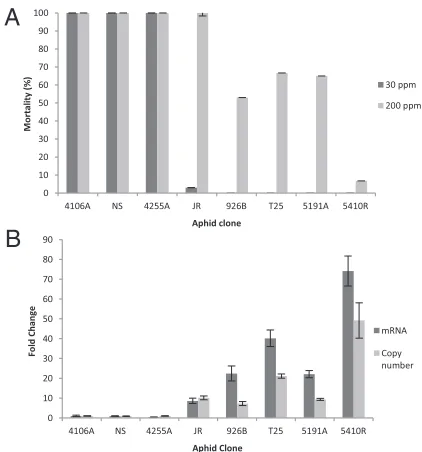
M. persicae nicotianaeIs Resistant to Nicotine.Five tobacco-adap-ted clones ofM. persicae nicotianae(5410R, T25, JR, 926B, and 5191A) and three unadapted clones ofM. persicaes.s. (4106A, NS, and 4255A) of diverse geographic origin were used in this study (Materials and Methods). Several of theM. persicae nicotianae
clones have been shown to be resistant to nicotine and/or neon-icotinoids previously (11, 21–23). We used an artificial feeding bioassay to confirm that allM. persicae nicotianaeclones are able to survive for 144 h on a diet containing 30 ppm nicotine. In contrast, allM. persicaes.s. clones showed 100% mortality at this time point on this diet (Fig. 1A). At higher nicotine concen-trations (200 ppm), variability in the level of nicotine tolerance of thefiveM. persicae nicotianaeclones was observed, with JR the most sensitive (100% mortality at 144 h) and 5410R the most resistant (7% mortality) (Fig. 1A).
CYP6CY3 Is Overexpressed in M. persicae nicotianae Compared withM. persicaes.s.A previous study on the molecular basis of neonicotinoid resistance in M. persicae sensu lato compared global gene expression levels in theM. persicae nicotianaeclone 5191A with the M. persicae s.s. clone 4106A using custom microarrays (23). A single P450 gene (CYP6CY3) was found to be highly and constitutively overexpressed (∼22-fold) in the 5191A clone. In the present study, we used quantitative PCR to show thatCYP6CY3is highly overexpressed (10- to 75-fold) in all
fiveM. persicae nicotianaeclones compared with theM. persicae
s.s. clones (Fig. 1B). Furthermore, CYP6CY3 expression levels were significantly correlated with observed mortality after feed-ing on 200 ppm nicotine (R2=0.91,P=0.0003). Interestingly,
CYP6CY3 was overexpressed in two M. persicae nicotianae
clones, JR and 926B, that have been shown previously to be resistant to neonicotinoid insecticides (21, 22). Significantly, both of these clones were collected and established before the in-troduction of neonicotinoids in 1991 (21, 22), indicating that
CYP6CY3overexpression has not evolved as a result of selection from this insecticide class but rather may have evolved to allow enhanced detoxification of nicotine during adaptation to tobacco. To investigate this possibility further, we examined the ability of
heterologously expressed CYP6CY3 to metabolize nicotine and neonicotinoids.
Recombinant CYP6CY3 Metabolizes Nicotine and Neonicotinoids in Vitro to Less-Toxic Metabolites. CYP6CY3 was coexpressed with the Drosophila melanogaster cytochrome P450 reductase in Sf9 insect cells with 100 pmol P450/mg protein obtained from iso-lated membranes. Incubation of microsomal preparations con-taining P450/cytochrome P450 reductase (CPR) with nicotine demonstrated that CYP6CY3 is highly effective at metabolizing nicotine with 90% of a 10 μM solution metabolized in 60 min (Fig. 2A). We were unable to source reference standards for all known nicotine metabolites, however, based on molecular mass (161.1073 Da) and the metabolic fate of nicotine in humans (Fig. S1) the primary metabolite produced was predicted to beΔ1′(5′)or Δ1′(2′)iminium ion (theoretical mass of 161.1079 Da) (Fig. 2C). As shown inFig. S1, these intermediates would be further processed in vivo to cotinine and aminoketone, respectively. Neither of these was found to cause any mortality to either M. persicae subspecies in bioassays using 2,000-ppm solutions of either compound, clearly demonstrating that CYP6CY3 detoxifies nicotine. When honeydew collected fromM. persicae nicotianaefed on nicotine was analyzed by liquid chromatography tandem mass spectrometry (LC-MS/MS), aminoketone was present at a fourfold higher amount than cotinine (Fig. 2D), suggesting CYP6CY3 primarily metabolizes nicotine to Δ1′(2′)iminium ion. As this is one of the P450-mediated pathways of nicotine metabolism in humans (24), the efficiency of nicotine metabolism by CYP6CY3/insect CPR was compared with CYP2A6/ human CPR the main high-affinity metabolizer of nicotine in humans (24). Based on substrate depletion, CYP6CY3 metabolizes nicotine more efficiently than CYP2A6 (Fig. 2B). The ability of both CYP6CY3 and CYP2A6 to metabolize two neonicotinoids, imidacloprid and clothianidin, was also examined. CYP6CY3 metabolizes imidacloprid to 5-hydroxy-imidacloprid (0.82 ± 0.04 pmol metabolite/min/pmol P450) and clothianidin to the n-desmethylated form thiazolylnitroguanidine (TZNG; 1.33±0.13 pmol metabolite/min/pmol P450). Both of these metabolites have been shown to be less toxic to aphids than the parent insecticide (25). Interestingly, human CYP2A6 also metabolizes both neonicotinoids but with lower efficiency (0.29±0.03 pmol 5-hy-droxy-imidacloprid/min/pmol P450 and 0.07±0.01 pmol TZNG/ min/pmol P450). These results clearly demonstrate that the active site of both CYP6CY3 and CYP2A6 can accommodate and metabolize both plant- and man-made antiherbivory compounds, albeit with different efficiency. The capacity of polyphagous insects and mites to evolve metabolic resistance to synthetic insecticides/acaricides has been suggested to result from the re-cruitment of detoxification mechanisms that have evolved to process plant allelochemicals (26). Ourfindings now provide clear evidence that this is true for the aphidM. persicae nicotianae.
Transgenic Expression ofCYP6CY3inDrosophila melanogaster Con-fers Resistance to Nicotine and Neonicotinoids in Vivo.To confirm that CYP6CY3 can confer resistance to nicotine and a neon-icotinoid in vivo we generated a transgenicD. melanogasterstrain containing an intact copy of the aphidCYP6CY3gene on chro-mosome 2. This transgene was confirmed by quantitative PCR to be constitutively expressed in adultflies with maleflies express-ing higher levels ofCYP6CY3than femaleflies (Fig. S2). For this reason, the ability of maleflies expressing the transgene to resist nicotine and a neonicotinoid (clothianidin) was examined in oral bioassays. Theseflies displayed significant resistance to both com-pounds (Fig. 3) compared with control progeny (flies of the same genetic background without the CYP6CY3 transgene), demon-strating unequivocally that transcription of CYP6CY3 alone is sufficient to give a resistant phenotype.
CYP6CY3 Is Overexpressed inM. persicae nicotianaeas a Result of Gene Amplification and Is Enhanced by a Polymorphic Dinucleotide Microsatellite.To identify the mutations that underlieCYP6CY3
overexpression in M. persicae nicotianae we used quantitative
A
B
0 10 20 30 40 50 60 70 80 90 1004106A NS 4255A JR 926B T25 5191A 5410R
M
o
rta
lity
(
%
)
Aphid clone
30 ppm 200 ppm
0 10 20 30 40 50 60 70 80 90
4106A NS 4255A JR 926B T25 5191A 5410R
Fol
d
C
h
ange
Aphid Clone
mRNA
Copy number
Fig. 1. Response to nicotine and changes in copy number and mRNA ex-pression ofCYP6CY3inM. persicae nicotianaeandM. persicaes.s. clones. (A) Mean mortality±SE (n=3) after feeding on nicotine (30 and 200 ppm) for 144 h. (B) Fold change inCYP6CY3mRNA expression and copy number. Error bars indicate 95% confidence intervals (n=3).
Bass et al. PNAS | November 26, 2013 | vol. 110 | no. 48 | 19461
EVOLUTI
PCR and genome walking to look for gene copy number varia-tion andcis-acting regulatory mutations in the 5′putative pro-moter region. Amplification of CYP6CY3 has been associated previously with resistance to neonicotinoids in the clone 5191A (23). In the present study, we foundCYP6CY3overexpression in allM. persicae nicotianaeclones, is due, at least in part, to gene amplification, with tobacco-adapted clones showing a 7- to 49-fold increase in gene copy number (from 2 copies in the diploid
M. persicae s.s. clones to 14–100 copies in the M. persicae nic-otianae clones) (Fig. 1B). Sequencing of CYP6CY3 coding se-quence revealed very little sese-quence variation either between or within any of the M. persicaes.l. clones, suggesting the amplifi -cation has occurred recently. In terms of interaphid clonal vari-ation two SNPs are present in the eight aphid clones, a synonymous SNP at nucleotide position 642 and a nonsynonymous SNP at position 74 causing a threonine to isoleucine substitution in the region encoding the transmembrane anchor of the P450 protein which would not be predicted to affect catalytic activity (Fig. S3). In terms of intraaphid clonal variation, two alleles are present in all threeM. persicaes.s. clones distinguished by a single G/A SNP resulting in either a glutamic acid or lysine amino acid at this position (Fig. S3). For allM. persicae nicotianaeclones, only a singleCYP6CY3coding sequence allele was detected (Fig. S3). The identicalCYP6CY3nucleotide sequence infiveM. persicae nicotianaeclones from three continents supports a single origin and global spread of the amplification event.
Beyond insects, the best documented examples of P450 gene amplification come from human P450s, specifically CYP2A6 and CYP2D6. Remarkably, both of these are involved in nicotine metabolism. CYP2A6 is duplicated in certain humans who show increased levels of nicotine metabolites in blood plasma and modified smoking behavior (27). CYP2D6 plays a more minor role in nicotine metabolism, but humans with up to 13 active copies, known as“ultrarapid metabolizers,”can metabolize nic-otine and a range of other xenobiotics (including many thera-peutic drugs) more rapidly than humans of normal copy number (28). The evolutionary parallels between human CYP2D6 and aphid CYP6CY3 continue further as amplification of both may have evolved as a mechanism to overcome plant secondary metabolites that defend against human and/or insect herbivory. CYP2D6 has a very high affinity for plant alkaloids and amplifi -cation of this P450 has been suggested to have arisen in North East Africa (where a high frequency of the population have the gene amplification) to allow previously toxic plants to be exploited during periods of famine (28).
For all but one of theM. persicae nicotianaeclones (JR), the increase in CYP6CY3 gene copy number is approximately half
the increase in the level of mRNA expression (Fig. 1B), sug-gesting that additional factor(s) underlie the change in expres-sion level in four of thefive clones. To identify additional regu-latory mutations, a ∼1.5-kb region of the putative 5′promoter region ofCYP6CY3 in all M. persicae s.s. and M. persicae nic-otianaeclones was PCR amplified by genome walking, cloned, and sequenced. Only two main sequence differences were ob-served between theM. persicaes.s. clones and the majority of the
M. persicae nicotianaeclones: a single A/G SNP 138 bp upstream of the translational start codon and a significant change in length of a AC(n) dinucleotide repeat (198 bp upstream of the start codon) from 15 repeat units inM. persicaes.s. clones to 48 repeat m/z
250.00 500.00 750.00 1000.00
%
0 20 40 60 80
100 161.1073
217.1049
293.1039 610.1918 887.2287
0 5 10 15 20 25
conine aminoketone
ng/m
l
A
B
C
D
Fig. 2. Metabolism of nicotine by recombinantly expressed aphid (CYP6CY3) and human (CYP2A6) P450s. (A) The recovery of nicotine after 10μM nic-otine was incubated with 50 pmol P450+reductase in the presence or absence of NADPH for 60 min. Mean data±SD (n=6). (B) Rate of nicotine metabolism with increasing nicotine concentration. The appar-entkcatand Kmvalues were calculated as kcatof
56.41±SEM (n=3) 6.18 pmol metabolite/min/pmol P450 andKmof 30.00±8.06μM for CYP6CY3, and
kcatof 21.03±4.11 andKmof 31.25±10.77μM for
CYP2A6. (C) High-resolution mass spectrum of the major metabolite [the peak atm/z161.1079 corre-sponds to the theoretical mass of nicotine-Δ1′(5/2′) -imi-nium ion]. (D) Amount of cotinine and aminoketone in aphid honeydew after feeding on nicotine-treated leaf discs for 48 h.
0 10 20 30 40 50 60
1h 2h 3h 6h 12h 24h 36h 48h 72h
M
o
rt
a
lity
(
%
)
Time
Exp Control
*
*
*
**
**
A
0 10 20 30 40 50 60 70 80 90 100
0h 1h 2h 3h 6h 12h 24h 36h
Mort
al
it
y (%
)
Exp Control
B
** **
Time
units inM. persicae nicotianaeclones (Fig. 4AandFig. S4). In-terestingly, the exception to this was theM. persicae nicotianae
clone JR, which like theM. persicaes.s. clones lacks the micro-satellite expansion. This is the onlyM. persicae nicotianaeclone where the fold-change increase inCYP6CY3gene copy number is equal to the increase seen in the level of mRNA expression (Fig. 1B), suggesting that the microsatellite polymorphism or the A/G SNP may play a functional role in further enhancingCYP6CY3
expression. To explore this possibility, the∼1.5-kb region upstream of CYP6CY3 was PCR-amplified from the 5191A and 4106A clones and cloned into the reporter gene vector pGL3. Reporter gene assays showed that the M. persicae nicotianae promoter insert drove around twofold greater reporter gene expression than theM. persicaes.s. insert (Fig. 4B). To examine whether the increase in AC(n)length or the single A/G SNP was responsible, site-directed mutagenesis was used to change the adenine at position−138 bp present in theM. persicae nicotianaepromoter to a guanine, mimicking the situation inM. persicaes.s. When the activity of this mutated insert was compared with theM. persicae nicotianae promoter insert, no reduction in reporter gene ex-pression was observed (Fig. 4B), indicating that it is the increase in length of the AC(n)repeat that is exclusively responsible for the expression difference. To investigate this possibility further, a series of synthetic versions of theM. persicaes.s. promoter were synthesized with AC(n)repeat lengths of AC(15), AC(30), AC(45), and AC(60). When these inserts were used in reporter gene assays, enhanced expression was only observed for the AC(45) and AC(60) constructs (Fig. 4C). Furthermore, no significant differences in expression were observed between the two longest or the two shortest constructs, suggesting a threshold effect. This
finding also suggests that the AC(48)repeat seen in most of the
M. persicae nicotianaeclones is the optimal length for enhancing the expression of CYP6CY3. We note that these findings are somewhat in contrast to previous studies where increases in the length of dinucleotide repeats show a more linear relationship with gene expression (29).
Microsatellites including AC(n)repeats have been historically considered nonfunctional neutral markers or “junk DNA.” However, there is now mounting evidence that they may be important cis-regulatory DNA sequences that have direct
in-fluence on both gene expression and phenotypic variation (30). Studies on humans where polymorphic AC(n)microsatellites are overrepresented in the genome have suggested they may
in-fluence transcription by binding transcription factors or by af-fecting DNA conformation (30). In yeast, polymorphic tandem repeats in promoters may facilitate gene expression by affecting local chromatin structure consistent with a role as“evolutionary tuning knobs” that mediate rapid evolution of gene expression (29). Our findings demonstrate that dinucleotide microsatellite variation is also a driver of adaptive change in gene expression during insect evolution.
Analysis of intraaphid clone sequence variation within the ∼1.5-kb region of the putative 5′promoter region revealed two variant promoter sequences in allM. persicaes.s. clones (distin-guished by a G/A SNP at position−545,Fig. S4), both of which lack the microsatellite expansion. Two alleles were also detected in clone JR (distinguished by a G/A SNP at position −138 bp, Fig. S4), both of which lack the microsatellite expansion. For all otherM. persicae nicotianaeclones, only a single promoter allele with the tandem repeat expansion was observed (Fig. S4). The
finding that, for four of the M. persicae nicotianae clones, all amplified copies ofCYP6CY3appear to share the microsatellite expansion suggests that this mutation predates the gene amplifi -cation event. Similar time courses ofcis-acting mutation followed by duplication have been described for P450s associated with insecticide resistance in fruitflies and mosquitoes (31, 32).
Summary
The genetic structure of globalM. persicaes.l. populations sug-gests that adaptation to tobacco arose as a recent, single evolu-tionary event, originating in East Asia, where tobacco-adapted forms werefirst reported (33); ourfindings are consistent with this. We conclude that the mutations leading to overexpression
0 0.002 0.004 0.006 0.008 0.01 0.012 0.014 0.016 0.018 0.02
Reporter gene
activity
(
norm
ali
s
ed
to Renil
la)
Construct
0 0.01 0.02 0.03 0.04 0.05 0.06 0.07
Reporter
gene
activity
(norm
a
lised to
Renil
la)
A
B
C
Construct
Fig. 4. CYP6CY3promoter analysis inM. persicae nicotianae
and M. persicaes.s. (A) Alignment of a region of the 5′ putative promoter region immediately upstream of the translation start codon ofCYP6CY3highlighting two poly-morphisms, an A/G SNP at position−138 bp and a change in length of an AC(n)dinucleotide repeat at position−198 bp. (B) Reporter gene activity (normalized to renillafl uores-cence) of the 5′ putative promoter regions ofCYP6CY3
amplified from the M. persicae clone 4106A and the
M. persicae nicotinaeclone 5191A. The activity of a mutated version of the 5191A promoter (5191Asdm), which has an A/G SNP present in the 5191A promoter corrected is also shown along with pGL3 and shuttle constructs (both con-trols). (C) Reporter gene activity of synthetic promoter constructs with different lengths of the AC(n)dinucleotide repeat. ForBandC, mean data±SD (n=4) is shown.
Bass et al. PNAS | November 26, 2013 | vol. 110 | no. 48 | 19463
EVOLUTI
ofCYP6CY3were a prerequisite for the host shift ofM. persicae
to tobacco. Furthermore, the recruitment of this detoxification mechanism preadapted this subspecies to resist neonicotinoids, a globally important class of insecticide. We suggest that muta-tion of a microsatellite was the initial step in this process and that subsequent gene amplification greatly enhanced expression of this gene. These results provide fundamental insights into the evolutionary processes that underlie the genotypic and pheno-typic changes that are involved in insect host shifts and we en-visage that both gene amplification and dinucleotide microsatellites may be an important source of genetic variation for adaptive evolution in other insect species.
Materials and Methods
Aphid Clones.Clones 4106A, NS, and 4255A are clones ofM. persicaes.s. collected from potatoes in Scotland in 2000, from an unrecorded plant in Germany (Bonn) in 1967, and from oilseed rape in the United Kingdom in circa 2000, respectively. Clones 926B, 5191A, and T25 are clones ofM. persicae nicotianaecollected in Greece from tobacco in 1990, 2007, and 2007; 5410R is a clone ofM. persicae nicotianaecollected from tobacco in Zimbabwe in 2010. Clone JR was collected from eggplants (a member of the Solanacae that contains relatively high levels of nicotine; ref. 34) in Toyoda, Japan, in 1983 but was found to readily accept tobacco (22). Japanese populations ofM. persicae nicotianaeare difficult to distinguish fromM. persicaes.s., but morphological examination suggested JR is“a tobacco feeding form of
M. persicaeclosely related to the tobacco aphidM. persicae nicotianae”(22). We refer to it in this study asM. persicae nicotianae.JR was previously found to be 10-fold resistant to nicotine compared with theM. persicaestrain NS in an oral feeding assay and 7-fold resistant to the neonicotinoid imidacloprid in a leaf-dip bioassay (22). Clone 926B showedfivefold resistance to nicotine in fumigation bioassays and 11-fold resistance to imidacloprid rising to 100-fold resistance to the neonicotinoid clothianidin compared with the M. persicaeclone 4106A (11, 21). Clone 5191A was recently shown to be 30- to 40-fold resistant to several neonicotinoids compared with 4106A (23).
Aphid Bioassays.Nicotine (Sigma) was dissolved directly into an aphid artificial diet (35) andfilter sterilized. A total of 0.5 mL was pipetted onto the end of a plastic cylinder (size: 25 mm deep, 25 mm internal diameter) that had been sealed with stretched Parafilm. A second layer of Parafilm was then stretched on top of this to form a sachet. Ten adult apterous aphids were transferred into the cylinder and the remaining opening sealed with Par-afilm. Three replicates were used for each concentration and mortality was assessed after 144 h at 18 °C under a 16:8 h light:dark regime. Mortality was controlled for by feeding aphids on artificial diet without nicotine under the same conditions.
Quantitative RT-PCR.Quantitative PCR was used to examine the expression of
CYP6CY3and changes in gene copy number using the primers CYP6F and CYP6R (Table S1) as described (23). Data were analyzed according to the ΔΔCTmethod (36), using the geometric mean of two housekeeping genes (actin and para, which encodes the voltage-gated sodium channel) for normalization according to the strategy described previously (37).
CYP6CY3 Coding Sequence Analysis.The coding sequence of CYP6CY3 was amplified from cDNA (prepared as described above) using primers CY3CDSF and CY3full R2 (Table S1). PCR reactions (20μL) consisted of 1 unit of Kappa high-fidelity polymerase (Kappa Biosystems), 4μL of PCR buffer containing 10 mM magnesium chloride, 1μL of 10 mM dNTPs, 1μL of each primer (10 mM), and 2μL of cDNA. Temperature cycling conditions were 95 °C for 1 min followed by 35 cycles of 95 °C for 30 s, 55 °C for 30 s and 72 °C for 2 min, followed by afinal extension of 72 °C for 10 min. Amplified fragments were visualized on 1% agarose gels, purified using the Wizard SV Gel kit and PCR Clean-Up System (Promega), and either“direct sequenced”or cloned (using the Strataclone PCR Cloning kit; Agilent Technologies) and sequenced using primers CY3seqF and CY3seqR (Table S1).
Genome Walking and Promoter Analysis of CYP6CY3. The GenomeWalker Universal Kit (Clontech) was used to PCR amplify the genomic DNA sequence upstream ofCYP6CY3. DNA was extracted from a pool offive adult aphids of the 5191A clone using the DNeasy Plant DNA Mini Kit (Qiagen) and used for genome walking following the manufacturer’s protocol with the primers shown in table S1. PCR products were recovered from agarose gels, cloned using the Strataclone PCR Cloning kit (Agilent Technologies) and sequenced. Specific primers were then designed (Table S1) and used to characterize the
∼1.5-kb putative promoter region immediately upstream of the translation start codon ofCYP6CY3of all of the aphid clones used in this study. PCR products were sequenced directly or cloned and sequenced as described for the characterization ofCYP6CY3coding sequence. For reporter gene assays, the same 1.5 kb of promoter sequence was amplified from DNA extracted from aphid clones 5191A and 4106A in PCR using a highfidelity taq (Ad-vantage 2 polymerase, Clontech), the conditions detailed above and primers CY3hindIIIR and CY3sac1F (Table S1). Following excision with HindIII and SacI these were ligated into pGL3-Basic (Promega) and transformed into XL1-Blue (Agilent). Plasmids were extracted with the GeneJet plasmid miniprep kit (Fermentas), sequenced and then adjusted to 300 ng/μL for use in dual luciferase assays using the An. gambiae cell line Sua5.1 maintained in Schneider’sDrosophilamedium supplemented with 10% FCS and 1% peni-cillin/streptomycin. Approximately 5×10⁵cells per well were plated into 24-well plates 1 d before transfection and allowed to reach 60–70% confluency. Qiagen effectene transfection reagent was used for transfection of con-structs, and the Dual-Luciferase Reporter Assay (Promega) used for promoter activity measurements. Reporter constructs (600 ng, CYP6CY3 upstream sequences in pGL3-Basic) and pGL3 without insert or 600 ng of shuttle construct pSLfa1180fa as controls (http://flybase.org/reports/FBmc0002761. html) were cotransfected with 1 ng of actin-Renilla internal control in 60μL of DNA condensation buffer, 4.8μL of enhancer and 6μL of effectene in triplicate. Following incubation at 27 °C for 48 h and washing of cells with PBS, cells were harvested in 100μL passive lysis buffer (Promega) and luciferase activity measured on a luminometer (EG&G Berthold). Construct luciferase activity was normalized to Renilla luciferase activity. The Quik-Change II Site-Directed Mutagenesis kit (Agilent) was used with primers CY3SDMF and CY3SDMR (Table S1) to change an adenine nucleotide at position−198 bp in theM. persicae nicotianaepromoter to a guanine. The plasmids obtained were sequenced to identify promoter constructs con-taining the nucleotide change. Finally, a series of synthetic versions of∼1.5 kb of theM. persicae 4106A promoter were synthesized (GeneArt, Life Technologies) where the AC(n)repeat length present∼200 bp upstream of the translational start codon was changed in length to, AC(15), AC(30), AC(45), and AC(60). These were then cloned into pGL3-Basic and used in reporter assays as described above.
Heterologous Expression of CYP6CY3.CYP6CY3 (GenBank accession no. HM009309) and theD. melanogaster(DROME) NADPH-dependent CPR (GenBank accession no. Q27597) were obtained by gene synthesis (Geneart) and inserted into the pDEST8 expression vector (Invitrogen). The PFastbac1 vector with no inserted DNA was used to produce a control virus. The recombinant baculovirus DNA was constructed and transfected into Sf9 insect cells (Gibco) using the Bac-to-Bac baculovirus expression system (Invitrogen) according to the manufacturer’s instructions. The titer of the recombinant virus was determined following standard protocols of the supplier. Sf9 cells were maintained in suspension culture under serum-free conditions (SF-900 II SFM, Gibco) at 27 °C containing 25μg/mL−1gentamycin (Gibco). Insect cells grown to a density of 2×10⁶cells per mL−1were coinfected with recombinant baculoviruses containing CYP6CY3 and CPR with various multiplicity of infection (MOI) ratios to identify the best con-ditions. Control cells were coinfected with the baculovirus containing vec-tor with no insert (ctrl-virus) and the recombinant baculovirus expressing CPR using the same MOI ratios. Ferric citrate and δ-aminolevulinic acid hydrochloride were added to afinal concentration of 0.1 mM at the time of infection and 24 h after infection. After 60 h, cells were harvested and washed with PBS, and microsomes of the membrane fraction were pre-pared according to standard procedures and stored at−80 °C (38). P450 expression and functionality was estimated by measuring CO-difference spectra in reduced samples (38). The protein content of samples was de-termined using Bradford reagent (Sigma) and BSA as a reference.
gradient mode. For detection and quantification, the multiple reaction monitoring transitions 163>117 (nicotine); 177>80 (cotinine); 179>106 (aminoketone); 256 >175 (imidacloprid); 250 > 132 (clothianidin) were monitored. Recovery rates of parent compounds using microsomal fractions without NADPH were normally close to 100%. Substrate turnover from two independent reactions were plotted vs. controls. Michaelis–Menten kinetics were determined using GraphPad Prism version 5 (GraphPad Software).
Analysis of Aphid Honeydew.Leaf discs were dipped in aqueous nicotine (2,000 ppm) containing 0.1% (wt/vol) Triton X-100, allowed to dry for 30 min, and then placed on a bed of agar in a small vented Petri dish. Ten aphids of clone JR were placed on the leaf disk, the lid of the Petri dish was sealed, and the dish was stored inverted for 48 h. Five replicates were prepared in this way. Aphid honeydew that had collected on the lid of the Petri dish was washed off in 500μL of water and analyzed for the presence of aminoketone and cotinine by ultra-performance LC-MS/MS analysis as detailed above.
Transgenic Expression of CYP6CY3 inD. melanogaster. CYP6CY3 was PCR amplified using primers CY3Xba1F and CY3HindIIIR (Table S1) following the conditions described above. Following digestion with HindIII and XbaI, the PCR amplicon was ligated into a modified pattB vector that had been digested with the same enzymes and transformed into XL1-Blue (Agilent). Using the PhiC31 system, clones were transformed into the germ line of aD. melanogaster strain carrying the attP docking site on chromosome 2 [“y1w67c23; P attP”, “1;2”] (40). The transgenic line was obtained and
balanced, and the integration of the intact gene was confirmed by PCR and sequencing as described above. Bioassays were used to assess the suscepti-bility of adult maleflies to nicotine and the neonicotinoid insecticide clo-thianidin. Compounds were dissolved in molten 0.5% agarose containing 5% (wt/vol) sugar, and 2 mL was allowed to set in the bottom of 15-mL falcon tubes. Adultflies (15–20, 2–5 d post eclosion) were then added to the tubes, and the mortality by oral ingestion was assessed at several time points spanning 1–74 h. Mortality was compared with control progeny (flies of the same genetic background but withoutCYP6CY3). Six to nine replicates were carried out for each concentration. Mortality due to factors other than secticide was controlled using tubes containing agarose/sucrose minus in-secticide. Unpaired Studentttests were used to compare the mortality of each experimental group with each control group for each time point. To confirm the expression ofCYP6CY3in the experimental group and the ab-sence of expression in the control group, total RNA was extracted from three pools offiveflies of each, and cDNA was synthesized as described above. Quantitative PCR was performed using the synthesized cDNA as template as described above but using the DrosophilaRPL11 housekeeping gene for normalization (Table S1).
ACKNOWLEDGMENTS. We are grateful to Helen Irving for help with quantitative PCR experiments on transgenicflies. We thank Stephen Foster for kindly providing some of the aphid clones. This work was funded by Biotechnology and Biological Sciences Research Council of the UK Grant BB/ G023352/1 (to C.B.).
1. Cates AG (1980) Feeding patterns of monophagous, oligophagous, and polyphagous insect herbivores: The effect of resource abundance and plant chemistry.Oecologia
46:22–31.
2. Kirsch R, et al. (2011) Host plant shifts affect a major defense enzyme inChrysomela lapponica.Proc Natl Acad Sci USA108(12):4897–4901.
3. Wheat CW, et al. (2007) The genetic basis of a plant-insect coevolutionary key in-novation.Proc Natl Acad Sci USA104(51):20427–20431.
4. Cohen MB, Schuler MA, Berenbaum MR (1992) A host-inducible cytochrome P-450 from a host-specific caterpillar: Molecular cloning and evolution.Proc Natl Acad Sci USA89(22):10920–10924.
5. Li X, Schuler MA, Berenbaum MR (2002) Jasmonate and salicylate induce expression of herbivore cytochrome P450 genes.Nature419(6908):712–715.
6. Ratzka A, Vogel H, Kliebenstein DJ, Mitchell-Olds T, Kroymann J (2002) Disarming the mustard oil bomb.Proc Natl Acad Sci USA99(17):11223–11228.
7. Wittstock U, et al. (2004) Successful herbivore attack due to metabolic diversion of a plant chemical defense.Proc Natl Acad Sci USA101(14):4859–4864.
8. Blackman RL (1987) Morphological discrimination of a tobacco-feeding form from
Myzus persicae(Sulzer) (Hemiptera: Aphididae), and a key to New WorldMyzus
(Nectarosiphon) species.Bull Entomol Res77:713–730.
9. Blackman RL, Eastop VF (2000)Aphids on the World’s Crops, an Identification and Information Guide(Wiley, Chichester, UK).
10. Margaritopoulos JT, Malarky G, Tsitsipis JA, Blackman RL (2007) Microsatellite DNA and behavioural studies provide evidence of host-mediated speciation inMyzus persicae(Hemiptera: Aphididae).Biol J Linn Soc Lond91:687–702.
11. Devine GJ, Harling ZK, Scarr AW, Devonshire AL (1996) Lethal and sublethal effects of imidacloprid on nicotine-tolerantMyzus nicotianaeandMyzus persicae.Pestic Sci48: 57–62.
12. Steppuhn A, Gase K, Krock B, Halitschke R, Baldwin IT (2004) Nicotine’s defensive function in nature.PLoS Biol2(8):E217.
13. Jeschke P, Nauen R (2008) Neonicotinoids-from zero to hero in insecticide chemistry.
Pest Manag Sci64(11):1084–1098.
14. Feyereisen R (2012) Insect CYP genes and P450 enzymes.Insect Molecular Biology and Biochemistry, ed Gilbert LI (Elsevier, London), pp 236–316.
15. Li XC, Schuler MA, Berenbaum MR (2007) Molecular mechanisms of meta-bolic resistance to synthetic and natural xenobiotics. Annu Rev Entomol52: 231–253.
16. Hung CF, Holzmacher R, Connolly E, Berenbaum MR, Schuler MA (1996) Conserved promoter elements in the CYP6B gene family suggest common ancestry for cyto-chrome P450 monooxygenases mediating furanocoumarin detoxification.Proc Natl Acad Sci USA93(22):12200–12205.
17. McDonnell CM, Brown RP, Berenbaum MR, Schuler MA (2004) Conserved regula-tory elements in the promoters of two allelochemical-inducible cytochrome P450 genes differentially regulate transcription.Insect Biochem Mol Biol34(10): 1129–1139.
18. Li W, Schuler MA, Berenbaum MR (2003) Diversification of furanocoumarin-metabolizing cytochrome P450 monooxygenases in two papilionids:
Speci-ficity and substrate encounter rate.Proc Natl Acad Sci USA 100(Suppl 2): 14593–14598.
19. Li W, Berenbaum MR, Schuler MA (2001) Molecular analysis of multipleCYP6Bgenes from polyphagousPapiliospecies.Insect Biochem Mol Biol31(10):999–1011. 20. Murray CL, Quaglia M, Arnason JT, Morris CE (1994) A putative nicotine pump at
the metabolic blood-brain barrier of the tobacco hornworm.J Neurobiol25(1): 23–34.
21. Foster SP, Cox D, Oliphant L, Mitchinson S, Denholm I (2008) Correlated responses to neonicotinoid insecticides in clones of the peach-potato aphid, Myzus persicae
(Hemiptera: Aphididae).Pest Manag Sci64(11):1111–1114.
22. Nauen R, et al. (1996) Aphicidal activity of imidacloprid against a tobacco feeding strain ofMyzus persicae(Homoptera: Aphididae) from Japan closely related toMyzus nicotianaeand highly resistant to carbamates and organophosphates.Bull Entomol Res86:165–171.
23. Puinean AM, et al. (2010) Amplification of a cytochrome P450 gene is associated with resistance to neonicotinoid insecticides in the aphidMyzus persicae.PLoS Genet6(6): e1000999.
24. Hukkanen J, Jacob P, 3rd, Benowitz NL (2005) Metabolism and disposition kinetics of nicotine.Pharmacol Rev57(1):79–115.
25. Nauen R, Tietjen K, Wagner K, Elbert A (1998) Efficacy of plant metabolites of imi-dacloprid againstMyzus persicaeandAphis gossypii(Homoptera: Aphididae).Pestic Sci52:53–57.
26. Dermauw W, et al. (2013) A link between host plant adaptation and pesticide re-sistance in the polyphagous spider miteTetranychus urticae.Proc Natl Acad Sci USA
110(2):E113–E122.
27. Rao YS, et al. (2000) Duplications and defects in theCYP2A6gene: Identification, genotyping, and in vivo effects on smoking.Mol Pharmacol58(4):747–755. 28. Ingelman-Sundberg M (2005) Genetic polymorphisms of cytochrome P450 2D6 (CYP2D6):
Clinical consequences, evolutionary aspects and functional diversity. Pharmacoge-nomics J5(1):6–13.
29. Vinces MD, Legendre M, Caldara M, Hagihara M, Verstrepen KJ (2009) Unstable tandem repeats in promoters confer transcriptional evolvability.Science324(5931): 1213–1216.
30. Rockman MV, Wray GA (2002) Abundant raw material for cis-regulatory evolution in humans.Mol Biol Evol19(11):1991–2004.
31. Itokawa K, Komagata O, Kasai S, Masada M, Tomita T (2011)Cis-acting mutation and duplication: History of molecular evolution in a P450 haplotype responsible for insecticide resistance inCulex quinquefasciatus. Insect Biochem Mol Biol41(7): 503–512.
32. Schmidt JM, et al. (2010) Copy number variation and transposable elements feature in recent, ongoing adaptation at theCyp6g1locus.PLoS Genet6(6):e1000998. 33. Margaritopoulos JT, Kasprowicz L, Malloch GL, Fenton B (2009) Tracking the
global dispersal of a cosmopolitan insect pest, the peach potato aphid.BMC Ecol
9:13.
34. Domino EF, Hornbach E, Demana T (1993) The nicotine content of common vegeta-bles.N Engl J Med329(6):437.
35. Mittler TE, Kunkel H (1971) Wing production by grouped and isolated apterae of the aphidMyzus persicaeon artificial diet.Entomol Exp Appl14:83–92.
36. PfafflMW (2001) A new mathematical model for relative quantification in real-time RT-PCR.Nucleic Acids Res29(9):e45.
37. Vandesompele J, Preter KD, Pattyn F, Poppe B, Roy NV, et al. (2002) Accurate nor-malization of real-time quantitative RT-PCR data by geometric averaging of multiple internal control genes.Genome Biol3:research0034.0031-0034.0011.
38. Phillips IR, Shephard EA (2006)Cytochrome P450 Protocols, ed Walker JM (Humana, Totowa, NJ).
39. Zhu F, et al. (2010) A brain-specific cytochrome P450 responsible for the majority of deltamethrin resistance in the QTC279 strain ofTribolium castaneum.Proc Natl Acad Sci USA107(19):8557–8562.
40. Markstein M, Pitsouli C, Villalta C, Celniker SE, Perrimon N (2008) Exploiting position effects and the gypsy retrovirus insulator to engineer precisely expressed transgenes.
Nat Genet40(4):476–483.
Bass et al. PNAS | November 26, 2013 | vol. 110 | no. 48 | 19465
EVOLUTI
![Fig. 2.Metabolism of nicotine by recombinantlynium ion]. (in aphid honeydew after feeding on nicotine-treatedCYP2A6](https://thumb-us.123doks.com/thumbv2/123dok_us/8922872.1843306/4.585.331.508.426.667/metabolism-nicotine-recombinantlynium-aphid-honeydew-feeding-nicotine-treatedcyp.webp)

